REAL CHEMISTRY FINAL STUDY GUIDE...
 Call Kai
 Learn
Learn Practice Test
 Spaced Repetition
 Match
Match Flashcards
 Knowt Play
1/116

There's no tags or description
Looks like no tags are added yet.
Name | Mastery | Learn | Test | Matching | Spaced | Call with Kai |
|---|
No analytics yet
Send a link to your students to track their progress
117 Terms
Which three molecular shapes are always nonpolar
linear, trigonal planar, and tetrahedral
Which two molecular shapes are always polar
bent or seesaw
If the central atom is surrounded by two different elements and one is polar but the other is nonpolar the molecule is most likely
POLAR
Common ways to tell if a molecule is polar
if there is a hydrogen bonded to a N, O, or F / lacks symmetry / arrows all point in one direction / arrows don’t cancel / electro negativity difference between 0.5 and 1.7
Common ways to tell if a molecule is nonpolar
diatonic molecule / only mad eup of carbon and hydrogen / symmetrical / electronegativity difference of 0.5 or less
delta -
represents the more electronegative atom of a polar bond
delta +
represents the less electronegative atom of a polar bond
True or False: A double and tripple bond only act as one electron domain
True
1 mole is = to how many atoms/molecules
6.022×10²³ atoms
How to calculate percent composition
mass of sample (atomic mass) /total mass (molar mass) x 100
How many decimal points should percent composition go to
1
how many decimal points should molar mass go to
2
how to calculate molar mass
take the atomic mass of each element and multiply it by the number of that element present. Then add.
How to make an empirical formula
convernt grams to moles. Then divide the moles by the smaller amount of moles
if it tells you the molar mass is 5x oxogen gas or nitrogen gas or hydrogen gas what do you do
because they are DIATONIC gasses, you multiply the atomic mass of H,N,O, or the group 17 elements by 2 and then by the multiplier it gives you
how to find the molecular formula
find the empirical formula
find the MM of the empirical formula
divide the molar mass of the compound given by the empirical formula molar mass
multiply empirical formula by that number
What is the ideal gas law
PV=nRT
What does p stand for in the ideal gas law
pressure
pressure
What does V stand for in the ideal gas law
Volume
volume
amount of space taken up by an object
what does t represent in the ideal gas law
temperature
temperature
measures the average kinetic energy of the particles
moles
meausres the number of particles
n
moles
indirect
variables on the same side of the equation. As one goes up the other goes down
direct
variables on different sides of the equation
value for r when pressure is in atm
0.08206
value for r when pressure is in kPa
8.314
value for r when pressure is in torr or mmHg
62.36
what are the values at STP
273.15 K / 1 atm / 22.4 L per mole
1 atm is equal to…
760 torr, 760 mmHg, and 101.3 kPa
Acids
substance with a ph less than 7/ the concentration of H+ ions is greater than the concentration of hydroxide (OH-) ions
Strong Acids
HCl
HI
HBr
HSO4
HNO3
HClO3
What is the most common weak acid?
Vinegar (HCH2COO)
Bases
substance with a ph greater than 7/ the concentration of H+ ions is less than the concentration of OH- ions
True or False: Strong Acids and Bases Completely disassociate from a solution
True
True or False: weak Acids and Bases only partially separate from a solution
True
Bases
substance with a ph greater than 7/ the concentration of H+ ions is less than the concentration of OH- ions
What is the most common weak base
ammonia, NH3
Strong bases
LiOH
NaOH
KOH
RbOH
CsOH
Ca(OH)2
Sr(OH)2
Ba(OH)2
SNAP Ions
Sodium, nitrate, ammonium, and potassium
Lewis acid theory
Acids accept electron pairs
Bronsted-Lowry acid theory
Acids donate H+ (protons)(H30+)
Arrhenius acid theory
Acids donate H+ (H30+)
Neutralization Reaction
A chemical reaction between an acid and a base that form a salt and water/ The point where the number of acid moles is equal to the number of base moles. / Neutralized limiting acid with excess base or neutralizing the limiting base with excess reactions.
Conjugate Acid
originally the base with an extra H+ ion/ when the base gains a hydrogen ion
Conjugate Base
When an acid loses a hydrogen ion
What would the conjugate base be for this acid- HCN
CN-
What would the conjugate acid be for this base- NH3
NH4
Identify the acid and base in this reaction and
NH3 + HNO3→ NO31- + NH41+
NH3 - base
HNO3 - acid
NO31- - conjugate base
NH41+ - conjugate acid
True or false: Conjugate acids and bases are weak
TRUE
Mantissa
everything to the right of the decimal point
when calculating the molarity/concentration of acid or bases, what equation do you use?
H+=10-pH
when calculating the molarity/concentration of acid or bases, do you use the mantissa or just count sig figs
sig figs
True or false: IF YOU ARE GIVEN THE PH AND ARE TOLD TO FIND THE MOLARITY-SIG FIGS ARE WHAT IS TO THE RIGHT OF THE DECIMAL POINT
True
diprotic (can donate 2 protons per molecule )
multiply the concentration of the acid/base by 2
triprotic
multiply the concentration of the acid/base by 3
if you are given the pH and are told to find the concentration of H+ ions, but you are also told the acid is diprotic, what do you do?
divide the 10-pH by 2
When solving for pH and you are told the acids and bases are either mono-, di-, or triprotic, what do you do?
multiply H+ by 1,2, or 3
to find the pH of an acid/base reaction with excess acid or base what do you do?
Find the moles of acid and base
Subtract to find leftover
Divide by total volume
Then do pH square
IF YOU HAVE OH- IN EXCESS YOU HAVE TO SOLVE FOR pOH FIRST AND THEN USE pH+pOH=14
true or false: pH and pOH have a direct relationship
true
what are strong electrolyes
Ionic compounds that contain SNAP ions, strong acids/bases. Dissolves and completely ionizes and conduct electricity
example of strong electrolytes
NaCl and HCl
what are weak electrolytes
Ionic compounds, weak acids and bases. Partially dissolves and ionizes or dissolves and partially ionizes and can conduct electricity to an extent
Examples of weak electrolytes
AgCl, HCH3COO, HF
Nonelectrolytes
Covalent Compounds, do not dissolve or dissolves but does not ionize
Examples of nonelectrolytes
glucose, paraffin wax, Iron, Ethanol, Sand
Concentration
measures the amount of a solute (substance) dissolved in a given amount of solvent or total solution
Dilute
describes a solution with a small amount of solute dissolved and has not molarity /. not a lot of material/ is used if there is a small amount of solute particles
Concentrated
describes a solution with a large amount of solute dissolved and has a high molarity
Unsaturated
the solution can dissolve more solute
Saturated
The maximum amount of dissolved solute
Molarity
Moles (mol) / volume (L)
Solute
the substance that is being dissolved
solvant
the substance that does the dissolving
How to find the concentrations of ions in solution
Determine the Molarity of the Compound, write disassociation equation, use stoichiometry to find the number of moles
Mole Fraction
Moles of solute / total moles of mixturee
mole percent
moles of solute/total moles of mixture x 100
How do you calculate the amount of grams (mass) needed to prepare specific concentrations of solutions?
M1V1=M2V2
How do you create a stock solution from power
Calculate the moles of solute that you will need. Convert the moles to mass using the molar mass.
Weigh the calculated mass of solute. Place the weigh boat on the balance and tare to subtract the mass of the weigh boat, then add solute to the desired mass.
Add approximately half of the solvent to a beaker. Then dissolve the solute in some of your solvent. Stir with a glass stirring rod to dissolve.
Using the funnel, carefully transfer all of the solution to a volumetric flask.
Rinse the beaker, stirring rod, and funnel with more solvent and add the rinse to the volumetric flask. Repeat.
Make sure that the solution is at room temperature and then fill the volumetric flask so that the bottom of the meniscus is at the calibration line on the neck of the volumetric flask. Stopper and shake to ensure that the solution is homogeneous.
How do you make the creation of a dilution from a stock solution
1. Calculate the Volume Needed
Calculate the volume of the stock solution needed. You can do this with dimensional analysis or you can use the dilution equation:
The Dilution Equation:Since the moles of solute remains constant before and after dilution and we know that molarity times liters gives us the number of moles, we can state that:
M1V1 = M2V2
Where 1 is the original stock solution and 2 is the new diluted solution.
2. Procedure:
Measure your desired volume of stock solution. To do this as accurately as possible, use a graduated pipette or the smallest graduated cylinder that will fit your sample.
Add approximately half of the solvent to the volumetric flask. Then add your measured stock solution.
Rinse the pipette or graduated cylinder with more of your solvent and add that to the volumetric flask. Mix and repeat.
Make sure that the solution is at room temperature and then fill the volumetric flask so that the bottom of the meniscus is at the calibration line on the neck of the volumetric flask. Stopper and shake to ensure that the solution is homogeneous.
Enthapy
the amount of heat exchanged
if heat is being removed from the system is enthapy positive or negative
negative
entropy
measure of disorder measured by Delta S
Gibbs free energy
How spontaneuous a system is measured in Delta G
Endothermic
heat is transferred from the surrounding to the system (enthalpy is positive) (q+)
Exothermic
heat is lost from the system and transfered to the surroundings. (enthalpy is negative) (q-)
system
the specific part of the universe that we are studying
surroundings
what is outside the system
universe
the system and it surroundings
the effect of entropy and temperature
When heat is removed from the universe (endothermic) there is a decrease in entropy / entropy is temperaure dependent/ low temperature = low energy
open system
heat and matter can be exchanged (example heta pack)
closed system
heat can be exchanged (example = sealed soda can)
isolated system
no heat or matter exchanged
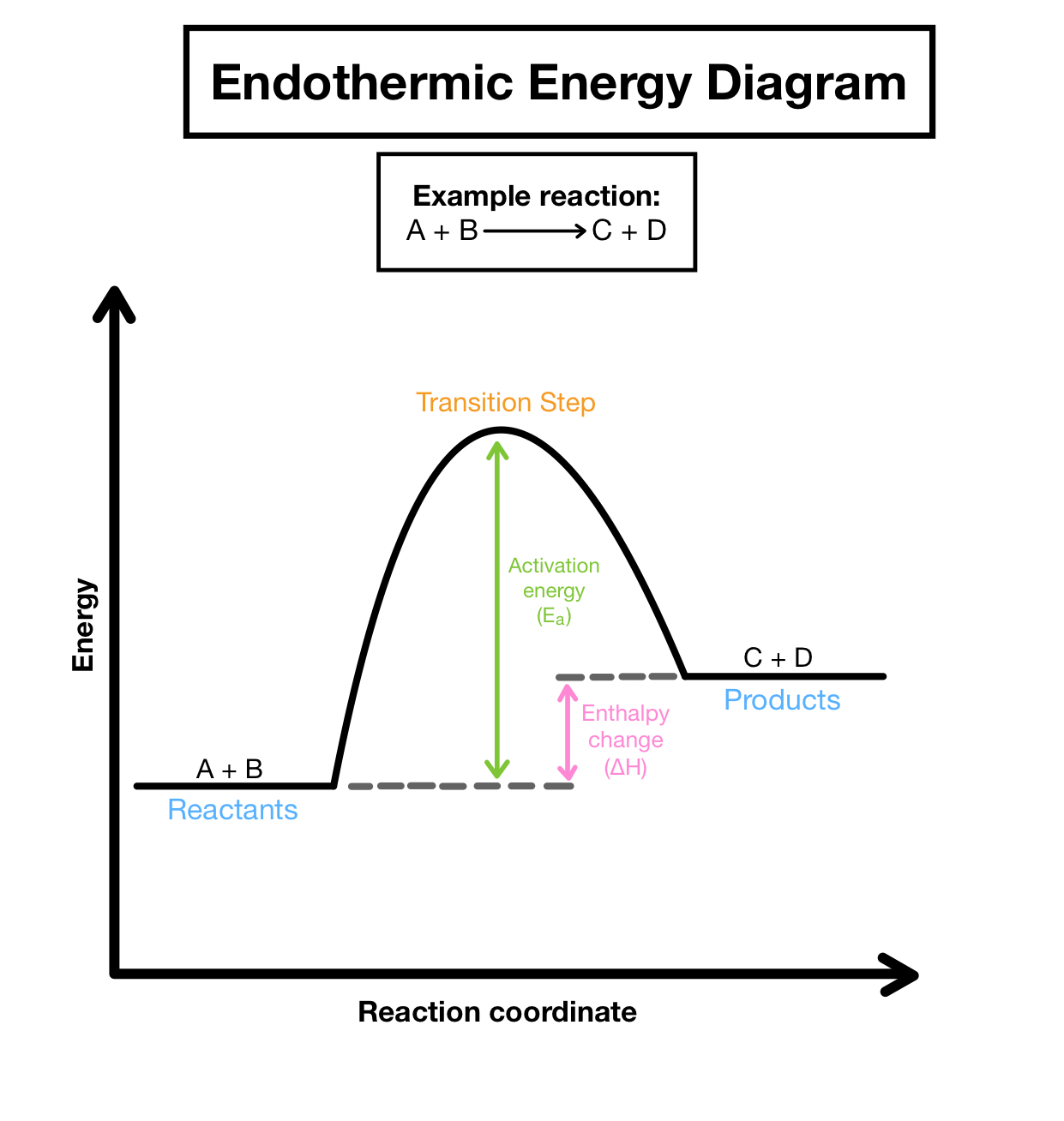
What type of reaction is shown in this diagram?
Endothermic because the heat of the product is greater than the reactants
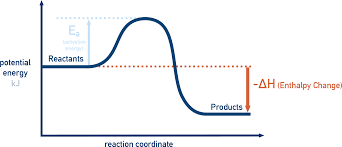
What type of reaction is shown in this diagram?
Exothermic because the heat of the product is less than that of the reactant
True or false, an exothermic system would make the surroundings feel hotter
true
an endothermic reaction would make the surroundings feel…
colder
sublimation is an example of
endothermic