prosocial behaviour + altruism
 Call Kai
 Learn
Learn Practice Test
 Spaced Repetition
 Match
Match Flashcards
 Knowt Play
1/35

There's no tags or description
Looks like no tags are added yet.
Name | Mastery | Learn | Test | Matching | Spaced | Call with Kai | Chat |
|---|
No analytics yet
Send a link to your students to track their progress
36 Terms
what does Tomasello (2019) believe we must focus on to explain + understand prosociality in humans
we must focus on understanding how great ape ontogeny in general has been transformed into human ontogeny, as the most frequent source of new traits is changes in manner in which pre-existing (+ shared) genes are expressed
what is prosocial behaviour
voluntary behaviour intended to benefit another, e.g. comforting, helping, sharing etc.
what is altruism
prosocial behaviour that is performed for unselfish motives → has no benefit to oneself, even in the long run
how does prosocial behaviour change with age (Eisenberg + Fabes, 1998)
altruism in infancy is not uncommon, but children generally engage in more prosocial behaviours with age
what are 3 types of prosocial behaviour
comforting → addressing negative emotional state
helping → addressing instrumental need (trying to achieve a practical outcome)
sharing → addressing material need/desire
when does comforting behaviour tend to increase (Zahn-Waxler et al., 1992)
the rate at which children comfort others who are in pain/distress increases over the second year of life
this contrasts to reacting with distress themselves (empathy)
how did Zahn-Waxler et al. (1992b) study heritability of comforting behaviour + what were the results
observed 94 MZ and 90 DZ twin pairs during 2nd year of life + recorded their reactions to adults pretending to be distressed
found heritability estimates indicated that genetic factors have a modest role in explaining toddlers’ prosocial actions + concern → suggests that genes might influence neurohormonal systems, influencing affective responses to others’ distress
how does Holmgren et al. (1998) explain individual differences in comforting behaviour
those who are not overwhelmed by the emotions they experience are more likely to feel sympathy, and those who are not overly inhibited are more likely to act on their sympathetic feelings
children who struggle to process or act on emotions seemingly show no concern/comforting
how do chimpanzees display similar + different comforting behaviours to humans
chimpanzees also comfort + reassure others as humans do, but later in development than humans
part of understanding human prosociality may therefore be when certain abilities emerge rather than solely ‘if’
overall, by what age do children show reasoned responsiveness to distress
3 years old
what did Liszkowski et al. (2008) find regarding when + how infants help others, and what does this suggest about helping
by 12 months, infants help others by pointing informatively, e.g. when an adult didn’t see where a desired object went (vs when they did)
shows even without physical assistance, communication helps others achieve an instrumental goal
at what age do infants demonstrate active assistance behaviour (Warneken + Tomasello, 2006)
18 months → start to help others in simple tasks when adults feign a need for help
does chimpanzee helping behaviour differ from humans’
chimpanzees help in similar situations where it is easy for them to infer what the other’s goal is, though there is some debate over whether they do display prosocial helping
how did Pettygrove et al. (2013) test methods of promoting helping behaviour at 2 different ages
assessed whether + how caregivers could promote helping behaviour in 18 month + 30 month-olds by:
1st phase → helped their mother clean up + maternal helping promotion behaviours were recorded
2nd phase (DV) → children had the chance to help another adult
what methods did Pettygrove et al. (2013) find were most effective at 18 + 30 months
certain styles of caregiver behaviour predicted infants’ likelihood of helping another adult, depending on age:
18 months → effective styles included:
directives → commands or requests e.g. ‘can you get that toy’
scaffolding → providing support e.g. emotional regulation, making child’s actions relevant in the activity
30 months → effective styles include:
scaffolding
negotiation → finding a compromise e.g. ‘if you tidy up you can play with this new toy’
what 3 approaches didn’t help at either age (Pettygrove et al., 2013)
reasoning → explaining the need e.g. ‘we need to tidy up to have space to play a new game’; kids at 30 months don’t have these reasoning skills
praise → positive commends e.g. ‘great tidying’; may be too open-ended/generic
character attribution → comments on the child’s characteristics e.g. ‘you’re so good at helping’; may promote self-esteem, but not helping
what are 3 forms of sharing
resource sharing
affiliative sharing → sharing social resources
fairness + reciprocity as values → there is cultural variation in these tendencies
at what age do infants share attention + interest (affiliative sharing)
around 6 months → joint attention
at what age do infants begin to actively give objects
around 9-10 months → sets the stage for notions of ‘mine’ + ‘yours’
what is the nature of sharing behaviour at 18 months (Brownell et al., 2013)
at this age, infants begin to share resources e.g. food + toys → this requires heavy scaffolding from adults initially + tends to be:
not very common
rarely spontaneous
not very generous (will only share a small amount with others)
how does resource sharing behaviour change between 18 and 24 months + what is this change driven by
by 24 months infants start to share more quickly/often, more generously and with less prompting
increased sharing = prompted by increased social understanding, e.g. infants starting to gain a concept of what is ‘mine’ + ‘yours’
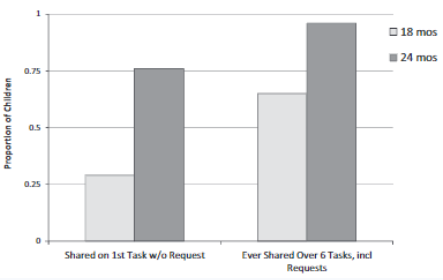
what behaviour regarding fairness + reciprocity develops around age 3
children begin to become more discerning about who should benefit from their prosocial behaviour
which 3 groups of people did Olson + Spelke (2008) find children tend to prefer sharing resources with
family + friends
people who have shared with them (reciprocity)
people who have shared with others (indirect reciprocity → fairness)
what other kind of reciprocity do children display at age 3 + how was this demonstrated (Robbins + Rochat, 2011)
strong reciprocity → evidenced by children sacrificing resources to punish + reward others for their behaviour
how did Blake et al. (2015) examine attitudes to fairness + in what 2 conditions
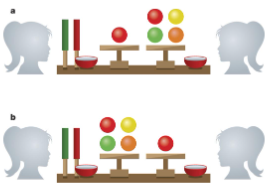
examined attitudes to fairness from 4-15 years in diverse societies. both children have a bowl + platform with levers → pulling the green lever means both children get sweets, whether red lever means none do. inequity is either:
advantageous → you have more sweets
disadvantageous → the other has more sweets
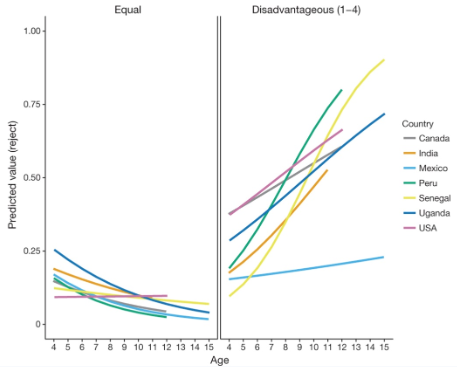
how does disadvantageous aversion reciprocity aversion change as children age
kids are more likely to pull the red lever (meaning they don’t get fewer sweets) as they age → emerged in all populations by middle childhood
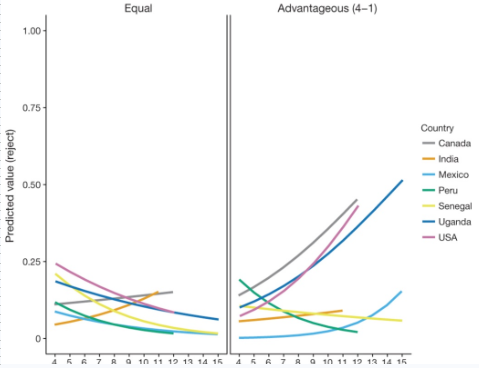
how does advantageous reciprocity aversion change as children age
found large cultural differences in advantageous reciprocity → generally increases a small amount with age, but levels are generally lower than disadvantageous
emerged in only 3 populations + later on in development
how are sharing behaviours different + similar in great apes
there is some sharing behaviours in other great apes, but is more limited to specific situations than in humans + limited to females
female chimpanzees have been known to share food
sharing is more common in bonobos → voluntarily hand food (but not toys/tools) to others
what is altruism (Dahl + Paulus, 2018)
acts motivated by the welfare of others, as prosocial behaviour can be for selfish purposes
what evidence did Hepach et al. (2013) find of altruism
found toddlers help each other whether or not there is an adult there to watch them, and whether or not the person they are helping is familiar
at what age did Warneken (2013) find evidence of altruism + how
found 2 year-olds displayed proactive prosociality by remedying unnoticed accidents e.g. picking up a dropped object, even when engaged in a task of their own (does not benefit them)
what are 3 motivational sources of prosociality
empathic concern → a sincere concern for others’ wellbeing
gratitude + guilt → gratitude sustains prosocial interactions + reinforces reciprocity, while guilt motivates repair of ruptured social relations
obligation → commitments create a sense of social obligation + norms create expectation of altruistic behaviour
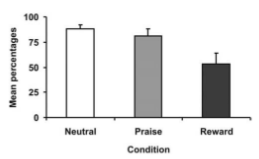
how did Warneken + Tomasello (2008) test the impact of material reward on altruism in 20 month-olds
children had the chance to help an adult in exchange for:
being given a material reward
verbal reward → praise
no reward → responded neutrally
DV → measured the likelihood of helping the adult again after first phase
what were Warneken + Tomasello (2008)’s findings + what does this suggest
children were significantly less likely to help again in the reward condition, and still slightly less likely in the praise condition → extrinsic motivator less effective to altruistic action
suggests importance of intrinsic motivation to altruistic action → no reward = more likely to help
what does Warneken + Tomasello (2009) think as to whether altruism is an innate tendency
yes → infants display helping from early in development + extrinsic motivation inhibits helping behaviour
chimpanzees helping others when it is easy to infer their goal suggests helping is an evolutionary function
what does Dahl + Paulus (2018) think as to whether altruism is an innate tendency
not exactly → early helping can be explained by a motivation for social interaction rather than altruism