meow
 Call Kai
 Learn
Learn Practice Test
 Spaced Repetition
 Match
Match Flashcards
 Knowt Play
1/41

There's no tags or description
Looks like no tags are added yet.
Name | Mastery | Learn | Test | Matching | Spaced | Call with Kai |
|---|
No analytics yet
Send a link to your students to track their progress
42 Terms
When Austentite slowcools you get…
pearlite
When austentite moderately cools you get…
bainite
When austentite rapidly quenches you get…
martensite
When you reheat martensite you get…
tempered martensite
When you reheat pearlite or bainite you get…
spheroidite
All microstructures we study are taken from a phase diagram of what kind of alloy?
steel
What are the four phases in the standard steel phase diagram
ferrite (alpha), austenite (gamma), Fe3C (Cementite), and liquid (L)
What is the eutectoid point of the standard steel phase diagram, and what are hypo and hyper eutectoid?
0.76% wt C, hypo means less than this number, hyper means more
what are phases are present before the euctectoid and after?
Before is ferrite and pearlite, after is cementite and pearlite.
What is the chemical makeup of pearlite?
ferrite and cementite
Between ferrite and cementite, which is harder?
Cementite is much harder
Why is martensite much harder than pearlite?
Martensite has a BCT structure which has a lot fewer slip planes, making slip harder and thus the material is harder and more brittle.
Rank all possible microstructures from strongest to hardest.
Martensite, tempered martensite, bainite, fine pearlite, coarse pearlite, spheroidite
Define fatigue
Fatigue is a type of a failure that looks like brittle fracture but comes from a cyclic or repeating, sine-wave ass type of stress.
Define creep
the slow deformation under constant stress and high temperature
Define ductile and brittle fracture
Brittle fracture is smooth and instant, ductile fracture takes the form of a cup and a cone and takes time
What is a 3-point bending test and what does it tell us about a ceramic?
Placing a specimen on 2 raised points and pressing on the middle to determine fracture strength and elastic modulus
How can you tell if a ceramic is crystaline based on a specific volume graph?
Non-crystalline ceramics will move slower and have a changing, piecewise slope while crystaline ceramics will have a smooth curve
What do Tg and Tm mean?
Tg means the temperature of glass transformation, Tm means melting point
What is the working temperature for most glasses.
Between 10^7 and 10³ viscocity
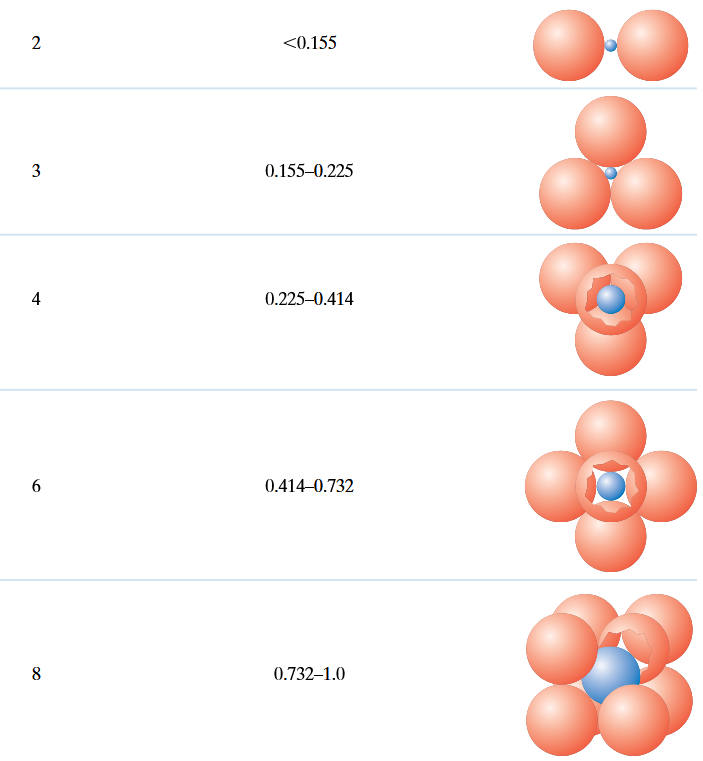
Name all 5 of these ceramic geometric structures in order
Linear, Triangular, tetrahedral, octahedral, cubic
Why does coldworking make a metal harder and stronger but less ductile?
Dislocation density increases making slip and plastic deformation much harder, which makes the material stronger
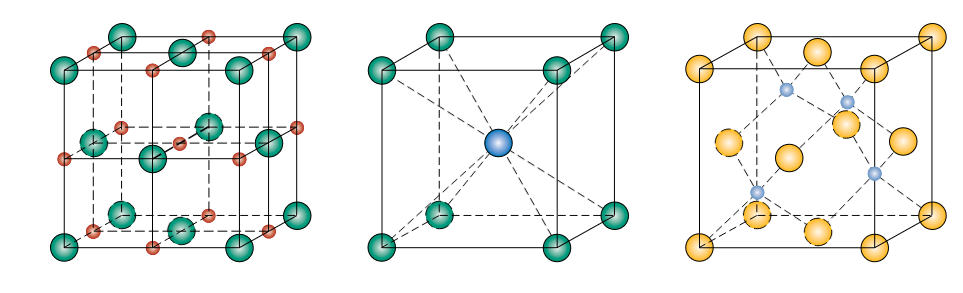
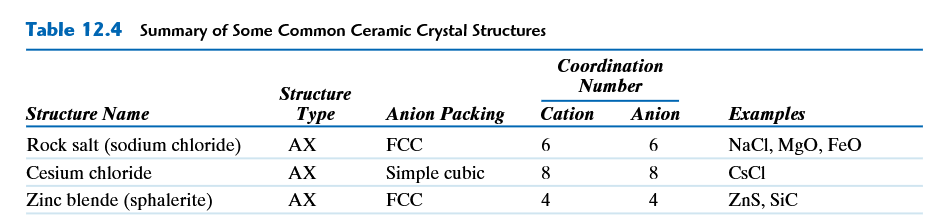
Name the structure names and types of these three ceramics (this is different from coordination geometry)
The first three rows of table 12.4 correspond to these images.
Name all 5 types of ceramic atomic defects
Cation interstitial, cation vacancy, anion vacancy, Shottky defect, Frenkel defect
What is the most important consideration when replacing atoms in a ceramic ionic structure?
NET CHARGE SHOULD ALWAYS BE 0, meaning if you replace Fe2+ with Na+, you need 2 Na atoms
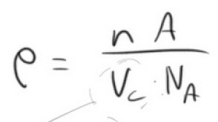
How do you calculate theoretical density?
mass over volume, where mass is mass of each atom times number of those atoms, and volume is the length of one side cubed, all divided by avogadros number.
How do you find the side length of a cube of atoms?
Show what atoms are on the edge of the cube, add their radii together to find the length of the side
Define how to find these on a graph: tensile strength, yield strength, modulus of elasticity, fracture strength, modulus of resilience, toughness, ductility.
Maximum stress point of the graph, stress at the top of 0.002 offset line, slope of the elastic part of the graph, end of the graph, area under the elastic part of the graph, area under the entire graph, drawing elastic slope from fracture point and multiplying that strain point by 100.
What are the si units for tensile strength, yield strength, modulus of elasticity, and fracture strength?
MPa
What are the units for modulus of resilience and toughness?
J/M³
How does one find the “change in diameter/change in side length” for a specimen in a tensile test?
Poisson’s ratio
How do I find the “elongation” of a specimen?
Find strain, rearrange the strain equation for delta l
What is slip and what are slip systems?
Slip is when a dislocation moves, causing plastic deformation. A slip system is the densely packed plane that slip happens along and the direction it slips.
How do you calculate molar mass?
Count the number of each type of atom and multiply that number by the atom’s molecular weight given on ptable.
What does coldwork change and what does it not change?
Coldwork changes tensile stress, yield stress, ductility, but does not change elastic modulus.
How do you find the average molecular weight of a polymer using either a number fraction table or a weight fraction table?
Find the number fraction or weight fraction and multiply by mean weight in each row then add them up.
What makes polymer structures less likely to crystalize?
If they are very random, have complex structures like network, or are very bulky.
Define hypoeutectoid, hypereutectoid, and proeutectoid.
hypo: to the left of the eutectoid point. hyper: to the right of the eutectoid point. pro: above the eutectoid point
What is DP?
Degree of polymerization, i.e. how many repetitions of the basic mer there are.
If given a composition C0, how do I find the compositions of the phases present?
Draw a tie line and then find the values at each end of the tie line.
How do I find the weight percentage of each part of a composition on a phase diagram?
Length of the opposite side of the tie line divided by the length of the entire tie line.
When below the eutectoid line, what will the microstructure of a hypoeutectoid steel look like? What about a hypereutectoid steel?
a hypo eutectoid steel below the line would look like pearlite with ferrite in between, and a hyper eutectoid steel below the line would look like pearlite with cementite in between.