1. Intro to Brain and Language
 Call Kai
 Learn
Learn Practice Test
 Spaced Repetition
 Match
Match Flashcards
 Knowt Play
1/27

There's no tags or description
Looks like no tags are added yet.
Name | Mastery | Learn | Test | Matching | Spaced | Call with Kai |
|---|
No analytics yet
Send a link to your students to track their progress
28 Terms
Examples of lateralised abilities
alot in the media about left and right brain
left - logic, language, rationality
right - creativity, attention, face processing
How does brain lateralisation manifest?
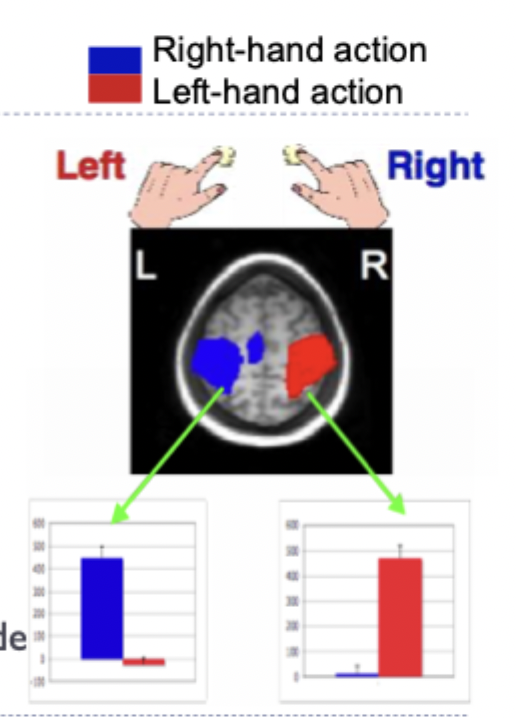
sensory input & motor control of one side of the body are linked to contralateral hemisphere
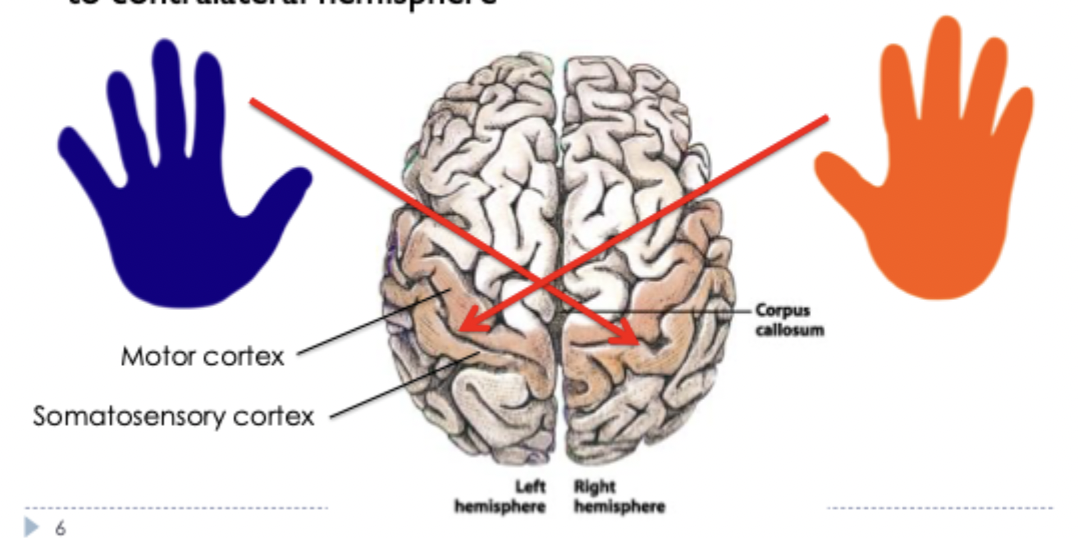
What are the features of brain lateralisation in the left hemisphere? (motor and touch)
controls right side of body
gets touch input from the right side
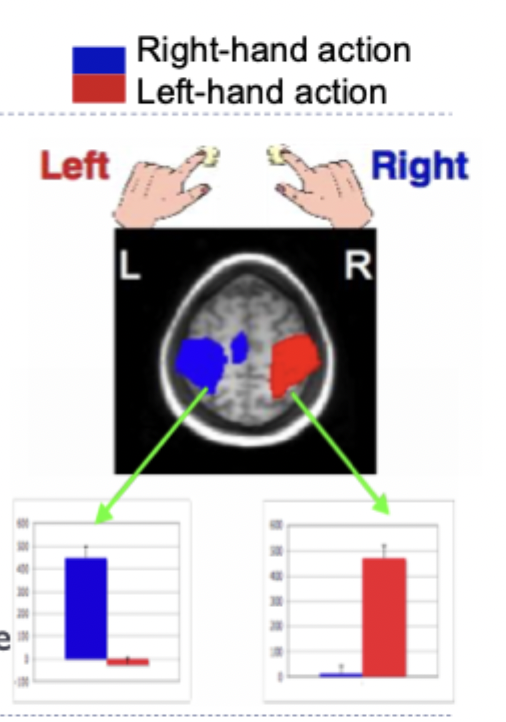
What are the features of brain lateralisation in the right hemisphere? (motor and touch)
controls left side of the body
gets touch input from the left side
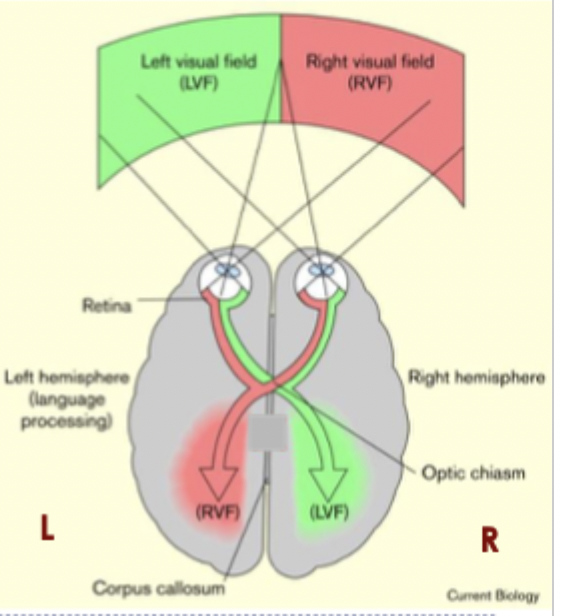
How is brain lateralisation seen for vision?
the left hemisphere gets direct visual input from the right visual field
the right hemisphere gets direct visual input from the left visual field
How are differences in handedness seen regarding language in the brain?
for most right-handed people, the left hemisphere is responsible for most language functions
right-hemisphere dominance observed only in 30% of left handers
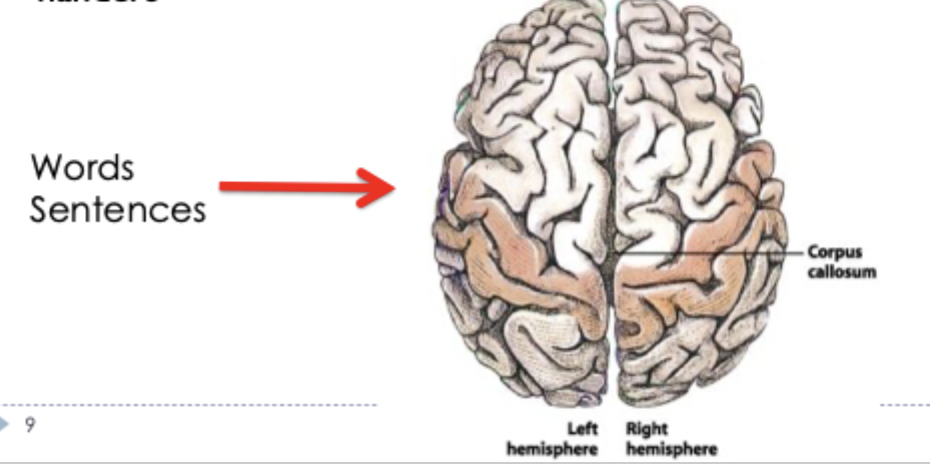
What is involved in the explanation of why there is hemisphere asymmetry in humans that it is due to precedents in the animal kingdom?
behavioural asymmetries in many vertebrates (e.g., visual, manipulation)
mammalian brain shows left lateralised preference for vocal communication (e.g., mice)
What is involved in the explanation of why there is hemisphere asymmetry in humans regarding possible mechanisms in evolution?
fitness benefits, especially in bipedal man
parallel processing of complementary information (e.g., global vs. local processing)
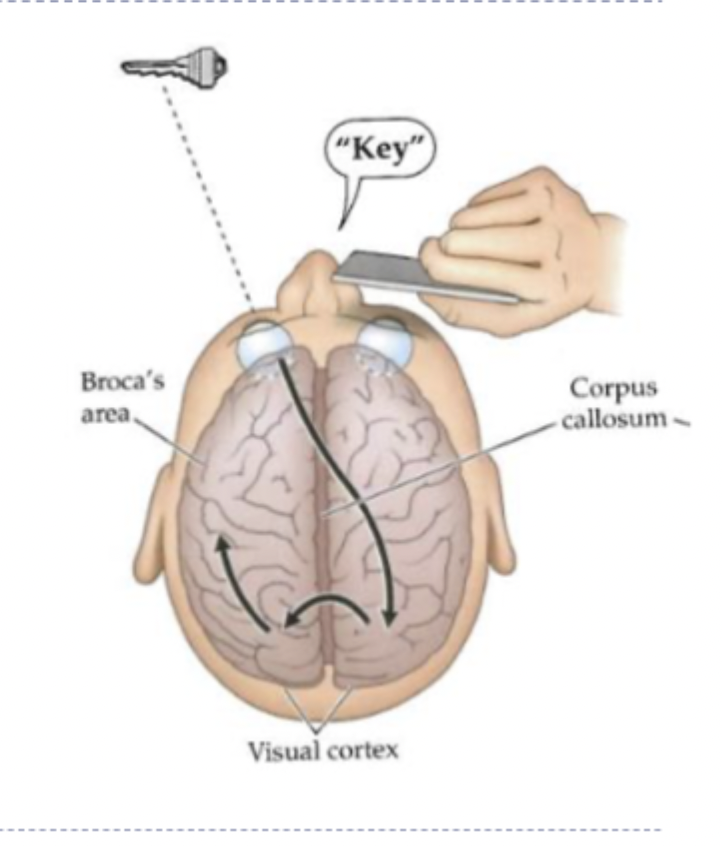
Why is naming objects is faster if the object is presented to the RVF?
Because RVF projects directly to the Left Hemisphere (LH).
The LVF in contrast projects directly to the RH, so naming is slower when the information has to be shared across the hemispheres via the corpus callosum, as represented in the image.
Why can split brain patients not name objects presented in the LVF?
Because the visual information is projected to the RH and would need to be shared with the LH to find the name stored in it.
Since the corpus callosum is severed, this information cannot be shared with the LH.
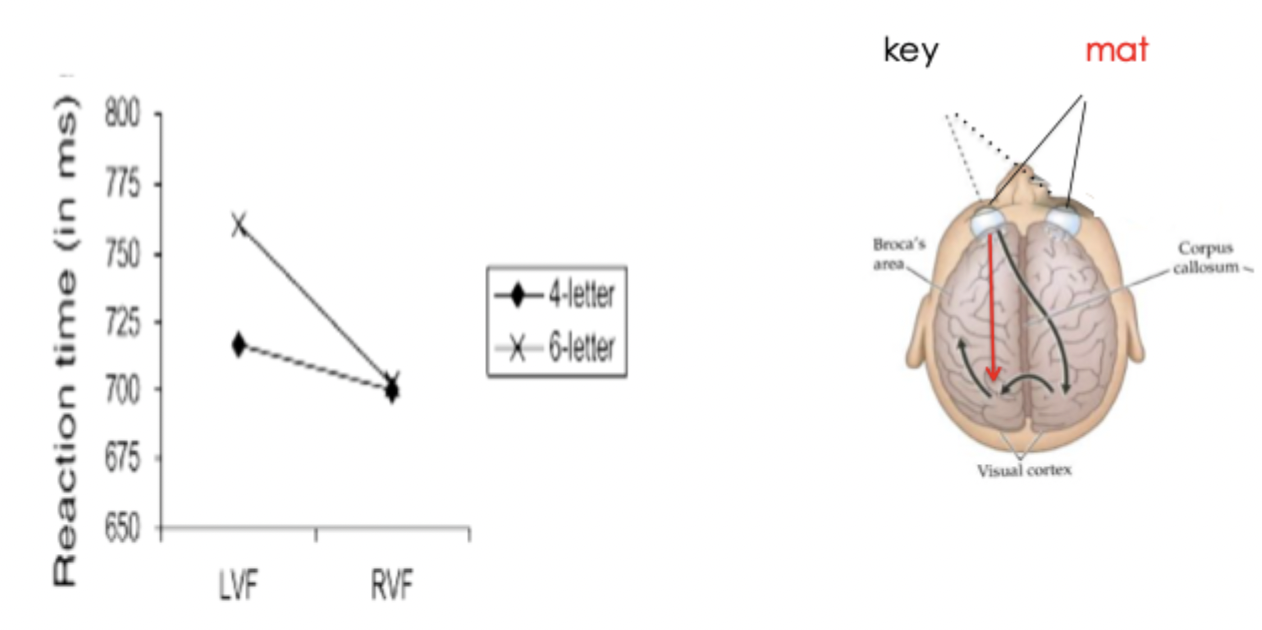
Why does the right visual field have an advantage for word recognition?
for reading, anything presented in right visual field will get to left hemisphere faster then words presented to left hemisphere
an even greater effect for longer words, shorter words can be globally perceived
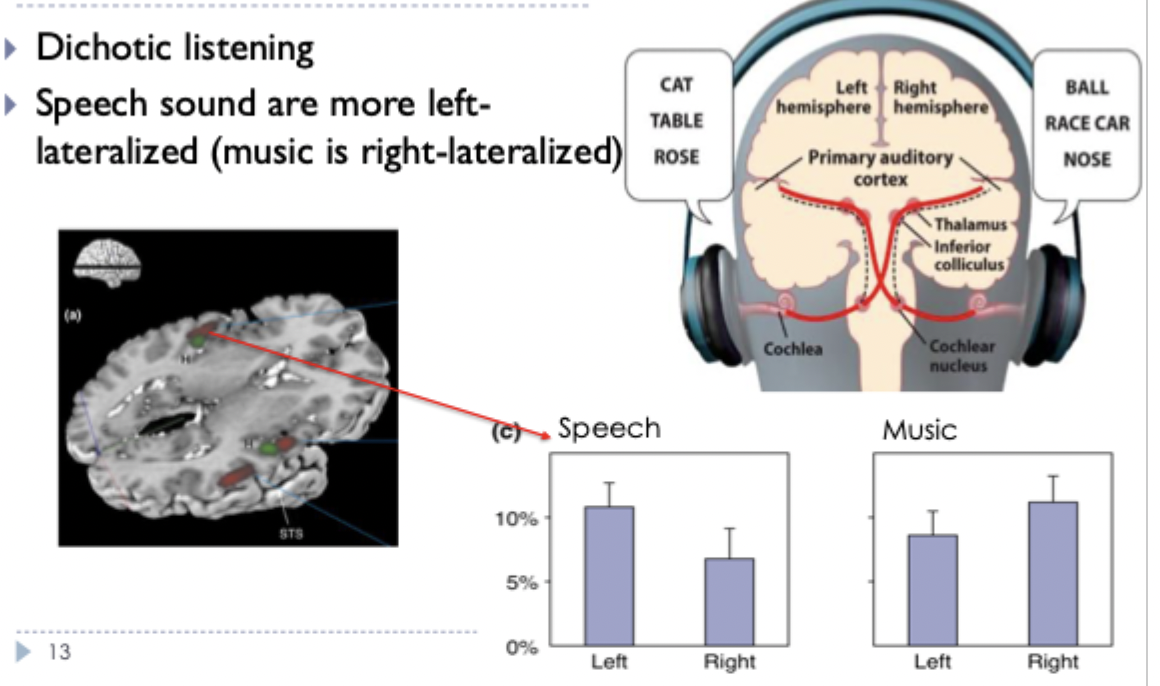
How is the processing of auditory information lateralised?
tested using dichotic listening
speech sounds are more left lateralised (right ear) and music is right lateralised (left ear)
intonation also right lateralised - therefore also associated with emotion
The Bantu Language
more activity in the LH than RH
uses clicks - but activating LH more because they are connected to meaning
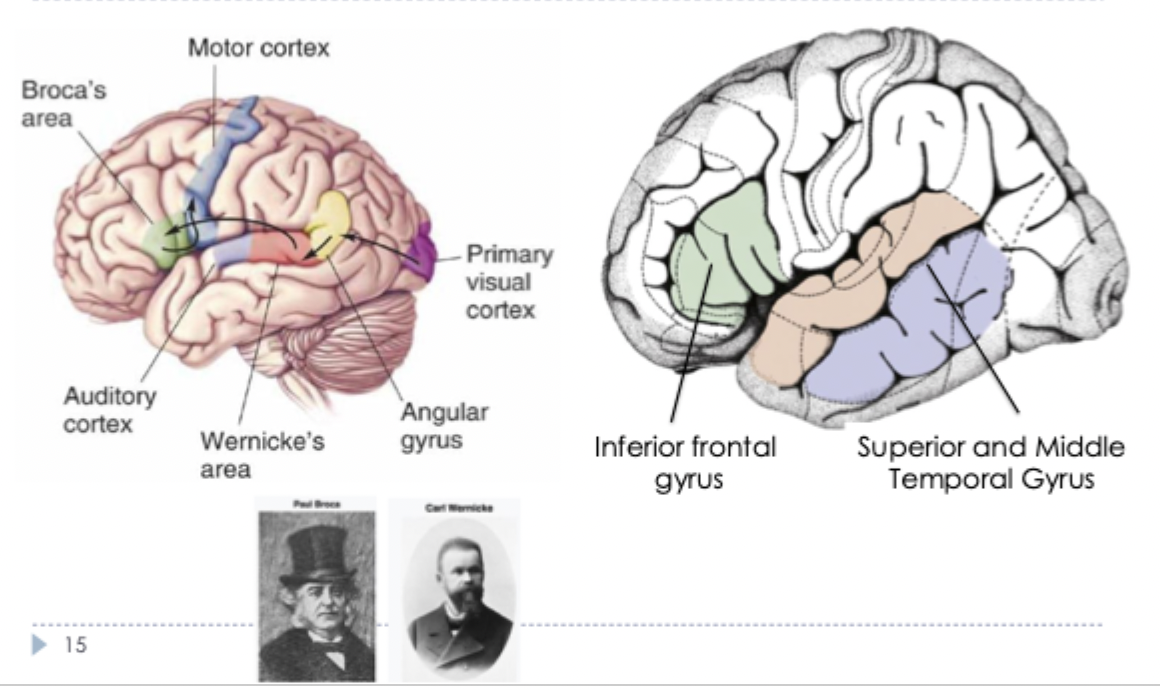
What are the main brain structures implicated in language?
traditional view developed using post-mortem methods
in the sylvanian fissure - the auditory cortex receives the input
brocas area = inferior frontal gyrus
superior and middle temporal gyrus = to do with words and representations of info about the world
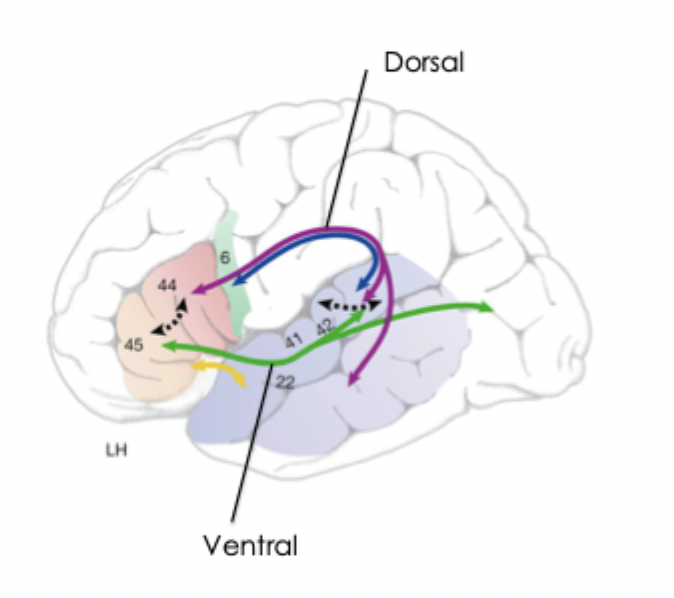
What are the important language-related white matter fibres?
the ventral route: meaning
the dorsal route: audition to motor cortex and output
What might a lesion in the auditory cortex and Wernicke’s area cause?
auditory cortex is in the STG, extracts sound identity (phonemes)
wernicke’s area, STG: fluent aphasia, nonsensical speech, impaired understanding
because they can’t hear others, they cannot hear themselves; cannot monitor what they are saying
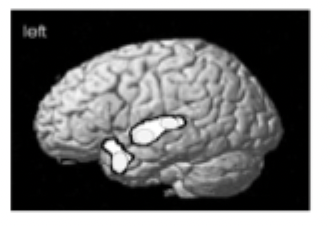
What have imaging studies shown up about understanding spoken words?
presenting intelligible vs unintelligible speech
temporal lobe involved in processing intelligible speech
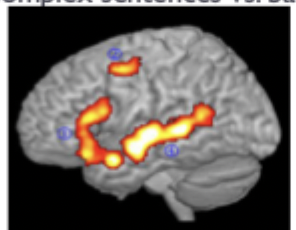
What have imaging studies shown up about understanding spoken words?
complex sentences vs baseline
all the regions active
all of ventral route activated with more than one word
What is activated when familiar words are understood?
ventral route
When is the dorsal route engaged?
sound repetition (involved in first and second language learning) engages the dorsal route
does not necessarily activate meaning
Which routes are involved in spontaneous production? e.g. I need some water
ventral route; saying something meaningful
and dorsal for production
What damage does this patient have?
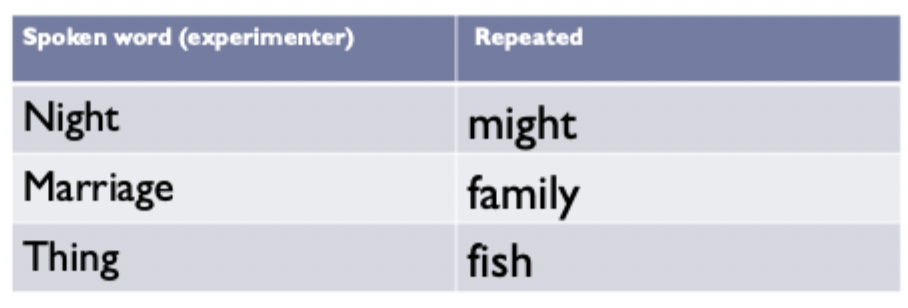
dorsal damage
substitution of sounds - phonological problems
and semantics preserved
What is involved in Disfluent aphasia?
left inferior frontal gyrus damage (Broca’s area)
affects the ability to convert thoughts into sentences
particularly affects the ability to construct a sentence around the action or verb
comprehension unimpaired
tested using procedures such as the cookie theft task
How is sentence comprehension tested in disfluent aphasia? And what is found
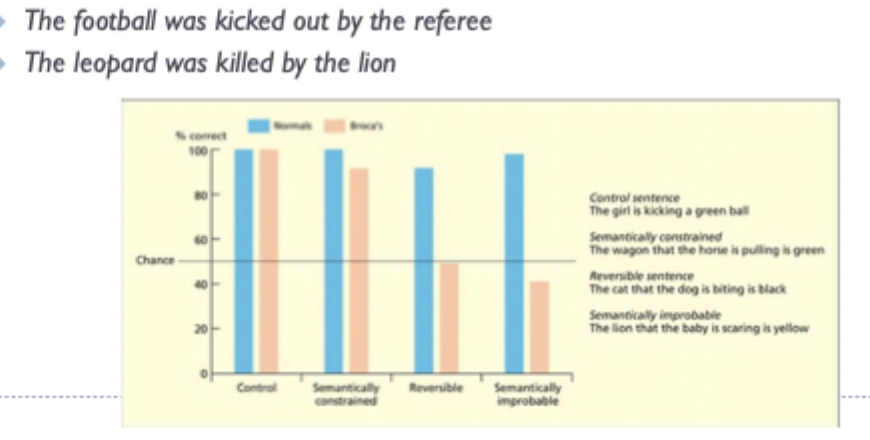
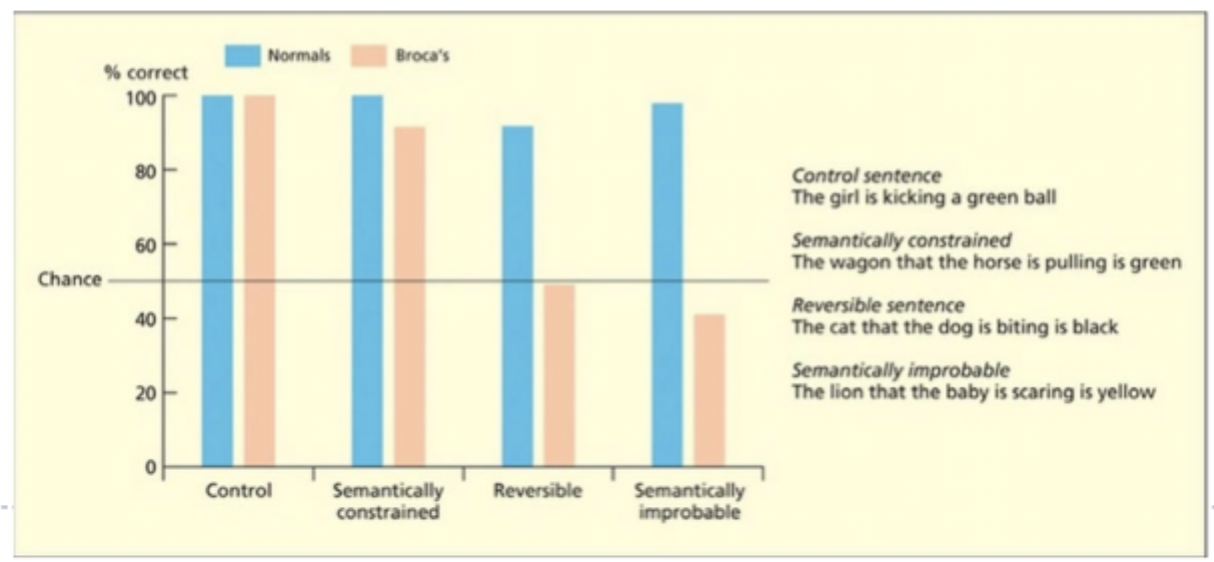
most of the time, Broca’s aphasics have little problems in comprehension
more subtle comprehension impairments are observed when small relational words are required for understanding
semantic knowledge may help interpretation, so the most difficult cases are those where interpretation cannot be inferred from word order or general world knowledge (reversible sentences)
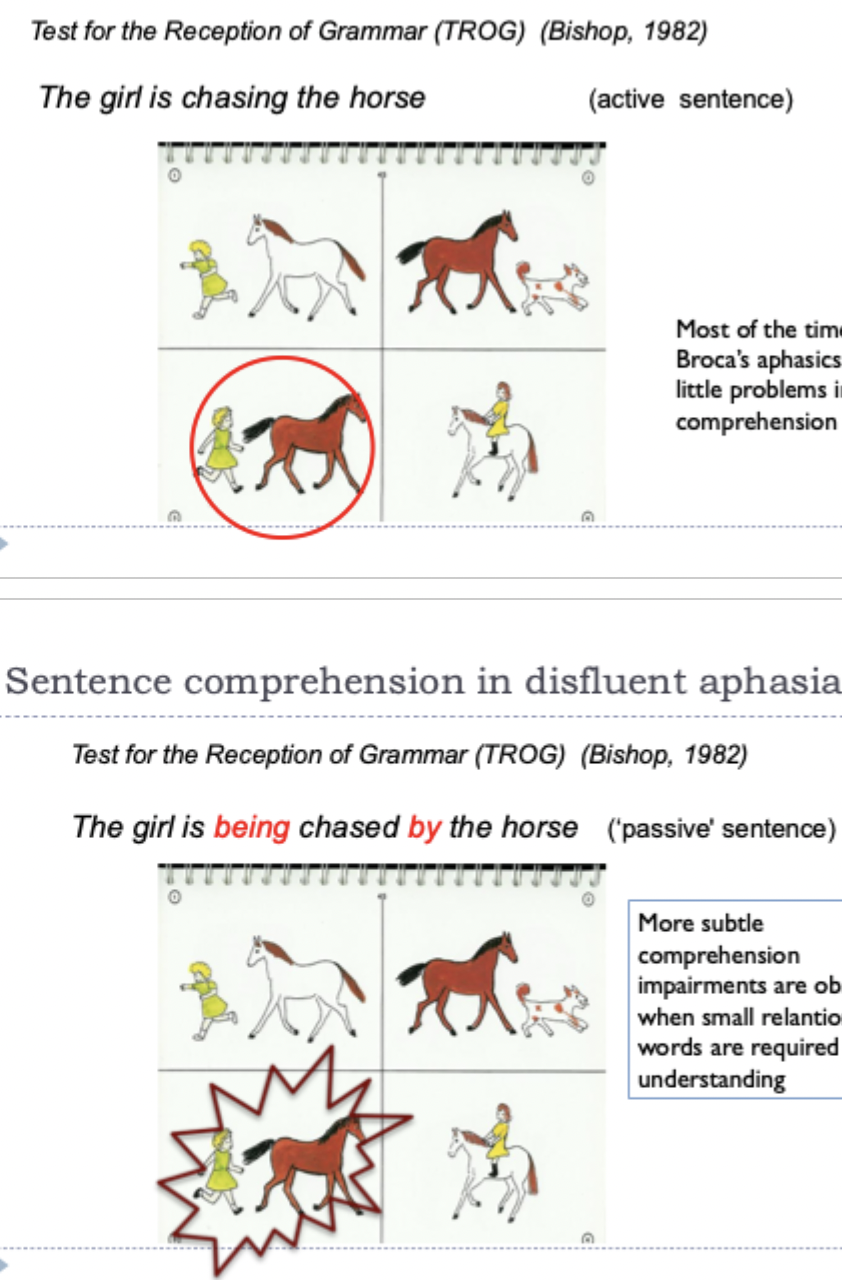
In terms of sentence comprehension, disfluent aphasia causes problems with…
relationships between words and verb retrieval
small words like is, by, the, of
inflectual endings like -ed, -ing, -s
In terms of sentence comprehension, disfluent aphasia patients base understanding on…
the meaning of individual words
general knowledge
simple word order assumptions
Which of the following would be the hardest for a patient with disfluent aphasia?
the cat that the dog is biting is black
What function of the LIFG relates to disfluent aphasia?
contributes to the combination of words in comprehension and production