States of Matter and Seperating Mixtures
 Call Kai
 Learn
Learn Practice Test
 Spaced Repetition
 Match
Match Flashcards
 Knowt Play
1/13

There's no tags or description
Looks like no tags are added yet.
Name | Mastery | Learn | Test | Matching | Spaced | Call with Kai |
|---|
No analytics yet
Send a link to your students to track their progress
14 Terms
Solid
Packed closly together with no gaps in a regular arragement
They cannot move but they can vibrate on the spot, the more heat.
energy you give themm the more they will vibrate.
They have a fixed volume and a fixed shape.
They have strong bonds.Strong forces of attraction between particles
Cannot be compressed.
Low energy.
Regular arragement
Thermal energy is converted into kinetic energy which is why particles in solids, liquids and gases are able to move or vibrate more.
Liquid
Irregular arragement
They have some gaps between them. Around half of the particles are touching.
They take the shape of the container that they are in.
Will move around their position
Fixed volume but not a fixed shape
Forces between particles are less
Particles are constantly moving.
The more the liquid is heated, the faster the particles will move.
They cannot be compressed easily.
Medium amount of energy.
Thermal energy is converted into kinetic energy which is why particles in solids, liquids and gases are able to move or vibrate more.
Gas
Irregular arragement
Large gaps
The particles can move more feely in all directions
No fixed volume because you can compress them
No fixed shape
Very weak forces of attraction between particles in gases
Gases can easily be compressed.
High energy
Thermal energy is converted into kinetic energy which is why particles in solids, liquids and gases are able to move or vibrate more.
Changing States
Melting: Solid to Liquid
Evaporating and Boiling: Liquid to Gas
Condensation: Gas to Liquid
Freezing or Solidification: Liquid to Solid
Sublimation: Solid to Gas
Deposition: Gas to Solid
The Law of the Conservation of Mass
Mass cannot be created or destroyed in a closed system in a chemical reaction.
Boiling
Boiling
Boiling: liquid is turning into gas, causing bubbles to form throughout the liquid.
Occurs at a certain temperature which is known as the boiling point.
Happens throughout the liquid.
Boiling is a fast process
Boiling needs more energy compared to evaporation because it needs constant heating.
Has bubbles
Temparature will remain constant during the boiling
All the particles will gain enough energy to vaporise.
Boiling depends on pressure, lower pressure lower boiling point. Higher pressure means higher boiling point.
Evaporation
Can happen at any temperature but will happen faster at a hotter temperature.
Occurs on the surface of a liquid
Evaporation is a slow process compared to boiling
Does not have bubbles
Only the fast moving particles will escape from the surface in evaporation.
There are 4 things which impact evaporation rate: wind or airflow, humidity, surface area, and temperature. The larger the surface area, the faster the rate of evaporation.
Tools needed for Evaporation
AND A STIRRING ROD
You place a gauze (made of metal) on the tripod, then you place the beaker or evaporatiing basin with the solution.
Set the bunsen to a blue flame, add the solution, then the solvent will evaporate, the solute will be left behind. Finally, set the bunsen burner to a safety flame or turn it off if you’re not useing it or if no one else is going to use it.
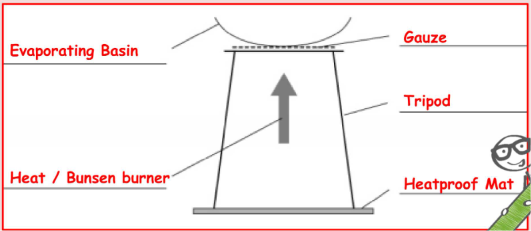
Parts of bunsen burner
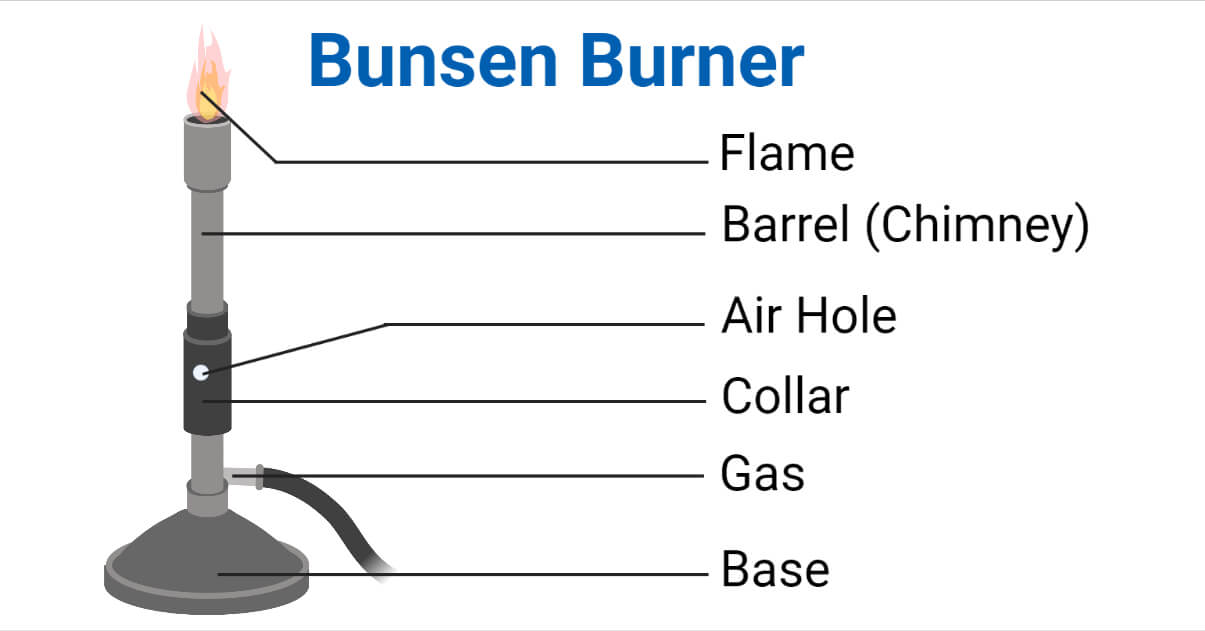
Evaporation
In the lab, we can use evaporation to recover solids that have been dissolved into a solvent with Heating to Dryness
Producing Salts
The Salt we use in food is called sodium chloride and it can be found in thick layers of rock underground. To extract pure salt, water can be pumped into the ground, dissolving the sodium chloride, then the salt solution (brine) is then pumped to the surgace and heated to evaporate the water, leaving pure sodium chloride. Pure salt is when is only contains Sodium Chloride molecules.
Rock Salt can be used for cooking in food and for snowy/icy roads so the cars do not slip.
Safety Guidelines
Use a medium flame to heat the solution.
Wear eye protection while heating.
Do not fill an evaporating basin more than half-full with solution.
If heating the liquid in a tube, make sure the open end of the tube does not point towards anyone.
Always use tongs to hold or move hot things.Tongs (in terms of science lab).
When most of the liquid has evaporated, turn the burner off. Let the rest of the liquid evaporate more slowly.
Always set the Bunsen burner to a safety flame when not in use and just before turning off.
Words for salt water
Saline Solution, Sodium chloride solution and Brine. Copper Sulfate solution is a type of salt solution.
Filtration
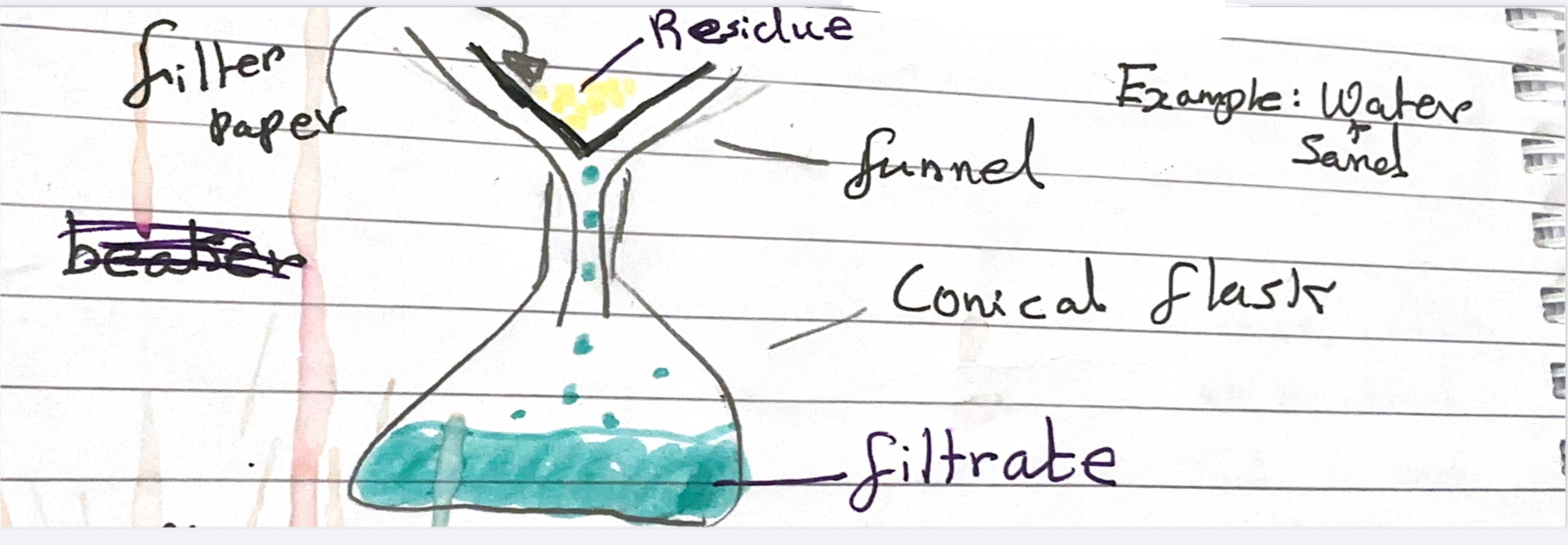
The mixture will be a liquid and an insoluble solid.