Adv Phys Exam III
 Call Kai
 Learn
Learn Practice Test
 Spaced Repetition
 Match
Match Flashcards
 Knowt Play
1/109

There's no tags or description
Looks like no tags are added yet.
Name | Mastery | Learn | Test | Matching | Spaced | Call with Kai |
|---|
No analytics yet
Send a link to your students to track their progress
110 Terms
ion and water balance
osmotic homeostasis
ionic homeostasis
removal of nitrogen
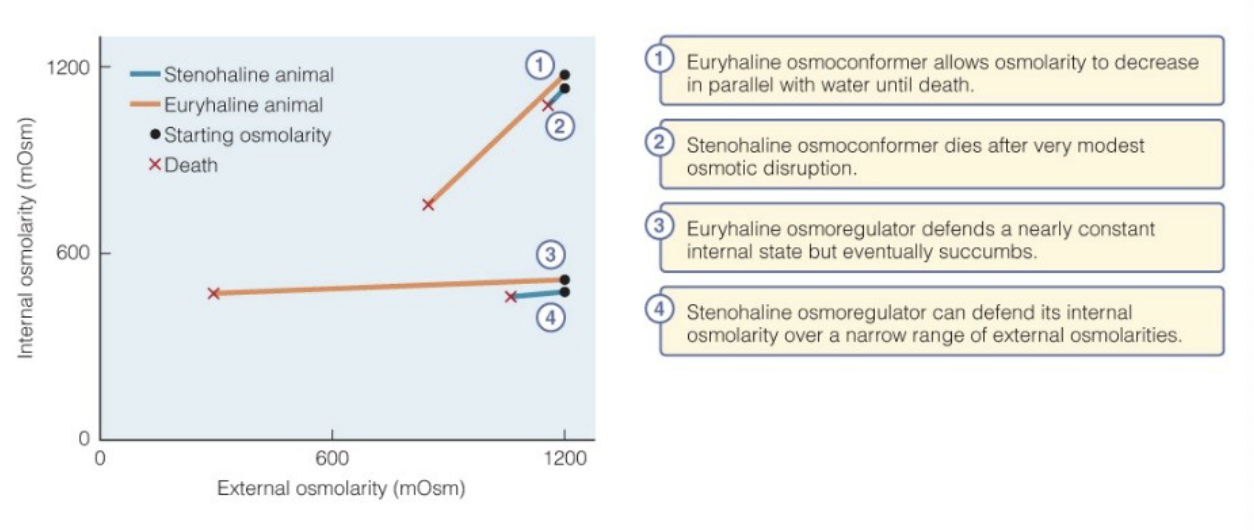
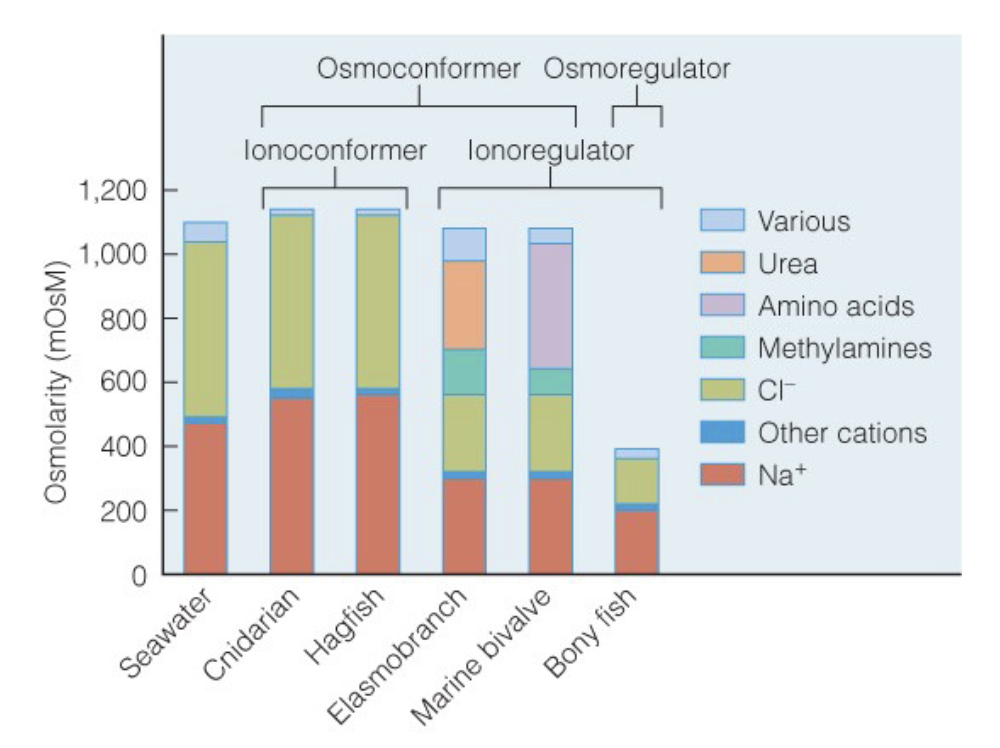
regulators vs conformers
iono, osmo
more mechanisms = slower rate of change for conformers (bc more layers between inside and outside)
must balance osmotically!!
best option is regulation of ions and osmolarity
ion and water balance 2
environments
air outside, water inside humans, body slowing rate of water loss
ingested materials
smaller slope = regulator (internal vs external change is not as drastic)
steeper slope = conformer (more drastic change as they change with envmnt)
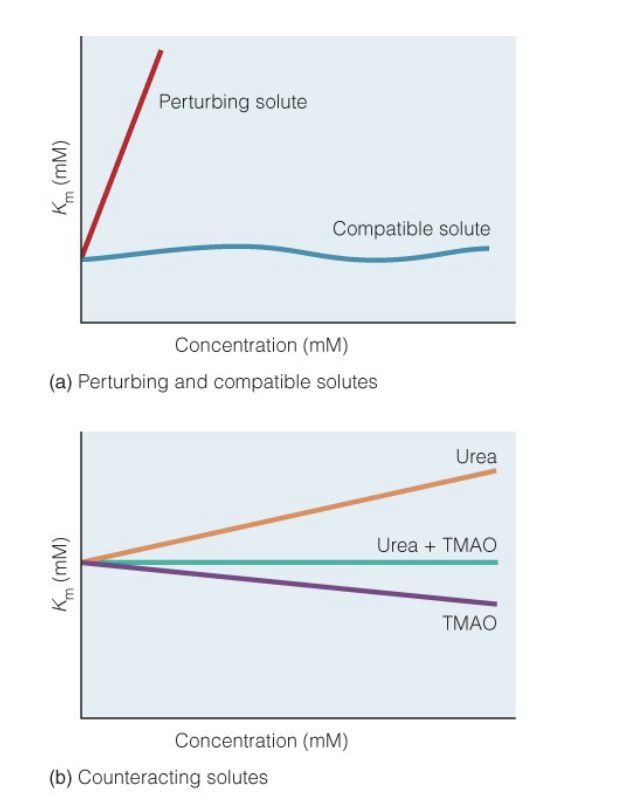
solutes
perturbing
solute results in large change in protein folding/function
compatible
solute does not effect protein folding/function
counteracting
solutes interact with each other and balance each other out or act more like a compatible solute
extracellular solutes
regulators have differences in their iono and osmo concentrations
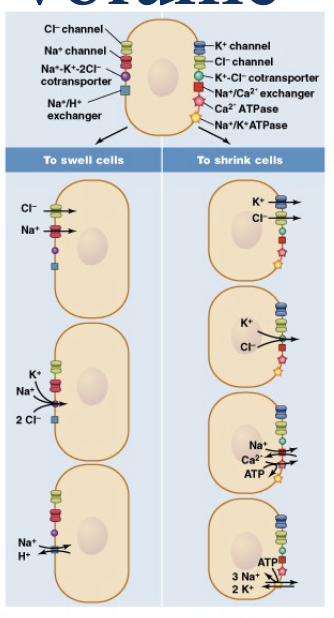
regulation of cell volume
water follows osmotic gradient
when ions are pumped into a cell, water follows and causes the cell to swell
pumping ions out causes water to follow and shrink the cell
maintain concentrations to regulate water movement
when ions come in from the environment/food and the cell swells with water, the cell responds by pumping ions out and preventing the swelling
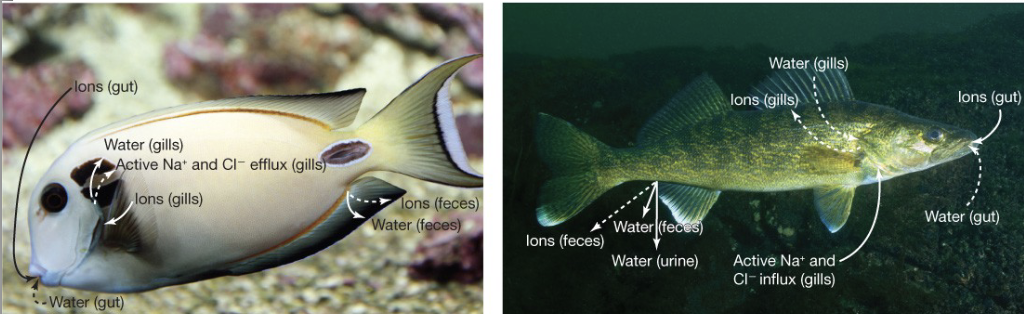
systems to regulate osmotic and ionic balance
organs affecting salt balance
exchange with environment
gills (gas and salt exchange, can also respond)
intestines/GI
integument (skin)
responding to changes from exchange
kidneys (change urine on a regular basis)
salt gland (concentrate salts and get them out)
rectal gland (remove salts from body)
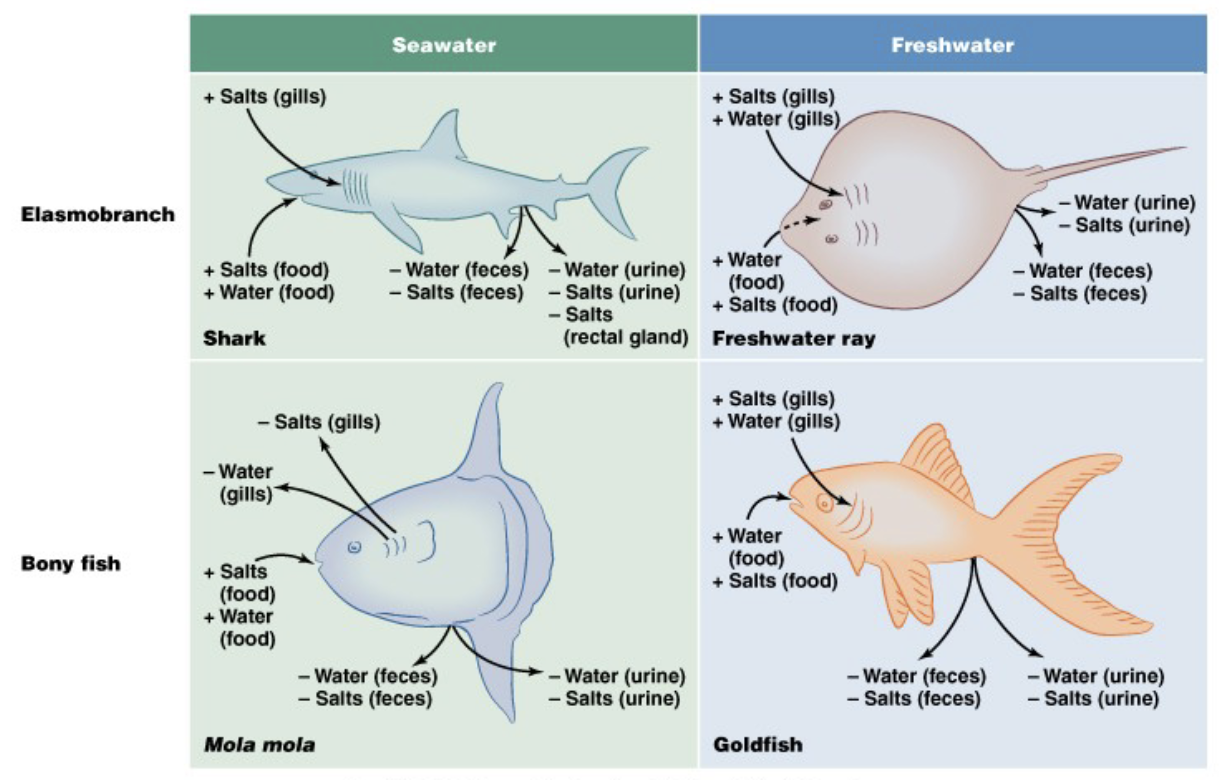
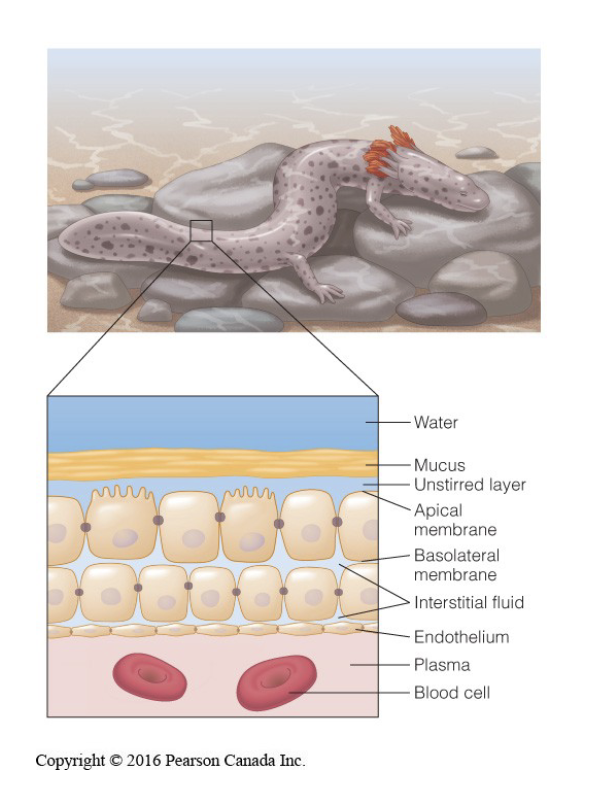
epithelial tissue
different transporters/channels on luminal and basolateral surfaces
ion channels, aquaporins, active (primary/secondary)
tight junctions
have large numbers of mitochondria
diverse cell types
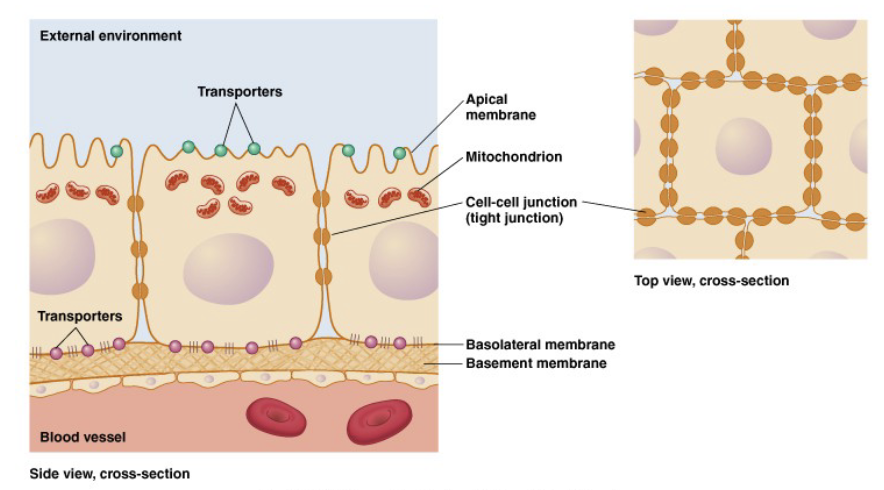
integument/skin
regulate aquaporins
less aquaporins = less water movement (good for dry environment animals)
hydrophobic substances
mucous, lipid secretions
cuticle
acts as a seal
stratum corneum
calluses
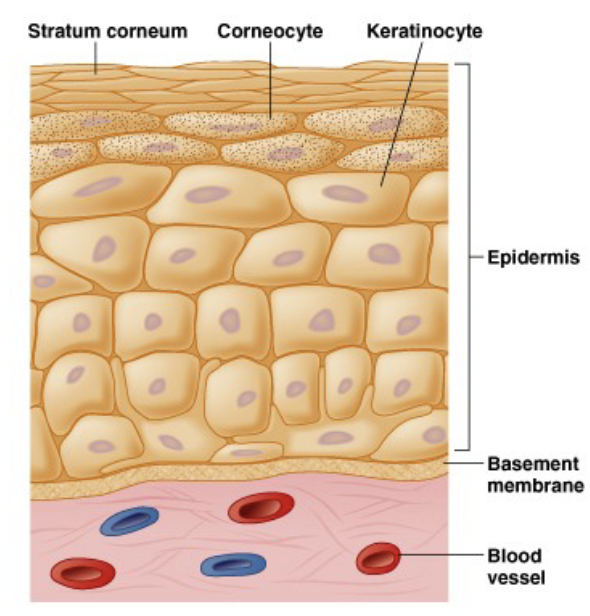
fish gills
pavement cells (PNA-)
import Na+
chloride cells (PNA+)
import Cl-
[direction of channels depends on external environmet]
![<ul><li><p>pavement cells (PNA<sup>-</sup>)</p><ul><li><p>import Na<sup>+</sup></p></li></ul></li><li><p>chloride cells (PNA<sup>+</sup>)</p><ul><li><p>import Cl<sup>-</sup></p></li></ul></li></ul><p>[direction of channels depends on external environmet]</p>](https://assets.knowt.com/user-attachments/3d91f069-e7b3-489b-b05b-e5b1c782b621.png)
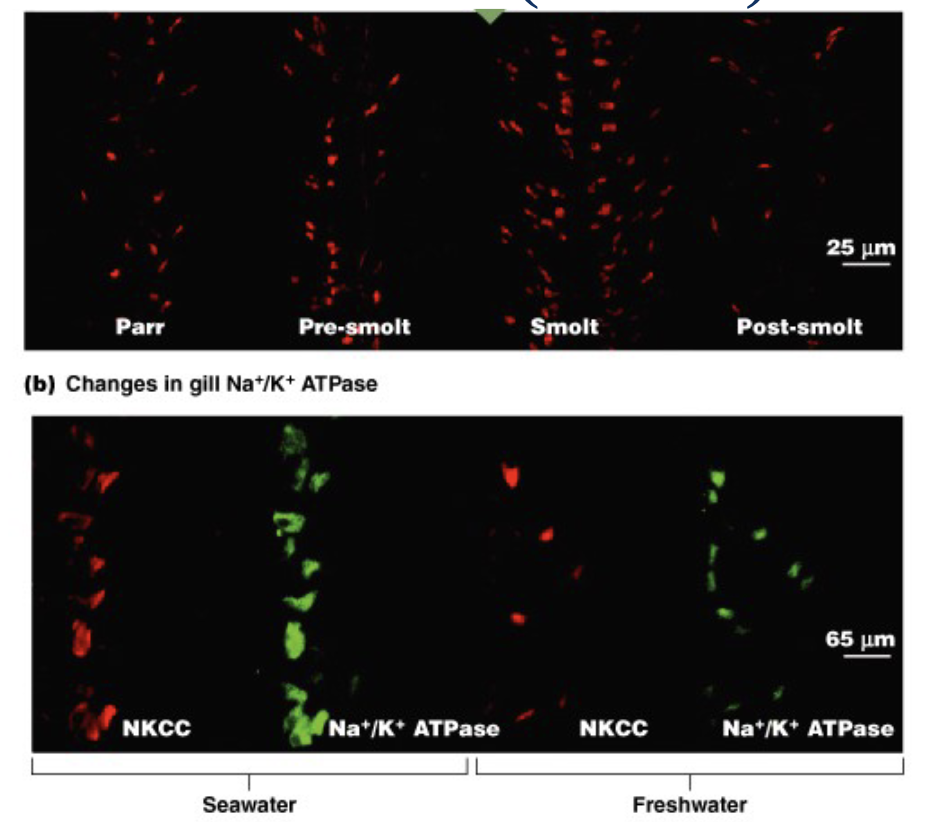
fish gills (10-12)
when salmon is in freshwater, it pumps less sodium out because less is coming in (more NKCC). in seawater, more salt is coming in so more needs to be pumped out (more Na/K ATPase)
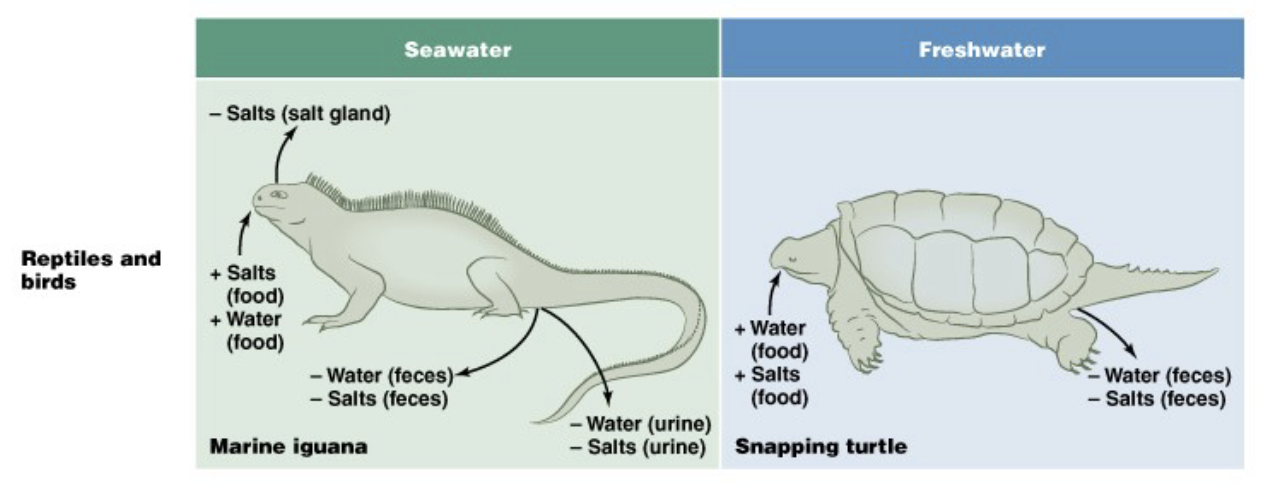
salt glands - reptiles/birds
environment
salty environments, around the sea or other places where excess salt needs to be removed from the body
secretory tubules dump salt
really salty fluid leaves first, blood will continually pump salt into the lumen, and lumen pumps salt the other way so the smaller gradient can be maintained without having to use as much energy to pump things farther (like if you had a large gradient)
countercurrent flow
maintains small gradients throughout the vessels so there is constant exchange
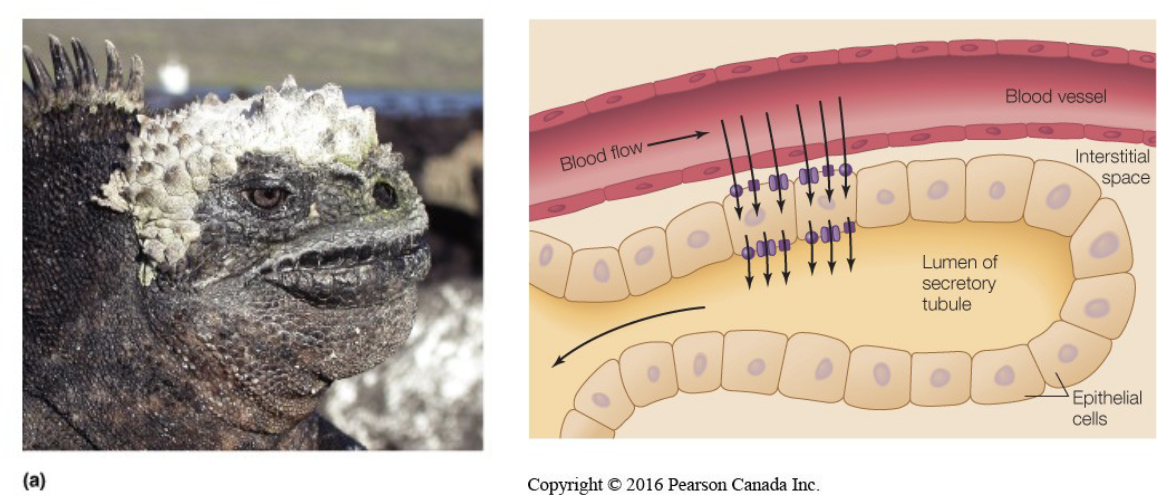
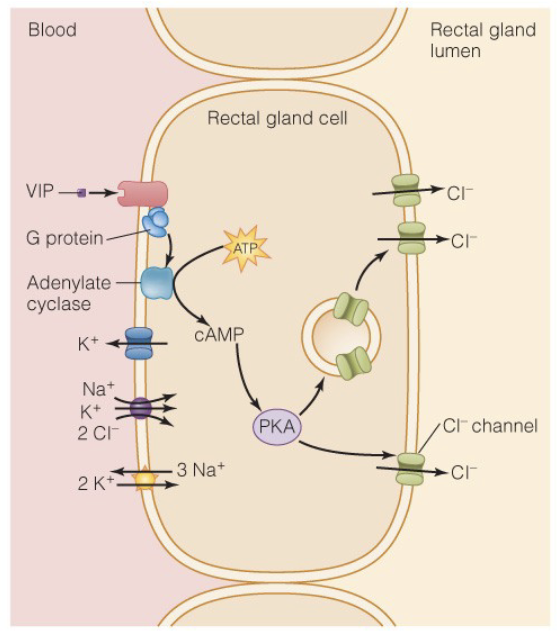
rectal gland - elasmobranchs
salt excretion
basolateral side invaginated (SA)
Na+, Cl- move to lumen of gland
kidney - vertebrates
kidney
ions
osmolarity
blood pressure
pH
excretion (removal of anything from the body)
hormone production
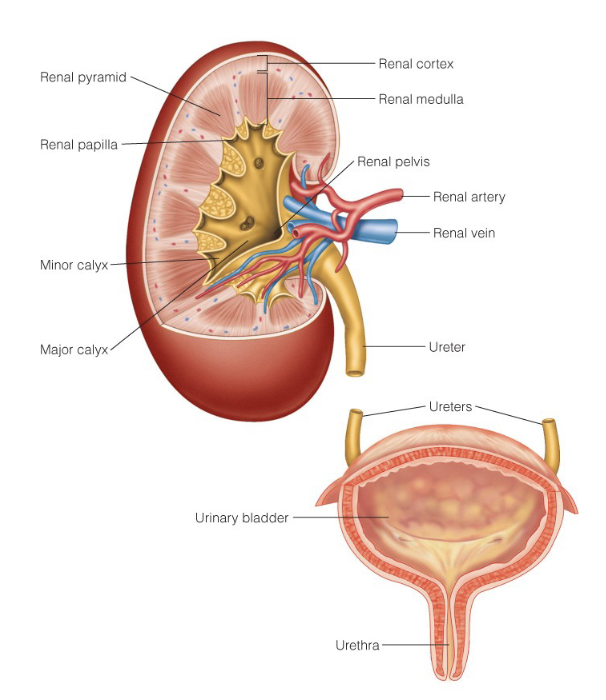
mammalian kidney
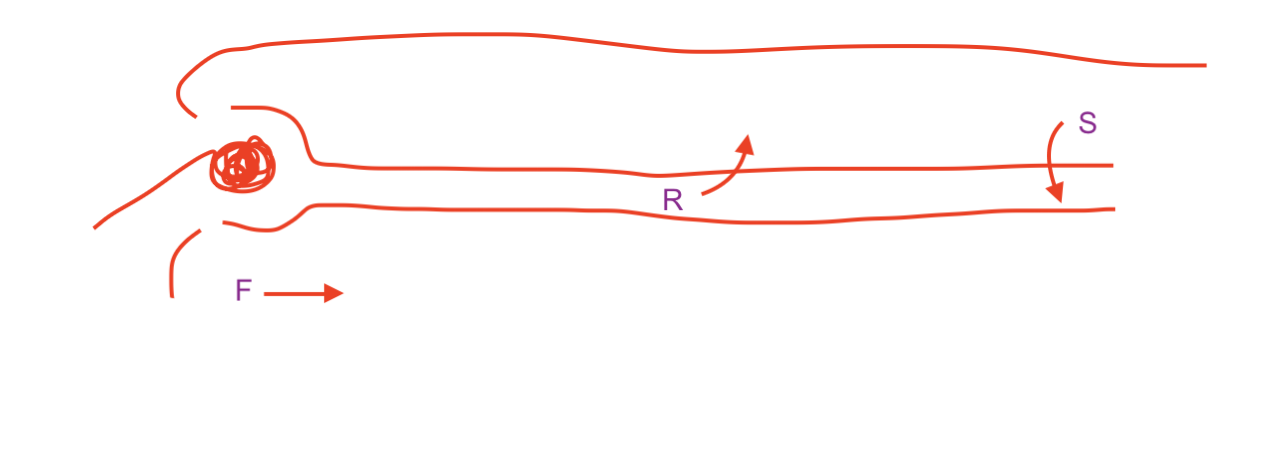
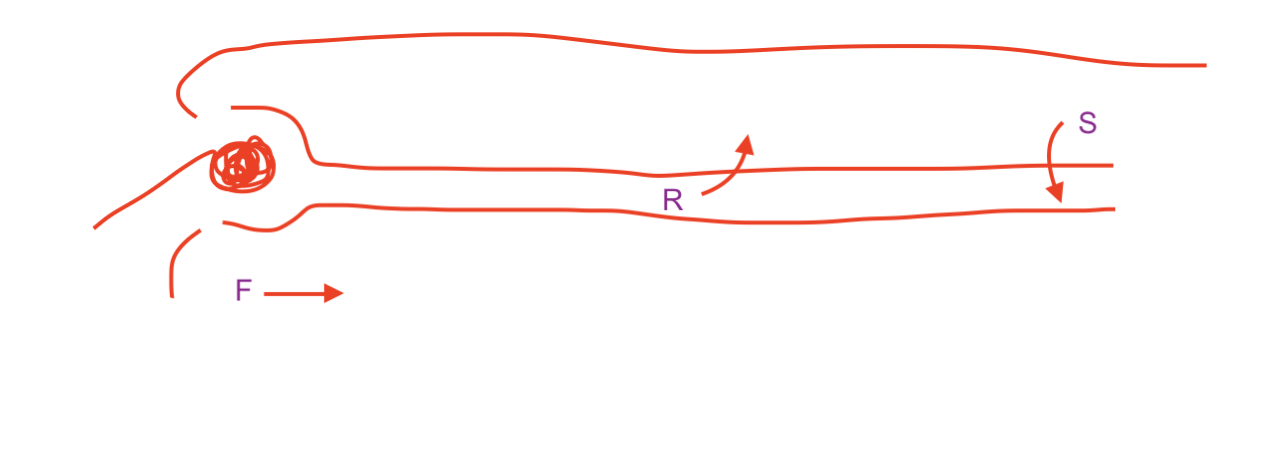
nephron (work force of the kidney)
filtration
from blood to nephron using bulk flow
reabsorption
nephron to blood by selective transport
secretion
from blood to nephron by selective transport
excretion
leaving body (E = +F - R + S)
[anything in blood is staying inside the organism, anything in the nephron will eventually go into the urine and leave the body]
![<ul><li><p>nephron (work force of the kidney)</p></li><li><p>filtration</p><ul><li><p>from blood to nephron using <u>bulk flow</u></p></li></ul></li><li><p>reabsorption</p><ul><li><p>nephron to blood by selective transport</p></li></ul></li><li><p>secretion</p><ul><li><p>from blood to nephron by <u>selective transport</u></p></li></ul></li><li><p>excretion</p><ul><li><p>leaving body (E = +F - R + S)</p></li></ul></li></ul><p>[anything in blood is staying inside the organism, anything in the nephron will eventually go into the urine and leave the body]</p>](https://assets.knowt.com/user-attachments/ab21a3bf-003c-4a5c-a021-e1dd2c71a044.png)
mammalian kidney 2
Filtration
glomerulus (1)
capillary bed
bowman’s capsule (2)
around capillary
Reabsorption
proximal tubule (3)
majority of reabsorption
loop of Henle (4)
sets up gradients to concentrate
distal tubule (5)
majority secretion (secretion so far down the tube stops “waste” from being reabsorbed further down the nephron)
collecting duct (6)
top has majority secretion
[“waste” is a broad category, meaning toxins like urea, foreign substances, or things we have in excess (excess sodium, etc)]
![<p>Filtration</p><ul><li><p>glomerulus (1)</p><ul><li><p>capillary bed</p></li></ul></li><li><p>bowman’s capsule (2)</p><ul><li><p>around capillary</p></li></ul></li></ul><p>Reabsorption</p><ul><li><p>proximal tubule (3)</p><ul><li><p>majority of reabsorption</p></li></ul></li><li><p>loop of Henle (4)</p><ul><li><p>sets up gradients to concentrate</p></li></ul></li><li><p>distal tubule (5) </p><ul><li><p>majority secretion (secretion so far down the tube stops “waste” from being reabsorbed further down the nephron)</p></li></ul></li><li><p>collecting duct (6)</p><ul><li><p>top has majority secretion</p></li></ul></li></ul><p>[“waste” is a broad category, meaning toxins like urea, foreign substances, or things we have in excess (excess sodium, etc)]</p>](https://assets.knowt.com/user-attachments/a3614346-935f-46db-8f81-d8947e746cb4.png)
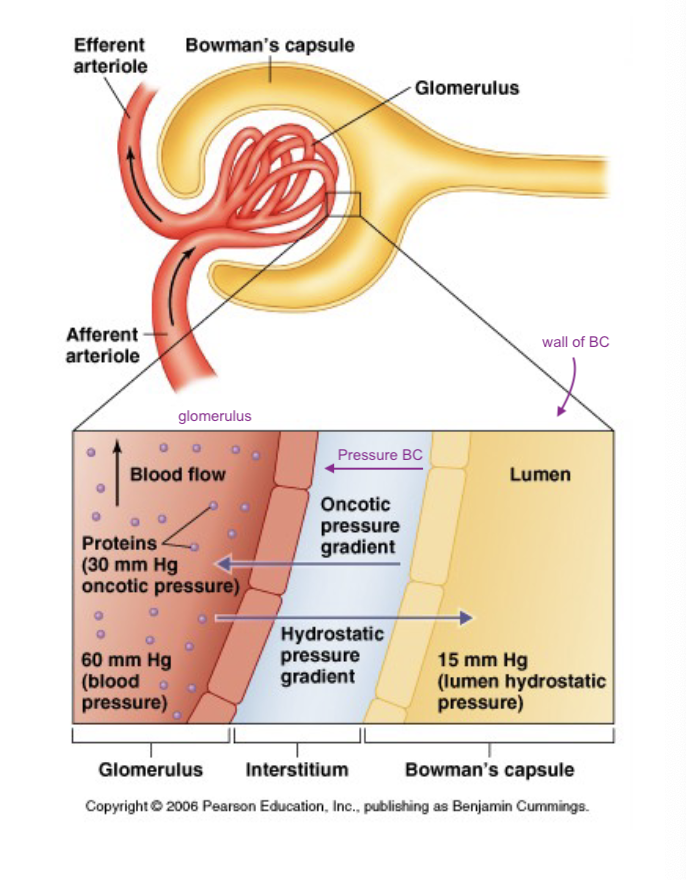
filtration
bulk flow process
blood to nephron
20% of volume filtered out
blood pressure
interstitial pressure (BCapsule)
fluid already in Bowman’s Capsule pushes back against the flow (a little bit)
oncotic pressure of blood
Filtration Pressure = PGC - PBC - πGC
[if all fluid is lost, cells shrink and form a clot]
[changing blood pressure, arteriole pressure, capillary pressure, etc. will change filtration pressure]
![<ul><li><p>bulk flow process</p></li><li><p>blood to nephron</p><ul><li><p>20% of volume filtered out</p></li></ul></li><li><p>blood pressure</p></li><li><p>interstitial pressure (BCapsule)</p><ul><li><p>fluid already in Bowman’s Capsule pushes back against the flow (a little bit)</p></li></ul></li><li><p>oncotic pressure of blood</p></li><li><p>Filtration Pressure = P<sub>GC</sub> - P<sub>BC</sub> - π<sub>GC</sub></p></li></ul><p>[if all fluid is lost, cells shrink and form a clot]</p><p>[changing blood pressure, arteriole pressure, capillary pressure, etc. will change filtration pressure]</p>](https://assets.knowt.com/user-attachments/5496da2c-999d-4686-a915-c1b038bf494b.png)
filtration 10.22
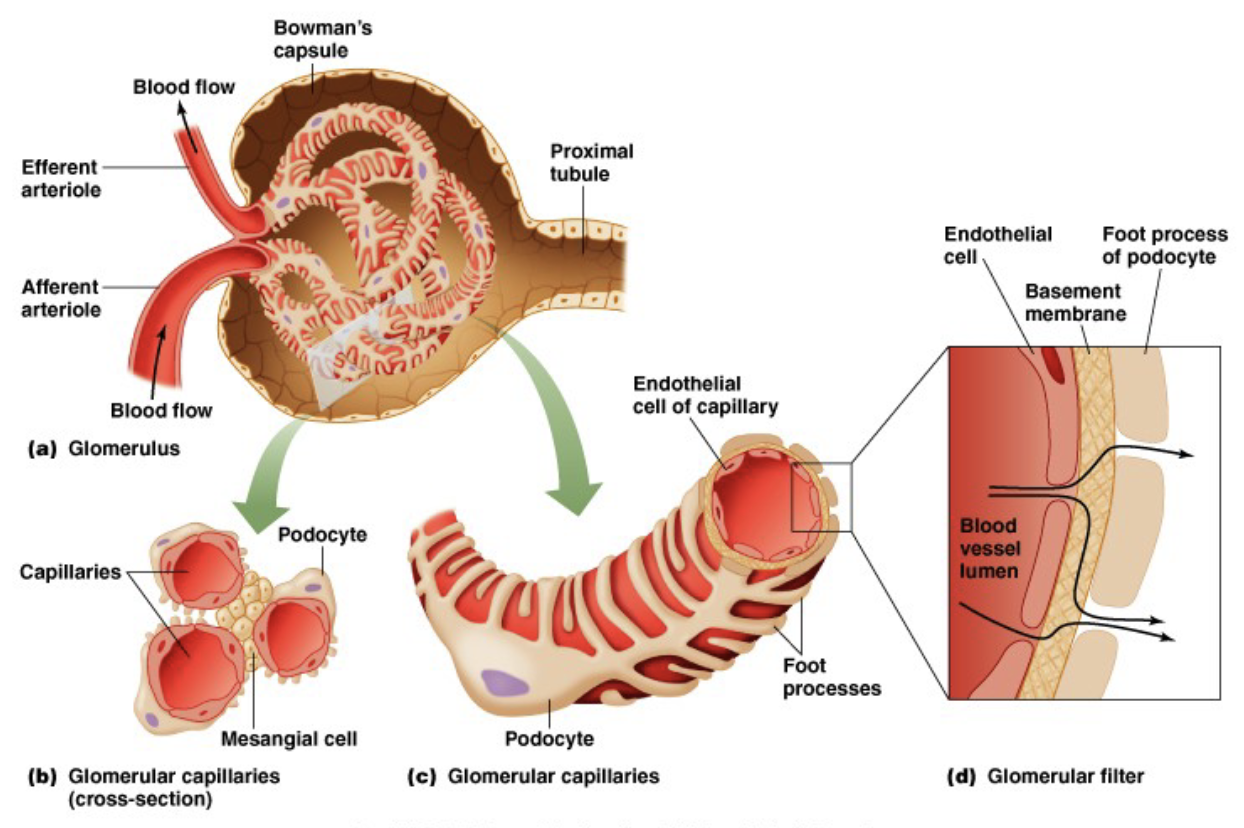
podocytes wrap around capillary and change how much surface area is exposed for filtration (less SA → less filtration)
kidneys need higher filtration, so glomerular filter is fenestrated (most can get out, but not big things like blood cells and proteins)
reabsorption
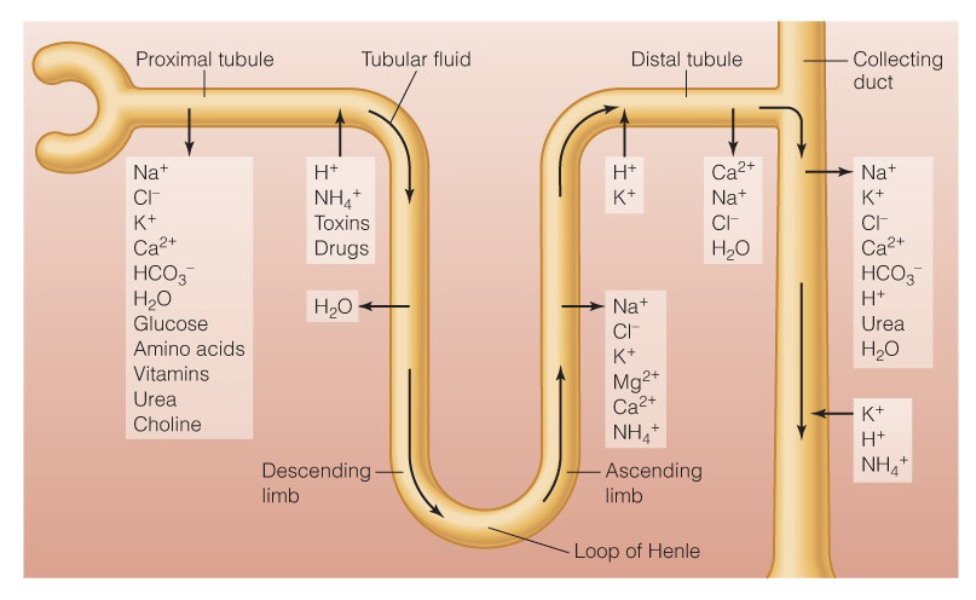
selective process - nephron to blood
mediated transport, diffusion → lipid soluble + water
99% can be reabsorbed (but more filtration = more excretion)
toxins may be secreted before the distal tubule because they cannot be reabsorbed, only excess can be reabsorbed, which is why it needs to be secreted later
distal can also reabsorb any extra things needed (like fine-tuning after typical needs from the proximal tubule have been absorbed)
renal threshold
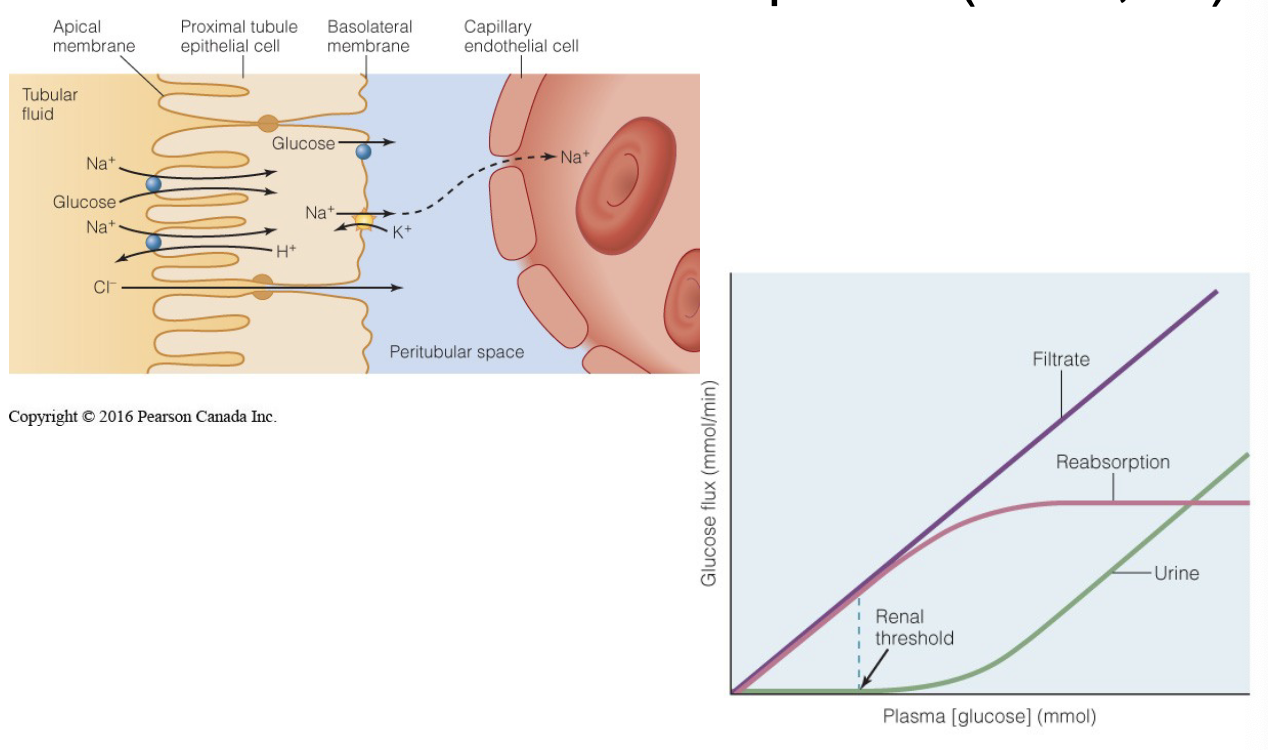
when mediated transporters become saturated (no more binding spots), reabsorption threshold is reached
filtrate above reabsorption threshold goes into urine
secretion and excretion
selective process → using transporters, can saturate (reach a max)
blood to nephron → leaving the body via urine
removal of excess or wastes →
filtration - reabsorption + secretion
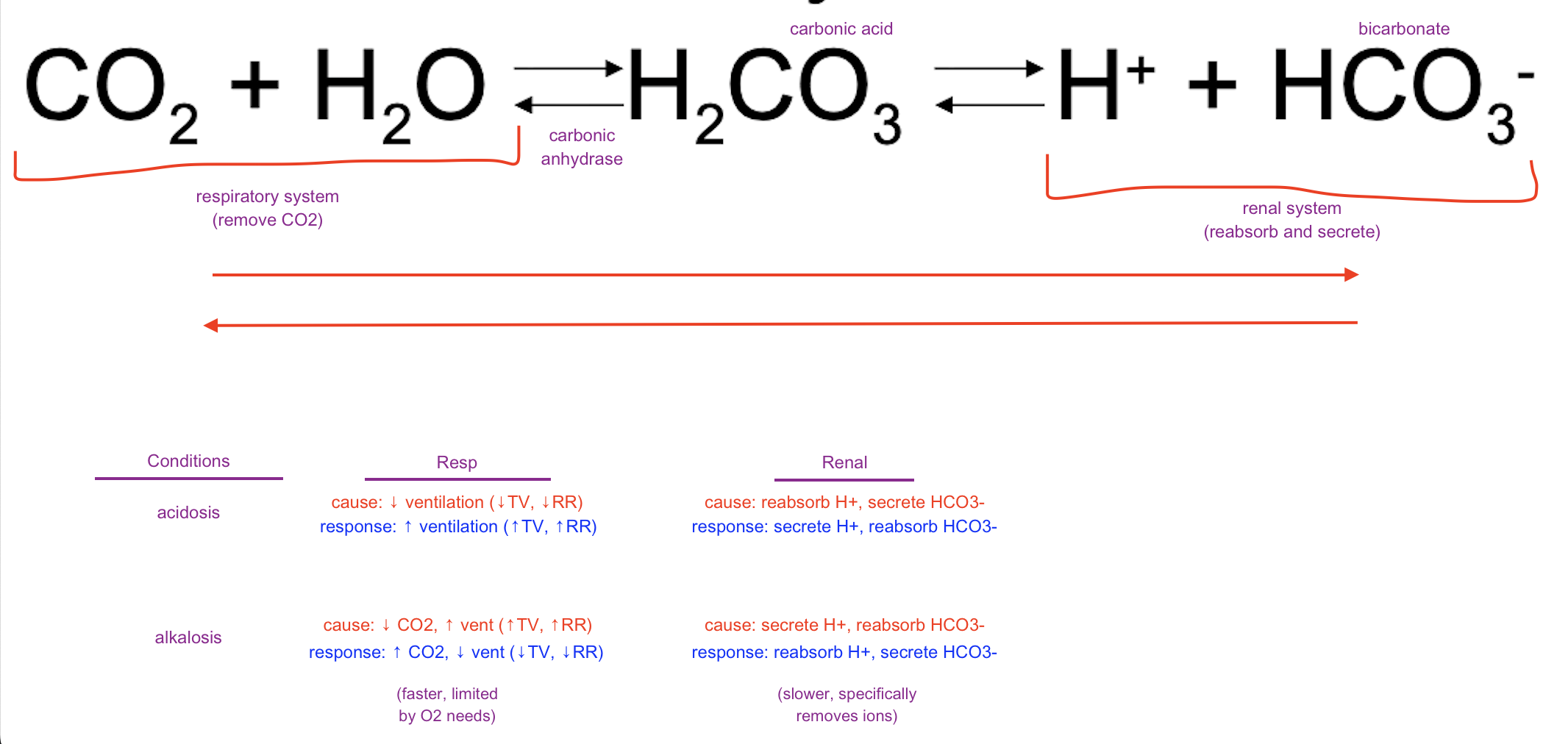
secretion, excretion, pH
pH regulated by gas exchange and osmotic balance systems
CO2 + H2O ←→ H2CO3 ←→ H+ + HCO3-
CO2 produced during metabolism, increase by tissues, decreased in lungs because of exhalation/removal of CO2 to envnmnt
bicarbonate more soluble in blood
renal system works with the back half of the system
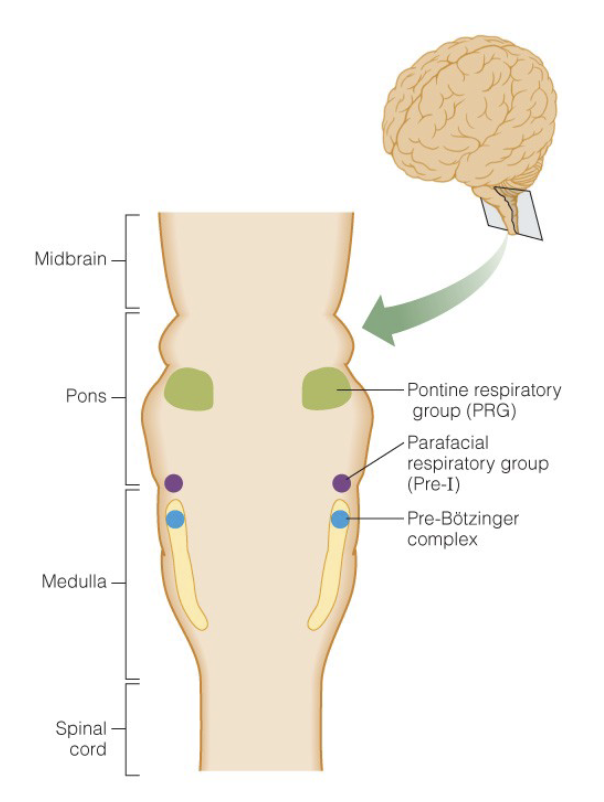
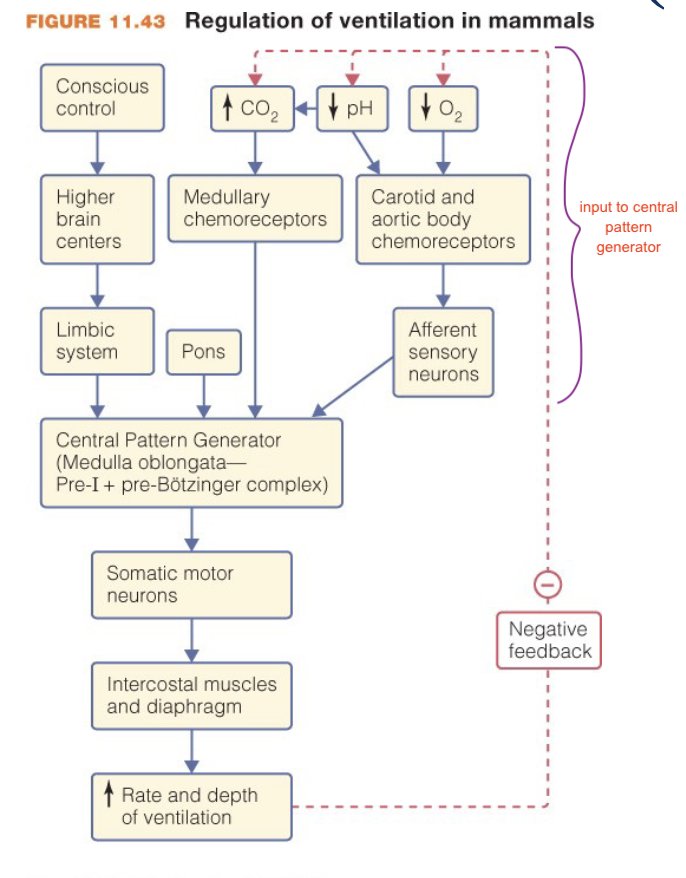
regulation of ventilation
respiratory general pattern generator
chemosensory input (CO2, pH, O2)
mechanoreceptors
Hering-Breuer reflex (limits lung expansion)
voluntary control
emotions
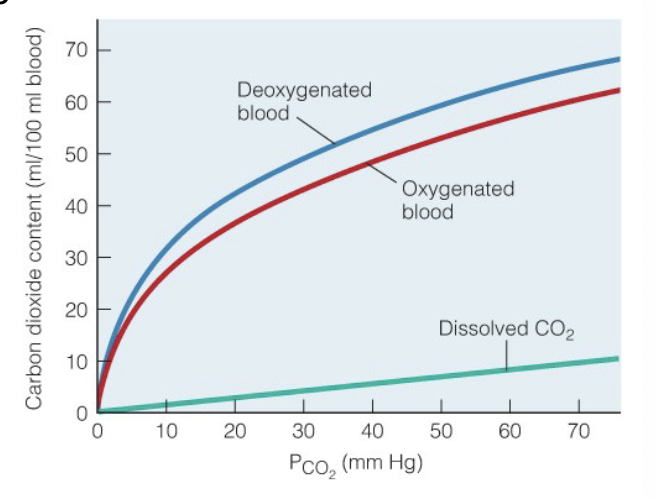
carbon dioxide in the blood
dissolved (small amount ~7%)
carbaminohemoglobin (when CO2 is bound to hemoglobin) (~25%)
Bicarbonate (~70%) (buffering system in EXC fluid)
H2O + CO2 ←→ H+ + HCO3-
deoxygenated blood released O2, bound CO2
oxygenated blood released CO2, bound O2
carbon dioxide in the blood
Bohr Effect (↓ affinity for O2)
increase in H+ binding to Hb releases more O2
Haldane effect (↓ affinity for CO2 and H+)
oxygenated blood releases CO2 and H+
Chloride Shift
when tissue cell is pumping bicarbonate out, it exchanges it for chloride
bicarbonate put back into lungs, chloride is removed
[more CO2 in tissues]
![<ul><li><p>Bohr Effect (↓ affinity for O<sub>2</sub>)</p><ul><li><p>increase in H<sup>+</sup> binding to Hb releases more O<sub>2</sub></p></li></ul></li><li><p>Haldane effect (↓ affinity for CO<sub>2</sub> and H<sup>+</sup>)</p><ul><li><p>oxygenated blood releases CO<sub>2</sub> and H<sup>+</sup></p></li></ul></li><li><p>Chloride Shift</p><ul><li><p>when tissue cell is pumping bicarbonate out, it exchanges it for chloride</p></li><li><p>bicarbonate put back into lungs, chloride is removed</p></li></ul></li></ul><p>[more CO<sub>2</sub> in tissues]</p>](https://assets.knowt.com/user-attachments/8d804d85-a6c2-4dd7-bbbd-8ae9d04520a2.png)
oxygen in blood/lymph
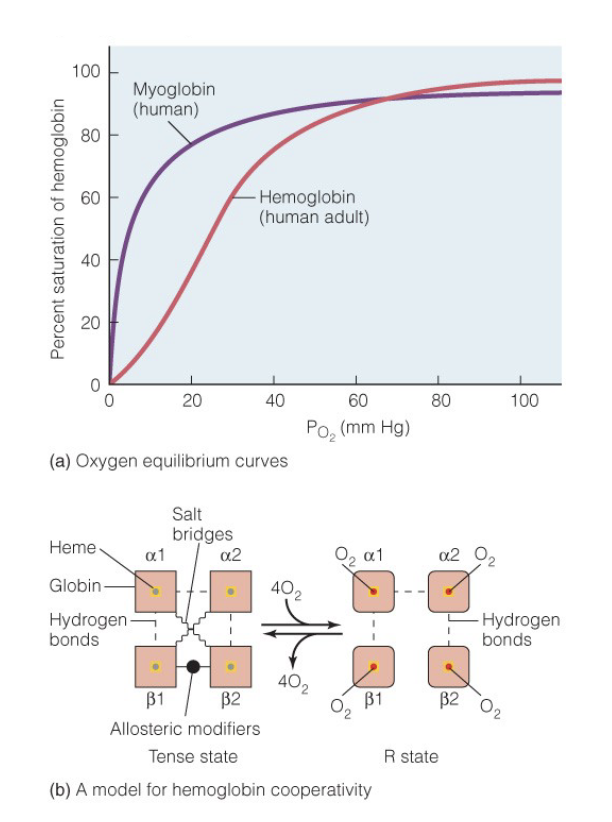
oxygen equilibrium/dissociation curve
saturation
bound/available x 100%
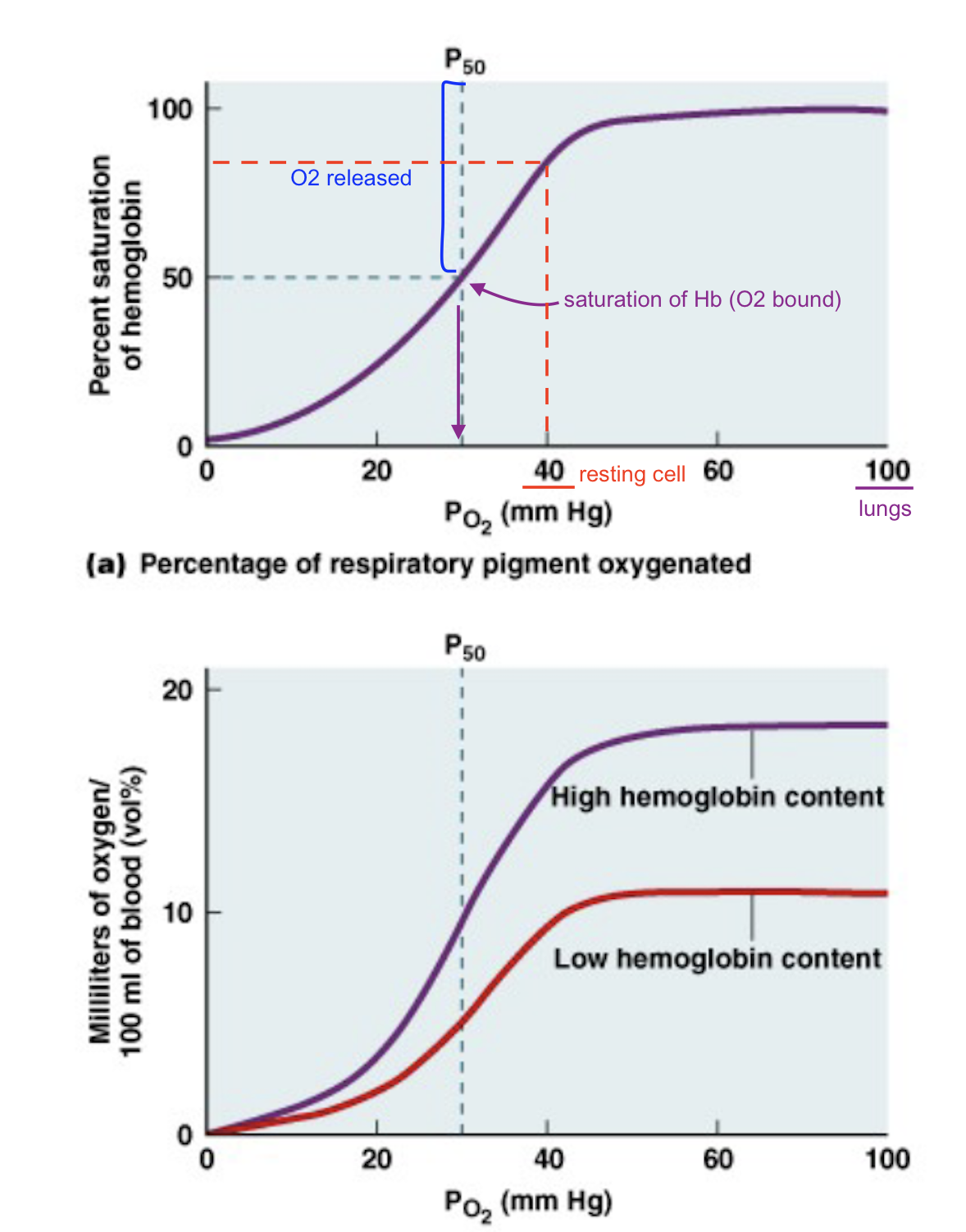
oxygen in blood
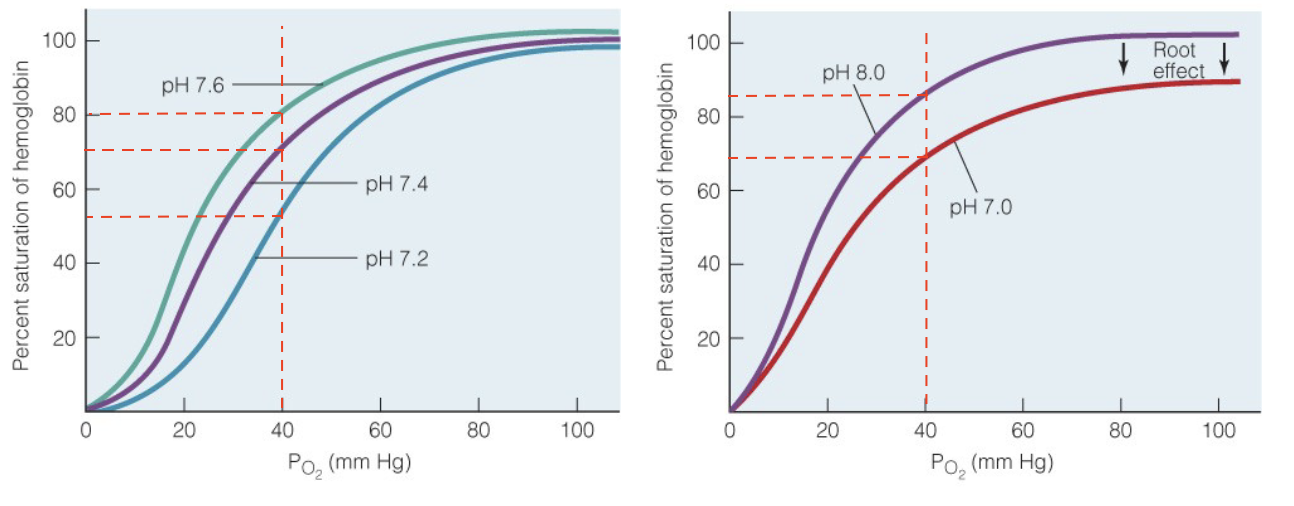
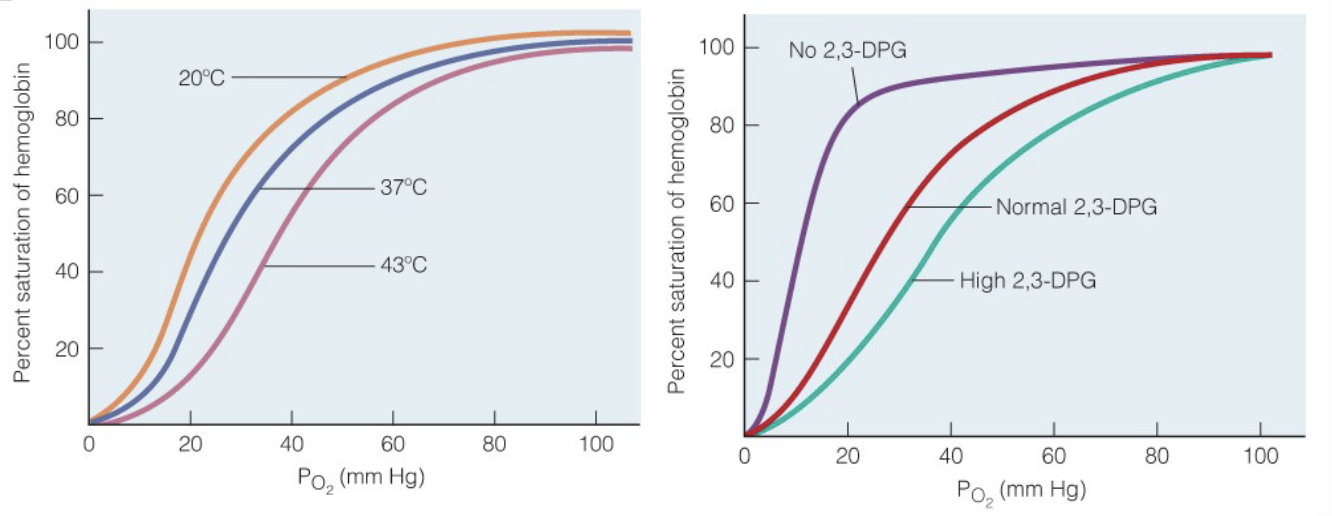
shifts in dissociation curve
type of binding protein (exercise = more CO2)
pH (low pH = low affinity for O2)
CO2 (more = low affinity for O2)
temp (higher = low affinity for O2)
DPG ( higher = low affinity for O2)
released by RBCs during hypoxia
oxygen in blood 11.34
oxygen in blood 11.37
regulation of ventilation
modification of urine
must filter fluid before modifying
glomerular filtration rate
affected by pressures
affected by surface area available
adjust urine using reabsorption (nephron to blood) and secretion (blood to nephron)
modification of urine 2
GFR (↑filtration rate → faster flow, less time for reabsorption)
myogenic regulation (smooth muscle contracts when stretched → limits pressure in capillaries)
muscle (myo) creation (genic)
tubuloglomerular feedback (compares blood to nephron on the way to urine, ↑ or ↓ GFR)
distal tubule → glomerulus
mesangial control
changes surface area, potocytes
pressure natriuresis
more solutes in blood = more water in blood, increases blood volume and pressure (increases filtration rates, decreases sodium reabsorption)
[higher filtration rates lead to more loss, because time for reabsorption is decreased]
![<p>GFR (↑filtration rate → faster flow, less time for reabsorption)</p><ul><li><p>myogenic regulation (smooth muscle contracts when stretched → limits pressure in capillaries)</p><ul><li><p>muscle (myo) creation (genic)</p></li></ul></li><li><p>tubuloglomerular feedback (compares blood to nephron on the way to urine, ↑ or ↓ GFR)</p><ul><li><p>distal tubule → glomerulus</p></li></ul></li><li><p>mesangial control</p><ul><li><p>changes surface area, potocytes</p></li></ul></li><li><p>pressure natriuresis</p><ul><li><p>more solutes in blood = more water in blood, increases blood volume and pressure (increases filtration rates, decreases sodium reabsorption)</p></li></ul></li></ul><p>[higher filtration rates lead to more loss, because time for reabsorption is decreased]</p>](https://assets.knowt.com/user-attachments/4298e4ff-55f6-4da5-b559-7de1617ee011.png)
modification of urine 3
clearance = basically measures the rate at which a substance is '“cleared” from the blood
GFR = C
filtration (freely filtered)
no reabsorption
no secretion
C = (UxV)/Px
v = vol of urine, u = urine conc, p = plasma conc
UxV = amount of substance in urine
amount in urine / conc in plasma
[inulin meets the qualifications for C = GFR, filtered only and never reabsorbed]
[if clearance of X (Cx) is greater than clearance of inulin (Ci), the only way to remove more X from the blood is by secretion] [if Cx < Ci, reabsorption is needed to put more X back in the blood]
modification of urine 4
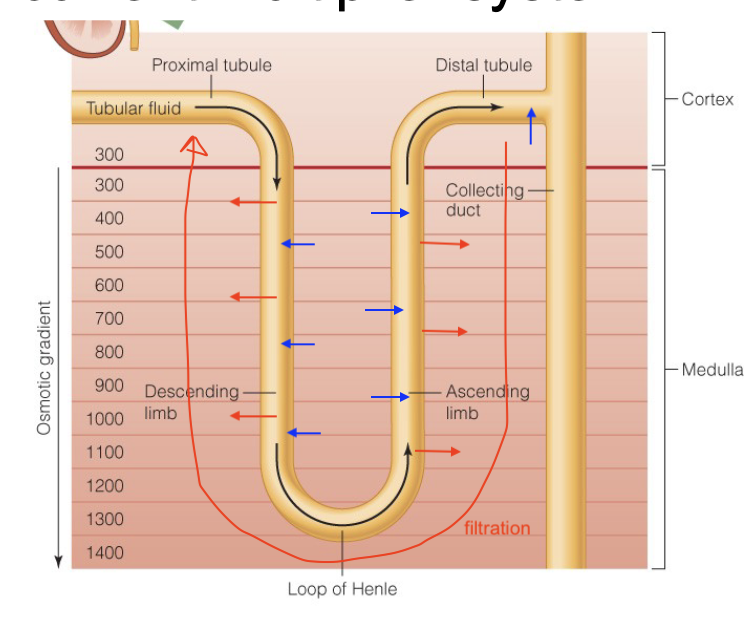
concentrating urine
reabsorption = N → B
secretion = B → N
loop of Henle (length)
countercurrent multiplier system
helps maintain a small but constant gradient
pick up little things when we really need them
modification of urine 5
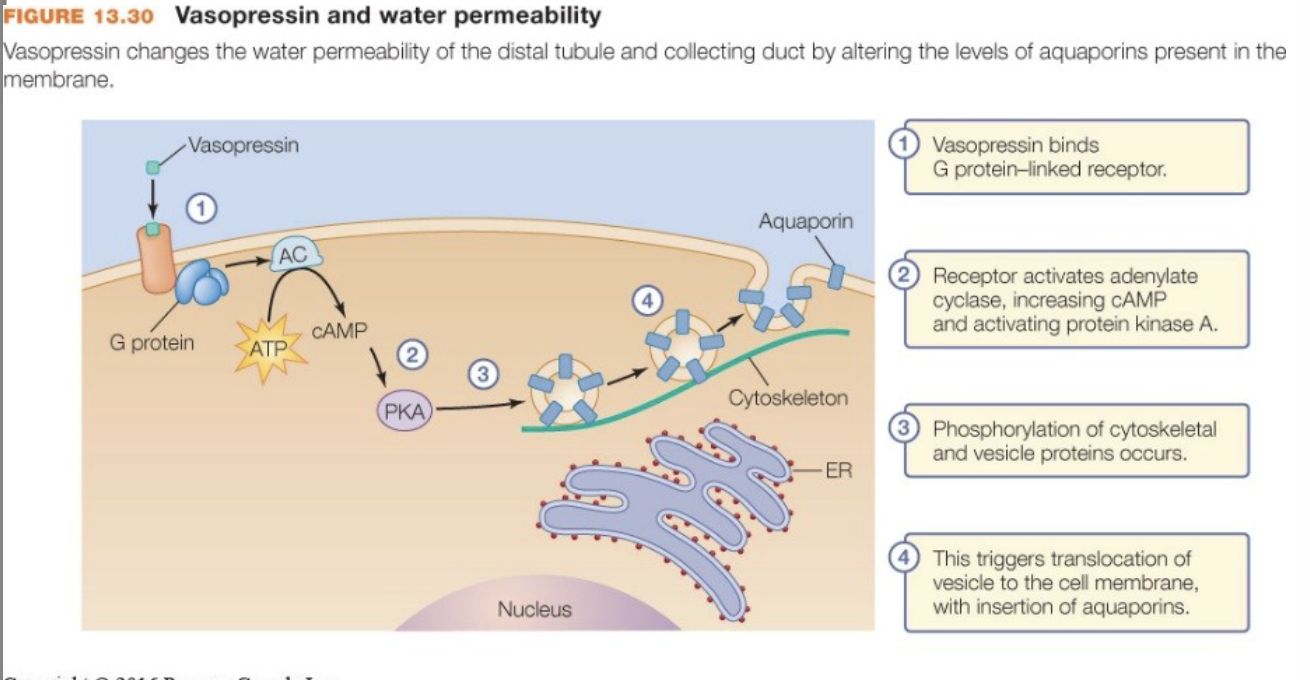
vasopressin/ADH (anti diuretic hormone)
↑ reabsorption of water
inserts aquaporins in the collecting duct (very few on it before this)
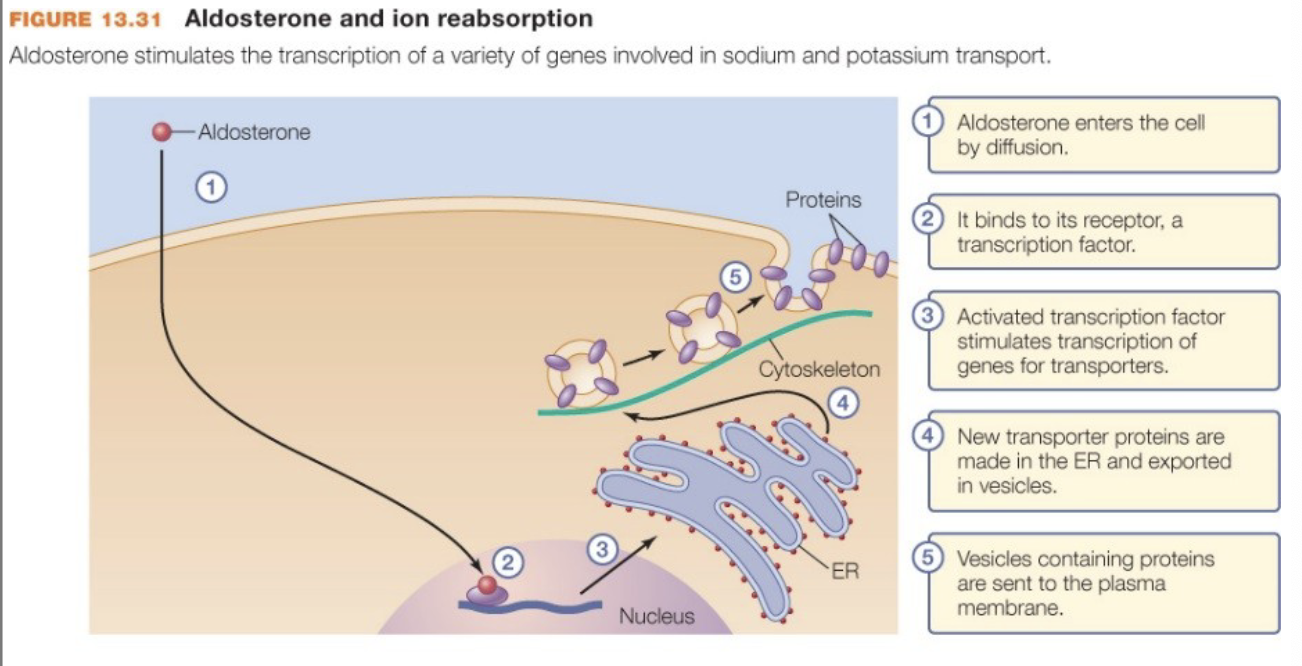
adlosterone
renin → angiotensin (constrict vessels, ↑bp) → aldosterone
renin released by kidneys due to ↓ blood pressure, helps ↑bp
↑ reabsorption of sodium (water follow sodium), ↑ secretion of potassium
inserts sodium-potassium ATPase pump to use for this
atrial natriuretic peptide
↓ reabsorption of sodium/natrium (water follows), ↓ secretion of potassium
↓ ADH and aldosterone release
↑ GFR
modification of urine 6
variety of genes = Na/K channels, Na/K ATPase
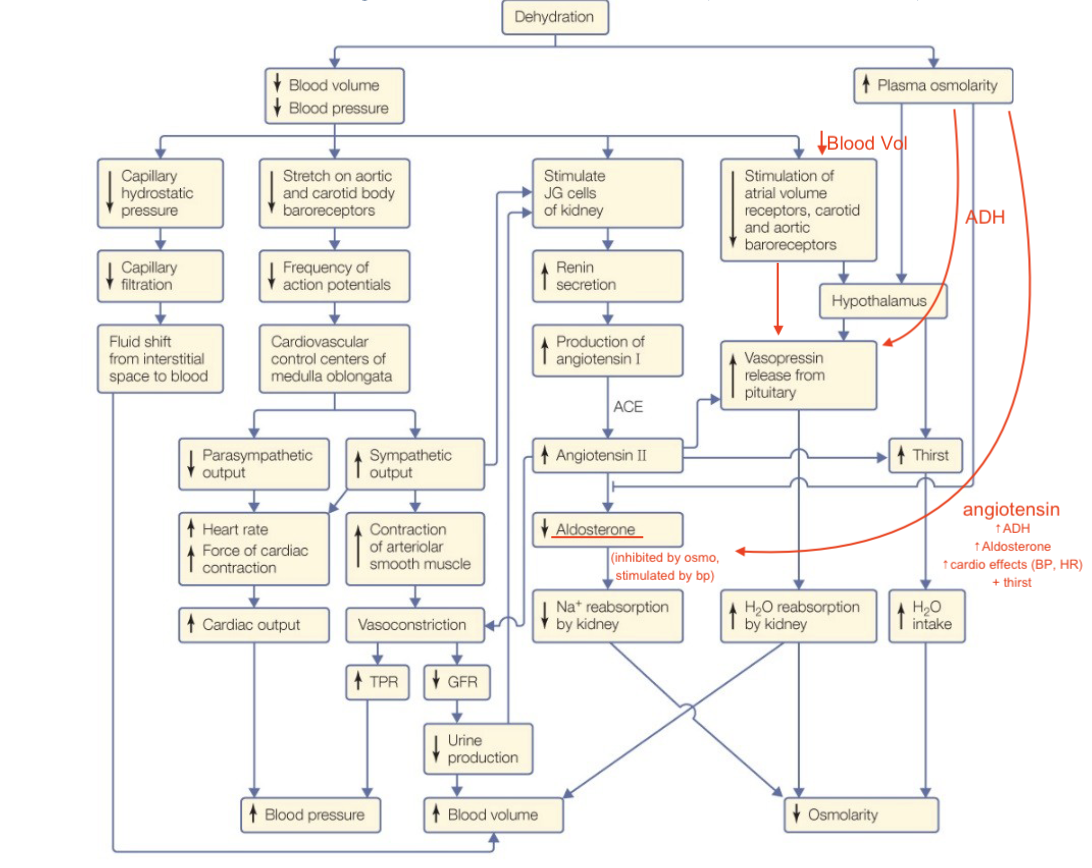
dehydration
↓ blood volume, ↓ blood pressure, ↑ osmolarity
sweating in heat, losing more water than salt
vomiting, losing water
want an increased ADH to reabsorb water
low blood vol says increase aldosterone, high salt says do not increase aldosterone (mixed signals, need a tiebreaker so body prioritizes osmolarity)(if osmolarity gets off, all systems are affected because cells shrink or lyse)
aldosterone will be slightly inhibited
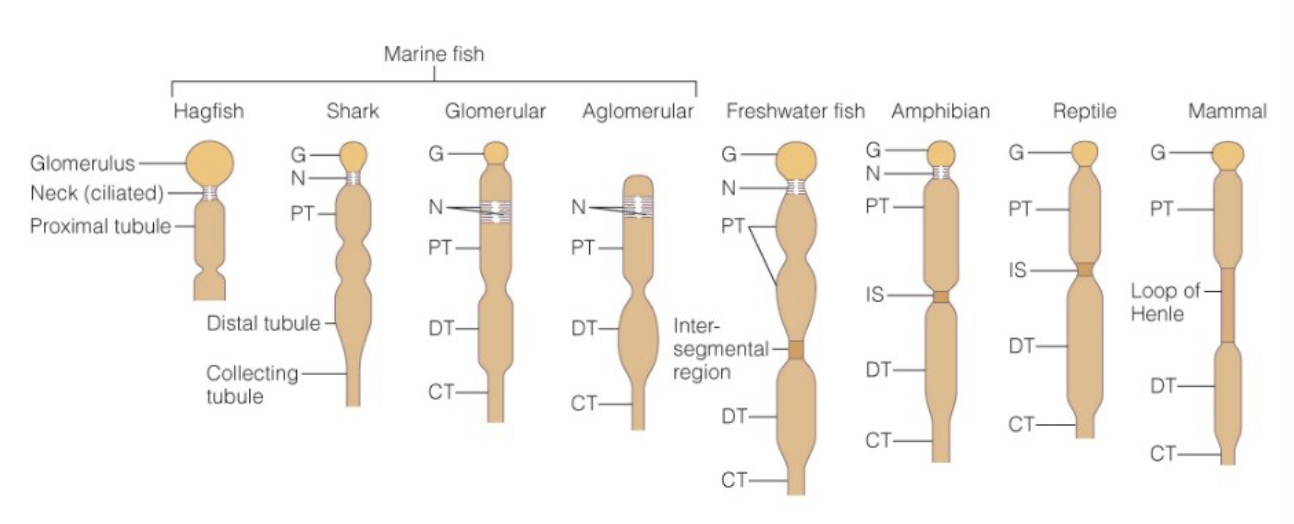
vertebrate kidneys
loops of Henle helps to create concentrated urine, animals that live in water do not need one
reptiles don’t have one because they have salt glands and tough/dry skin that minimizes water loss (better barriers)
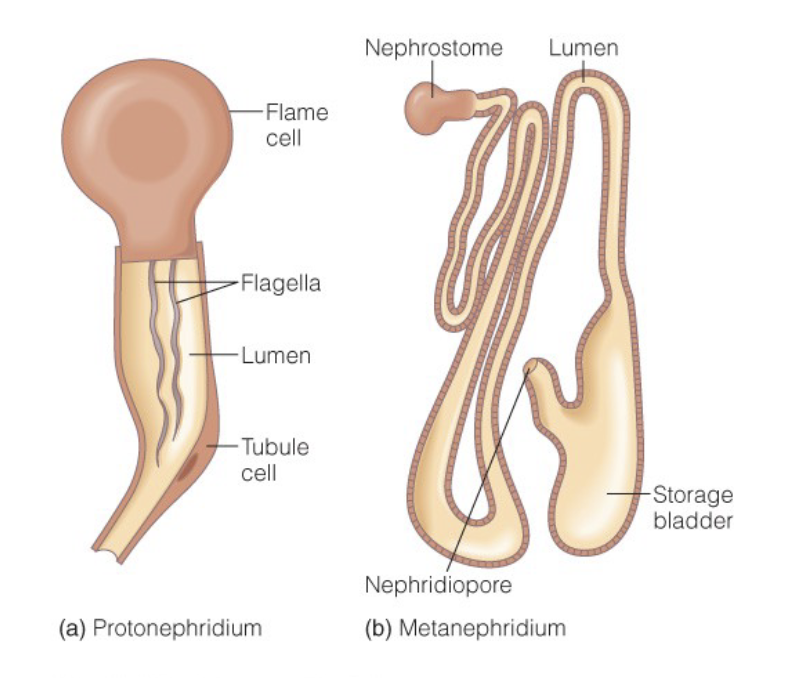
invertebrate kidneys
direct excretion
protonephridia
metanephridia
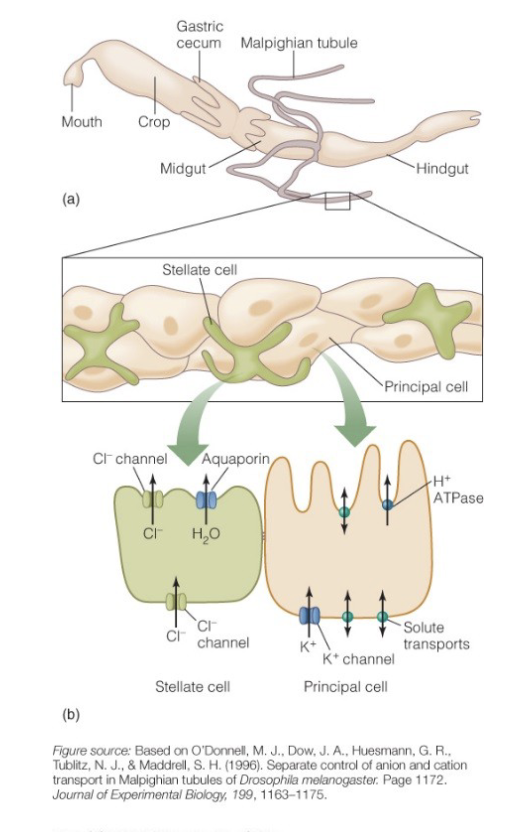
insect kidneys
malphagian tubules
stellate cell
principal cell
hormones
cation transport
myokinins
fluid
nitrogen wastes
ammonia
ammoniotelic
least energy, need lots of water to wash it out
in fish
urea
ureotelic
more energy to assemble bonds, less toxic, middle ground
in mammals
uric acid
uricotelic
more energy to assemble bonds, less toxic, gets rid of the most nitrogen
in birds
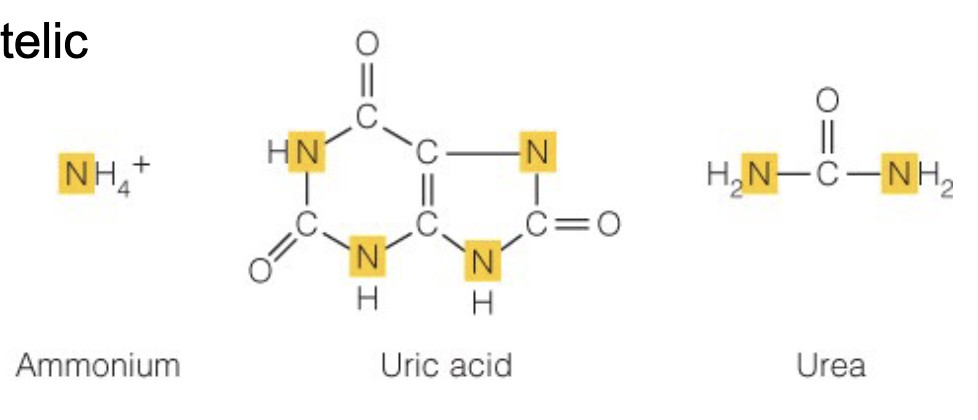
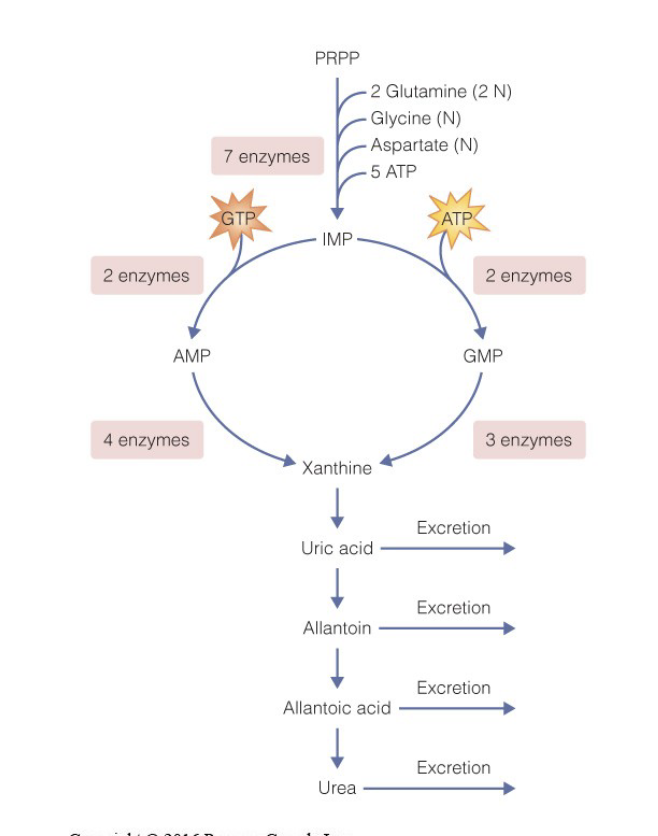
nitrogen waste pathway
coming from breakdown of proteins/amino acids
carnivores have more nitrogenous waste to get rid of (high protein diet)
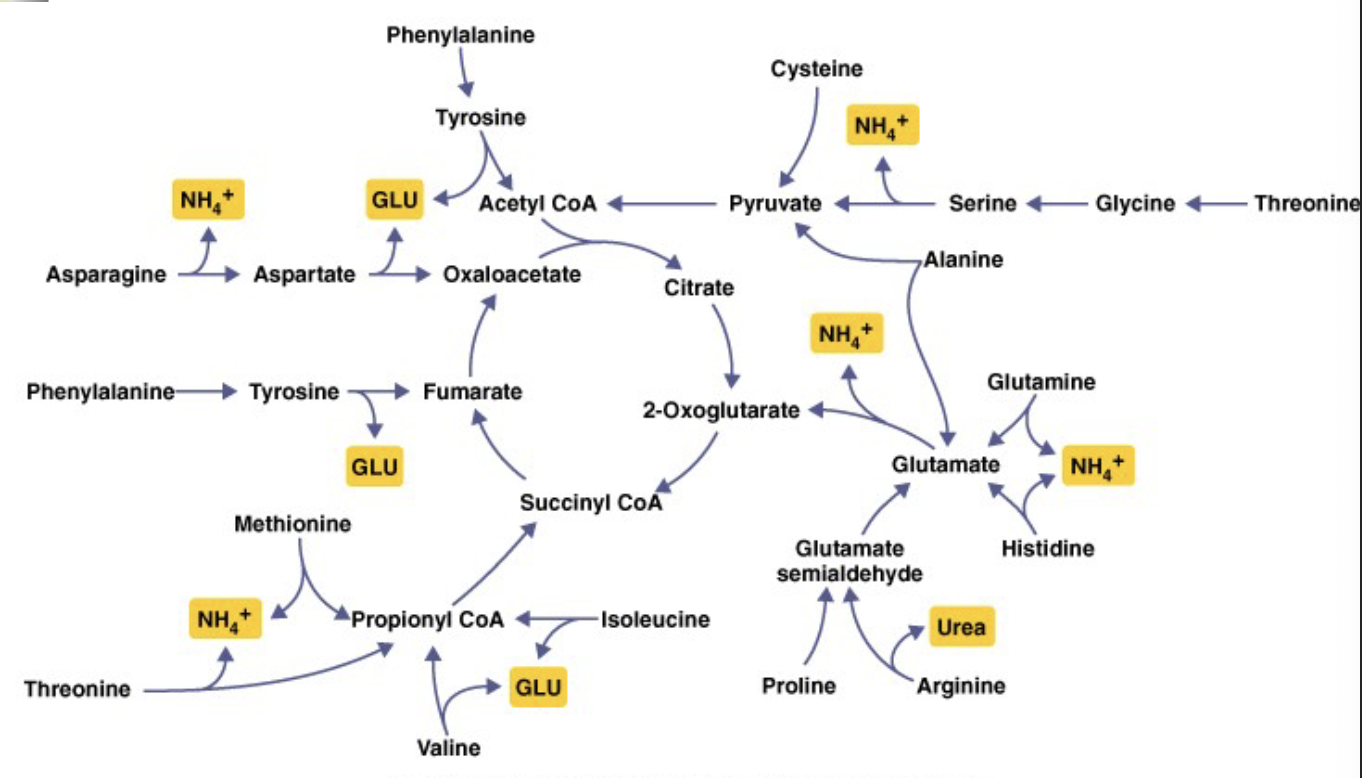
nitrogen wastes
factors
diet
water available
metabolic costs
digestion
purpose
features
ingesting
motility (movement and mechanical digestion) (physical mushed around, broken down into smaller chunks) (regulated by body)
secretions (communication and chemical digestion of foods, breaking chemical bonds) (regulated by body)
digestion (due to motility and secretions)
absorption (done mostly by mediated transport, GI tract has epithelial cells. gradient created to diffuse water [osmosis], nonpolar/small particles use simple diffusion, some transcytosis)
egestion (excretion, waste removal)
![<ul><li><p>purpose</p></li><li><p>features</p></li><li><p>ingesting</p><ul><li><p>motility (movement and mechanical digestion) (physical mushed around, broken down into smaller chunks) (regulated by body)</p></li><li><p>secretions (communication and chemical digestion of foods, breaking chemical bonds) (regulated by body)</p></li><li><p>digestion (due to motility and secretions)</p></li><li><p>absorption (done mostly by mediated transport, GI tract has epithelial cells. gradient created to diffuse water [osmosis], nonpolar/small particles use simple diffusion, some transcytosis)</p></li></ul></li><li><p>egestion (excretion, waste removal)</p></li></ul><p></p>](https://assets.knowt.com/user-attachments/31a3d843-3581-4be8-80f1-2a1b144efd70.png)
digestion 2
nutrient groups
energy groups
energy needs
SDA: how much energy does it actually take to do the metabolism (some bonds easier to break than other, proteins are difficult = more energy to break down, higher SDA)
keto diets are heavy in protein, takes more energy to break things down, loss in body weight
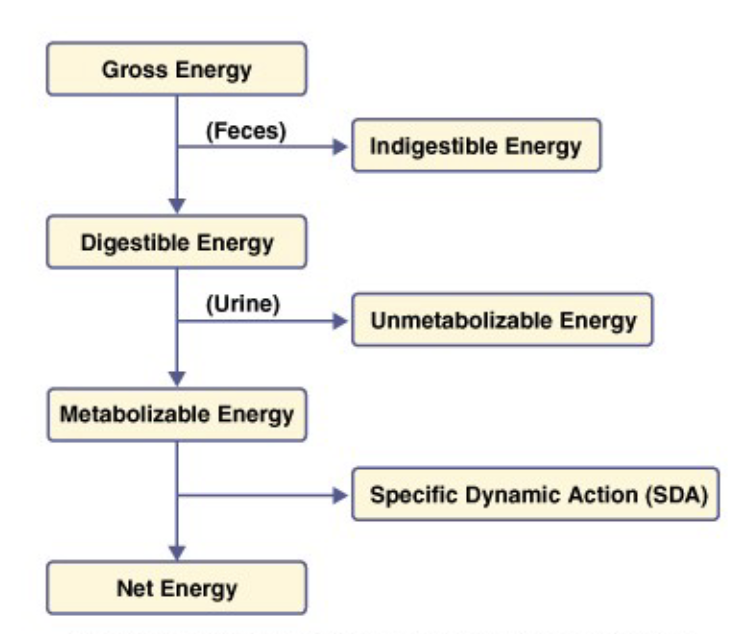
ingestion
accidental/random
directing water flow and cells grab things from the environment
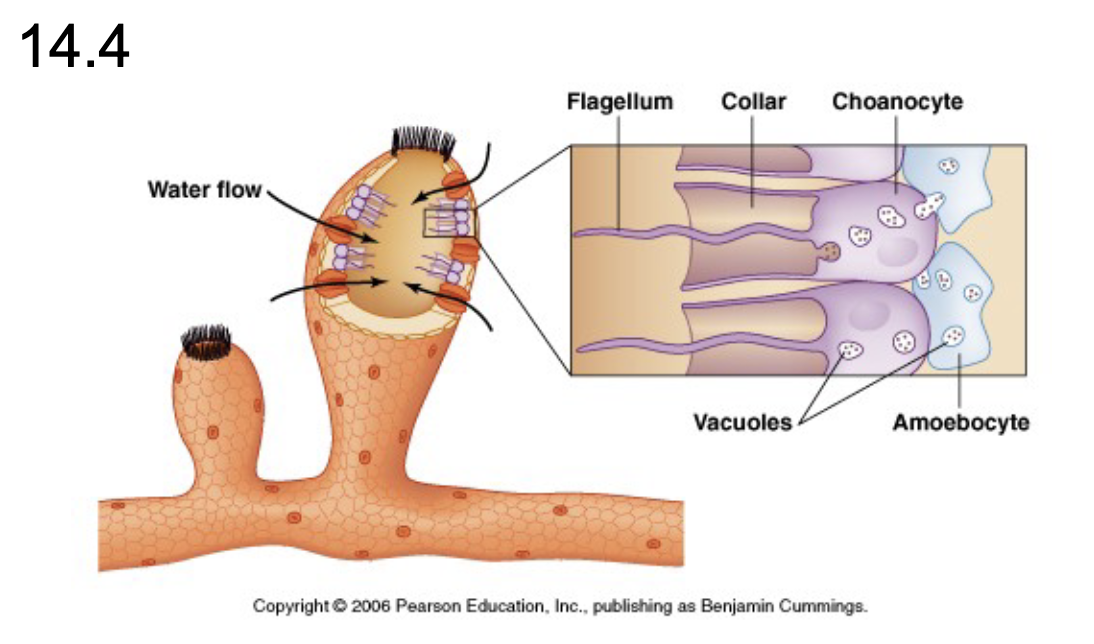
ingestion 2
sense food/prey
chemoreceptors
electromagnetic receptors
attract/capture
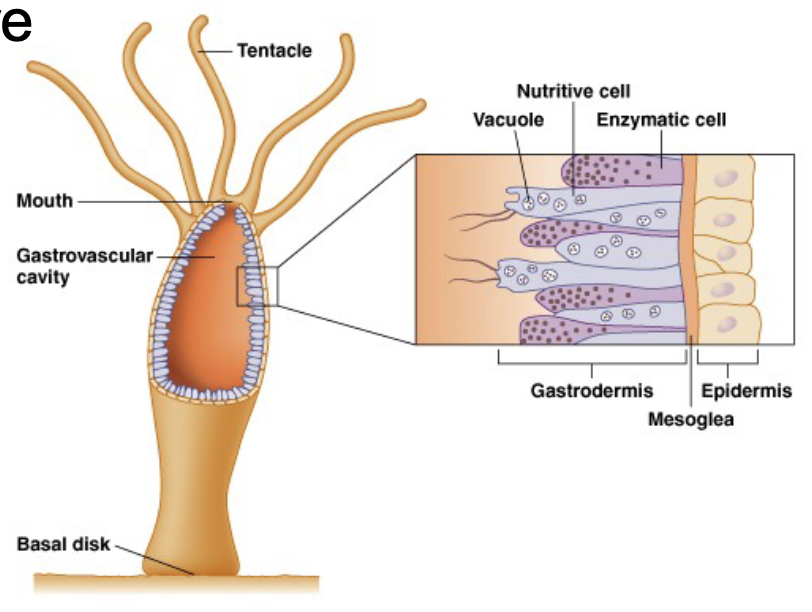
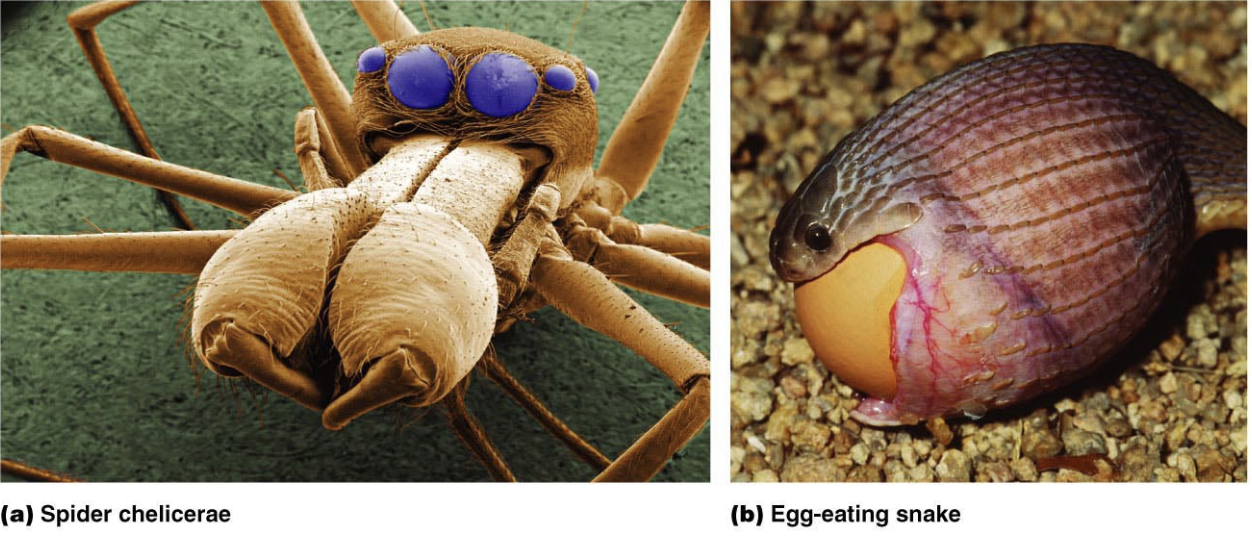
ingestion 3
feeding structures
structure/function relationships
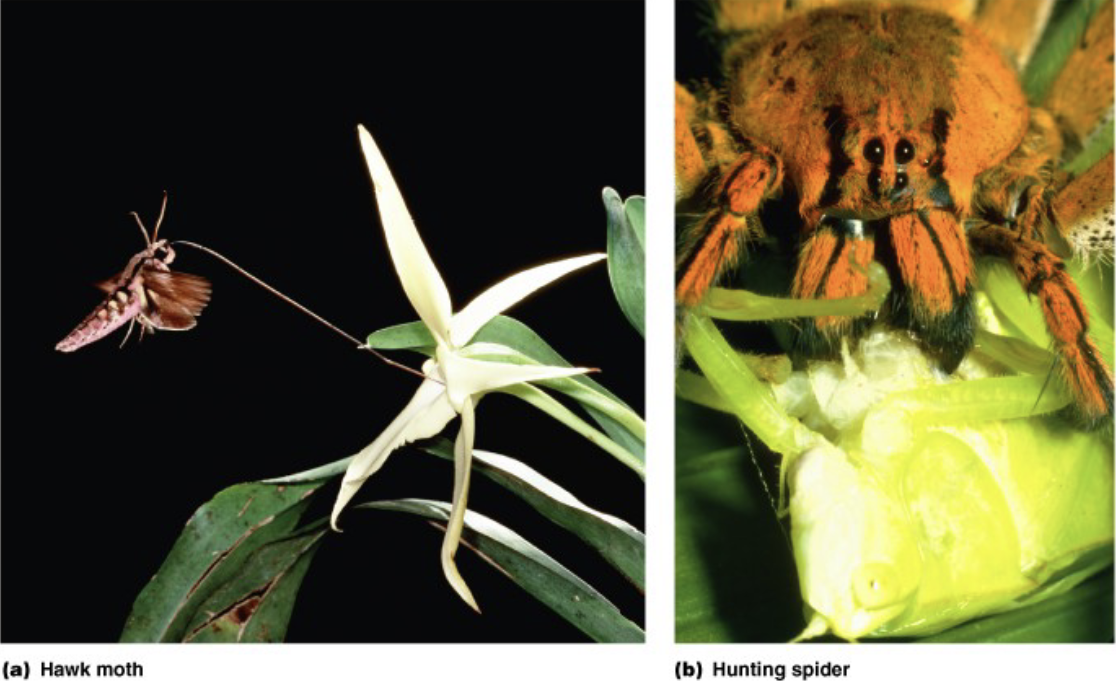
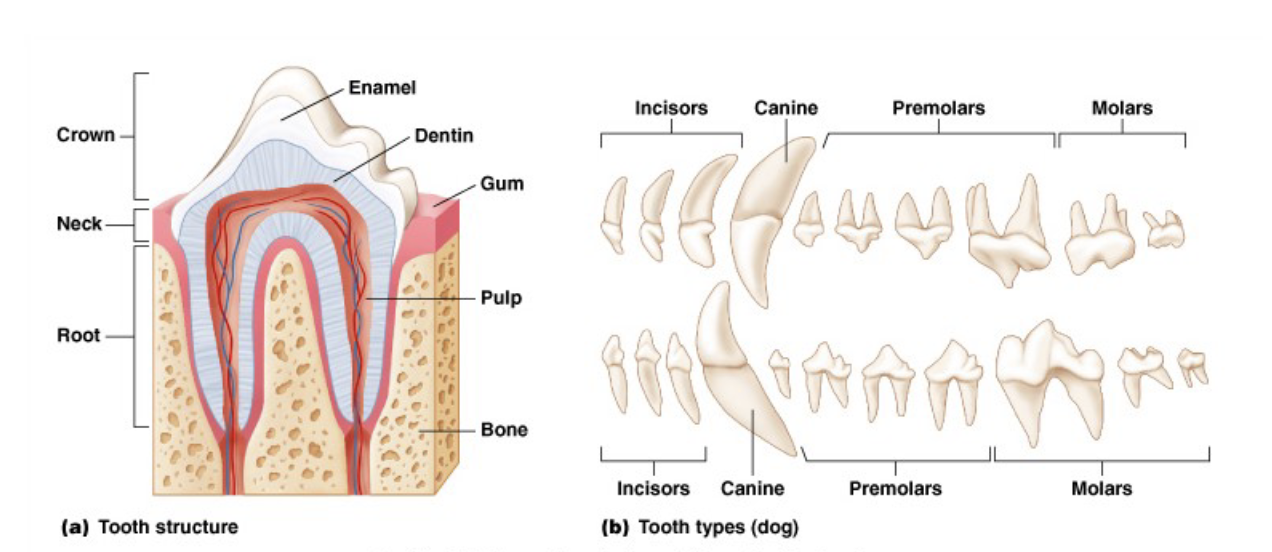
ingestion - teeth
canines for carnivores
molars for herbivores
food source and teeth shapes tend to match up (sharp for shredding/tearing, flat for grinding/mashing)
GI tract
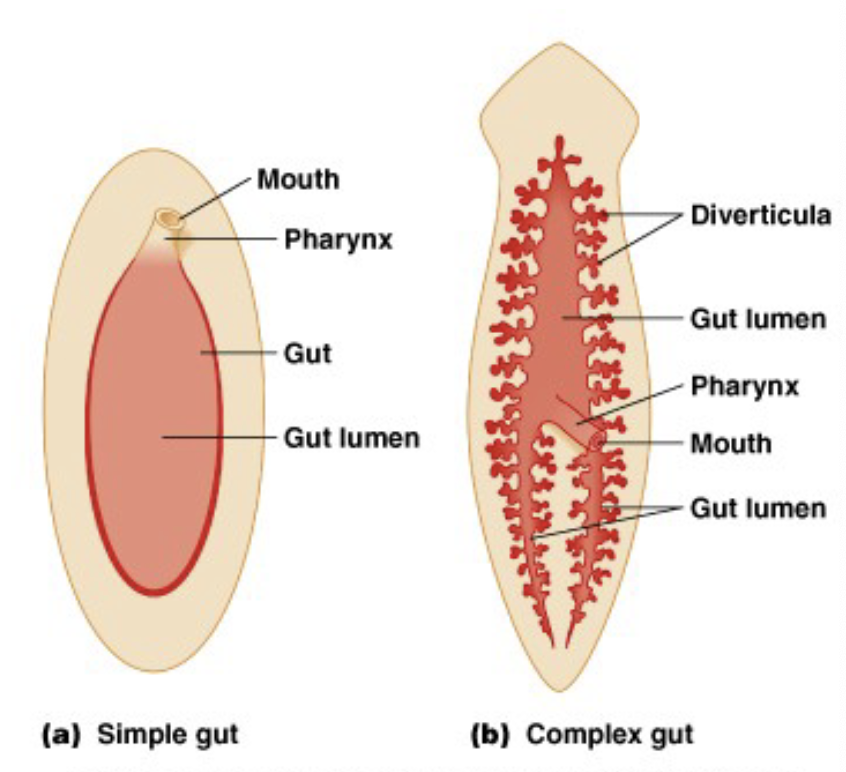
two-way gut
simple gut: less surface area, best simple particles and gas/nutrient exchange
complex gut: more surface area for exchange, better absorption
GI tract 2
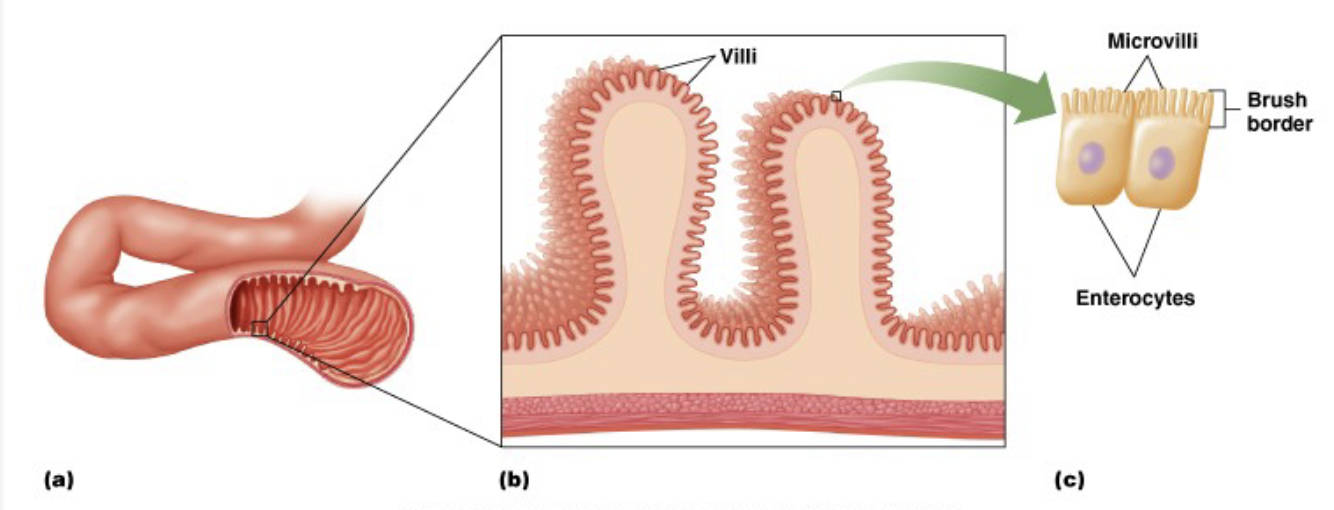
increased surface area
more places for transporters, channels, enzymes to digest
mucosal folds in the stomach/intestines
spiral valves
villi covered with epithelial cells sealed off by tight junctions
enterocytes, forces things to go through the cells instead of around them, covered in microvilli)
GI tract
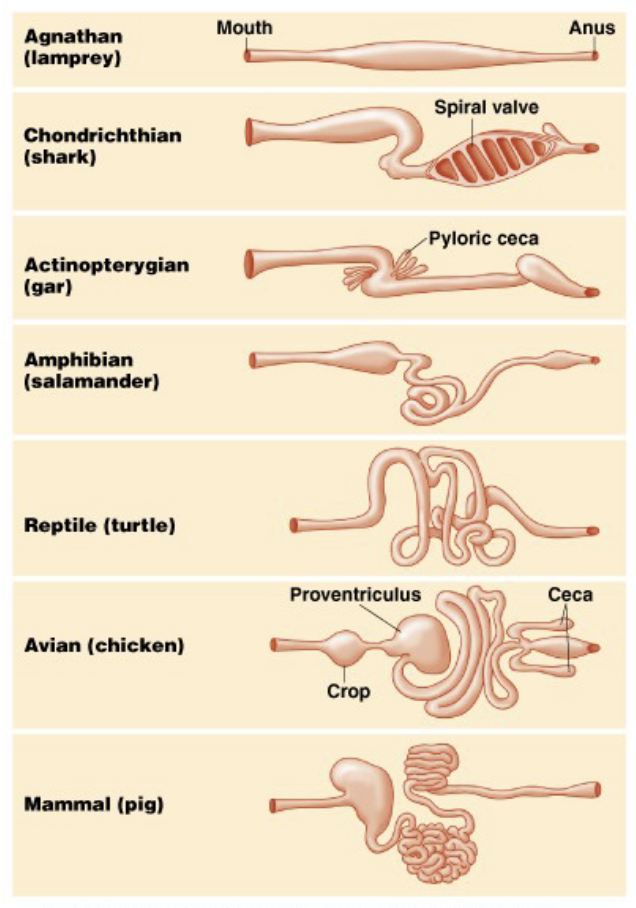
one-way gut
no mixing, allows for compartmentation
specialized compartments
can hold rocks, bacteria, pH ranges (like stomach being more acidic than the rest of the body)
length of tract is related to digestibility of food
longer intestinal tracts in mammals
chickens/birds have a crop that stores little rocks to help crush seeds, because they don’t have teeth
motility
digestion depends on motility and secretion (both regulated by bodies)
peristalsis
wave-like contraction that helps move food in one direction (mouth → anus. in cows: mouth → first stomach → mouth → GI tract)
for moving
segmentation
circular muscle contraction (circumference around the muscle), pushes stuff back and forth
for mixing (digestive enzymes and food) (helps push stuff along the walls into the center, and things in the center to the walls to increase absorption)
migrating motor complex
clears out GI tract, strong wave-like contractions. clears out non-digestible items
cleaning motility
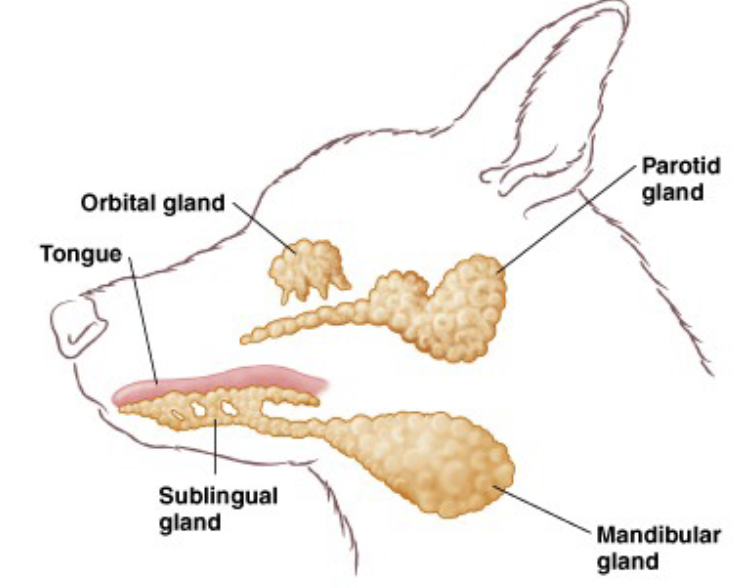
salivary glands
secrete enzymes → made of proteins, active in specific pH ranges
saliva enzymes only active in the neutral pH, not in the stomach. the more you chew your food, the more time enzymes will have to break things down
soften food → due to water
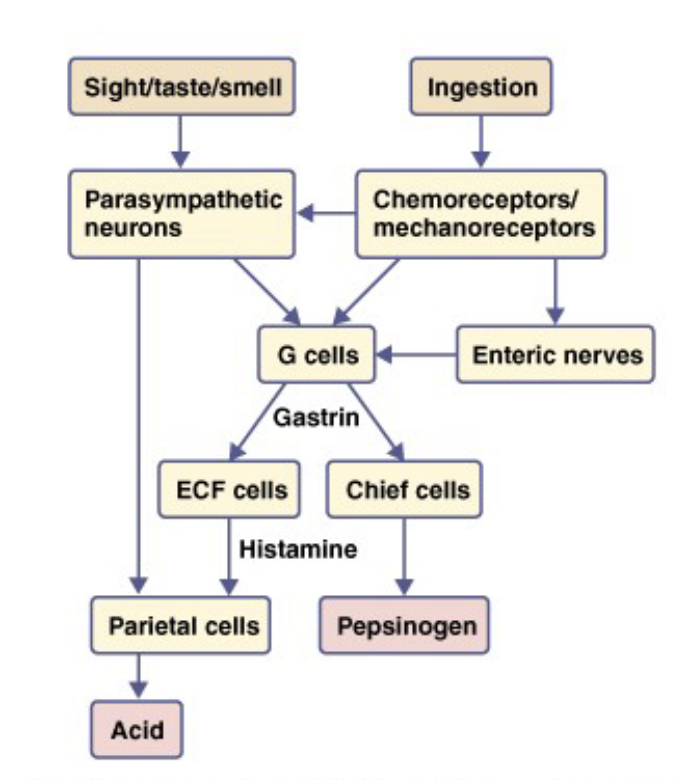
regulation of gastric secretions
enzymes
help to chemically digest food
hormones → communication, send signals between GI tract and brain
gastrin (histamine) - ↑ acid production in stomach
produced by stomach
VIP (vasoactive intestinal peptide)
produced by intestine
somatostatin - ↓ acid production
produced by stomach
GIP (gastric inhibitory peptide) - ↓ acid and motility in stomach, ↑ insulin production
produced by intestine
secretin - ↓ acid production
produced by intestine
other → range of functions
acid (immune and digestion), bicarbonate (neutralize acid released from another area)
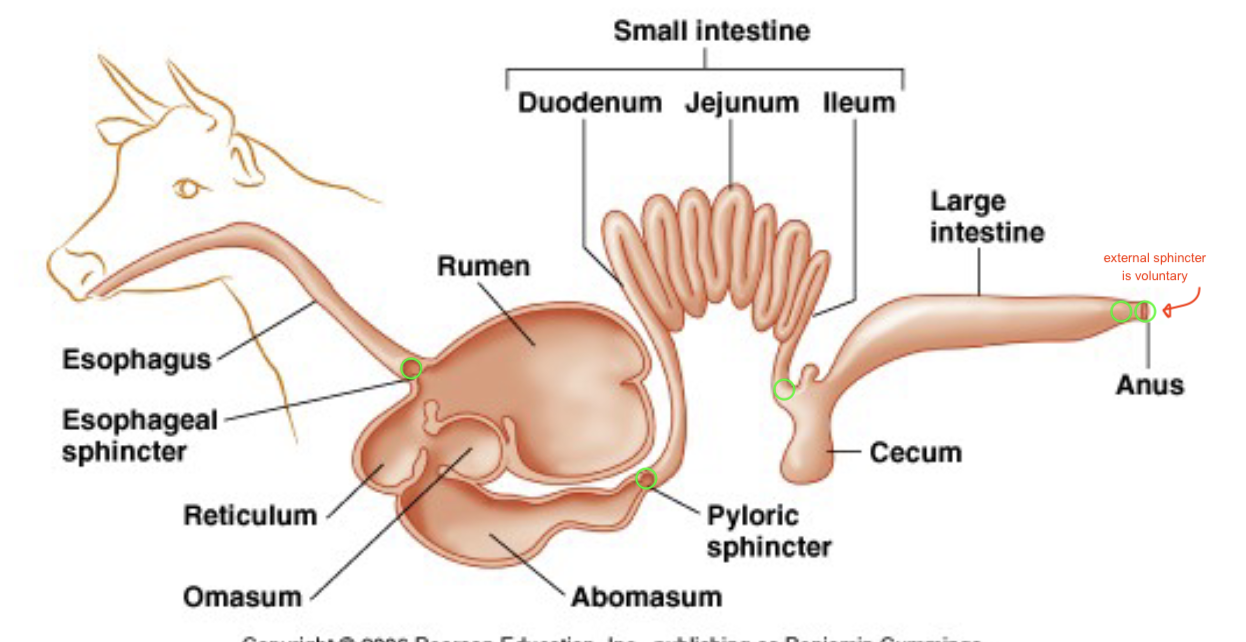
stomachs
crop (birds, collect small stones to grind seed)
mono-gastric stomach → one compartment
rumen (first stomach) used to ferment/break down things, food sent back up to the mouth, then to reticulum (second stomach)
digastric stomach
sphincters → bands of smooth muscle separating one area from another along a “tube”
stomach
mucosa layer
acid
denatures proteins and immune protection
affects food
enzymes
pepsin(ogen) [proteins], gastric lipase [lipids]
affects food
mucous/bicarbonate
protect the stomach wall, bicarbonate neutralizes H ions along the walls so acid is not constantly touching the stomach walls
glycoproteins inside sticky mucous to absorb water, bicarbonate mixed in, stays along the stomach walls lining
![<p>mucosa layer</p><ul><li><p>acid </p><ul><li><p>denatures proteins and immune protection</p></li><li><p>affects food</p></li></ul></li><li><p>enzymes</p><ul><li><p>pepsin(ogen) [proteins], gastric lipase [lipids]</p></li><li><p>affects food</p></li></ul></li><li><p>mucous/bicarbonate</p><ul><li><p>protect the stomach wall, bicarbonate neutralizes H ions along the walls so acid is not constantly touching the stomach walls</p></li><li><p>glycoproteins inside sticky mucous to absorb water, bicarbonate mixed in, stays along the stomach walls lining</p></li></ul></li></ul><p></p>](https://assets.knowt.com/user-attachments/697c6fa4-8b94-4c25-acb7-6cbf318161d4.png)
regulation of intestinal secretions
CCK (cholecystokinen)
release enzyme for fat and protein digestion, bile emulsifies fat (lack of gallbladder makes it harder to digest fat, has to rely on bile from liver)
stimulated by fats and proteins
motilin
stimulated by fasting
↑ motility → MMC
VIP (vasoactive inhibitory peptide) - ↓ acid production and motility
produced by intestine, also in stomach
GIP (gastric inhibitory peptide OR glucose dependent insulinotropic peptide) - ↓ acid and motility in stomach, ↑ insulin production
produced by intestine, also in stomach
secretin - ↓ acid production
produced by intestine, also in stomach
stim to be released by acid entering intestine
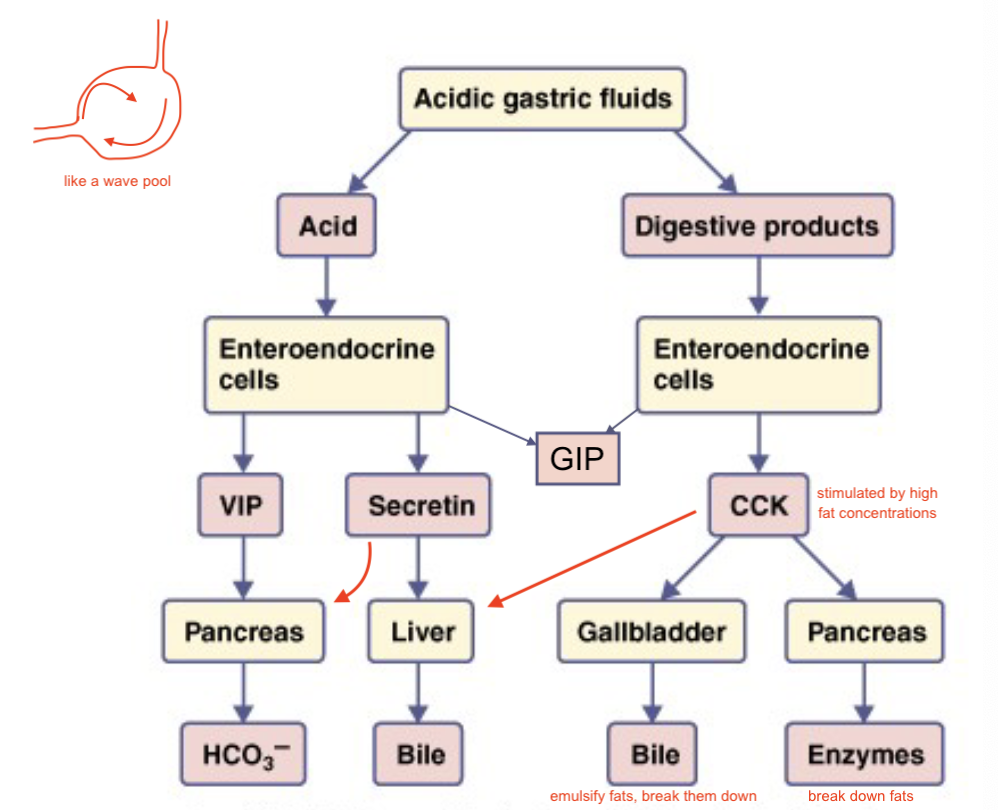
intestines - small
small intestine is where the majority of motility, secretion, digestion, and absorption happen
enzymes are made/secreted in inactive/proenzyme form so they don’t being breaking down the cell they’re in
activated by acid (in stomach) OR enzymes in the intestine (enterokinase and enteropeptidase)
these enzymes activate the digestive enzymes
“pro—” or “—ogen” tells you it’s in inactive form
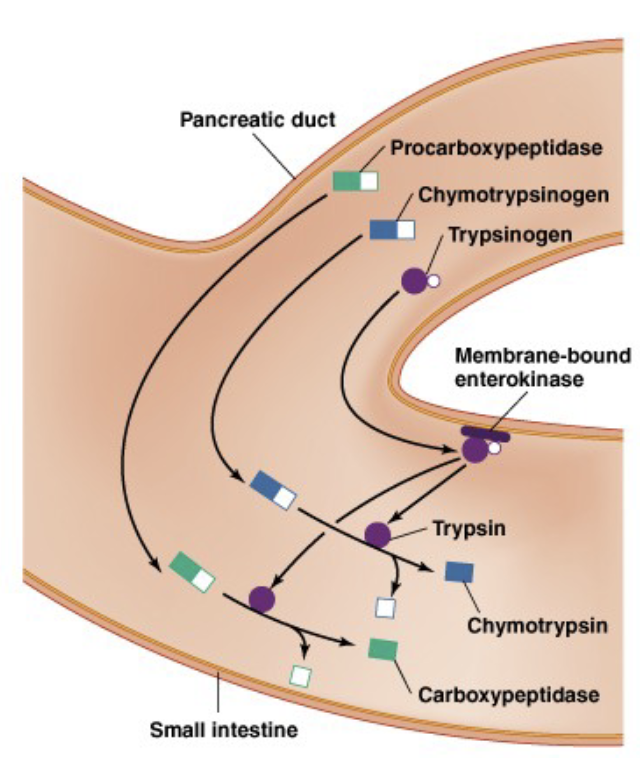
intestines - absorption
first real absorption
because most of chemical digestion, ↑SA and time
secretions from liver, pancreas, and gallbladder
as well as intestinal wall to a lesser extent
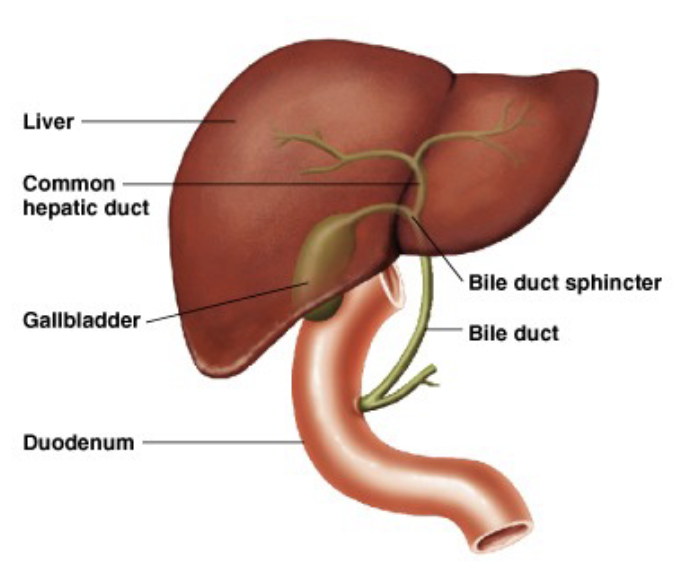
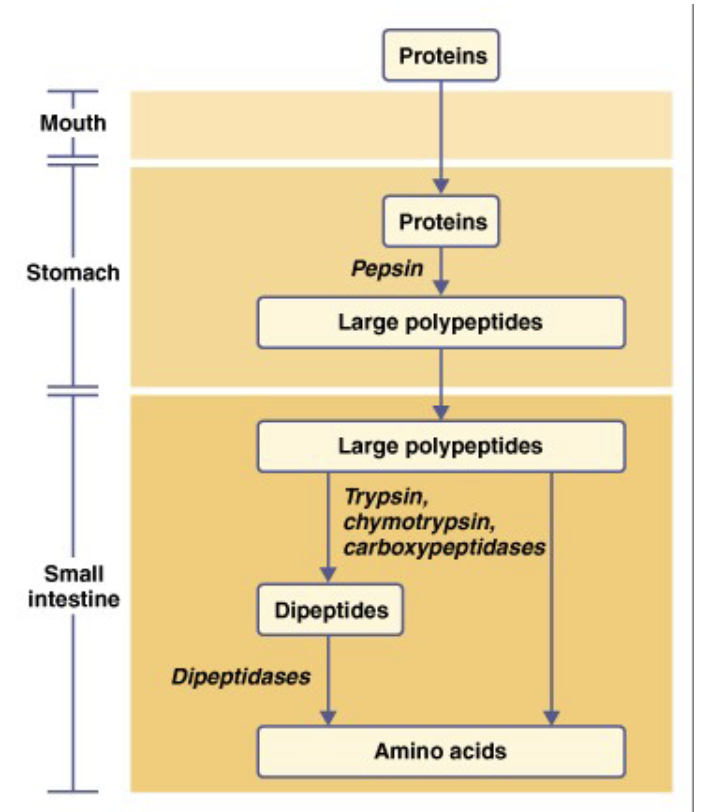
enzymes for digestion
lipases
lipids/fats
proteases
proteins
peptidases
peptides
amylases
carbs
disaccharidases
sugars/carbs
nucleases
DNA/RNA
less about energy, more for defense
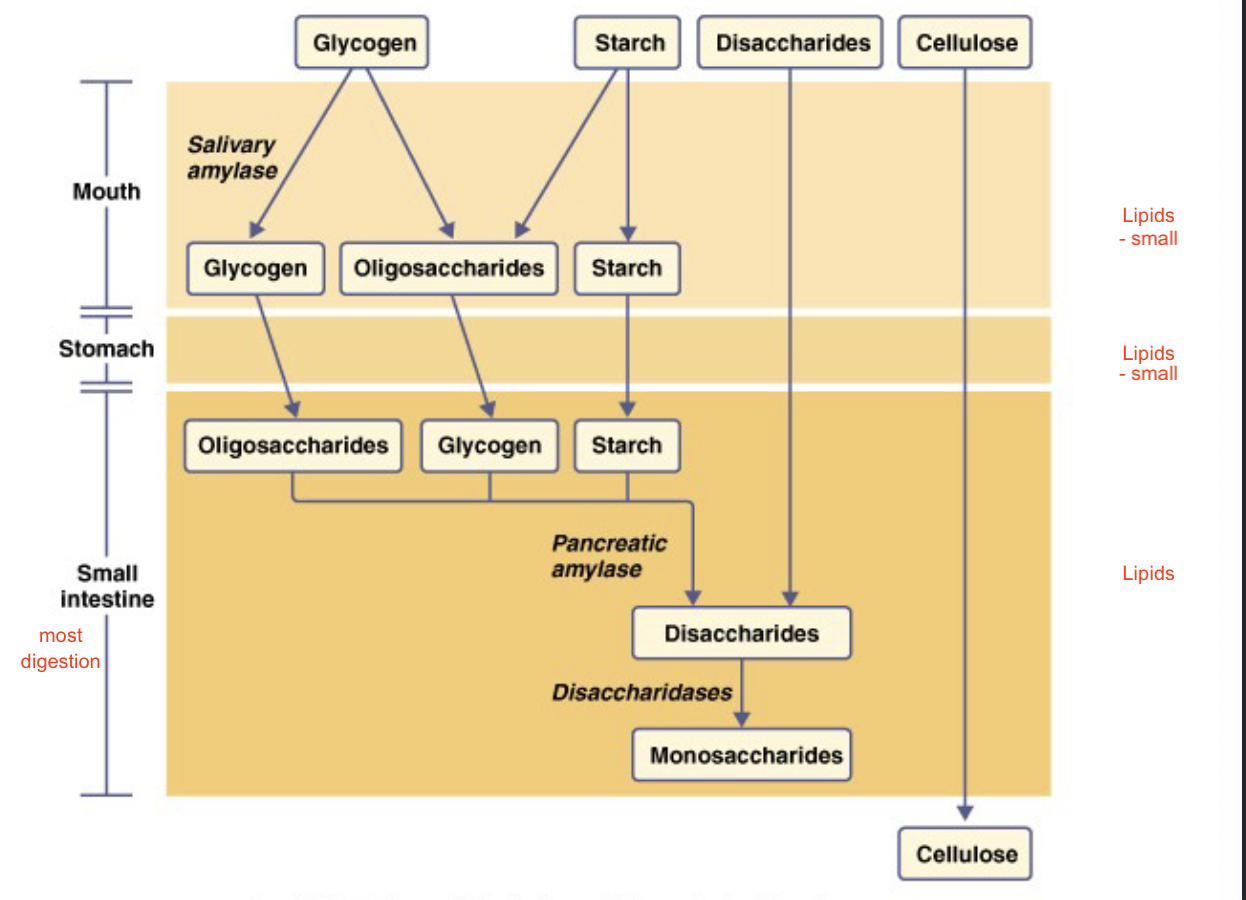
symbiotic digestion
enterosymbionts
symbiotic organism in GI tract
bacteria helping to digest fiber/cellulose
exosymbionts
live outside an organism’s body
endosymbionts
live inside organism’s body
absoprtion
diffusion
small, lipophilic things and water (osmosis)
mediated transport
most ions and nutrients (selective)
specificity, affinity, saturation, competiton
transcytosis
larger peptides and some fats
tight junctions between epithelial cells (sealed off)
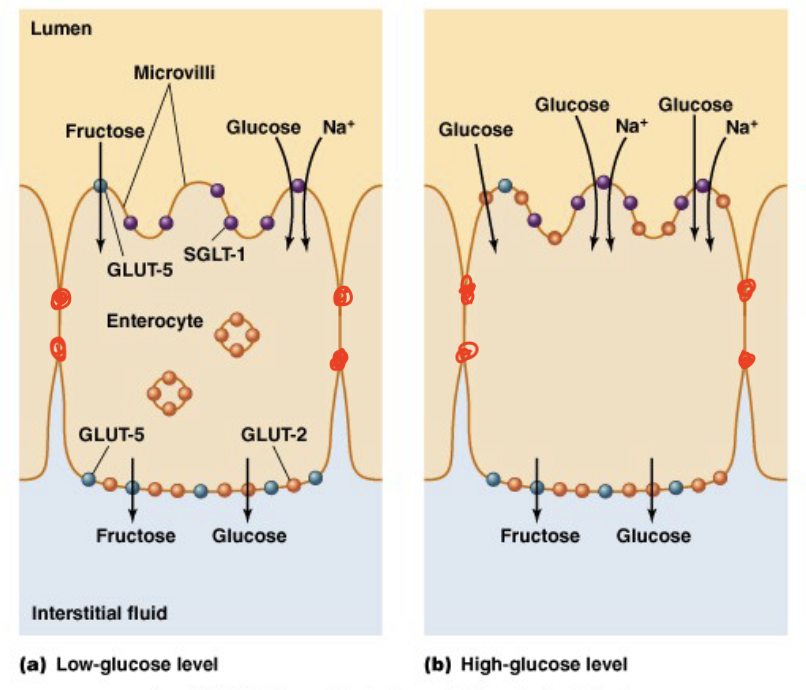
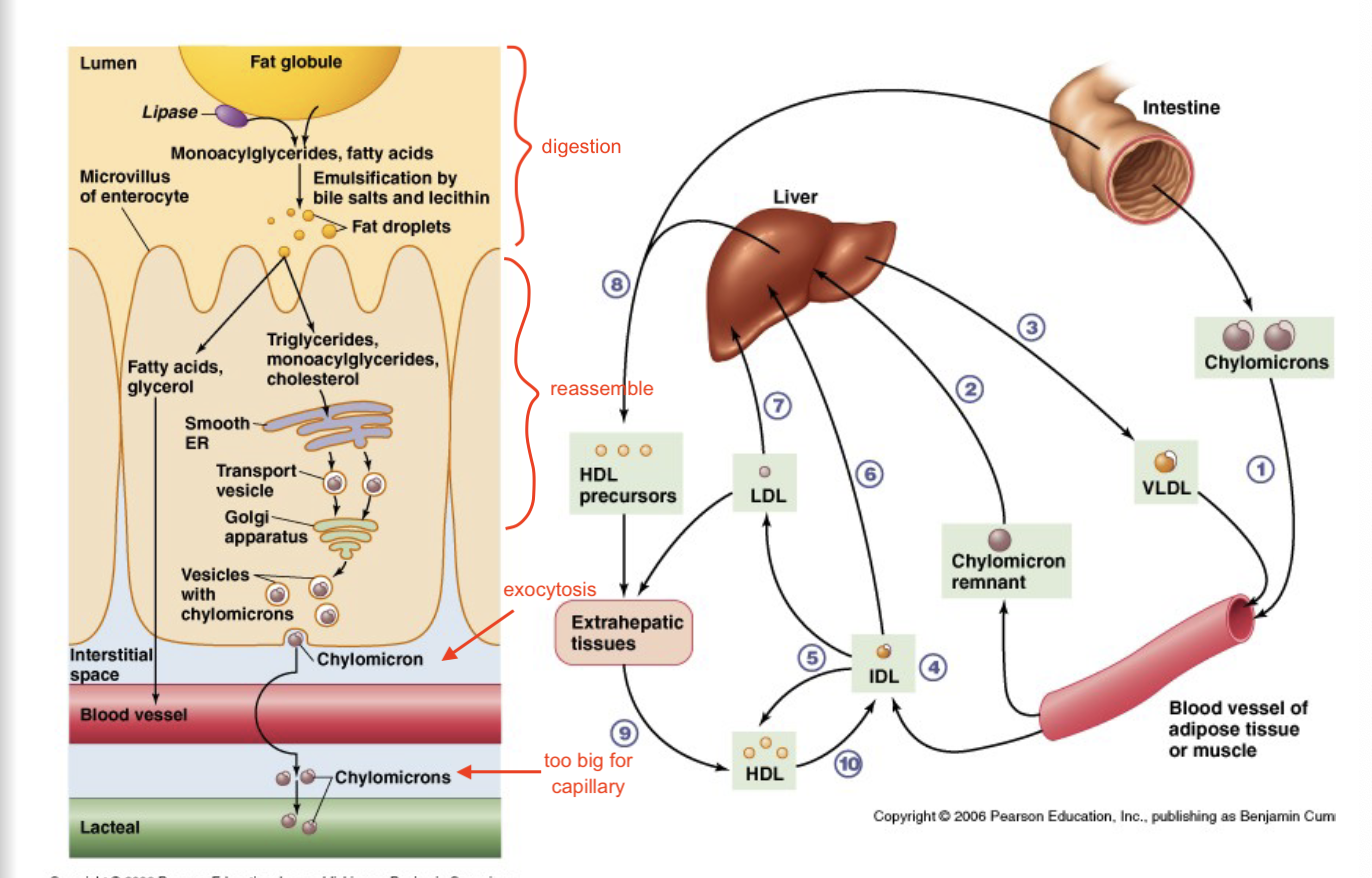
absorption of lipids
bile to emulsify fats, easier to digest after that
multiple trips to the liver to metabolize diff products to diff densities
lymph dumps fats into larger veins
high density fats are better to help to scrub/clear out vessels (prevents plaques)
low/intermediate density fats can get into cells easier
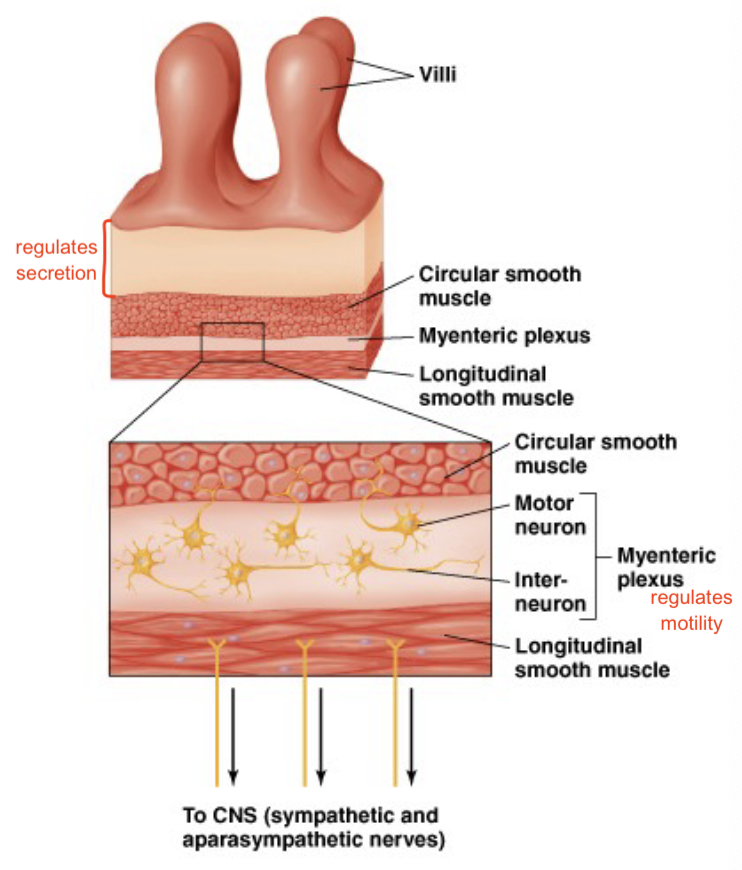
control of digestive processes
nervous system
nervous network in gut and CNS
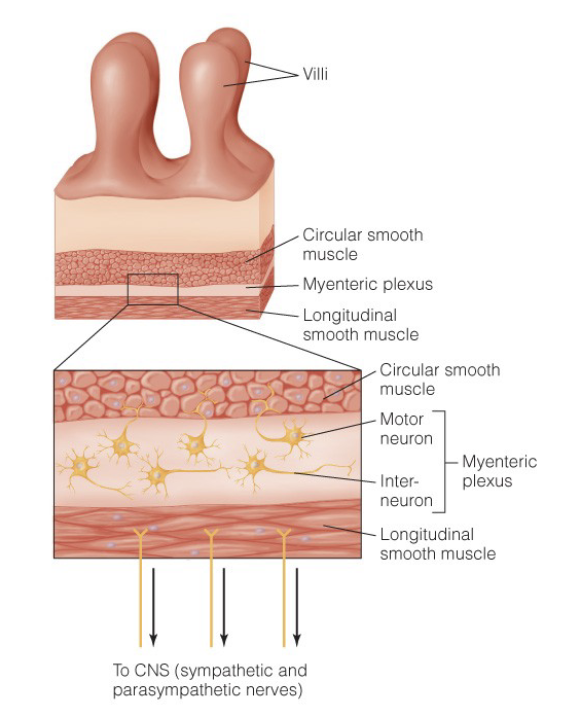
myenteric plexus regulates motility
submucosal plexus regulates secretion (gets input from mucosa)
endocrine system
hormones
enteric nervous system
regulation of feeding
leptin
produced by adipose tissue (fat)
more tissue when you have eaten more
inhibits feeding center
ghrelin
produced by the stomach
stimulates feeding center when empty
peptide YY
produced by the colon
inhibits feeding center when full
insulin
produced by the pancreas
in response to high glucose
[keep big picture focus, how can information from around body regulate food input]
![<ul><li><p>leptin</p><ul><li><p>produced by adipose tissue (fat)</p></li><li><p>more tissue when you have eaten more</p></li><li><p>inhibits feeding center</p></li></ul></li><li><p>ghrelin</p><ul><li><p>produced by the stomach</p></li><li><p>stimulates feeding center when empty</p></li></ul></li><li><p>peptide YY</p><ul><li><p>produced by the colon</p></li><li><p>inhibits feeding center when full</p></li></ul></li><li><p>insulin</p><ul><li><p>produced by the pancreas</p></li><li><p>in response to high glucose</p></li></ul></li></ul><p>[keep big picture focus, how can information from around body regulate food input]</p>](https://assets.knowt.com/user-attachments/49e927d3-7ac0-4bbe-a830-9aa795e96758.png)
changes between meals
sources of energy
carbs → shorter term, fast access
lipids → longer term, slower access, more energy needed
energy expenditure
how rapidly do you need the energy
use of energy
what is energy being used for
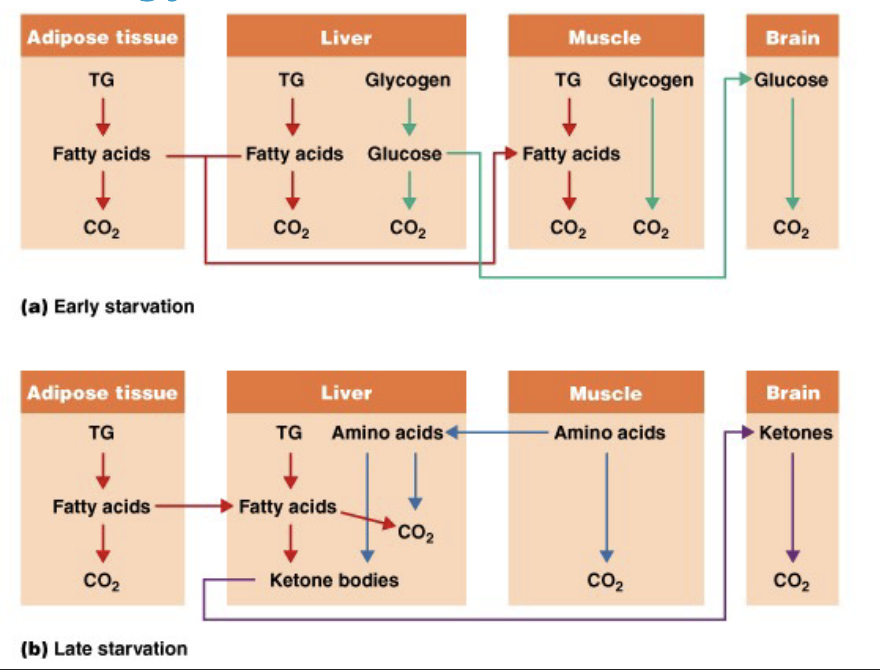
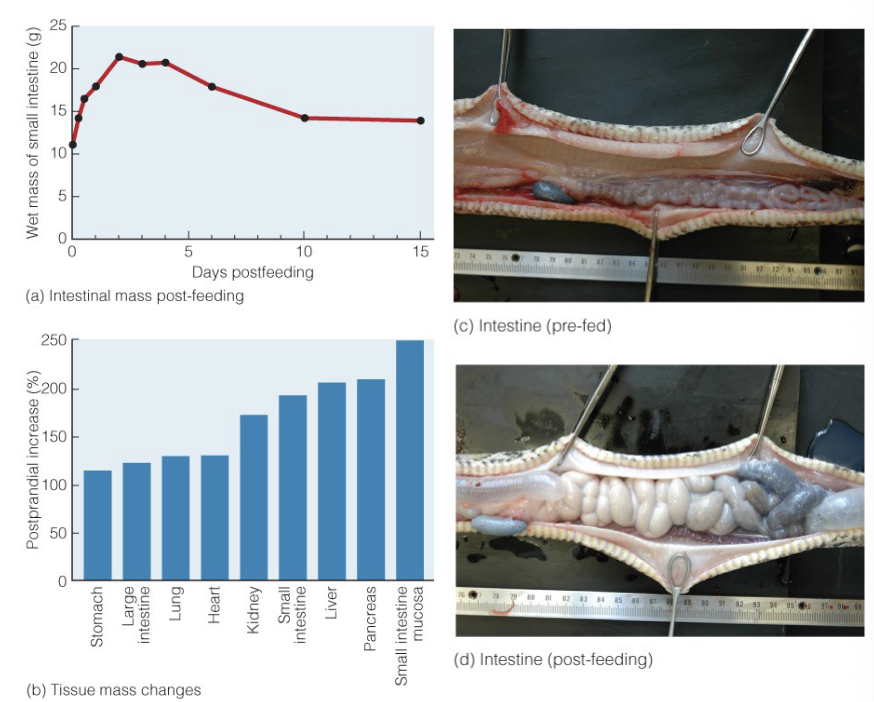
changes between meals - snakes
snakes do not eat very often
before feeding, they break down intestinal and muscle walls to use as energy
after feeding, they use energy to rebuild the walls for digestion
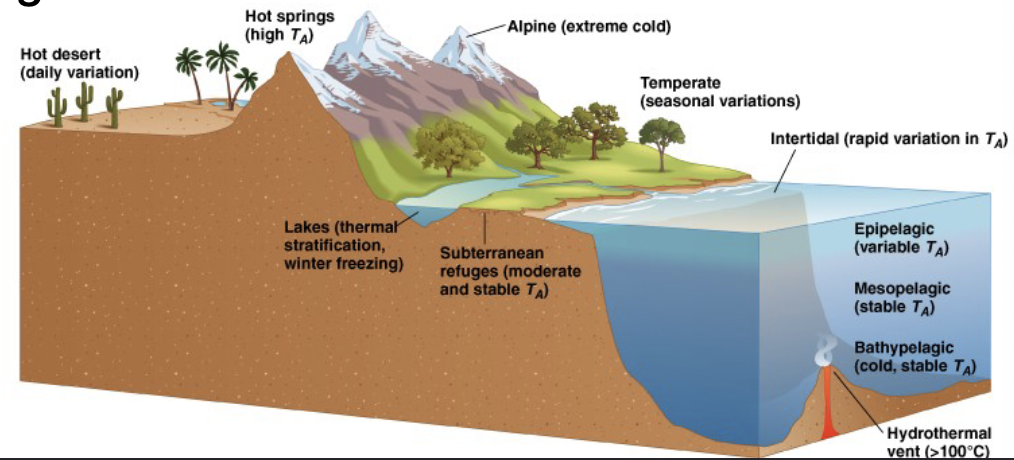
thermal physiology
TA = ambient temp
TB = body temp
both are for heat exchange between organism and environment
factors
behavioral → how body is arranged, where the organism is (open vs shelter)
biochemical → what is being consumed, chemical rxns of breakdown (proteins vs fats)
physiological → blood flow, insulation, etc.
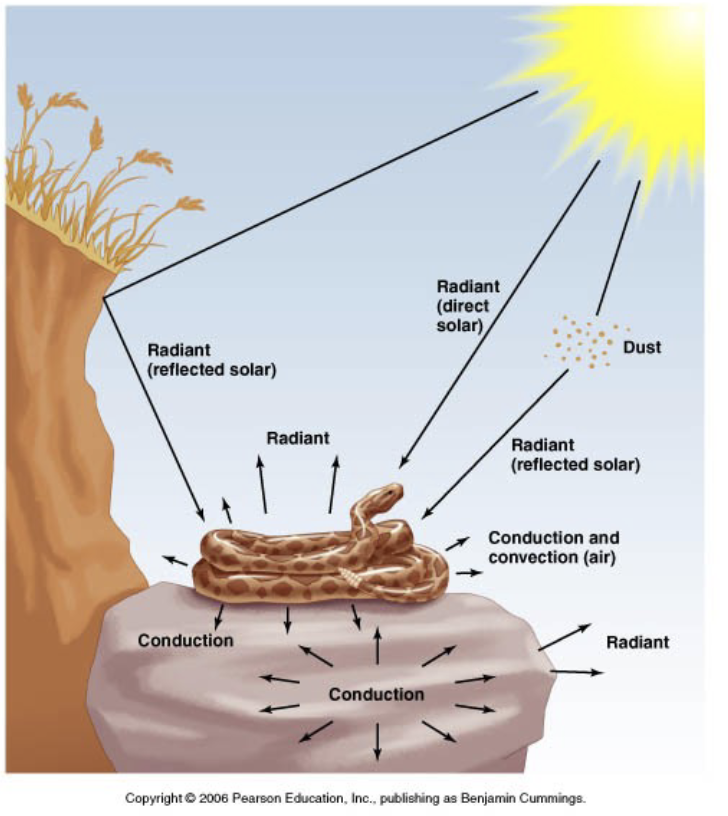
ΔH = ΔHmetabolism + ΔHconduction + ΔHconvection + ΔHradiation + ΔHevaporation
thermal energy types
conduction
touching, direct contact
convection
movement of air, water
radiation
movements of energy source itself (light rays)
evaporation
loss of heat by putting energy into water, liquid to gaseous form
SA: Vol
higher SA:Vol ratio, more room to exchange heat with environment
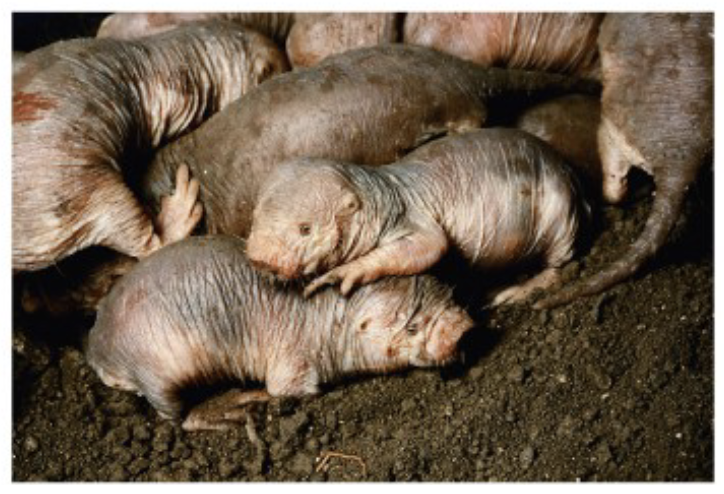
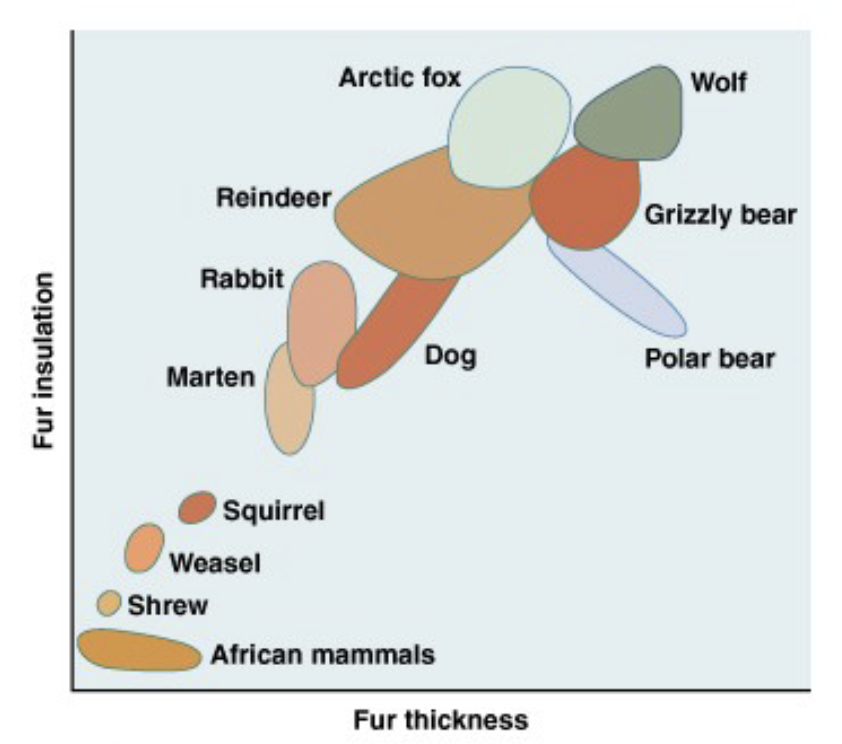
insulation
regulating heat loss
thickness
thicker fur → more insulation
thicker layer of subcutaneous fat → more insulation
density
polarity
fats/lipids are not polar (bad heat conductors, helps keep heat inside)
thermal strategy terms
ectotherms
rely on outside temps
endotherms
regulate their own temps
homeothermic
maintain a similar temp on a regular basis
poikilothermic
wider range of internal temps
[endotherms are typically homeothermic, but some endotherms (ice fish, tropical fish) are ectothermic and homeothermic because their environments do not change much]
![<ul><li><p>ectotherms</p><ul><li><p>rely on outside temps</p></li></ul></li><li><p>endotherms</p><ul><li><p>regulate their own temps</p></li></ul></li><li><p>homeothermic</p><ul><li><p>maintain a similar temp on a regular basis</p></li></ul></li><li><p>poikilothermic</p><ul><li><p>wider range of internal temps</p></li></ul></li></ul><p>[endotherms are typically homeothermic, but some endotherms (ice fish, tropical fish) are ectothermic and homeothermic because their environments do not change much]</p>](https://assets.knowt.com/user-attachments/301c5c7d-bc56-40a5-80f2-82e298ea6c6f.png)
thermal strategy chart
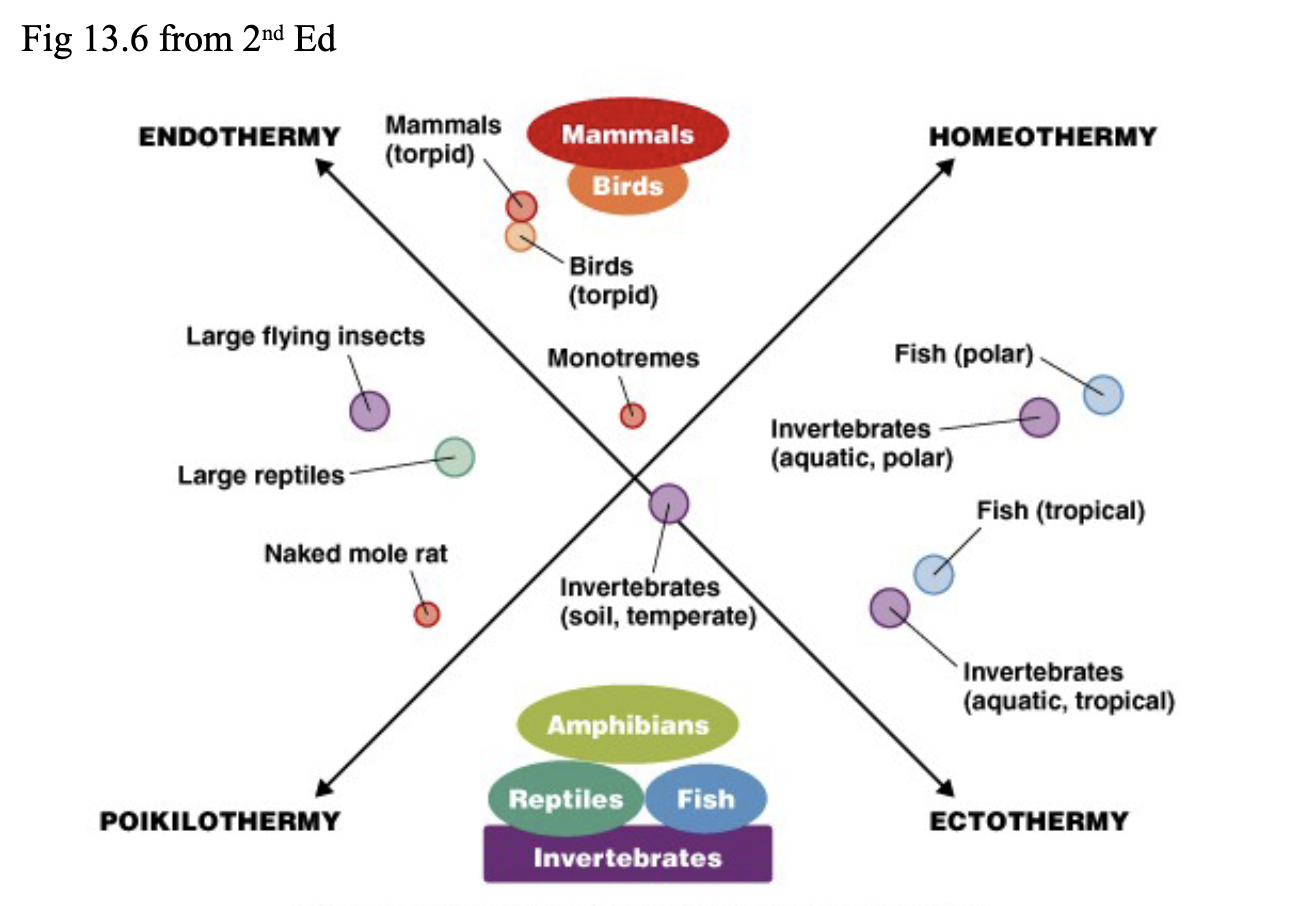
thermal strategy - heterotherms
↓ TB to save energy
temporal heterotherms - time: overnight
regional heterotherms (area of body)
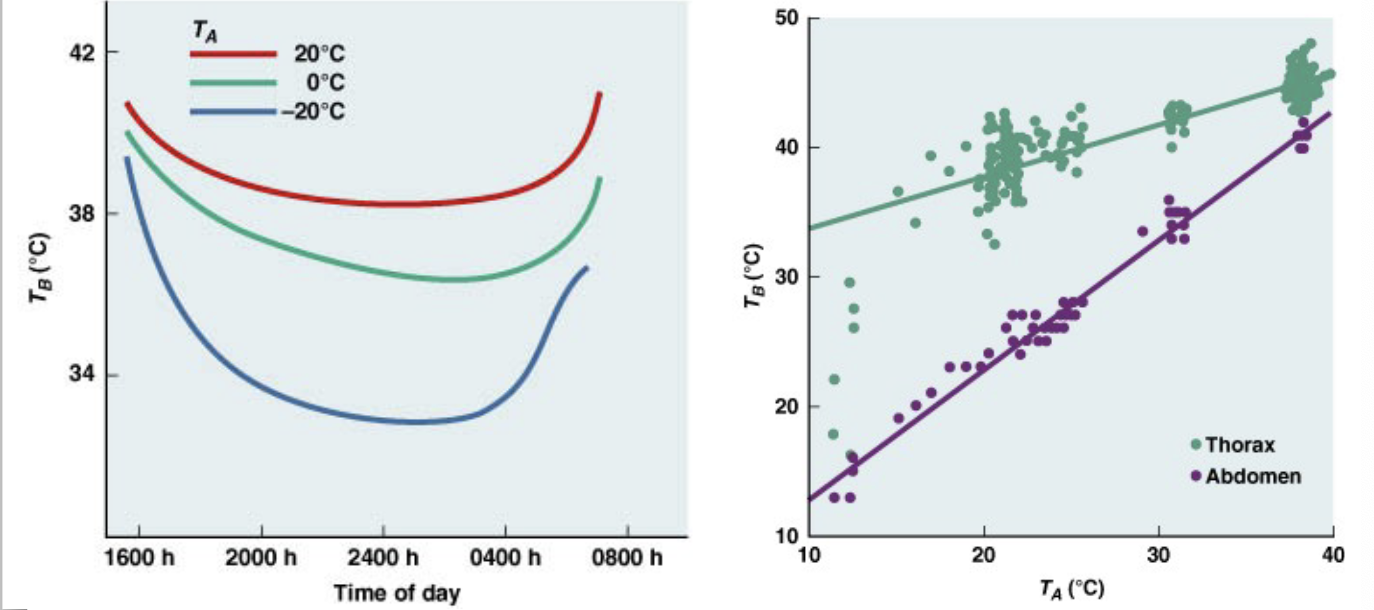
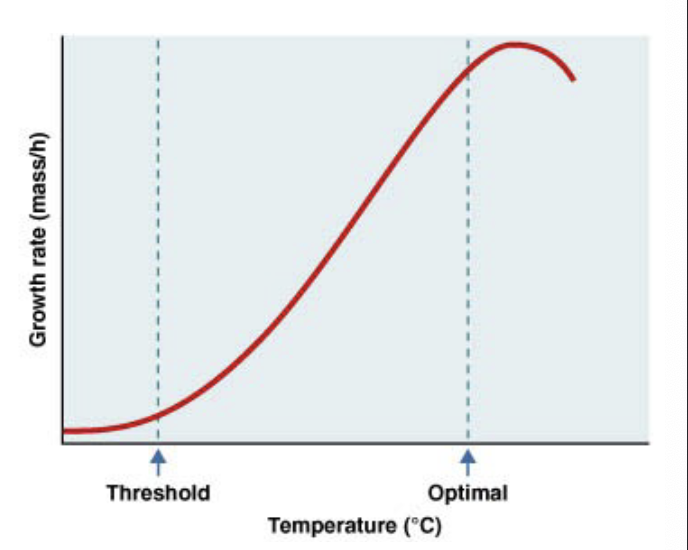
metabolic rates and temps
thermoneutral zones
eurythermic - wider range
stenothermic - narrow range
low 70s for humans
organisms cannot cool themselves down because every metabolic process loses energy as heat, body if fighting against itself when trying to decrease heat
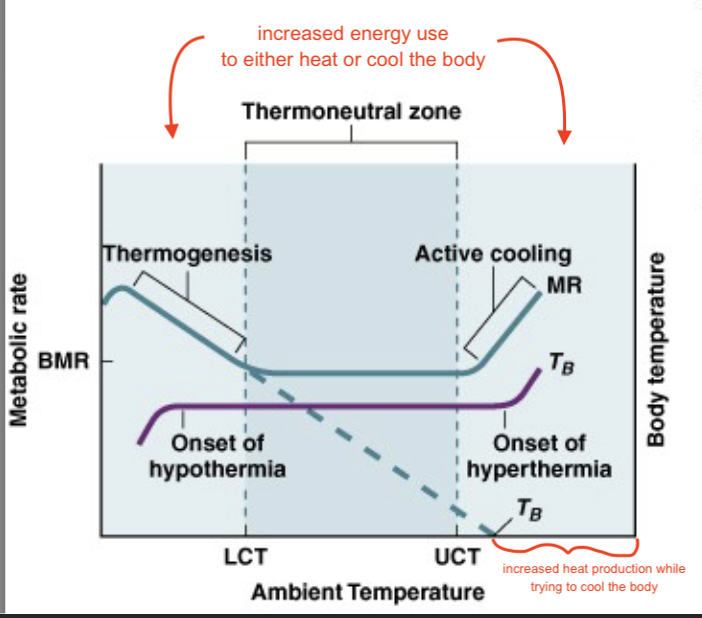
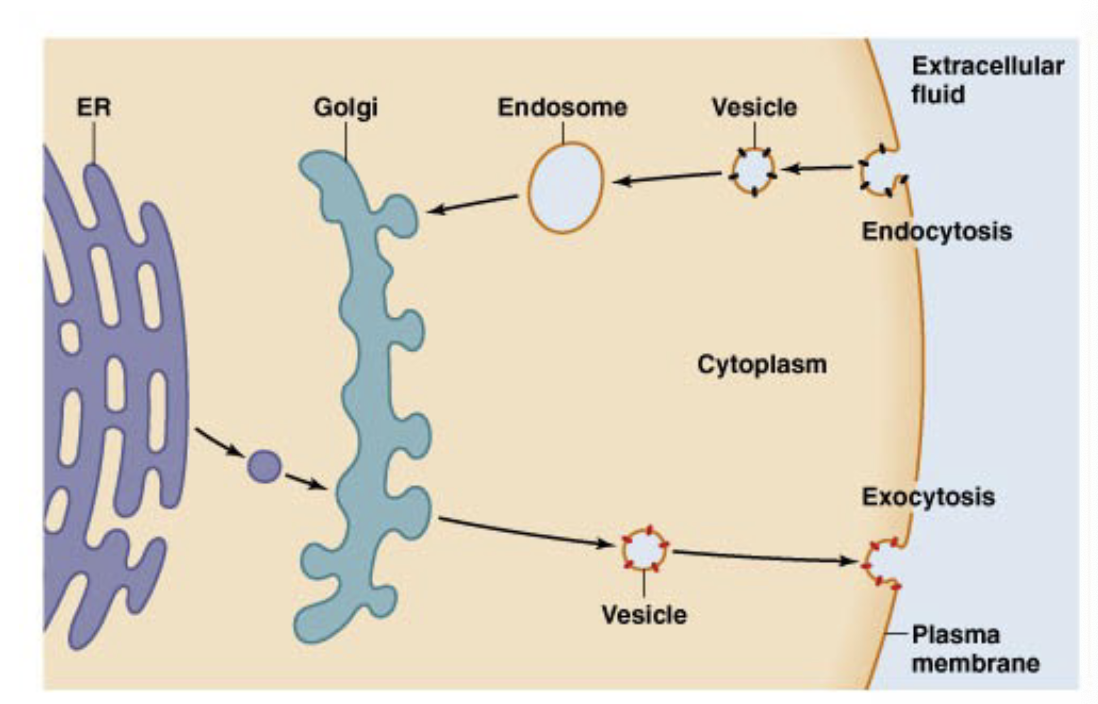
membranes and temps
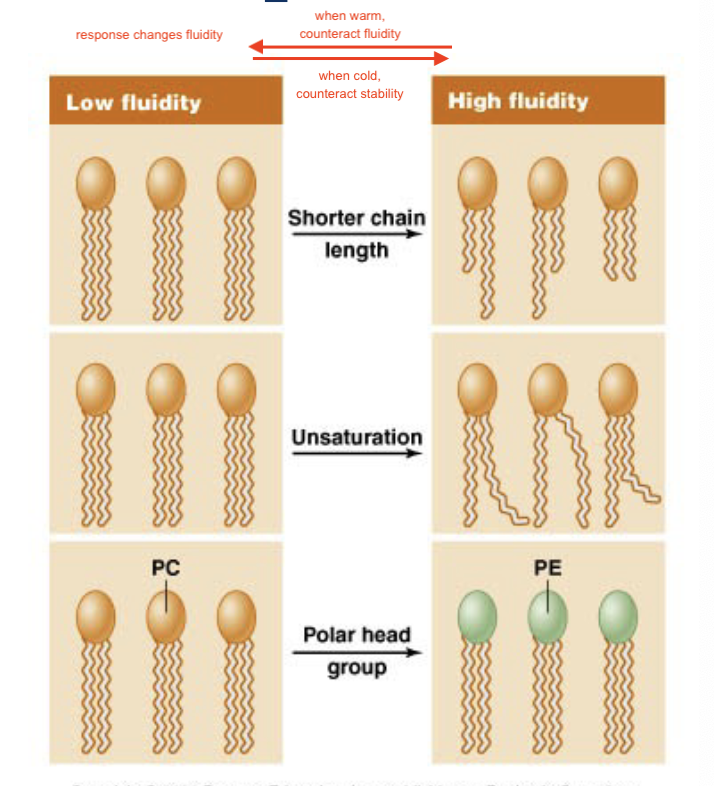
colder = more stable, warmer = more fluid
homeoviscous adaptation
length of FA chains
saturation of FA
phospholipids
cholesterol levels (create space between hydrocarbon tails, increase fluidity)
enzymes and temp
folding patterns
functional proteins
stability
ionization
heat shock proteins
temp range
[temp, salt/ion conc, pH all affect protein folding]
![<ul><li><p>folding patterns</p><ul><li><p>functional proteins</p></li></ul></li><li><p>stability</p></li><li><p>ionization</p></li><li><p>heat shock proteins</p></li><li><p>temp range</p></li></ul><p>[temp, salt/ion conc, pH all affect protein folding]</p>](https://assets.knowt.com/user-attachments/b6baf889-37a7-468e-a687-4aa6b128a170.png)
freezing temperatures
ice formation
osmolarity
pierce membranes, expands inside cells
water freezes first, sugars and other things freeze after
nucleators
start formation of ice crystals
anti-freeze
prevents formation of ice crystals
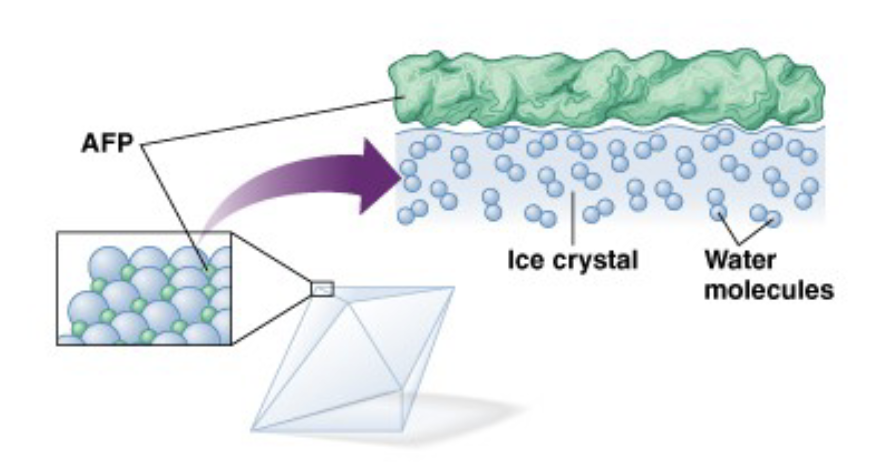
thermogenesis
TB homeostasis or pyrogens/fever
increase in the set point, heat needs to be generated to reach it
temp change can be whole body or local
shivering
futile muscle contractions
futile cycles (no real purpose, but heat is generated)
enzymatic rxn - final product not made
antagonistic muscles
altering functions
leaky membranes - constantly using energy to pump things up a gradient because they fall back through the membrane
non-shivering thermogenesis
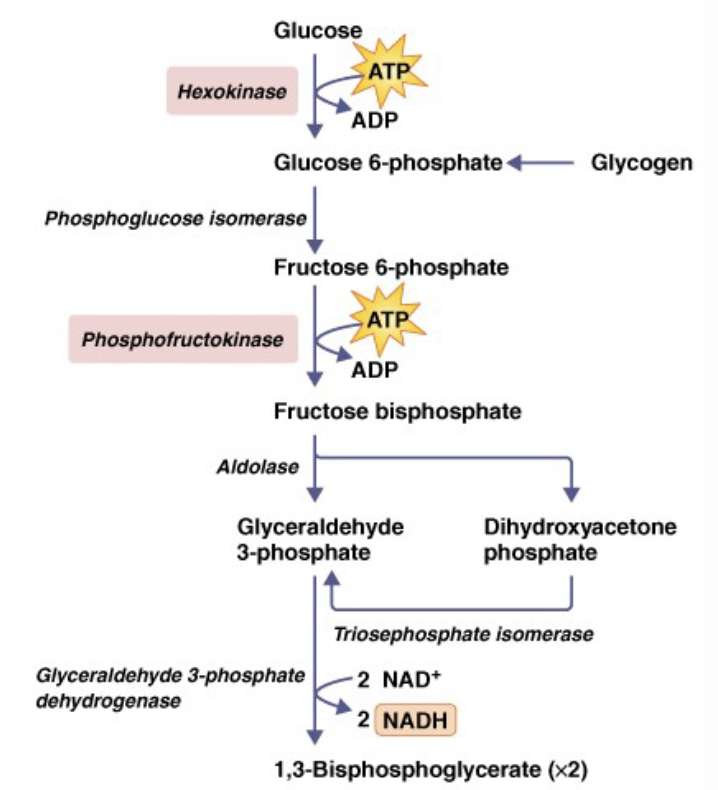
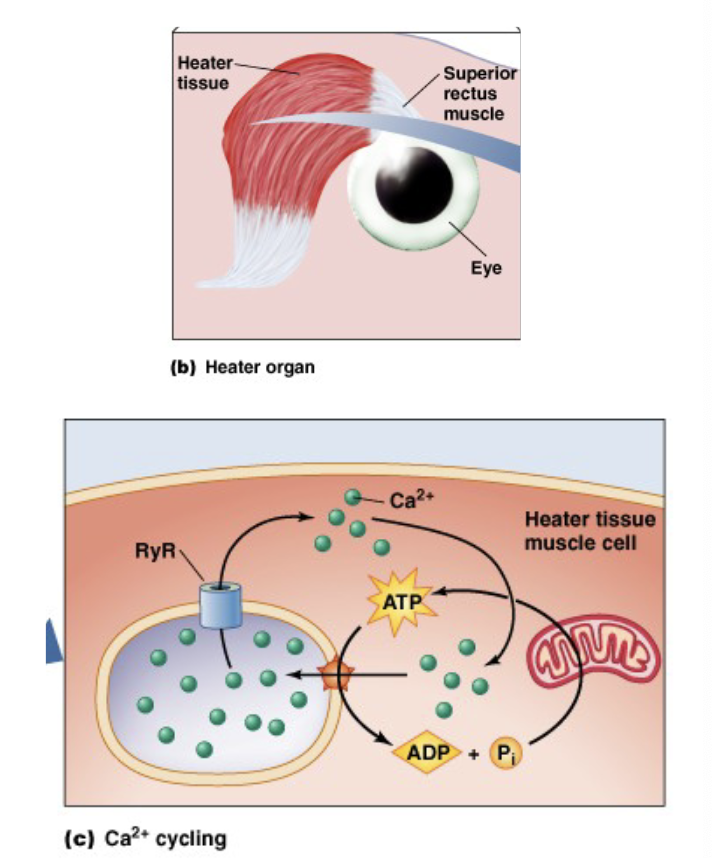
adaptations of muscle heater and electric organs
trans-differentiation
billfish heater organ
uncoupled Ca2+ release and contraction
Ca diffuses down the gradient and is pumped back up → heat is released
electric organ
lose sarcomeres, increase in size
arranged in stacks
thermogenesis - adipose tissue
mitochondria has a dual membrane, uses oxidative phosphorylation to produce ATP
if membranes are leaky, H+ can fall back into the cells and will continue to cycle in and out because of active transport
brown adipose tissue: leaky membranes in mitochondria so lots of “pumping” but no ATP formed
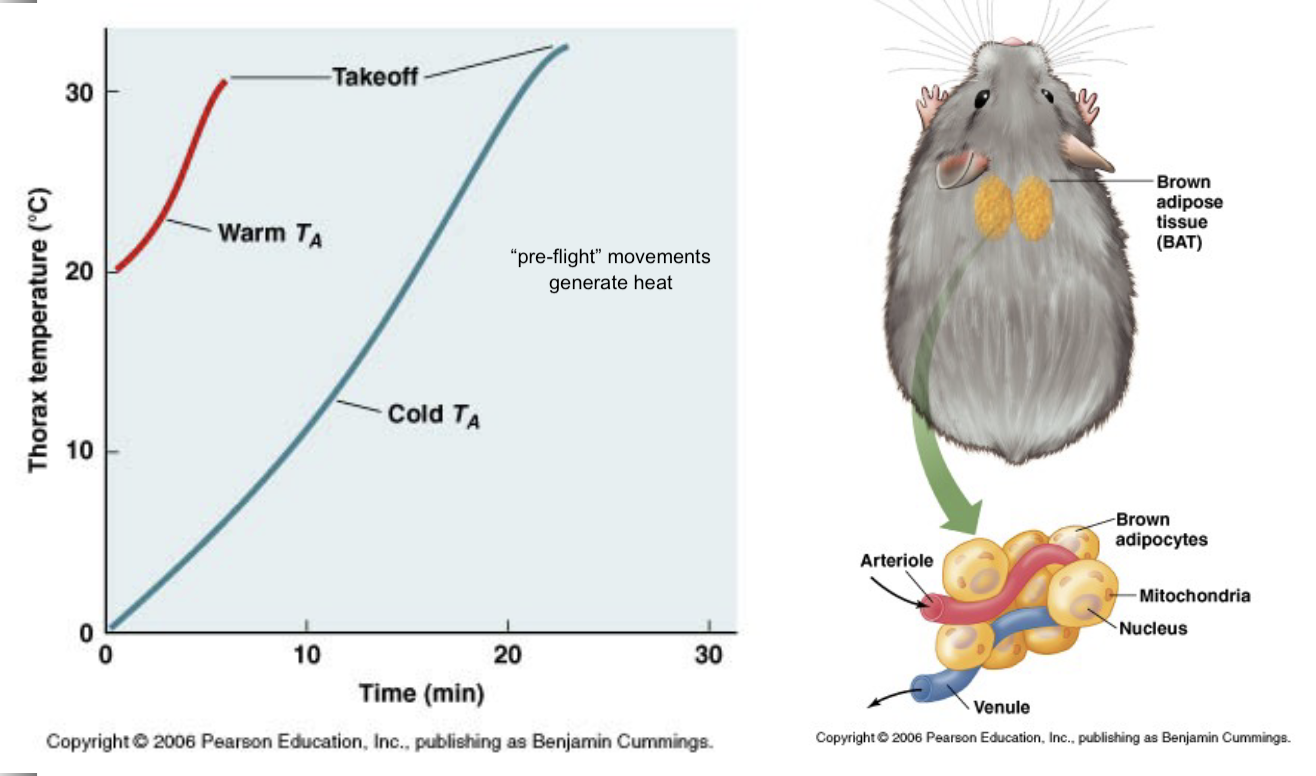
regulation of temp - feedback loop
too cool down, release more heat to environment
ideally, decrease heat production
to warm up, keep heat in and generate more
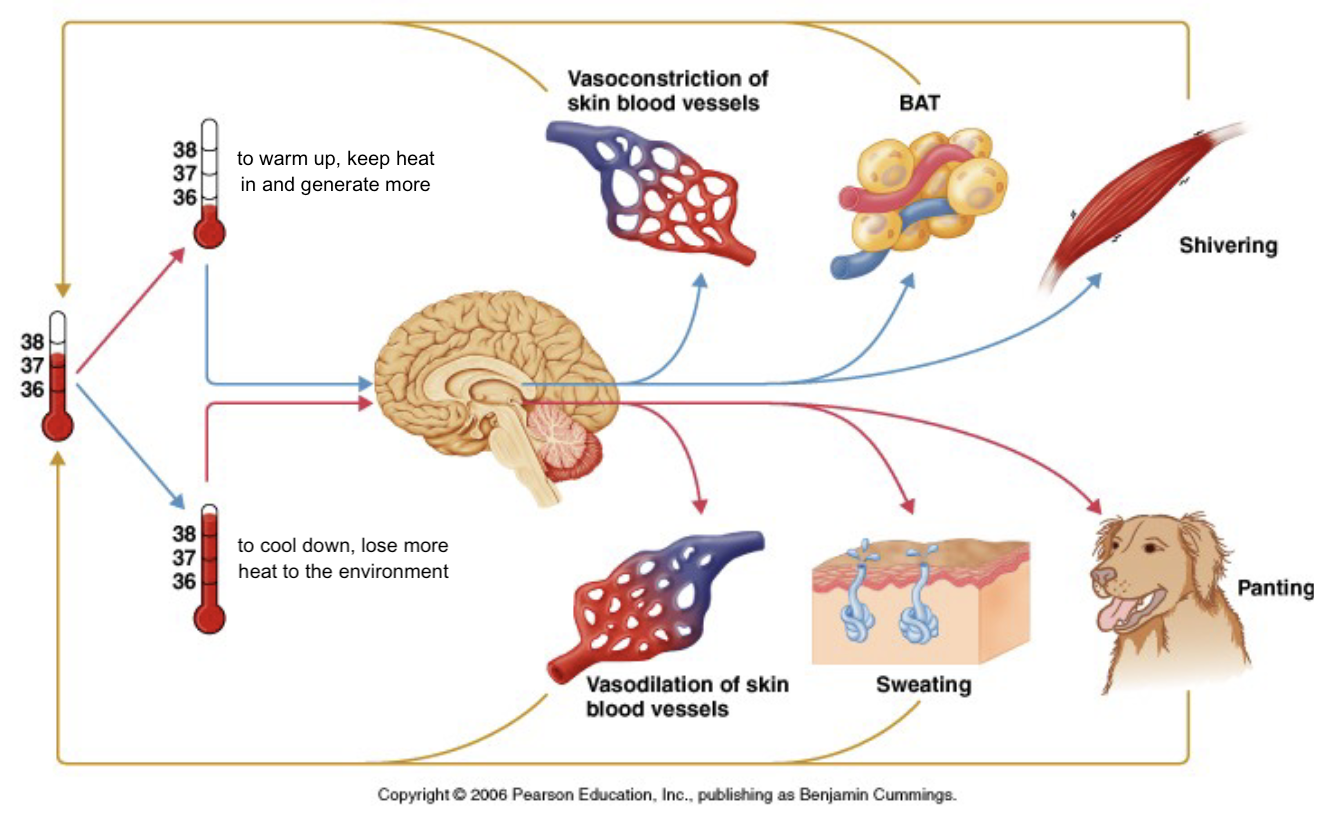
heat loss
piloerection
raise up fur, more distance, more insulation
lowered hair, less distance, allows for more heat loss
vasomotor response
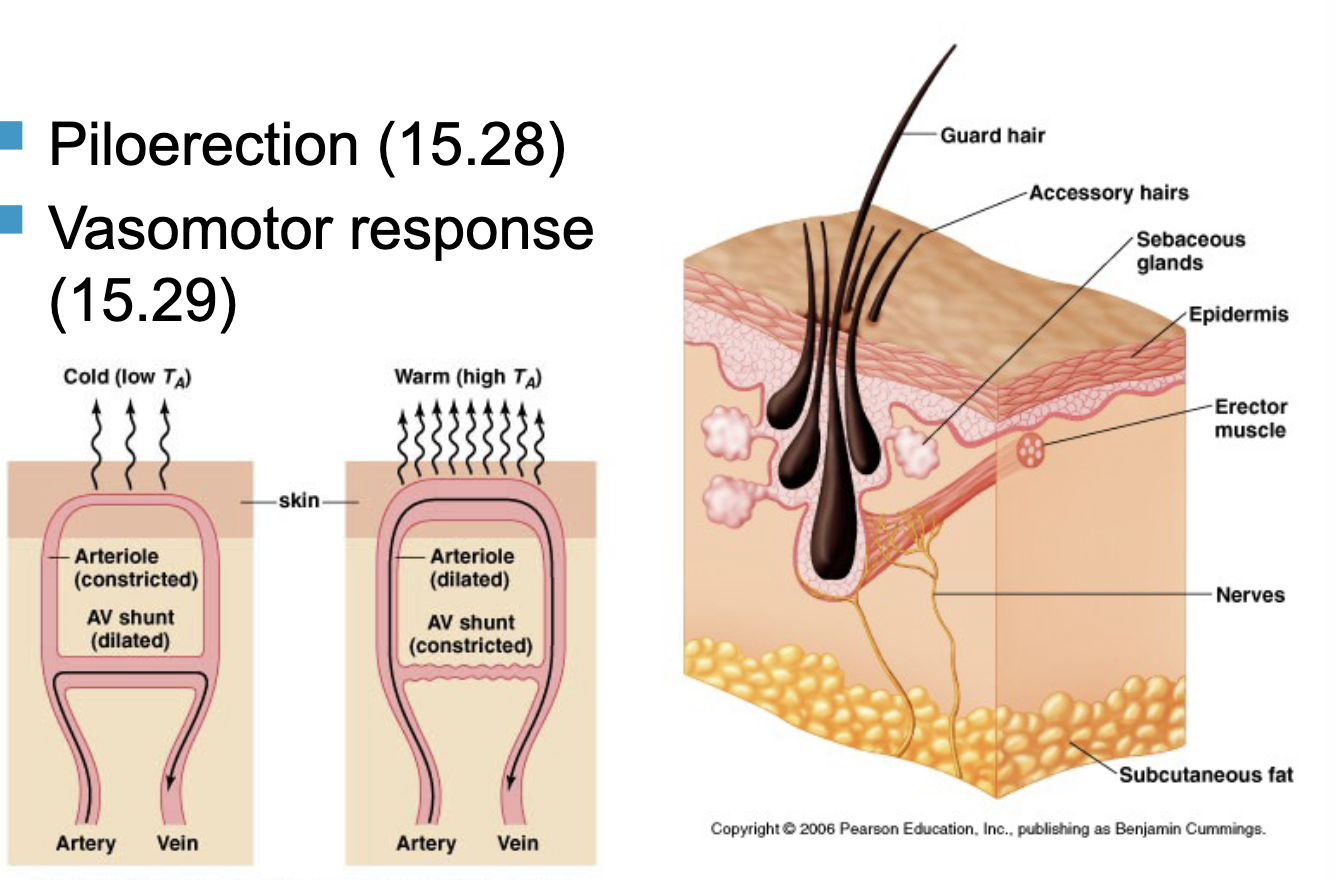
heat loss - countercurrent exchange
countercurrent exchange
blood flows out through arteries (warm blood), vein is coming back from feet (cold blood), countercurrent allows for heat exchange to blood in the vein can warm up before it gets to the core of the body. blood in artery will cool by the time it gets to the feet, minimizing heat lost to the environment
continual exchange
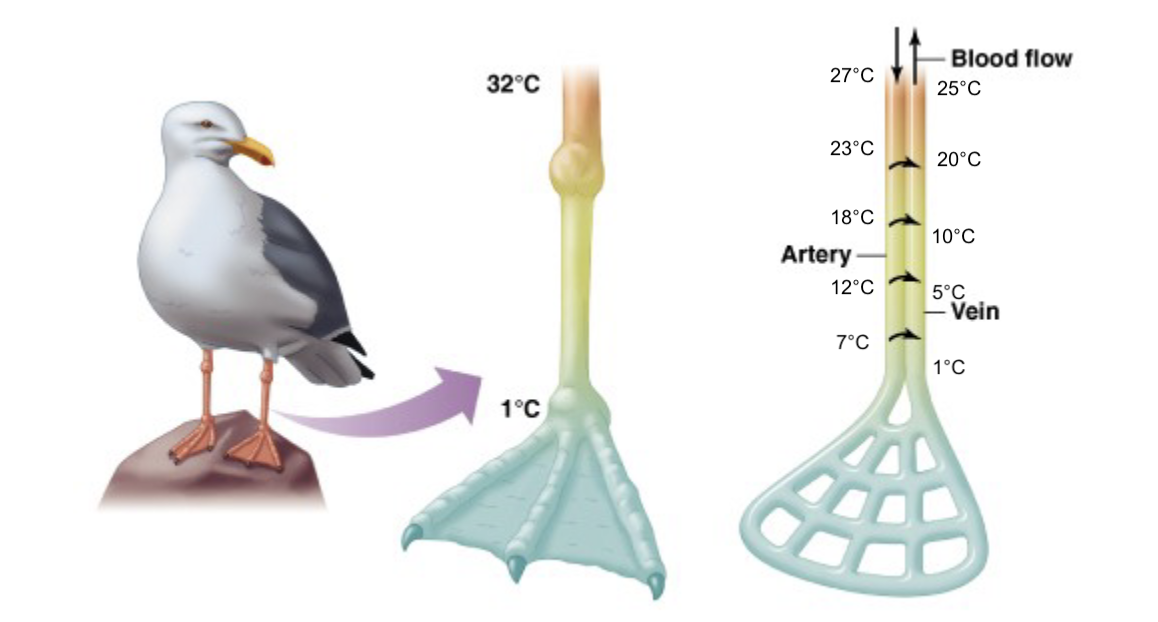
heat loss - evaporation
evaporation
sweating
panting
breathing
cold air comes in, longer pathway allows air to be warmed before it gets to lungs
nasal breathing conserves heat and moisture (water) (low temp)
mouth breathing loses water and heat (high temp)
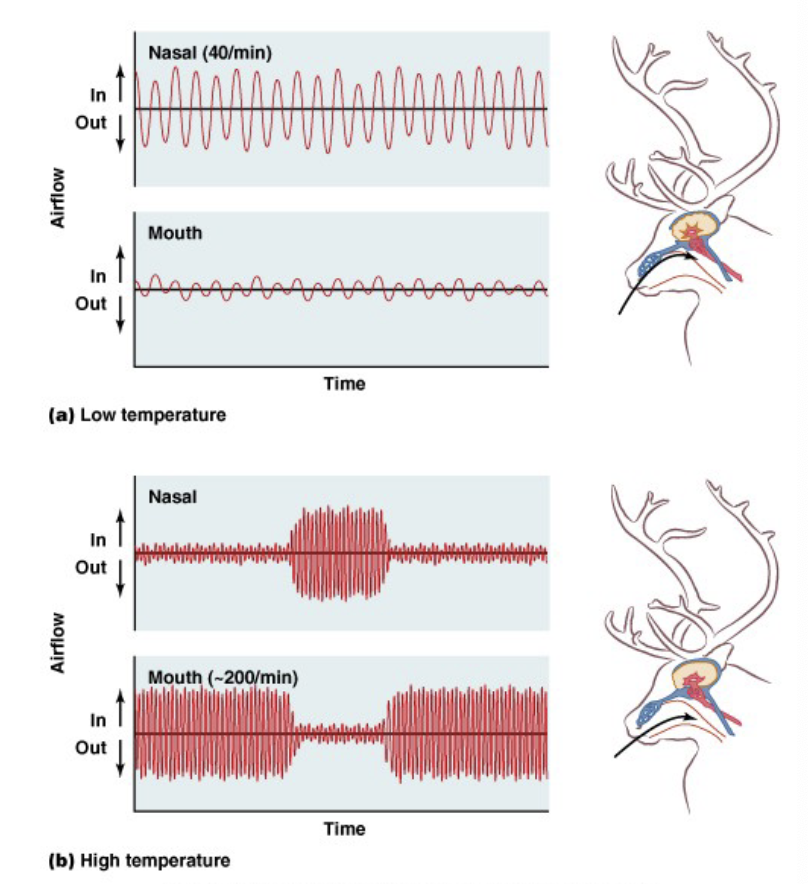
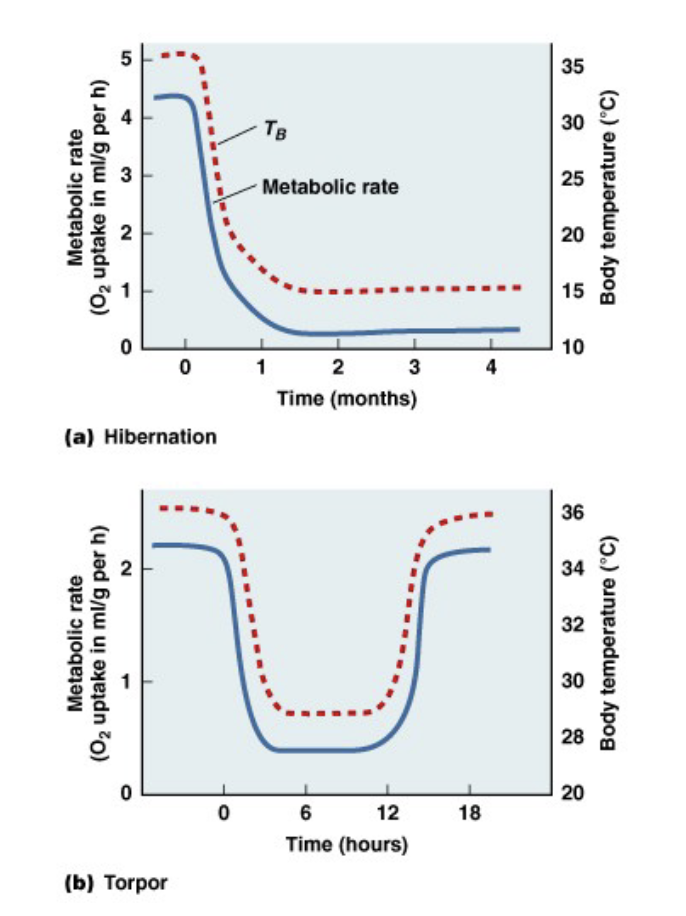
hypometabolic states
regional or temporal heterothermy
for short periods of time
relaxed endothermy
hibernation → long term
torpor → routine, daily cycle
↓ TB means less energy requirement, so metabolic rate can decrease
also decreased O2 use and CO2 production
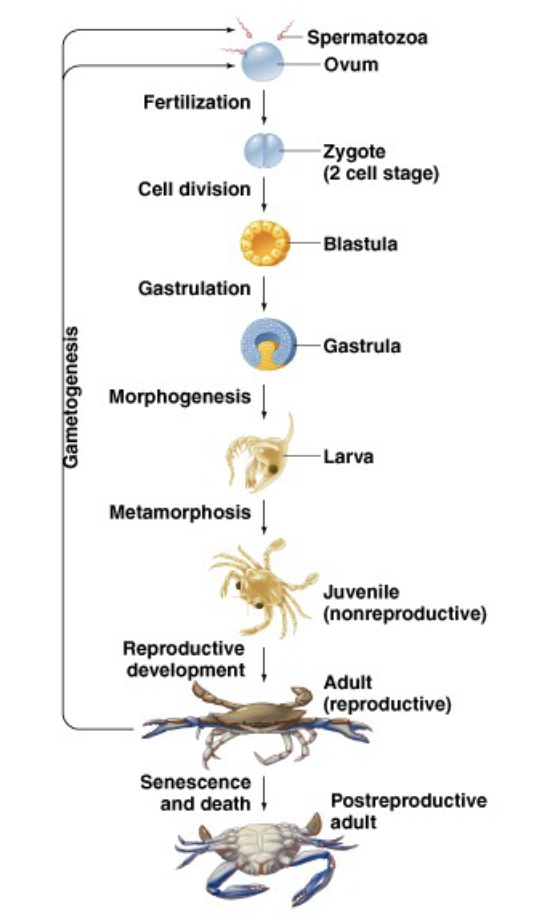
reproduction
genetic
passing on DNA
behavioral
physiological
changes in body function
hormonal regulation
producing gametes, sexual maturation
bottom line - need to pass on genetic info
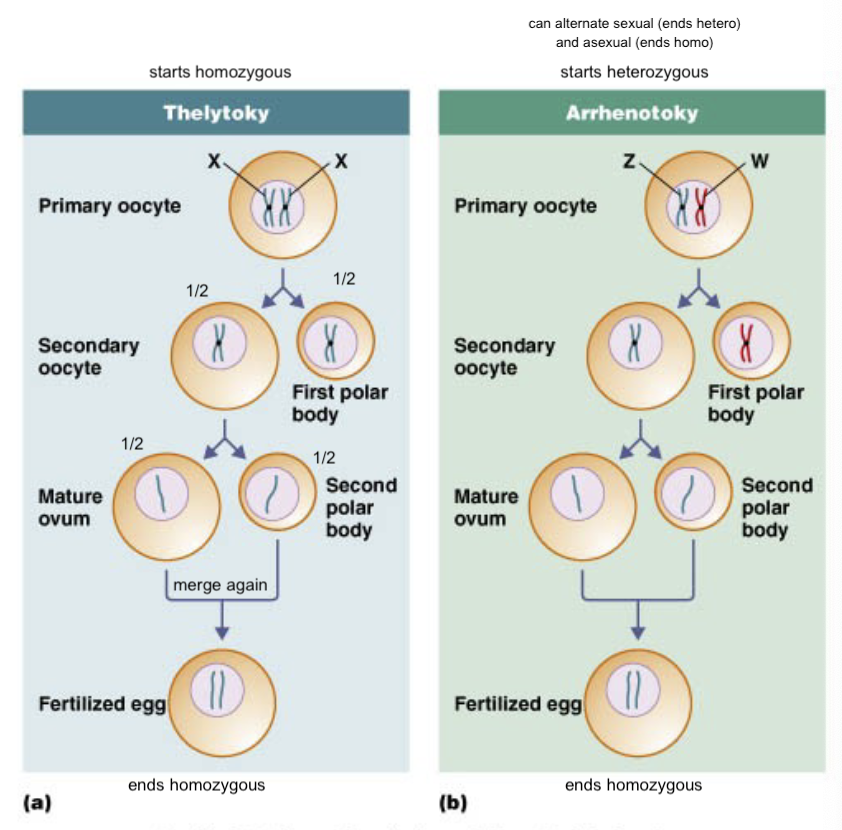
asexual reproduction
cloning
budding
parthenogenesis (self-fertilizing)
automictic → smaller cells with ½ DNA = polar bodies (only used to remove the half DNA they have during meiotic division)
homozygous offspring only (no differentiation, second polar body has identical DNA)
Thelytoky
starts and ends homozygous
Arrhenotoky
starts heterozygous, can end homo (asexual) or heterozygous (sexual)
benefits (asexual) → no need to find a mate, you can reproduce at any time; quick reproduction; saves a bit of energy
disadvantages → no genetic diversity
gametogenesis - sexual
oogenesis - has pauses
pause in meiosis I
1 oocyte/oogonium
2-3 polar bodies
larger gametes (due to unequal division of polar bodies) (provides raw materials for growth)
spermatogenesis - continuous
no paise
4 sperm/spermatogonium
smaller gametes (more traveling, only supply DNA)
advantage: creates diversity, natural selection processes
disadvantage: you have to find a mate (timing, resources, etc have to line up)
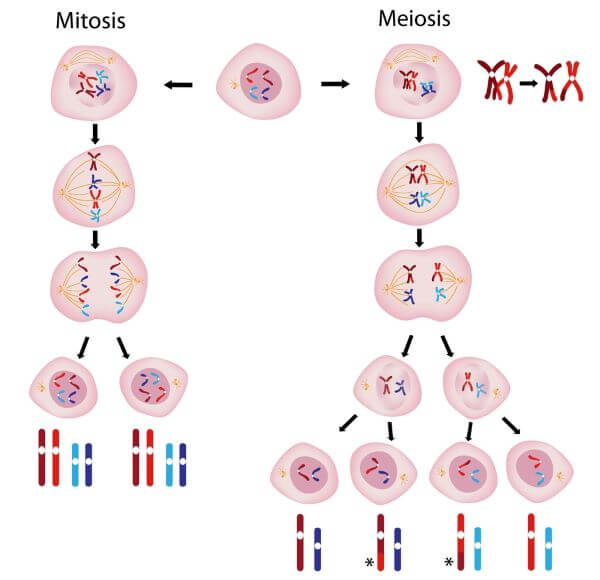
[meiosis has two divisions, mitosis has only one]
![<ul><li><p>oogenesis - <em>has</em> <em>pauses</em></p><ul><li><p>pause in meiosis I</p></li><li><p>1 oocyte/oogonium</p></li><li><p>2-3 polar bodies</p></li><li><p>larger gametes (due to unequal division of polar bodies) (provides raw materials for growth)</p></li></ul></li><li><p>spermatogenesis - <em>continuous</em></p><ul><li><p>no paise</p></li><li><p>4 sperm/spermatogonium</p></li><li><p>smaller gametes (more traveling, only supply DNA)</p></li></ul></li><li><p>advantage: creates diversity, natural selection processes</p></li><li><p>disadvantage: you have to find a mate (timing, resources, etc have to line up)</p></li></ul><p>[meiosis has two divisions, mitosis has only one]</p>](https://assets.knowt.com/user-attachments/d8039b34-1d7c-4c0e-a2b6-9829ada234d2.png)
mitosis/meiosis
mitosis
two identical cells
meiosis
four cells (two identical, other two identical)
spermatogenesis
occurs in testes
Sertoli cells - make sperm
Leydig cells - produce testosterone
packages as semen with other secretions
water for motility/transport
bicarbonate buffer (acid in the female reproductive tract would kill sperm if buffer was absent)
glucose, amino acids for nutrition
mucous → sticky, holds sperm in a group to protect them from acid while they adjust to it
prostaglandins → more motility in female repro-tract (smooth muscle contractions do most of the work for moving sperm while in mucous)
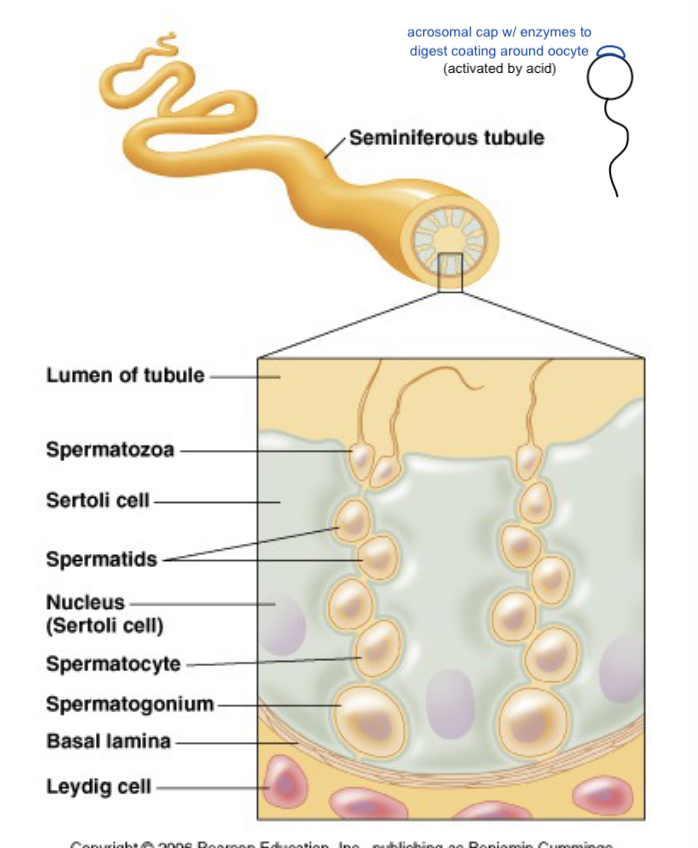
oogenesis
oviparous - chicken
offspring “hatch” from egg
ovi = egg
viviparous - mammals
live birth, no egg to hatch from
nutrition from parent during gestation
vivi = live
ovoviviparous - sharks
grows in egg → egg hatches in female reproductive tract → “live” birth
egg live birth
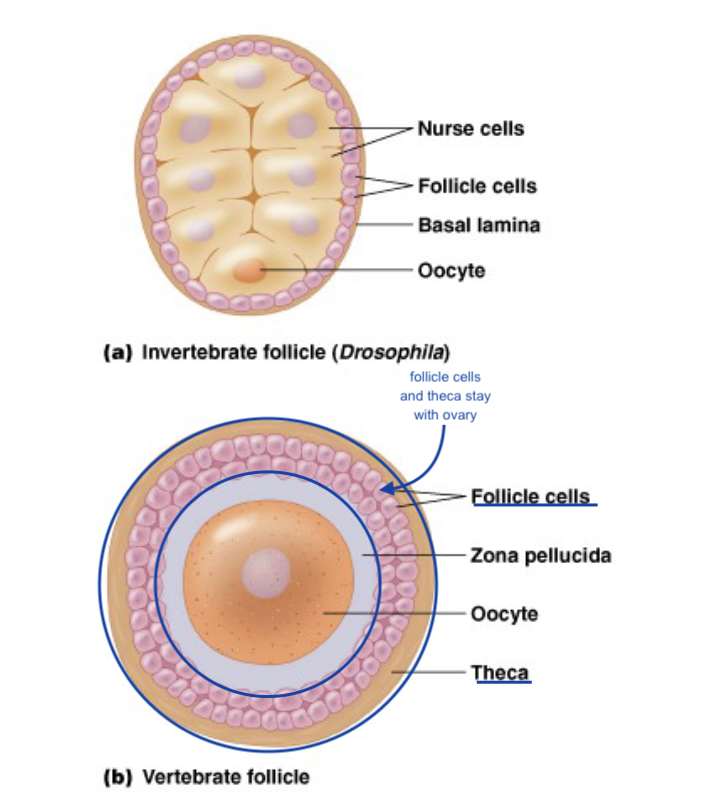
oogenesis conditions
environment
land fertilization: harder shell, less permeable
water or internal fertilization: can use a layer of “gel” but no real shell
source of nutrition
only egg → needs lots or nutrition or parent releases lots of offspring to increase chances of survival
from mom → smaller oocyte because nutrition is provided during development
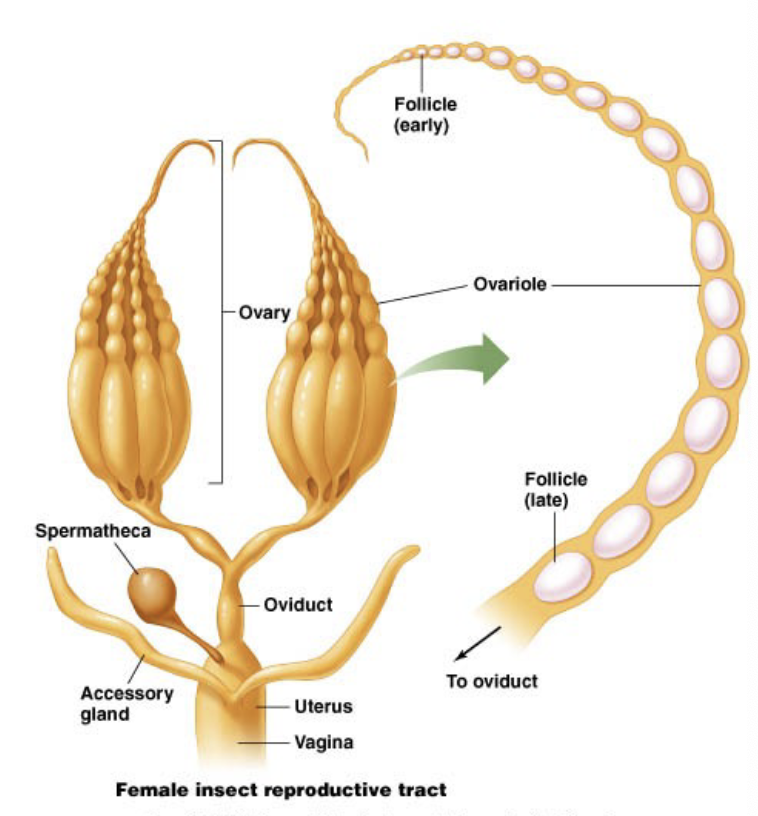
fertilization
release of sperm from body
spray over eggs
no direct transfer
copulation
direct transfer - lining up openings, no insertion
hemipene - insert organ into female
blood pressure - increased blood leads to increase in size and stiffness (allows for insertion)
Os penis - actual bone (walruses, raccoons)
[dogs have an os penis and they use blood pressure (combination)]
![<p>release of sperm from body</p><ul><li><p>spray over eggs</p><ul><li><p>no direct transfer</p></li></ul></li><li><p>copulation</p><ul><li><p>direct transfer - lining up openings, no insertion</p></li><li><p>hemipene - insert organ into female</p></li><li><p>blood pressure - increased blood leads to increase in size and stiffness (allows for insertion)</p></li><li><p><em>Os penis - </em>actual bone (walruses, raccoons)</p></li></ul></li></ul><p>[dogs have an os penis <em>and</em> they use blood pressure (combination)]</p>](https://assets.knowt.com/user-attachments/6db4ed5d-0294-4dff-8c75-4c9b2df52813.png)
fertilization variations
multiple matings → OR some females can store sperm and then eject it if a better mate comes along, or can store it until conditions are optimal for fertilization
polyandry - multiple sperm from several males fertilize offspring
delayed implantation (embryonic pause) → fertilization occurs, then the process pauses
rodents, kangaroos, river otter
sex determination
mammals
XY (M), XX (F)
XXY, XXX, or XØ are possible (will not be able to reproduce), but not YØ (cannot survive)
birds, butterflies
ZZ (M), ZW (F)
bees
diploid (F), haploid (M)
tortoises, crocodiles
temperature-dependent sex determination (warmer temps = ↑ number of females, cooler temp = ↓ number of males)
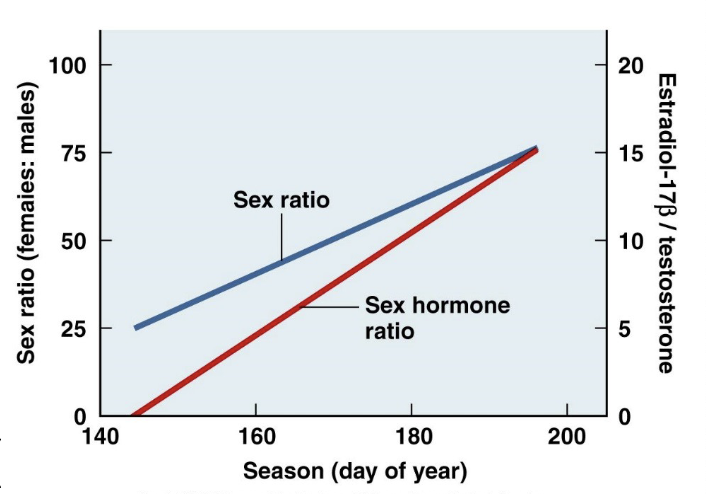
hermaphrodites
protogynous
female first → male later in life
protandrous
male first → female later in life
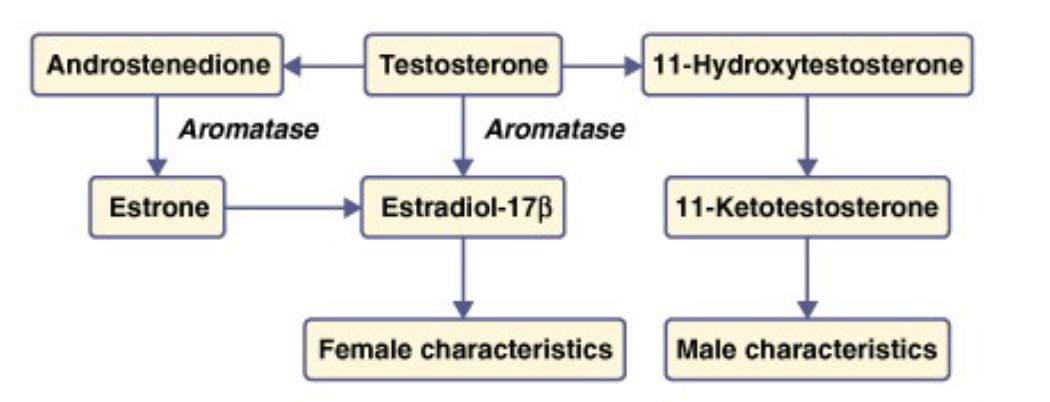
vertebrate reproductive hormones
FSH
follicle stimulating hormone (helps increase gamete numbers, more production)
follicle holds egg
LH
luteinizing hormone
forms corpus luteum from remains of follicle, increase production of gonad
CG → mammals only (signals implantation so placenta will be created)
chorionic gonadotropin, made by placenta, letter before indicates species
hCG = human
bCG = bovine
GnRH controls release
Gonadotropin Releasing Hormone (comes from hypothalamus)
releasing hormones come from hypothalamus, tropin = growth/increase (so more gonads produced)
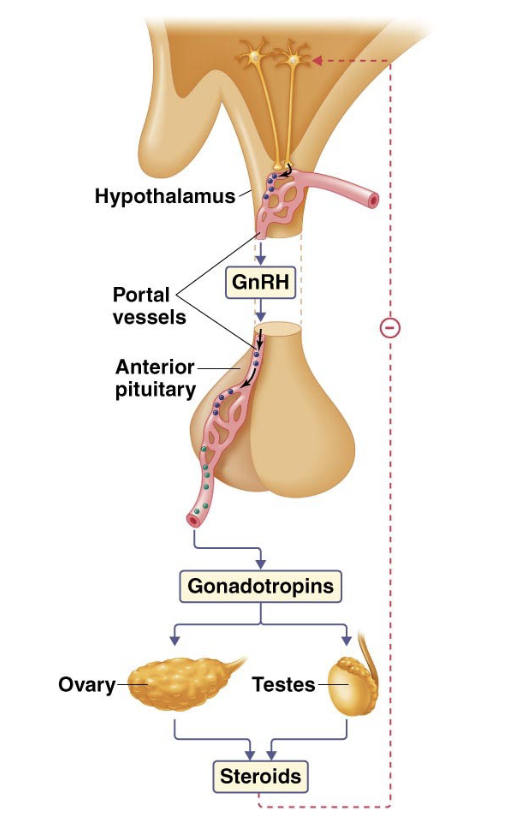
reproductive hormones
steroid hormones (verts)
progesterone
androgens
estrogens
ecdysteroids (inverts)
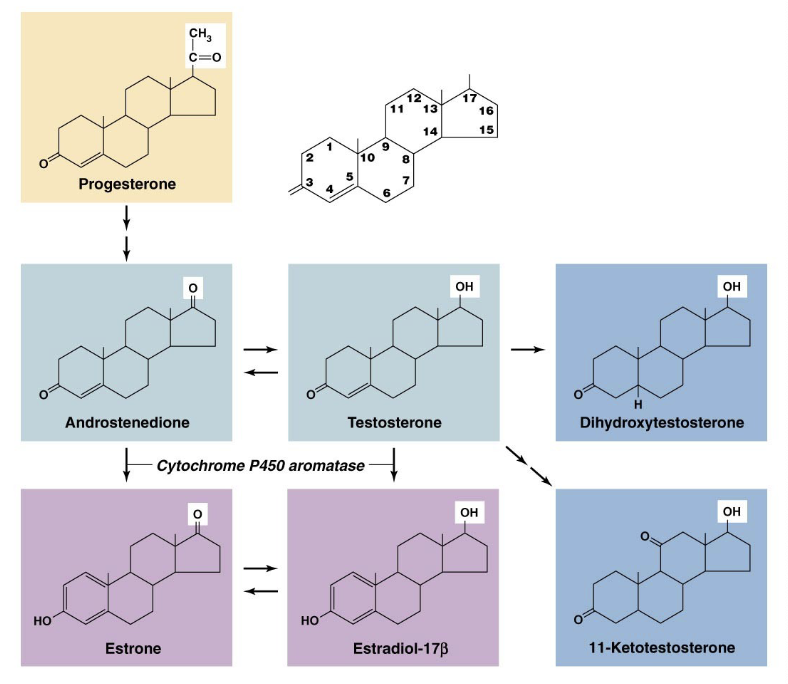
steroid hormone synthetic pathways
the enzymes ultimately determine what the final product is
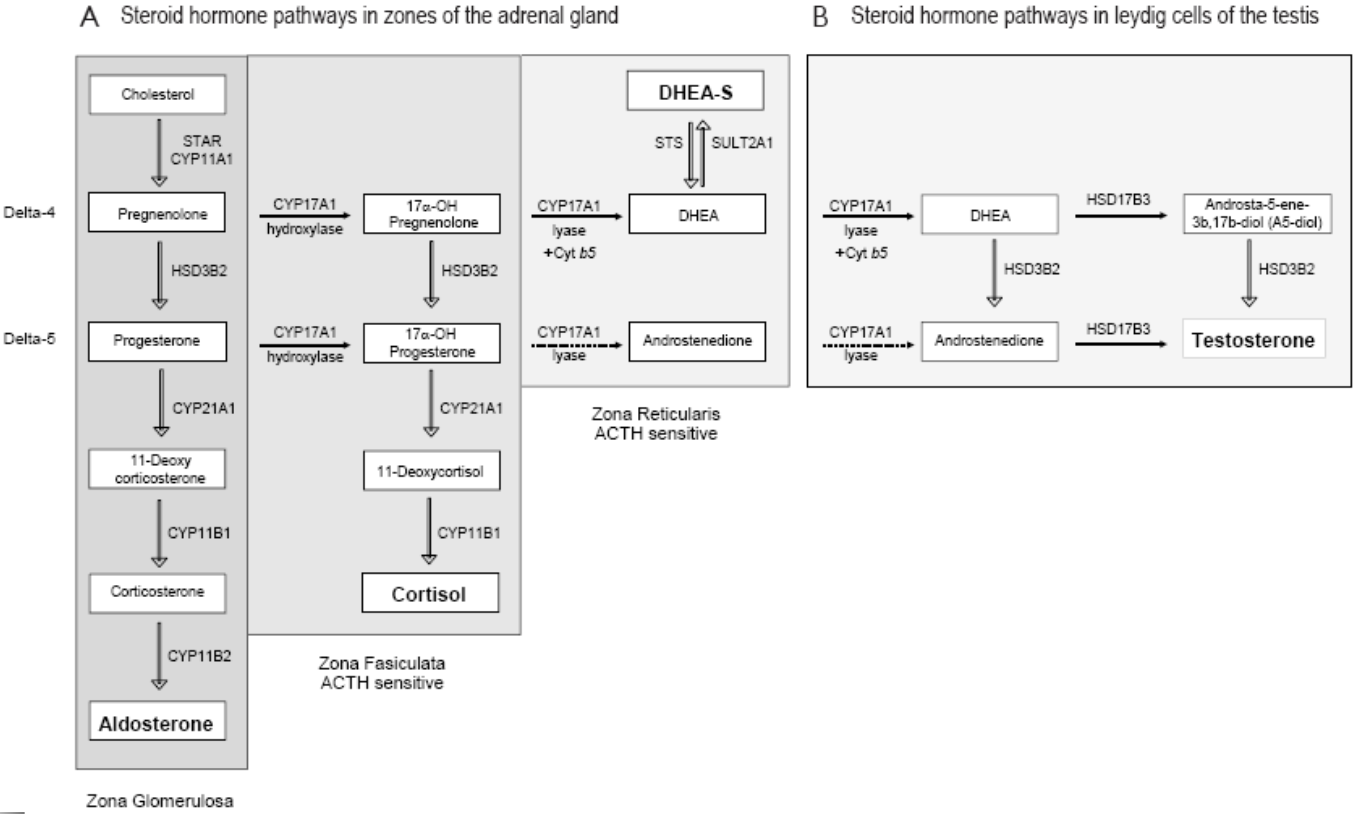
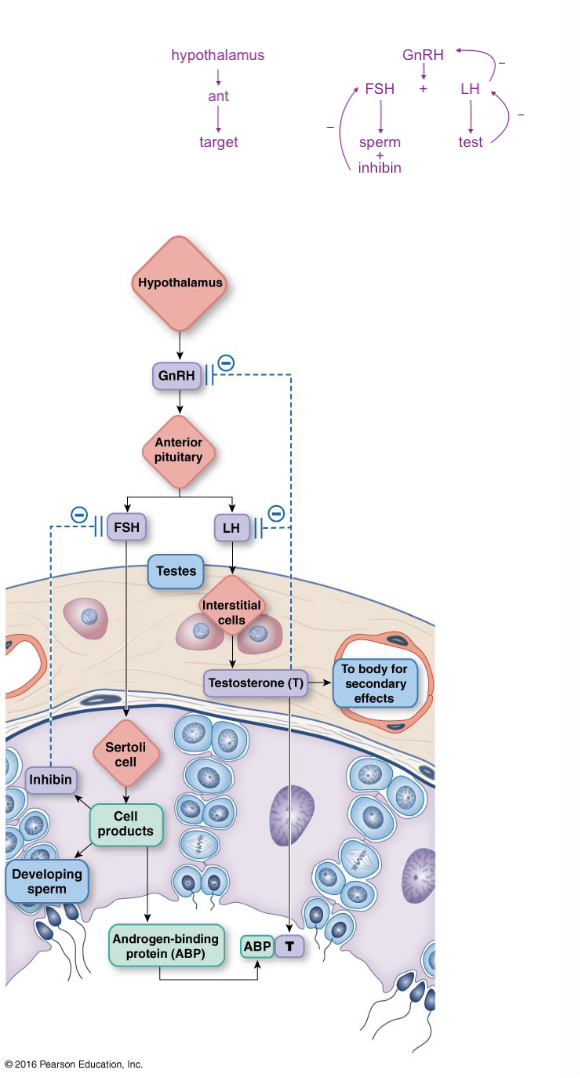
male control loops
GnRH – stimulates FSH and LH
LH
Stimulates Leydig (interstitial) cells to produce testosterone (inhibits GnRH and LH)
FSH
Stimulates Sertoli (nurse, sustentacular) cells to produce sperm and Inhibin