Intro to Comp Networks Exam 1 (Ch 1 - Ch 2)
0.0(0)
Studied by 2 people Call Kai
 Learn
Learn Practice Test
 Spaced Repetition
 Match
Match Flashcards
 Knowt Play
Card Sorting
1/93

Earn XP
Description and Tags
Last updated 11:33 PM on 10/9/22
Name | Mastery | Learn | Test | Matching | Spaced | Call with Kai | Chat |
|---|
No analytics yet
Send a link to your students to track their progress
94 Terms
1
New cards
Protocols define the ________, __________ of messages sent and received among network entities, and actions taken on msg transmission receipt
format, order
2
New cards
Because the internet is so large, it is usually described as a network of _______.
networks
3
New cards
(T/F) A web server is considered a host in a network.
True
4
New cards
The network core of the Internet is:
- Interconnected hosts
- Interconnected routers
- Data centers
- None of the above
- Interconnected hosts
- Interconnected routers
- Data centers
- None of the above
Interconnected routers
5
New cards
- A single router is transmitting packets, each of length L bits, over a single link with transmission rate R Mbps to another router at the end of the link
- Suppose that the packet length is L = 16000 bits, and that the link transmission rate along the link to router on the right is R = 1000 Mbps
What is the transmission delay?
- Suppose that the packet length is L = 16000 bits, and that the link transmission rate along the link to router on the right is R = 1000 Mbps
What is the transmission delay?
0.000016 sec
6
New cards
- A single router is transmitting packets, each of length L bits, over a single link with transmission rate R Mbps to another router at the end of the link
- Suppose that the packet length is L = 16000 bits, and that the link transmission rate along the link to router on the right is R = 1000 Mbps
What is the maximum number of packets per sec that can be transmitted by this link?
- Suppose that the packet length is L = 16000 bits, and that the link transmission rate along the link to router on the right is R = 1000 Mbps
What is the maximum number of packets per sec that can be transmitted by this link?
62,500 packets
7
New cards
(T/F) One advantage in the Client-Server paradigm is that both the client and server have permanent IP addresses
False
8
New cards
A sender’s email server uses _________ protocol to deliver an email message to the receiver’s server.
SMTP
9
New cards
One example of an open application-layer protocol is:
- HTTP
- IP
- Skype
- UDP
- HTTP
- IP
- Skype
- UDP
HTTP
10
New cards
Since servers using HTTP protocol can not maintain information about past client requests, HTTP is described as ______.
stateless
11
New cards
(T/F) If Process_1 running within host_A wants to send a message to Process_2 within host_B, then Process_2 will be identified by its IP address
False
12
New cards
Let’s suppose that:
- The RTT delay between the client and server is 10 msecs;
- The time a server needs to transmit an object into its outgoing link is 0.25 msecs;
- Any other HTTP message not containing an object has a negligible (zero) transmission time
Suppose the client makes 90 requests, one after the other, waiting for a reply to a request before sending the next request
- Assume the client is using HTTP 1.1 and the IF_MODIFIED_SINE header line
- Assume 40% of the objects requested have NOT changed since the client downloaded them (before these 90 downloads are performed)
How much time elapses in (milliseconds) between the client transmitting the first request, and the completion of the late request?
- The RTT delay between the client and server is 10 msecs;
- The time a server needs to transmit an object into its outgoing link is 0.25 msecs;
- Any other HTTP message not containing an object has a negligible (zero) transmission time
Suppose the client makes 90 requests, one after the other, waiting for a reply to a request before sending the next request
- Assume the client is using HTTP 1.1 and the IF_MODIFIED_SINE header line
- Assume 40% of the objects requested have NOT changed since the client downloaded them (before these 90 downloads are performed)
How much time elapses in (milliseconds) between the client transmitting the first request, and the completion of the late request?
913.5 ms
13
New cards
Hosts
End systems, devices connected to the Internet
14
New cards
Communication links
Connect end systems in a network, made up of different types of physical media
15
New cards
Packets
data chunks created when end system 1 sends data to end system 2
end system 1: segments data and adds header bytes to each segment
end system 2: reassembles packets into original data
end system 1: segments data and adds header bytes to each segment
end system 2: reassembles packets into original data
16
New cards
Packet switch
takes arriving packets and forwards it to another communication link
17
New cards
Route/path
sequence of communication links and packet switches that a packet travels through
18
New cards
Internet Service Provider (ISP)
network of packet switches and communication links, allows end systems to access Internet
19
New cards
Internet Protocol (IP)
specifies format and order of packets that are sent/received from routers and end systems
20
New cards
At the network's edge is
hosts (clients and servers) and servers often found in data centers
21
New cards
At the network's core is
interconnected routers and a network of networks
22
New cards
How are end systems connected to the edge routers?
through residential access nets, institutional access networks (school, company), and mobile access networks (WiFi, 4G/5G)
23
New cards
Packet-switching
hosts break application-layer messages into packets (chunks of data)
forwards packets from router to router
entire packet must arrive at router before it can be transmitted to next link
forwards packets from router to router
entire packet must arrive at router before it can be transmitted to next link
24
New cards
Transmission delay
L bits/R Mbps
L: packet length (bits), R: link transmission rate (bps)
L: packet length (bits), R: link transmission rate (bps)
25
New cards
End-end delay
2L bits/R Mbps
L: packet length (bits), R: link transmission rate (bps)
L: packet length (bits), R: link transmission rate (bps)
26
New cards
If arrival rate (in bps) to link exceeds transmission rate (bps) of link for a period of time
- packets will queue, waiting to be transmitted on output link
- packets can be dropped (lost) if memory buffer in router fills up
- packets can be dropped (lost) if memory buffer in router fills up
27
New cards
The two key network-core functions are
forwarding function (local action) and routing function (global action)
28
New cards
Network-core forwarding function
local action: move arriving packets from router’s input link to appropriate router output link
29
New cards
Network-core forwarding function
global action: determine source-destination paths taken by packets, routing algorithms
30
New cards
Circuit switching
end-end resources allocated to, reserved for "call" between source and destination
31
New cards
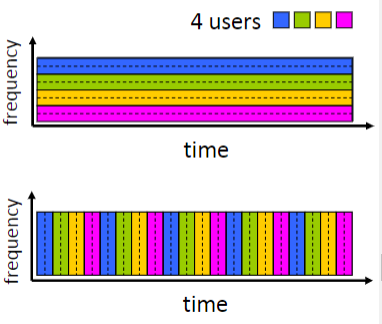
Which of these graphs represents circuit switching's FDM?
Upper
32
New cards
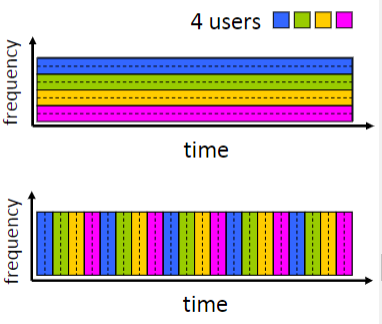
Which of these graphs represents circuit switching's TDM?
Lower
33
New cards
Why is packet switching considered better than circuit switching?
It allows more users to use the network, is simpler with no call setup, and great for sending bursts of data
34
New cards
What are the downsides to using packet switching?
Excessive congestion is possible leading to packet delay and loss due to buffer overflow
35
New cards
Given millions of acces to ISPs, how can they be connected together?
Connect each acces ISP to one global transit ISP, where customer and provider ISPs have economic agreement
36
New cards
How does packet loss and delay occur?
Arrival rate to link (temporarily) exceeds output link capacity
37
New cards
Propagation delay
d/s
d: length of physical link, s: propagation speed
d: length of physical link, s: propagation speed
38
New cards
Throughput
Rate (bits/time units) at which bits are being sent from sender to receiver
39
New cards
If arrival rate of packets to link exceeds transmission rate of link for a period of time AND if buffer in router fills up
- packets can be dropped
- some packets will be returned to source
- packets will queue as long as needed
- buffer in router will adjust to process all packets
- packets can be dropped
- some packets will be returned to source
- packets will queue as long as needed
- buffer in router will adjust to process all packets
packets can be dropped
40
New cards
(T/F) Local forwarding in network-core determines source-destination paths taken by packets
true
41
New cards
The Internet protocol stack, as a complex system, is organized as _________________.
layers
42
New cards
Suppose that the packet length is L = 4000 bits, and that the link transmission rate along the link to router on the right is R = 10 Mbps.
What is the transmission delay?
What is the transmission delay?
0.0004 sec
43
New cards
Suppose that the packet length is L = 4000 bits, and that the link transmission rate along the link to router on the right is R = 10 Mbps.
What is the maxmimum number of packets per second that can be transmitted by this link?
What is the maxmimum number of packets per second that can be transmitted by this link?
2500 packets
44
New cards
Instantaneous throughput
rate at given point in time at which bits are being sent from
sender to receiver
sender to receiver
45
New cards
Average throughput
rate over longer period of time at which bits are being sent from
sender to receiver
sender to receiver
46
New cards
Bottleneck link
link on end-end path that constrains end-end throughput
47
New cards
Layers
each one implements a service, via its own internal-layer actions relying on services provided by the one below it
48
New cards
Why are network protocols organized as layers?
helps deal with complex systems and allows easier identification, maintenance, and updates
49
New cards
Internet protocol stack
(top to bottom) application, transport, network, link, physical
50
New cards
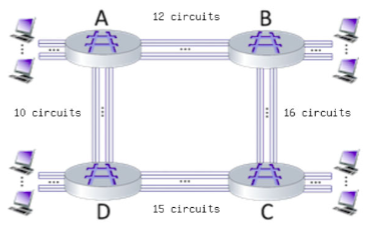
A circuit-switched network with circuit switches A, B, C, and D. Suppose there are 12 circuits between A and B, 16 circuits between B and C, 15 circuits between C and D, and 10 circuits between D and A.
What is the maximum number of connections that can be ongoing in the network at any one time?
What is the maximum number of connections that can be ongoing in the network at any one time?
53
51
New cards
A circuit-switched network with circuit switches A, B, C, and D. Suppose there are 12 circuits between A and B, 16 circuits between B and C, 15 circuits between C and D, and 10 circuits between D and A.
Suppose that these maximum number of connections are all ongoing. What happens when another call connection request arrives to the network, will it be accepted?
Suppose that these maximum number of connections are all ongoing. What happens when another call connection request arrives to the network, will it be accepted?
no
52
New cards
Server
always-on host, permanent IP address
53
New cards
Clients
contact and communicate with server, may have dynamic IP addresses
54
New cards
Peer-peer (P2P) architecture
peers request service from other peers, provide service in return to other peers
55
New cards
Process
program running within a host
56
New cards
Client process
process that initiates communication
57
New cards
Server process
process that waits to be contacted
58
New cards
Socket
process sends/receives messages to/from this
59
New cards
(T/F) A socket's sending process doesn't rely on transport infrastructure on other side of door to deliver messages to the socket at receiving process.
false
60
New cards
Identifier includes both ___________ and ___________ associated with process on host
IP address, port numbers
61
New cards
Does the IP address of a host on which a process runs suffice for identifying the process?
no, many processes can be running on the same host
62
New cards
Application-layer protocol
types of messages exchanged, message syntax, message semantics, open protocols, proprietary protocols, rules for processes
63
New cards
What transport service does an app need?
data integrity, throughput, timing, security
64
New cards
What are the main types of Internet transport protocol services?
TCP, UDP
65
New cards
What is the main different between TCP and UDP?
TCP is more reliable in sending and transferring data than UDP
66
New cards
(T/F) In a client-server paradigm, clients can communicate directly with each other
false
67
New cards
(T/F) In order for two processes running on different hosts to exchange messages, two sockets must be involved: one on each side
true
68
New cards
The default port for processes running on an HTTP server is ______________.
80
69
New cards
(T/F) Generally, a file transfer application can tolerate some loss of data
false
70
New cards
In a non-persistent HTTP connection:
- the connection will remain open until all objects are sent
- multiple object can be sent
- at most one object is sent
- the objects that are sent will not be persisted
- the connection will remain open until all objects are sent
- multiple object can be sent
- at most one object is sent
- the objects that are sent will not be persisted
at most one object is sent
71
New cards
In order for websites and client browsers to maintain some state between transactions, they use:
- persistent TCP
- none of the others
- persistent HTTP connections
- cookies
- persistent TCP
- none of the others
- persistent HTTP connections
- cookies
cookies
72
New cards
(T/F) HTTP/2 has increased flexibility at server in sending objects to client
true
73
New cards
(T/F) One similarity between HTTP and SMTP is that both are pull protocols
False
74
New cards
When a user agent retrieves an e-mail message from its e-mail server, it uses this protocol:
- IMAP
- UDP
- none of the others
- SMTP
- IMAP
- UDP
- none of the others
- SMTP
IMAP
75
New cards
What is the purpose of HTTP GET?
- The HTTP GET request message is used by a web client to request a web server to send the requested object from the server to the client
- The HTTP GET request message is sent by a web server to a web client to get the next request from the web client
- The HTTP GET request message is used by a web client to post an object on a web server
- The HTTP GET request message is sent by a web server to a web client to identity of the web client
- The HTTP GET request message is used by a web client to request a web server to send the requested object from the server to the client
- The HTTP GET request message is sent by a web server to a web client to get the next request from the web client
- The HTTP GET request message is used by a web client to post an object on a web server
- The HTTP GET request message is sent by a web server to a web client to identity of the web client
The HTTP GET request message is used by a web client to request a web server to send the requested object from the server to the client
76
New cards
Assume that the RTT delay between the client and server is 30 msecs and the TCP connected is already established;
- the time a server needs to transmit an object into its outgoing link is 0.5 msecs;
- any other HTTP message not containing an object has a negligible (zero) transmission time
Suppose the client again makes 50 requests, one after the other, waiting for a reply to a request before sending the next request
- assume the client is using HTTP 1.1 and the IF-MODIFIED-SINCE header line
- assume 50% of the objects requested have NOT changed since the client downloaded them (before these 50 downloads are performed)
How much time elapses (in milliseconds) between the client transmitting the first request, and the completion of the last request?
- the time a server needs to transmit an object into its outgoing link is 0.5 msecs;
- any other HTTP message not containing an object has a negligible (zero) transmission time
Suppose the client again makes 50 requests, one after the other, waiting for a reply to a request before sending the next request
- assume the client is using HTTP 1.1 and the IF-MODIFIED-SINCE header line
- assume 50% of the objects requested have NOT changed since the client downloaded them (before these 50 downloads are performed)
How much time elapses (in milliseconds) between the client transmitting the first request, and the completion of the last request?
1512.5 ms
77
New cards
Assume an RTT of 10 msec is needed for each:
- to initiate and establish a TCP connection
- for HTTP request and first few bytes of HTTP response to return
Assume an object transmission time is 0.5 msec
Assume the HTML page being requested references 5 objects in addition to the base HTML file and that HTTP/1.0 is being used
What is the total response time for the entire page to be delivered to the browser?
- to initiate and establish a TCP connection
- for HTTP request and first few bytes of HTTP response to return
Assume an object transmission time is 0.5 msec
Assume the HTML page being requested references 5 objects in addition to the base HTML file and that HTTP/1.0 is being used
What is the total response time for the entire page to be delivered to the browser?
123.0 ms
78
New cards
Assume that the RTT delay between the client and server is 30 msecs and the TCP connected is already established;
- the time a server needs to transmit an object into its outgoing link is 1 msecs;
- any other HTTP message not containing an object has a negligible (zero) transmission time
Suppose the client again makes 60 requests, one after the other, waiting for a reply to a request before sending the next request
- assume the client is using HTTP 1.1 and the IF-MODIFIED-SINCE header line
- assume 60% of the objects requested have NOT changed since the client downloaded them (before these 60 downloads are performed)
How much time elapses (in milliseconds) between the client transmitting the first request, and the completion of the last request?
- the time a server needs to transmit an object into its outgoing link is 1 msecs;
- any other HTTP message not containing an object has a negligible (zero) transmission time
Suppose the client again makes 60 requests, one after the other, waiting for a reply to a request before sending the next request
- assume the client is using HTTP 1.1 and the IF-MODIFIED-SINCE header line
- assume 60% of the objects requested have NOT changed since the client downloaded them (before these 60 downloads are performed)
How much time elapses (in milliseconds) between the client transmitting the first request, and the completion of the last request?
1824 ms
79
New cards
(T/F) A user requests a Web page that consists of some text and three images. For this page, the client will send one request message and receive four response messages.
False
80
New cards
(T/F) With nonpersistent connections between browser and origin server, it is possible for a single TCP segment to carry two distinct HTTP request messages.
False
81
New cards
What is the purpose of a cookie value in the HTTP GET request?
- The cookie value itself doesn't mean anything. It is just a value that was returned by a web server to this client during an earlier interaction.
- The cookie value indicates whether the user wants to use HTTP/1, HTTP/1.1, or HTTP/2 for this GET request
- None of the others
- The cookie value encodes the format of the reply preferred by the client in the response to this GET request
- The cookie value is an encoding of a user email address associated with the GET request
- The cookie value itself doesn't mean anything. It is just a value that was returned by a web server to this client during an earlier interaction.
- The cookie value indicates whether the user wants to use HTTP/1, HTTP/1.1, or HTTP/2 for this GET request
- None of the others
- The cookie value encodes the format of the reply preferred by the client in the response to this GET request
- The cookie value is an encoding of a user email address associated with the GET request
The cookie value itself doesn't mean anything. It is just a value that was returned by a web server to this client during an earlier interaction.
82
New cards
A web page consists of base HTML-file which includes several referenced ___________, each addressable by a URL.
objects
83
New cards
HTTP
hypertext transfer protocol, web's application layer protocol
84
New cards
(T/F) Protocols that maintain their past history (state) are complex.
True
85
New cards
What is the main different between non-persistent and persistent HTTP?
- non-persistent sends at most one object over a TCP connection, persistent sends multiple objects over a single TCP connection
- non-persistent uses multiple TCP connections to send a few objects at a time, persistent uses a single TCP connection to send all objects at once
- non-persistent sends all objects through a single TCP connection, persistent uses several TCP connections to send one object at a time
- none of these
- non-persistent sends at most one object over a TCP connection, persistent sends multiple objects over a single TCP connection
- non-persistent uses multiple TCP connections to send a few objects at a time, persistent uses a single TCP connection to send all objects at once
- non-persistent sends all objects through a single TCP connection, persistent uses several TCP connections to send one object at a time
- none of these
non-persistent sends at most one object over a TCP connection, persistent sends multiple objects over a single TCP connection
86
New cards
RTT
time for a small packet to travel from client to server and back
87
New cards
Non-persistent HTTP response time
2RTT + file transmission time
88
New cards
(T/F) It requires one RTT to initiate a TCP connection and two RTT for an HTTP request.
False
89
New cards
The main two types of HTTP mesages:
request, response
90
New cards
HTTP GET/response interaction is ____________
stateless
91
New cards
Web sites and client browser use ____________ to maintain some state between transactions
cookies
92
New cards
User configures browser to point to a ____________
web cache
93
New cards
What is the goal of web caches (proxy servers)?
to satisfy client request without involving origin server
94
New cards
Why do we use web caching?
- reduce response time for messages being sent out
- reduce internet traffic on any access link and increase the flexibility of request messages
- reduce response time for client request as well as the traffic on an institution's access link
- none of the others
- reduce response time for messages being sent out
- reduce internet traffic on any access link and increase the flexibility of request messages
- reduce response time for client request as well as the traffic on an institution's access link
- none of the others
reduce response time for client request as well as the traffic on an institution's access link