Bonding
 Call Kai
 Learn
Learn Practice Test
 Spaced Repetition
 Match
Match Flashcards
 Knowt Play
1/54

There's no tags or description
Looks like no tags are added yet.
Name | Mastery | Learn | Test | Matching | Spaced | Call with Kai | Chat |
|---|
No analytics yet
Send a link to your students to track their progress
55 Terms
Metallic Bonds structure
The strong electrostatic force of attraction between a lattice of positive metal ions (cations) and a sea of delocalised electrons.
Heat- metal properties
electrons gain kinetic energy in hotter areas of the metal and are able to quickly transfer it to other parts of the metal lattice due to their freedom of movements. the metal ions vibrate, contributing to the flow of heat through the metal lattice
Electricity- metal properties
When a voltage is applied to a metal, one end of the metal becomes positive and the other end of the metal becomes negative. since the electrons are free to move, all electrons experience a force toward the positive end. the movement of electrons is an electric current
Malleable and Ductile- metallic bonding
Metals are malleable and ductile because metallic bonds are non‑directional. , allowing layers of ions to move past each other without disrupting the forces between the positive ions and the negative electron sea.
High Melting Point/boiling point metals
high melting and boiling points as there is a greater attractive force between the metal cations and the electrons meaning a higher energy is required to overcome the forces between them
High Density
Most metals have relatively high densities because their metal lattices are closely packed.
What in an electron determines reactivity?
valence electrons
Ionic Bonds
is the electrostatic attraction between oppositely charged ions in an orderly lattice
High melting and Boiling Points- Ionic
Ionic compounds are held together by electrostatic forces between the oppositely charged ions. As the ionic lattice has strong bonds between ions, a lot of energy is needed to overcomes their bonds.
Brittle -ionic
When an ionic compound is struck by a force, the ion layer shifts. when this happens, ions of the same charge are next to each other. the repulsive forces between like charged ions causes the crystal to shatter. ions break on smooth planes due to the regular arrangement of ions.
Conductivity solid -ionic
the rigid structure of an ionic compound in a solid state does not allow the ions to move. the movement of charged particles is required for a current to be made.
Conductivity in water- ionic
When an ionic compound dissolves in water, the ionic lattice breaks apart into free‑moving ions. The presence of these mobile ions allows the solution to conduct electricity. Cations move toward the negatively charged cathode, while anions move toward the positively charged anode. Similarly, when an ionic compound is molten, the ions are free to move and the liquid can conduct electricity.
Moleucle
is a group of 2 or more non-metal atoms that are bonded together in a fixed proportion.
IMF molecules to each other
Molecules are weakly attracted to each other by intermolecular forces
Covalent bond
is the strong electrostatic attraction between a shared pair of electrons and the nuclei of the bonded atoms
Single bond and example
Shares 1 pair of electrons (Cl2)
Double Bond
shares 2 pairs of electrons, O2
Triple Bond
shares 3 pairs of electrons N3

HCL

H2O

CH4
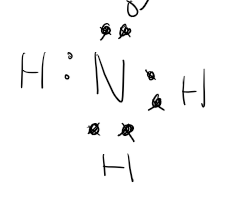
NH3

C3H8

CO2

SO3

OH -

NH4 +

SO4 2-

PO4 3-

CO3 2-

NO3 -
Coordinate Covalent Bonds
Both bonding electrons are contributed by the same atom
Thing to remember with covalent molecular substances
weak intermolecular forces between molecules in a covalent bond
low melting and boiling point covalent structures
as they only have to overcome weak IMF holding the molecules together. As these forces are weak, lower energy is required to overcome them, meaning they have a low melting and boiling point
soft covalent structures
they have weak readily broken IMF between molecules, however crystals are an exceptions, because in crystals there are stronger bonds between molecules
Conducts electricity covalent structures
since electrons aren’t free to move and only are around the molecule they belong too, there is no movement of a charged particle meaning there is no current
outline the bonds in a covalent compound
Strong covalent bonds between atoms in the molecule, and there is a weak intermolecular bonds between molecules
Giant Covalent Networks
are large, rigid, three-dimensional arrangements of atoms held together by strong covalent bonds
Giant covalent networks are made up
of a three dimensional network of strong covalent bonds
Giant covalent networks bonds
are formed by atoms covalently bonding with other atoms in large 3d network
Melting/Boiling Point Diamond, graphite and silicon
High, as they have strong covalent bonds resulting in a high melting point, requiring lots of energy overcome them, meaning there is a high melting and boiling point
Giant Covalent networks malleability is brittle
the strong covalent bonds are very stiff which makes is brittle
Solubility in Water insoluble giant covalent networks
strong covalent bonds also make covalent networks insoluble in water. this is because the strong covalent bonds are much stronger than the bonds that can be formed between water and the atoms in the covalent network. so water molecules cannot attract and pull apart any parts of the giant covalent network meaning it can’t dissolve.
graphite is soft
Graphite is much softer than diamond because it is composed of 2D sheets connected by weak intermolecular forces, that are easily broken
diamond is hard
connected to each other with covalent bonds, harder to break
Diamond no conduct electricity
Most covalent networks, like diamond, don’t conduct electricity. This is because all the valence electrons are incorporated in covalent bonds. This means there are no free charge carriers to facilitate the flow of electric current!
Graphite electrical conductivity
Graphite forms 2D sheets of carbon. Spare delocalised electrons lie in the space between these sheets. These electrons are free to move along this space between the sheets. This means that graphite can conduct electricity and is often used as a conductor.
graphite covalent bonds
In graphite, covalent bonds only extend along one 2D plane to form a sheet of covalently bonded carbon atoms.
The intermolecular forces between sheets in graphite are much weaker than the strong covalent bonds between atoms in the 2D sheets.
With reference to the bonding of each substance, explain why CH4 boils at -161.6°C while SiO2 boils at 2230°C.
CH4 is a covalent molecular substance and therefore consists of separate, non-polar molecules held together by relatively weak dispersion forces.
SiO2 is a solid covalent network and consists of strong covalent bonds in three dimensions.
The stronger bonding in SiO2, due to its structure as a covalent network, means that more energy is required to break the intermolecular bonds. Therefore, its boiling point is much higher (2230˚C) than the temperature where CH4 boils (-161.6˚C).
Account for the differences in hardness and electrical conductivity between diamond and graphite with reference to the relevant bonding in these two minerals.
Diamond contains carbon atoms that are covalently bonded to four other carbon atoms in three dimensions. Graphite, on the other hand, involves sheets of covalently bonded carbons all within the same plane. Weak dispersion forces hold together these two-dimensional sheets.
Hardness:
Diamond is extremely hard due to its strong covalent bonds in three dimensions, giving rise to a dese, crystal structure.
On the other hand, graphite is soft. The weak imf forces between the sheets of carbon are easily broken, meaning the structure deforms easily.
Electrical conductivity:
Diamond is unable to conduct electricity as there are no mobile charge carriers (free ions or electrons). As all the valence electrons are utilised in covalent bonding, they are unable to move.
In graphite, there are spare, delocalised electrons between the two-dimensional sheets. As these electrons are free to move and carry charge, graphite is electrically conductive.
Generally speaking, covalent molecular substances tend to be softer than ionic or metallic structures.
Explain this statement with reference to the bonding in each structure. In your answer, identify and explain an exception to this rule.
Generally speaking, covalent molecular substances are soft because their molecules are held together by dispersion forces. These weak intermolecular forces are easily broken by small amounts of energy. In comparison, the electrostatic attraction and metallic bonding present in ionic and metallic structures, respectively, require more energy to break. This causes these structures to be much harder.
An exception to this rule is ice (solid H2O), which is a covalent molecular substance. Unlike other covalent molecular substances, ice is hard. In its solid state, hydrogen bonds hold water molecules together in a rigid crystal lattice. The strong hydrogen bonds in a regular, repeating structure make ice relatively hard.