unit 5 heredatiry retake
 Call Kai
 Learn
Learn Practice Test
 Spaced Repetition
 Match
Match Flashcards
 Knowt Play
1/24

There's no tags or description
Looks like no tags are added yet.
Name | Mastery | Learn | Test | Matching | Spaced | Call with Kai |
|---|
No analytics yet
Send a link to your students to track their progress
25 Terms
Saccharomyces cerevisiae is a diploid yeast species that can reproduce either sexually or asexually. An experiment was performed to induce mitotically dividing S. cerevisiae cells in to undergo meiosis. Which of the following best describes the steps these cells will follow to form gametes?
The first division will reduce the number of chromosomes by half for each daughter cell, and the second division will move single chromatids to each daughter cell.
Both mitosis and meiosis begin with a parent cell that is diploid. Which of the following best describes how mitosis and meiosis result in daughter cells with different numbers of chromosomes?
Mitosis produces two identical diploid daughter cells after one round of division. Meiosis produces four haploid daughter cells after two rounds of division.
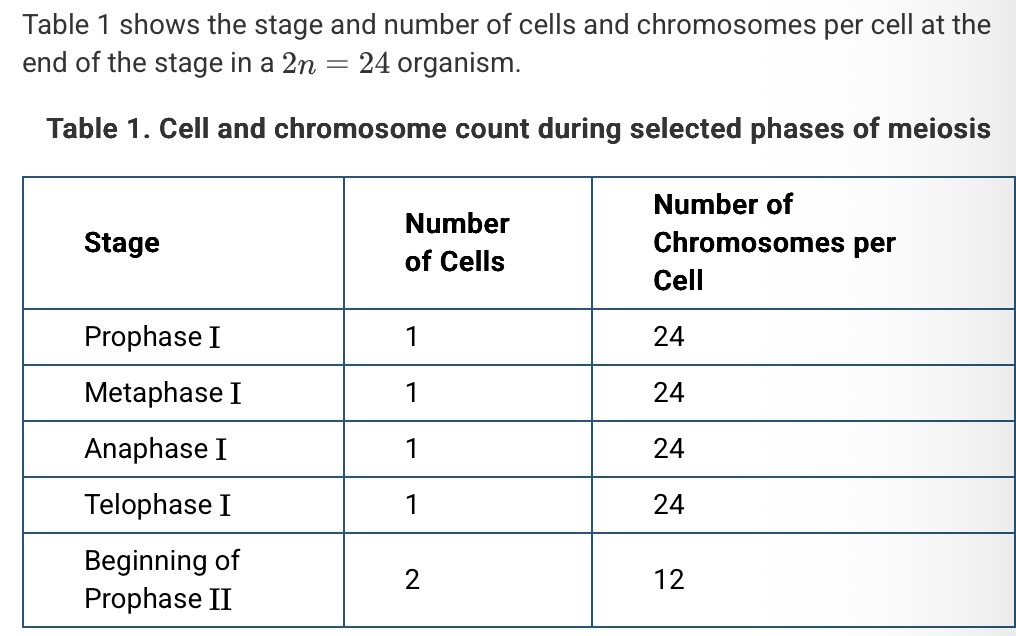
Which of the following statements correctly describes the chromosomes in each daughter cell at the end of meiosis ?
Each daughter cell contains 12 chromosomes, each composed of two chromatids. Each chromosome is one of a pair of homologous chromosomes from the parent cell, with the other homologue found in the other daughter cell.
The diploid number of chromosomes in the cell of a domesticated dog is . Which of the following options includes the correct number of chromosomes in a cell after each cellular process ( checkpoint, meiosis, and fertilization, respectively)?

The events listed below generally take place during meiosis.
I. Synapsis occurs.
II. Crossing-over is completed.
III. Condensation of chromosomes begins.
IV. Separation of homologous chromosomes begins.
Which of the following is the correct sequence of these events?
III, I, II, IV
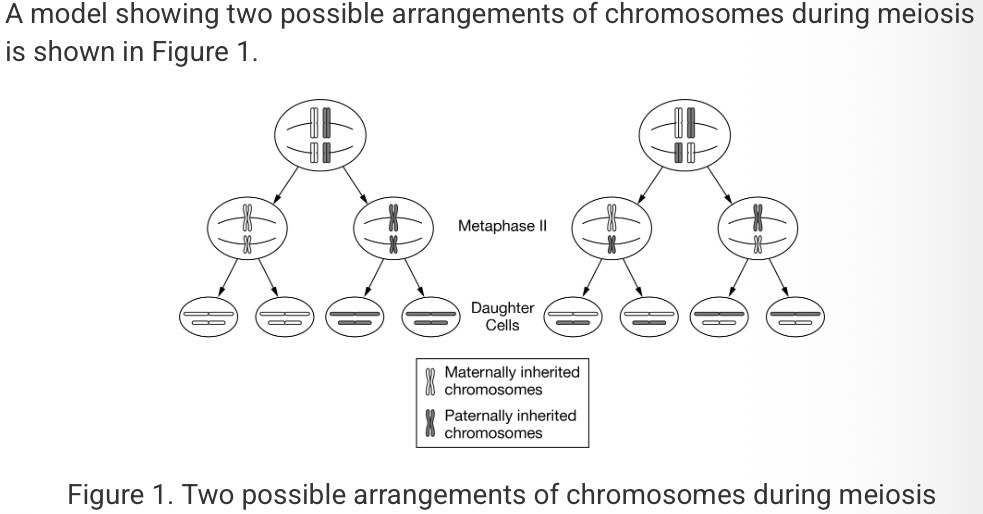
Which of the following questions about genetic diversity could most appropriately be answered by analysis of the model in Figure 1 ?
How does the independent assortment of the two sets of homologous chromosomes increase genetic diversity?
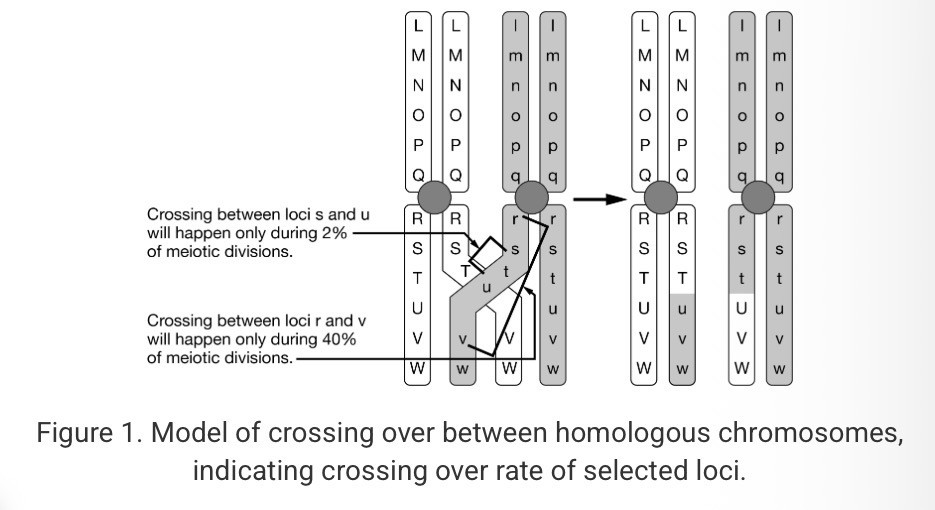
During prophase replicated homologous chromosomes pair up and undergo synapsis. What testable question is generated regarding synapsis and genetic variability by Figure 1 ?
Is the distance between two gene loci related to crossover rate?
In a breeding pair of eukaryotic organisms, no crossing over occurs between chromatids of homologous chromosome pairs during either egg formation or sperm formation. Which of the following best explains the genetic makeup of the offspring produced when eggs are fertilized by sperm in this breeding pair?
All offspring will be genetically different from each other and from the parents.
Which of the following best explains why triploid bananas do not produce seeds?
The production of gametes is disrupted because of unequal pairing of homologous chromosomes during meiosis.
A blue-flowered African violet of unknown ancestry self-pollinated and produced 50 seeds. These seeds germinate and grow into flowering plants. Of these plants, 36 produce blue flowers and 14 produce pink flowers. What is the best explanation for the pink-flowered offspring?
Pink flower color is a trait recessive to blue flower color.
Directions: Each group of questions below concerns an experimental or a laboratory situation. In each case, first study the description of the situation. Then choose the one best answer to each question following it.
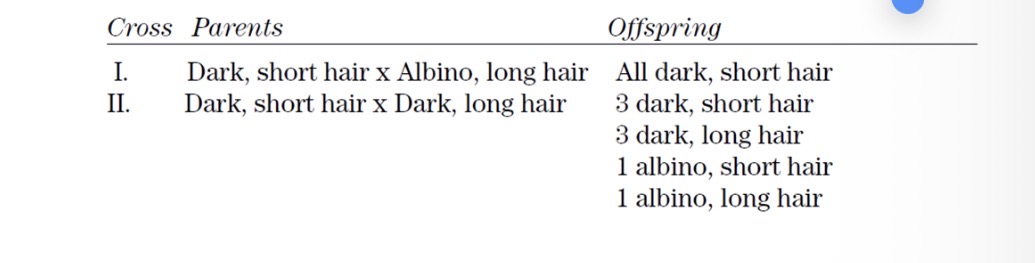
In dogs, one pair of alleles determines coat color (dark and albino). Another pair of alleles determines hair length (short and long). Thus, each gamete will contain one of the coat-color alleles, C or c and one of the hair-length alleles, Bor b. In repeated crosses of a specific dark, short-haired dog with an albino, long-haired dog, all the offspring were dark with short hair, as shown in cross I. However, in subsequent crosses of another dark, short-haired dog with a dark, long-haired dog, the ratios shown in cross II below were obtained.
In cross II, the genotype of the dark, short-haired parent is
CcBb
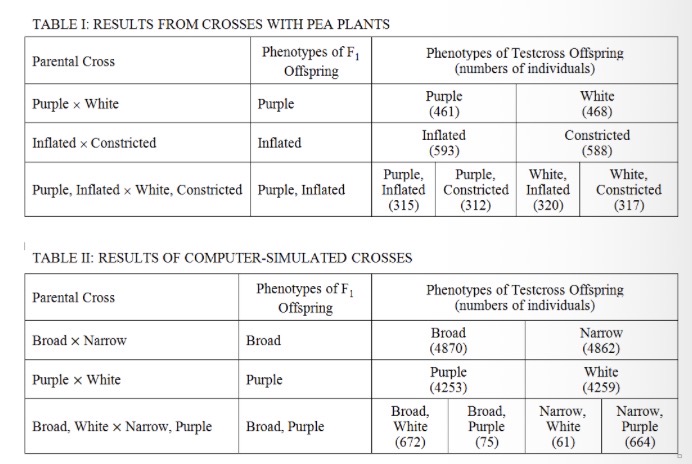
Table I shows the results of breeding experiments to examine the inheritance of flower color (purple versus white) and pod shape (inflated versus constricted). For the crosses recorded in Table I, true-breeding parents were crossed to produce F1 offspring, which were then testcrossed to homozygous recessive individuals. Table II shows the results of computer-simulated crosses to model the inheritance of leaf shape (broad versus narrow) and flower color (purple versus white).
Based on the data in Table I, which of the following best explains why there are no individuals with constricted pods in the F1 generation?
Inflated pod shape is dominant to constricted pod shape.
A researcher hypothesizes that, in mice, two autosomal dominant traits, trait Q and trait R, are determined by separate genes found on the same chromosome. The researcher crosses mice that are heterozygous for both traits and counts the number of offspring with each combination of phenotypes. The total number of offspring produced was . The researcher plans to do a chi-square analysis of the data and calculates the expected number of mice with each combination of phenotypes.
Which of the following is the expected number of offspring that will display both trait Q and trait R?
36
In pea plants, flower color and the length of the flower’s pollen grains are genetically determined. Researchers studying pea plants crossed homozygous dominant pea plants with homozygous recessive pea plants. The plants were then crossed, and the number of offspring with each phenotype was recorded. The researchers’ observed data, however, differed from the expected data. The researchers did a chi-square analysis and calculated the chi-square value to be .
Based on their calculation, the researchers would most likely conclude which of the following?
The differences between observed data and expected data are due to chance.
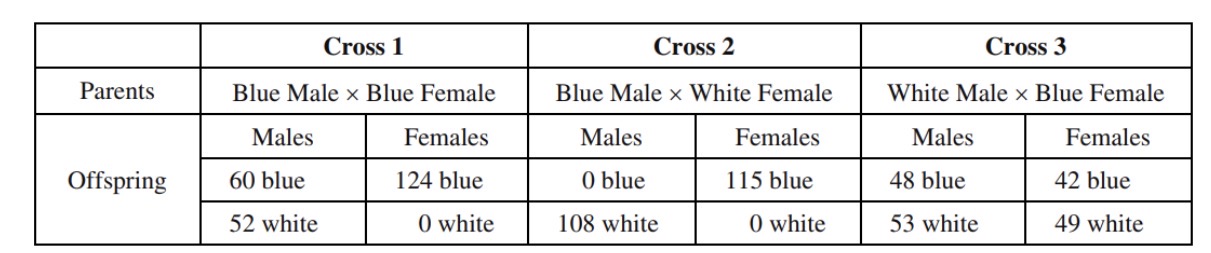
The data above represent the results of three different crosses involving the inheritance of a gene that determines whether a certain organism is blue or white. Which of the following best explains the mechanism of inheritance of the gene?
The allele for blue is an X-linked dominant allele because there are no blue male offspring in cross 2.
In humans, red-green color blindness is a sex-linked recessive trait. If a man and a woman produce a color-blind son, which of the following must be true?
The mother carries the allele for color blindness.
A researcher observes that when two heterozygous plants with red flowers are crossed, the resulting offspring include plants with red, white, or pink flowers. The researcher proposes the null hypothesis that flower color is the result of independent assortment and incomplete dominance. The researcher calculates a chi-square value of .
Assuming two degrees of freedom, which of the following is the correct interpretation of the chi-square analysis, using a -value of ?
The null hypothesis should be rejected because the critical value is less than the calculated value.
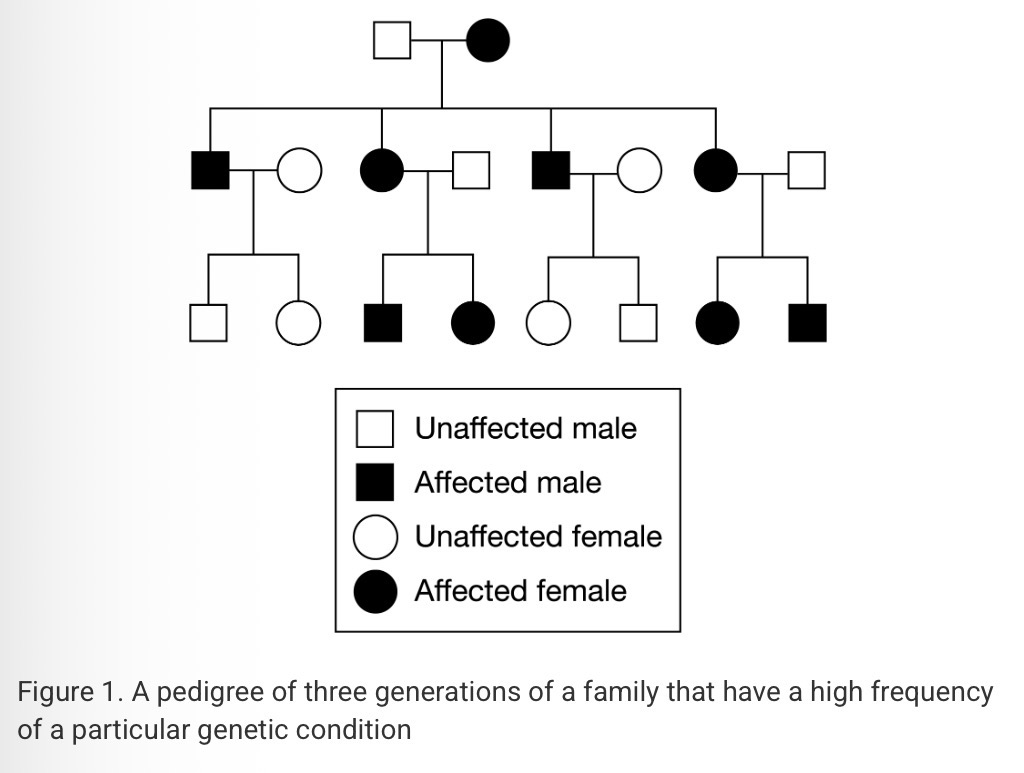
Figure 1 shows the inheritance of a particular genetic condition in three generations of one family. Which of the following best explains the observed pattern of inheritance?
The condition is passed from mothers to offspring via a mitochondrial gene.

The mean map distance between gene R and gene L is closest to which of the following?
28 map units
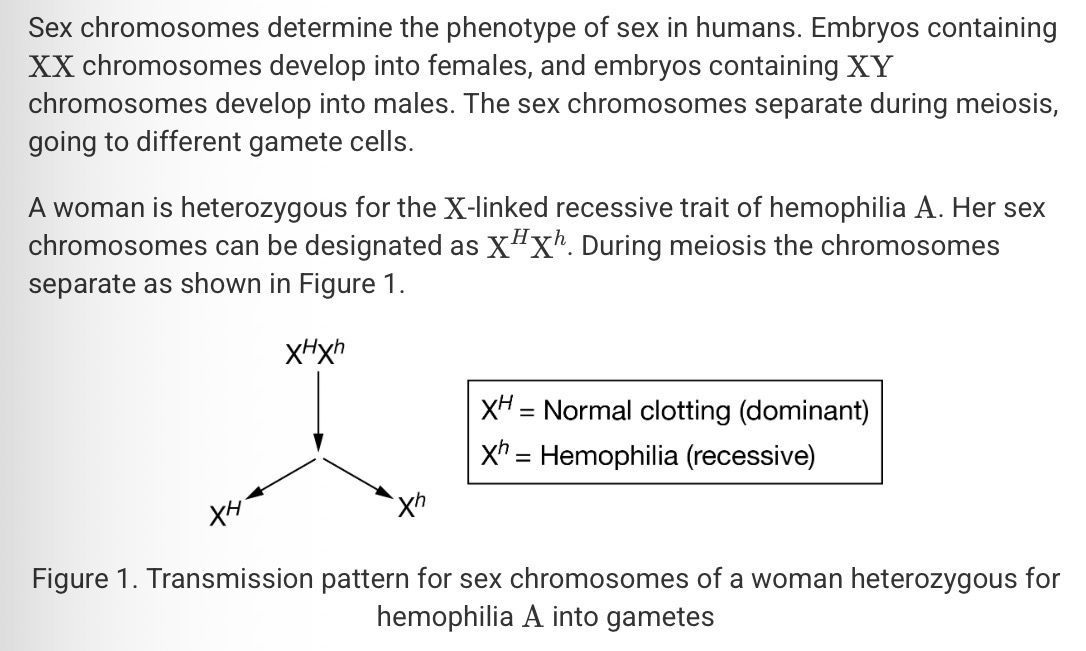
If the woman and a man with normal clotting function have children, what is the probability of their children exhibiting hemophilia A?
50 percent for sons, 0 percent for daughters
Himalayan rabbits are a breed of rabbits with highly variable fur color. If genetically similar rabbits are raised in environments that have different temperature conditions, the rabbits can have different color patterns.
Which of the following statements best explains how the fur color can be different in Himalayan rabbits raised under different temperature conditions?
The environment determines how the genotype is expressed.
Australian dragon lizards have a ZW sex-determination system. The male genotype is homogametic (ZZ), and the female genotype is heterogametic (ZW). However, all eggs incubated at temperatures 32 C above tend to develop into females.
Which of the following best explains how the development of phenotypic female Australian dragon lizards with a ZZ genotype occurs when incubation temperatures are above 32 C?
Incubation temperatures above inhibit the genes on the Z chromosome that produce proteins necessary for male development.
In the spring and summer, the fur of an arctic fox contains a pigment called melanin that gives the fox’s fur a dark color. In the fall and winter, the fur of the arctic fox is white.
Which of the following most likely explains how the changing seasons result in changing fur color in an arctic fox?
Environmental factors cause changes in gene expression, resulting in seasonal variations in pigment production.
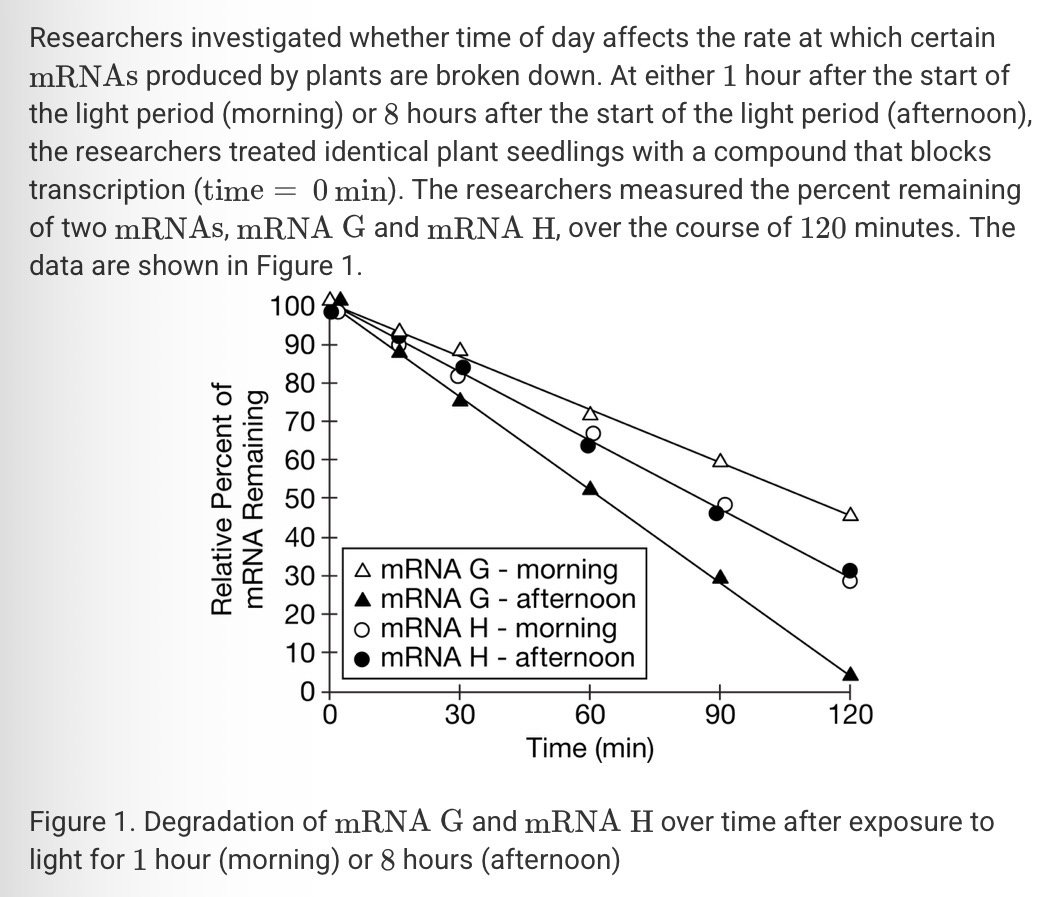
Based on the data, which of the following best describes the relationship between light and the degradation of mRNA Gand mRNA H?
A longer exposure to light increases the rate of mRNA G degradation but not of mRNA H degradation.
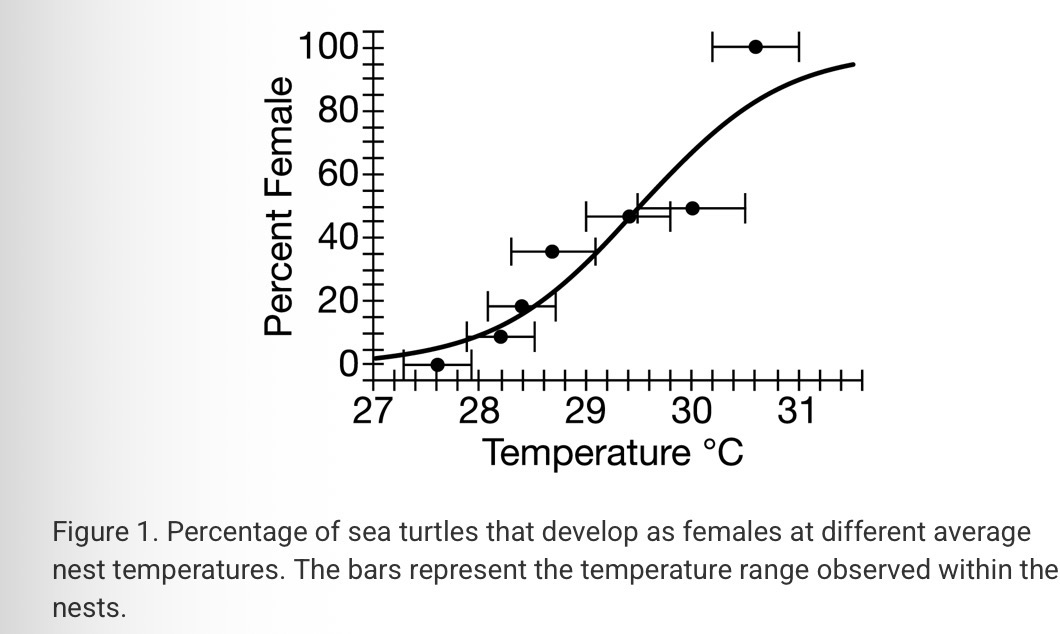
Some green sea turtle females deposit their eggs in nests that are dug on warm, tropical beaches. Researchers have studied the effects of temperature on the hatching rate and the proportion of female to male hatchlings produced at different average nest temperatures in Suriname (Figure 1). At temperatures below 23 C or above 33 C, the eggs do not develop.
Warmer nests produce more female sea turtles than do cooler nests.