Chem 215-1 Midterm 3
 Call Kai
 Learn
Learn Practice Test
 Spaced Repetition
 Match
Match Flashcards
 Knowt Play
1/12

There's no tags or description
Looks like no tags are added yet.
Name | Mastery | Learn | Test | Matching | Spaced | Call with Kai |
|---|
No analytics yet
Send a link to your students to track their progress
13 Terms
Epoxides as substrates conditions?
Neutral and basic = Sn2 first then proton transfer to make an alcohol
Acidic = Proton transfer to positive O, SN2
START: Epoxides
END: Depends on reagents
In an epoxide as substrate reaction, why are they able to have an RO- as a leaving group (ineffective for SN2 reactions)?
Because epoxides are highly strained, this releases ring strain
In epoxides as substrate reactions, which C does the nucleophile attack?
Neutral/basic conditions, attacks at the less highly substituted C atom of the ring
Acidic, attacks at more highly substituted atom
When does Walden inversion occur and what is it?
When a nucleophile attacks a C atom in an SN2 step, the connected three groups point away from the nucleophile (dashed and wedged stay the same), like an umbrella flipping in and out
Formation of epoxides by nucleophilic substitution conditions?
START: Halohydrin (looks like a ketone with H on oxygen)
END: Epoxide
Proton transfer → SN2 (oxygen nucleophile attacks itself to close ring with Cl- as leaving group)
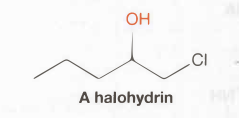
What is diazomethane?
CH2N2
Diazomethane (CH2N2) formation of methyl esters conditions?
START: Carboxylic acid
NEED: Diazomethane
END: Ester with methyl on end (with O)
Proton transfer → SN2 (both with diazomethane)
Amines + quaternary ammonium salts from alkyl halides conditions?
START: Amines
NEED: alkyl halide
END: Primary → secondary → tertiary → quaternary amine
SN2 → Proton transfer
What does excess NH3 do for a quaternary ammonium reaction?
Ensures that the alkyl halide reactions with NH3 rather than the amine product (which would increase the degree of the amine), still decent amount of it though
Alkylation not that effective to synthesize specific amines (degrees)
What does adding a large excess of alkyl halide do in a quaternary ammonium reaction?
Allows for the formation of a lot of quaternary ammonium ions
Hofmann elimination conditions?
START: Primary amine
NEED: Excess CH3I
END: anti-Zaitsev product
SN2 → Proton transfer → 2 more alkylations → Replaces og SN2 leaving group with HO- → E2
Generating alkynes by elimination conditions?
START: Alkene
NEED: Base
END: Alkyne
E2 → Proton transfer → Proton transfer (acid)
Leaving group in vinylic position
Carried out at extreme temperatures, >200 degrees C
Acid workup
Alkylation of terminal alkyne (reactions that alter the carbon skeleton) conditions?
START: terminal alkene
NEED:
END:
Proton transfer → SN2