HC 6: Genomics and Metagenomics
 Call Kai
 Learn
Learn Practice Test
 Spaced Repetition
 Match
Match Flashcards
 Knowt Play
1/14

There's no tags or description
Looks like no tags are added yet.
Name | Mastery | Learn | Test | Matching | Spaced | Call with Kai |
|---|
No analytics yet
Send a link to your students to track their progress
15 Terms
a genome tells us a lot about the ecology of an organism:
for example, this bacterium creates one type of siderophore, but has receptors for multiple types
this means that it leaches of off siderophores created by other bacteria →
this means that this bacterium lives around other species!
Genomics provide us insight into:
The genomic complexity and evolution of an organism
Metabolic pathways and potential ecology
Elements that are lacking, things it can not make, which may help with cultivation.
What can genome sequences not tell us:
Levels of transcription, and if those transcripts are made into proteins and whether they are modified after
Relative efficiency of enzymes
The functions of genes that have not been well characterized.
Major flaw in genome annotation:
Mostly based on homology → this gene looks like a gene that codes for this, based on my database, so it must be the same function.
Some references are a bit sketchy, this way gene function calling can go wrong.
You should prove that a gene has a certain function, but often just reference genes from databases are used.
transcriptomics
Examination of gene expression across an entire genome
Relies on having the genome sequence and accurate data on gene annotation
Only examined mRNA levels
Not really quantitative: doesn’t say anything about how much is transcribed
sequencing approaches
1. Extract RNA
RNA is isolated from the cells (e.g., bacteria under different conditions).
2. Convert RNA to cDNA
Because RNA is unstable, it is converted into complementary DNA (cDNA) using reverse transcriptase.
3. Sequence the cDNA
The cDNA fragments are sequenced
4. Analyze the reads
The sequences are mapped back to the genome to identify which genes they came from.
The number of reads per gene shows how strongly that gene is expressed.
Proteomics
Look at all the proteins that are made, and compare which are more active and prevalent in different conditions.
Extract proteins from a sample
Cut them into peptides
Measure them with mass spectrometry
Match the data to protein databases to identify proteins
Quantify protein levels across samples
Metagenomics: targeted versus shot-gun approaches
Targeted: looking for specific thing within the metagenome
Shot-gun: sequence everything and then piece it back together later on.
targeted
DNA is extracted directly from an environmental sample
then fragmented and cloned into vectors (often large-insert vectors like fosmids or BACs)
These constructs are introduced into a bacterial host (e.g., E. coli) to create a metagenomic library.
The library is then functionally screened for traits of interest, such as antibiotic production or enzyme activity.
»It does have to contain 16S rRNA gene.
Metagenomics for the discovery of new drugs and natural products
DNA from environments (soil, ocean, gut, etc.) is sequenced or cloned into libraries.
Researchers search for new genes and biosynthetic pathways that may produce useful molecules.
Functional screening can identify microbes or genes that make antibiotics, enzymes, or other bioactive compounds.
This expands the search beyond easily cultured microbes, revealing many previously unknown natural products.
Ecology-based nature mining:
when you look at antioxidant compounds → where does nature need antioxidants? → wood that’s attacked by fungi.
The fungi put toxic stuff in the wood, so bacteria that want to grow there are packed with antioxidants
Where do you look for antibiotics?
You look at places where you know where bacteria are fighting with each other. Like biofilms etc.
Appreciate the possibilities but also the limitations of metagenomic approaches
mogelijkheden
o ontsluit het “verborgen chemische potentieel” van de enorme meerderheid aan micro-organismen die we niet kunnen kweken
o reconstrueren van volledige metabole paden in complex gemeenschappen
beperkingen
o hoe diverser het monster, hoe moeilijker het is om volledige informatie terug te krijgen vanwege de lagere redundance in sequencing
o veel functies worden toegekend op basis van gelijkenis/homologie in databases, wat riskant is als de oorspronkelijke referentie niet klopt
o DNA alleen bewijst niet dat een organisme op dat moment actief is
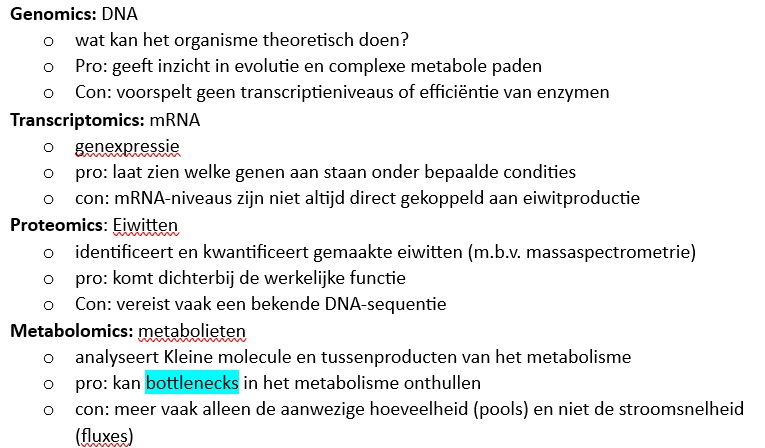
different “omics” approaches: genomics, Transcriptomics, Proteomics, Metabolomics
what can and cannot be inferred from patterns of co-occurrence
- wat het wel zegt: statistische netwerken van microben die vaak juist wel of niet samen voorkomen —> identificeren generalisten en specialiten
- wat het niet zegt: Co-occurrence betekent niet automatisch een fysieke interactie à het is een statistisch patroon dat ook veroorzaakt kan worden doordat microben bijv. simpelweg dezelfde omgevingsvoorkeuren hebben
Metagenome-Assembled Genomes (MAGs):
Door stukjes DNA die altijd in dezelfde verhouding verschijnen samen te voegen, kunnen (delen van) genomen worden gereconstrueerd van organismen die we nog nooit in een reincultuur hebben gezien