Chapter 10 - classification and evolution
 Call Kai
 Learn
Learn Practice Test
 Spaced Repetition
 Match
Match Flashcards
 Knowt Play
1/23

There's no tags or description
Looks like no tags are added yet.
Name | Mastery | Learn | Test | Matching | Spaced | Call with Kai |
|---|
No analytics yet
Send a link to your students to track their progress
24 Terms
What is taxonomy?
Taxonomy is the practice/study of biological classification
What is classification?
Arranging organisms into groups based in their similarities and differences. This makes it easier for scientists to study and identify them.
How many levels are there in the taxonomic hierarchy?
there are 8 levels
What are all of the levels called in a taxonomic hierarchy?
Domain
Kingdom
Phylum
Class
Order
Family
Genus
Species
What is the overall name for a group in the taxonomic system?
A taxon
Are there more or less groups going down the taxonomic hierarchy?
There are more groups but less individuals in each group
What are the three domains?
Bacteria
Archaea
Eukarya
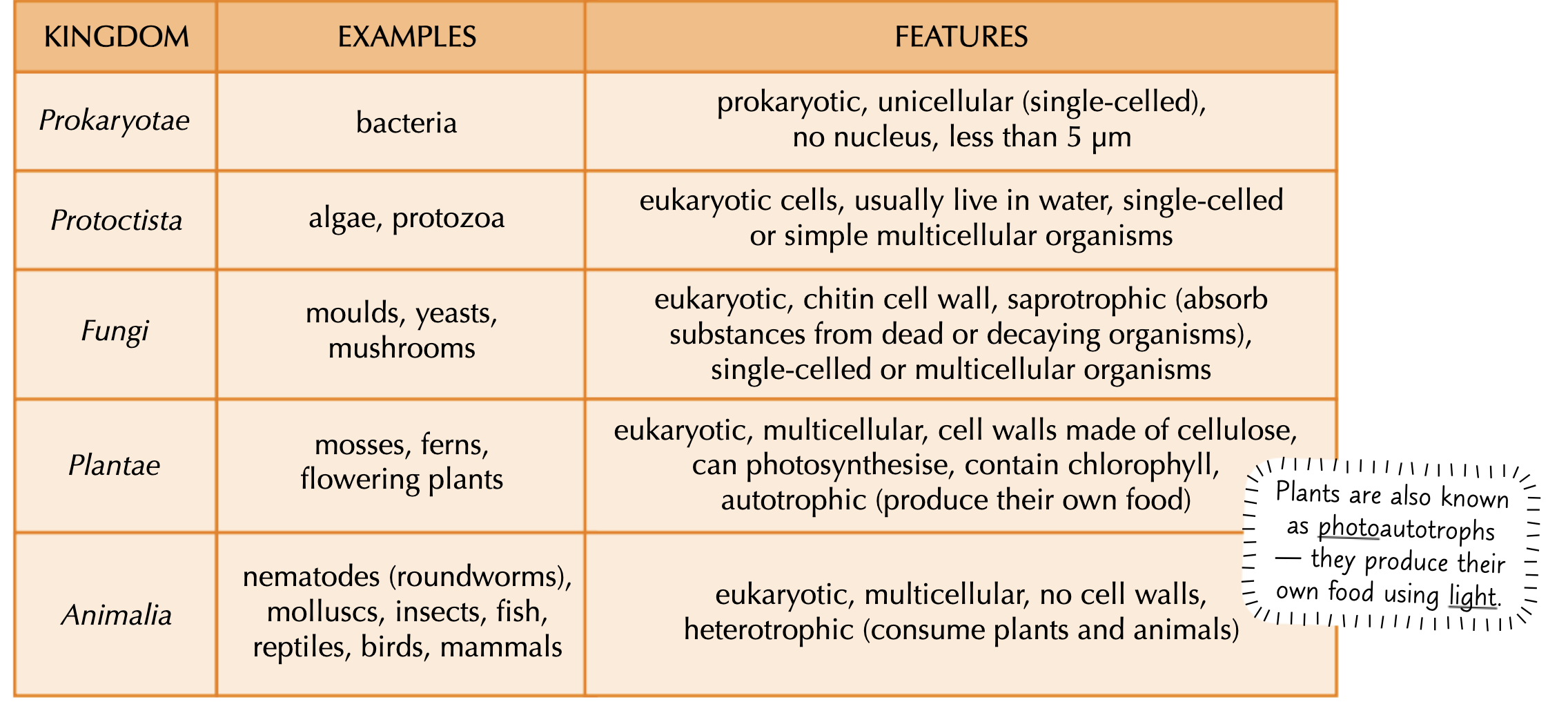
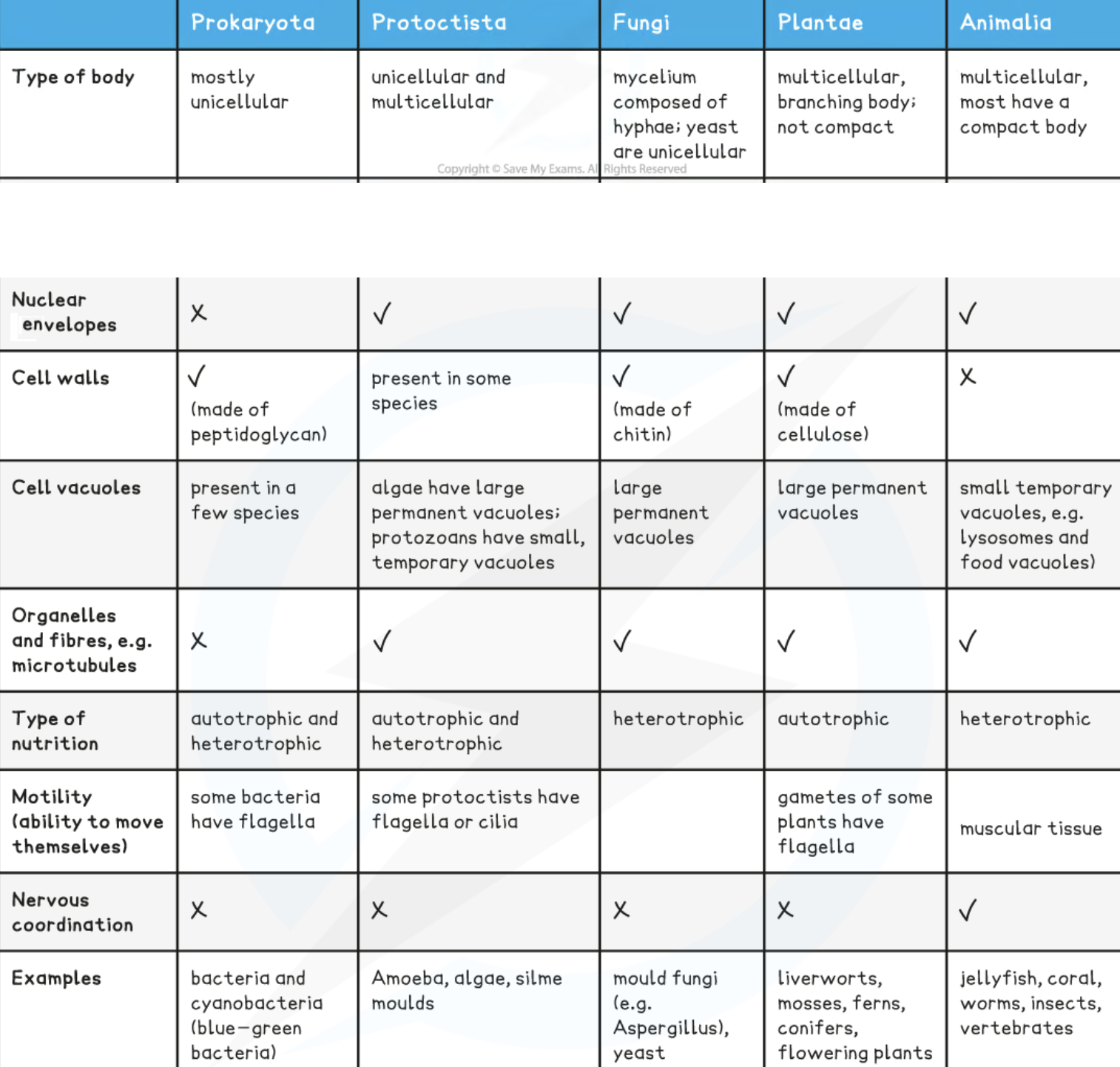
What are the 5 kingdoms?
Plantae (plants)
Animalia (animals)
Protoctista (unicellular eukaryotes)
Fungi (such as yeasts)
Prokaryote (e.g. bacteria)
What is the binomial naming system?
Where all organisms are given two names in Latin that are universally recognised. The first part is the Genus and the second part is the species. The genus is capitalised and the second part is lower case. The binomial name should always be in italics. e.g. Homo sapiens is humans.
Why is the binomial name useful?
It helps to avoid confusion of using common names.
How came up with the binomial naming system?
Carl Linnaeus
What are the features of the five kingdoms?
Give some characteristics of archaea.
Organisms within this domain are sometimes referred to as the extremophile prokaryotes, as archaea were first discovered living in extreme environments (although not all archaea do)
Archael cells have no nucleus (and so are prokaryotic)
They were initially classified as bacteria until several unique properties were discovered that separated them from known bacteria, including:
Unique lipids being found in the membranes of their cells
No peptidoglycan in their cell walls
Ribosomal structure (particularly that of the small subunit) are more similar to the eukaryotic ribosome than that of the bacteria
Archaea have a similar size range as bacteria (and in many ways metabolism is similar between the two groups)
DNA transcription is more similar to that of eukaryotes
Example: Halobacterium salinarum is a species of the archaea domain that can be found in environments with high salt concentrations like the Dead Sea
Give some characteristics of bacteria.
These are organisms that have prokaryotic cells which contain no nucleus
They vary in size over a wide range: the smallest are bigger than the largest known-viruses and the largest are smaller than the smallest known single-celled eukaryotes
Bacterial cells divide by binary fission
Example: Staphylococcus pneumoniae is a species of bacteria that causes pneumonia
Give some characteristics of ekarya.
Organisms that have eukaryotic cells with nuclei and membrane-bound organelles are placed in this domain
They vary massively in size from single-celled organisms that are only several micrometres across, to large multicellular organisms many-metres in size, such as blue whales
Eukaryotic cells divide by mitosis
Eukaryotes can reproduce sexually or asexually
Example: Canis lupus, also known as wolves
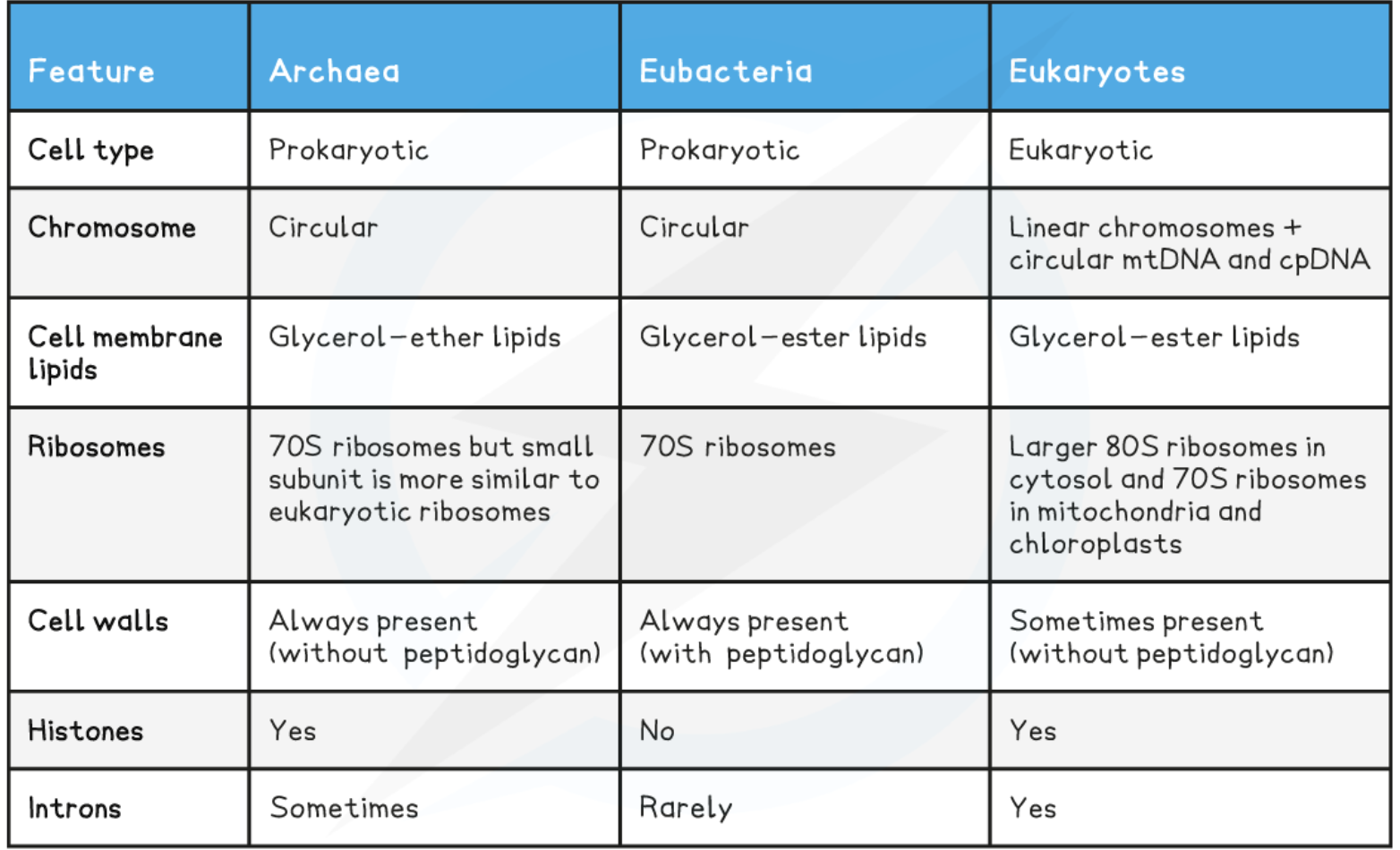
What are the key differences between archaea and bacteria?
The membrane lipids of Archaea consist of branched hydrocarbon chains bonded to glycerol by ether linkages
The membrane lipids of Bacteria consist of unbranched hydrocarbon chains bonded to glycerol by ester linkages
The base sequences of ribosomal RNA in Archaea show more similarity to the rRNA of Eukarya than Bacteria
The primary structure of ribosome proteins in Archaea show more similarity to the ribosome proteins in Eukarya than Bacteria
Organisms from the Bacteria domain have cells that always possess cell walls with peptidoglycan
Organisms from the Archaea domain also have cells that always possess cell walls, however these do not contain peptidoglycan
Explain the main features of the 3 domains
Compare the 5 kingdoms
What is phylogeny?
The evolutionary history of organisms
What are the advantages of phylogenic classification
It produces a continuous tree that doesn't force organisms into specific taxonomic groups where they don't quite fit.
There is no overlap between the groups produced.
How does phylogeny link to classification.
Classification was based on visible features, which had problems as scientists couldn’t always agree on the importance of different feature. Now it’s mainly based on phylogeny—the evolutionary history and relationships between organisms
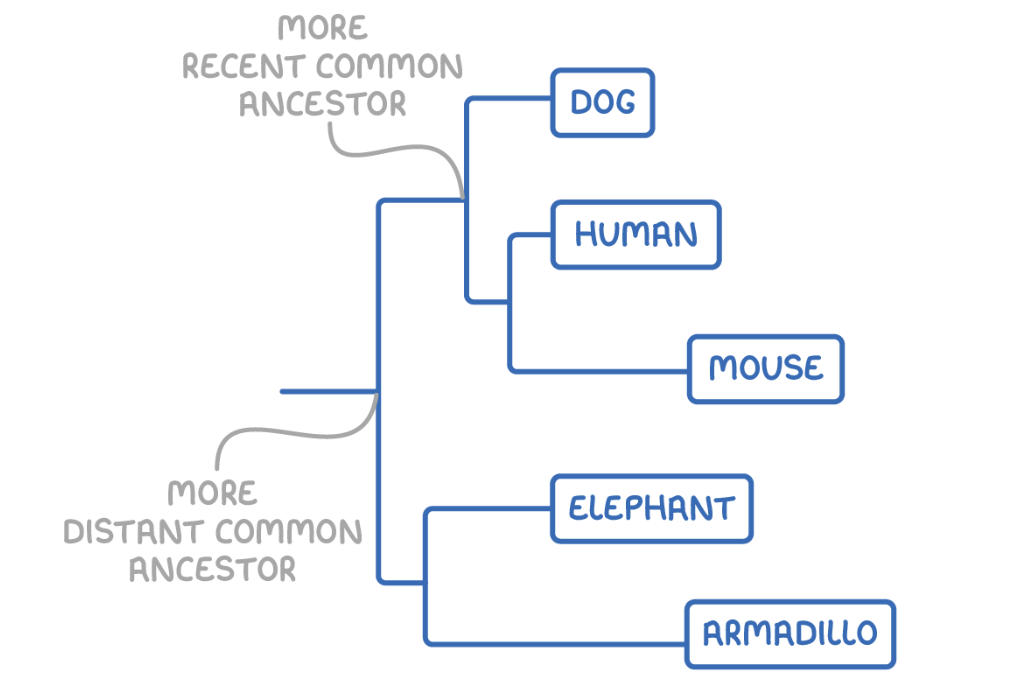
What does a phylogenic tree show?
The relative positions of branching points show distance of shared common ancestors.
The relative distances between vertical lines shows closeness of species' evolution from common ancestral branches.
The proximity of species to each other indicates the closeness of their evolutionary relationship.
Why is molecular analysis useful?
You can compare things like how DNA is stored and the sequence of DNA bases. e.g. the base sequence for human and chimpanzee DNA is about 94% the same.
You can also compare the sequence of amino acids in proteins from different organisms. e.g. The more similar the amino acid sequence in a certain protein in two different species, the more closely related the species are likely to be.
This allows scientists to classify organisms according to their phylogeny more accurately than using visible characteristics