A1.2 nucleic acids
 Call Kai
 Learn
Learn Practice Test
 Spaced Repetition
 Match
Match Flashcards
 Knowt Play
1/22

There's no tags or description
Looks like no tags are added yet.
Name | Mastery | Learn | Test | Matching | Spaced | Call with Kai |
|---|
No analytics yet
Send a link to your students to track their progress
23 Terms
What is the biological macromolecule that includes DNA?
nucleic acid
What are the building blocks of nucleic acids
nucleotides (repeating monomers)
they join together to make nucleic acids through polymerisation (condensation reaction)
What are the 2 types of nucleic acids
RNA (Deoxyribonucleic acid)
RNA (ribonucleic acid)
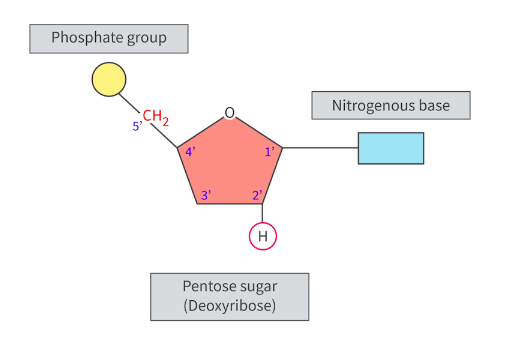
List the 3 components of a nucleotide and draw it
pentose sugar
nitrogenous base
a phosphate group
How do nucleotide units link together? What is this process called?
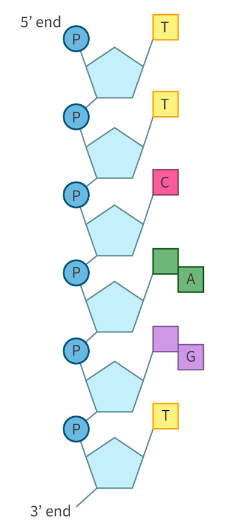
sugar-phosphate binding
nucleotide units use covalent bonds to form a single strand of DNA/RNA
forms between phosphate group (5’C of one pentose sugar) and hydroxyl group (3’C of another sugar)
this releases 1 x H2O
forms a sugar-phosphate backbone
what are the 3 ends of DNA?
5’ end —> phosphate end of one sugar
3’ end —> --OH group of another sugar
What are the 2 types of bases? give examples
purines = 2 rings
adenine, guanine
pyrimidines = 1 ring
thymine, cytosine, uracil
Draw DNA
Compare and contrast DNA and RNA
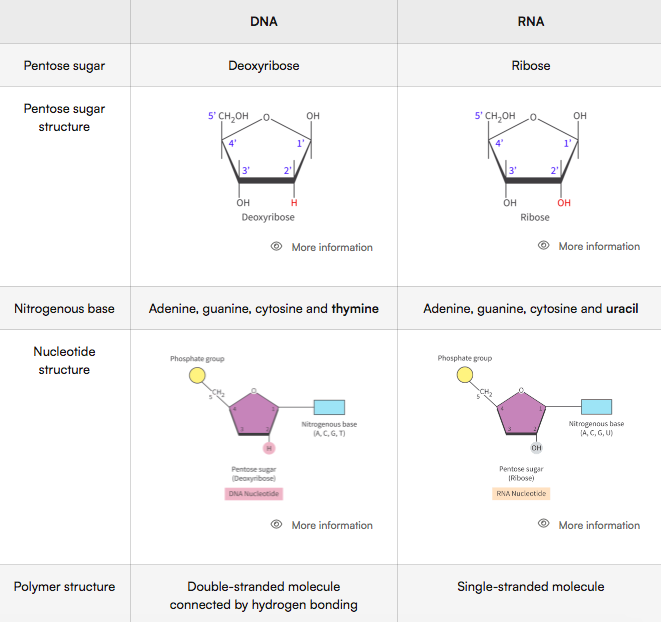
DNA
double helix
the permanent genetic code
RNA
variety of shapes depending on the type of RNA
does not contain a permanent genetic code except in RNA viruses
How are the 2 strands of DNA joined together? Why is this important?
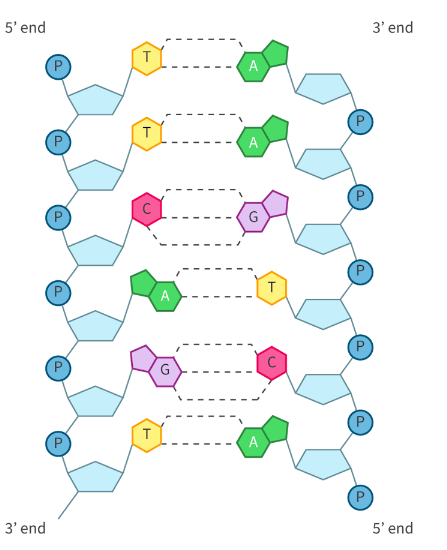
complementary base pairing between N-bases
this helps stabilise double helix
List some functions of the complementary base pairing rule
Stabilises double helix
maintains the accurate base sequence during DNA replication
ensures the same protein is produced (same code) during geneexpression
The genetic code is used by who?
all living organisms, meaning the same protein will be made no matter who translates it
How many bonds are formed in A,T,C,G?
AT = 2 hydrogen bonds
CG = 3 hydrogen bonds
Replication, transcription, translation all occur in which direction? why does direction matter?
5’ to 3’
ensures the conservation of DNA base sequence so the same protein is produced
also, enzymes can only attach in a certain direction
Why must A always pair with T, and C with G?
If A binds with G, for example, the length is too long
If T binds with C, the length is too short
AT, CG complementary bonding is needed to stabilise DNA because the length of the base pairs is consistent
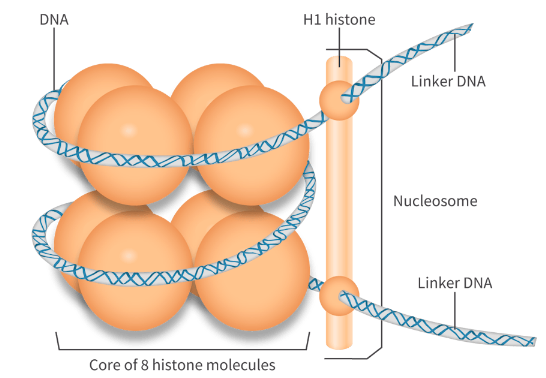
What form is eukaryotic DNA found in the nucleus? describe the structure
as nucleosomes:
has DNA (Around 150 base pairs) wrapped around a core of 8 histones + H1 special histone (maintains shape) TWICE
nucleosomes are linked together, with DNA strand from one nucleosome going into the next nucleosome (this section is called DNA linker)
What is the relationship between nucleosomes and chromosomes?
Chromosome > chromatin fibre > nucleosomes > double helix
nucleosomes stack up and coil around other proteins in a very condensed shape called chromosomes
Why are nucleosomes important?
Since eukaryotes have large genomes, nucleosomes help supercoil DNA while ensuring appropriate access to it
this helps fit it into the nucleus
DNA can be accessed when coils unwind and histones are removed so DNA can be copied/transcribed
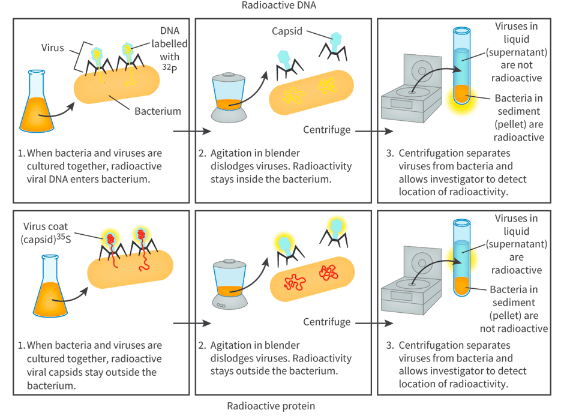
Describe the hershey-chase experiment and the steps involved
goal: prove that DNA makes up genetic material and not protein
used T2 bacteriophage (virus that infects E. coli bacteria). The virus injects its DNA into bacteria cell while protein coat remains on outside
used radioactive phosphorus (to label DNA) and sulfur (to label protein)
conclusion: when bacteriophages with (32P) infected non-radioactive bacteria, all the infected cells became radioactive. THe next generation of bacteriophages were all radioactive. When bacteria were infected with bacteriophages (35S), no radioactivity was detected (since virus coats were removed)
thus: bacteriophages inject DNA into bacterial cell while protein component remains outside
What did Chargaff’s data prove?
before: thought that DNA was single stranded and made from repeating units of tetranucleotides —> equal amounts of A, G, C, T
Now: Chargaff analyzed DNA using paper chromatography to analyze relative concentrations of A, T, C, G
conclusion = amount of A = T, and amount of C = G
supported double helix model and about complementary base pairing
What type of reaction forms covalent bonds to create the sugar phosphate backbone?
condensation
Compare and contrast ribose vs. deoxyribose
Ribose:
C5H10O5
has 1 more oxygen than deoxyribose (a OH group at C2 instead of H)
Deoxyribose
C5H10O4
give 4 examples of nucleic acids
mRNA
tRNA
rRNA
ATP