CHE217 - 2.3 Strengthening Mechanisms
 Call Kai
 Learn
Learn Practice Test
 Spaced Repetition
 Match
Match Flashcards
 Knowt Play
1/19

There's no tags or description
Looks like no tags are added yet.
Name | Mastery | Learn | Test | Matching | Spaced | Call with Kai |
|---|
No analytics yet
Send a link to your students to track their progress
20 Terms
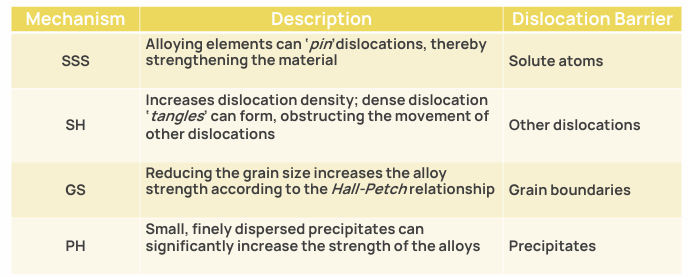
Solid Solution Strengthening
Impurity atoms distort the lattice and generate stress
Stress can produce a barrier to dislocation motion
Substitutional impurities
Smaller and larger __ __ tend to diffuse into strained regions around dislocations.
Amount of solute
Size of solute atoms
Shear modulus of solute atoms
Strength of hardening effect is proportional to:
Strain Hardening
Also called as COLD WORKING
Plastic deformation of ductile materials to increase strength
Temperature is lower than recrystallization temperature (~ 1/3 to ½ of melting temperature)
Increase of dislocation density with plastic deformation.
Parameters affected due to strain hardening
Increasing hardness
Increasing yield strength
Decreasing ductility (materials are more brittle)
Annealing
Removes effects of coldworking
Softens metal and reverts to strain-free condition
Recovery
Low temperature annealing
Eliminate residual stresses introduced during deformation
Does not reduce strength
Recrystallization
Medium temperature annealing
Eliminates all effects of the strain hardening produced
Grain growth
Movement of grain boundaries by diffusion to reduce the amount of grain boundary areas
Grain size strengthening
Materials with fine grain size are stronger than materials with coarse grains.
Barrier strength increases with misorientaation
Grain boundary barrier to dislocation motion → slip plane changes orientation/discontinues
Hall-Peth Equation
σy = σo + kyd(-1/2)
Strength varies with grain size
d can be controlled by rate of solidication
Obtaining smaller grain sizes
Grain refiners
Cooling materials faster during casting
Cooling materials faster during heat treatment
Precipitation Hardening
Age hardening - strength develops through heat treatment with time
Strength is enhanced by precipitation of very fine and uniformly dispersed hard phase
Fine precipitates distort the parent lattice and act as obstacles to dislocation movement
Requirement for age hardening alloys
Phase diagram must show decrease in solubility
Matrix phase must be ductile and strengthening precipitate is hard
Precipitate phase should be coherent with the matrix but distort sufficiently to block motion
Alloy should be quenchable
Noncoherent precipitate
No relationship with the crystal structure
Coherent precipitate
There is a definite relationship between the precipitate’s and matrix’s crystal structure.
Solution heat treatment
Form a homogeneous single phase solid solution
Quenchihng
Produce a supersaturated solid solution of alloying elements in the matrix.
Ageing
Form fine dispersion of precipitates
Natural ageing: Room temperature
Artificial ageing: Above room temperature
Summary of Mechanisms