predicted economics paper 1
 Call Kai
 Learn
Learn Practice Test
 Spaced Repetition
 Match
Match Flashcards
 Knowt Play
1/14

There's no tags or description
Looks like no tags are added yet.
Name | Mastery | Learn | Test | Matching | Spaced | Call with Kai |
|---|
No analytics yet
Send a link to your students to track their progress
15 Terms
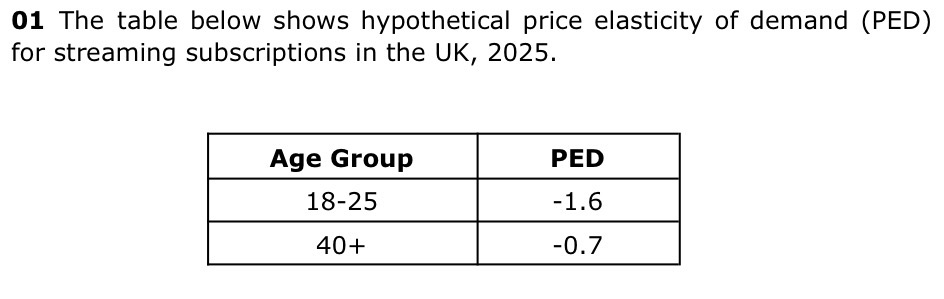
Explain one likely reason for the difference in PED between these age groups (4)
PED: measures the responsiveness of quantity demanded to a change in price
The demand for streaming subscriptions among 18-25 year olds is more price elastic (-1.6) because younger consumers tend to have greater access to substitutes such as free platforms like YT or social media entertainment such as TikTok
This means that if the price of a subscription rises, they can easily switch to alternative forms of entertainment → leading to a larger % fall in Qd
In contrast, older consumers (40+) have more inelastic demand (-0.7) as they may be more brand loyal or less familiar alternative services, making them less responsive to price changes
Factors affecting PED
NASBIT
Necessity or luxury
Addiction and habit
availability of Substitutes
Brand loyalty
proportion of Income
Time
Factors affecting PES
TEASS
Time period
state of the Economy
Availability of substitutes
Spare capacity
Stockpiles and perishability

Explain one likely factor that influences the price elasticity of supply (PES) of streaming services compared to physical cinema tickets (4)
PES measures the responsiveness of quantity supplied to a change in price.
The supply of streaming services is likely to be more price elastic because content is distributed digitally, allowing firms like Netflix, which reaches 59.2% of UK homes, to scale up access almost instantly by increasing server or cloud capacity
This means producers can respond quickly to higher demand without significant additional cost
In contrast, the supply of cinema tickets is more price inelastic since the number of physical seats and showings is fixed in the short run, making it difficult for cinemas to increase output when prices rise
Draw a graph to show a firm switching its objective from profit maximisation to revenue maximisation
Pmax: MC=MR
Rmax: MR=0
(Showing equilibrium)
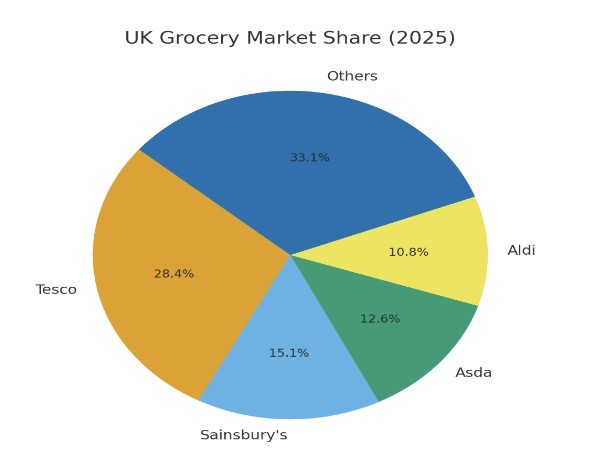
With reference, explain the market structure of the UK supermarket industry (4)
An oligopoly is a market structure in which a few large firms dominate total market sales
The UK supermarket industry fits this definition, as Tesco (28.4%), Sainsbury’s (15.1%), Asda (12.6%) and Aldi (10.8%) together control around 2/3 of the market
This high level of market concentration indicates that a small number of firms have significant power, creating high barriers to entry for new competitors due to economies of scale and brand loyalty
However, competition between these these major firms, particularly from discount retailers such as Aldi, still places pressure on prices and market behaviour
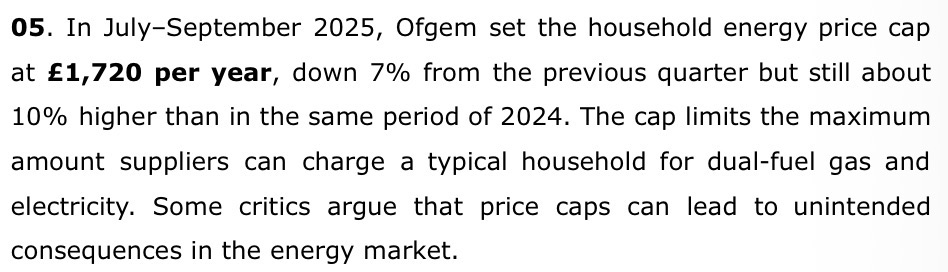
Explain one likely microeconomic reason for imposing this maximum price on energy bills (4)
A maximum price (also known as a price ceiling) is the highest price that firms are legally allowed to charge for a good or service
Ofgem’s 2025 energy price cap of £1,720 per year limits how much suppliers can charge households for gas and electricity
This policy aims to protect consumers from excessively high energy bills
By keeping prices below the free market equilibrium, the cap helps to make energy more affordable for lower-income and vulnerable households, ensuring they can maintain access to essential utilities
Brain drain
When highly skilled workers leave one country to work in another, reducing the domestic labour supply
Factors affecting elasticity of labour supply
(wtr: SUT): skills & qualifications (elastic in markers requiring low skills), unemployment levels (high = elastic), time (increase in wages = inelastic bc little time to train and apply)
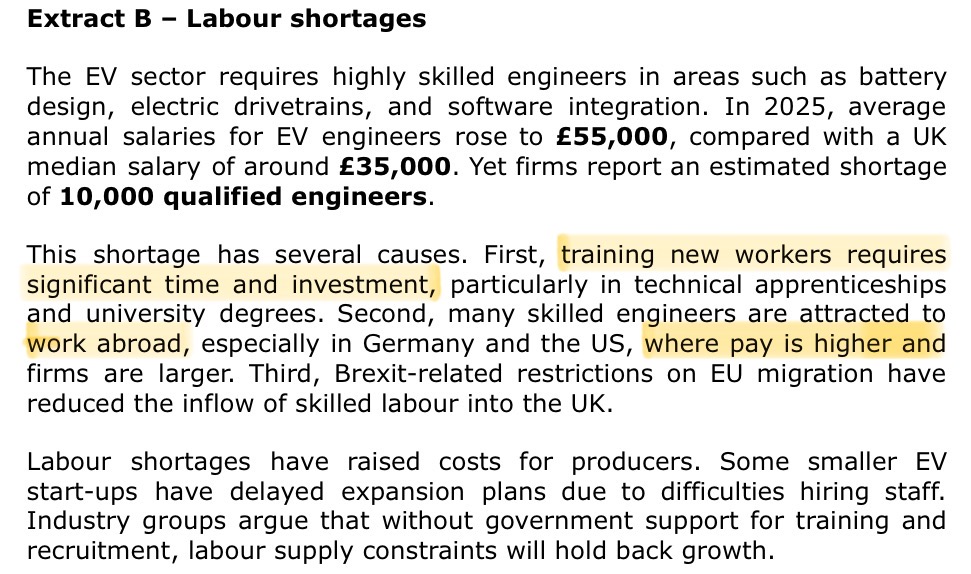
Examine two factors influencing the supply of labour in the EV sector (8)
Paragraph 1: factor
The first major influence is skills and training requirements
Production depends on electrical engineers, chemists and software specialists
Because these skills take years to develop, the SR supply of labour is inelastic, limiting how quickly firms can expand employment
Government STEM programmes and apprenticeships gradually shift the labour supply curve rightward, but capacity constraints remain in 2025
Paragraph 2: alternative factor
A second determinant is relative wages and working conditions
Higher pay in EV plants compared with traditional car factories attracts workers, increasing supply
However, if real wages fail to keep pace with inflation or working hours are antisocial, potential recruits may remain in other sectors
Geographical immobility is further reinforced in the EV sector because gigafactories tend to be concentrated in specific regions, meaning that even if skilled engineers exist elsewhere in the UK, their unwillingness or inability to relocate reduces the responsiveness of labour supply to rising wages.
Paragraph 3: conclusion
Overall, labour supply in the EV industry reflects a tension between high-skill scarcity and wage incentives
In the short run limited training pipelines dominate; in the long run better pay and government training can gradually ease shortages, making supply more elastic
Assess whether firms in the EV industry are likely to benefit from economies of scale (10) (use extract)
Knowledge
EOS are reductions in long-run average cost (LRAC) as output rises
Can arise from technical, managerial, purchasing, financial, marketing, and risk-bearing EOS
Shown by a downward-sloping LRAC curve up to the minimum efficient scale
Application
Battery industry mergers: firms combining operations to share R&D costs
Output rising 28% → spreading fixed costs over more units
Bulk buying inputs like lithium and nickel reduces unit input costs
Automation in gigafactories lowers unit labour costs
Real-world context: Tesla, CATL, BYD all scaling up to exploit EOS
Analysis
As firms expand, average costs fall, shifting LRAC downwards.
Sharing expensive R&D across merged firms lowers per-unit innovation costs → stronger competitiveness.
Purchasing EOS from bulk buying reduces costs, enabling lower consumer prices → higher market share.
Technical EOS: investment in high-capacity production lines raises efficiency
Can lead to increased profitability, or allow firms to cut prices → potential market dominance.
Diagram: LRAC falling with output; MES shown where lowest average cost reached
Evaluation
EOS may be offset by diseconomies of scale: communication problems, loss of managerial control.
Rising raw material prices (e.g. lithium) may erode bulk-buying advantages.
Large firms may suffer X-inefficiency due to lack of competition.
Mergers could attract regulatory scrutiny (competition authorities).
In fast-changing industries, smaller firms may be more flexible and innovative.
Long-term EOS depend on sustained demand growth in EV/battery markets
Discuss the likely concerns of competition authorities about the proposed merger in the battery industry (12)
→ concerns and evaluation of a merger
Knowledge:
Merger reduces the number of firms → increases market concentration
Competition authorities (CMA, EU commission) assess whether it leads to a substantial lessening of competition (SLC0
Higher prices, reduced innovation, consumer detriment
Concerns/ EV 1 (PRICE)
Reduced competition → higher prices for car makers → potentially higher EV prices for consumers
EoS (lower LRAC) could reduce costs → lower prices
Concerns/ EV 2 (INNOVATION)
May stifle innovation if less competitive pressure exists
Mergers may allow greater R&D investment → accelerating EV battery innovation
Concerns/ EV 3 (COMPETITION)
Barriers to entry rise → if merged firm controls R&D patents, raw material contracts or charging infrastructure
Global competition → Chinese and Korean firms (CATL, LG, BYD) already dominate → merger may be necessary to compete internationally
Concerns/ EV 4 (POTENTIAL PROBLEM, SOLUTION)
Collusion risk → merged firm may exploit market power
Authorities may approve with conditions → eg requiring deinvestments, limiting market share, or ensuring technology licensing
With a reference to extract D and figure 2, discuss possible government interventions to improve recycling rates of EV batteries (15)
Knowledge:
Market failure: under-provision of recycling → due to negative externalities (pollution, landfill, resource depletion) + positive externalities (conserves scarce metals, environmental benefits)
Government can intervene with policies to correct the market failure
Application/ analysis + EV
Subsidies (recycling plants)
Batteries contain lithium, cobalt, nickel → scarce and expensive raw materials
Help offset high fixed costs of building recycling plants
Lower costs of recycling → shifts supply curve right → higher recycling rates at lower costs
EV: cost to government: subsidies may require high spending → opportunity cost
Regulation (mandatory recycling quotas)
Ensures minimum recycling standards
EV: effectiveness: regulation may raise business costs and EV prices + difficult to monitor recycling
Taxes (disposal of batteries/ landfill)
Internalise negative externalities, discourage landfill dumping
EV: landfill taxes may discourage improper disposal
Deposit-refund schemes (to encourage consumer returns)
Incentivises consumers: return battery, receive rebate
Public information campaigns (to raise awareness)
EV: consumer response: campaigns may have limited impact without financial incentives
EV: global context: supply chains international; recycling policy needs international cooperation
EV: In the LR: innovation in battery design (eg solid-state, cobalt-free batteries) may reduce the need for recycling intervention

Evaluate the microeconomic effects of rising wages and labour shortages on firms in the hospitality industry or another industry of your choice
(Applies to healthcare, logistics, agriculture)
Ao1 Knowledge
Real wages: the purchasing power of wages (money wages adjusted for inflation
Labour shortages: Q of labour demanded exceeds the Q of labour supplied at the prevailing wage
Labour demand: derived demand, based on the demand of the goods/ services labour helps produce
Labour supply: number of workers willing and able to work at a given wage rate
Raising wages increase variable costs, shifting MC and AC upwards → reduces SNP
In a competitive market firms may be forced to absorb costs/ exit
Ao2 Application and real world examples
Firms face recruitment difficulties despite wage rises
→ hospitality industry examples
Post-Brexit staff shortages (fewer EU workers in UK)
Covid-19 impact → workers moving to different industries
Rising NMW
→ Firms like restaurants, hotels, bars are labour-intensive → more exposed to higher wage costs
Point 1: wages
Rising wages increases firms’ labour costs (major component of total costs in hospitality as industry is highly labour intensive with many low- and semi-skilled roles such as chefs, waiters and cleaners) → higher labour costs shift the SR supply curve to the left → firms supply fewer services at existing prices → (graph showing increase in costs and reduced SNP) → reduces the ability of firms to invest in training, marketing, or expansion + higher wages incentivise firms to change their staffing structure (reducing part-time/ low skilled roles and increase reliance on higher-skilled staff to maintain productivity) → creates chain reaction: fewer staff may reduce capacity, longer waiting times reduce customer satisfaction → lower service quality can lead to reduced demand, particularly in markets where consumers have alternative options
Evaluation 1:
Depends on PED for hospitality services → if demand is elastic → increase in prices leads to a disproportionately large fall in Qd → reducing revenue and forcing firms to cut costs further or reduce services. Where demand is inelastic (high-end restaurants or hotels in tourist-heavy locations) → firms may pass on higher wages to consumers without losing significant revenue → higher wages may improve staff retention, increase morale, attract highly skilled workers → increase productivity and service quality offsetting the cost pressures → therefore, while rising wages increase costs in the short term, they may encourage firms to adopt efficiency-enhancing measures and create longer-term benefit
Point 2: labour shortages
Reduces staff availability which directly limits output in restaurants, pubs, hotels → firms may experience longer waiting times, lower service quality and reduced consumer satisfaction → loss of repeat business and revenue + shortages can force existing staff to work longer hours → increasing stress and the risk of burnout → reduce productivity or increase staff turnover + firms unable to expand or operate at full capacity, persistent shortages can result in temporary closures or reduced opening hours → overall, labour shortages create a chain of negative effects that directly harm the operational efficiency, rev and rep of hospitality firms*
Evaluation 2:
Firms may take steps to mitigate the negative effects of labour shortages (may offer higher wages, signing bonuses, or non-wage incentives such as flexible working hours/ better working conditions) → attract and retain staff + investment in labour saving technologies (self-serving kiosks, online booking systems, automated checkins) → allows firms to maintain output and service quality with fewer employees + training/ upskilling existing staff can increase productivity → fewer workers needed to deliver the same or better level of services + some firms may adjust their business model (reducing menu options, offering fewer services or targeting higher-paying consumers to maintain profitability) → therefore, although labour shortages create significant challenges, proactive strategies can help firms adapt and even maintain efficiency and competitiveness
Conclusion:
In conclusion, rising wages + labour shortages create both immediate challenges and longer-term opportunities for hospitality firms. → in the ST, higher wages increase costs + reduce profit, while labour shortages reduce output/ service quality. However, in the LT → firms may respond by investing in productivity-enhancing technology, improving working conditions, raising staff motivation → offset some initial negative impacts. Overall depends on market structure, price elasticity of demand, firm size, flexibility of labour supply
To what extent can the UK energy supply industry be considered contestable? (25)
Knowledge:
Contestability: a contestable market is one where entry and exit are easy and costless, due to low or zero sunk costs
Key condition: the threat of entry disciplines incumbent firms, even if no entry occurs
Core characteristics of contestable markets: freedom of entry and exit, low sunk costs (advertising, r&d, set-up costs minimal), access to technology and inputs, absence of significant legal/regulatory barriers, potential for hit-and-run entry (enter to earn profits, exit quickly without losses)
Application
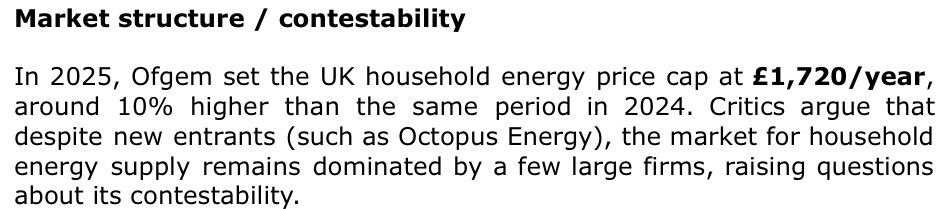
Ofgem price cap at £1,720 (july-sept 2025)
Market dominated by ‘big six’, though new entrants like Octopus energy
Barriers to entry: infrastructure, regulation, customer switching inertia
Analysis
Low contestability: high sunk costs (grid infrastructure), regulation, brand loyalty
Price cap limits firms’ ability to earn abnormal profits
New entrant suggest some degree of competition (Octopus, Ovo)
Evaluation
Government regulation creates artificial contestability (reduced regulation/ Ofgem licensing
Long-run: green energy transition may lower entry barriers (smaller renewable providers) → Octopus Energy: they built their model heavily around green energy and technology