Evolution Test 4 Part 1
 Call Kai
 Learn
Learn Practice Test
 Spaced Repetition
 Match
Match Flashcards
 Knowt Play
1/60

There's no tags or description
Looks like no tags are added yet.
Name | Mastery | Learn | Test | Matching | Spaced | Call with Kai |
|---|
No analytics yet
Send a link to your students to track their progress
61 Terms
Quantitative traits influenced by multiple genes
generate a normal distribution curve
polygenic
a characteristic that is influenced by two or more genes
Epistatic
the expression of one gene is modified (masked, inhibited or suppressed) by the expression of one or more other genes
quantitative/continuous traits
phenotypes that show a smooth spectrum of variation between two extremes rather than falling into distinct categories, are usually polygenic
Phenotypic plasticity
the property of organisms to produce distinct phenotypes in response to environmental variation
Quantitative genetics
study of the genetic mechanisms underlying quantitative/continuous phenotypic traits
VP
total phenotypic variance in the population
VG
variance due to genetic variance
VE
variance due to environmental variance
VP =
VG + VE
H2 =
VG / VP = VG / (VG + VE)
H2
broad sense heritability, captures the proportion of phenotypic variation due to all genetic influences
VG =
VA + VD + VI
VA
additive genetic variance; makes offspring look like parents; expression of more than one gene contributes to phenotype, and the phenotypic expression is the sum of these contributions
VD
relationship between dominance and recessive (can sometimes make offspring look less like parents)
VI
Epistasis, the effect of one gene is modified or masked by one or more other genes at different locations (can sometimes make offspring look less like parents)
h2 =
VA / VP = VA / (VA + VD + VI + VE )
h2
narrow sense heritability, the proportion of phenotypic variance caused by additive genetic variation, causes offspring to resemble parents, and is thus the variation upon which selection acts
Selection differential (S)
measures the strength of selection of the parents vs the whole population, measures the intensity of selection
Response to selection (R)
the difference between the offspring and the population, measures the evolutionary change across one generation
Selection can occur…
without evolution
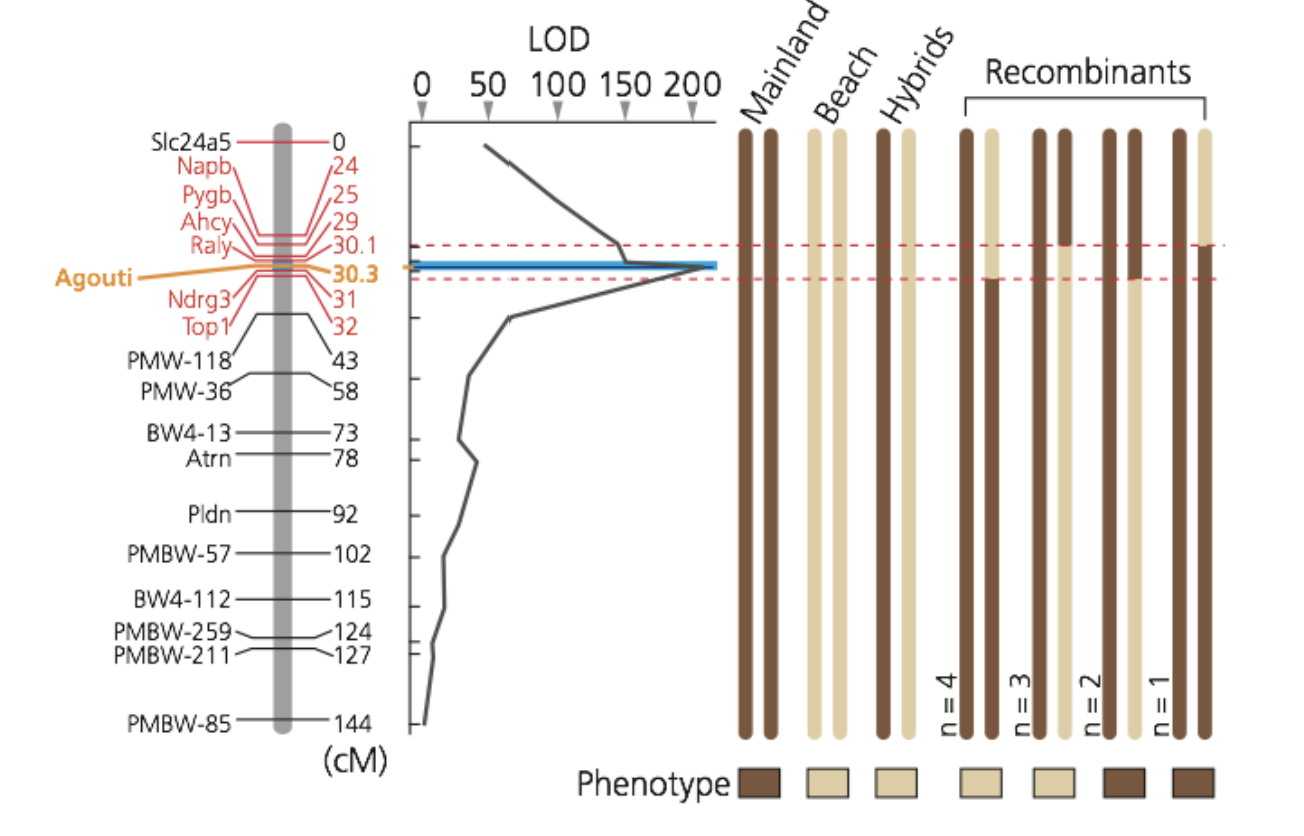
Quantitative Trait Loci (QTL) analysis
used when you have a trait that is continuous
LOD score being high
phenotype is likely to be linked to a specific spot on the chromosome, and therefore it can be passed onto the offspring
Introgression
the transfer of genetic information from one species to another as a result of hybridization between them and repeated backcrossing
Single Nucleotide Polymorphisms (SNPs)
a random variation at a single position in a DNA sequence among individuals, occurring when a single nucleotide—adenine, thymine, cytosine, or guanine—is altered
Genome-wide Association Studies (GWAS)
study of a genome-wide set of genetic variants in different individuals to see if any variant is associated with a trait
Phenotypic plasticity
there is a large contribution of the environment to the alternate phenotype, a single genotype can produce multiple phenotypes because of interaction with the environment
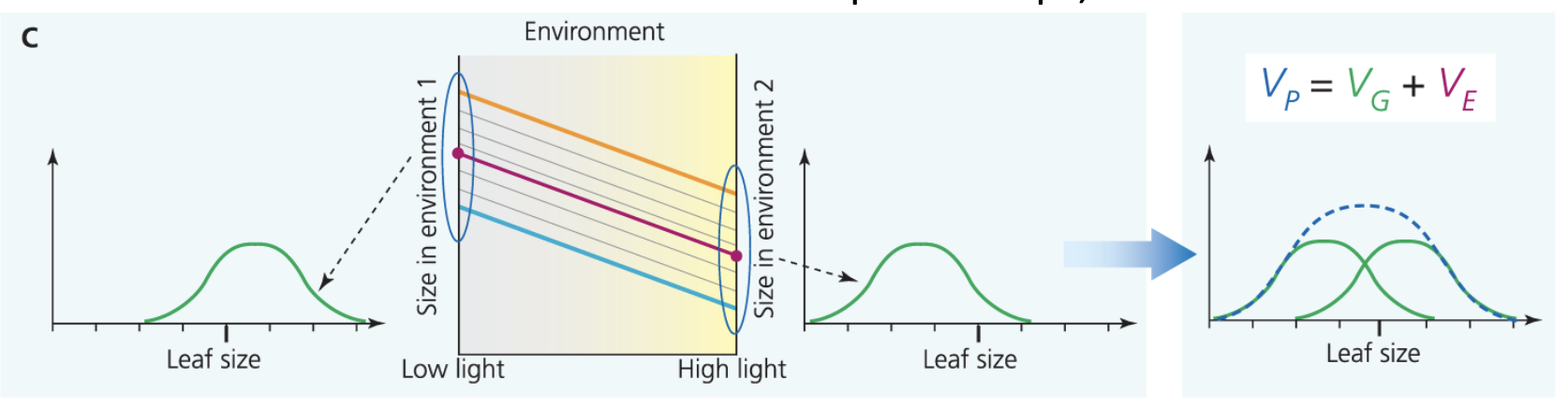
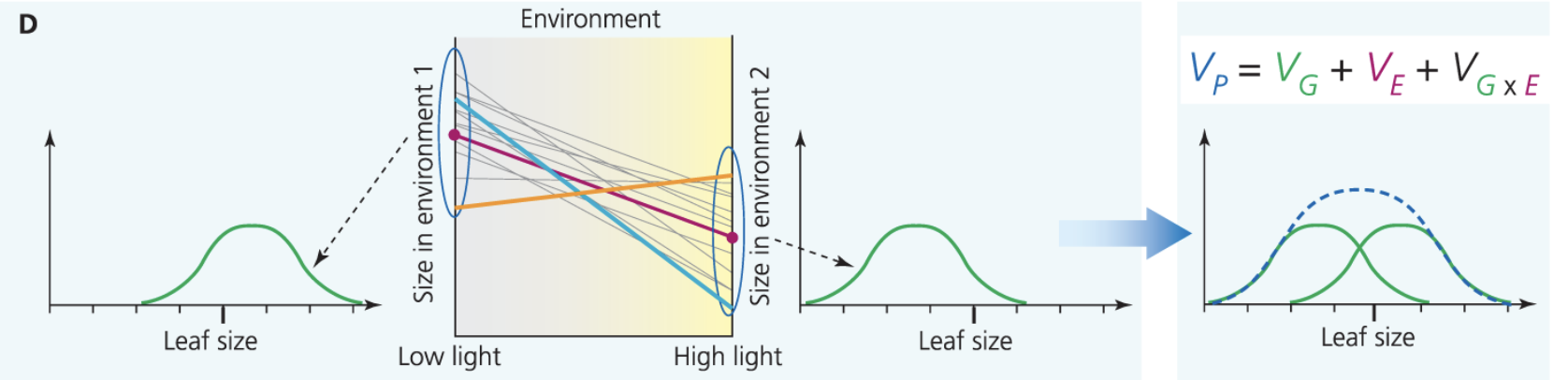
Reaction norm
graph with an environmental variable on the x-axis and a phenotype on the y-axis
If there are multiple genotypes/reaction norms, but all the same slope, shape and elevation
VP = VE
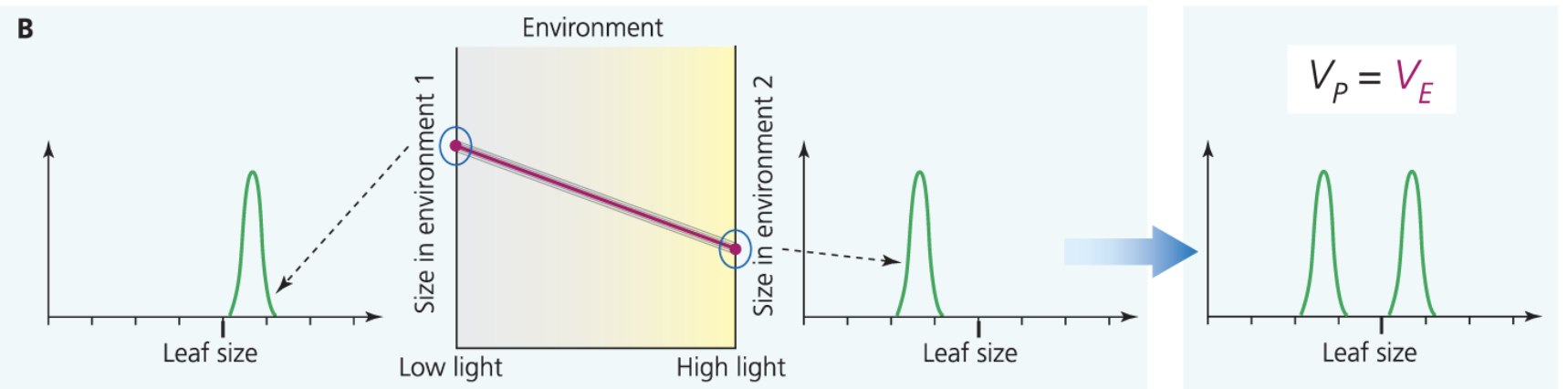
Multiple genotypes/reaction norms; all the same slope and shape, but different elevations
VP + VE + VG
Multiple genotypes/reaction norms; but the slopes are different.
VP + VE + VG + VG x E (x means interaction). This is a type of genetic variation that will respond to selection.
Polyphemism / polyphenic trait
Alternate, discrete phenotypes that are induced by different environmental conditions, discrete (not continuous) curve (S-shaped) on reaction norm
predator-induced polyphenisms
form of phenotypic plasticity where an organism alters its development in response to cues indicating predator presence
spadefoot toads phenotypic plasticity example
two different morphs, omnivore at high water levels, and carnivore at low water levels
tadpoles phenotypic plasticity example
Tadpoles can hatch earlier if they sense a predator trying to eat their egg, these tadpoles are smaller, which are less fit; this is an example of predator-induced polyphenisms
Peppered moth phenotypic plasticity example
Soot-covered trees are more black, so to blend in, they need to be darker; the larvae of the moths exhibit plasticity to camouflage (not polyphenic, but continuous)
cue vs challenge
cues predict the coming presence of a predator so that the organism can adjust in advance, challenges are a direct environmental stress or harmful condition that already affects survival or fitness
Mismatch
occurs when the environment that the plastic response has evolved for does not occur or occurs too late
Dutch Hunger Winter 1944
Individuals who were in utero during the winter experienced greater incidence of obesity, diabetes and heart disease as adults; as fetuses they were exposed to low nutrient conditions, so they adapted to develop a physiology that aligns with that environment; but the war ended and there was plenty of food
evo devo
slang for evolutionary developmental biology, the study of how developmental processes influence evolution
Developmental mechanisms are conserved
major concept 1, Developmental mechanisms are conserved
the same core genetic and molecular pathways that control body plan formation are shared across different animal groups, even when those animals look very different
Dorsal ventral patterning example of major concept 1
Protostomes and deuterostomes have opposite body orientations, but use homologous genes
(Protostomes: dorsal = Dpp, ventral = Sog)
(Deuterostomes: dorsal = Chordin, ventral = BMP4)
however Dpp ≈ BMP4 and Sog ≈ Chordin
Protostome nervous system vs digestive system locations
Nervous system is on the ventral side, digestive system is on the dorsal side
Deuterostome nervous system vs digestive system location
Nervous system is on dorsal side, digestive system is on ventral side
Hox genes
determine positional identity along the body axis, gene order on chromosome = order of expression, same across animals
Mutations in hox genes example of major concept 1
Flies normally have bumps (Halteres) that are like gyroscopes instead of a second pair of wings because of Ubx, but if they lack Ubx, they develop a second pair of wings. In vertebrates, hox mutations can transform vertebra identity (lumbar → thoracic)
Major Concept 2: Homology is best understood as a hierarchical concept
homology depends on the level of biological organization being considered
vertebrate limb vs wing major concept 2 example
Human hand, seal limb, bird wing, and bat wing are all homologous at the level of a vertebrate limb; but bird wing and bat wing are not homologous at the level of a wing because they evolved independently
Major concept 3: Deep homology can be detected (with caution) by similarities in gene expression during development
related structures may share a common evolutionary origin if they are built using the same genetic toolkit
Homology of spider and insect segments example for major concept 3
spider legs correspond to insect mouthparts, we know this because they are both controlled by the same hox genes in the same order.
Homology of appendages across Metazoa example for major concept 3
because the Shh gene is expressed the same in mice and flies for building their legs, then that means that their legs are deeply homologous
Shh gene
acts as a positional identity cue, helps the limb organize itself, to help construct the limbs
Distal-less gene
a transcription factor expressed in developing appendages, it tells a cluster of cells to start growing outward from the body
Homology of insect wings and crustacean gills example for major concept 3
Insect wings may have evolved from crustacean gills because Pdm and nubbin are expressed in both developing insect wings and crustacean gills. So, the gills on crustacean legs became wings on insects
Major Concept 4: Evolution occurs by tinkering
evolution doesn't design from scratch, it repurposes and modifies whatever already exists
Darwin’s finches example of major concept 4
Bmp4 helps develop beaks (Deeper and wider beaks = stronger bmp4 expression). Evolution didn't invent a new beak-building gene for each finch species. Instead, it tinkered with the same existing gene.
The evolutionary loss of snake forelimbs example of major concept 4
Forelimbs form at a specific zone defined by Hox gene expression, but in snakes, this boundary shifted all the way up to the base of the skull (change in spatial expression). Evolution didn't delete a limb-building gene, it just got repositioned so it can’t grow limbs because there’s no room.
The evolutionary loss of snake hindlimbs example of major concept 4
The ZRS enhancer normally switches Shh on in limb buds, driving limb growth. In snakes, the ZRS is broken/degraded
The evolution of crustacean “maxillipeds”
Ubx expression tells segments to become legs, but in the segments that became maxillipeds, Ubx expression retreated, so those segments were freed up to develop differently and became feeding appendages instead, change in the spatial expression of a Hox gene
maxillipeds
used for eating in crustaceans, mouth feet