BI 222 Topic 3
 Call Kai
 Learn
Learn Practice Test
 Spaced Repetition
 Match
Match Flashcards
 Knowt Play
1/50

There's no tags or description
Looks like no tags are added yet.
Name | Mastery | Learn | Test | Matching | Spaced | Call with Kai |
|---|
No analytics yet
Send a link to your students to track their progress
51 Terms
Autocrine
Self target
Cell produces a signaling protein to make something.
Gab junction
protein channel
protein tunnel through two cells so they can send signals to one another or smaller items like Ca+ ions.
Paracrine
Nearby Cell
cell targets nearby cell, but it has to diffuse slightly to send these signals, cells are not directly touching.
Endocrine
Distant cell, via the blood.
Targets specific cells and must circulate in the blood. Stays in the body!
Exocrine
Many types, usually part of the digestive system to excrete items from the body.
How many steps does Signal Transduction and Cell Signaling have?
3 stages.
Reception
Propagation
Response
Signal Transduction and Cell Signaling
1 Reception
ligand (signaling molecule) will bind to the receptor.
Signal Transduction and Cell Signaling
2 Propagation
Internal targets are activated
Signal Transduction and Cell Signaling
3 Response
Final target activated, causing cellular change.
Ligand
Small diffusible item that binds a receptor
example: hormones in the blood!
G protein
protein that binds and hydrolyzes GTP into GDP
GDP is typically considered?
OFF
GTP is typically considered?
ON
Kinase
Enzyme that phosphorylates another protein.
Phosphorylation means?
Adding a Phosphate group!
Kinase brings the P to the party.
Phosphatase
Enzyme that removes a phosphate. (Dephosphorization)
Internal Receptors
Receptors that reside within the cytoplasm.
What is required of ligands when it comes to internal receptors?
small nonpolar ligands must pass through the PM
Examples of internal receptor?
Estradiol and testosterone.
What happens after a internal receptor is activated?
It heads to the nucleus.
(After the assassin infiltrated the outside gates, he headed to the king’s chamber.)
Internal receptor often act as what?
Transcription factors.
Ligand Gated Ion Channel
Ligand Binds
Gate Opens
Ion diffuses down the concentration gradient
Common example of Ligand Gated Ion channel?
Acetylcholine and Na+
That work as a neuro transmitter
Voltage Gated Ion Channel
Certain amounts of +/- charge will open the protein channel gate and let ions diffuse down their concentration gradient.
G Protein Coupled Receptors
Receptor associated with G protein
Has 2 main classes - Small G protein, and heterotrimeric
G Protein Coupled Receptors
1 Small G protein
1 subunit that does everything
Example: RAS - associated with receptors
G Protein Coupled Receptors
2 - Heterotrimeric
alpha, beta, gamma
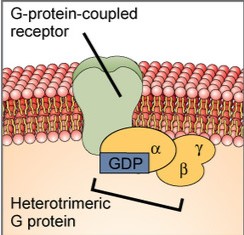
What step of the G Protein Coupled Receptors Cycle is this?
The receptor has the GDP and is waiting for the signaling ligand.
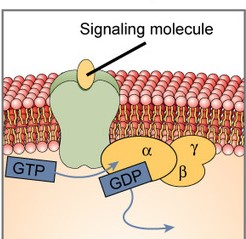
What step of the G Protein Coupled Receptors Cycle is this?
When the signaling ligands binds to the G Protein and activates the alpha heterotrimeric G protein into swapping GDP for GTP ( turning it on)
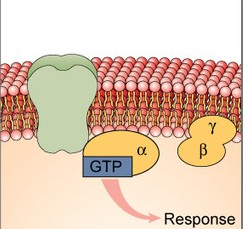
What step of the G Protein Coupled Receptors Cycle is this?
The Alpha part of the heterotrimeric disassociates from the gamma and beta and sends out a signal response.
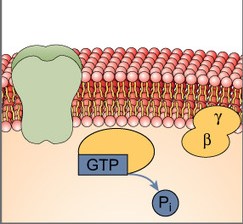
What step of the G Protein Coupled Receptors Cycle is this?
The GTP is hydrolyzed back into GDP (turning it off)
Tyrosine Kinase Receptor is a type of what?
Amino Acid
Propagation of Signal
Amplify and spreads out response
Protein activation (phosphorylation and dephosphorization)
Second messengers are?
Small items produced in large amounts that amplify signals
Ca+ is a second messanger to what?
Muscles in a reticulum → released to stop muscle contraction
One MEK can phosphorize how many ERK?
10
IP3 is created by what?
PLC
cAMP
Cyclic AMP
Response includes modifications and changes to?
Gene expression
Cell metabolism
Cell growth
cell death (apoptosis)
IR
Insulin Receptor
Type: Tyrosine Kinase Receptor
IRS-1
IR Substrate
PKC
Protein Kinase C
GluT-4
channel protein that brings in glucose down the concentration gradient.
(facilitated diffusion)
PP1 -
Protein Phosphetase 1
-removes a phosphate group from glycogen synthase
GS
glycogen synthase
dephospholized = on/active
Glucagon Receptor (GPCR)
G-Protein Coupled receptor
GP (1st)
G Protein- Inactive bound to GDP, active with GTP
(You stay inactive sleeping on the couch with your dog, but active when running away from a tiger.)
AC
Adenylyl Cyclase - Converts ATP into cAMP
PKA
Protein Kinase A → activated by cAMP
PK
Phosphorylase Kinase
Activated by phosphorylation from PKA
(You take the A from PKA to activate the PK)
GP (2nd)
Glycogen Phosphorylase-
Activated by phosphorylation from PK. Hydrolyzes glycogen into glucose.