ch 45
 Call Kai
 Learn
Learn Practice Test
 Spaced Repetition
 Match
Match Flashcards
 Knowt Play
1/69

There's no tags or description
Looks like no tags are added yet.
Name | Mastery | Learn | Test | Matching | Spaced | Call with Kai |
|---|
No analytics yet
Send a link to your students to track their progress
70 Terms
Edward Jenner infected individuals with ____ to protect them from ____.
| a. | chickenpox; smallpox |
| b. | smallpox; chickenpox |
| c. | smallpox; cowpox |
| d. | cowpox; smallpox |
| e. | cowpox; chickenpox |
cowpox; smallpox |
Edward Jenner’s work became the basis for worldwide ____ against ____.
| a. | vaccination; polio |
| b. | vaccination; smallpox |
| c. | antibiotic treatment; polio |
| d. | antibiotic treatment; smallpox |
| e. | vaccination; chickenpox |
vaccination; smallpox |
The inherited mechanisms that protect the body from pathogens are called ____.
| a. | the immune system |
| b. | vaccination |
| c. | restriction endonucleases |
| d. | the pathogen defense system |
| e. | immunological tolerance |
the immune system |
Disease-causing viruses or organisms are called ____.
| a. | pathogens |
| b. | vaccines |
| c. | mast cells |
| d. | macrophages |
| e. | memory cells |
pathogens |
The immune system consists of ____.
| a. | physical barriers only |
| b. | innate immunity only |
| c. | adaptive immunity only |
| d. | innate and adaptive immunity only |
| e. | physical barriers, innate immunity, and adaptive immunity |
innate and adaptive immunity only |
Arrange the three lines of defense from the first to the last.
1 = Adaptive immune system
2 = Physical barriers
3 = Innate immune system
| a. | 1, 2, 3 |
| b. | 2, 1, 3 |
| c. | 2, 3, 1 |
| d. | 3, 1, 2 |
| e. | 3, 2, 1 |
2, 3, 1 |
The enzyme lysozyme offers protection from some ____ by breaking down their ____.
| a. | viruses; protein coat |
| b. | bacteria; cell walls |
| c. | viruses; envelopes |
| d. | bacteria; DNA |
| e. | viruses and bacteria; nucleic acids |
bacteria; cell walls |
Adaptive immunity is also referred to as ____ immunity.
| a. | acquired |
| b. | innate |
| c. | secondary |
| d. | latent |
| e. | hidden |
acquired |
How is adaptive immunity different from innate immunity?
| a. | adaptive immunity is less effective than innate immunity |
| b. | adaptive immunity is nonspecific; innate immunity is specific |
| c. | adaptive immunity is immediate; innate immunity is slower acting |
| d. | adaptive immunity has memory; innate immunity does not |
| e. | adaptive immunity is the first line of defense; innate immunity is the second line of defense |
adaptive immunity has memory; innate immunity does not |
Upon a second exposure to a pathogen, the ____ immune system responds ____ than it did upon the first exposure.
| a. | innate; slower |
| b. | adaptive; slower |
| c. | innate; faster |
| d. | adaptive; faster |
| e. | innate; more powerfully |
adaptive; faster |
The major phagocytic cells in the body are____.
| a. | macrophages and lymphocytes |
| b. | macrophages and neutrophils |
| c. | macrophages and mast cells |
| d. | monocytes and mast cells |
| e. | monocytes and basophils |
macrophages and neutrophils |
Which type of leukocyte is involved in killing eukaryotic parasites?
| a. | monocytes |
| b. | neutrophils |
| c. | eosinophils |
| d. | lymphocytes |
| e. | basophils |
eosinophils |
Molecules that regulate defense responses via signal transduction pathways are called ____.
| a. | complement proteins |
| b. | histamines |
| c. | macrophages |
| d. | cytokines |
| e. | defensins |
cytokines
Histamine ____.
| a. | causes blood vessels to contract |
| b. | causes capillaries to lose their permeability |
| c. | causes an outward flow of fluids from the capillaries |
| d. | reduces tissue swelling |
| e. | causes cells to release interferons |
causes an outward flow of fluids from the capillaries |
Which symptoms are characteristic of the inflammatory response?
| a. | pain only |
| b. | swelling only |
| c. | tenderness and swelling only |
| d. | pain and heat only |
| e. | pain, swelling, tenderness and heat |
pain, swelling, tenderness and heat |
While running in a garden, a girl steps on an old board and a nail goes through her shoe and skin, causing a deep puncture wound. Which non-specific defense mechanism will aid in protecting her from pathogens?
| a. | ciliated epithelial cells |
| b. | lysozyme |
| c. | acidic skin secretions |
| d. | inflammation |
| e. | cytotoxic T cells |
inflammation |
During inflammation, tissue damage activates ____, which release ____.
| a. | cytotoxic T cells; cytokines |
| b. | macrophages; histamine |
| c. | mast cells; histamine |
| d. | neutrophils; cytokines |
| e. | eosinophils; chemokines |
mast cells; histamine |
Interferons____.
| a. | make holes through bacterial cell membranes |
| b. | make holes through bacterial cell walls |
| c. | prevent entry of viruses into cells |
| d. | block the replication of viruses within cells |
| e. | bind iron and make it unavailable for bacteria and viruses |
prevent entry of viruses into cells |
Natural killer cells destroy target cells by releasing ____.
| a. | antibiotics, which breakdown the target cell’s membrane |
| b. | perforin, which creates holes in the target cell’s membrane |
| c. | histamine, which signals other blood cells to aggregate |
| d. | lysozyme, which breaks down the bacterium’s cell wall |
| e. | antibodies, which break down the bacterium’s cell wall |
perforin, which creates holes in the target cell’s membrane |
The complement system is a group of ____.
| a. | vaccines |
| b. | defense proteins |
| c. | antibodies |
| d. | antibiotics |
| e. | lymphocytes |
defense proteins |
A foreign molecule that triggers an adaptive immune response is called a(n)____.
| a. | lymphocyte |
| b. | antibody |
| c. | antigen |
| d. | chemokine |
| e. | pyrogen |
antigen
The leukocytes that are central to adaptive immunity are the____.
| a. | lymphocytes |
| b. | macrophages |
| c. | neutrophils |
| d. | mast cells |
| e. | eosinophils |
lymphocytes
B cells differentiate in the ____, while T cells mature in the ____.
| a. | bone marrow; thymus |
| b. | thymus; bone marrow |
| c. | bone marrow; bone marrow |
| d. | bone marrow; blood |
| e. | blood; thymus |
bone marrow; thymus |
How is antibody-mediated immunity different from cell-mediated immunity?
| a. | Antibody-mediated immunity requires lymphocytes; cell-mediated immunity does not. |
| b. | Antibody-mediated immunity is innate; cell-mediated immunity is adaptive. |
| c. | Antibody-mediated immunity is adaptive; cell-mediated immunity is innate. |
| d. | Antibody-mediated immunity requires both B and T cells; cell-mediated immunity requires T cells but not B cells. |
| e. | Antibody-mediated immunity requires T cells; cell-mediated immunity requires B cells. |
Antibody-mediated immunity requires both B and T cells; cell-mediated immunity requires T cells but not B cells. |
Which macromolecules can serve as antigens?
| a. | proteins only |
| b. | carbohydrates only |
| c. | nucleic acids only |
| d. | proteins and carbohydrates only |
| e. | proteins, carbohydrates and nucleic acids |
proteins, carbohydrates and nucleic acids |
An antibody molecule consists of ____ polypeptide chain(s).
| a. | four light |
| b. | four heavy |
| c. | two light and two heavy |
| d. | three light and one heavy |
| e. | one light and three heavy |
two light and two heavy |
Antibodies are classified as____.
| a. | nucleoproteins |
| b. | immunoglobulins |
| c. | steroids |
| d. | carbohydrates |
| e. | lipids |
immunoglobulins |
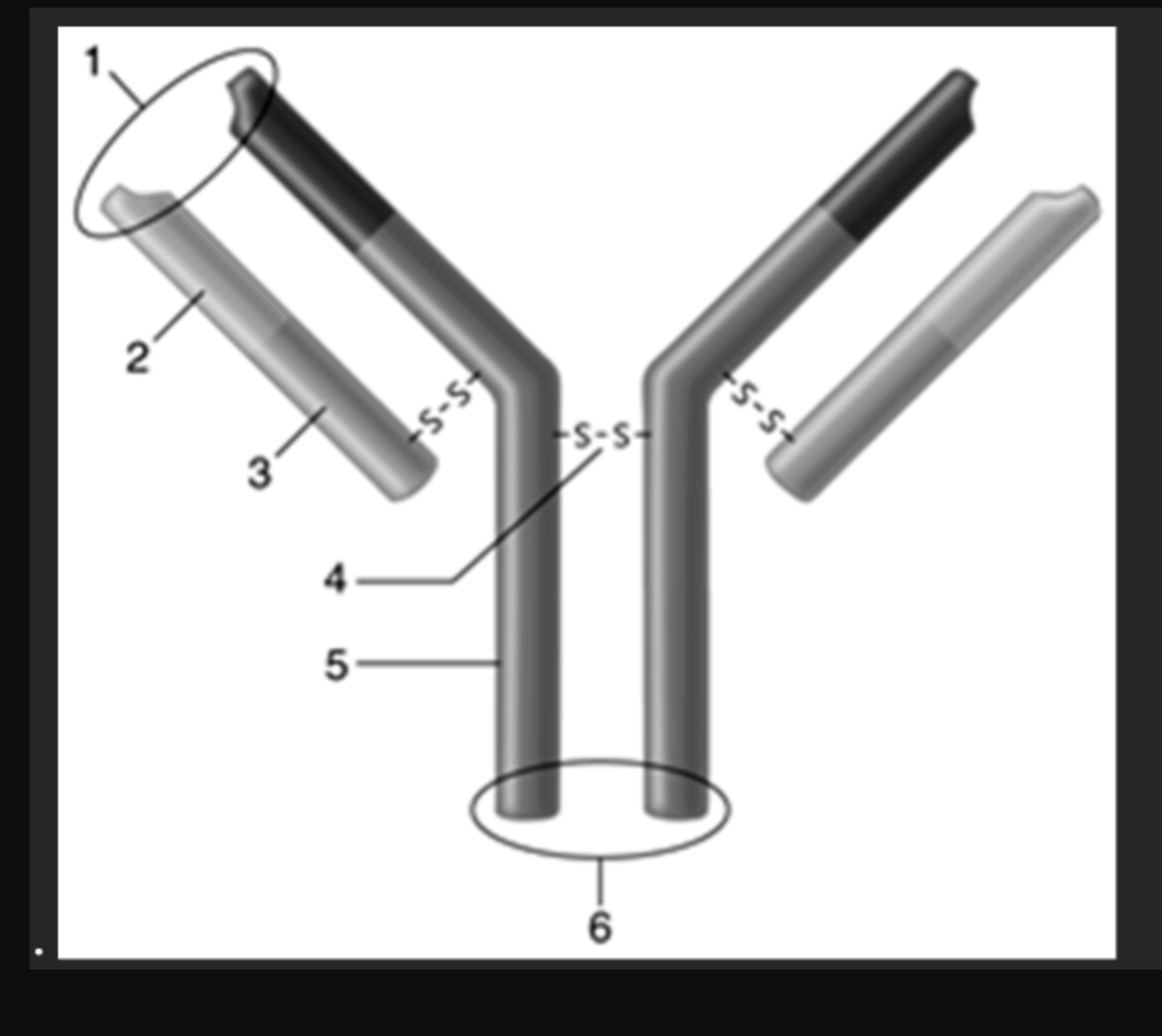
Answer the question using the accompanying figure. The antigen-binding site is indicated by number____.
| a. | 1 |
| b. | 2 |
| c. | 4 |
| d. | 5 |
| e. | 6 |
1 |
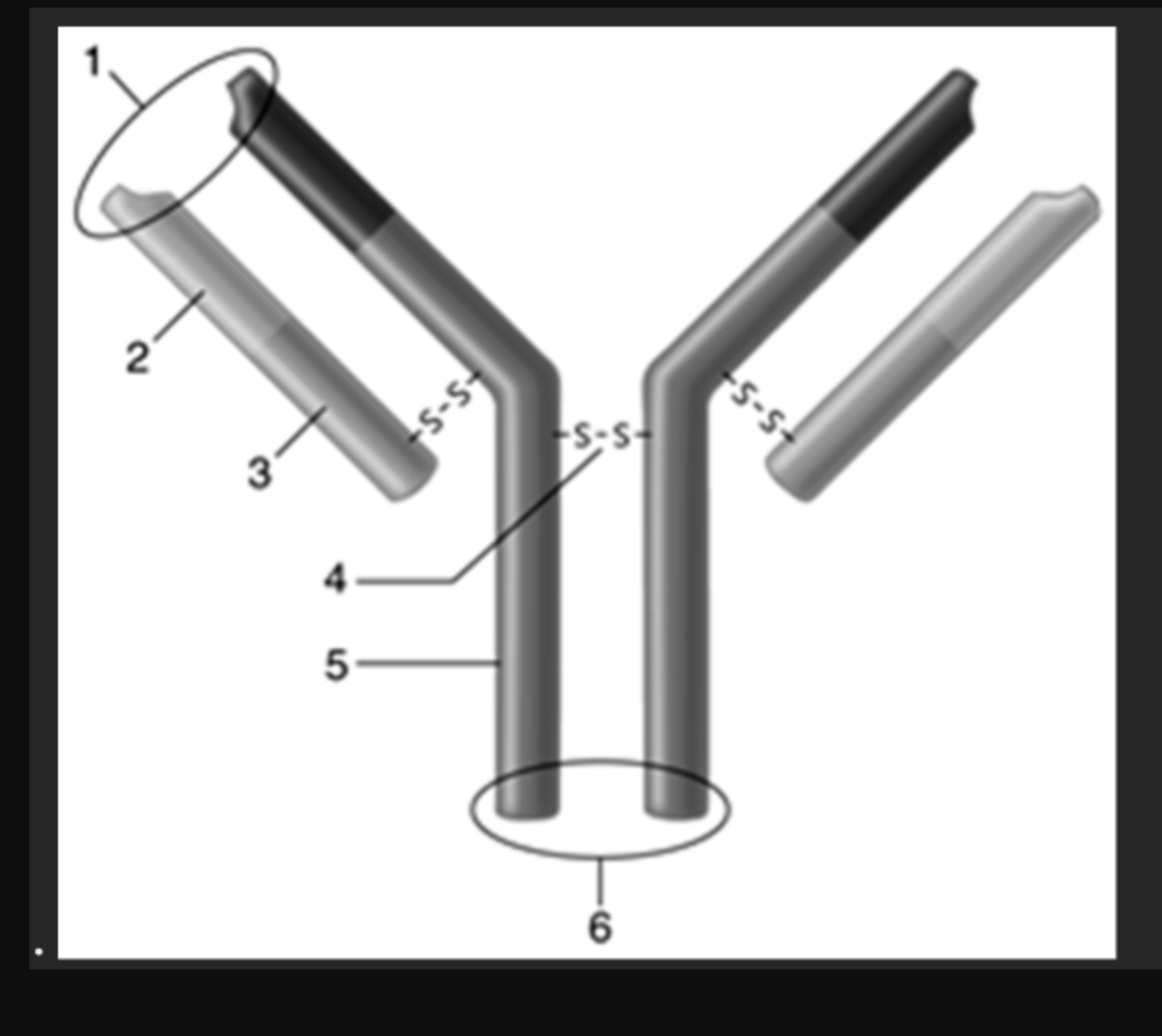
Answer the question using the accompanying figure. The constant region of a light chain is indicated by number____.
| a. | 1 |
| b. | 2 |
| c. | 3 |
| d. | 4 |
| e. | 5 |
3 |
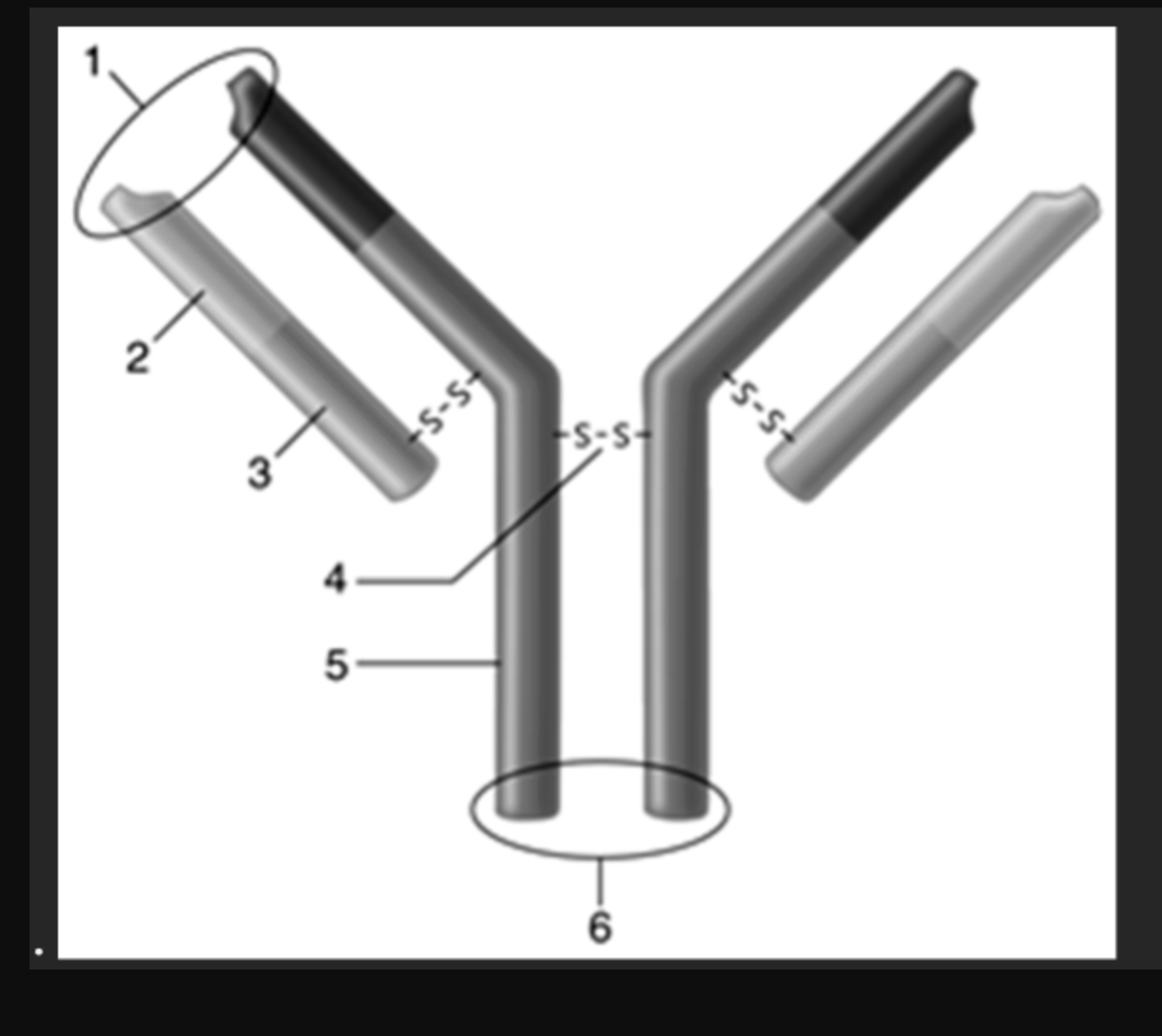
Answer the question using the accompanying figure. The variable region of a light chain is indicated by number____.
| a. | 1 |
| b. | 2 |
| c. | 3 |
| d. | 4 |
| e. | 5 |
2 |
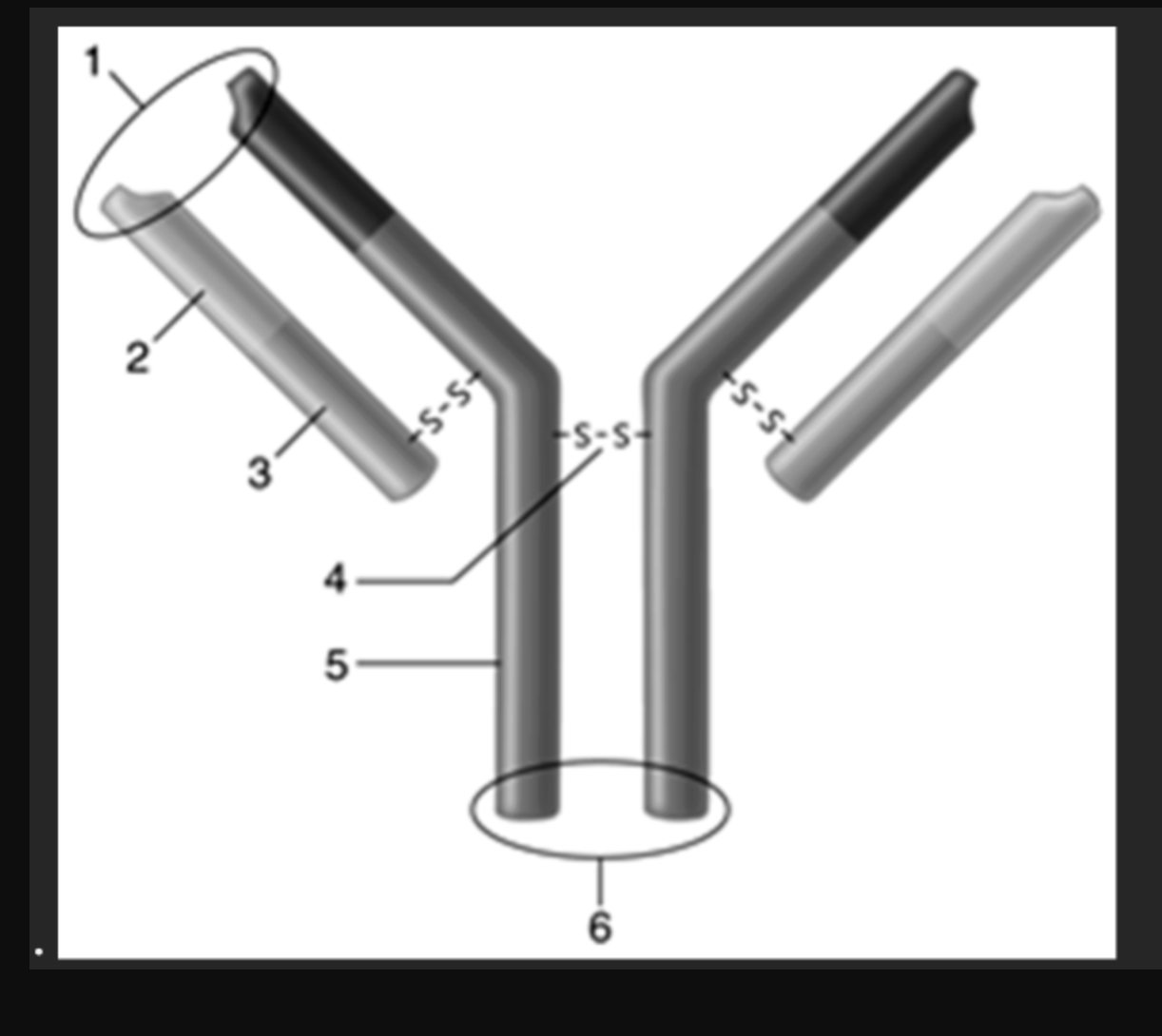
Answer the question using the accompanying figure. The constant region of a heavy chain is indicated by number____.
| a. | 1 |
| b. | 2 |
| c. | 3 |
| d. | 4 |
| e. | 5 |
5 |
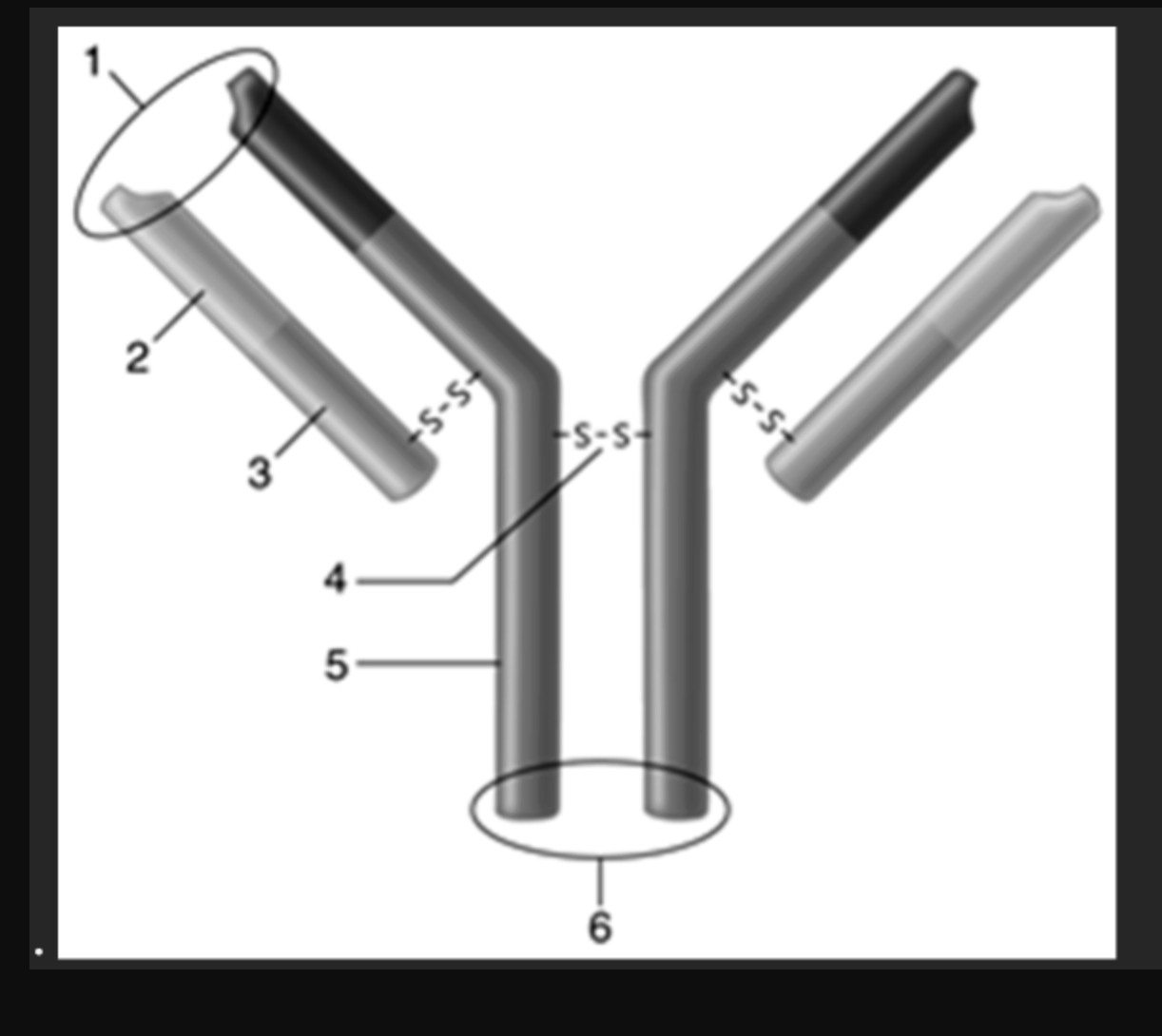
Answer the question using the accompanying figure. The region that determines the class of antibody is indicated by number ____.
| a. | 1 |
| b. | 2 |
| c. | 3 |
| d. | 4 |
| e. | 5 |
5 |
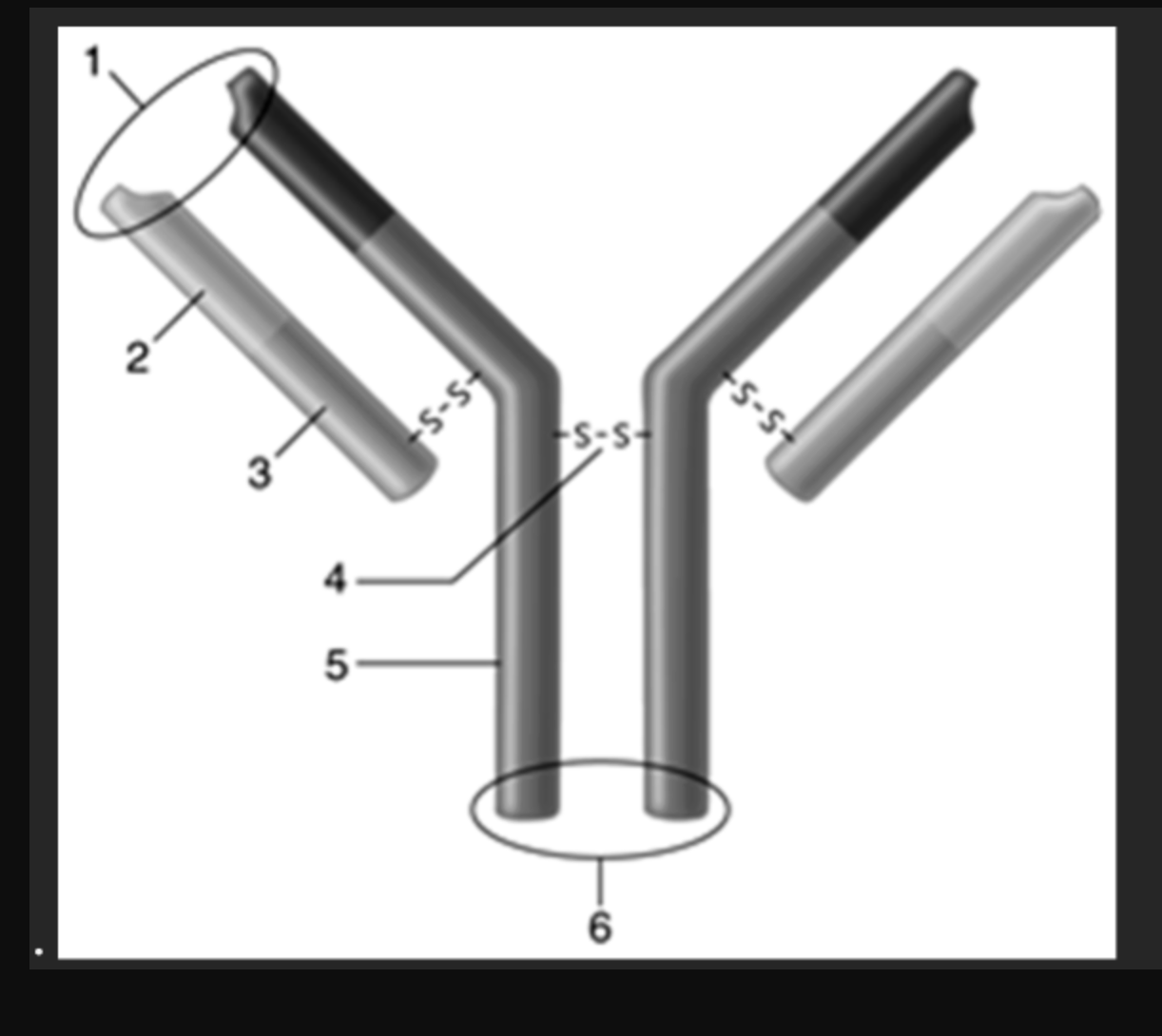
Answer the question using the accompanying figure. If an antibody serves as a B-cell receptor, it will bind to the host cell membrane via region number____.
| a. | 1 |
| b. | 2 |
| c. | 3 |
| d. | 4 |
| e. | 6 |
6
The major source of diversity for B and T cell receptors is____.
| a. | mitosis |
| b. | meiosis |
| c. | transcript processing |
| d. | random recombination of gene segments |
| e. | mutation |
random recombination of gene segments |
B-cell receptors on B cells are ____.
| a. | IgG molecules only |
| b. | IgE molecules only |
| c. | IgD or IgE molecules |
| d. | IgM or IgD molecules |
| e. | IgM molecules only |
IgM or IgD molecules |
An epitope is ____.
| a. | the antigen binding site of an antibody molecule |
| b. | found only in IgG and IgM |
| c. | part of an antigen that binds to a specific antibody |
| d. | too small to stimulate an immune response |
| e. | a complement protein that initiates lysis of target cells |
part of an antigen that binds to a specific antibody |
Dendritic cells present antigens on their surface in the context of ____.
| a. | class I major histocompatibility complex (MHC) proteins |
| b. | class II MHC proteins |
| c. | antibodies |
| d. | B cell receptors |
| e. | T cell receptors |
class II MHC proteins |
A dendritic cell with an antigen displayed on its surface is called a(n) ____.
| a. | cytotoxic T cell |
| b. | plasma cell |
| c. | antigen presenting cell |
| d. | major histocompatibility complex |
| e. | CD4+ T cell |
antigen presenting cell |
A CD4+ T cell binds to an antigen only if this antigenis ____.
| a. | in a complex with a class I MHC protein |
| b. | in a complex with a class II MHC protein |
| c. | in a complex with a class III MHC protein |
| d. | not in a complex with MHC proteins |
| e. | presented on the surface of a B cell |
in a complex with a class II MHC protein |
Helper T cells secrete ____, which activate B cells and stimulate their proliferation.
| a. | antigens |
| b. | allergens |
| c. | antibodies |
| d. | interferons |
| e. | interleukins |
interleukins |
Which immune cells are long-lived cells that can respond to a later encounter with the same antigen?
| a. | helper T cells |
| b. | plasma cells |
| c. | dendritic cells |
| d. | memory cells |
| e. | cytotoxic T cells |
memory cells |
The main antibody present during the primary immune response is____.
| a. | IgE |
| b. | IgA |
| c. | IgD |
| d. | IgG |
| e. | IgM |
IgM |
The secondary immune response is ____ than the primary immune response because the secondary immune response ____.
| a. | more rapid; does not require B or T cells |
| b. | more rapid; involves memory B and T cells that have been stored |
| c. | slower; requires initiation of clonal selection of new B and T cells |
| d. | slower; requires more antigen than the primary immune response |
| e. | more rapid; is less specific than the primary immune response |
more rapid; involves memory B and T cells that have been stored |
Vaccinations introduce ____ into the body to stimulate the immune system and produce immunological memory.
| a. | T cells |
| b. | antigens |
| c. | antibodies |
| d. | B cells |
| e. | dendritic cells |
antigens |
Arrange the steps of antibody-mediated immunity in the proper order.
1. Plasma cells secrete antibodies.
2. Helper T cells interact with B cells displaying the same antigen-MHC complex.
3. Contact with antigen.
4. Clones of B cells produced.
5. Fragmentation of antigen.
| a. | 3, 2, 5, 1, 4 |
| b. | 3, 5, 2, 4, 1 |
| c. | 1, 3, 5, 2, 4 |
| d. | 4, 3, 2, 1, 5 |
| e. | 5, 3, 4, 2, 1 |
3, 5, 2, 4, 1 |
In ____, antibodies bind to toxin molecules, preventing them from carrying out their damaging action.
| a. | inflammation |
| b. | phagocytosis |
| c. | agglutination |
| d. | neutralization |
| e. | clonal selection |
neutralization |
Antibodies enhance ____ of bacteria and viruses because cells, such as macrophages, have receptors on their surfaces that recognize the ____ end of antibodies.
| a. | phagocytosis; heavy-chain |
| b. | phagocytosis; antigen-binding |
| c. | neutralization; heavy-chain |
| d. | neutralization; light-chain |
| e. | phagocytosis; light-chain |
phagocytosis; heavy-chain |
How is active immunity different from passive immunity?
| a. | Active immunity is slower in onset and shorter-lived. |
| b. | Active immunity is slower in onset and longer-lived. |
| c. | Active immunity is faster in onset and shorter-lived. |
| d. | Active immunity is faster in onset and longer-lived. |
| e. | Only active immunity involves antibodies. |
Active immunity is slower in onset and longer-lived. |
The transfer of IgA antibodies in the first breast milk fed from the mother to the baby is an example of ____.
| a. | active immunity |
| b. | passive immunity |
| c. | innate immunity |
| d. | cell-mediated immunity |
| e. | autoimmunity |
passive immunity |
A typical primary response to an antigen peaks at about____.
| a. | one-two days |
| b. | four-five days |
| c. | two weeks |
| d. | two months |
| e. | four months |
two weeks |
A patient's serum is analyzed and found to have an abnormally low level of CD8 molecules. This suggests that the patient has insufficient numbers of ____.
| a. | macrophages |
| b. | B cells |
| c. | cytotoxic T cells |
| d. | helper T cells |
| e. | NK cells |
cytotoxic T cells |
A CD8+ T cell binds to an antigen only if this antigen is____.
| a. | in a complex with a class I MHC protein |
| b. | in a complex with a class II MHC protein |
| c. | in a complex with a class III MHC protein |
| d. | not in a complex with MHC proteins |
| e. | presented on the surface of a B cell |
in a complex with a class I MHC protein |
APCs interact with ____during an antibody-mediated immune response, and with ____ during a cell-mediated immune response.____
| a. | CD8+ T cells; CD4+ T cells |
| b. | CD4+ T cells; CD8+ T cells |
| c. | CD8+ T cells; CD8+ T cells |
| d. | CD4+ T cells; CD4+ T cells |
| e. | macrophages; CD4+ T cells |
CD4+ T cells; CD8+ T cells |
B cells and dendritic cells can both ____.
| a. | act as APCs |
| b. | produce antibodies |
| c. | differentiate into memory cells |
| d. | carry out a cell-mediated immune response |
| e. | activate helper T cells |
act as APCs |
Hybridomas are cells formed by the fusion of____.
| a. | B cells and melanoma cells |
| b. | B cells and myeloma cells |
| c. | T cells and melanoma cells |
| d. | T cells and myelomacells |
| e. | B cells, T cells, and myeloma cells |
B cells and myeloma cells |
A monoclonal antibody reacts against____.
| a. | a single antigenic determinant |
| b. | different epitopes on the same antigen |
| c. | different antigens of the same organism |
| d. | a single type of pathogen |
| e. | different types of macromolecules on the same pathogen |
a single antigenic determinant |
B cells and T cells that react with self-antigens are destroyed by____.
| a. | apoptosis |
| b. | phagocytosis |
| c. | cytokinesis |
| d. | diakinesis |
| e. | endocytosis |
apoptosis |
Autoimmune diseases result from a breakdown in the ability of the body to____.
| a. | produce antibodies |
| b. | produce memory cells |
| c. | destroy major histocompatibility proteins |
| d. | distinguish self from non-self |
| e. | distinguish between harmless and pathogenic microorganisms |
distinguish self from non-self |
Immunological tolerance refers to ____.
| a. | decreased immune system response to latent viruses |
| b. | decreased immune system response to nonpathogenic bacteria |
| c. | decreased tolerance of the body for pathogens it has already encountered |
| d. | desensitization to allergens to lessen allergic responses |
| e. | protection of the body’s own molecules from attack by its immune system |
protection of the body’s own molecules from attack by its immune system |
Rheumatoid arthritis is caused by____.
| a. | a deficiency of antibodies |
| b. | inability to respond to antigenic stimulation |
| c. | a virus |
| d. | a self-attack on blood cells |
| e. | a self-attack on joints |
a self-attack on joints |
Which autoimmune disease is correctly matched with the tissue it affects?
| a. | lupus - blood |
| b. | rheumatoid arthritis-lymphatics |
| c. | multiple sclerosis -joints |
| d. | lupus -nerves |
| e. | multiple sclerosis - pancreas |
lupus - blood |
The primary targets for HIV are ____.
| a. | helper T cells and macrophages |
| b. | helper T cells and cytotoxic T cells |
| c. | B cells, helper T cells, and cytotoxic T cells |
| d. | B cells and helper T cells |
| e. | B cells and macrophages |
helper T cells and macrophages |
Allergens induce ____ cells to secrete an overabundance of ____ antibodies.
| a. | CD4+ T; IgA |
| b. | B; IgE |
| c. | dendritic; IgG |
| d. | CD8+ T; IgE |
| e. | B; IgG |
B; IgE |
Anaphylactic shock ____.
| a. | involves IgG antibodies rather than IgE antibodies |
| b. | can occur the first time an individual is exposed to an allergen |
| c. | involves the release of antihistamine from mast cells |
| d. | results from HIV infection |
| e. | is a life-threatening condition resulting from severe inflammation |
is a life-threatening condition resulting from severe inflammation |
Arrange the steps of an allergic response in the proper order.
1. Allergic symptoms appear.
2. Allergen binds with IgE.
3. IgE combines with mast cell receptors.
4. Mast cells release histamine.
5. Plasma cells sensitized.
| a. | 5, 3, 2, 4, 1 |
| b. | 1, 5, 2, 4, 3 |
| c. | 5, 2, 4, 3, 1 |
| d. | 1, 4, 5, 2, 3 |
| e. | 4, 5, 2, 3, 1 |
4, 5, 2, 3, 1 |
Which defense mechanism(s) is/are found in invertebrates?
| a. | phagocytes and antibodies |
| b. | lysozyme and antibodies |
| c. | antibodies only |
| d. | phagocytes and lysozyme |
| e. | phagocytes, lysozyme, and antibodies |
phagocytes and lysozyme |
Moths have an immunoglobulin-family protein called ____, which binds to pathogens and enhances their phagocytosis.
| a. | hemolysin |
| b. | cadherin |
| c. | interleukin |
| d. | hemolin |
| e. | defensin |
hemolin |
The Nef protein helps HIV evade the adaptive immune system by____.
| a. | destroying cytotoxic T cells |
| b. | destroying class I MHC proteins present on the surface of infected cells |
| c. | destroying class I MHC proteins in the cytoplasm |
| d. | binding to class I MHC proteins at the cell surface, thereby blocking their availability to cytotoxic T cells |
| e. | binding to class I MHC proteins and preventing their transport to the cell surface |
binding to class I MHC proteins and preventing their transport to the cell surface |
You had a cold last month and you caught another one this month from your brother. What is the most likely reason for this happening?
| a. | Memory cells were not formed as a response to the first cold. |
| b. | The antibodies formed as a response to the first cold were degraded. |
| c. | The two cold viruses are different. |
| d. | Your macrophages are unable to perform phagocytosis. |
| e. | Your antigen-presenting cells do not recognize the second cold virus. |
The two cold viruses are different. |
According to a 2003 study performed by Michelle Khan and her coworkers, the rate of cervical cancer appears to be the greatest when women are ____.
| a. | positive for HPV 16 |
| b. | negative for HPV16 but positive for HPV18 |
| c. | negative for HPV16/18 but positive for other cancer-causing HPV |
| d. | negative for all cancer-causing HPV |
| e. | positive for HIV |
positive for HPV 16 |