19 aromatics 1
 Call Kai
 Learn
Learn Practice Test
 Spaced Repetition
 Match
Match Flashcards
 Knowt Play
1/10

There's no tags or description
Looks like no tags are added yet.
Name | Mastery | Learn | Test | Matching | Spaced | Call with Kai |
|---|
No analytics yet
Send a link to your students to track their progress
11 Terms
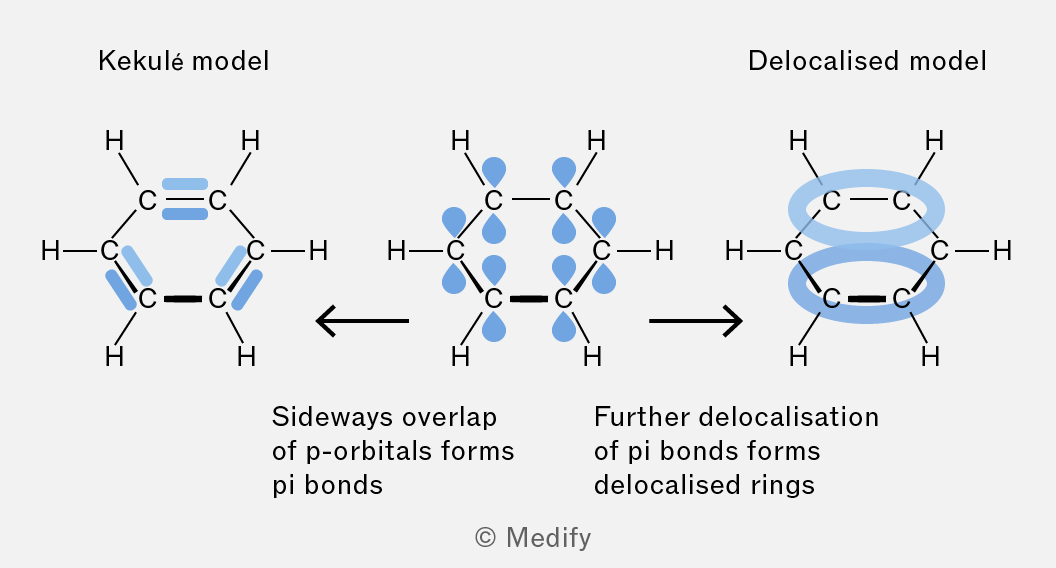
compare kekulé and the delocalised model of benzene
kekulé:
alternating C-C and C=C bonds
three pi bonds
delocalised:
p orbitals overlap sideways
forms a delocalised pi system
pi bonds are spread over all 6 carbon atoms
all C-C bond lengths are the same
why is benzene more stable than in kekulé’s model predicts?
benzene contains a delocalised pi system
pi bonds spreads all over 6 carbon atoms
delocalised electrons stabilise benzene
what are the three evidence that the delocalised model is correct than kekule?
1) substitution takes place NOT addition eg decolourises Br2
2) all C-C bond lengths are equal
3) enthalpy change of hydrogenation of benzene was less exothermic than predicted
how is substituted aromatic compounds names?
Use Benzene as the parent name
Examples:
methylbenzene
chlorobenzene
nitrobenzene
Number positions if more than one substituent:
1,2-dimethylbenzene
make sure the long chain is the main chain eg. 1,2 -dimethylethylbenzene
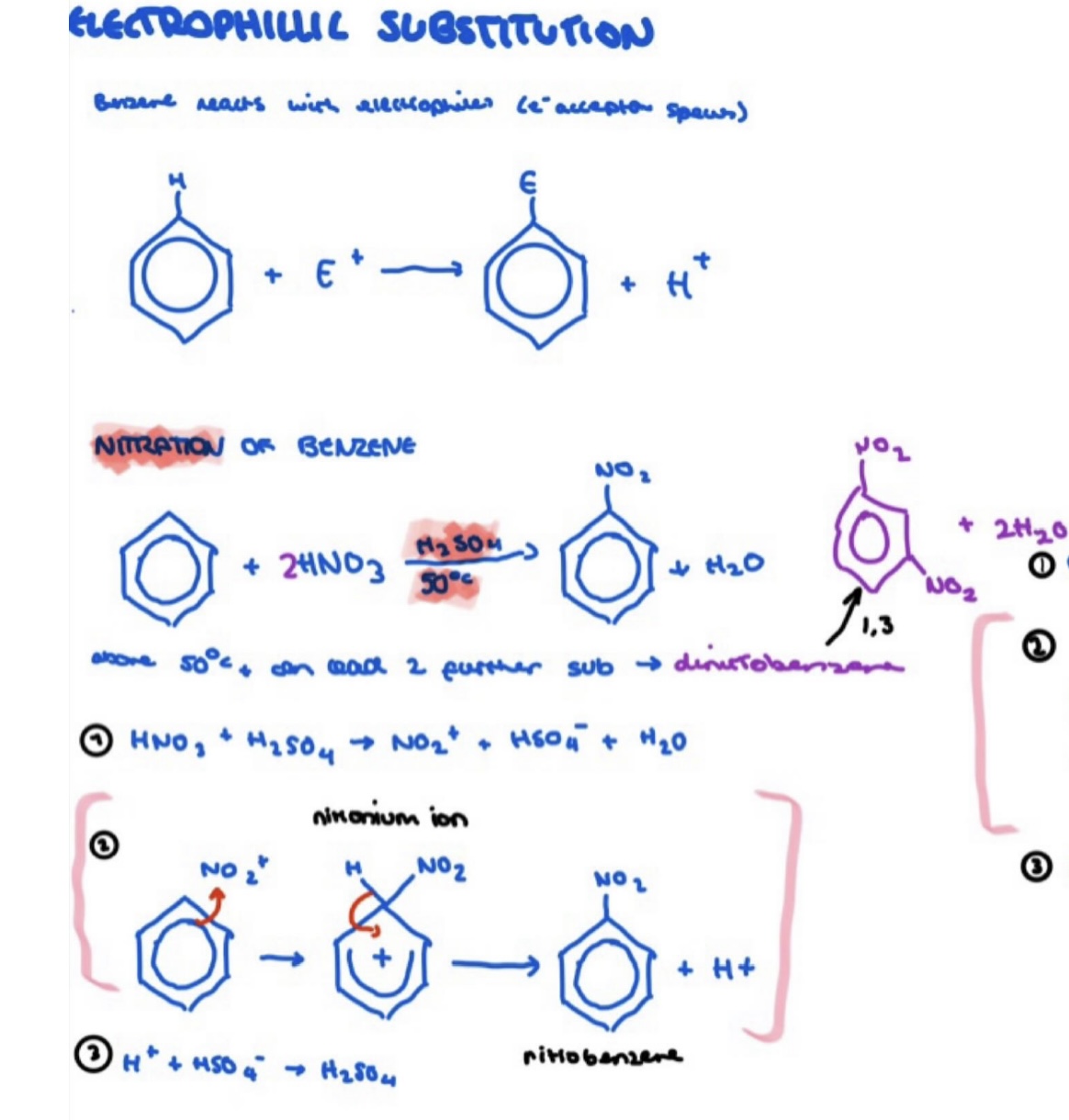
what are the reagents and conditions for nitration of benzene?
reagents:
conc HNO3
conc H2SO4
conditions:
50°c
product: nitrobenzene
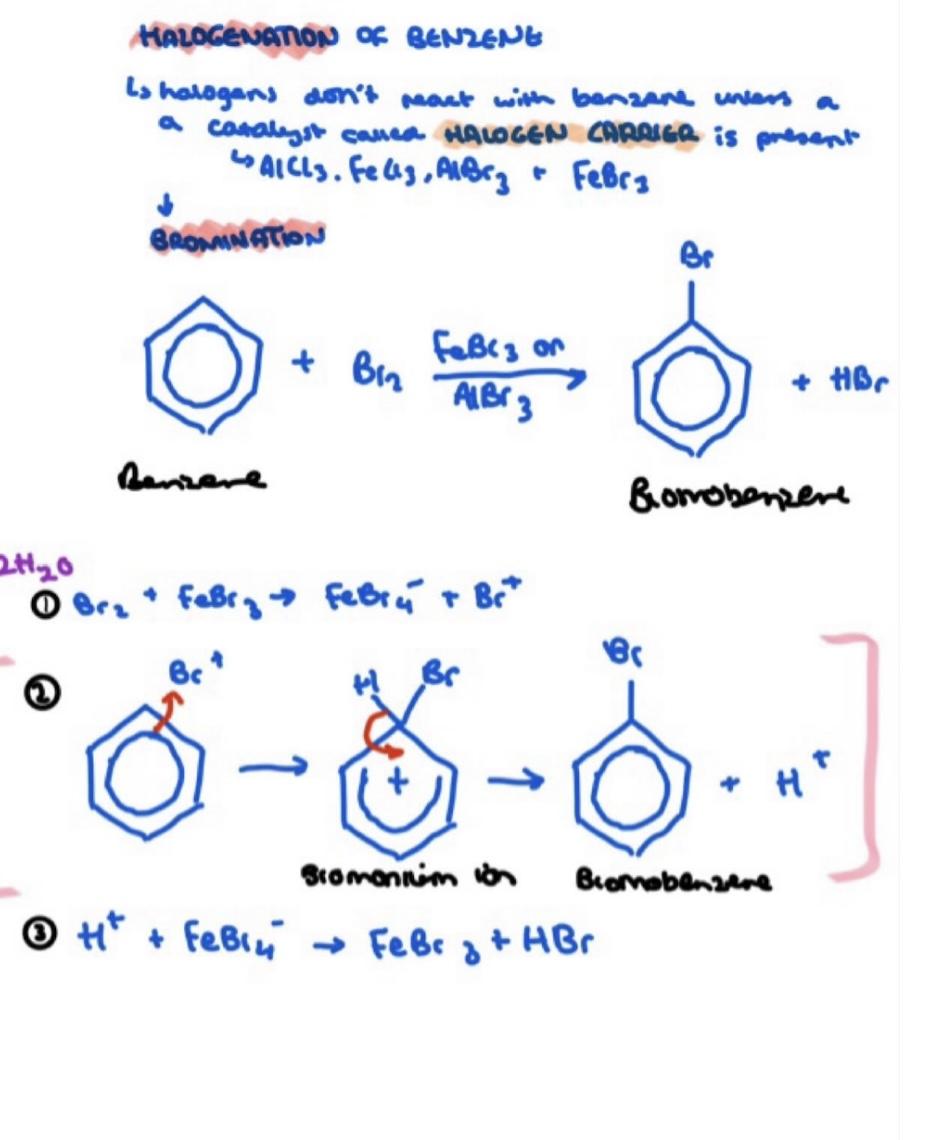
reagents and conditions for halogenation of benzene?
reagents:
Br2 / Cl2
catalyst:
FeBr3, FeCl3, or AlCl3
product: halogenobenzene
reagents and conditions for alkylation?
reagents:
haloalkane
catalyst
AlCl3
product: akylbenzene
forms C-C bond
reagents and condition for acylation
reagents: acyl chloride
catalyst: AlCl3
product: aromatic ketone
what mechanism type does aromatics do?
electrophilic substitution
why does alkenes undergo addition reaction more easily than benzene
Alkenes
π bond electrons are localised
high electron density
easily attacked by electrophiles
Benzene
electron density delocalised across ring
benzene is more stable
less reactive towards electrophiles