Microtubles and Actin FIlaments
 Call Kai
 Learn
Learn Practice Test
 Spaced Repetition
 Match
Match Flashcards
 Knowt Play
1/19

There's no tags or description
Looks like no tags are added yet.
Name | Mastery | Learn | Test | Matching | Spaced | Call with Kai |
|---|
No analytics yet
Send a link to your students to track their progress
20 Terms
Actin units, referred to as, structure, what do they do
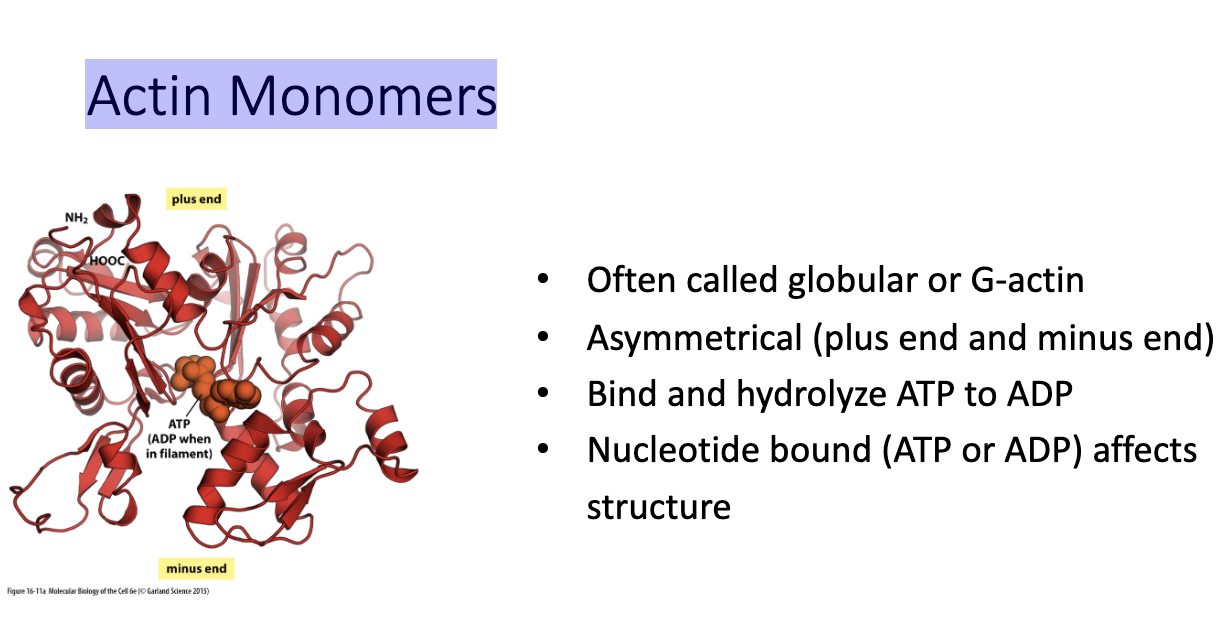
Actin monomers are often referred to as globular or G-actin.
Actin monomers have asymmetrical structure with plus end and minus end
Actin monomers bind to & hydrolyze ATP.
nucleotide (ATP or ADP) bound by actin monomer affects structure of protein.
Actin Filaments, referred to as, made of, characteristics
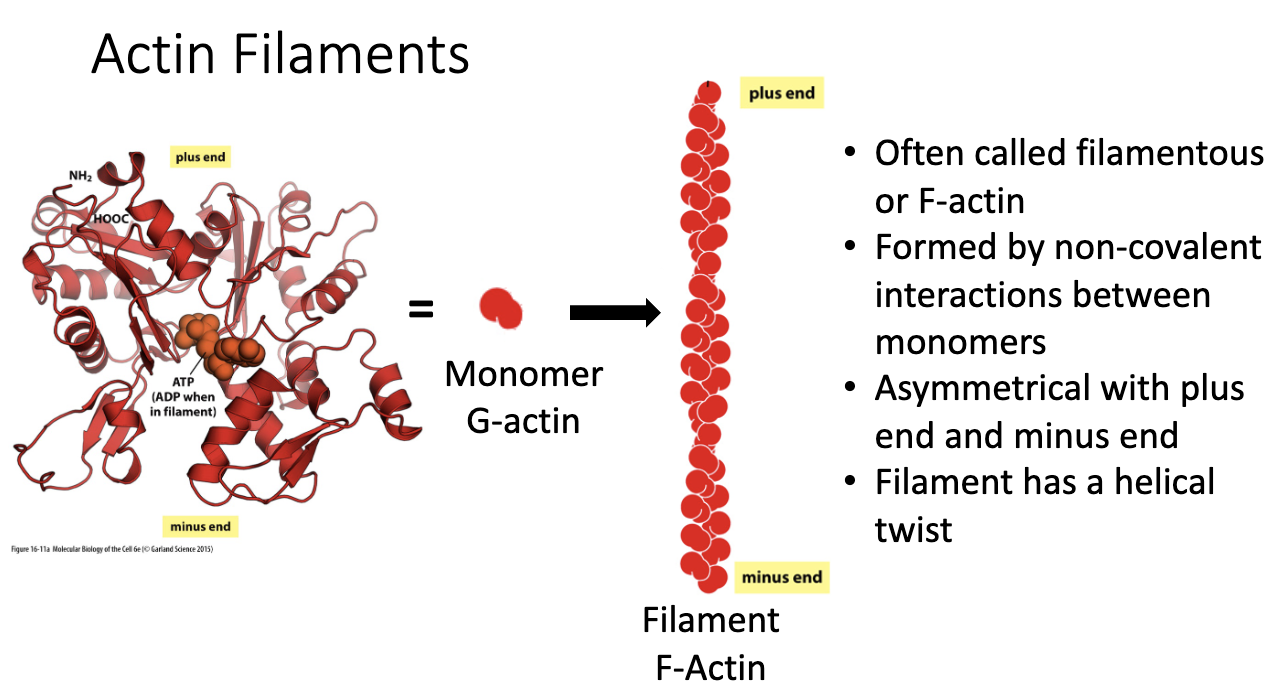
Actin filaments, often called filamentous or F-actin
formed by non-covalent binding of actin monomers to each other.
asymmetrical subunits always associate in the same orientation, creating an asymmetric filament with a plus end and a minus end.
orientation of subunits result in a filament with helical twist.
Tubulin Dimers, what are they made of, what do they look like
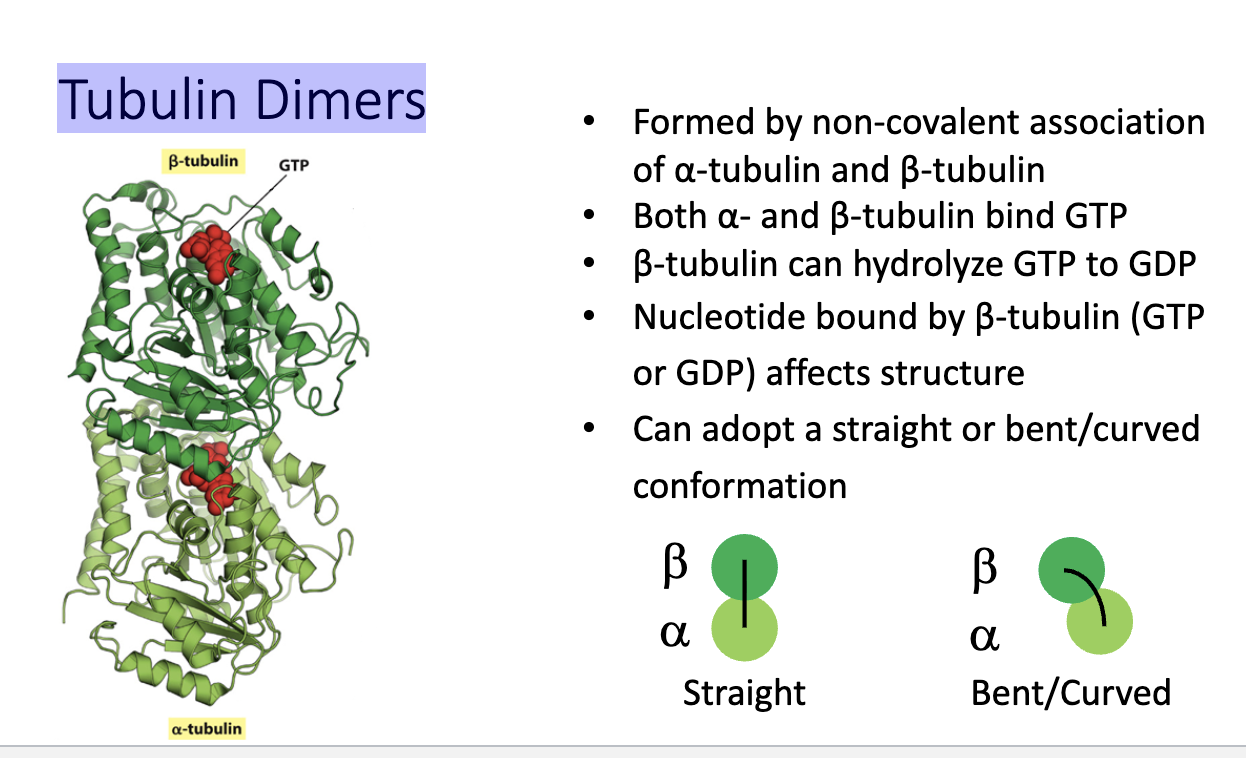
Alpha tubulin and beta tubulin are two highly related proteins that associate non covalently to form tubulin dimers.
Both alpha and beta tubulin bind to GTP but only beta tubulin can hydrolyze GTP to GDP.
The nucleotide (GTP or GDP) bound by beta tubulin, affects the structure of the protein.
Tubulin dimers can adopt a straight or bent or curved conformation.
Microtubule Structure
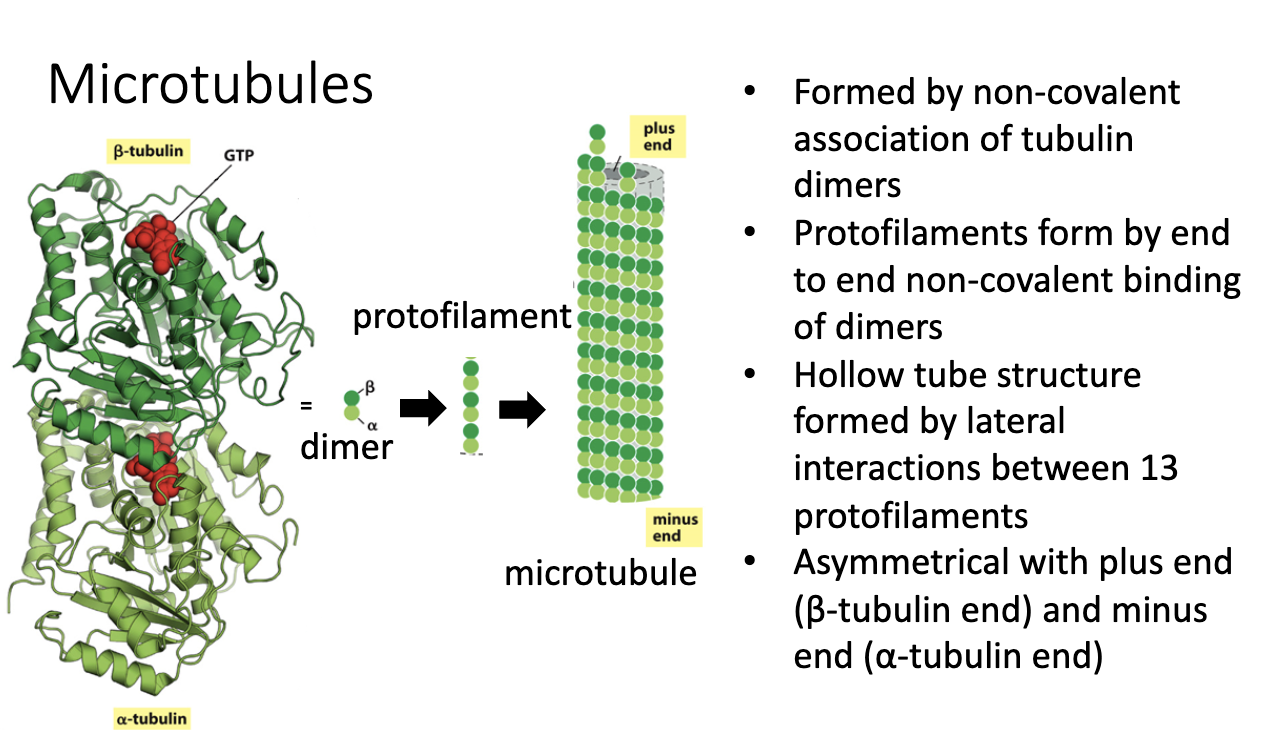
Microtubules are filaments formed by the non-covalent interaction of tubulin dimers, protofilaments (formed by end-to-end association of dimers).
Lateral interactions between dimers and different protofilaments lead to the formation of a hollow tube structure with 13 protofilaments.
Microtubules are asymmetrical
alpha tubulin side of dimers on one end, minus
beta tubulin side of dimers on other end, plus .
Protofilaments
A protofilament is a single, linear strand of polymerized alpha and beta tubulin heterodimers stacked end-to-end. Typically, 13 of these protofilaments associate laterally to form the hollow, cylindrical structure of a microtubule.
definition of nucleus in this context
stable complex of subunits that favors the addition of more subunits.
Nucleation of Filaments
Filament formation is also referred to as assembly or polymerization.
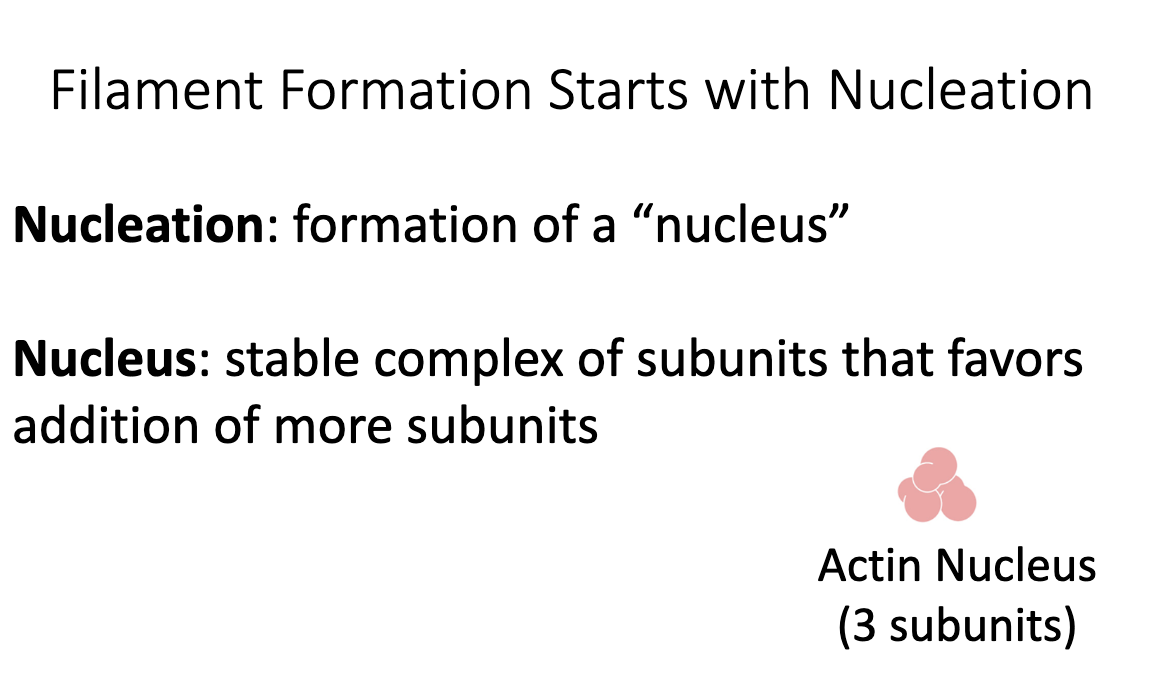
The formation of new filaments starts with nucleation which is the formation of a nucleus.
The definition of a nucleus in this context is a stable complex of subunits that favors the addition of more subunits.
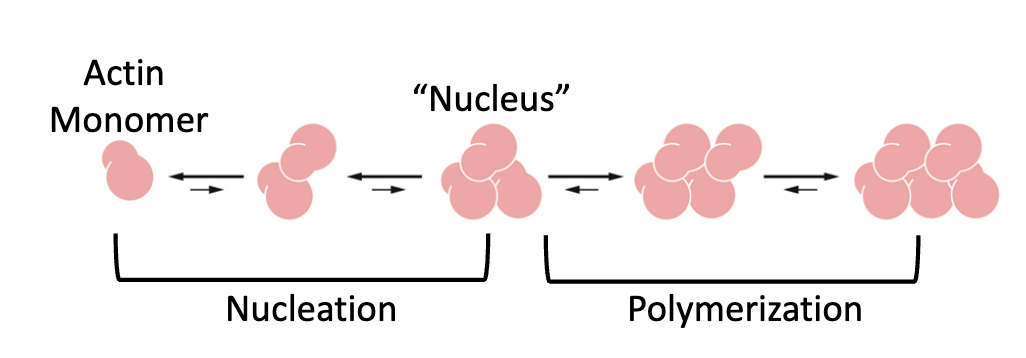
An actin nucleus consists of a complex of three subunits. For microtubule formation, the nucleus is larger and more complex.
When there are only two subunits, the complex is more likely to disassemble than gain a subunit as shown by the larger arrow point to the left.
Once the nucleus forms, filament assembly or polymerization occurs at a higher rate as indicated by the longer arrows pointing towards the right.
how does nucleation occur
In this case, nucleation occurs by spontaneous association of subunits.
Another way for nucleation to occur is through the presence of a nucleation factor or nucleator that promotes nucleation.
Some nucleators are protein complexes that mimic the structure of a nucleus.
Filament Dynamics (Addition and Removal)
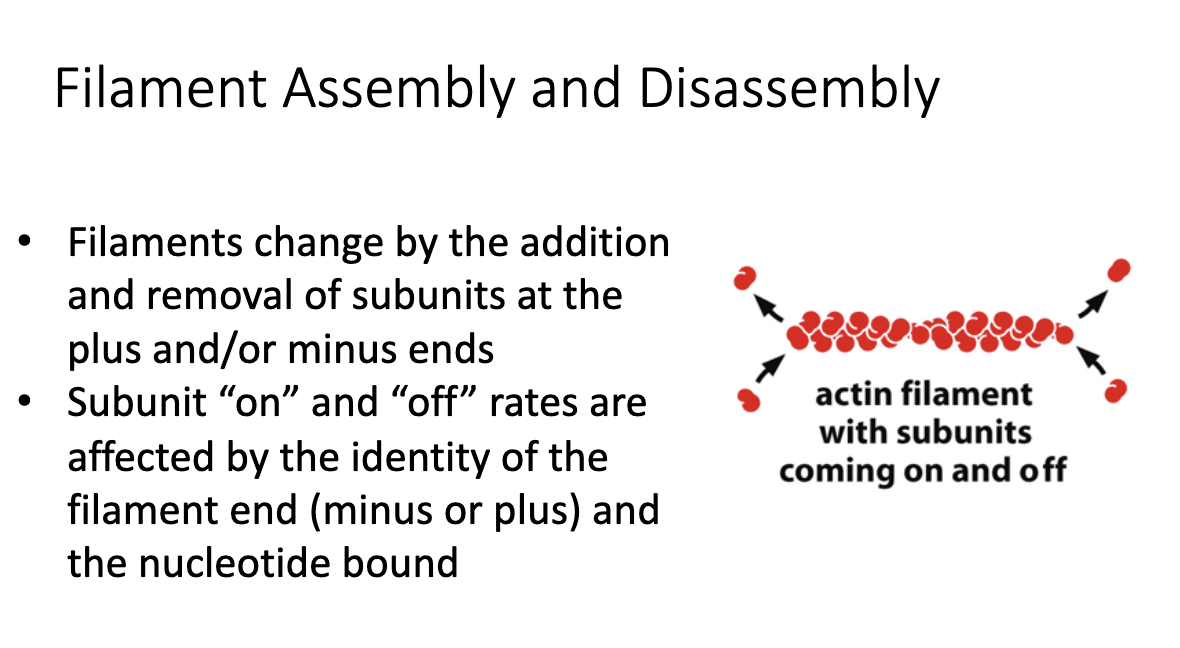
Existing filaments can change by the addition or removal of subunits.
Subunits are typically added or removed only at the ends of a filament.
The on and off rates of subunits are affected by the identity of filament end and the type of nucleotide bound by the subunit.
Microtubule growth
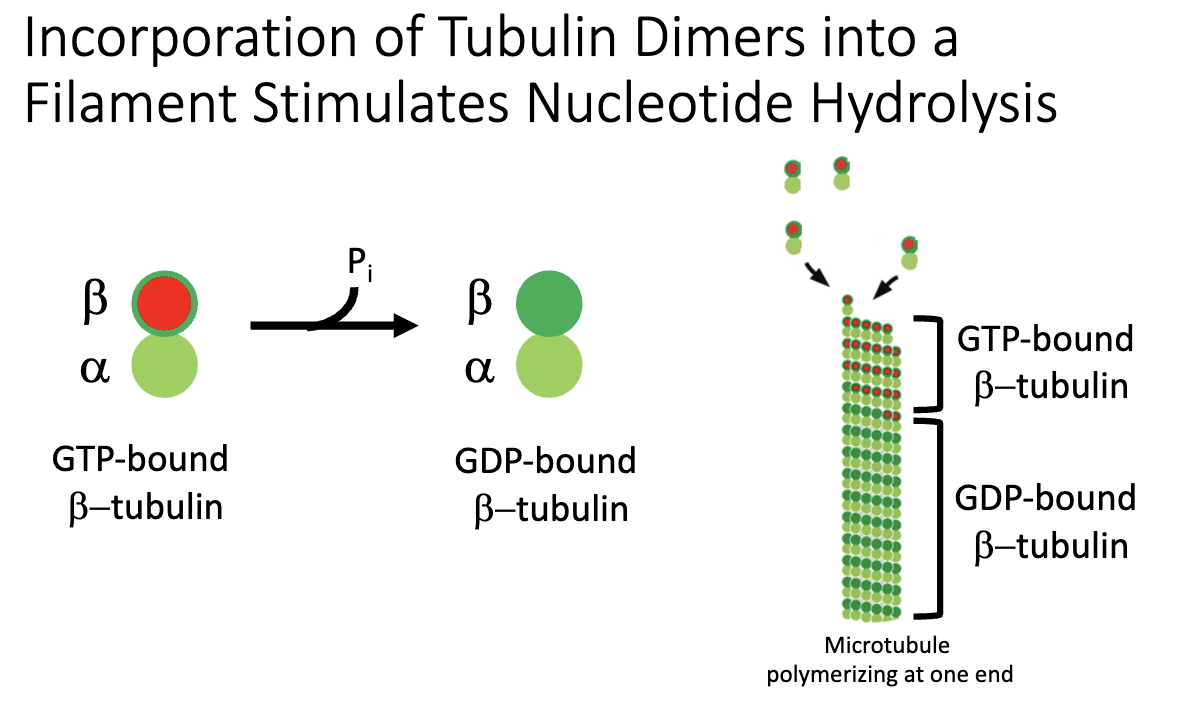
Beta tubulin can bind and hydrolyzed GTP.
This diagram represents GTP bound beta tubulin with a red circle inside the dark green circle.
GTP hydrolysis leads to a beta tubulin subunit with GDP bound represented here by just the dark green circle.
On the right side is a diagram of a polymerizing or growing microtubule.
This microtubule is growing at the end located on the top of the diagram.
The subunits adding to microtubule have GTP bound tubulin.
Incorporation of subunits into the filament induces GTP hydrolysis after some period of time,
results in GDP bound subunits in
middle
end that is not growing
GTP bound subunits close to the growing end.
The GTP bound tubulin dimers at the end of a growing microtubule are often referred to as a GTP cap.
Actin growth
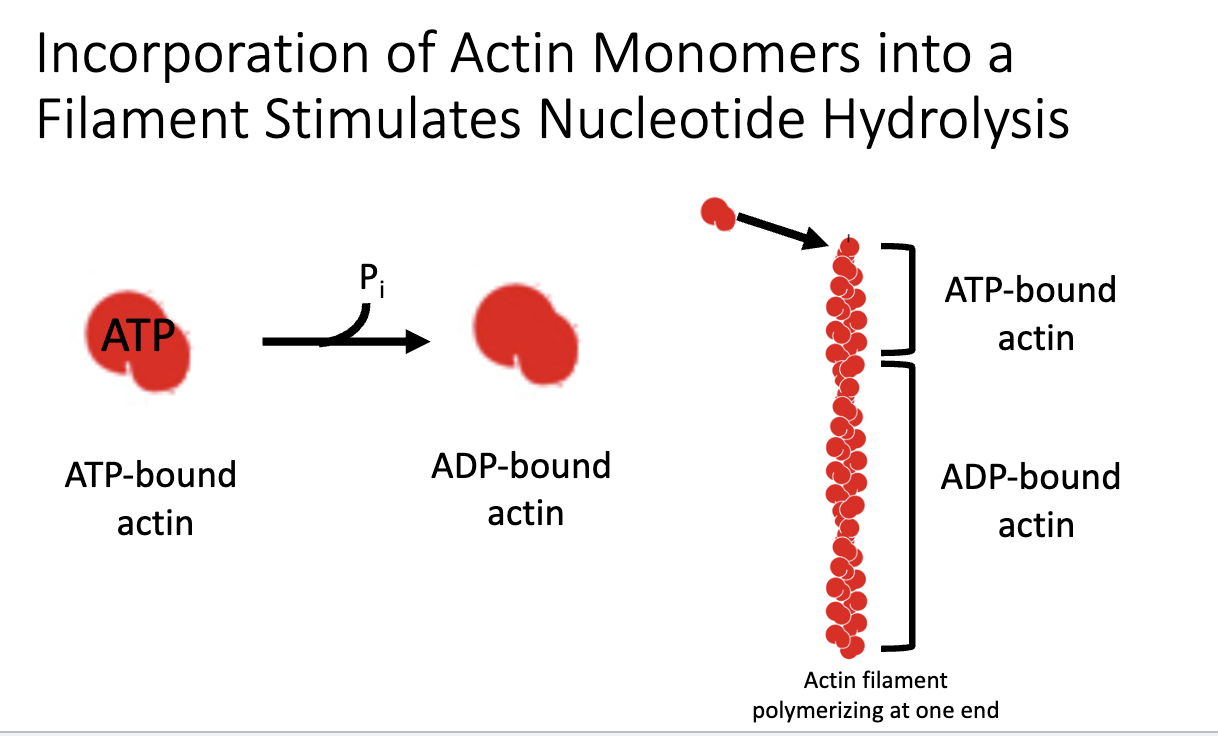
Similarly, actin monomers hydrolyze ATP and incorporation of actin monomers into a filament stimulates hydrolysis.
A filament undergoing addition of ATP bound subunits at one end will have a region of recently added ATP bound subunits at the growing end and ADP bound subunits in the middle and non-growing end.
Summary of Microtubules and Actin Filaments
In summary, actin monomers and tubulin dimers are asymmetrical and form asymmetric filaments. Actin monomers and tubulin dimers bind and hydrolyze nucleotide triphosphates. Nucleation is the initial step of filament formation. Subunits are added to and removed from filament ends. Nucleotide hydrolysis is stimulated when a subunit is added to a filament
Actin Monomers
Actin Filaments
Tubulin Dimers
Microtubules
Filament Formation Starts
Filament Assembly and Disassembly
Incorporation of Tubulin Dimers into a Filament
Summary
Actin monomers and tubulin dimers are asymmetrical and form asymmetric filaments
Actin monomers and tubulin dimers bind and hydrolyze nucleotide triphosphates
Nucleation is the initial step of filament formation
Subunits are added to and removed from filament ends
Nucleotide hydrolysis is stimulated when a subunit is added to a filament