AQA A Level Bio 4.1 DNA, Genes and Chromosomes
 Call Kai
 Learn
Learn Practice Test
 Spaced Repetition
 Match
Match Flashcards
 Knowt Play
1/8

Earn XP
Description and Tags
Name | Mastery | Learn | Test | Matching | Spaced | Call with Kai | Chat |
|---|
No analytics yet
Send a link to your students to track their progress
9 Terms
Describe how a gene is a code for the production of a polypeptide. Do not include information about transcription or translation in your answer. (3)
(Because) base/nucleotide sequence (1)
(in) triplet(s) (1)
(Determines) order/sequence of amino acid sequence/primary structure (in polypeptide (1)
Define the term exon (1)
Base/nucleotide/triplet sequence coding for polypeptide/sequence of amino acids/primary structure (1)
Describe how a phosphodiester bond is formed between two nucleotides within a DNA molecule. (2)
Condensation (reaction)/loss of water (1)
(Between) phosphate and deoxyribose (1)
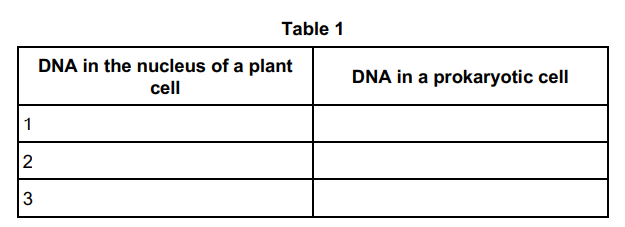
Complete Table 1 to show three differences between DNA in the nucleus of a plant cell and DNA in a prokaryotic cell. (3)
Associated with histones (1)
Linear vs circular (1)
Introns vs no introns (1)
Scientists investigated the genetic diversity between several species of sweet potato. They studied non-coding multiple repeats of base sequences.
Define ‘non-coding base sequences’ and describe where the non-coding multiple repeats are positioned in the genome.(2)
DNA that does not code for protein/polypeptides (1)
(Positioned) between genes
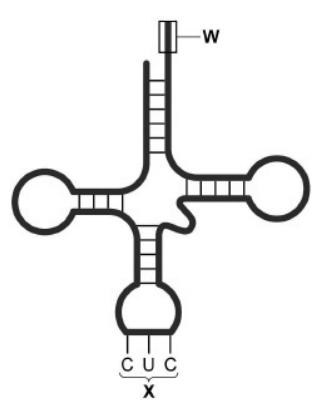
The diagram shows a tRNA molecule
Name the structures labelled W and X in the diagram.(1)
W = amino acid binding site and X = anticodon (1)
Not all mutations in the nucleotide sequence of a gene cause a change in
the structure of a polypeptide.
Give two reasons why (2)
Triplets code for the same amino acid (1)
Occurs in introns/non-coding sequence (1)
This question is about the genetic code. Define universal, non-overlapping and degenerate.(3)
(Universal) The same codon/triplet always codes for the same amino acid (1)
(Non-overlapping) Each base is only part of one triplet/codon (1)
(Degenerate) More than one codon/triplet codes for each amino acid; (1)
The two DNA strands of a particular gene contain 168 guanine bases between them. The relationship between the numbers of guanine bases (G), adenine bases (A), thymine bases (T) and cytosine bases (C) in these two strands of DNA is shown in the following equation.
G = 4(A + T) – C
Use this information and your understanding of DNA structure to calculate the maximum number of amino acids coded by this gene. Show your working. (2)
only one strand acts as the template !!
168= 4(A+T) -C
168=4(A+T)-168
336= 4(A+T)
84= A+T
168×2+84= 420
420/2= 210 210/3= 70 (2)