Unit 6 and 7 AP CHEM Final Review
 Call Kai
 Learn
Learn Practice Test
 Spaced Repetition
 Match
Match Flashcards
 Knowt Play
1/10

There's no tags or description
Looks like no tags are added yet.
Name | Mastery | Learn | Test | Matching | Spaced | Call with Kai |
|---|
No analytics yet
Send a link to your students to track their progress
11 Terms
For a classroom demonstration, a chemistry teacher puts samples of two different pure solid powders in a beaker. The teacher places the beaker on a small wooden board with a wet surface, then stirs the contents of the beaker. After a short time, the students observe that the bottom of the beaker is frozen to the wood surface. Which of the following is the best claim and justification based on the students' observations.
An exothermic physical change occurred because heat flowed from the contents of the beaker and the water on the board to the room.
Which of the following best describes the flow of heat when 1.0 mol of XY₂ decomposes?
50 kJ of heat is transferred from the surroundings.
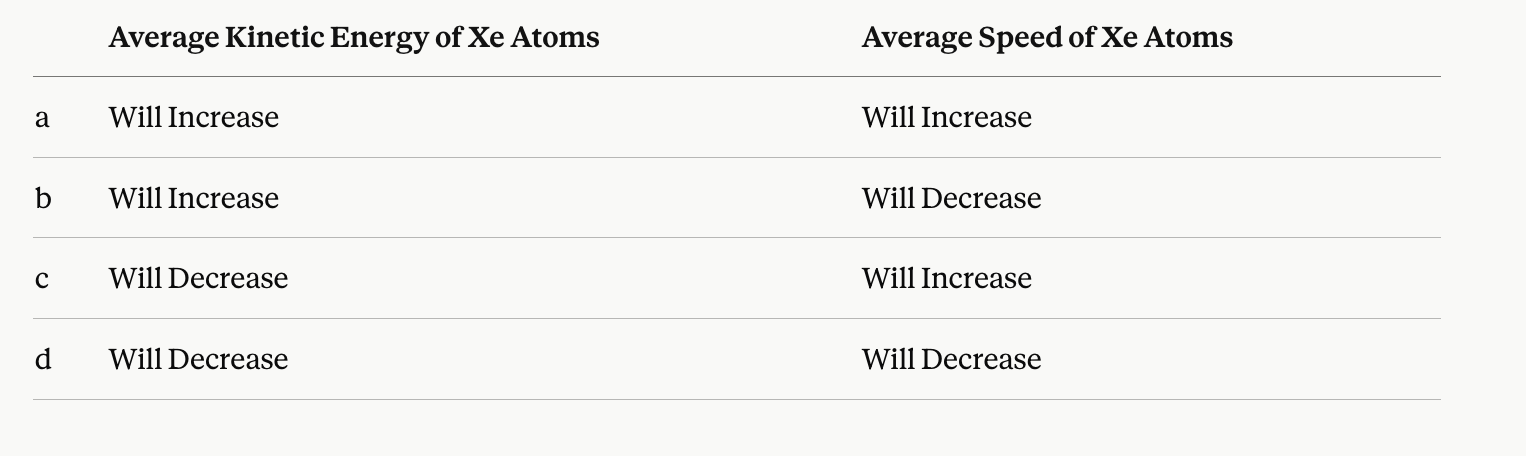
A 1.0 mol sample of He(g) at 25°C is mixed with a 1.0 mol sample of Xe(g) at 50°C. Which of the following correctly predicts the changes in average kinetic energy and the average speed of the Xe(g) atoms that will occur as the mixture approaches thermal equilibrium?
D) will decrease, will decrease
How much heat is required to raise the temperature of a 4.48 g sample of iron (specific heat = 0.450 J/g°C) from 25.0°C to 79.8°C?
110 J
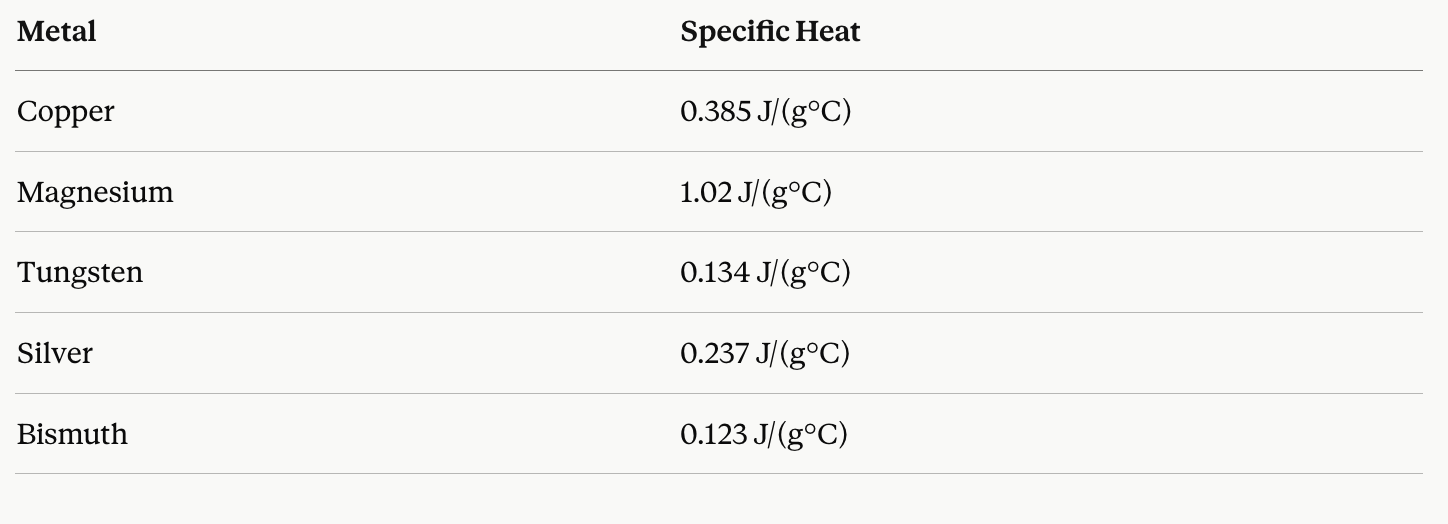
If the same amount of heat is added to 25.0 g of each of the metals, which are all at the same initial temperature, which metal will have the highest final temperature?
Bismuth
A 18.3 g piece of aluminum (which has a specific heat of 0.891 J/°C·g) is heated to 82.4°C and dropped into a calorimeter containing water (specific heat of water is 4.18 J/g°C) initially at 22.3°C. The final temperature of the water is 25.8°C. Calculate the mass of water in the calorimeter. (Choose the closest answer)
63.1 g
How much energy (in kJ) is required to heat 30.0 g of ice at -15.0°C to 95.0°C?
22.9 kJ