Multivariate Final Concepts
 Call Kai
 Learn
Learn Practice Test
 Spaced Repetition
 Match
Match Flashcards
 Knowt Play
1/52

There's no tags or description
Looks like no tags are added yet.
Name | Mastery | Learn | Test | Matching | Spaced | Call with Kai |
|---|
No analytics yet
Send a link to your students to track their progress
53 Terms
What is a p-value?
A p-value tells us how likely we would be to observe results this extreme, or more extreme, if the null hypothesis were true.
What is the alpha level?
The alpha level is the cutoff we choose for deciding statistical significance.
The most common alpha level is:
α = .05
What is variance?
Variance measures how spread out scores are around the mean.
Higher variance means scores are more spread out.
Lower variance means scores are closer together.
What is covariance?
Covariance tells us whether two variables tend to move together.
Covariance is like correlation, but it is not standardized, so its size depends on the units of the variables.
What is the difference between variance and covariance?
Variance describes how much one variable varies by itself.
Covariance describes how two variables vary together.
What is an interaction?
An interaction means the effect of one predictor on an outcome depends on the level of another predictor.
The effect of X on Y changes depending on Z.
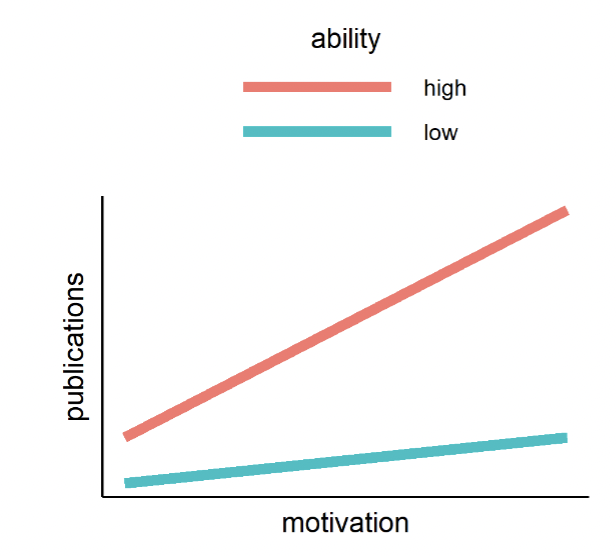
What is a synergistic interaction?
A synergistic interaction happens when two predictors strengthen or amplify each other.
The effect of one predictor becomes stronger at higher levels of the other predictor.
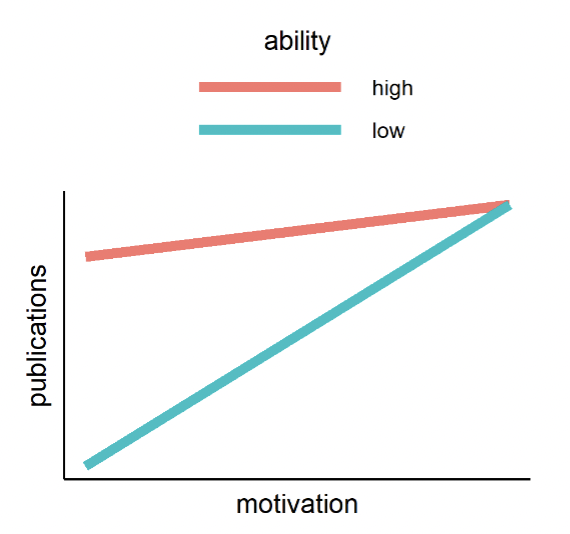
What is a compensatory interaction?
A compensatory interaction happens when one predictor makes up for a lower level of another predictor.
What do parallel lines suggest in an interaction graph?
Parallel lines suggest no interaction.
What is a crossover interaction?
A crossover interaction happens when the effect of a predictor goes in opposite directions for different groups.
What are odds?
Odds compare the probability that an event happens to the probability that it does not happen.
odds = p / (1 - p)
What are log odds?
Log odds are the natural log of the odds.
log odds = ln(odds)
In logistic regression, coefficients are usually given in log odds units.
Helpful interpretation:
log odds > 0 means odds are above 1, so the event is more likely than not
log odds = 0 means odds are 1, so probability is .50
log odds < 0 means odds are below 1, so the event is less likely than not
How do you convert log odds to odds?
Exponentiate the log odds.
odds = exp(log odds)
How do you convert odds to probability?
p = odds / (1 + odds)
How do you convert log odds directly to probability?
Use two steps:
Convert log odds to odds:
odds = exp(log odds)Convert odds to probability:
p = odds / (1 + odds)
How do you interpret a logistic regression coefficient?
A logistic regression coefficient tells how much the log odds of the outcome change for a 1-unit increase in the predictor.
Example:
If GPA coefficient = 1.05, then each 1-unit increase in GPA increases the log odds of admission by 1.05.
What is an odds ratio?
An odds ratio tells how the odds change when a predictor increases by 1 unit.
odds ratio = exp(coefficient)
Interpretation:
OR > 1: odds increase
OR = 1: odds do not change
OR < 1: odds decrease
How are log odds, odds, and probability related?
They are three ways of describing the same prediction.
What is mediation?
Mediation means the effect of an independent variable on a dependent variable is transmitted through a third variable called a mediator.
How do you interpret a visual mediation model?
A basic mediation model has this structure:
X → M → Y
Where:
* X = independent variable
* M = mediator
* Y = dependent variable
The model asks whether X affects Y through M.
What do paths a, b, c, and c′ mean in a mediation model?
a= effect of X on Mb= effect of M on Y, controlling for Xc= total effect of X on Y before including the mediatorc′= direct effect of X on Y after including the mediator
The mediator explains part or all of the X → Y relationship if the indirect path a × b is meaningful.
What is the product of coefficients method in mediation?
The product of coefficients method tests the indirect effect.
Formula:
indirect effect = a × b
Where:
a= effect of X on Mb= effect of M on Y, controlling for X
If a × b is statistically significant, then there is evidence of mediation.
What is full mediation?
Full mediation occurs when X affects Y only through the mediator.
This means:
The indirect effect
a × bis significant.The direct effect
c′is not significant after including the mediator.
What is partial mediation?
Partial mediation occurs when X affects Y through the mediator, but X also still has a direct effect on Y.
This means:
The indirect effect
a × bis significant.The direct effect
c′is still significant after including the mediator.
What are direct, indirect, and total effects in mediation?
Direct effect: effect of X on Y after accounting for M
direct effect = c′Indirect effect: effect of X on Y through M
indirect effect = a × bTotal effect: overall effect of X on Y
total effect = c′ + (a × b)
How do you interpret a significant indirect effect?
A significant indirect effect means X predicts Y through the mediator.
What is a latent variable?
A latent variable is an unobserved construct that is inferred from observed variables.
What is a manifest variable?
A manifest variable is an observed/measured variable.
In latent variable models, manifest variables are usually the items or indicators used to measure the latent construct.
Why do items correlate in a latent variable model?
Items correlate because they are assumed to share an underlying latent factor.
What is a factor loading?
A factor loading shows how strongly an observed item is related to a latent factor.
Higher loadings mean the item is a stronger indicator of the latent construct.
In a standardized solution, loadings are interpreted somewhat like correlations between the item and the factor.
What is residual variance in a latent variable model?
Residual variance is the part of an observed item’s variance that is not explained by the latent factor.
It includes:
item-specific variance
measurement error
anything not captured by the latent variable
What is the variance-covariance matrix used for in latent variable models?
Latent variable models are fit to the observed variance-covariance matrix or correlation matrix.
The model tries to reproduce the observed relationships among items using fewer latent factors and parameters.
What is the difference between EFA and CFA?
EFA stands for Exploratory Factor Analysis.
Used to discover the factor structure.
Data-driven.
Asks: “What structure appears in the data?”
CFA stands for Confirmatory Factor Analysis.
Used to test a hypothesized factor structure.
Theory-driven.
Asks: “Does this specific structure fit the data?”
What are modification indices?
Modification indices suggest which fixed or constrained parameters would improve model fit if they were freely estimated.
What is a Latent Growth Curve Model?
A Latent Growth Curve Model, or LGCM, models change over time.
It estimates two main latent factors:
Intercept: starting point or initial level
Slope: rate of change over time
What does the intercept represent in a Latent Growth Curve Model?
The intercept represents the estimated starting point or initial level of the outcome.
What does the slope represent in a Latent Growth Curve Model?
The slope represents the estimated rate of change over time.
A positive slope means the outcome increases over time.
A negative slope means the outcome decreases over time.
A slope near zero means there is little or no change over time.
What does significant intercept variance mean in an LGCM?
Significant intercept variance means people differ in their starting levels.
What does significant slope variance mean in an LGCM?
Significant slope variance means people differ in their rates of change.
What does the intercept-slope covariance or correlation tell us in an LGCM?
It tells us whether starting level is related to rate of change.
Positive intercept-slope correlation: people who start higher tend to increase more quickly.
Negative intercept-slope correlation: people who start higher tend to increase more slowly or decrease more.
Near-zero correlation: starting level is not strongly related to rate of change.
What is a within-construct correlation in LGCM?
A within-construct correlation is a relationship between growth factors from the same construct.
What is a between-construct correlation in LGCM?
A between-construct correlation is a relationship between growth factors from different constructs.
Example:
depression intercept correlated with anxiety intercept
depression slope correlated with anxiety slope
depression intercept correlated with anxiety slope
This tells us how starting levels or changes in one construct relate to starting levels or changes in another construct.
How do you interpret a between-construct intercept correlation?
A between-construct intercept correlation tells us whether starting levels of two constructs are related.
How do you interpret a between-construct slope correlation?
A between-construct slope correlation tells us whether change in one construct is related to change in another construct.