3.4.2 Mass transport in plants
 Call Kai
 Learn
Learn Practice Test
 Spaced Repetition
 Match
Match Flashcards
 Knowt Play
1/61

There's no tags or description
Looks like no tags are added yet.
Name | Mastery | Learn | Test | Matching | Spaced | Call with Kai |
|---|
No analytics yet
Send a link to your students to track their progress
62 Terms
Give the 2 mass transport systems
1. Xylem- water and minerals in solution from roots to leaves, by transpiration. UP.
2. Phloem- organic substances e.g. sugars in solution UP + DOWN plant, by translocation.
Describe the function of xylem tissue.
Transports water (and mineral ions) through the stem, up the plant to leaves.
Suggest how xylem tissue is adapted for its function.
● Cells joined with no end walls forming a long continuous tube → water flows as a continuous column
● Cells contain no organelles / cytoplasm → water flow not obstructed
● Thick cell walls with lignin → provides support / withstand tension / waterproof
● Pits in side walls → allow lateral water movements
Adaptations of gas exchange in plants
- Numerous stomata
- Large surface area of mesophyll cells
- Air spaces facilitate diffusion
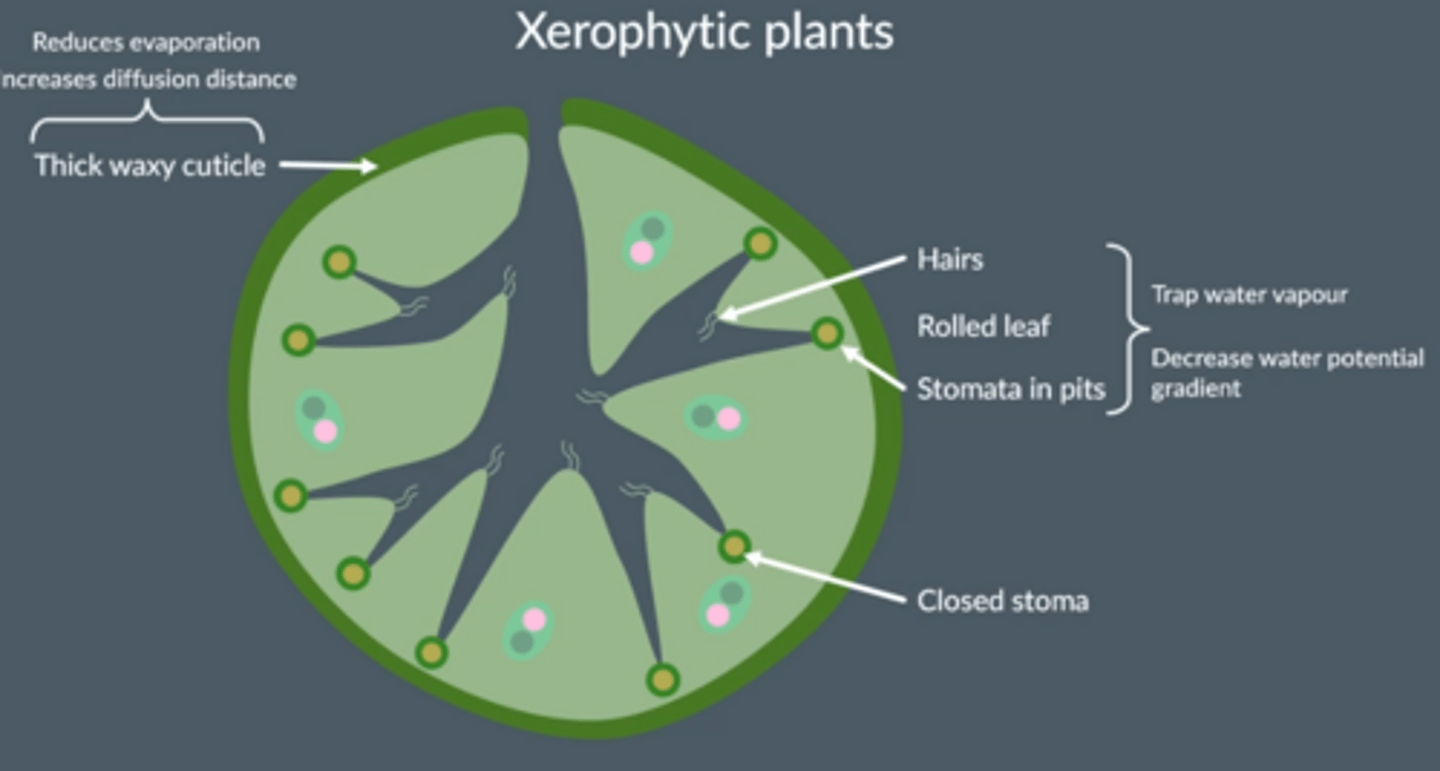
Adaptations of xerophytic plants to prevent water loss
- Hairs, rolled leaf, stomata in pits: Trap water vapour, decrease water potential gradient
- Closed stoma
- Thick waxy cuticle increases diffusion distance and reduces evaporation
Explain the cohesion-tension theory of water transport in the xylem.
1. Water evaporates / transpires from leaves (from mesophyll cells into air spaces) water vapour diffuses through (open) stomata
2. Reducing Ψ of mesophyll cells
3. So water drawn out of xylem down a Ψ gradient
4. Creating tension ('negative pressure' or 'pull') in xylem
5. Hydrogen bonds result in cohesion between water molecules (stick together) so water is pulled up as a continuous column
6. Water also adheres (sticks to) to walls of xylem
7. Water enters roots via osmosis
Describe how water is moved through a plant according to the cohesion tension hypothesis. (4)
1. Water evaporates / transpires from leaves;
2. Reduces Ψ in mesophyll cell / Ψ gradient across cells (ignore reference to air space);
3. Water is drawn out of xylem;
4. Creates tension (accept negative pressure);
5. Cohesive forces between water molecules;
6. Water pulled up as a column;
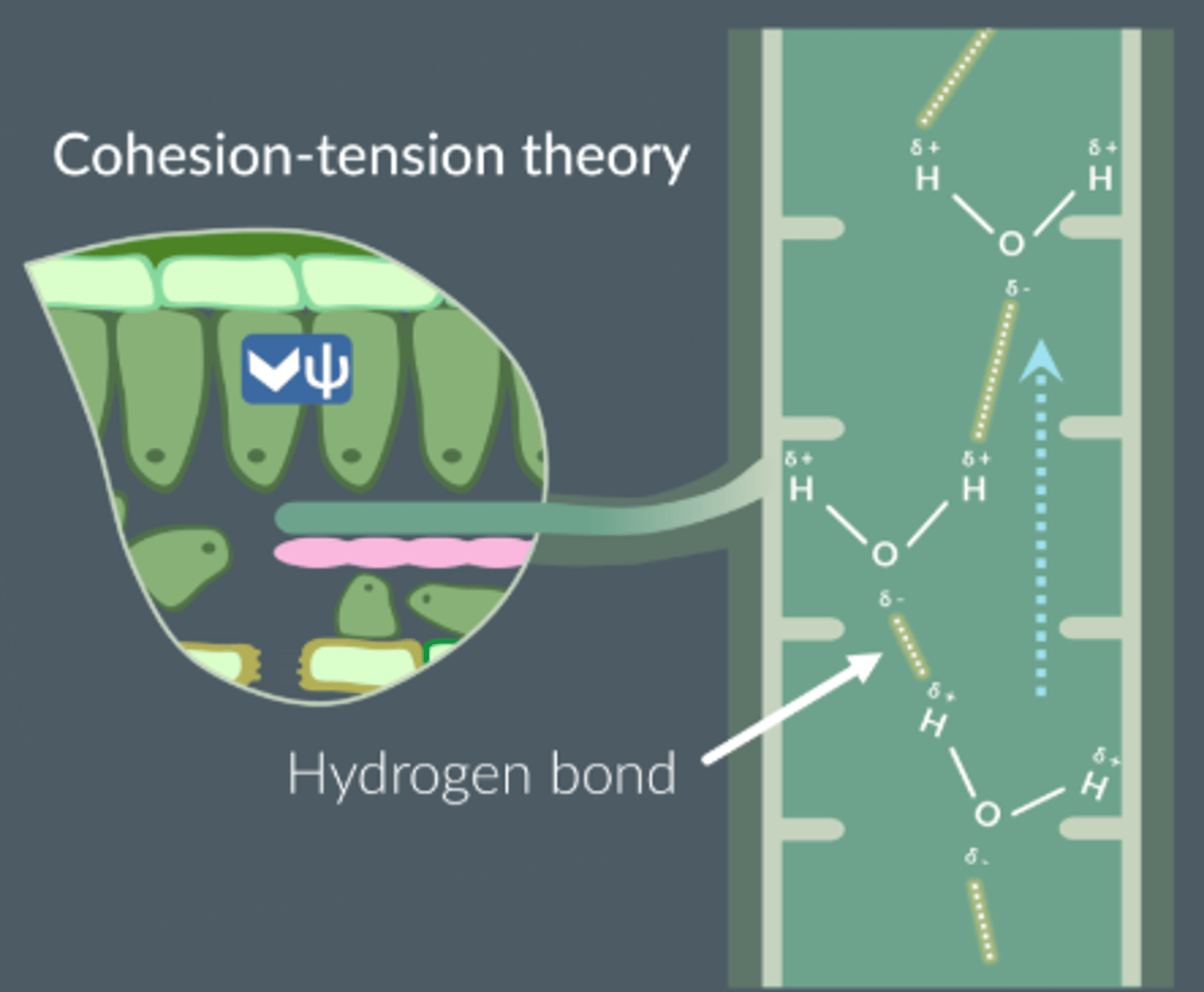
Explain the cohesion-tension theory of water transport in the xylem. (Diagram)
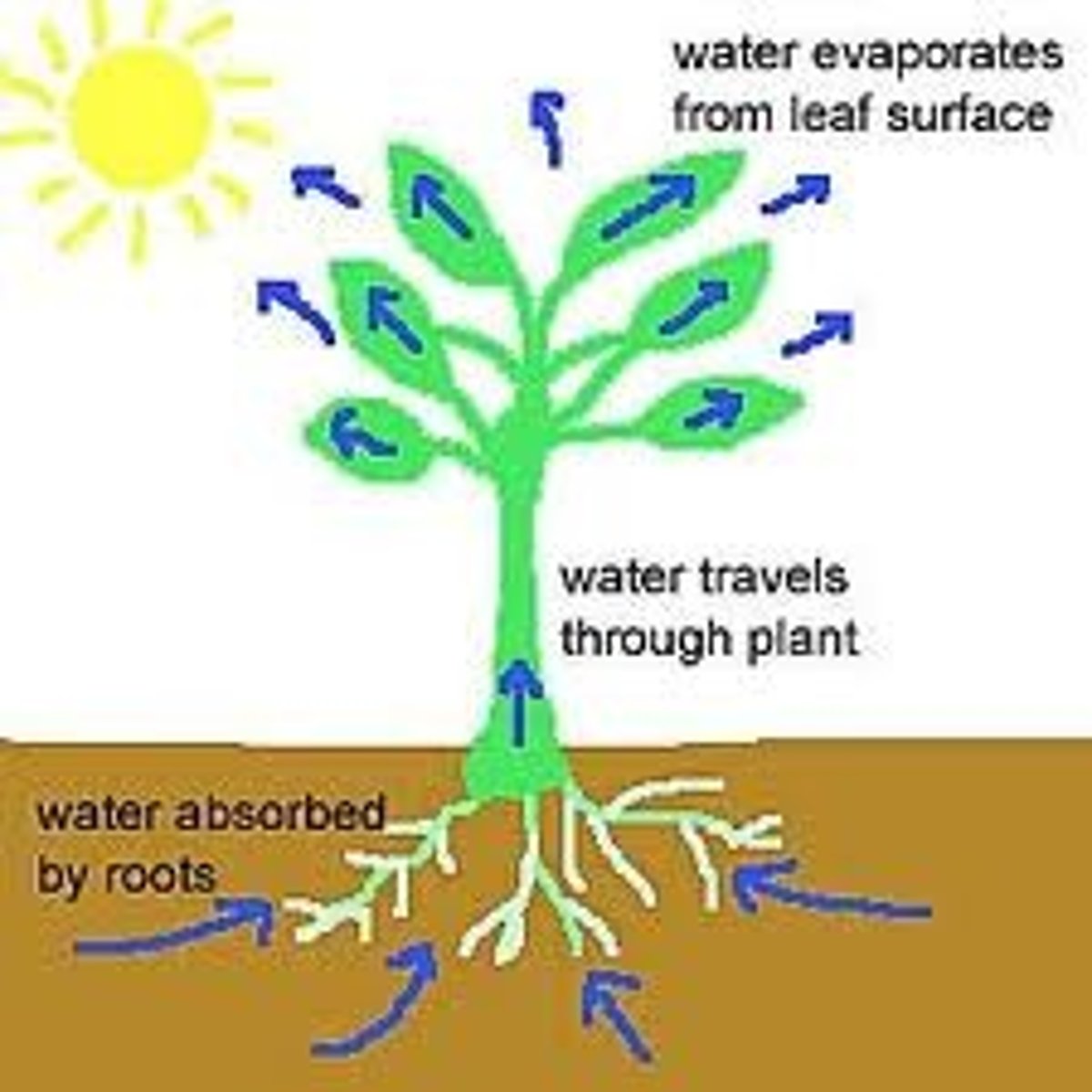
Cohesion
Positively charged hydrogen atom of one water molecule is attracted to the negatively charged oxygen atom of another water molecule, forming a hydrogen bond.
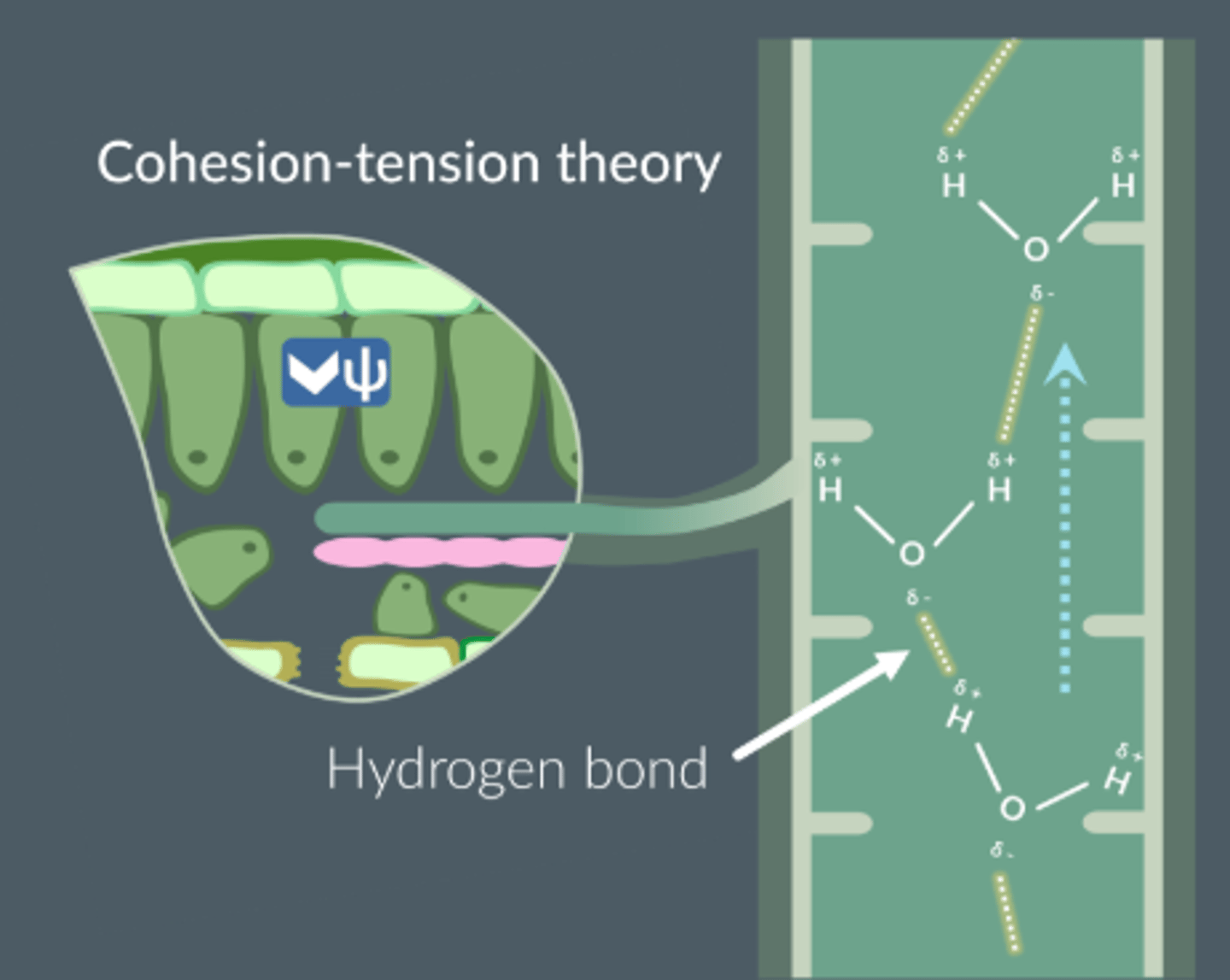
Cohesion-tension hypothesis
Explains how water is moved through plants: water molecules stick together (cohesion) and are pulled up through the plant due to transpiration creating tension.
Tension in xylem
The force created by the evaporation of water from the leaves, pulling water up through the xylem to replace it.
Summarise the cohesion-tension theory of water transport in the xylem.
1. The loss of water by transpiration decreases the water potential in mesophyll cells.
2. This pulls water up the xylem, which puts it under tension.
Inside the column, water molecules adhere to the walls, and they're stuck together by hydrogen bonds.
https://www.youtube.com/watch?v=cJrSa8sfd7A
Describe how to set up a potometer.
1. Cut a shoot underwater at a slant → prevent air entering xylem
2. Assemble potometer with capillary tube end submerged in a beaker of water
3. Insert shoot underwater
4. Ensure apparatus is watertight / airtight
5. Dry leaves and allow time for shoot to acclimatise
6. Shut tap to reservoir
7. Form a SINGLE air bubble- quickly remove end of capillary tube from water
Why must the shoot be cut from the plant underwater (and at an angle?) ?
Due to the cohesion-tension creating a negative pressure in the xylem, if it was cut in air it would draw water into the xylem tube
Breaking the continuous water column, preventing transpiration
Cutting underwater ensures only water is drawn into the xylem
Describe how a potometer can be used to measure the rate of transpiration
Potometer estimates transpiration rate by measuring water uptake:
1. Record position of air bubble
2. Record distance moved in a certain amount of time (eg. 1 minute)
3. Calculate volume of water uptake in a given time:
● Use radius of capillary tube to calculate cross-sectional area of water (πr^2)
● Multiply this by distance moved by bubble
4. Calculate rate of water uptake - divide volume by time taken
Why are the leaves dried?
So that only water loss from transpiration is measured, prevents overestimation
How can you ensure the equipment is air tight ? Why ?
● Use rubber seals and petroleum jelly
● So any water lost is solely from transpiration
What variables would have to be controlled ?
Surface area of leaves (number and size of leaves)
Describe how a potometer can be used to investigate the effect of a named environmental variable on the rate of transpiration.
● Carry out the above, change one variable at a time (wind, humidity, light or temperature)
○ Eg. set up a fan OR spray water in a plastic bag and wrap around the plant OR change distance of a light source OR change temperature of room
● Keep all other variables constant
What factors affect the rate of transpiration?
Increased temperature, light intensity, wind speed;
Decreased humidity
Suggest how light intensity affects transpiration rate.
Increases rate of transpiration
● More stomata open in light to let in CO2 for photosynthesis
● Allowing more water to evaporate faster
● Stomata close when it's dark so there is a low transpiration rate
Suggest how temperature affects transpiration rate.
Increases rate of transpiration
● Water molecules gain kinetic energy
● So water evaporates faster
● So increased tension
Suggest how humidity affects transpiration rate.
Decreases rate of transpiration
● More water in air / around leaf, so it has a higher water potential
● Decreasing water potential gradient from leaf to air
● Water evaporates slower
Suggest how wind intensity affects transpiration rate.
Increases rate of transpiration
● Wind blows away water molecules from around stomata
● Decreasing water potential of air around stomata
● Increasing water potential gradient so water evaporates faster
What creates the tension in the xylem?
Water moving out by osmosis
Suggest limitations in using a potometer to measure rate of transpiration.
● Rate of water uptake might not be same as rate of transpiration
○ Water used for support / turgidity
○ Water used in photosynthesis and produced during respiration
● Rate of movement through shoot in potometer may not be same as rate of movement through shoot of whole plant
○ Shoot in potometer has no roots whereas a plant does (doesn't account for water uptake in roots)
○ Xylem cells very narrow
phloeeeeeeeeeemmmmmmmmmmmmmmmmm
What are sources and sinks?
Sources- Places sugars are produced or transported
Sinks- Places substances are needed / stored
How do plants commonly transport carbohydrates?
As sucrose
- Reduces the amount of energy (rather than 2 molecules glucose + fructose)
- Sucrose is less reactive than glucose so less likely to unwanted react
What else does the phloem transport? How does it transport substances?
Larger carbohydrate polymers
Amino acids
Phloem contains water which the substances are dissolved into: sap (so are water-soluble)
The roots can act as..
Both a source and a sink
Describe the function of phloem tissue.
Transports organic substances e.g. sucrose in plants
Suggest how phloem tissue is adapted for its function.
1. Sieve tube elements
○ Few organelles → easier flow of organic substances
○ End walls between cells perforated (sieve plate)
2. Companion cells have many mitochondria → high rate of respiration to make ATP for active transport of solutes
State 5 uses of the glucose produced during photosynthesis.
- Respiration
- Converted into insoluble starch for storage
- Produce fat or oil for storage
- Produce cellulose
- Produce amino acids for protein synthesis
What is translocation?
● Movement of assimilates / solutes such as sucrose
● From source cells to sink cells, by mass flow hypothesis
Give examples of translocation.
- Substances travelling upwards from storage organs called tubers to shoot tips.
- Substances travelling downwards from the leaves to the developing fruit.
Describe the translocation of sucrose in the phloem (movement)
- Source cell, moves into a companion cell and moves into a sieve tube element.
- Sieve tube elements responsible for transporting sucrose solution throughout the plant.
- They contain sieve plates, which have holes the sucrose solution can travel through.
- There, the sucrose solution moves up or down through the sieve tube elements.
- When it gets to where it is needed, the sucrose solution moves into a second companion cell and then into the desired sink cell.
Explain the mass flow hypothesis for translocation in plants.
1. At source, sucrose is actively transported into phloem sieve tubes / cells
2. By companion cells
3. This lowers Ψ in sieve tubes so water enters (from xylem) by osmosis (down Ψ gradient)
4. This increases hydrostatic pressure in sieve tubes (at source) / creates a hydrostatic pressure gradient
5. So mass flow occurs - movement from source to sink
6. At sink, sucrose is removed by active transport to be used by respiring cells or stored in storage organs
Explain the mass flow hypothesis for translocation in plants (diagram)
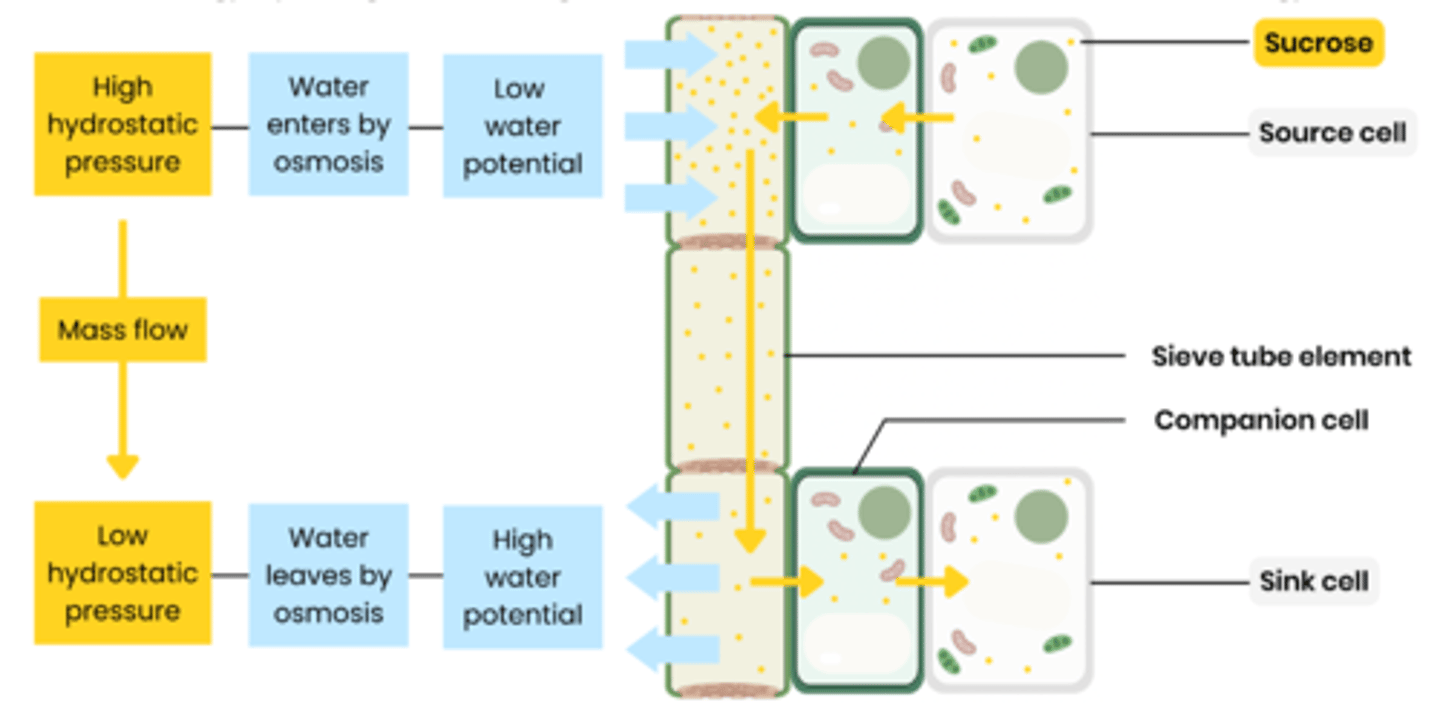
(a) One theory of translocation states that organic substances are pushed from a high pressure in the leaves to a lower pressure in the roots.
Describe how a high pressure is produced in the leaves.
1. Water potential becomes lower / more negative (as sugar enters phloem);
2. Water enters phloem by osmosis;
3. Increased volume (of water) causes increased pressure
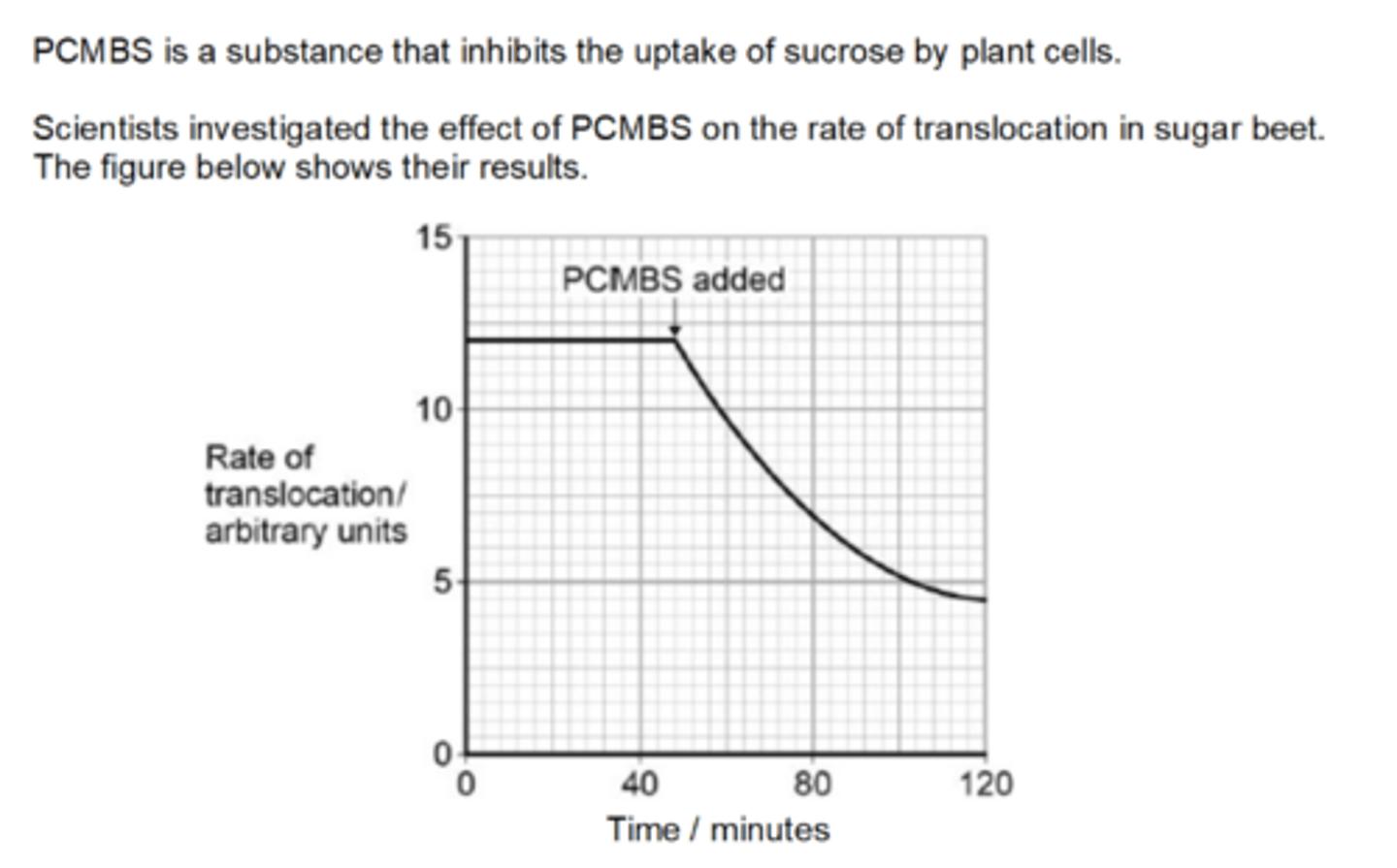
(c) The scientists concluded that some translocation must occur in the spaces in the cell walls.
Explain how the information in the figure above supports this conclusion.
1. Rate of translocation does not fall to zero / translocation still occurs after 120 minutes;
2. But sucrose no longer able to enter cytoplasm of phloem cells.
So if translocation only happened inside the phloem cells (through the living cells), adding PCMBS should stop translocation almost completely. But the graph shows the rate drops a lot, then levels off at a lower value - meaning some translocation is still happening.
That “still happening” bit supports the idea that some translocation must be going through the spaces in the cell walls (the apoplast), because that route doesn’t rely on the cell’s carrier proteins, so PCMBS wouldn’t block it.
How does sucrose move from a source cell, to a companion cell, and into the sieve tube element?
Co-transport facilitated by active transport
- A carrier protein moves H+ ions from the companion cell's cytoplasm to the cell wall.
- This creates a concentration gradient, and the H+ ions return to the cytoplasm via a co-transport protein (also transports sucrose)
- Once in the companion cell, the sucrose diffuses into the sieve tube element
- ACTIVE TRANSPORT SO REQUIRES ATP
Where does water move out the sieve tube element?
Near the sink, where there is a low conc of sucrose
Water moves back into xylem by osmosis
Explain the mass flow experiment by Münch.
- The high concentration sucrose solution has a lower water potential than the surrounding water.
- So, water moves into the high concentration sucrose solution by osmosis
- Then, the sucrose solution is forced to move along a hydrostatic pressure gradient.
Describe what happens to the water potential and hydrostatic pressure of when:
a) Sucrose loaded onto the sieve tube element
b) Sucrose removed from the sieve tube element
a) Sucrose is loaded into the sieve tube element, which decreases the water potential and increases the hydrostatic pressure.
b) Sucrose is removed from the sieve tube element, which increases the water potential and decreases the hydrostatic pressure.
Describe the use of tracer experiments to investigate transport in plants.
1. Leaf supplied with a radioactive tracer e.g. CO₂ containing radioactive isotope 14C
2. Radioactive carbon incorporated into organic substances (sucrose) during photosynthesis
3. These move around plant by translocation. Detected in other parts of the plant
4. Movement tracked using autoradiography or a Geiger counter, indicating that the materials have moved through the phloem.
What conclusions can be drawn from tracer experiments?
● Confirms that organic compounds, (ie sugars), move bidirectionally in the phloem and can be transported from source to sink tissues
● As the other tissues do not blacken the film, it follows that they do not carry sugars and that phloem alone is responsible for their translocation.
Describe the use of ringing experiments to investigate transport in plants.
1. Remove / kill phloem e.g. remove a ring of bark
2. Bulge forms on source side of ring
3. Fluid from bulge has higher conc. of sugars than below - shows sugar is transported in phloem. Sugars can't move past area where bark was removed.
4. Tissues below ring die as cannot get organic substances
Upward flow of xylem remains unaffected.
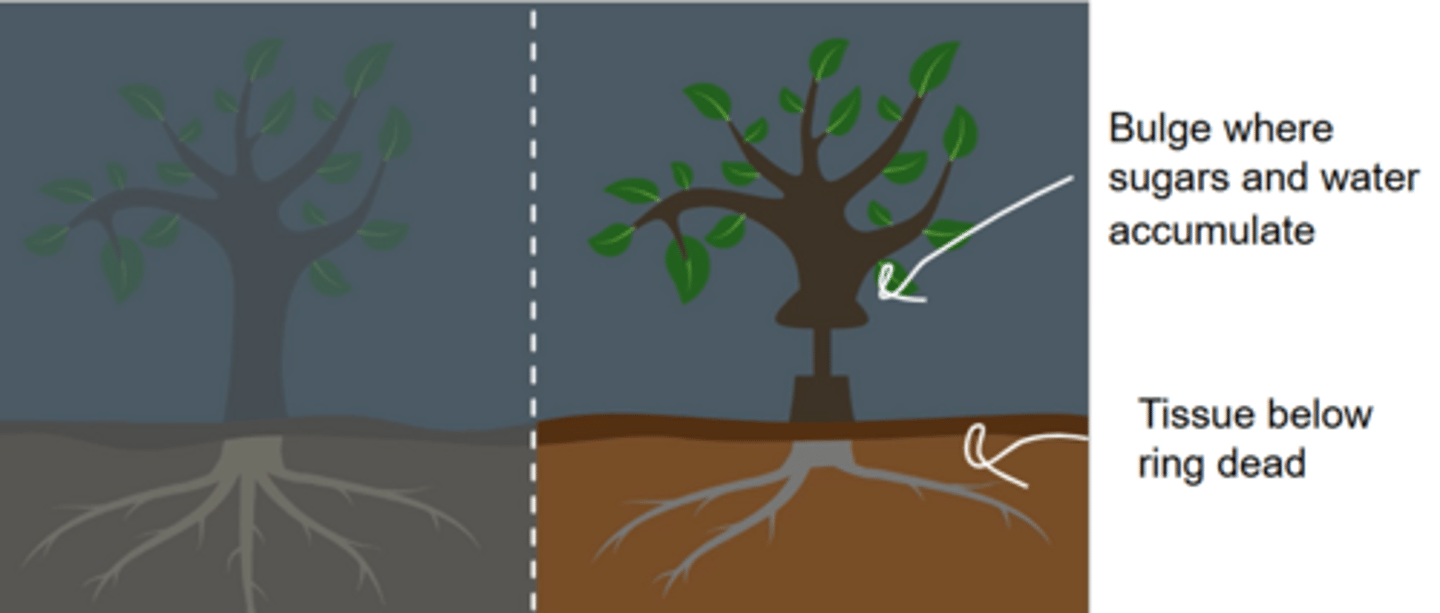
What conclusions can be drawn from ringing experiments?
● Phloem, rather than xylem, is the tissue responsible for translocating sugars in plants.
● Because the ring of tissue removed had not extended into the xylem, its continuity had not been broken.
● If it were the tissue responsible for translocating sugars you would not have expected sugars to accumulate above the ring nor tissues below it to die.
Suggest some points to consider when interpreting evidence from tracer & ringing experiments and evaluating evidence for / against the mass flow hypothesis.
● Is there evidence to suggest the phloem (as opposed to the xylem) is involved ?
● Is there evidence to suggest respiration / active transport is involved?
● Is there evidence to show movement is from source to sink? What are these in the experiment?
● Is there evidence to suggest movement is from high to low hydrostatic pressure?
● Could movement be due to another factor e.g. gravity?
Name one piece of evidence that does not support this hypothesis.
• Not all solutes travel at same speed
• Sieve plates too obstructive
• Rate of sucrose delivery not different depending on concentration at that region
Explain fully the process of translocation of sucrose in the phloem. Include details about movement of sucrose through the companion cells in your answer.
1. A carrier protein moves H+ ions from the cytoplasm of the companion cell to the cell wall, using active transport.
● This creates a conc gradient, so H+ ions are returned to the cytoplasm via a co-transport protein, which also transports sucrose.
2. Sucrose diffuses from companion cell into sieve tube element
3. This causes the water potential in the sieve tube element to decrease.
4. Water moves from the xylem into the sieve tube element by osmosis, causes the hydrostatic pressure in the sieve tube element to increase.
6. At the sink cell, sucrose moving out of the sieve tube element decreases the hydrostatic pressure here.
7. As a result, the sucrose solution moves down the hydrostatic pressure gradient.
8. Finally, sucrose moves into the sink cell.
Name one piece of evidence that supports this hypothesis.
• woody stem ringing experiments
• radioactive tracers
• pressure in sieve tube seen when cut
• conc of sucrose higher at source than sink
• downward flow in light but not in dark
• metabolic poison inhibits translocation
• companion cells have a lot of mitochondria
What are the key points of mass flow transport?
- Water moves in and out phloem by osmosis
- Pressure moves the sucrose solution
- It involves active processes that use ATP
Explain 3 key points and how they support mass flow.
1. Water moves in and out phloem by osmosis:
Higher sucrose conc at source than sink
2. Pressure moves the sucrose solution:
Pressure in sieve tube seen when cut
3. It involves active processes that use ATP:
As rate of respiration increases, rate of translocation increases, as it involves processes which use ATP
Give 3 features which undermine the mass flow hypothesis.
1. The speed of substances.
- If all substances are transported under pressure, they would all be expected to travel at the same speed through the phloem.
- However, evidence has shown that this isn't the case. e.g. experiments have shown that sucrose dissolved in the sap travels faster than amino acids.
2. The function of the sieve plates.
- Sucrose solution should move down sieve tube elements. Phloem should provide maximum possible space for the solution to make as efficient as poss.
- However, hinders mass flow. Some scientists suggest they might prevent the sieve tube elements from bursting under pressure.
3. Sucrose delivery
- Sucrose should travel from areas with a high to low conc of sucrose.
- However, evidence has shown that sucrose doesn't always travel to areas with the lowest concentration.
- Suggests the movement of sucrose may not be entirely due to differences in water potential, and the resulting hydrostatic pressure gradient.
Oak trees are deciduous, which means they lose their leaves during the winter.
The outer layer of bark was removed from 2 oak trees, one in summer and the other in winter. Both trees were left overnight. It was observed that the swelling above the ring of bark removed was greater when the bark was removed in summer than the winter.
Explain these results, including details of whether the results of this ringing experiment support or contradict the mass flow hypothesis.
- Leaves are the site of photosynthesis in plants, so rate of photosynthesis of the oak tree is higher in summer than winter, since the tree has no leaves during the winter.
- Sucrose produced in photosynthesis. So there is greater translocation during summer than winter.
- The outer layer of bark removed contains the phloem. Swell above the ring due to substances transported in the phloem, including sucrose, accumulating.
- Swelling is greater in summer than winter as there is greater transport of sap in summer, as a result of the greater rate of photosynthesis.
- These results support the mass flow hypothesis, specifically the fact that the translocation of sucrose takes place in the phloem.
Carbon dioxide, containing radioactive carbon, was fed to a leaf of a Liana plant by enclosing the leaf within a sealed bag.
After 30 minutes, radioactive carbon was detected in the stem of the plant.
After 3 hours, radioactive carbon was detected in the roots of the plant.
The experiment was repeated with a pine tree. Radioactive carbon was detected in the trunk of the tree after 9 hours, and in the roots after 24 hours.
Explain these results, including details of whether the results of this tracer experiment support or contradict the mass flow hypothesis.
- Radioactive carbon dioxide taken up by leaf and used for photosynthesis. The sucrose produced in photosynthesis is therefore radioactively labelled.
- Transport of sucrose from the source, which is the leaves, to the sink, which is the root, can be tracked by tracking the radioactive label of sucrose with special scanners.
- Since the tracer travelled from the source to the sink in less time in the Liana than the pine tree, the rate of sap flow is faster in the Liana than the pine tree.
- This experiment supports the mass flow hypothesis, specifically that transport of sucrose takes place in the phloem, and sucrose travels from the source to the sink.
A student wants to investigate the surface areas of the upper sides of leaves from different species of tree. Suggest how they could measure this accurately.
1. Place leaf on centimetre squared / graph paper
2. Trace the shape
3. Count the number of squares in the outline
or model leaf as a series of circles/triangles/squares, find dimensions of shape, calculate combined area of the shapes.
A student carried out tracer and ringer experiments on some cherry trees. What would be found and why?
- Sucrose is transported by mass flow from source to sink by phloem
- Radioactive carbon used by cherry tree to produce radioactive sucrose
- If mass flow hypothesis correct, removing phloem = no mass flow from source to sink
- So no radioactive sucrose should be detected below the stem where phloem was removed
(b) The student wanted to determine the rate of water loss per mm2 of surface area of the leaves of the shoot in Figure 1.
Outline a method she could have used to find this rate. You should assume that all water loss from the shoot is from the leaves.
1. Method for measuring area;
e.g. draw round (each) leaf on graph paper and count squares
2. Of both sides of (each) leaf;
3. Divide rate of water loss / uptake by potometer by (total) surface area (of leaves);