Macro Y12 - everything after the march test
 Call Kai
 Learn
Learn Practice Test
 Spaced Repetition
 Match
Match Flashcards
 Knowt Play
1/25

There's no tags or description
Looks like no tags are added yet.
Name | Mastery | Learn | Test | Matching | Spaced | Call with Kai |
|---|
No analytics yet
Send a link to your students to track their progress
26 Terms
Balance of payments
Account measuring inflows and outflows of money to/from a country
Components:
Current account - record of international trade
Financial Account - investments, assets
Capital account - Small, capital transfers of non-produced and non-financial assets
Current account components
Net trade balance:
Value of trade in goods
Value of trade in services
Primary income:
Earnings from abroad: foreign investments/payments made to foreign investors
Wages from abroad
Secondary income:
Current transfers - govt. transfers
Aid, fees, etc.
Phillips curve
Effects of unemployment on inflation
ADD DIAGRAM
When there are unemployed resources, price level expected to be constant
When there’s less unemployment, smaller pool of potential employees (wages increase as incentive), workers have more bargaining rights, wages increase, driving prices up, increased spending
Milton Friedman on Phillips Curve
Attacked it
Monetarist
Argued relationship between UE and inflation non-existent in long run
If economy were to settle down at certain point w/ substantial inflation, people would adapt and economy would return to natural rates of unemployment, whilst inflation keeps rising
Trade off between economic growth and inflation
As spare capacity in economy depletes, Greater economic growth (fuelled by AD) leads to rising inflation rates
ADD DIAGRAM
Macroeconomic conflicts
Economic growth and protection of environment (government choosing whether to prioritise welfare of current or future society)
Controlled low inflation or balance of payments (Raising interest rates to control inflation makes currency stronger, so net trade deficit worsens)
Demand side policies
Influence AD
FISCAL POLICY or MONETARY
International trade fosters…
Interconnectedness of global economies
INTERDEPENDENCE - policies of one country have global ripple effects
Exchange Rate
Price of one currency in terms of another
Floating exchange rate
Price of one currency in terms of another determined by forces of demand and supply
In forex markets
No govt./ central bank intervention - purely market forces determine value of exchange rate
Fixed exchange rate
Currency is fixed in value to another (by govt.), maintained by regular intervention (usually central bank)
Hybrid exchange rate
Managed exchange rate
Usually floating, w/ periodic interventions by authorities
Monetary policy
Manipulation of monetary variables by central bank to achieve macro objectives
Variables:
Interest rate
Exchange rate
Money supply + QE
Expansionary monetary policy
Decrease nominal interest rates
Cost of borrowing decreases, stimulates more investment and consumption in economy
Affects housing market - incentivises new buyers to buy houses (fixed rate mortgages)
FALL IN REAL INTEREST RATES (if interest 3% and inflation 3%, real interest rate is 0) (possible for real interest rates to be negative)
Depreciation of exchange rate (less hot money inflows, less demand for currency in forex markets). This increases demand for exports and decreases demand for imports, improving the net trade balance.
Increase money supply:
QE - central bank buys back govt. bonds from commercial banks with new electronic money
Commercial banks have increased availability of credit, increased liquidity
Able to lend at lower interest rates
Encourages investment, consumption
The demand for currency falls, currency depreciates
This makes EXPORTS cheaper for foreign buyers and imports more expensive for domestic buyers
Reducing trade deficit
Increasing AD, helping stimulate economic growth
Contractionary monetary policy
Increase interest rates in case of inflationary pressures
Reward for saving increases
Negative multiplier effect - less spending, less revenue, cuts in workforce
More S, less C and I
Tightening of credit supply (loans harder to get)
Appreciation of exchange rate.
Factors to consider when setting interest rates
1) GDP and spare capacity - estimate of output gap
2) Bank lending - consumer credit figures, retail sales (availability of credit)
3) Equity markets and house market
4) Business + consumer confidence
5) Growth of wages, avg. earnings, labour productivity, unit labour costs
6) Trends in forex markets - sterling appreciating or depreciating against other countries
7) International data on trading partners
Transmission mechanism of monetary policy
1) Change in market interest rates (feeds through to borrowing/saving rate)
2) Impact on demand
Income inequality vs Wealth inequality
Wealth = stock concept - total value of assets owned by individual or household (real estate, investments, savings possession)
Wealth inequality is inequality in distribution of assets
Income = flow concept, return on factors of production over period of time
Income inequality = measure of unequal distribution of income among households
Causes of income + wealth inequality within a country:
Labour market - wage differentials based on skill, demand for jobs, experience
Wealth - already high levels of wealth
Chance - by luck, bought house
Age - more experienced workers have had longer to accumulate wealth
Quality of education
Causes of inequality between countries:
Globalisation - uneven effects - outsourcing + offshoring - widen imbalance
Historical context - colonialism, unequal access to resources
Geopolitical factors - conflicts, wars, political instability
Impact of economic growth on inequality
Can either EXARCEBATE or REDUCE inequality depending on how it is distributed
Inclusive growth policies that target marginalised groups can help reduce inequality
EVAL:
IN developing countries, the Gini coefficient usually decreases with economic growth
But this depends on whether focus is on equitable development
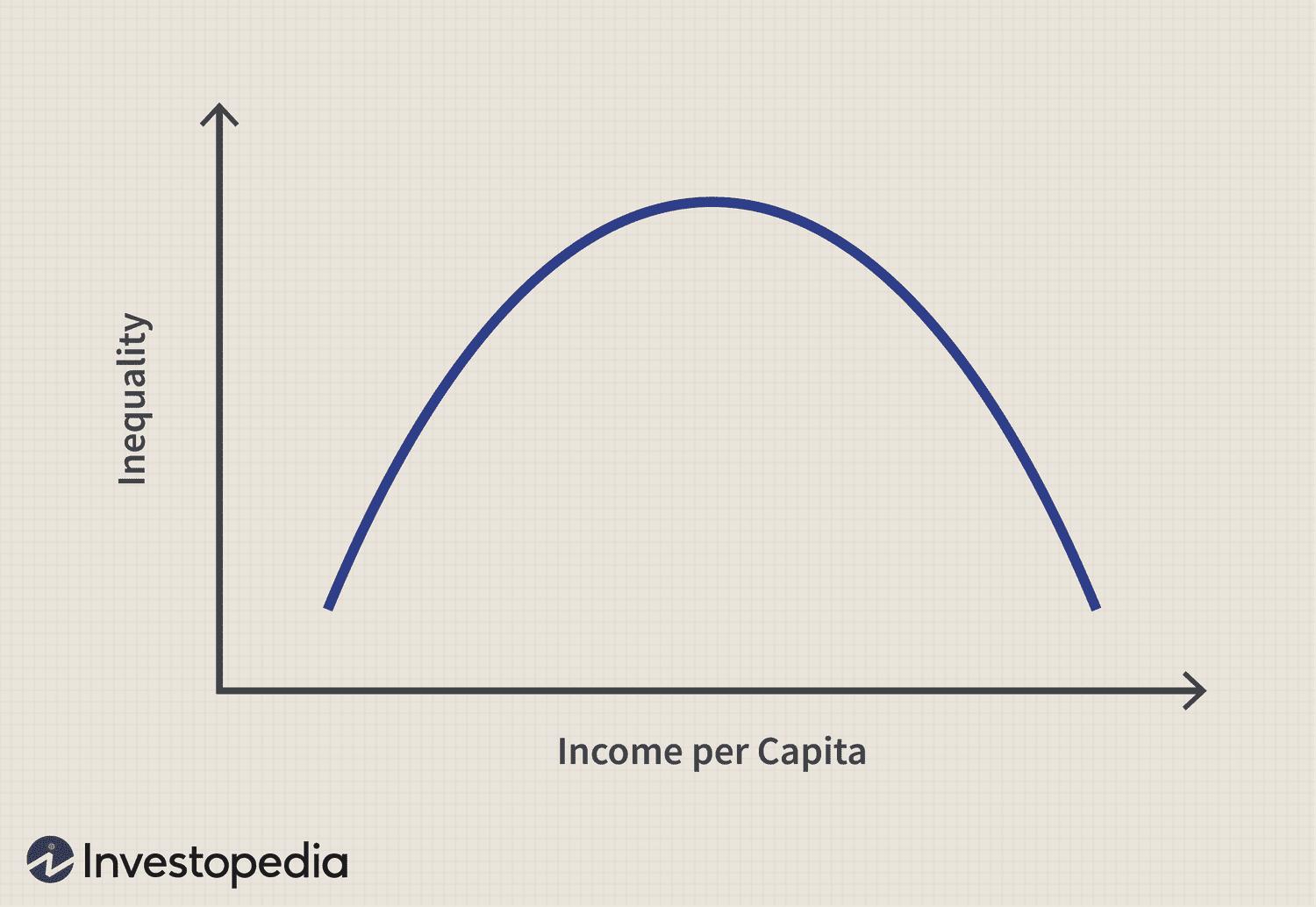
Kuznets hypothesis
Relationship between income per capita and inequality
Agrarian stage - most of population works in agriculture, inequality low
Industrialisation stage - few move to city, to higher paying urban sectors, inequality becomes worse because large gap between richer and poorer
Maturation stage - over time, majority of population transitions to industrial + service sectors, govt. steps in to provide healthcare, education - pushes inequality DOWN
EVAL:
Piketty argues this is not true because of capital accumulation, concentration of wealth at the top
Significance of capitalism for inequality
Positive :
Incentivises innovation - which drives economic growth, can be good as long as distributed correctly
Negative:
Unregulated capitalism = income and wealth concentration among elite - increasing inequality
Conflict between equality and equity