RCD Quiz 1 to 3
 Call Kai
 Learn
Learn Practice Test
 Spaced Repetition
 Match
Match Flashcards
1/45

There's no tags or description
Looks like no tags are added yet.
Name | Mastery | Learn | Test | Matching | Spaced | Call with Kai |
|---|
No analytics yet
Send a link to your students to track their progress
46 Terms
The modular ratio (n) is used to transform a reinforced concrete section into an equivalent area of a single material. What is the correct ratio and the concept behind it?
A. Ec/Es-Concrete is more elastic than steel
B. Es/Ec-Steel is stiffer than concrete
C. Es/Ec-Concrete has higher modulus of elasticity than steel
D. Ec/Es-Steel is more flexible than concrete
B. Es/Ec-Steel is stiffer than concrete
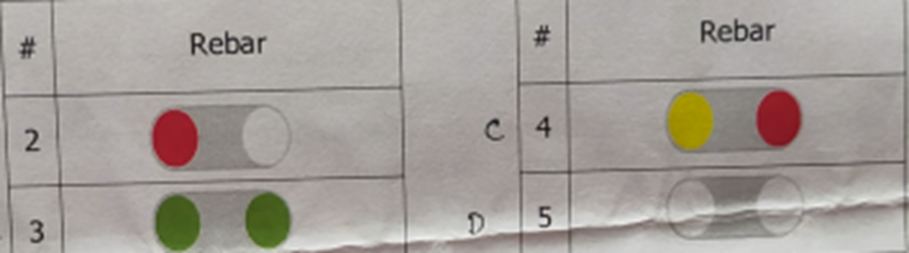
Specify the appropriate rebar grade and material classification for each of the color-coded items below:
B. Grade 33- Weldable
Grade 40- Weldable
Grade 60-Non-weldable
Grade 33 Non-Weldable

Match the locations of the three primary patterns of loadings:
A. P-3, Q-1, R-2
B. P-1, Q-2, R-3
C. P-1, Q-3, R-2
D. P-3, Q-2, R-1
D. P-3, Q-2, R-1
If a structural engineer is designing a reinforced concrete tower, which type of concrete test specimen must be provided to verify the required structural integrity?
A. concrete cylinders
B. concrete beams.
C concrete slump
D. concrete box
A. concrete cylinders
In a cantilever beam, what type of bending does it experience and which of the following is the correct orientation of the reinforcements?
A Positive - Tension at the bottom, Compression at the top.
B. Negative-Compression at the bottom, Tension at the top.
C. Positive - Tension at the top, no reinforcement at the bottom.
D. Negative - Compression at the bottom, no reinforcement at the top
B. Negative-Compression at the bottom, Tension at the top.
According to NSCP 2015 Section 425.2.3, minimum spacing of longitudinal reinforcement (main bars) shall be at least the greatest of:
A 25 mm, db, (4/3)dagg
C. 30 mm, db, (4/3)dagg
B. 50 mm, db, (4/3)dagg
D. 40 mm, 1.5db, (4/3)dagg
A 25 mm, db, (4/3)dagg
Tendons are stressed before concrete is poured.
A. relaxation
B. post-tensioning
C. creep
D. pre-tensioning
D. pre-tensioning
In the flexural analysis of a reinforced concrete beam, the concrete cover below the tension reinforcement is typically neglected in strength calculations. What is the primary engineering justification for this assumption?
A. The cover's primary function is to provide a thermal barrier and corrosion protection, so it lacks any inherent compressive or tensile capacity.
B. Including the cover would shift the neutral axis too far toward the tension face, causing the beam to be designed as over-reinforced and prone to brittle failure.
C. At the ultimate limit state, the concrete in the tension zone is assumed to be cracked, and the cover is susceptible to spalling, making its contribution to strength unreliable.
D. NSCP 2015 mandates its exclusion to simplify the calculation of the moment of inertia for deflection checks.
C. At the ultimate limit state, the concrete in the tension zone is assumed cracked (so it carries negligible tensile stress), and the cover below the tension steel can spall off, so relying on it for strength is unreliable.
According to section 425.6.1.3 of NSCP 2015, bars larger than what diameter shall not be in bundled beams?
A. 10mm
B. 20mm
C. 28mm
D. 36mm
D. 36mm
Identify the theorems and mathematical principles used to determine the centroidal location and the second moment of area for composite structural sections
A. Pythagorean Theorem & Simpson's 1/3 rule
B. Sine Law & Cosine Law
C. Varignon's Theorem & Parallel-axis Theorem
C. Varignon's Theorem & Parallel-axis Theorem
. In the analysis of a reinforced concrete beam that has transitioned to a cracked stage, which region of the cross-section is traditionally assumed to have zero contribution.
A. The concrete area located above the neutral axis.
B. The area immediately adjacent to the neutral axis.
C. The area located within the compression zone.
D. The concrete area located within the tension zone
D. The concrete area located within the tension zone
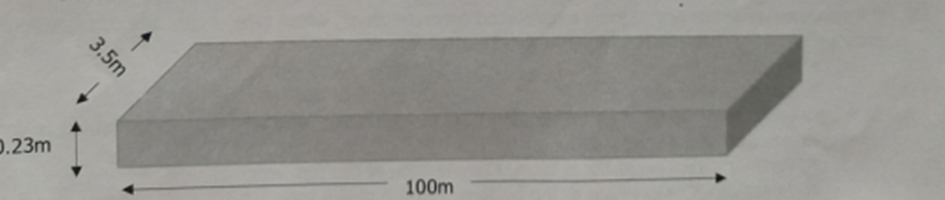
Concreting using PCCP is required for the bridge pavement shown, which serves as a single lane of the two-lane inbound/outbound route to Cagayan de Oro City. Determine the type of test specimen and the total number of sets required for the complete pavement.
A. 1 set (3 concrete beams)
B. 1 set (3 concrete cylinders)
C. 2 sets (6 concrete cylinders)
D. 2 sets (6 concrete beams
D. 2 sets (6 concrete beams
Retempering concrete by adding water or by other means is:
A. Not permitted in any time
B. Not permitted if the operations occurred after 45 mins
C. Permitted in any time
D. Permitted if the operations occurred not long after 45 minutes
B. Not permitted if the operations occurred after 45 mins
. Sleeves shall be of such design that they do not collapse during construction. Hence, the sleeves for dowel bars shall be metal of approved design to cover of
A. 50mm(2in) ± 6 mm (1/2 in)
B. 50 mm (2 in) ± 5 mm (1/4 in)
C. 70 mm (3 in) ± 6 mm ( 1/4 in)
D. 70 mm (3 in) ± 5 mm ( 1/4 in)
B. 50 mm (2 in) ± 5 mm (1/4 in)
As per DPWH Bluebook item 311.3.7. Mixing Concrete, the time elapsed from the time water is added to the mix until the concrete is deposited in place at the site shall not exceed how many minutes when hauled in truck mixers?
A. 45 minutes
B. 60 minutes
C. 90 minutes
D. 100 minutes
C. 90 minutes.
When there is an interruption in the concreting to form a slab, how much long is permissible before the excess concrete from the last preceding joint shall be disposed?
A. 4.5m
B. 3.5m
C. 2.5m
D. 1.5m
D. 1.5m
During hot weather, the Engineer shall require that steps be taken to prevent the temperature of mixed concrete from exceeding a maximum temperature of:
A 90 ° F (32 ° C)
C. 90 ° F (37 ° C)
B. 70 °* F (21 ° * C)
D. 70 ° F (26 ° C)
A. 90°F (32°C)
Which of the following describes an 'under-reinforced' beam section?
A. Concrete reaches its ultimate strain before the steel yields.
B. The beam has no tension reinforcement.
C. Both steel and concrete reach their limit states simultaneously.
D. Steel yields before the concrete reaches its ultimate compressive strain.
D. Steel yields before the concrete reaches its ultimate compressive strain.
What is the assumed maximum strain at the extreme concrete compression fiber at the point of failure?
A. 0.002
C. 0.004
B. 0.003
D. 0.005
B. 0.003
In a high-rise residential project, an architect insists on reducing the depth of a floor beam to increase the ceiling height. If the moment demand exceeds the capacity of a singly reinforced section of that depth, what is your most viable engineering solution?
A. Increase the diameter of the tension bars.
B. Remove the beam and rely on the floor slab alone.
C. Design the section and add compression steel.
D. Use a lower grade of concrete.
C. Design the section and add compression steel.
In a doubly reinforced beam, if the concrete is very high strength, what happens to the shape of the actual compressive stress distribution?
A. It becomes triangular or linear.
B. It becomes perfectly rectangular.
C It becomes parabolic.
D. It becomes circular.
A. It becomes triangular or linear.
For a singly reinforced beam, if the width of the beam is doubled while keeping the reinforcement and depth the same, the neutral axis depth will:
A Stay the same
B. Decrease
C. Double
D. Increase
B. Decrease
In a doubly reinforced beam, why is it necessary to provide lateral ties (stirrups) around the compression reinforcement?
A. To improve the bond between concrete and tension steel.
B. To reduce the amount of concrete needed.
C. To prevent the compression bars from buckling outward through the concrete cover.
D. To increase the tensile capacity of the beam.
C. To prevent the compression bars from buckling outward through the concrete cover.
In a singly reinforced rectangular beam, what happens to the depth of the neutral axis if the amount of tension reinforcement is increased while keeping the beam dimensions constant?
A A. It remains the same.
C. It increases
B. It decreases.
D. It becomes zero
C. It increases.
What is the primary reason for providing compression reinforcement in a doubly reinforced beam when the applied moment is less than the balanced moment capacity?
A. To increase compressive strength of concrete.
B. To decrease the depth of the beam.
C. To make the beam over-reinforced.
D. To decrease long term deflections due to creep and shrinkage.
D. To decrease long term deflections due to creep and shrinkage.
Which parameter determines the value of ẞused to calculate the depth of the Whitney stress block?
A. yield strength
B. total depth of beam
C. area of compression steel
D. compressive strength of concrete
D. Compressive strength of concrete
What is the physical significance of the 'Strain Hardening' region in the behavior of reinforcing steel?
A. It is the point where the steel snaps immediately.
B. It is the region where steel strength decreases after yielding.
C. It only occurs in concrete, not steel.
D. It provides a reserve of strength beyond the yield point before ultimate failure occurs.
D. It provides a reserve of strength beyond the yield point before ultimate failure occurs.
. What happens to the internal 'lever arm' of a doubly reinforced beam compared to a singly reinforced beam of the same depth and tension steel?
A. The lever arm decreases significantly.
B. The lever arm becomes zero.
C. The lever arm stays exactly the same.
D. The effective lever arm typically increases.
D. The effective lever arm typically increases.
In a singly reinforced beam, if the steel is changed from Grade 40 to Grade 60, while keeping As constant, how does the behavior change?
A. The nominal capacity increases, but "c" moves deeper.
B. The beam becomes more ductile.
C. The concrete crushing strain changes to 0.005.
D. The beam stiffness increases.
A. The nominal capacity increases, but "c" moves deeper.
. Why is the equivalent rectangular stress block depth "a" always less than the neutral axis depth "c"?
A. Because the steel is stronger than concrete.
B. To ensure the beam is designed as under-reinforced.
C. Because the actual stress distribution in concrete is parabolic, not rectangular.
D. To account for the weight of the concrete.
C. Because the actual stress distribution in concrete is parabolic, not rectangular.
If a beam is designed as a doubly reinforced, but the compression steel is placed very deep (d'), what is the most likely risk?
A. The compression steel will be in the tension zone.
B. The concrete will crack.
C. The stirrups will fail.
(D) The beam will become over-design.
A. The compression steel will be in the tension zone.
When designing a beam, if the concrete strength fc' is increased from 21 MPa to 35 MPa, how does the factor ẞ1 change?
A. It increases.
B) It decreases.
C. It becomes 1.0
D. It becomes constant at 0.85
B. It decreases.
For non-prestressed beams, what is the location of the critical section where sections between the face of support and this point may be designed for Vu at that critical section?
a At h/2 from the face of support.
b. At d from the face of support.
c. At the face of support only.
d. At mid-height of the beam.
b. At (d) from the face of support.
When the lecture describes a T-beam as monolithic, it specifically emphasizes that there is:
a A construction joint between the web and the flange /
b. No construction joint between the web and the flange
c. A cold joint at the flange-web interface
d. Mechanical connection between slab and beam
b. No construction joint between the web and the flange
What is the strength reduction factor for shear?
a. 0.90
b. 0,85
C. 0.75
d. 0.65
C. 0.75
In bidirectional shear (e.g., beams in frames), "along x" and "along y" refer to:
a. Two different beam depths.
b. Axial compression and tension.
c. Stirrup spacing only.
d. Shear forces in two orthogonal horizontal directions
d. Shear forces in two orthogonal horizontal directions
In the design procedure for singly reinforced T-beams, when is the assumption a = tf used?
a. To calculate the final required As
b. To find the minimum reinforcement area
c. To determine the effective flange width /
d. To compute Mnflange and compare it with the required Mn
d. To compute $M_{n, \text{flange}}$ and compare it with the required $M_n$.
In the comparison, a rectangular beam has lower moment of inertia because: a. It is centered closer to the neutral axis in a narrow cross section
b. Its material is centered farther from the neutral axis
c. It has a wider flange
d. It removes redundant concrete in the tension zone
a. It is centered closer to the neutral axis in a narrow cross section
For circular members in NSCP 2015, what value is permitted for the effective depth d when calculating shear strength?
(a) 0.8 times the diameter D.
b. 0.6 times the diameter D.
c. The full diameter D of the section.
d. Half of diameter D of the section.
(a) 0.8 times the diameter D.
Which type of axial force helps concrete resist shear better?
a. Compression (positive Nu)
b. Tension (negative Nu)
c. Both the same
d. Neither
a. Compression (positive Nu)
In the design of singly reinforced T-beams, if Mnflange > Mn, what does this indicate?
a Compression area is in the web
b. Compression area is in the flange
c. The beam is over-reinforced
d. Minimum reinforcement is insufficient
b. Compression area is in the flange
. What is the typical angle of inclination for the critical shear crack in a reinforced concrete beam without stirrups, as observed in experiments?
a. Approximately 45 degrees to the longitudinal axis.
b. Approximately 90 degrees, perpendicular to the beam axis,
c. Approximately 30 degrees, aligned with flexural cracks.
d. Approximately 60 degrees, due to compression struts.
a. Approximately 45 degrees to the longitudinal axis.
The economic advantage of T-beams over rectangular beams is best explained by the fact that T-beams:
a. Require significantly more concrete in the tension zone to match stiffness
b. Produce heavier dead loads due to the added flange mass
Optimize material usage by eliminating unnecessary concrete below the neutral axis in tension and engaging the slab in compression
d. Concentrate loads at discrete points, reducing overall material efficiency
c. Optimize material usage by eliminating unnecessary concrete below the neutral axis in tension and engaging the slab in compression.
For doubly reinforced T-beams (as introduced in the lecture outline), what is the usual first assumption when setting up equilibrium?
a. Only compression steel yields
b. Neither steel yields
Both tension and compression steel yield
d. Only tension steel yields
c. Both tension and compression steel yield.
Why is the denominator 14Ag used in the axial compression formula but 3.5Ag in the axial tension formula?
Compression has a stronger beneficial effect than the detrimental effect of tension, so the modifier is less sensitive to Nu in compression.
b. Tension is four times more damaging than compression
c. The values are arbitrary and unrelated to physical behavior.
d. 14Ag applies only when Pu > 1000 kN.
a. Compression has a stronger beneficial effect than the detrimental effect of tension, so the modifier is less sensitive to $N_u$ in compression.
If a beam has a flange on one side only, it is still classified as a form of T-beam but with:
a. Symmetrical flange contribution on both sides
b. Asymmetrical effective flange width, typically limited more stringently on the flanged side
c. No effective flange width consideration
d. Identical behavior to an interior T-beam with flanges on both sides
b. Asymmetrical effective flange width, typically limited more stringently on the flanged side.