Surface area to volume ratio
 Call Kai
 Learn
Learn Practice Test
 Spaced Repetition
 Match
Match Flashcards
 Knowt Play
1/6

There's no tags or description
Looks like no tags are added yet.
Name | Mastery | Learn | Test | Matching | Spaced | Call with Kai |
|---|
No analytics yet
Send a link to your students to track their progress
7 Terms
Describe the relationship between the size and structure of an organism and
its surface area to volume ratio (SA:V)
● As size increases, SA:V tends to decrease
● More thin / flat / folded / elongated structures increase SA:V
How is SA:V calculated? Use an example
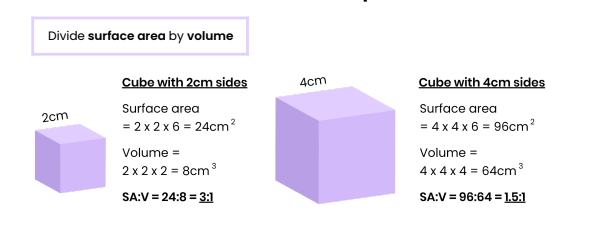
Suggest an advantage of calculating SA:mass for organisms instead of SA:V
Easier / quicker to find / more accurate because irregular shapes
What is metabolic rate? Suggest how it can be measured
● Metabolic rate = amount of energy used up by an organism within a given period of time
● Often measured by oxygen uptake → as used in aerobic respiration to make ATP for energy release
Explain the relationship between SA:V and metabolic rate
As SA:V increases (smaller organisms), metabolic rate increases because:
● Rate of heat loss per unit body mass increases
● So organisms need a higher rate of respiration
● To release enough heat to maintain a constant body temperature ie. replace lost heat
Explain the adaptations that facilitate exchange as SA:V reduces in larger
organisms
1. Changes to body shape (eg. long / thin)
○ Increases SA:V and overcomes (reduces) long diffusion distance / pathway
2. Development of systems, such as a specialised surface / organ for gaseous exchange e.g. lungs:
○ Increases (internal) SA:V and overcomes (reduces) long diffusion distance / pathway
○ Maintain a concentration gradient for diffusion eg. by ventilation / good blood supply
Exam insight: common mistakes ❌
