exam 2 everything!!!
 Call Kai
 Learn
Learn Practice Test
 Spaced Repetition
 Match
Match Flashcards
 Knowt Play
1/231

There's no tags or description
Looks like no tags are added yet.
Name | Mastery | Learn | Test | Matching | Spaced | Call with Kai |
|---|
No analytics yet
Send a link to your students to track their progress
232 Terms
what is the healthiest period of the entire life span.
middle childhood
One particular way to improve fine motor skills is through
art and music
childhood obesity
In a child, having a BMI above the 95th percentile, according to the U.S. Centers for Disease Control’s 1980 standards for children of a given age
asthma
A chronic disease of the respiratory system in which inflammation narrows the airways from the nose and mouth to the lungs, causing difficulty in breathing. Signs and symptoms include wheezing, shortness of breath, chest tightness, and coughing
selective attention
Focusing on one stimulus instead of another. This can be innate, as when a baby focuses on a person’s eyes, or deliberate, as when a student attends to the teacher, not to a classmate
reaction time
The time it takes to respond to a stimulus, either physically (with a reflexive movement such as an eyeblink) or cognitively (with a thought).
aptitude
The potential to master a specific skill or to learn a certain body of knowledge.
g (general intelligence)
The idea assumes that intelligence is one basic trait, underlying all cognitive abilities. According to this concept, people have varying levels of this general ability.
Flynn effect
The rise in average IQ scores that has occurred over the decades in many nations.
multiple intelligences
The idea that human intelligence is composed of a varied set of abilities rather than a single, all-encompassing one
neurodiversity
The idea that each person has neurological strengths and weaknesses that should be appreciated,
in much the same way diverse cultures and ethnicities are welcomed.
____ seems particularly relevant for children with disorders on the autism spectrum.
developmental psychopathology
The field that uses insights into typical development to understand and remediate developmental disorders.
comorbid
Refers to the presence of two or more unrelated disease conditions at the same time in the same person
multifinality
A basic principle of developmental psychopathology that holds that
one cause can have many (multiple) final manifestations
equifinality
A basic principle of developmental psychopathology that holds that
One symptom can have many causes
attention-deficit/hyperactivity disorder (ADHD)
A condition characterized by a persistent pattern of inattention and/or by hyperactive or impulsive behaviors; interferes with a person’s functioning or development
specific learning disorder
A marked deficit in a particular area of learning that is not caused by an apparent physical disability, by an intellectual developmental disorder, or by an unusually stressful home environment
dyslexia
Unusual difficulty with reading; thought to be the result of some neurological underdevelopment.
dyscalculia
Unusual difficulty with math, probably originating from a distinct part of the brain.
autism spectrum disorder (ASD)
A developmental disorder marked by difficulty with social communication and interaction — including difficulty seeing things from another person’s point of view — and restricted, repetitive patterns of behavior, interests, or activities.
individual education plan (IEP)
A document that specifies educational goals and plans for a child with intellectual developmental disorder
least restrictive environment (LRE)
A legal requirement that children with intellectual developmental disorders be assigned to the most general educational context in which they can be expected to learn
response to intervention (RTI)
An educational strategy intended to help children who demonstrate below-average achievement in early grades, using special intervention
Biosocial Growth: Middle Childhood 6-11 years old
• Slower growth
• Greater Processing speed & Reaction time
• Advanced Motor Skills
***Selective Attention & Automatization!
*** Health & Strength!
*** Psychopathology!
middle childhood brain development
Brain Maturation → More connections
PFC → Mastery of tasks
Faster Reaction Time
Selective Attention?
Automatization
(repetition → routine → ↓ conscious thought)
how much physical activity do kids need
at least an hour a day
Outcomes Due to Excess Body Weight
Decrease in self-esteem
Lower school achievement
Increased loneliness
Parents as
Role Models...
• RQ: How do parents’ health
behaviors influence their kids?
• 24-hr recall for eating habits,
7-day record of PA, measured BMI
• Findings: HPRM Index
- Most parents were not healthy
role models
- Most parents & kids did not meet
health guidelines (F&V, PA)
- Healthier role models → kids eat
more F&V
study
How can parents influence their kids to be healthy?
If Healthy behaviors → Healthy habits → Better lifelong health
we know that role modeling is a powerful teaching strategy - but clearly most parents in this study are not always great role models...
Molly (8 years old) and Maria (5 years old) are playing tag outside,
when Molly says to Maria – “Race you to the flagpole?” Maria
says, “You’re on!” Which child is most likely to make it to the
flagpole first?
A. Molly
B. Maria
C. Both girls will arrive at the same time.
D. Given the information available it’s impossible to guess
the outcome.
chat gpt
Developmental Psychopathology &
Variety of Special Needs Among
Children
Abnormality is normal.
Disability changes year by year.
Plasticity & compensation for long-term experience.
Diagnosis & treatment reflect the social context
what percent of Children at Risk for Dyslexia:
5-20%
what percent of children have Autism Spectrum
Disorder
3%
Problems in social interaction & social use of language
Restricted, repetitive patterns of behavior, interests, & activities
Much variety in skills & difficulties across children (neurodiversity)
A variety of proposed causal factors
what percent of children have ADHD
11%
Difficulty concentrating; inattention, impulsivity, & overactivity
Externalizing behaviors (aggression)
A variety of proposed causal factors
concrete operational thought
Piaget’s term for the ability to reason logically……. about direct experiences and perceptions.
classification
The logical principle that things can be organized into groups (or categories or classes) according to some characteristic that they have in common
seriation
The knowledge that things can be arranged in a logical series
knowledge base
A body of knowledge in a particular area that makes it easier to master new information in that area
control processes
Mechanisms (including selective attention, metacognition, and emotional regulation) that combine memory, processing speed, and knowledge to regulate the analysis and flow of information within the information-processing system. (Also called executive processes.)
English Language Learners (ELLs)
Children in the United States whose proficiency in English is low — usually below a cutoff score on an oral or written test. Many children who speak a non-English language at home are also capable in English; they are not ELLs
immersion
A strategy in which instruction in all school subjects occurs in the second (usually the majority) language that a child is learning
bilingual education
A strategy in which school subjects are taught in both the learner’s original language and the second (majority) language.
English as a Second Language (ESL)
A U.S. approach to teaching English that gathers all of the non-English speakers together and provides intense instruction in English. Students’ first languages are never used; the goal is to prepare students for regular classes in English
hidden curriculum
The unofficial, unstated, or implicit patterns within a school that influence what children learn.
For instance, teacher background, organization of the play space, and tracking are all part of the hidden ____ not formally prescribed, but instructive to the children
National Assessment of Educational Progress (NAEP)
An ongoing and nationally representative measure of U.S. children’s achievement in reading, mathematics, and other subjects over time; nicknamed “the Nation’s Report Card.”
voucher
A promise of payment under certain conditions. When used in education, vouchers allow public funds to be paid for private school tuition.
charter school
A school funded by public taxes that is exempt from some requirements for traditional public schools
home-school
When a child is taught at home, usually by a stay-at-home parent, instead of being enrolled in any school, public or private
True or False?
• Jonah loves to play outside in the snow, and he now follows a routine to take off his shoes immediately when he comes inside. At this point in the season, he doesn’t have to think about it – he just takes off his shoes. Jonah’s behavior reflects automatization.
• If a family member dies suddenly, a child is likely to exhibit a variety of emotional responses. This understanding of development reflects multifinality.
• Your friend’s child tends to act out physically, or externally, in order to express frustration. Your friend’s child is most likely a girl.
True
true
false
How Do Early Home Activities Continue to Impact
Language Skills in Middle Childhood?: Law et al. (2018)
• RQ: To what extent do child, family,
home activities, & early language
skills relate to language skills at 11yrs
old?
• Participants: 5,682 children from the
UK Millennium Cohort Study –
assessed at 9mos,3,5,7,&11yrs
• Method: Medical records, Cognitive
skills tests, & self-report surveys
Findings...
- Early language predicted higher
vocabulary scores later
- Parents who read to their child at
least weekly
• Equifinality?
study
Cognitive Growth: Early Childhood → Middle
Childhood 6-11 years old
• Advanced Info-processing to learn
- Memory
- Knowledge base
- Control processes
- Metacognition
• Further language development
• Concrete Operations stage
Information Processing for Learning in Middle Childhood 6-11 yrs old
Able to sense & perceive lots of info
Input → Connections → Output
Experiment with strategies → adopt practices that work for you
Repetition → Automatization → Brain Growth
Learning builds over time = continuity
IP – Memory (Again, like a Funnel)
Experience & Brain Maturation for short-term memory
sensory memory
Working Memory (current thought)
Long-term Memory
Strategies for WM (rehearsal, chunking)
Chunking:
Grouping information into smaller, easier-to-remember units.
Rehearsal:
Repeating information to keep it in memory.
IP – Knowledge Base: learning influences
Experience
Current Opportunity
Motivation
IP – Knowledge Base: Control Processes:
(Regulate flow of info for learning)
Processing speed
↑ Memory
Challenge of Impulse control
Language Growth middle childhood
Figurative Phrases & Flexibility
Concrete Operations (early logic)
Classification (groups)?
Decentration (> 1)?
Seriation (order)?
Reversibility (undo)?
Can conserve?
Transitive Inference?
(compare & contrast)
Pre-Operations
• Symbolic Thought
• Centration (1)
• Lack conservation
• Appearance
• Irreversibility
• Egocentrism
Concrete Operations examples
Michael learned
in class that a
broken bone is
painful. His leg
hurts, so he
thinks he broke
it.
Melissa organized
her homework
based on what
she needs to do:
read, write, and
calculate.
Jesse was playing
Wii when the
controller fell off
his wrist across
the room. He saw
that the clasp had
come undone, so
he put it back on
his wrist and
reclosed the clasp
myelination
The process by which axons become coated with myelin, a fatty substance that speeds the transmission of nerve impulses from neuron to neuron
The prefrontal cortex (PFC)
plays a crucial role in various cognitive functions, including: Executive Functions: Planning and decision-making, Working memory (holding information in mind for short periods), Attention control, and Inhibitory control (suppressing inappropriate thoughts and actions)
Maturation of the Prefrontal Cortex 2-6 years old (p.193)
The entire frontal lobe develops for many years after early childhood; dendrite density and myelination are still increasing in emerging adulthood. Nonetheless, significant maturation of the prefrontal cortex during early childhood is crucial.
though before action!
Sleep becomes more regular.
Emotions become more nuanced and responsive.
Temper tantrums subside.
Uncontrollable laughter and tears are less common.
lateralization
Literally, sidedness, referring to the specialization in certain functions by each side of the brain, with one side dominant for each activity. The left side of the brain controls the right side of the body, and vice versa.
corpus collosum
A long, thick band of nerve fibers that connects the left and right hemispheres of the brain and allows communication between them.
impulse control
The ability to postpone or deny the immediate response to an idea or behavior.
perseveration
To stay stuck, or persevere, in one thought or action for a long time. The ability to be flexible, switching from one task to another, is beyond most young children
injury control/harm reduction
Practices that are aimed at anticipating, controlling, and preventing dangerous activities; these practices reflect the beliefs that accidents are not random and that injuries can be made less harmful if proper controls are in place
primary prevention
Actions that change overall background conditions to prevent some unwanted event or circumstance, such as injury, disease, or abuse.
secondary prevention
Actions that avert harm in a high-risk situation, such as stopping a car before it hits a pedestrian.
tertiary prevention
Actions, such as immediate and effective medical treatment, that are taken after an adverse event (such as illness or injury) and that are aimed at reducing harm or preventing disability.
child maltreatment
Intentional harm to or avoidable endangerment of anyone under 18 years of age.
child abuse
Deliberate action that is harmful to a child’s physical, emotional, or sexual well-being
child neglect
Failure to meet a child’s basic physical, educational, or emotional needs.
substantiated maltreatment
Harm or endangerment that has been reported, investigated, and verified.
reported maltreatment
Harm or endangerment about which someone has notified the authorities
permanency planning
An effort by child-welfare authorities to find a long-term living situation that will provide stability and support for a maltreated child. A goal is to avoid repeated changes of caregiver or school, which can be particularly harmful to the child.
foster care
A legal, publicly supported system in which a maltreated child is removed from the parents’ custody and entrusted to another adult or family, who is reimbursed for expenses incurred in meeting the child’s needs
kinship care
A form of foster care in which a relative of a maltreated child, usually a grandparent, becomes the approved caregiver.
(not the main focus for this exam) Biosocial Growth: From 1st 2 Years
Nutrition
• Sensory Abilities
• Reflexes
• Transient Exuberance
• Early Motor Skills
(main focus for this exam) Biosocial Growth: Ages 2 – 6 Years
Further Brain Development
- Myelination
- Corpus callosum
- Prefrontal Cortex
- Limbic System
- Lateralization
• Advanced Motor Skills
Extensive Brain Growth:Early Childhood (2 – 6)
• Myelin (processing speed)
• Prefrontal Cortex
(complex cognitive functions)
• Lateralization (side dominance)
• Corpus Callosum
(both hemispheres work together)
• Limbic System
- Amygdala (emotion)
- Hippocampus (memory &
learning)
- Hypothalamus (drives)
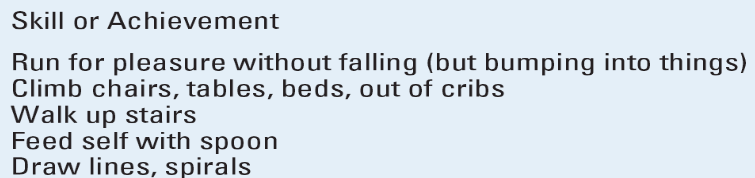
Motor skills at 2 years old
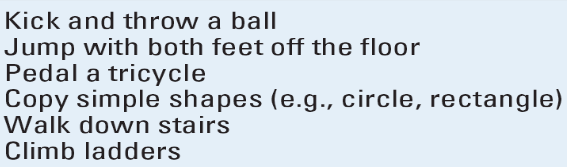
Motor skills at 3 years old
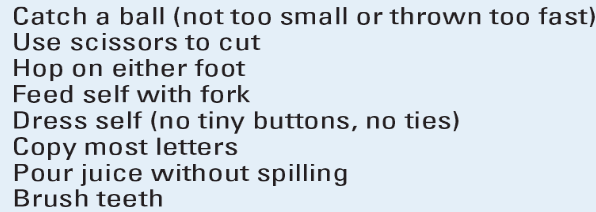
Motor skills at 4 years old
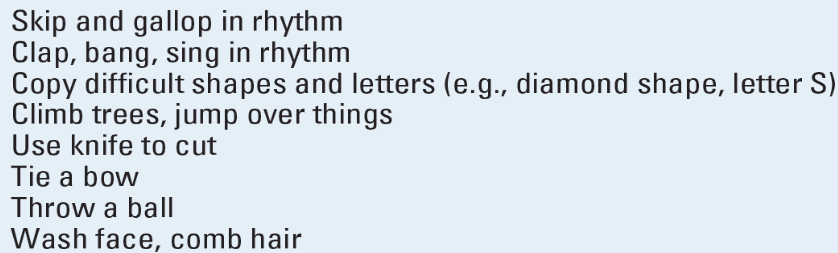
Motor skills at 5 years old
Motor skills at 6 years old
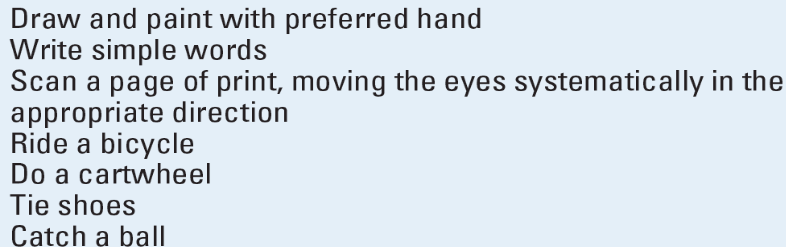
Gross Motor Skills (DyS). How might culture influence the development of these skills?
Experience-Dependent Development: meaning that children develop certain skills based on the opportunities and experiences provided by their environment.
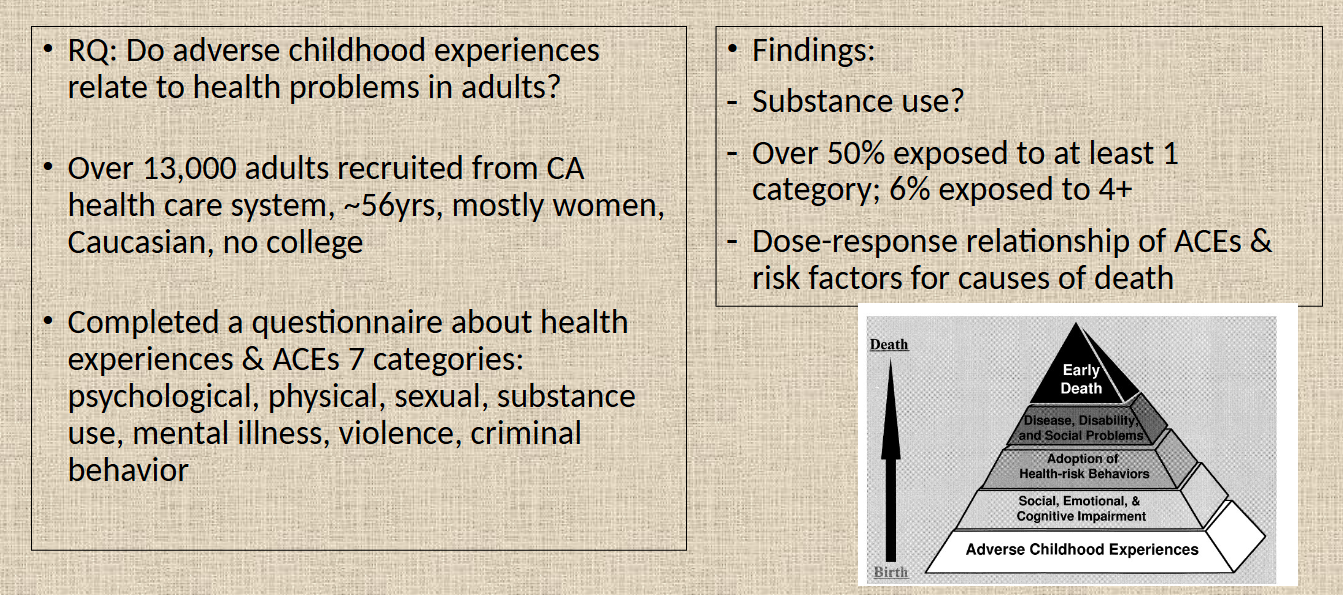
Relationship of Childhood Abuse & Household Dysfunction to Death in Adults... ACEs... (Felitti et al., 1998)
true or false: fine motor skills are harder to master than gross motor skills
true
ACEs & Levels of Prevention
Primary prevention (to make harm less likely for everyone)
Community-wide parent education
Secondary prevention (to avoid harm in high-risk situations/groups)
Respite/support for families with special needs
Tertiary prevention (after injury, to reduce potential for more damage)
Counseling services
Leads:
can refer to clues or pieces of information that help progress an investigation
early childhood 2-6 years old: growth patterns
Height and weight increase in those four years (by about a foot and 16 pounds, almost 30 centimeters and 8 kilograms).
Dramatic changes occur in shape: Children slim down, the lower body lengthens, fat is replaced by muscle.
By age 6, the average child in an affluent nation:
is at least:
3 ½ feet tall (more than 110 centimeters).
weighs between 40 and 50 pounds (between 18 and 23 kilograms).
looks lean.
has adultlike body proportions (legs now constitute about half the total height)
early childhood 2-6: nutrition
what is the main problem?
Although they rarely experience starvation, 2- to 6-year-olds can be malnourished.
Small appetites are satiated by unhealthy snacks, crowding out needed vitamins.
Wasting and stunting are still possible if climate change, war, or extreme poverty makes food scarce in an entire community,
but the main nutritional problem for young children is overweight.
they do not always obtain adequate iron, zinc, and calcium
early childhood 2-6: obesity
Some adults may encourage children to overeat, protecting them against famine that was once common.
During childhood, obesity correlates with other measures of adversity and is linked to depression
Later on, it increases the risk of early death from heart disease, diabetes, strokes, and suicide.
obesity defined as
the heaviest 5% of children
early childhood 2-6: sugar + recommendation
no more than six teaspoons
The most immediate harm from sugar is cavities and decaying teeth before age 6.