Lecture 3
 Call Kai
 Learn
Learn Practice Test
 Spaced Repetition
 Match
Match Flashcards
 Knowt Play
1/50

Earn XP
Description and Tags
Experimental determination of the PBL depth, Thermally driven winds, Slope winds, Valley winds, Cold air pools, Low level jets
Name | Mastery | Learn | Test | Matching | Spaced | Call with Kai |
|---|
No analytics yet
Send a link to your students to track their progress
51 Terms
What is the parcel method used for?
determination of PBL depth from measurements
Which two applications of the parcel method exist in general?
simple and advanced parcel method
Describe the simple parcel method.
seek height where potential temperature profile equals the surface temperature
assumes a CBL-like vertical structure
in SBL no PBL-depth which is a problem
does not account for mixing due to windshear
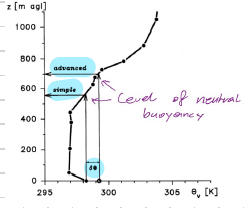
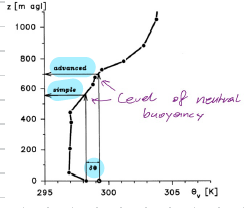
Describe the advanced parcel method.
does account for a surface temperature excess delta theta which represents effects of entrainment in the unstable case and of shear-driven mixing in the stable case
works well for CBL and SBL
delta theta is scaled on the strength of shear
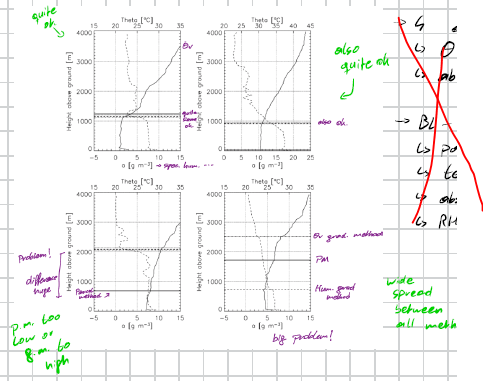
What is the gradient method used for?
determine PBL depth from measurements
Describe the gradient method.
seek height of strongest potential temperature gradient (or other quantities RH, q)
alternatively height where potential temperature gradient exceeds a predetermined value
What is a known issue when using parcel or gradient method to determine PBL depth?
often PBL-depths don’t agree between methods
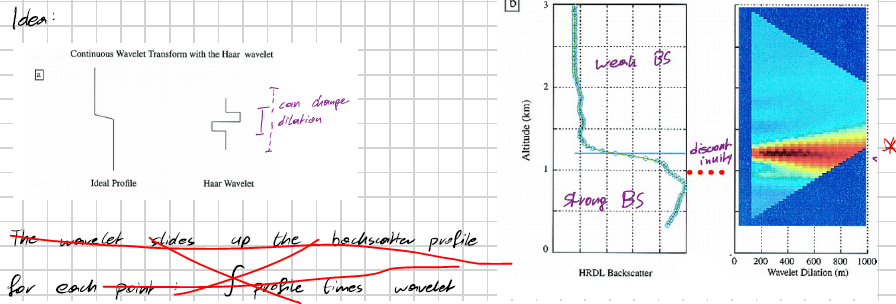
Describe how wavelet algorithms work with LIDAR backscatter measurements to determine the PBL-depth.
uniform strong backscatter in lower well mixed BL
weak backscatter in free atmosphere above
transition trough entrainment zone in the shape of a haar wavelet
wavelet slides up the profile, at transition zone suddenly strong negative contribution → PBL depth
How can one determine the PBL depth from SODAR backscatter?
CBL: sharp vertical changes in turbulence and temperature stratification at BL top cause elevated max. in reture signal → look for secondary maximum in the SODAR-backscatter
SBL: less useful, if necessary look for hight of strongest curvature of SODAR-backscatter
What are the key steps to get to the linearized version of the ideal gas law?
assume mean + pertubation and pert. « mean
insert in ideal gas law, products of pertubations are small → neglect
use ideal gas law with only mean quantities, insert and bring equation to form: pertubations / means
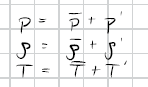
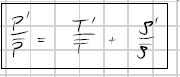
How does the linearized version of the ideal gas law look?
From which equation can the diurnal cycle of the mean circulation in the PBL be understood?
Vorticity eqation, especially the baroclinic production term
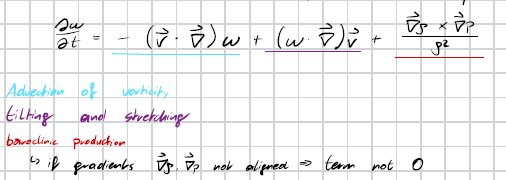
What would be a typical example for a diurnal variable mean circulation in the PBL
Sea breezes
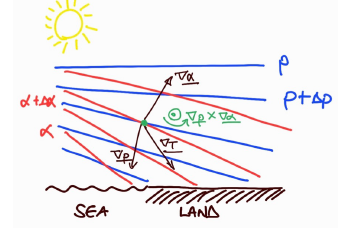
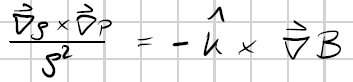
How does the baroclinic production term can be written in terms of buoyancy?
What is a key property of all thermally driven winds?
have a distinct diurnal variability
What are favourable conditions for pronounced thermally-driven winds?
days with clear skies, strong incoming solar radiation, weak synoptic scale pressure gradients
What are typical velocity scales of thermally-driven winds?
a few m/s, rarely above 10-15m/s
What is the main reason for the variety of thermally driven circulation systems over mountains?
differential heating at various spatial scales
What are the three thermally-driven winds over mountains?
slope winds
valey winds
plane-to-mountain winds
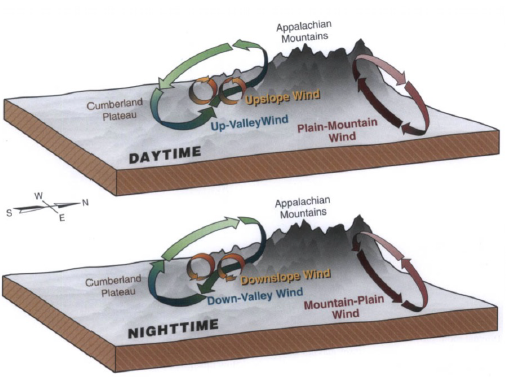
For differential heating, which are the warm/cold sectors for daytime slope winds?
atmosphere near slope (warm) and atmosphere in the valley and the adjacent plain (cold)
For differential heating, which are the warm/cold sectors for daytime valley winds?
atmosphere in the valley (warm) and atmosphere in the adjacent plain (cold)
How do slope winds behave at night?
surface cools at slope and leads to local stable stratification, from the baroclinic production term resulting cross-wise vorticity is postive → into the picture
so we get flow down the slope
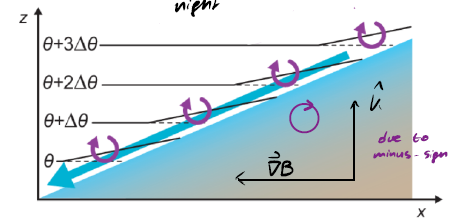
How do slope winds behave during daytime?
local heating of slope leads to local unstable stratification, from baroclinic production term resulting cross-wise vorticity is negative → out of the picture
so we get flow up the slope
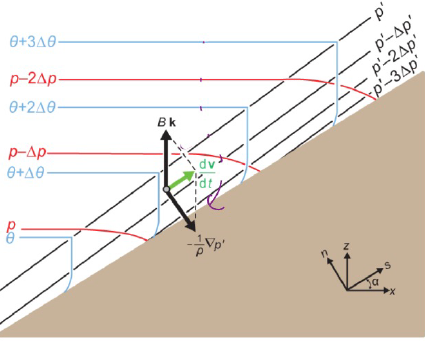
What is an alternative view to understand slope winds apart from local stratification?
Looking at pressure pertubations,
heating hydrostatically induces a pressure pertubation near the slope
the vector sum of the buoyancy force due to heating and the pressure gradient result in upslope acceleration
(local differences in heating → isobars not parallel)
friction counteracts acceleration → steady state
What does the Prandlt model describe?
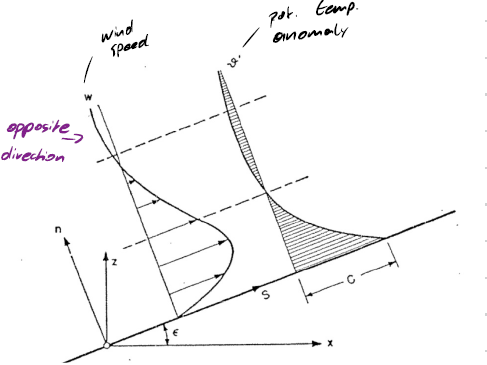
describes steady state of slope wind system
model cast in rotated coordinates parallel/normal to the slope (s,n)
provides a profile along n of wind speed and temperature pertubation caused by surface heating/cooling
model is 1D → does not account for any variability along s
provides similar to Ekman spiral analytic solution to Navier-Stokes equations and features an exponential decay of disturbances
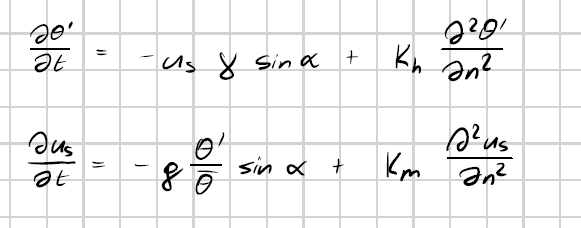
What are the governing equations for the Prandl model for flow over a slope?
alpha … slope angle
us … along slope wind component
K … eddy transfer coefficients
gamma … potential temperature gradient in the environment
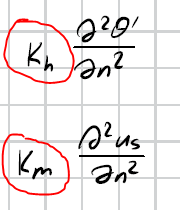
What are eddy transfer coefficients?
for momentum and heat they account for mixing effect of atmospheric turbulence,
for the laminar version of the Prandtl model they become the molecular transfer coefficients (nu, Kappa)
for atmospheric processes they are essentially tuning parameters (1-10 m²s^-1)
What are the solutions to the Prandtl model assuming steady state?
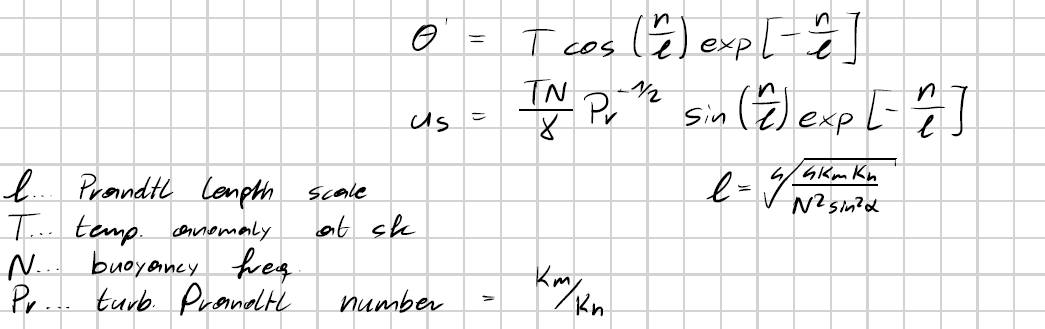
What are important properties of the solution to the Prandtl model?
amplitude of pertubation not dependant on slope angle → upslope speed same for same pertubation
steeper slopes → pertubations with shorter wavelenght and faster decay with n,
shallow slopes → deep upslope circulation systemsno solution for alpha = 0 (flat terrain) and N = 0 → only exist in stably stratified atmosphere
in a well mixed valley there are no slope winds possible → they happen mostly in the morning
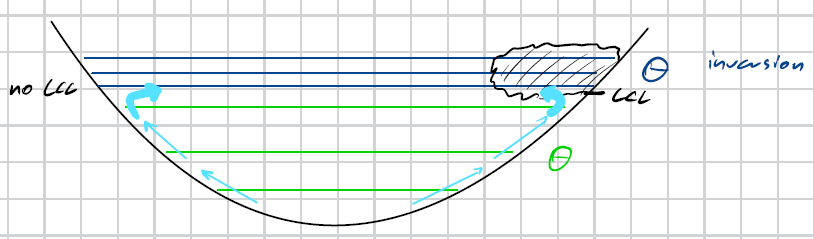
What can be a reason for slope winds to detach from the slope?
encountering of an inversion layer, resulting cross -valley circulation sometimes visible as clouds if LCL at right place
What are reasons for Valley winds?
pressure gradients along the valley axis
compared to an adjacent plain, the atmosphere of the valley is warmer/cooler during day/night
the valley atmosphere has a larger amplitude of diurnal temperature cycle
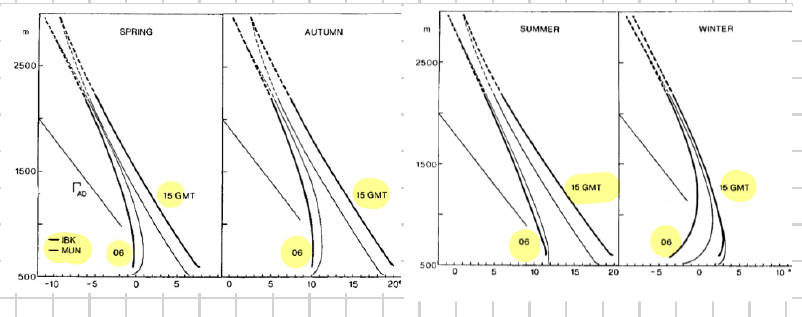
How do Valley winds in behave in winter?
they do not exist as the temperature in the valley is cooler day and night than in the plain leading to no positive pressure difference
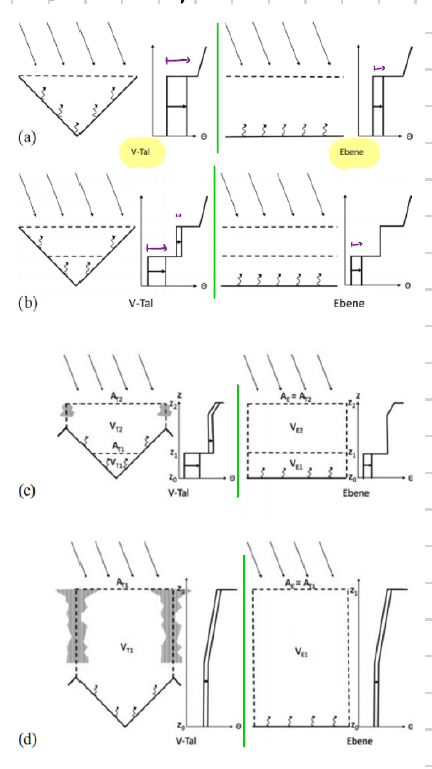
How do geometric effects impact valley winds?
larger temperature oscillations in the valley due to part of atmospheric volume is taken by orography
stonger heating/cooling because of less volume and more surface area
How does the vertical extent of thermals influence valley winds?
capping inversions below or at mountain top lead to stronger heating in the valley than in the plain → Valley winds
mixing above the mountain top reduces differntial heating
for very strong thermal convection there is basically no differential heating anymore so no valley winds
What is the reason for nocturnal cooling over a flat terrain?
near surface air is cooled by net longwave radiation loss of the uppermost soil layer
baiscally surface cools → atmosphere above cools
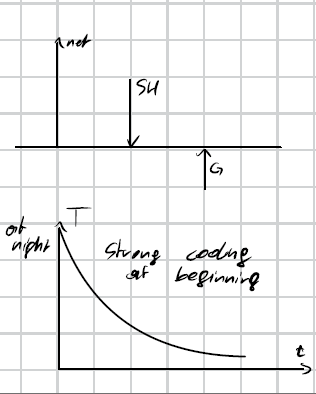
How do radiation fluxes behave during nighttime cooling?
downward sensible heat flux
upward ground heat flux
decrease in net outgoing longwave radiation
these 3 processes combined lead to a negative feedback: the more the surface cools, the slower the cooling rate becomes
What are factors favouring strong nocturnal cooling and very low temperatures?
cold dry airmass
weak winds (less mixing due to turbulence)
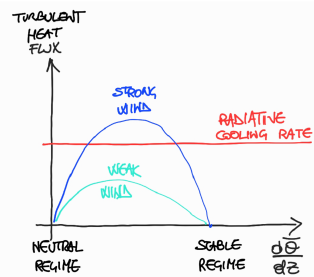
for very stable conditions turbulent heat flux is smaller than the net radiation loss leading to an imbalance which leads to rapid cooling and further surpression of turbulence heat transport → runaway cooling as negative buoyancy wins over shear
What are the two major differences for nocturnal cooling in a basin compared to the flat case?
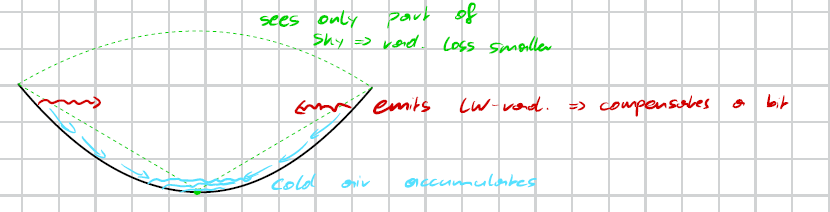
concave orography keeps air at basin floor from being mixed with the ambient flow once stable stratifcation has developed, also windless conditions at basin floor established earlier in the night and maintained more easily, by cooling down fastest air at basin floor isolates itself from air higher above
sky-view factor reduced → part of downward LW-radiation at basin floor does not originate from the atmosphere, but the surrounding terrain. this effectively enhances net radiation available at night.
Example Grünloch: What is happening in this case?
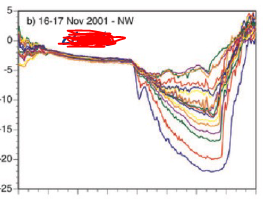
Clouds first part of the night
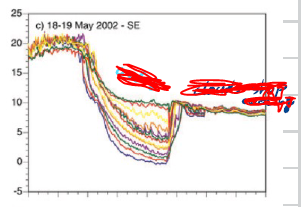
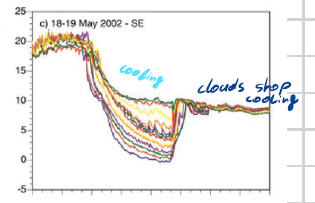
Example Grünloch: What is happening in this case?
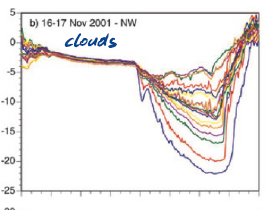
Cooling, then stopped by clouds
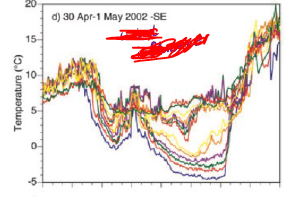
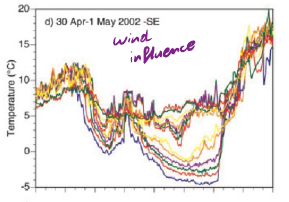
Example Grünloch: What is happening in this case?
wind influence leading to mixing
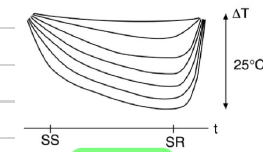
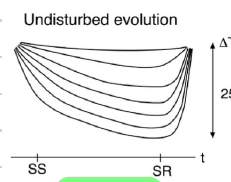
What is happening here to the cold air pool?
Undisturbed evolution
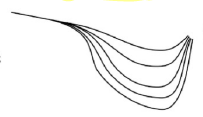
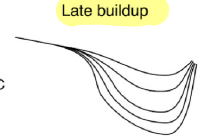
What is happening here to the cold air pool?
Late buildup: dissipation of clouds or suddenly weakend winds at some point during the night
What is happening here to the cold air pool?
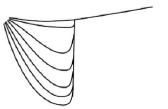
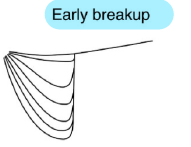
Early breakup: Frontal passages, Föhn onsets
What is happening here to the cold air pool?
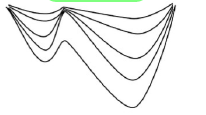
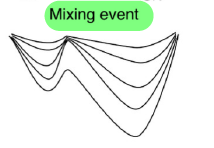
Mixing event: Strong and gusty windsat the top of the cold air pool
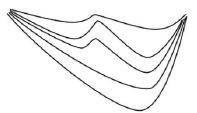
What is happening here to the cold air pool?
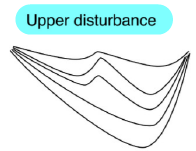
Upper disturbance: Similar to mixing but cold air pools remains stably stratified
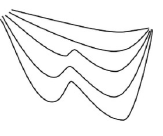
What is happening here to the cold air pool?
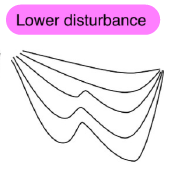
Lower disturbance: Possibly intrusions of relatively warm air into part of the basin (horizontal, not vertical heterogeneity)
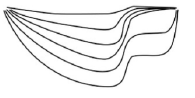
What is happening here to the cold air pool?
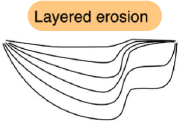
Layered erosion: Increasing winds with shift in direction (turbulent erosion on top, lateral advection below)
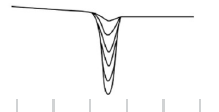
What is happening here to the cold air pool?
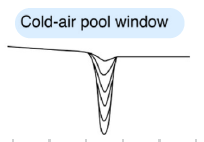
Cold air pool window: Cloud gap or short wind calm, similar to late buildup case, but favourable conditions do not persist
What are some favourable conditions for persistant cold air pools?
clear sky, weak wind, etc…
synoptic scale subsidence
persistent low level cloudiness
What is the main cause for nocturnal low level jets?
caused by decoupling of the geostrophic wind from surface friction which is a consequence of formation of a stable BL at night, which implies the cessation of deep vertical mixing
decoupling breaks original balance between pressure gradient force, Coriolis force and friction → leading to inertial oscillations
Their maximum is seen as nocturnal LLJ just above the SBL