GCSE Physics- Waves (Y10)
 Call Kai
 Learn
Learn Practice Test
 Spaced Repetition
 Match
Match Flashcards
 Knowt Play
1/84

There's no tags or description
Looks like no tags are added yet.
Name | Mastery | Learn | Test | Matching | Spaced | Call with Kai |
|---|
No analytics yet
Send a link to your students to track their progress
85 Terms
What are the 2 types of wave?
Transverse
Longitudinal
What kind of wave are the ripples on a water surface?
transverse
What makes something a transverse wave?
Oscillations are perpendicular to the direction of the energy transfer / wave travel
What makes something a longitudinal wave?
Oscillations are parallel to the direction of energy transfer / wave travel
Show areas of compression (where the particles are closest together) and rarefaction (where the particles are furthest apart)
What is an example of a longitudinal wave?
Sound waves travelling through air
What is the amplitude of a wave?
The maximum displacement of a point on the wave away from its undisturbed position
(On transverse wave, measure height from undisturbed middle line or half of the height from trough to peak)
What does higher amplitude of a wave mean?
The bigger the amplitude of the waves, the more energy the waves carry
What is the wavelength of a wave?
The distance from a point on one wave to the equivalent point on the adjacent wave
(So the distance from one peak/trough/compression to the next)
What is the frequency of a wave?
The number of waves passing a point each second
(Also the number of oscillations per second)
Measured in Hertz (Hz)
What happens to the wavelength when the frequency increases?
decreases
What is the period of a wave?
The time taken for one whole wave to pass a point
What is wave speed?
The speed at which the energy is transferred (or the wave moves) through the medium
How would you measure the speed of sound waves in air?
Measure time between seeing and hearing loud far away action
Speed = distance / time
How would you measure the speed of ripples on a water surface?
Take picture of ripple tank next to ruler to find wavelength
Count number of waves that pass a point in 10 secs (can be on slow motion video with stopwatch if needed) then divide by 10 to find frequency
wave speed = frequency x wavelength
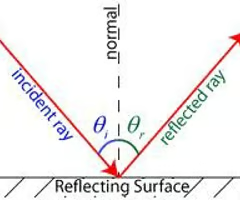
How would you illustrate the reflection of a wave using a ray diagram?
Draw a normal (a dashed line 90° from the surface it's reflecting off)
Measure and label the angle of incidence (angle between normal and ray that hasn't yet been reflected)
Draw and label reflected ray - the angle of incidence = the angle of reflection (from the normal, but on the other side of it)
Draw arrows on all rays to show the direction of energy transfer
Can sound waves travel through all mediums?
Yes
Can travel through solids causing vibrations in the solid
How do we hear?
Sound waves cause the ear drum and other parts of the ear to vibrate which causes the sensation of sound
Why is human hearing restricted?
The conversion of sound waves to vibrations as solids works over a limited frequency range
What happens to our perception of a sound wave when we increase its amplitude?
Its volume increases / it gets louder
What happens to our perception of a sound wave when we increase its frequency?
It gets higher (pitch changes)
What is the range of normal human hearing?
20 Hz to 20 kHz
How do ultrasound waves work?
Have higher frequency than our upper limit of hearing
Partially reflected when they meet a boundary between 2 different media
The time taken for the reflections to reach a detector can be used to determine how far away such a boundary is
This allows ultrasound waves to be used for both medical and industrial imaging
What are seismic waves?
Waves produced by earthquakes
What are P-waves?
Longitudinal seismic waves
Travel at different speeds through solids and liquids
Detected on the opposite side of Earth
Refractions between layers cause 2 shadow zones where no P-waves are detected. The size and positions of these indicate there's a solid inner core
What are S-waves?
Transverse seismic waves
Can ONLY travel through solids
Slower than P-waves
Aren't detected on the other side of the world which suggests the mantle is solid but the outer core must be liquid
What is one use of echo sounding using high frequency sound waves?
Detecting objects in deep water and measuring water depth
What are electromagnetic waves?
Transverse waves that transfer energy from the source of the waves to an absorber
What is the difference between the speeds of the different waves in the electromagnetic spectrum?
All types of electromagnetic wave travel at the same velocity through a vacuum (space) or air
How are the waves in the electromagnetic spectrum grouped?
Wavelength
Frequency
What is the electromagnetic spectrum from long to short wavelength (or low to high frequency)?
Radio
Microwave
Infrared
Visible light (red to violet)
Ultraviolet
X-rays
Gamma rays
Acronym for electromagnetic spectrum
Rich Martians Invaded Venus Using X-Ray Gadgets
What parts of the electromagnetic spectrum do our eyes detect?
Visible light so a limited range of electromagnetic waves
What are the 4 things that may happen to waves at the boundary between 2 materials?
Absorb
Transmit
Reflect
Refract
Why does refraction happen?
Due to the difference in velocity of the waves in different substances
How do you know which way a wave will refract?
When a wave travels from a fast to slow medium (e.g air to glass) it will bend towards the normal at the boundary and vice-versa
How do you illustrate the refraction of waves using a ray diagram?
Draw refracted ray refracting in correct direction
If needed, the angle of refraction is between the refracted ray and the normal (dashed line 90° to boundary)
If going back to original medium, the transmitted ray (ray that comes out of medium after refraction) will be refracted the same amount as the incident ray was but in the opposite direction so will be parallel to incident ray
How may radio waves be produced?
by oscillations in electrical circuits
What may radio waves do when they're absorbed?
May create an alternating current with the same frequency as the radio wave itself
So radio waves can themselves induce oscillations in an electrical circuit
What can changes in atoms and the nuclei of atoms result in?
Electromagnetic waves being generated or absorbed over a wide frequency range
Gamma rays originate from changes in the nucleus of an atom
Which waves can have a hazardous effect on human body tissue?
Ultraviolet waves
X-rays
Gamma rays
What does the effect of hazardous waves on the body depend on?
Type of radiation
Radiation dose
What is radiation dose?
A measure of the risk of harm resulting from an exposure of the body to the radiation
Measured in sieverts (Sv)
How can ultraviolet waves be dangerous?
Can cause skin to age prematurely
Can increase risk of skin cancer
How can X-rays and gamma rays be dangerous?
Ionising radiation
Can cause the mutation of genes and cancer
What are some uses of radio waves?
Television and radio
What are some uses of microwaves?
Satellite communications
Cooking food
What are some uses of infrared?
Electrical heaters
Cooking food
Infrared cameras
What are some uses of visible light?
Fibre optic communications
What are some uses of ultraviolet?
Energy efficient lamps
Sun tanning
What are some uses of X-rays and gamma rays?
Medical imaging and treatments
How does a lens form an image?
By refracting light
What happens in a convex lens?
Parallel rays of light are brought to a focus at the principal focus (converging)
What is focal length?
The distance from the lens to the principal focus
What type of image can be produced by a convex lens?
Real or virtual, inverted or upright, magnified or diminished or same size
What type of image can be produced by a concave lens?
Only virtual, upright, diminished
How do you draw a ray diagram for a convex lens?
Draw one ray going straight to lens from top of image, then down through the focal point
Draw another ray going straight through centre line
If they overlap, draw arrow from centre line to place where they do. This is image. Downwards arrow = inverted.
If lines don't cross over, follow them the other way to create a virtual image
How do you draw a ray diagram for a concave lens?
Draw one ray going straight to lens from top of image, then line up ruler with focal point on same side as image and point where ray met lens and draw a virtual ray.
Draw another ray going straight through centre line
Virtual image is where they overlap.
What is the magnification equation?
magnification = image height / object height
the units of height should be the same as each other
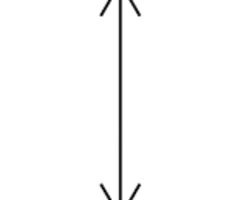
How can a convex lens be represented on a ray diagram?
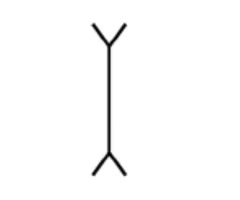
How can a concave lens be represented on a ray diagram?
Why do we see different colours within the visible light spectrum?
Each colour has its own narrow band of wavelength and frequency
What are the primary colours of light?
red, green, blue
Which colour has the highest frequency and shortest wavelength?
Violet
Which colour has the lowest frequency and longest wavelength?
Red
What is specular reflection?
Reflection from a smooth surface in a single direction
What is diffuse reflection?
Reflection from a rough surface which causes scattering
How do colour filters work?
By absorbing certain wavelengths (colours) and transmitting other wavelengths (colours)
How is the colour of an opaque object determined?
By which wavelengths of light are most strongly reflected
Wavelengths that are not reflected are absorbed
If all wavelengths are reflected equally the object appears white
If all wavelengths are absorbed the object appears black
What do you call objects that transmit light?
Transparent or translucent
What emits infrared radiation?
All bodies, no matter what temperature, emit and absorb infrared radiation
The hotter the body, the more infrared radiation it radiates in a given time
What is a perfect black body?
An object that absorbs all of the radiation incident on it
Does not reflect or transmit any radiation
Since a good absorber is also a good emitter, a perfect black body would be the best possible emitter
What determines how much radiation a body (object) emits?
All bodies emit radiation
The intensity and wavelength distribution of any emission depends on the temperature of the body
When would the temperature of a body increase?
A body at constant temperature is absorbing radiation at the same rate as it is emitting radiation
The temperature of a body increases when the body absorbs radiation faster than it emits radiation
What are some factors affecting the temperature of the Earth?
The rates of absorption and emission of radiation
Reflection of radiation into space
G (prefix)
Giga, 109
M (prefix)
Mega, 106
k (prefix)
kilo 103
c (prefix)
centi 10-2
m (prefix)
milli 10-3
μ (prefix)
micro 10-6
n (prefix)
nano 10-9
What are the units for the period of a wave?
seconds (s)
What are the units for frequency?
Hertz (Hz)
What are the units for wave speed?
m/s
What are the units for wavelength?
m