L&D
0.0(0)
Studied by 1 person Call Kai
 Learn
Learn Practice Test
 Spaced Repetition
 Match
Match Flashcards
 Knowt Play
Card Sorting
1/238

Earn XP
Description and Tags
Last updated 12:10 AM on 10/12/23
Name | Mastery | Learn | Test | Matching | Spaced | Call with Kai | Chat |
|---|
No analytics yet
Send a link to your students to track their progress
239 Terms
1
New cards
When does the pre-embryonic stage occur
* The ovum is fertilized and now has half the chromosomes from mom and half from dad (Called a zygote)
* Undergoes mitosis
* Travels down the fallopian tube to uterus
* Undergoes mitosis
* Travels down the fallopian tube to uterus
2
New cards
Describe the pre-embryonic
* Btw 6-10 days after fertilization blastocyst implants/attaches to uterine wall → trophoblast becomes placenta and inner cells become embryo → Progesterone surge so the blastocyst implants strongly along uterine wall
* Endometrial lining becomes more vascular so blastocyst can attach
* Endometrial lining becomes more vascular so blastocyst can attach
3
New cards
When does the embryonic stage occur
* 10-12 days after fertilization until 8 weeks
* Zygote becomes embryo
* Fetal pole is earliest form of embryo → seen 3-4wks after fertilization
* EDC used at this time
* Organogenesis
* Zygote becomes embryo
* Fetal pole is earliest form of embryo → seen 3-4wks after fertilization
* EDC used at this time
* Organogenesis
4
New cards
What is the embryonic period critical for
Organ development
5
New cards
Describe the embryonic period
* Highly susceptible to teratogens
* Spontaneous abortion is common here
* Spontaneous abortion is common here
6
New cards
Describe the embryonic to fetal stage
* Starts 9 weeks after fertilization/11 weeks gestation and ends at birth
* Officially a fetus at this stage
* Officially a fetus at this stage
7
New cards
Describe the placenta
* Temporary vital organ
* Placental development starts with first contact of outer shell of developing blastocyst with uterine mucosa
* Placental development starts with first contact of outer shell of developing blastocyst with uterine mucosa
8
New cards
What is the fx of the placenta
Circulation
Protection
Hormone Production
Protection
Hormone Production
9
New cards
What is inside the umbilical cord
2 umbilical arteries
1 umbilical veins
1 umbilical veins
10
New cards
Briefly describe fetal circulation
* The placenta is doing the work that baby’s lung will do after birth
* Placenta accepts de-O2 blood from fetus via BV leaving fetus through UC.
* Blood goes through placenta and picks up O2
* O2 rich blood goes to baby via umbilical vein in UC.
* O2 rich blood enters fetus passes through liver and enter right side of heart
* Placenta accepts de-O2 blood from fetus via BV leaving fetus through UC.
* Blood goes through placenta and picks up O2
* O2 rich blood goes to baby via umbilical vein in UC.
* O2 rich blood enters fetus passes through liver and enter right side of heart
11
New cards
What is the patent foramen ovale (PFO)
* The hole btw the R&L atrium.
* Allows for O2 rich blood to shunt from right to left atrium then left ventricle and out aorta
* Allows for O2 rich blood to shunt from right to left atrium then left ventricle and out aorta
12
New cards
What is the ductus arteriosus
* Sends O2 poor blood to organs and lower half of fetal body
* Allows for low O2 blood to leave via arteries and go to placenta
* Allows for low O2 blood to leave via arteries and go to placenta
13
New cards
Pre-natal visits trimester 1:
* 1-2 visits
* Initial bloodwork
* Initial physical assessment
* Initial dating U/S
* Nuchal translucency U/S
* Initial bloodwork
* Initial physical assessment
* Initial dating U/S
* Nuchal translucency U/S
14
New cards
Pre-natal care visits trimester 2:
* 3-4 visits
* Ongoing maternal physical assessment
* Fetal assessment
* Anatomy U/S 18-20 wks
* GTT
* Ongoing maternal physical assessment
* Fetal assessment
* Anatomy U/S 18-20 wks
* GTT
15
New cards
Pre-natal assessment trimester 3:
* 3-5 visits
* Ongoing maternal and fetal assessment
* GBS swap at 35 weeks
* Ongoing maternal and fetal assessment
* GBS swap at 35 weeks
16
New cards
Assessments for Fetal Well-Being
* Leopolds Manuevers
* Systematic assessment to determine: fetal lie, presentation, attitude and position
* Important to empty bladder prior
* Supine with slight head telt
* Systematic assessment to determine: fetal lie, presentation, attitude and position
* Important to empty bladder prior
* Supine with slight head telt
17
New cards
If Pre-Pregnancy BMI is less than 18.5 what is the expected weight gain during
* 12.5-18kg (28-40lbs)
* 0.44-0.58kg/wk (1-1.3lbs_
* 0.44-0.58kg/wk (1-1.3lbs_
18
New cards
If pre-pregnancy BMI is 118.5-24.9, what is expected weight gain during pregnancy
11\.5-16kg (25-35lbs)
* 0.35-0.50kg/wk (0.8-1lbs)
* 0.35-0.50kg/wk (0.8-1lbs)
19
New cards
If pre-pregnancy BMI is 25-29.9 what is expected weight gain during pregnancy
7-11.5kg (15-25lbs)
* 0.23-0.33kg/wk (0.5-0.7lbs)
* 0.23-0.33kg/wk (0.5-0.7lbs)
20
New cards
If pre pregnancy BMI is 30+, what is expected weight gain during pregnancy
5-9kg (11-20lbs)
* 0.17-0.27kg/wk (0.4-0.6lbs)
* 0.17-0.27kg/wk (0.4-0.6lbs)
21
New cards
How often should you feel your baby move
6 times in every 2 hours
22
New cards
what is VBAC
vaginal birth after caesarean
23
New cards
What are the types of FHR monitorin
* Intermittent - dopplar
* Continuous - mom & baby monitor
* External fetal monitoring
* Continuous - mom & baby monitor
* External fetal monitoring
24
New cards
What is the non-stress test?
* Women pushes button everytime she feels baby move
* Compare baby HR during movement and contractions
* Usually HR increases when baby moves
* Compare baby HR during movement and contractions
* Usually HR increases when baby moves
25
New cards
What should be the first thing you determine when looking at FHR
Baseline
26
New cards
What is the normal FHR activity
* Baseline - 110-160bpm
* Variability - moderate (6-25 bpms)
* Accels - present or absent
* Decels - no late/variable/prolonged
* Variability - moderate (6-25 bpms)
* Accels - present or absent
* Decels - no late/variable/prolonged
27
New cards
What is FHR variability
Beat-to-beat change in the FHR
28
New cards
What are the categories of FHR variability and their parameters
Absent = 0-1bpm
Minimal = <5bpm
Moderate = 6-25 bpm
Marked = >25 bpm
Minimal = <5bpm
Moderate = 6-25 bpm
Marked = >25 bpm
29
New cards
What are FHR accels
Increases of FHR of at least 15bpm above baseline
* Start and peak within 30 sec
* Not less than 15 seconds
* Should subside within 2 mins
* Start and peak within 30 sec
* Not less than 15 seconds
* Should subside within 2 mins
30
New cards
What are FHR decels
Periodic decreases in FHR from baseline
31
New cards
Early onset decelerations
Occurs before onset of uterine contraction
Usually benign - no intervention required
Gradual drop in FHR
Usually benign - no intervention required
Gradual drop in FHR
32
New cards
What is a cause of early decels
Head compressions
33
New cards
What are late decels
Occur after onset of uterine contraction
Uniform shape that reflects associated contraction
Drop in FHR gradual
Uniform shape that reflects associated contraction
Drop in FHR gradual
34
New cards
What is a cause of late decels
Disruption of O2 transfer
35
New cards
What are variable decels
Onset varies in timing with onset of contraction
Variable shape
Abrupt drop in FHR
Variable shape
Abrupt drop in FHR
36
New cards
What is a cause of variable
Umbilical cord compression
37
New cards
Initial Newborn Assessment
* Done within first minutes of birth
* Determine need for resusciation
* Delay cord clamping for 60 secs
* Done by L&D primary nurse
* Determine need for resusciation
* Delay cord clamping for 60 secs
* Done by L&D primary nurse
38
New cards
What are normal VS for babys
HR = 120-160
RR = 30-60
Temp = 36.5-37.2
RR = 30-60
Temp = 36.5-37.2
39
New cards
What is heat loss by conduction example
Heat loss d/t cold stethoscope
40
New cards
Heat loss due to radiation
Baby warmer
41
New cards
Describe vitamin K prophylaxis tx for newborns
0\.5mg to 1.0mg depending on wt
Given IM
Prevention of hemorrhagic disease of the newborn
NEED CONSENT
Given IM
Prevention of hemorrhagic disease of the newborn
NEED CONSENT
42
New cards
What is nageles rule
Assumes a gestational age of 280 days
* Add 7 days to LMP, subtract 3 months then add a year
* Add 7 days to LMP, subtract 3 months then add a year
43
New cards
When is trimester 1
Conception to 13 weeks
44
New cards
When is trimester 2
Week 13-26
45
New cards
When is trimester 3
Week 27-40
46
New cards
What is GTPAL
G - Gravida
T - Term
P - Preterm
A - Abortion
L - Living
T - Term
P - Preterm
A - Abortion
L - Living
47
New cards
Define gravida
Number of times a women has been pregnant regardless of pregnancy outcome
48
New cards
Define term
Number of pregnancies delivered at 37w0d gestation and beyond
49
New cards
Define preterm
Number of pregnancies delivered from 20w0d throguh 36w6d gestation
50
New cards
Define abortion
Number of pregnancies ending before 20w0d gestation
* may be spontaneous (miscarriage) or induced abortions
* may be spontaneous (miscarriage) or induced abortions
51
New cards
Define living
Number of currently living children
52
New cards
Define parity
Number of pregnancies carried to viable gestational age (20-24wk gestation)
53
New cards
Integumentary changes: Linea nigra
Dark line btw belly-button and pubic bone
Hormone induced excess production of melanin
After delivery may never disappear
Hormone induced excess production of melanin
After delivery may never disappear
54
New cards
Integumentary changes: Cholasma
Brownish pigmentation of the skin over the face and forehead (known as mask of pregnancy)
Begins about week 16 of pregnancy and gradually increases
Usually fades after deliver
Begins about week 16 of pregnancy and gradually increases
Usually fades after deliver
55
New cards
Integumentary changes: stretch marks
D/t weight increase over abdomen thighs and breasts
Usually fade after delivery but never completely disappear
Usually fade after delivery but never completely disappear
56
New cards
Integumentary changes: sweat glands
Activity of sweat glands increase during pregnancy so you sweat more
57
New cards
Urinary System changes:
Kidneys work extra hard causing amount of urine to increase
Renal pelvis and ureters dilate causing more frequent urination
Renal pelvis and ureters dilate causing more frequent urination
58
New cards
GI Changes:
Acid reflux - d/t enlarges/displaced uterus disrupting lower esophageal sphincter and progresterone relaxes it
Slowed digestive process - muscle walls in GI relax slightly and slows it down
Slowed digestive process - muscle walls in GI relax slightly and slows it down
59
New cards
Respiratory changes
* Minute ventilation increases about 50%
* Increased tidal vol., slight increased RR
* Functional residual capacity, expiratory reserve vol., and residual vol decrease
* ALL d/t displacement of diaphragm
* Increased tidal vol., slight increased RR
* Functional residual capacity, expiratory reserve vol., and residual vol decrease
* ALL d/t displacement of diaphragm
60
New cards
Cardiovascular changes
Increased blood volume and enhanced coagulation
* Increased circulatory needs of uterus, fetus and placenta
* Mom is protected from bleeding at time of delivery
* Increased circulatory needs of uterus, fetus and placenta
* Mom is protected from bleeding at time of delivery
61
New cards
Why is CO increased during pregnancy
Bc needs to pump so much more to feed fetus and placenta
62
New cards
CO for non-pregnant women
2\.5L/min
63
New cards
CO end of 1st trimester
5L/min
64
New cards
CO end of 2nd trimester
6L/min
65
New cards
CO Full term
7L/min
66
New cards
Hormones in pregnancy
HCG
Prolactin
Insulin
Oxytocin
Estrogen
Progesterone
Prolactin
Insulin
Oxytocin
Estrogen
Progesterone
67
New cards
What is HCG
Stimulates the corpus luteum to secrete estrogen and progesterone for up to approx. 14 weeks until placent takes over
Indicator for being pregnant
Indicator for being pregnant
68
New cards
What is prolactin
Prepares breasts for lactation and secreted by anterior pituitary gland
69
New cards
Insulin
Production of insulin increases in response to antagonistic effects of estrogen and progesterone
70
New cards
Oxytocin
Stimulates uterine contractions, milk ejection from breasts
Secreted from posterior pituitary gland
Secreted from posterior pituitary gland
71
New cards
Estrogen
Increase in estrogen enables uterus and placenta to further vascularize, transfer nutrients, and support growth of fetus
72
New cards
Progesterone
Helps uterus grow, keeps mom from having cx, helps prepare breasts for milk production
73
New cards
Primary level of prevention
Nutrition
Comfort
Sexual health
Knowledge
Coping
Comfort
Sexual health
Knowledge
Coping
74
New cards
Secondary Level of Prevention
Screening for maternal and fetal well being
Maternal - weight, physical, urine, blood, US
Fetal - HR, growth, movement
Maternal - weight, physical, urine, blood, US
Fetal - HR, growth, movement
75
New cards
Tertiary Level of Prevention
Management of pregnancy related concerns
Gestational HTN & GDM
Antenatal bleeding
Gestational HTN & GDM
Antenatal bleeding
76
New cards
First trimester lab testing and imaging
* Initial lab work: CBC, PLT, ABO/RH, Rubella, Varicella, Syphillis, STI screening
* A1C if risk for diabetes
* Genetic screening offered
* Early dating US
* Urine for protein
* A1C if risk for diabetes
* Genetic screening offered
* Early dating US
* Urine for protein
77
New cards
Second trimester lab testing and imaging
* Anatomy US 18-20wks
* Quad screen
* Glucose screening followed by GTT 24-28wks
* Quad screen
* Glucose screening followed by GTT 24-28wks
78
New cards
Third trimester lab testing and imaging
RH immunoglobulin if needed at 28 weeks
Re-screen for syphillis if at risk
GBS culture 35-36weeks
Re-screen for syphillis if at risk
GBS culture 35-36weeks
79
New cards
Describe WinRho immunoglobulin
Given IM
At any point if bleeding
At 28 wks routinely if NO bleeding
another at delivery
MUST be an RN or LPN with special competency to give
At any point if bleeding
At 28 wks routinely if NO bleeding
another at delivery
MUST be an RN or LPN with special competency to give
80
New cards
What is the nuchal translucency screening
* Can be done 11w4d until 13w6d pregnancy
* US and maternal BW are done within 24 hrs of each other
* US - looking for neck thickness, extra fluid (trisomy 13 or 18), ensuring nasal bone
* BW - hCG, PAPP-A and AFP
* Results: indicate a risk for down syndrome of trisomy 13 or 18 condition
* US and maternal BW are done within 24 hrs of each other
* US - looking for neck thickness, extra fluid (trisomy 13 or 18), ensuring nasal bone
* BW - hCG, PAPP-A and AFP
* Results: indicate a risk for down syndrome of trisomy 13 or 18 condition
81
New cards
Vaccinations in pregnancy
* Whooping cough vaccine
* Flu vaccine
* Covid-19 can be given
* Flu vaccine
* Covid-19 can be given
82
New cards
What is hyperemesis gravidarum
* Vomiting to point of dehydration causing electrolyte imbalance
* Nausea
* Cannot hold any food, water, fluids
* Thinner women at risk of this
* Nausea
* Cannot hold any food, water, fluids
* Thinner women at risk of this
83
New cards
Bleeding and Miscarriage in Pregnancy
* Always treated as irregular
* Do a cervical exam
* Post-coidal bleeding is acceptable, anything more than 1-2 tsps is not good
* Do a cervical exam
* Post-coidal bleeding is acceptable, anything more than 1-2 tsps is not good
84
New cards
Hypertension in pregnancy
140/90 without protein in urine or signs of end organ dysfx
dx at 20wks gestation and onward
dx at 20wks gestation and onward
85
New cards
What is pre-eclampsia
* Characterized by high BP, signs of damage to another organ system
* Usually begins after 20wks of pregnancy in women whose BP has been normal
* Difference between gestational HTN is protein in urine
* Usually begins after 20wks of pregnancy in women whose BP has been normal
* Difference between gestational HTN is protein in urine
86
New cards
Patients at risk for pre-eclampsia start what med in the first trimester
Aspirin
87
New cards
What happens with severe pre-eclampsia
Leads to induction of pre-term birth
* After 34 weeks if baby will do better outside than inside
* If not deliver imminently are treated with IV magnesium sulfate
* After 34 weeks if baby will do better outside than inside
* If not deliver imminently are treated with IV magnesium sulfate
88
New cards
Management of pre-eclampsia
Antihypertensives for BP >160/11-mmhg
Mag-sulfate to prevent eclampsia
Continued lab and urine analysis
LOTS of education
Ongoing assessments: fetal-well being, BPP, US, NST
May need induction
Mag-sulfate to prevent eclampsia
Continued lab and urine analysis
LOTS of education
Ongoing assessments: fetal-well being, BPP, US, NST
May need induction
89
New cards
What does HELLP syndrome stand for
H - Hemolysis (Destruction of RBC)
E - Elevated →
L - Liver enzymes indicating liver damage
L - Low →
P - Platelet count - risk of bleeding
E - Elevated →
L - Liver enzymes indicating liver damage
L - Low →
P - Platelet count - risk of bleeding
90
New cards
What is HELLP syndrome
* Complication of pre-eclampsia
* Only cure is delivery
* If after 34wks baby delivered ASAP
* Only cure is delivery
* If after 34wks baby delivered ASAP
91
New cards
What happens if you have HELLP syndrome prior to 34 wks
* Delivery is imminent but wait 48 hrs to deliver
* Give mom beta (2 doses of corticosteriod given 24 hrs apart)
* Helps w fetal lung development
* Give mom beta (2 doses of corticosteriod given 24 hrs apart)
* Helps w fetal lung development
92
New cards
Pathophysiology of GDM
* Insulin resistance IS necessary for securing glucose for fetal G&D
* GDM patients cannot compensate for normal insulin resistance d/t Beta cell dysfx
* Leads to hyperglycemic state and fat metabolis causing ketosis
* GDM patients cannot compensate for normal insulin resistance d/t Beta cell dysfx
* Leads to hyperglycemic state and fat metabolis causing ketosis
93
New cards
Diagnosing GDM
* Test done 24-28 wks gestation *NOT PERFORMED AFTER 35 WKS*\*
* GTT is warranted if 1 hr glucose val is 7.8-11mmol/L
* GDM is dx if 1 hr glucose val is greater than or equal to 11.1 mmol/L
* GTT is warranted if 1 hr glucose val is 7.8-11mmol/L
* GDM is dx if 1 hr glucose val is greater than or equal to 11.1 mmol/L
94
New cards
Polyhydramnios
* Excess amniotic fluid
* Can lead to pre-term, PPH
* TX = Amnio-reduction
* Can lead to pre-term, PPH
* TX = Amnio-reduction
95
New cards
Oligohydramnious
* Lower than expected vol of amniotic fluid
* Etiology: PROM and fetal anomalies
* Maternal dehydration can be a factor
* Fundal height smaller than expected is a sign
* TX = Amniofusion
* Etiology: PROM and fetal anomalies
* Maternal dehydration can be a factor
* Fundal height smaller than expected is a sign
* TX = Amniofusion
96
New cards
What are the 5 P’s
Passenger
Passageway
Powers
Position
Psyche
Passageway
Powers
Position
Psyche
97
New cards
Passenger =
Fetus, placenta
98
New cards
Passageway =
birth canal (bony pelvis, soft tissues
99
New cards
Powers =
Contractions, pushing/bearing down
100
New cards
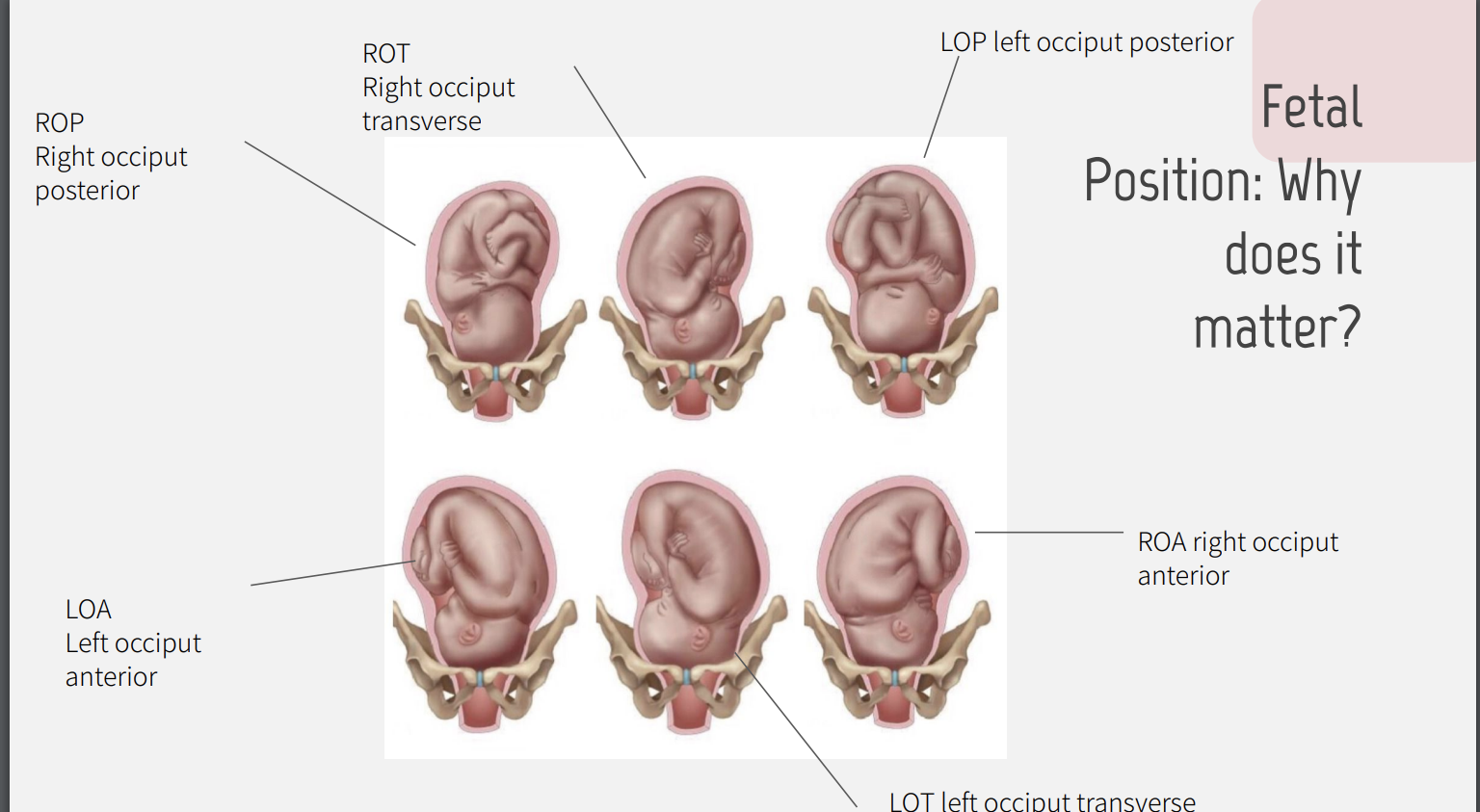
Position =
Woman, fetus