Week 12 OCEAN
 Call Kai
 Learn
Learn Practice Test
 Spaced Repetition
 Match
Match Flashcards
 Knowt Play
1/17

There's no tags or description
Looks like no tags are added yet.
Name | Mastery | Learn | Test | Matching | Spaced | Call with Kai |
|---|
No analytics yet
Send a link to your students to track their progress
18 Terms
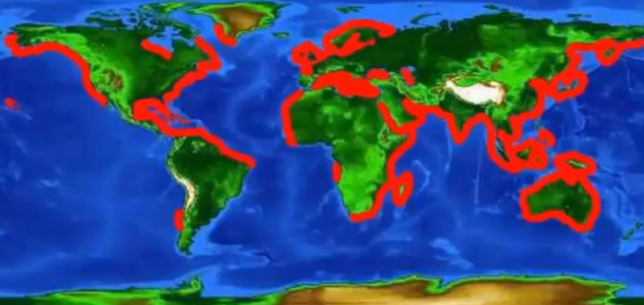
What are the most productive ecosystems in the marine environments?
Coral reefs and algae beds (including kelp forests)
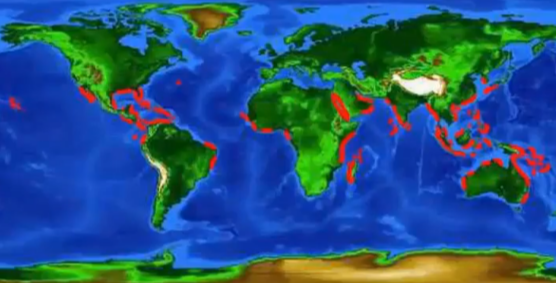
Where are coral reefs found? What are some environmental requirements for coral reefs?
Coral reefs are found in warmer waters along shorelines. They require shallow (for zooxanthellae photosynthesis), warm (avg 18-30°C but optimal 23-25°C), clear + clean (low sedimention, pollution, + plankton) water w/stable salinity (not too salty but not near rivers), good circulation (brings nutrients), and a hard substrate.
What is coral and what are coral reefs made of?
Coral polyps are a small benthic animal of Phylum Cnidaria that eat w/stinging tentacles, are colonial, and make structures of CaCO3 for protection. These polyps make a colony acting as a single organism (coral) which can connect to more and more colonies (coral reefs).
What is symbiosis? Describe the 3 types of symbiotic relationships and give an example of each.
Symbiosis: close relationship between 2 species where at least 1 benefits
Mutualism (win-win): both organisms benefit. Ex: Moray eel gives food (parasites), cleaner shrimp removes parasites.
Commensalism (win-neutral): 1 benefits + 1 is unbothered. Ex: fire urchin (toxic spines) gives carrier crab (can hook things + put on its back) protection, carrier crab gives no harm or benefit to fire urchin
Parasitism (win-lose): 1 benefits + 1 is harmed.
Describe the symbiotic relationship between coral and zooxanthellae, including the effects each one has on the other
Mutualism: Zooxanthellae gives coral its color and shares the nutrients it makes through photosynthesis (to make up for the nutrients coral would get from more plankton). In exchange, the coral gives the zooxanthellae protection (it lives within it) and nutrients.
What is zooxanthellae?
Autotrophic (photosynthesizes) unicellular algae (specifically a type of dinoflagellate)
What is the difference between hard coral and soft coral?
Hard/Stony coral: makes exoskeleton of CaCO3, reef-builders
Soft coral: makes exoskeleton of CaCO3 + protein, less rigid than hard coral
Non-reef-building coral found everywhere, reef-building coral needs specific conditions
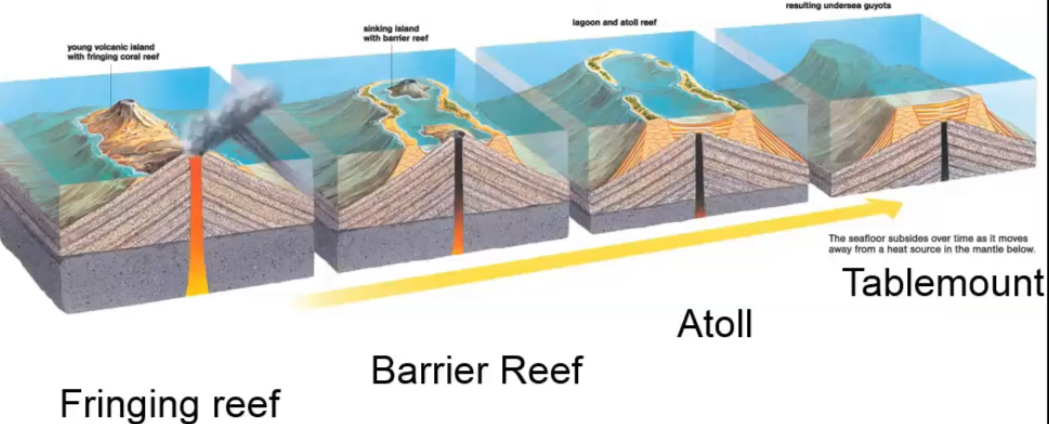
How are coral reefs formed? About how long can this take?
Formation Steps: 1. Fringing Reef 2. Barrier reef 3. Atoll 4. Tablemount
Massive corals grow 0.3-2cm/year, Branching corals grow up to 10cm/year
Can take up to 10k yrs for a coral reef to form
Depending on size: Barrier reefs + atolls can take 100k-30M years to form
Where are kelp forests found? What are some environmental requirements for kelp forests?
They're found in colder waters. They require a rocky substrate, a water depth of no more than 30m, and nutrient-rich cold (5-20°C), clear water.
What are the different types of seaweed?
Division Chlorophyta: Green algae, chlorophyll a + b = dominant pigments, fewer marine species (more freshwater)
Division Phaeophyta: Brown algae, contains chlorophyll but masked by xanthophyll, includes kelp
Division rhodophyta: Red algae, contains chlorophyll but masked by phycobilin, diverse size + complexity + morphology
What are the differences between terrestrial plants and seaweed?
Roots vs Holdfast, Roots absorb nutrients vs Nutrients not absorbed through holdfast (acts as anchor), Leaves w/veins vs blades w/o veins, Distinct top+bottom leaf surface vs No distinct top+bottom blade surface, Seeds vs No seeds, Vascular system vs No vascular system
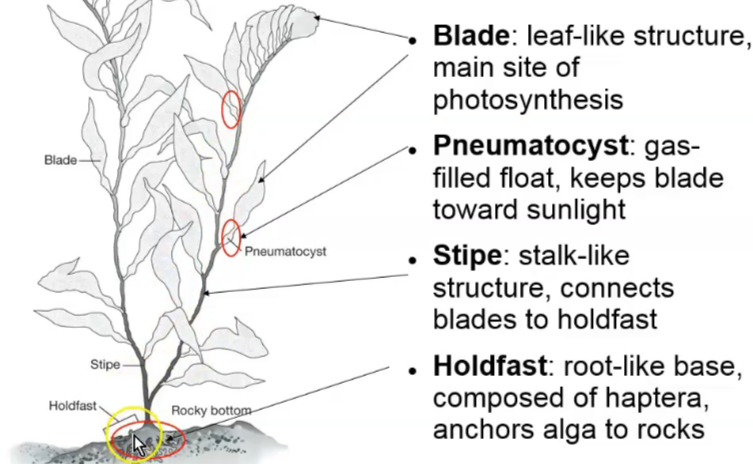
Be able to label the different structures found on kelp and know their functions
Blade: leaf-like structure, main site of photosynthesis
Pneumatocyst: gas-filled float, keeps blade towards sunlight
Stipe: stalk-like structure, connects blades to holdfast
Holdfast: root-like base, made of haptera, anchors alga to rocks
Know what makes the 3 types of algae different colors. Which type of algae is most similar to terrestrial plants based on its pigments?
Anything containing chlorophyll photosynthesizes but some pigments mask the color of chlorophyll. Chlorophyta (green algae) has chlorophyll a + b as its dominant pigments (unmasked), so it's most similar to terrestrial plants. Phaeophyta (brown algae) contains chlorophyll but it’s masked by xanthophyll. Rhodophyta (red algae) contains chlorophyll but it’s masked by phycobilin.
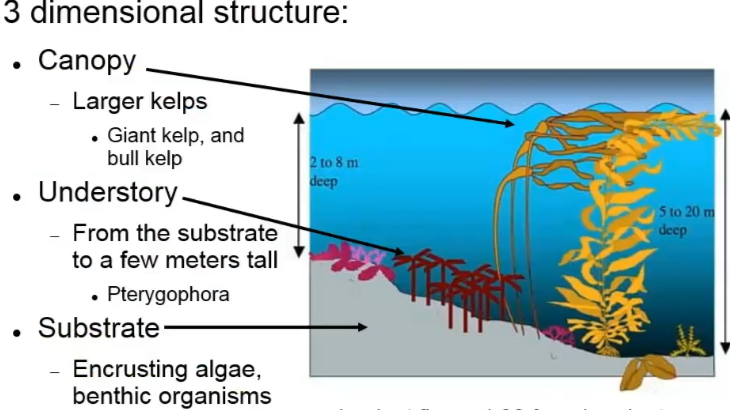
3 parts of the kelp forest (canopy, understory, substrate): be able to describe each.
Canopy: Larger kelps, giant kelp + bull kelp here
Understory: From the substrate to a few meters tall, pterygophora here
Substrate (bottom): encrusting algae + benthic organisms here
What are the two types of kelp that make up kelp forests on the west coast of the US? How fast do they grow?
Bull Kelp (Nereocystis): grows 10cm/day
Giant Kelp (Macrocystis): grows 27-61cm/day
Give some reasons why coral reefs and kelp forests are important
Kelp Forests: habitat for millions of species of fish + invertebrates, breeding/ nursery grounds (dampen waves + are slightly warmer), protection
Coral Reefs: home to ~¼ of all marine species + ⅓ of global marine fish, breeding grounds, shelter, food, more biodiversity than tropical rainforests, lots of symbiosis (shows interdependence of reef organisms), fringe ⅙ of global coastlines (human consumption)
What are mangroves? Where are they found?
Mangroves have adapted to waterlogged soils, saltwater w/changing salinity, shallow/shifting/soft sediments, shifting coastlines, waves. There are 38 species (+ ferns, palms, + trees that’re less typical). They actively exclude salt (some dump it in senescent leaves), have areal roots (extensions growing into air so they can dry a little) + buttress roots. They’re important bc they reduce rate of erosion, provide substrate for algae, food (for insects, molluscs, crabs, terrestrial mammals), nutrient cycling (leaves fall + their nutrients = recycled into environment), habitat. Found in tropical/subtropical habitats.
What are seagrasses and where are they found?
Seagrasses have adapted to waterlogged soils, saltwater w/changing salinity, shallow/shifting/soft sediments, shifting coastlines, waves. 50-60 species. Have adapted to live submerged in salty water. Adaptations: deep thick roots w/horizontal branching roots (rhizomes) (better anchor), ribbon-shaped leaves (move easier w/currents), air spaces in leaves (more buoyant → more sun for photosynthesis), excrete salt from their cells (don't dehydrate). Reduce erosion, food (for fish, manatees, seagrass-eating turtles, + invertebrates), nursery, habitat, protection. Found in most of the world.