Turning points
 Call Kai
 Learn
Learn Practice Test
 Spaced Repetition
 Match
Match Flashcards
 Knowt Play
1/84

There's no tags or description
Looks like no tags are added yet.
Name | Mastery | Learn | Test | Matching | Spaced | Call with Kai |
|---|
No analytics yet
Send a link to your students to track their progress
85 Terms
How do CRTs work?
A PD is applied across a discharge tube with a low pressure gas in it
This will separate out the electrons from gas atoms to form ions and electrons
Positive ions → cathode → more electrons released
Electrons → anode
Electrons released collide with atomic electrons to excite then deexcite, releasing photons
What properties did Thompson show cathode particles had?
Mass
Negative charge
Large charge to mass ratio (specific charge)
Why is the glow of a CRT brightest at the cathode?
Gas ions and electron can recombine to emit photons
Thermionic emission
When a metal is heated in order for the free electrons on its surface to gain enough energy to be emitted
How do electron guns work?
1) A cathode is heated until electrons are emitted (thermionic emission)
2) There is a PD across the electrodes so the electrons are accelerated towards the anode
3) The anode has a hole in it which allows the electrons to pass through
Work done and kinetic energy of an electron emitted from an electron gun
W = eV = ½ mv2
Fine beam tube method for specific charge
1) Electrons are accelerated using an electron gun and enter the tube perpendicular to the direction of the B-field
2) The magnetic force acts perpendicular to the direction of the electrons’ motion causing circular motion
3) As the electrons move the collide with gas atoms causing excitation and deexcitation, therefore the radius of the electrons’ path can be measured
How can we find the equation for specific charge using a fine beam tube (equation)?
mev2/r = Bev
½ mev2 = eV, v2 = 2eV/me
me(2eV/me)1/2/r = Be
me2V/r2 = B2e
e/me = 2V/B2r2
Thomson’s crossed fields method for specific charge
1) Electrons are accelerated with an electron gun and enter the apparatus perpendicular to the direction of both fields
2) The crossed fields act like a velocity selector
3) The fields are adjusted until the electron passes through the fields undeflected
Equations for Thomson’s crossed fields
Bev = Ve/d, v = V/Bd
½ mev2 = eVa
V2/B2d2 = 2eVa/me
e/me = V2/2B2d2Va
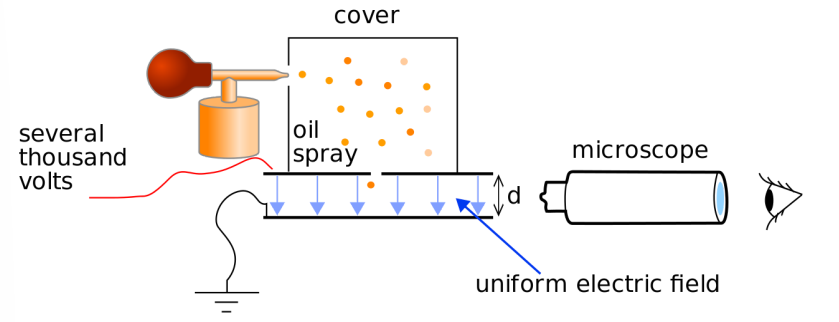
Purpose of the equipment in this image
PD - Provide an accelerating electric field for the oil drops
Cover - For the oil droplets to be sprayed onto
Oil spray - To negatively charge the droplets due to friction
Microscope - To record when the force due to the electric field is equal to the weight of the drop (so it is stationary in the air)
Expression for weight in Millikan’s oil experiment
mg = QV/d
Why is the PD removed from the electric field in Millikan’s experiment
As the mass is unknown, it needs to be found. By removing the PD, the oil drop will start to fall. When it reaches terminal velocity, the weight will be equal to the viscous drag force, which can be rearranged to find the radius of the oil drop
Stokes’ law for viscous drag force
F = 6πηrv
How is the speed of a falling oil drop measured?
A microscope with a calibrated graticule is used to measure the distance a drop falls in a certain time, which is then used with v = s/t
What did Millikan’s oil drop experiment show?
All the charges of the oil drops were integer multiples of 1.6 × 10⁻¹⁹ C
Showing that charge is quantised (exists in discrete packets)
Corpuscular theory of light
Newton theorised that light was made up of tiny particles
Newton’s explanation of reflection
The corpuscles collide with the surface and a repulsive force pushes them back, causing their component of velocity perpendicular to the surface to change direction
Newton’s explanation of refraction
As the corpuscules approach a denser medium, short range forces of attraction cause their velocity perpendicular to the surface to increase
This means the light will bend towards the normal
What did Newton say about the speed of light in a denser medium?
It was faster
Huygen’s principle
Light is made up of waves
Where every point on a wavefront is a point source to secondary wavelets, which then spread out to form the next wavefront
How can reflection be explained with Huygen’s theory?
As the whole wavefront will not reach the surface at the same time, wavelets spread away from the surface once they reach it and rejoin with others
How can refraction be explained using Huygen’s theory?
It was assumed that light travels slower in a more dense medium (and therefore as c = fλ and f is constant, λ decreases), so it would then bend towards the normal because the wavelet that arrives at the surface first would have more time to propagate, but would propagate slower
Why was Newton’s theory originally prefered to Huygen’s?
Newton had a much higher reputation
Diffraction had not yet been observed (which would disprove Newton’s theory)
The speed of light had not been measured (in different mediums)
The existence of sharp-edged shadows
Why was Young’s double slit experiment important for the theory of light?
It showed experimental evidence for diffraction, which did not fit with the corpuscular theory of light
It also showed light interference, which is a wave property
Where does constructive interference occur in Young’s double slit experiment?
Where the path difference is nλ
Where does destructive interference occur in Young’s double slit experiment?
Where the path difference is (n + 1/2)λ
How are EM waves formed?
Of perpendicular electric and magnetic fields oscillating as transverse waves
Maxwell’s equation for the speed of EM waves
c = 1/sqrt(μ0ε0)
What is μ0?
The permeability of free space
The ability of free space to support the formation of magnetic fields
What is ε0?
The permittivity of free space
The ability of free space to support the formation of electric fields
How did Hertz’s first experiment show EM waves existed?
The dipole receiver sparked, showing that there was an induced current in it due to a B-field and that sparks were created between the capacitors, showing the electric field
How could the wavelength of EM waves be calculated?
Place a metal sheet in front of a transmitter to reflect the waves and form stationary waves. Then use a dipole receiver to find two consecutive nodes, and the wavelength will be double the length between the nodes
How did Hertz’s experiment show that EM waves are polarised?
The dipole receiver sparked more at a certain angle, and had a certain angle where no sparks were produced, meaning that the wave oscillated in a specific direction
How did Fizeau’s experiment work?
A light source was reflected by a glass plate through a rotating, toothed disk to hit a mirror at the other end, where it would then bounce back through the disk where an observer could see through the glass plate.
Formula for what fraction of a revolution of Fizeau’s disk would cause a tooth to replace a gap
1/2n (n = number of teeth and gaps)
How did Fizeau derive the speed of light from his experiment?
rev% = 1/2n
trev = 1/f
ttooth replaces gap = 1/2nf
s = d/t = 2d/1/2nf
c = 4dnf
(where d is distance from disk to mirror)
What is a black body?
A hypothetical object that is a perfect emitter and absorber (emits and absorbs all wavelengths of radiation)
Ultraviolet catastrophe
Where the classical wave model of light caused a prediction for a small wavelength of light to emit infinite energy
What model caused the UV catastrophe?
The Rayleigh-Jean equation
Wien’s displacement law
λmax = b/T
How did Planck’s quanta theory solve the UV catastrophe?
The experimental radiation curve could be explained in terms of individual particles. At the peak, each individual photon has the entirety of the predicted energy emission. Past that, each photon has more energy than that, so the probability of emission drops (as the system is not hot enough to radiate the photons).
Why could the photoelectric effect not be explained by wave theory?
Wave theory suggests that any frequency of light should be able to cause photoelectric emission - hence the work function should not exist
The photoelectric effect is immediate, it does not require any time for energy to build up
Increasing the intensity of light does not increase the KEmax, instead it increases the current
Photoelectrons have a range of kinetic energies
How did Einstein’s photon theory explain photoelectricity
Photons have to transfer all of their energy in a collision with an atomic electron, which explains the work function
The photon energy is immediately transferred, which explains the immediate emission of photoelectrons
Intensity is the number of photons emitted per second, so would increase the number of collisions (1:1 ratio)
All electrons receive the same energy, but some need to use more KE to escape the material
What is the stopping potential?
The minimum potential required that is applied across the metal surface that stops the photoelectrons with the highest KE
Vs = KEmax/e
Einstein’s photoelectric equation in terms of stopping potential
Vs = h/e f - ϕ/e
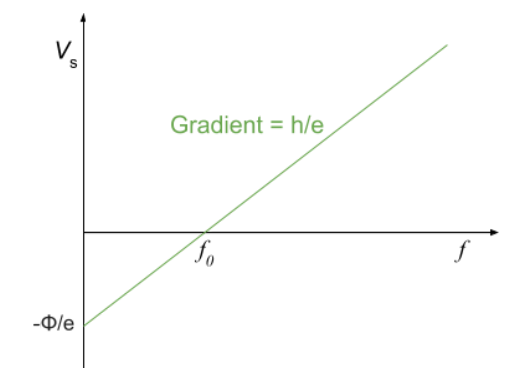
de Broglie hypothesis
All particles have a wave like nature and a particle like nature
de Broglie wavelength
λ = h/mv = h/p
What experiment provided evidence for the de Broglie hypothesis?
Electron diffraction
How is electron diffraction carried out?
Electrons are accelerated by an electron gun (1/2mv2 = eV) towards a crystal lattice, so that the electrons’ wavelength (λ = h/sqrt(2meV)) is similar to the distance between the gaps in the lattice. A diffraction pattern of concentric circles on a screen is then formed
How did electron diffraction provide evidence for the de Broglie hypothesis?
If electrons are accelerated more, they will have a larger momentum, and therefore a smaller de Broglie wavelength. It is then observed that the fringe spacing is decreased. The converse is also true (less acceleration → smaller momentum, larger de Broglie wavelength and fringe spacing increases)
Resolving power of a microscope
The ability of a microscope to distinguish structures which are close to each other.
What happens to the resolving power of an electron microscope when the electron wavelength decreases?
It increases
TEM
Transmission Electron Microscope
What lenses does a TEM have?
Condenser
Objective
Projector
What does a condenser lens do?
It deflects the electrons from the electron gun so that they form a wide beam, which is then directed at the sample
What does the objective lens do?
This is the lens which is directly below the sample
It will form an image of the sample
What does the projector lens do?
This lens will magnify the image made by the objective lens and project it onto the fluorescent screen
What is the resolving power of a TEM limited by?
Sample thickness
Electrons travelling with a range of speeds
What is the voltage of the electron gun needed to produce an electron wavelength similar to the diameter of an atom (0.1 nm) for a TEM
150 V
STM
Scanning Tunnelling Microscope
How does an STM work?
A very fine tipped probe is moved close to the surface of a sample with a small PD applied across the probe tip and the sample
When the tip is close enough, some electrons in the sample (due to their wave function overlapping with the end of the tip) can tunnel through the gap into the tip of the probe, which forms a current which’s magnitude is proportional to the distance from the probe tip to the surface of the sample.
How does quantum tunnelling work
Quantum tunnelling allows particles to overcome potential barriers that they should not have enough energy to overcome
This occurs due to the wave function of particles, which says that particles are represented as a ‘cloud’ of probability of where they can lie
If another object overlaps with the edge of the wave function of a particle in another object, there is a small chance that the particle is found in the other object
The two modes of an STM
Constant height - current varies so can be used to determine the distance
Constant current - distance adjusted and recorded so the current is constant
What is Ether?
Ether was a hypothetical substance which scientists used to believe permeated the entire universe which was the hypothetical medium for light
What was the purpose of an interferometer?
To measure the absolute speed of the Earth through the ether
What was the interferometer made from?
Light source
3 mirrors
A beam splitter (+ a compensating plate)
The mirrors and light source were arranged such that they form a square, so the split beams of light are reflected back on themselves
Why did Michelson and Morley use an interferometer to try and prove the existence of the ether?
They believed that the speed of the light beam moving parallel to the motion of the Earth would be affected, so an interference pattern would be formed that would shift if the interferometer was rotated 90 degrees
3 conclusions drawn from the Michelson-Morley experiment
1) The ether does not exist
2) Or the Earth drags the ether along with it as it moves
3) The speed of light is invariant in free space
Inertial reference frame
Frames which move at a constant velocity relative to each other
Einstein’s special relativity postulates
1) The speed of light in free space is invariant
2) The laws of physics have the same form in all inertial frames
Time dilation
An external observer will always observe a larger time than an observer moving at a relativistic speed
Expression for speed an object moves with and its experienced time
v ∝ 1/t (Inverse proportionality)
Proper time
The time experienced by the stationary observer (within the inertial reference frame) (t0 < t)
Lorentz factor
(γ = ) (1-v2/c2)-1/2
How to derive proof of time dilation
Light clock - find time taken
Light clock on a moving train of velocity v
Use trig for the distances travelled by the light on the train
Rearrange for t and factorise out
What phenomenon provides evidence of time dilation and why?
Muon decay
The muons travelling between two detectors have a half life such that very few should survive the distance, but many more than predicted do
Therefore the muons at a very high speed (0.996c) must experience time slower than us
Length contraction
Objects at a relativistic speed seem shrunken for external observers
Proper length
The length measured by an observer who is at rest relative to the object
Relativistic mass
The mass observed for a body which has had energy added to it, therefore increasing its mass
Energy expression of a relativistic mass
ET = E0 + Ek
How to work out the total mass of a relativistic object
ET = m0c2*γ
Bertozzi’s experiment
Particle accelerator which accelerates groups of electrons at an aluminium plate through a detector which could determine the number of electrons emitted.
How to calculate the kinetic energy of one electron from Bertozzi’s experiment
When the electrons collide with the target all of their kinetic energy is converted to thermal energy
ET = mcΔθ
Eone electron = mcΔθ/n
Why can an object never reach the speed of light?
At the speed of light, relativity says that the object will have an infinite kinetic energy, which is impossible
The Lorentz factor will also be equal to 0, so when working out the energy it will give an expression divided by 0, which is impossible