Forces (Acceleration/Newtons Law/Stopping Distance)
 Call Kai
 Learn
Learn Practice Test
 Spaced Repetition
 Match
Match Flashcards
 Knowt Play
1/33

There's no tags or description
Looks like no tags are added yet.
Name | Mastery | Learn | Test | Matching | Spaced | Call with Kai |
|---|
No analytics yet
Send a link to your students to track their progress
34 Terms
Acceleration
Rate of change in velocity
change in velocity = change in speed/direction or both
What is negative acceleration
Deceleration
How to calculate average acceleration (if it is not constant)
a = delta V / t
a = accel m/s²
delta v = change in velocity = m/s
t = time taken (s)
Units for acceleration
m/s²
MUST BE SQUARED
Estimating Accelerations
Might have to estimate acceleration of the object
Use the typical speeds in order to estimate
eg. car will have typically speed of 25m/s
car comes to a stop in one second
so deceleration is -25m/s²
Uniform Acceleration (Constant Acceleration)
v² (m/s) - u² (m/s) =2 a (m/s) s(m)
Distance
How far an object has moved (Scalar Quantity)
Displacement
Measures distance and direction of an object (vector quantity)
Speed
How fast something is going (scalar quantity)
Velocity
How fast something is going and in which direction (vector quantity)
Constant Speed not true
Constant Speed not true
Objects can have a constant speed but changing velocity
Circular motion
Happens when an object is changing direction whilst at the same speed
Important Speeds
Walk - 1.5m/s
Run - 3m/s
Cycle - 6m/s
Sound 330m/s
Car - 25m/s
Train - 55m/s
Plane -250m/
Factors that affect speed in every day life
Fitness,age,terrain,effort
What sound waves are travelling through
Wind speed is affected by pressure,and objects
Distance formula
D=ST or S=VT
Important Stuff When Calculating-
When object is stationary its (INITIAL) velocity is 0m/s
When object is dropped normally its 9.8m/s
When to choose which acceleration equation?
if given distance use constant
if give time use average
Friction
acts in opposite direction to the movement
to travel at a steady speed driving force need to balance the frictional forces
friction occurs when two surfaces are in contact or when object passes through a fluid (usually caslled drag)
Drag
air resistance eg. drag
Frictional forces from fluids always increase with speed
Car has much more friction to work against
Ways on icnreasing the top speed of a vehicle
reducing drag (change the shape of vehicle)
increasing power of vehicles engine
Terminal Velocity
Maximum velocity attanable by an object as it falls through a fluid (liquid or gas)
RESULTANT FORCE = ZERO
Air resistance
Force Caused by moving object colliding with particles in the air
What two forces are in balance at terminal velocity?
weight and air resistance (so will cancel each other out)
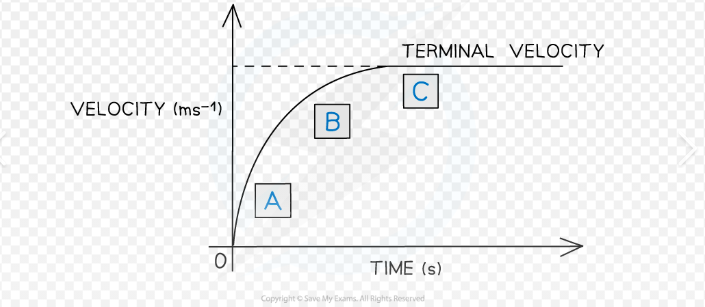
Terminal velocity graph
Parachute and Plane Example
As a person jumps out of a plane they are statinoary and their velocity is zero
As they have a mass weight starts to bring them down and because the velocity is low there is little air resistance
As they are falling air resistance starts to increase and eventually the magnitude of the weight and resistance area equal
Therefore the resultant force is zero this is terminal velocity
Once a parachute is open the surface area increases by a lot meaning that resistant force will now be upwards because of more air resistance
This means that the person is decelerating (accel upwards)
Eventually they will reach a new terminal velocity
Reasons for larger air resistance
More collisions with air particles
Velocity - Faster the object is moving the more particles it collides with
Surface Area - Large SA means there is a larger area over which collisions can take place
What happens to an object that is dropped in a fluid?
Initially accelerates due to force of gravity
Stopping Distance
sum of the distance the vehicle travels during the driver’s reaction time (thinking distance) and the distance it travels under the braking force (braking distance).
Stopping Distance equals
Stopping Distance = Thinking + Braking Distance
Thinking Distance
Distance a car travels between the point a driver spots a danger and the point they apply the brakes
Braking Distance
Distance a car travels between the point a driver applies the brakes and the point the car stops moving
Factors that affect thinking distance
how fast you are going
reaction time
5 Factors that affect Braking Distance
Quality of breaks
Quality of tyres (how much tread they have)
The road surface (ice/wet)
Speed of Vehicle
Mass of Vehicle
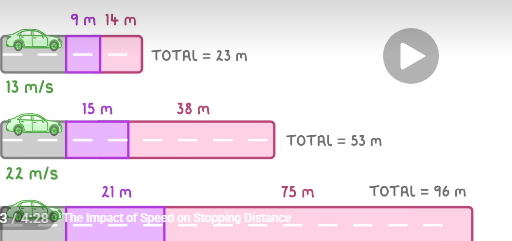
speed limits affect stopping distance
as car speeds up thinking distance increases at the same rate as the speed (directly proportional)
as thinking time stays constant (higher speed more distance covered)
Braking distance and Speed
increases faster as you speed up
speed doubles braking distance increases x4 (2²)