2.3.1 + 2.3.2: Characteristics of aggregate supply and SRAS
 Call Kai
 Learn
Learn Practice Test
 Spaced Repetition
 Match
Match Flashcards
 Knowt Play
1/7

There's no tags or description
Looks like no tags are added yet.
Name | Mastery | Learn | Test | Matching | Spaced | Call with Kai |
|---|
No analytics yet
Send a link to your students to track their progress
8 Terms
What is aggregate supply
The volume of goods and services produced within the economy at a given price level
It indicates the ability of an economy to produce goods and services and show the relationship between the real GDP and the average price levels
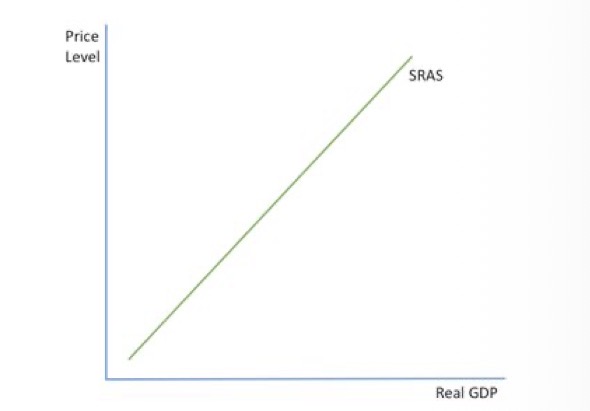
The AS curve
In the short run, if a business wants to increase production they have to increase their employees work hours
They will not necessarily want to employ additional permanent full time staff as they would then be committed to them and have to give redundancy packages if sales fell late
Firms may take on temporary workers or get current workers do work overtime- would entail offering incentive of some sort e.g. bonuses
Basic wage rates remain, however, the average marginal cost of labour per good will rise- this would be passed onto the consumer
This is why the curve is upwards sloping
Elasticity in AS
SRAS is likely to be elastic
An increase in output by firms is likely to lead an increase in costs onto consumers
However, the factor prices are constant meaning the increase in prices will be relatively small
If demand falls, firm swill cut prices in an attempt to stimulate sales
However, they will not be able to achieve much of a reduction because of constant prices and an unwillingness in the short run to lay of workers
Movements and shifts
A change in price level will lead to a contraction or expansion (a movement along the curve)
A shift in the curve is caused by a range of other factors
These factors depend on whether it is the SSRAS or LRAS curve
Relationship between long and short run
Short run is the period of time when at least one factor of production is fixed and cannot be changed
On the AS curve, in the sort run, money wage rates, factor of production prices and the state of technology are fixed
A change in these result in a shift of the curve
In the long run, all factors of production are variable
There is disagreement amongst economists on the shape of the LRAS
Factors affecting SRAS: Changes in the cost of raw materials and energy
An increase in the cost of raw materials and energy increases the cost of production
This means the SRAS curve will shift left a it will cost more to make the same amount of goods and therefore businesses will only produce this amount of goods if prices rise
Oil prices are an important cost in determining the level of SRAS, since they affect costs for almost all businesses
Factors influencing SRAS: Changes in exchange rates
A weaker pound will lead to an increase in the price of imports and this will cause SRAS to decrease as production becomes more expensive
Stronger pound, cheaper immports and so SRAS increaes
This is important in the uK which is imort dependent
The inflarion the UK expeirences after Brexit was caused by the fall in th pound, which pished import prices up and led to cost-push inflation
Factors influencing SRAS: Changes in tax rates
Taxes increase the cost of production and this they cause a fall in SRAS, shifting it to the left
Subsidies shift the curve right as they decrease costs