3. Superposition + Standing Waves
 Call Kai
 Learn
Learn Practice Test
 Spaced Repetition
 Match
Match Flashcards
 Knowt Play
1/20

There's no tags or description
Looks like no tags are added yet.
Name | Mastery | Learn | Test | Matching | Spaced | Call with Kai |
|---|
No analytics yet
Send a link to your students to track their progress
21 Terms
What is the principle of superposition?
When two waves meet at a point, the resultant displacement is the sum of the two individual displacements
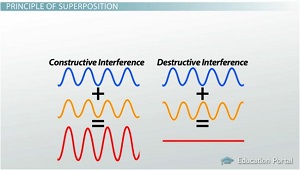
What is constructive + destructive interference?
Constructive interference - displacements add to give a greater displacement
Destructive interference - displacements add to give a smaller displacement
What does path difference mean?
Difference in how far two waves have travelled to a certain point
When does constructive + destructive displacement occur?
Constructive:
In phase - phase difference of a multiple of 2π (e.g 0, 2π, 4π)
Path difference is whole number of wavelengths
Destructive
Antiphase - phase difference of an odd multiple of π (e.g π, 3π, 5π)
Path difference is a half number of wavelengths
What does coherent mean + condition needed?
Coherent - constant phase difference between two waves
Condition needed - same frequency
What is two-source interference + condition needed?
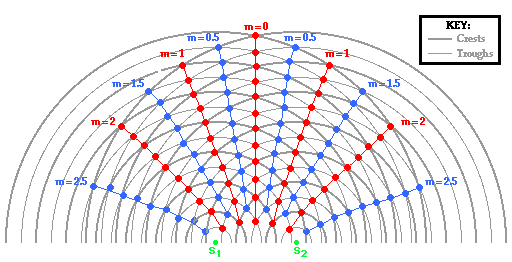
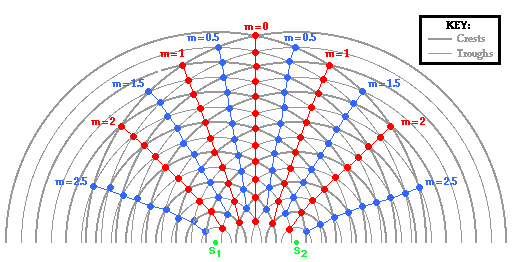
Two-source interference - waves from two source interfere to produce an interference pattern of maximas + minimas
Condition needed - two coherent sources
Where do maximas + minimas occur + order?
Maxima - when path difference is a whole number of wavelengths → constructive interference
Minima - when path difference is half a wavelength → destructive interference
Order:
Central maxima
1st order minima
1st order maxima
2nd order minima etc
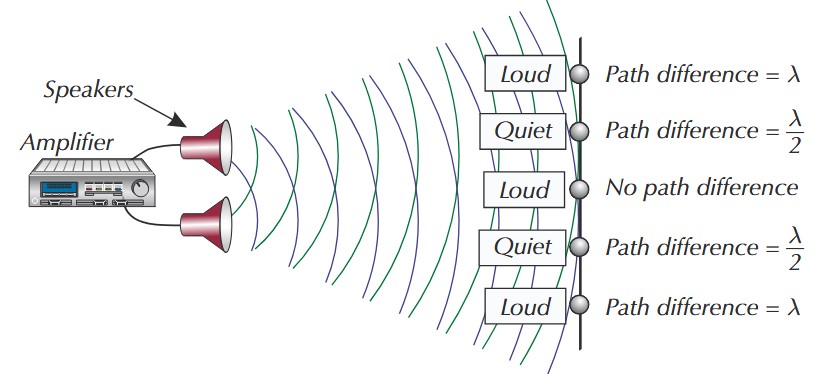
How to investigate two source interference of sound + microwaves?
Sound:
Setup amplifier connected to two speakers
Walk parallel to line of speakers
There will be areas of loud (constructive interference) + quiet sound (destructive interference)
Microwaves:
Setup signal generator connected to two microwave transmitter cones
Move microwave receiver parallel to line of cones
There will be areas of strong (constructive interference) + weak signals (destructive interference)
How to do Young’s double slit experiment?
Setup a mounted card with two slits the same size as the wavelength of the laser light
Shine a laser through the slits
An interference pattern of light (maxima) + dark fringes (minima) should form
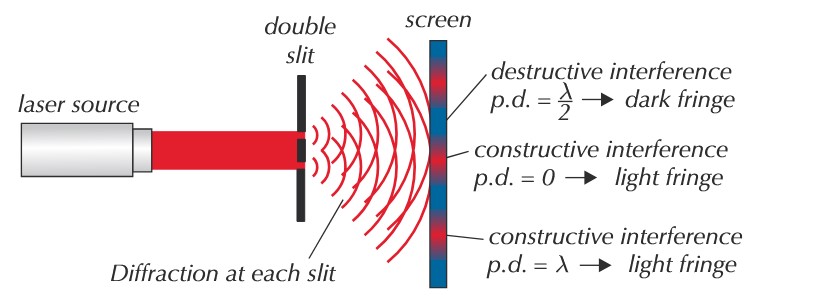
What is the equation for the double-slit experiment?
λ = ax / D (wavelength = spacing between slits x fringe spacing between two adjacent maxima / distance between slit + screen)
What three conditions are needed for stationary waves to form?
Two waves:
with same frequency
with same amplitude
travelling in opposite directions
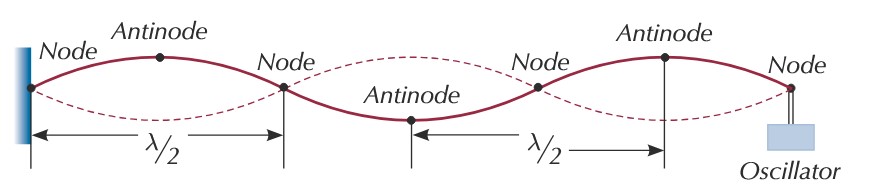
What is a node + antinode?
Node - the two waves meet in antiphase → amplitude is always zero
Antinode - the two waves meet in phase → amplitude can reach maximum
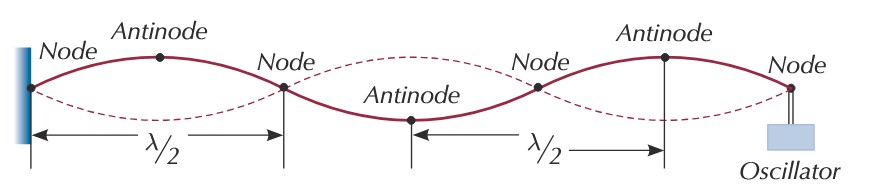
How to find the wavelength of stationary wave?
Distance between two nodes x 2
What are three differences between progressive + stationary waves?
Progressive waves transfer energy whereas stationary waves store energy
Progressive waves have the same amplitude in all parts whereas stationary waves have varying amplitude throughout
Progressive waves have continuously varying phase difference whereas all point between two nodes in a stationary waves are in phase + points in adjacent nodes are in antiphase
What do fundamental mode of vibration + fundamental frequency mean?
Fundamental mode of vibration (1st harmonic) - one half wavelength fits on string → wavelength is 2L
Fundamental frequency (f0) - frequency of this wave
What is the equation for the wavelength + frequency of the nth harmonic?
λ = 2L / n (wavelength = 2 x length of string / n)
f = nf0 (frequency = n x fundamental frequency)
How are stationary waves formed in stringed instruments?
Your finger creates a node at the point where you press the string
The string vibrates
Waves are sent out at both directions + reflected → stationary wave
How are stationary waves formed in a closed end tube + wavelength + frequency?
Node at closed end
Antinode at open end
λ = 4L / 2n - 1 (wavelength = 4 x length of string / 2n - 1)
f = (2n - 1) f0 (frequency = (2n - 1) x fundamental frequency)
How are stationary waves formed in a open end tube + wavelength + frequency?
Antinode at both ends
λ = 2L / n (wavelength = 2 x length of string / n)
f = nf0 (frequency = n x fundamental frequency)
How to investigate stationary waves using microwaves?
Setup a microwave transmitter pointed at a metal plate
Move a microwave receiver connected to a speaker perpendicular to the transmitter
Max sound → antinode
Min sound → node
How to find the speed of sound using stationary waves?
Setup a hollow tube filed with water in a measuring cylinder
Choose a tuning fork + record the frequency of it
Hit the tuning fork on a table + hold it above the tube
Move the tuning fork up + down until the sound is the loudest
Measure distance between top of water to tuning fork
Repeats + average
Repeat for other tuning forks with different frequencies
Plot a graph of frequency (y-axis) against 1 / wavelength (x-axis)
The gradient is the speed of sound