Unit 4 Sensation and Perception
 Multiple Choice & FRQ
 Call Kai
1/140

Earn XP
Description and Tags
141 Terms
Sensation
the process by which our sensory receptors and nervous system receive and represent stimulus energies from our environment
perception
the process of organizing and interpreting sensory information, enabling us to recognize meaningful objects and events
bottom-up processing
analysis that begins with the sensory receptors and works up to the brain’s integration of sensory information
top-down processing
information processing guided by higher-level mental processes, as when we construct perceptions drawing on our experience and expectations
selective attention
the focusing of conscious awareness on a particular stimulus
inattential blindness
failing to see visible objects when our attention is directed elsewhere
change blindness
failing to notice changes in the environment, man switch behind door -man giving directions doesn’t notice the man changed
transduction
conversion of one form of energy into another. in sensation, the transforming of stimulus energies, such as sights, sounds, and smells, into neural impulses our brain can interpret
absolute threshold
the minimum stimulation needed to detect a particular stimulus 50% of the time
priming
the activation often unconsciously, of certain associations, thus predisposing one’s perception, memory, or response
difference threshold
the minimum difference between 2 stimuli required for detection 50% of the time. we experience the difference threshold as a just noticable difference (jnd)
weber’s law
the principle that, to be perceived as different, 2 stimuli must differ by a constant minimum % (rather than a constant amount)
sensory adaptation
diminished sensitivity as a consequence of constant stimulation
psychophysics
the study of relationships between the physical characteristics of stimuli, such as their intensities, and our psychological experience of them
subliminal
below one’s absolute threshold for conscious awareness
wavelength
the distance from the peak of one light or sound wave to the peak of the next. electromagnetic wavelengths vary from the short blips of cosmic rays to the long pulses of radio transmission
intensity/amplitude
the amount of energy in a light or sound wave, which we perceive as brightness or loudness, as determined by the wave’s output
long/low-frequency wavelength=
light- red hue
sound- low pitch
wavelength=
hue and pitch
short/high-frequency wavelength
light- blue hue
sound- high pitch
short amplitude
light- dim
sound- quiet
tall amplitude
light- vibrant
sound- loud
amplitude
saturation/brightness and volume
pupil
the adjustable opening in the center of the eye through which light enters
iris
a ring of muscle tissue that forms the colored portion of the eye around the pupil and controls the size of the pupil opening

locate all of the terms
eye diagram
lens
the transparent structure behind the pupil that changes shape to help focus images on the retina
mnemonic for eye structure
can people in london read french? really cool brits give other nations (cornea pupil iris lens retina fovea rods cones bipolar cells ganglion cells optic nerve -thalamus occipital lobe visual cortex)
retina
the light-sensitive inner surface of the eye, containing the receptor rods and cones plus layers of neurons that begin the processing of visual information
where does transduction occur in the eye
retina
accomodation
the process by which the eye’s lens changes shape to focus near or far objects on the retina
rods
retinal receptors that detect black-white-gray; necessary for peripheral and twilight vision, when cones don’t respond
cones
retinal receptor cells that are concentrated near the center of the retina (close to the fovea) and that function in daylight or in well-lit conditions. the cones detect finer details and give rise to color sensations
fovea
the central focal point in the retina, around which the eye’s cones cluster
blind spot
the point at which the optic nerve leaves the eye, creating a “blind'“ spot because no receptor cells are located there
feature detectors
nerve cells in the brain that respond to specific features of the stimulus, such as shape, angle, or movement
cocktail party effect
ability to attend to one voice among a sea of others (being able to hear your name being said no matter how quiet or far away)
choice blindness
being unaware of choices made; usually by not paying attention (and the brain makes up a reason) - order something and given another thing but you didnt notice so you think you actually did order it
cornea
eye’s clear, protective outer layer
sensory adaptation allows us to
focus on more important things/changes in the environment (biological process- can’t prevent it)
nearsightedness
eyeball is abnormally long, focal point of light occurs in front of retina (myopia)
farsightedness
eyeball is abnormally skinny, light never gets focused by the time it reaches retina (hyperopia)
bipolar cells
neurons transport from the retina into the bipolar cells which then transport it to the ganglion cells
ganglion cells
connected to the bipolar cells and neurons get transported through it, ganglion cells intertwine to turn into the optic nerve
optic nerve
the nerve that carries neural impulses from the eye to the brain
young-helmholtz trichromatic theory
the theory that the retina contains 3 different color receptors - one most sensitive to red, green, or blue - which when stimulated in combination, can produce the perception of any color
parallel processing
the processing of many aspects of a problem simultaneously; the brains natural mode of info-processing for many functions (like vision)
opponent-process theory
the theory that opposing retinal processes (red-green, yellow-blue, black-white) enables color vision
afterimage
our brain tires of white response, so it fires its opponent color
(if you look at something red for a long time and then look away and blink rapidly, you will see the object in green- ex the random shape on the slides in white and black outline (looking at the white shape in the middle), look at the white slide and you blink and you see the black outline of jesus)
dichromatism
2 cones function, one not, red-green color blindness is most common-98% of all color blindness cases
monochromatism
one cone functional, two not, everything appears as shades of one color, very rare
frequency
the number of complete wavelengths that pass a point at a certain time
pitch
a tone’s experienced highness or lowness, depends on frequency
middle ear
the chamber between the eardrum and cochlea containing 3 tiny bones that concentrate the vibrations of the eardrum on the oval window (hammer, anvil, stirrup)
cochlea
coiled bony, fluid-filled tube in the inner ear; sound waves traveling through the cochlear fluid trigger neural impulses
pinna
external part of your ear, funnels sound into ear canal
ear canal
channels sounds toward ear drum (tympanic membrane)
eardrum (tympanic membrane)
tight membrane in outer ear, starts hearing process
oval window
cochlea’s membrane covered opening
basilar membrane
stiff inner structure of the cochlea, contains hair cells, hair bends, transduction occurs
auditory nerve
carries neural message to thalamus, then auditory cortex
semicircular canals
contains fluid to help our body sense movement and balance
vestibular sacs
contains calcium crystals that send information to cerebellum about balance
cochlear implant
converts sound into electrical signals and directly stimulates auditory nerve through electrodes threaded into cochlea
Sensorineural Hearing Loss/Deafness
hearing loss caused by damage to the cochlea’s receptor cells or to the auditory nerve
Conduction Hearing Loss/Deafness
hearing loss caused by damage to the mechanical system, that conducts sound waves to the cochlea
place theory
in hearing, the theory that links the pitch we hear with the place where the cochlea’s membrane is stimulated
place theory explains
high pitched sounds
frequency theory
in hearing, the theory that the rate of nerve impulses traveling up the auditory nerve matches the frequency of a tone, thus enabling us to sense its pitch
frequency theory explains
low pitched sounds
gate-control theory
the theory that the spinal cord contains a neurological “gate” that blocks pain signals or allows them to pass on to the brain. the “gate” is opened by the activity of pain signals traveling up small nerve fibers and is closed by activity in larger nerve fibers or by information coming from the brain
gate-control theory explains the effectiveness of
acupuncture
volley principle
neurons fire in alternative bursts to account for frequencies above 1000 waves per second
nociceptors
sensory receptors that detect harmful temperatures, pressure and chemicals
phantom limb sensations
brain misinterprets spontaneous stimulation of central nervous system as sensory input, happens to amputees who lose a limb
tinnitus
ringing in ear
super taster
Higher number of tastebuds than average. Low gustatory absolute threshold. (25% of population)
medium taster
Average number of tastebuds. Average gustatory absolute threshold (50% of population)
non-taster
Lower number of tastebuds than average. High gustatory absolute threshold. (25% of population)
6 taste sensations
salty, sweet, bitter, sour, umami (savory/meaty), fatty (oleogustus)
which senses are chemical?
smell and taste
olfactory membrane
contains olfactory receptor cells in the top of each nasal cavity
olfactory nerve
formed from converging axons of the olfactory membrane
olfactory bulb
in the frontal/temporal lobes
kinesthetic sense
the system for sensing the position and movement of individual body parts
vestibular sense
the sense of body movement and position, including the sense of balance
which sense bypasses the thalamus?
smell
synesthesia
Stimulation of one sense triggers the experience of another, Brain circuitry for one sense gets wired with another (people who say music appears to them visually in shapes and colors)
perceptual set
mental predisposition to perceive one thing and not another
4 things that affect our perceptual set
context, motivation, emotion, culture

figure-ground
the organization of the visual field into objects (figures) that stand out from their surroundings (ground)
sensory interaction
the principle that 1 sense may influence another, as when the smell of food influences taste (ex: vision and hearing, yanny-v-laurel, stairway to heaven in reverse sounds like satanic worship)
gestalt
an organized whole- human tendency to integrate pieces of information into meaningful wholes
grouping
the perceptual tendency to organize stimuli into coherent groups
depth perception
the ability to see objects in 3 dimensions although the images that strike the retina are 2-dimensional; allows us to judge distance
visual cliff
a laboratory device for testing depth perception in infants and young animals
binocular cues
depth cues, such as retinal disparity, that depend of the use of both(2) eyes
perceptual context
our immediate surroundings affect how we perceive the world
motivation
gives us energy to work toward a goal: disrupt our perceptions (desirable objects appear closer than they are, water bottle for a thirsty person (energizes us to work toward it))
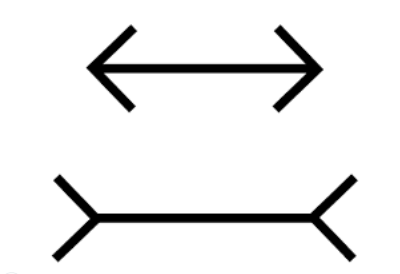
Muller Lyer Illusion
optical illusion, lines are same length but people think the second is longer because the branching lines are extending out