VLIII - Channel Flows
 Call Kai
 Learn
Learn Practice Test
 Spaced Repetition
 Match
Match Flashcards
 Knowt Play
1/22

There's no tags or description
Looks like no tags are added yet.
Name | Mastery | Learn | Test | Matching | Spaced | Call with Kai |
|---|
No analytics yet
Send a link to your students to track their progress
23 Terms
How can turbulence be modelled
as additional viscosity
how is turbulent viscosity calculated
q’*l
q magnification of fluctuation
Reynolds averages kinetic energy Production term importance
Production taken from mean flow and taken to fluctuations
Has HIT Production explain why
No, due to it being a dissipating flow (isotropic)
Different way of writing production term and significance of it
Subtraction of isotropic part of RST => only anisotropic flow states can have production in incompressible flows
Through what can production occur
Through the symmetric velocity-gradient tensor
Where is energy produced (production highest) round jet?
In the macro scale and at 0,6*r0,5, energy traveling downstream while staying in the middle
Where has the mean flow convection the highest energy round jet
In the middle
Which stress is dominant along the walls Channel flow
Viscous stress
why do Reynolds stresses disappear at the wall
due to no-slip condition (fluctuations are zero)
Where do Reynolds stresses dominate channel flow
In the middle of the channel
What does a higher Re Number lead to channel flow stresses
Viscous stresses fall of steeper
Reynolds stresses get larger in near wall region
Dominating parameters in near wall region channel flow
Viscosity
Wall shear stress
Whats the Friction reynolds number
Ratio between channel width and l+
What are wall units
y+
Ratio out of Wall distance and l+
whats l+
viscous lengthscale
ration out viscosity and friction velocity
Whats the friction velocity
sqrt(wall shear stress / density)
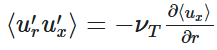
Explain eddy viscosity approach for turbulent jets
Simplified relation between Reynolds stress and mean velocity. Which are connected via eddy viscosity (turbulence viscosity)
Name two differences and similarities of laminar and turbulent channel flows
differences:
no Reynolds stress in laminar flow
lower maximum velocity for turbulence
similarities:
same control parameters
pressure gradient in x direction to drive flow
linear dependence of total stress on channel height
Name parameters necessary to fully describe turbulent channel flow. Explain universal parameters derived
Describe:
density
viscosity
channel height
wall shear stress or pressure gradient
Universal parameters:
friction velocity ut
viscous length scale l+
Friction Reynolds number Ret
dimensionless wall unit y+
Explain the concept of the universal law of the wall. Discuss which layers are introduced, their limits, and - if applicable - universal laws for the velocity.
Viscous sublayer: y+<5, universally computable dimensionless velocity u+=y+.
Buffer layer: 5<y+<30, dimensionless velocity not universally computable.
Logarithmic layer: y+>30, y/δ<0.3, universally computable dimensionless velocity u+=1/κlog(y+)+A.
Velocity-defect layer: y/δ>0.3, dimensionless velocity not universally computable.
Explain the behavior of the velocity fluctuations with decreasing wall distance. Discuss why wall modeling is in general a challenge for turbulence modeling.
Near the wall, u′ and w′ ∝ y, while v′ ∝ y². so fluctuations are mainly parallel to the wall (quasi-2D flow). Wall modeling is challenging because the wall strongly influences the Reynolds stresses, which turbulence models must capture accurately.
What is the criterion for the smallest cell size in a DNS of a turbulent boundary layer, and what is the criterion in a RANS simulation?
DNS: Kolmogorov scale must be resolved with a given number of cells (between 3 and 10)
RANS: y+=1 must hold at the center of the first cell at the wall, i.e., Δx=2y+.