Bio 2 Unit 4 Test
 Call Kai
 Learn
Learn Practice Test
 Spaced Repetition
 Match
Match Flashcards
 Knowt Play
1/103

Earn XP
Description and Tags
Contain information on Intro to Animals (ch 32), The Invertebrates, and Phylum Chordata (Ch 33-34)
Name | Mastery | Learn | Test | Matching | Spaced | Call with Kai |
|---|
No analytics yet
Send a link to your students to track their progress
104 Terms
1st Multicellularity requirement
Cell signaling
2nd Multicellularity requirement
Cell-to-cell connections
What does cell signaling pathways rely on?
pore-like proteins that provide connection b/w cells
What are animals cells anchored by?
adherence proteins
What do all animals contain?
connective tissue collagen
What type of nerve system does animals rely on?
simple nerve network, or more complex nervous system
What does simple nerve network, or more complex nervous system provide?
rapid control of cellular function, major organ systems, muscle contraction, reflexes
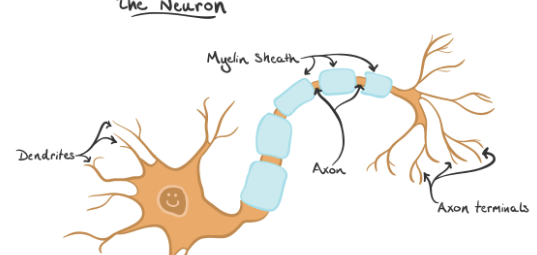
Neurons
generate minute electrical impulses called action potentials that rapidly spread from cell to cell
What happens when action potentials reach a chemical synapse?
they cause the release of Neurotransmitters (signaling chemicals)
Where do synapses lie?
Between 2 neurons or between a neuron and a particular tissue/organ (heart, muscle....)
What does the release of Neurotransmitters provide?
rapid & precise control of cells & tissues “downstream”
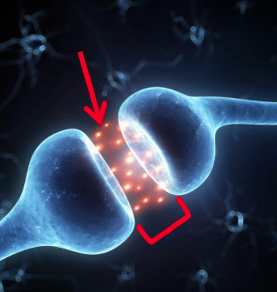
What does Neurotransmitters released do?
diffuse across tiny gap (synaptic cleft) & bind to membrane proteins of target cell triggering cellular response
What do lines of cells within animals do?
release chemical messengers called hormones, slower than the nervous system
What do hormones do?
drift through the body’s fluids (ex, blood) and can bind target cells with the proper type of receptor proteins
What do hormones control?
homeostasis of key internal variables & coordinate growth and reproduction
endocrine system
regulates hormonal control
What do animal cells lack?
Cell Walls, just have cell membranes
Embryonic tissue layers “Germ Layers”
formed during gastrulation and consist of three primary layers—ectoderm, mesoderm, and endoderm—which give rise to all tissues and organs
Tissue
groups of similar cells that act as a functional unit
Examples of tissue
Nervous tissue and muscle tissue with work together to allow body movement
1st Characteristic of Animals
Are motile at some point in the lifecycle
2nd Characteristic of Animals
Heterotrophic
3rd Characteristic of Animals
Digest food internally
What are the closets living relative of animals?
choanoflagellate protists
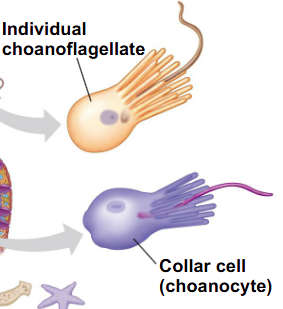
What animal cell and protist look similar?
Choanoflagellates and sponge choanocyte cells
What are animals characterized by?
Their body plan (set of morphological and developmental traits)
1st Type of Animal Body Plan
Symmetry
2nd Type of Animal Body Plan
Tissue layers
3rd Type of Animal Body Plan
Body cavities
4th Type of Animal Body Plan
Type of development
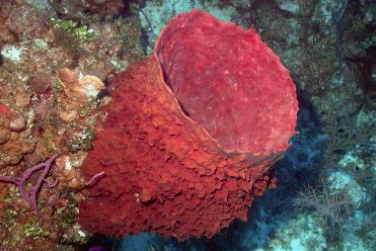
Asymmetrical
lack symmetry (irregular shape)
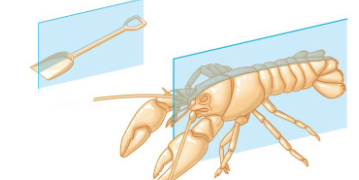
Bilateral symmetry
a body plan where an organism can be divided into identical left and right mirror-image halves along a single, central vertical plane
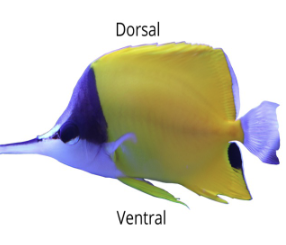
1st Trait of Bilateral Symmetrical Animals
Dorsal (top) and ventral (bottom) sides
2nd Trait of Bilateral Symmetrical Animals
Right and left sides
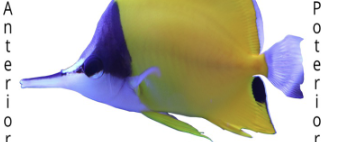
3rd Trait of Bilateral Symmetrical Animals
Anterior (front) and posterior (back) ends
4th Trait of Bilateral Symmetrical Animals
Many have sensory equipment (brain, eyes, etc.) at the anterior end
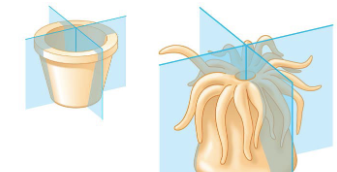
Radial symmetry
A object or animals that is divided into identical halves by multiple planes passing through the center
How do radial animals often move?
They are sessile or planktonic (drifting or weakly swimming)
How do bilateral animals often move?
actively and have a central nervous system
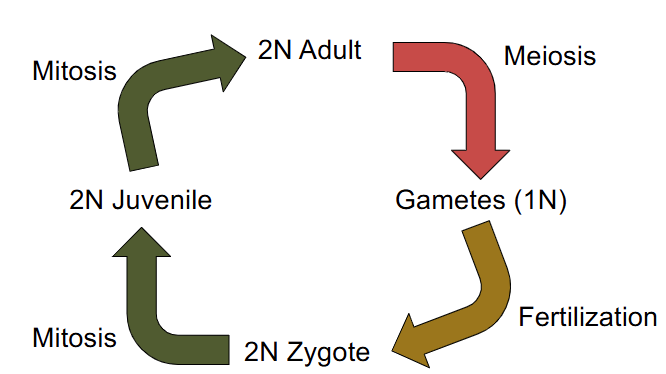
How do most animals reproduce?
sexually, with the diploid stage dominating the life cycle
1st Type of Asexual Reproduction in Animals
Mitosis produces an identical daughter bud
2nd Type of Asexual Reproduction in Animals
Fragmentation
What happens after egg fertilization?
the zygote undergoes rapid cell division called cleavage
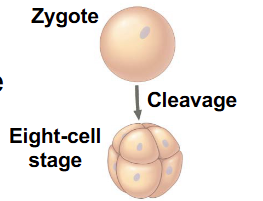
How does a zygote becomes a cleavage?
Via simple division
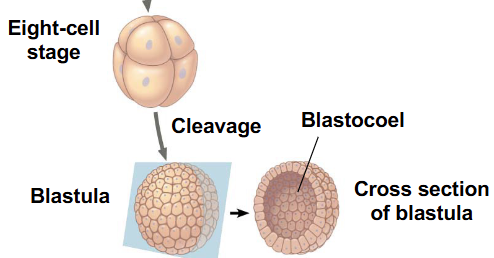
What does the cleavage turn into?
a multicellular, hollow blastula
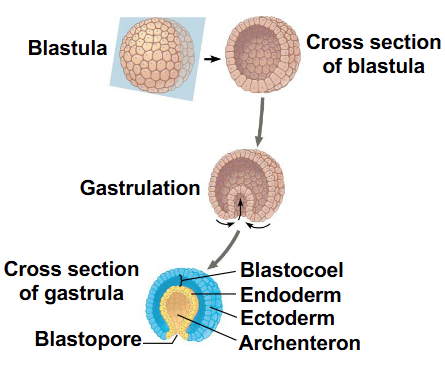
What happens to the blastula after it’s formed?
It undergoes gastrulation, forming a gastrula with different layers of embryonic tissues
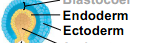
Ectoderm
germ layer covering the embryo’s surface (epidermis/skin, nervous tissue)
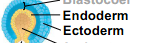
Endoderm
innermost germ layer that lines the developing digestive tube (archenteron) and gives rise to some organs (liver, lungs, etc.)
Diploblastic animals
only have ectoderm and endoderm
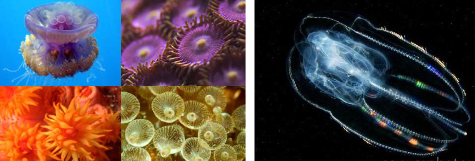
What animals are diploblastic?
Cnidarians and ctenophores
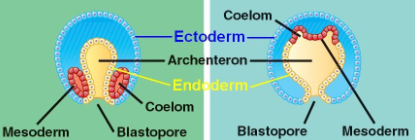
Triploblastic animals
have an additional middle tissue layer called mesoderm
What does the mesoderm do?
Fills the space between the ectoderm and endoderm and forms the muscles and some organs
What animals are triploblastic?
Any animal will bilateral symmetry
What does most triploblastic animals have?
A body cavity
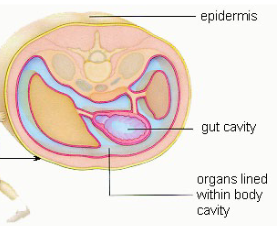
body cavity
Fluid filled space located between the digestive tract and the outer body wall
What is a “true” body cavity called?
coelom
What is the coelom derived from?
Mesoderm
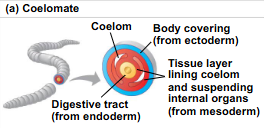
Coelomate animals
possess a “true” coelom
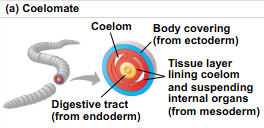
In coelomate animals, what does the tissue do?
surround the cavity and suspends internal organs
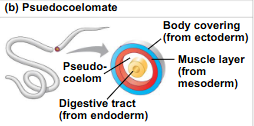
Pseudocoelomates
possess a body cavity bounded by mesoderm and endoderm, doesn’t completely surround the body cavity
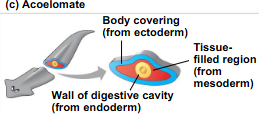
Acoelomates
lack a body cavity
1st Function of the body cavity
In soft-bodied animals, it can act as a hydrostatic skeleton
2nd Function of the body cavity
Cushions suspended organs, prevents internal injury
3rd Function of the body cavity
Enables internal organs to grow and move independently of the outer body wall
Protostomes
blastopore becomes the mouth
Deuterostomes
blastopore becomes the rectum
1st Type of Digestive System
None
2nd Type of Digestive System
gastrovascular cavity
3rd Type of Digestive System
complete digestive tract
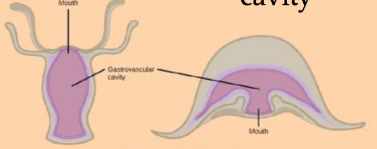
gastrovascular cavity
Incomplete digestive system, 1 opening
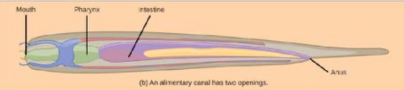
complete digestive tract
Separate mouth and rectum, allows for cephalization of parts
1st Type of coelomate circulatory system
Open circulatory system
2nd Type of coelomate circulatory system
Closed circulatory system
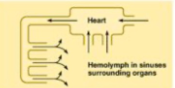
Open circulatory system
blood pumped through vessels that open into body cavities, organs bathed in hemolymph
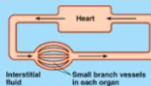
Closed circulatory system
blood remains enclosed in vessels
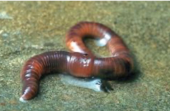
segmentation
Repetition of body parts along the length of the body
Are acoelomates and pseudocoelomates segmented?
No
Are coelomates segmented?
They can or can’t be
Invertebrates
animals that lack a backbone
What animals belong to phylum porifera?
Sponges
Where are sponges found?
marine (mostly) or fresh water
What is the symmetry of sponges?
Asymmetrical
What is the tissue type of sponges?
None, they lack true tissue
Adult sponges’ level of motility
Sessile
Larval sponges level of motility
Mobile
Sponge Body Plan
consist of a gelatinous internal layer and various unique cells
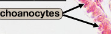
Choanocytes (flagellated collar cells)
generate a water current through the sponge and ingest suspended food
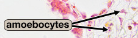
Amoebocytes
perform several functions including digestion, nutrient dispersal, and production of spicules or spongin (collagen)
supportive skeletal fibers of sponges
function to maintain shape and/or for protection
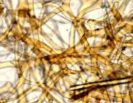
spongin
made of collagen
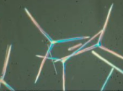
spicules
made of CaCO3 or silica (SiO2), needle-shaped, 1-6 rays
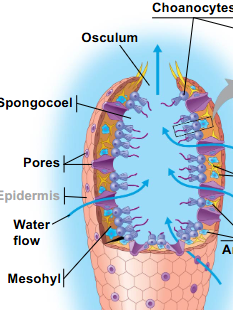
How do sponges feed?
Filter feeders, Capture food particles suspended in the water that passes through their body
1st Class of Sponges
Class Calcarea
2nd Class of Sponges
Class Hexactinellida
3rd Class of Sponges
Class Demospongiae
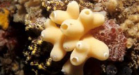
Class Calcarea
spongin/CaCO3 spicules
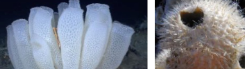
Class Hexactinellida
glass sponges, silica spicules

Class Demospongiae
Most lack spicules, often used as bath sponges