Ch. 48 Pt. 1-2 (Animal Neurons, Synapses, & Signaling)
 Call Kai
 Learn
Learn Practice Test
 Spaced Repetition
 Match
Match Flashcards
 Knowt Play
1/21

Earn XP
Description and Tags
action potential type stuff & neurons
Name | Mastery | Learn | Test | Matching | Spaced | Call with Kai |
|---|
No analytics yet
Send a link to your students to track their progress
22 Terms
some neurons can conduct speeds up to________
120 m/s (275 mph)
Peripheral Nervous System (PNS) has which neurons?
1) Sensory neurons(INPUT) →transmit info abt external stimuli (touch or smell)
2) motor neurons(OUTPUT) →transmit signals to muscle cells to contract
Central Nervous System (CNS) has what neurons?
interneurons→lots of dendrites (integration=analysis & interpretation of sensory input)
flow of information processing
sensory input(PNS)→CNS(integration)→motor output(PNS)→effector
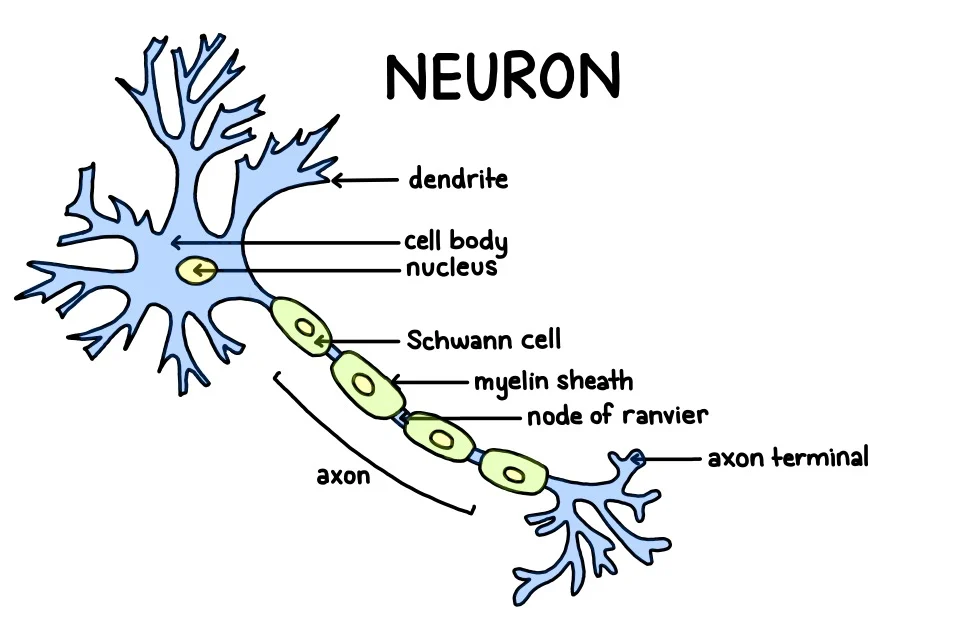
know these structures: dendrites, cell body, nucleus, axon hillock, axon, synapse, synaptic terminal
do u know it?
pre-synaptic cell vs. post synaptic cell
pre-synaptic cell→sends the neurotransmitters across synapse
post-synaptic cell→ receives the neurotransmitter signals
examples of glia
these are supporting cells of neurons
1) astrocytes
2) microglia
3) Oligodendrocytes (CNS)→create myelin sheath around axon
4) Schwann Cells (PNS) →create myelin sheath around axon
node of ranvier
where signals “jump” or saltate from 1 node to another
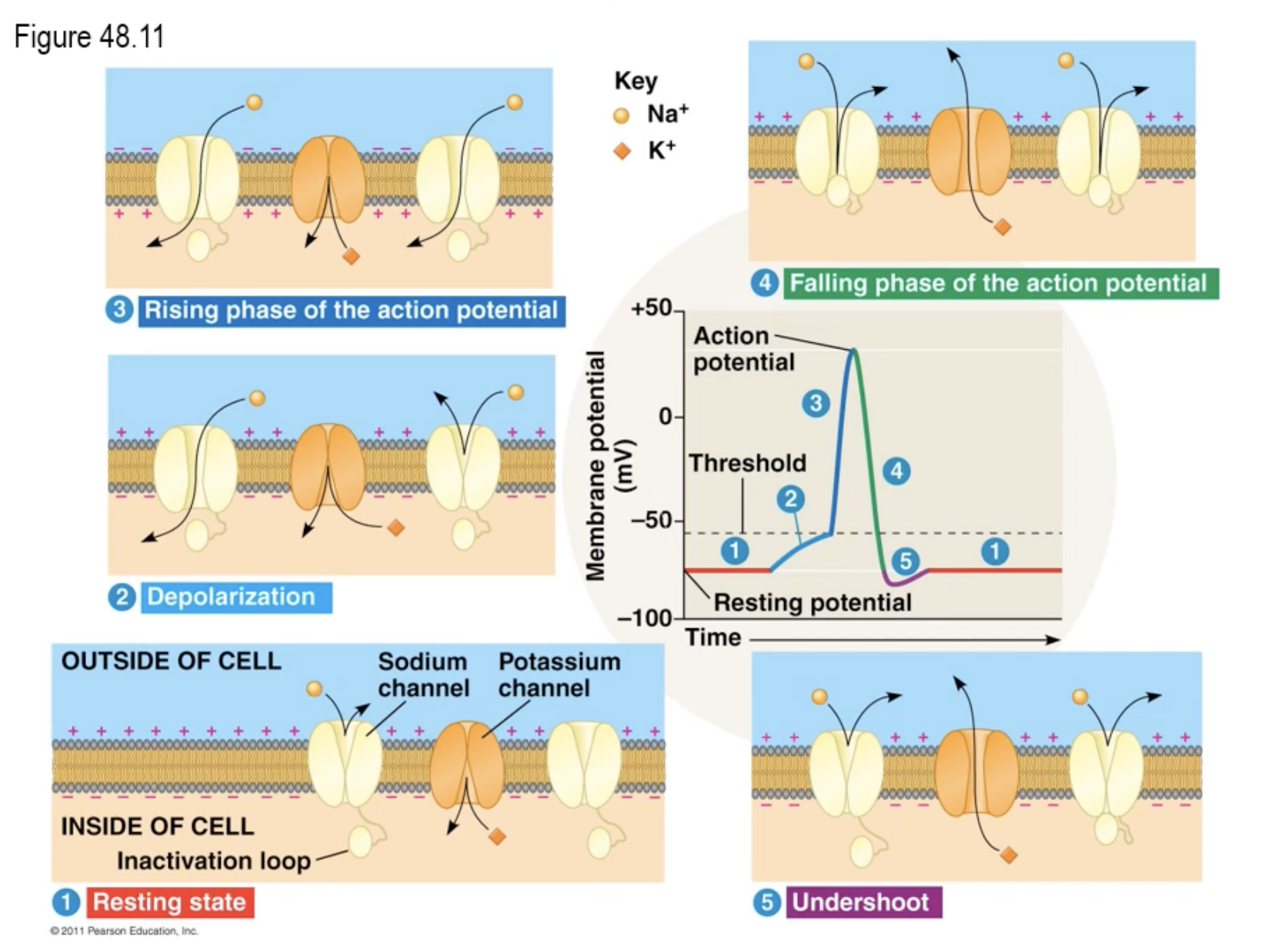
Resting Potential membrane potential(mV) & distribution of ions
-70 mV (-60 to -80)
-more K+ ions inside membrane & more Na+ ions outside membrane
(also Cl- ions outside & proteins inside)
why is it that a neuron is more negative(-) inside & more positive(+) outside) during resting potential?
there are more ungated channels for K+ to diffuse outside than Na+ channels=most positive ions going out=more negative inside
ALL GATED CHANNELS ARE CLOSED
what kind of diffusion is going on in a neuron ALWAYS
passive diffusion of Na+ into cell & K+ ions out the cell
what does Sodium-Potassium Pump do?
active transport that requires ATP
—pumps 3 Na+ out & 2 K+ in to maintain concentration gradient =always more K+ inside than outside during resting potential
what happens during graded potential & what are the 2 types?
specific GATED channels will open when stimulated
1) depolarization
2) hyperpolarizaton
are graded potential actual nerve signals?
NO (only action potential), but they are major effect on generation of nerve signals
what causes depolarization & what happens as a result? its membrane potential?
a stimulus causes Na+ gated channels to open & flow into cell=inside is more positive
-56 to -70mV
what causes hyperpolarization & what happens as a result? its membrane potential?
a stimulus causes Cl- gated channels to open & flow into cell=inside more negative
-80 mV ish
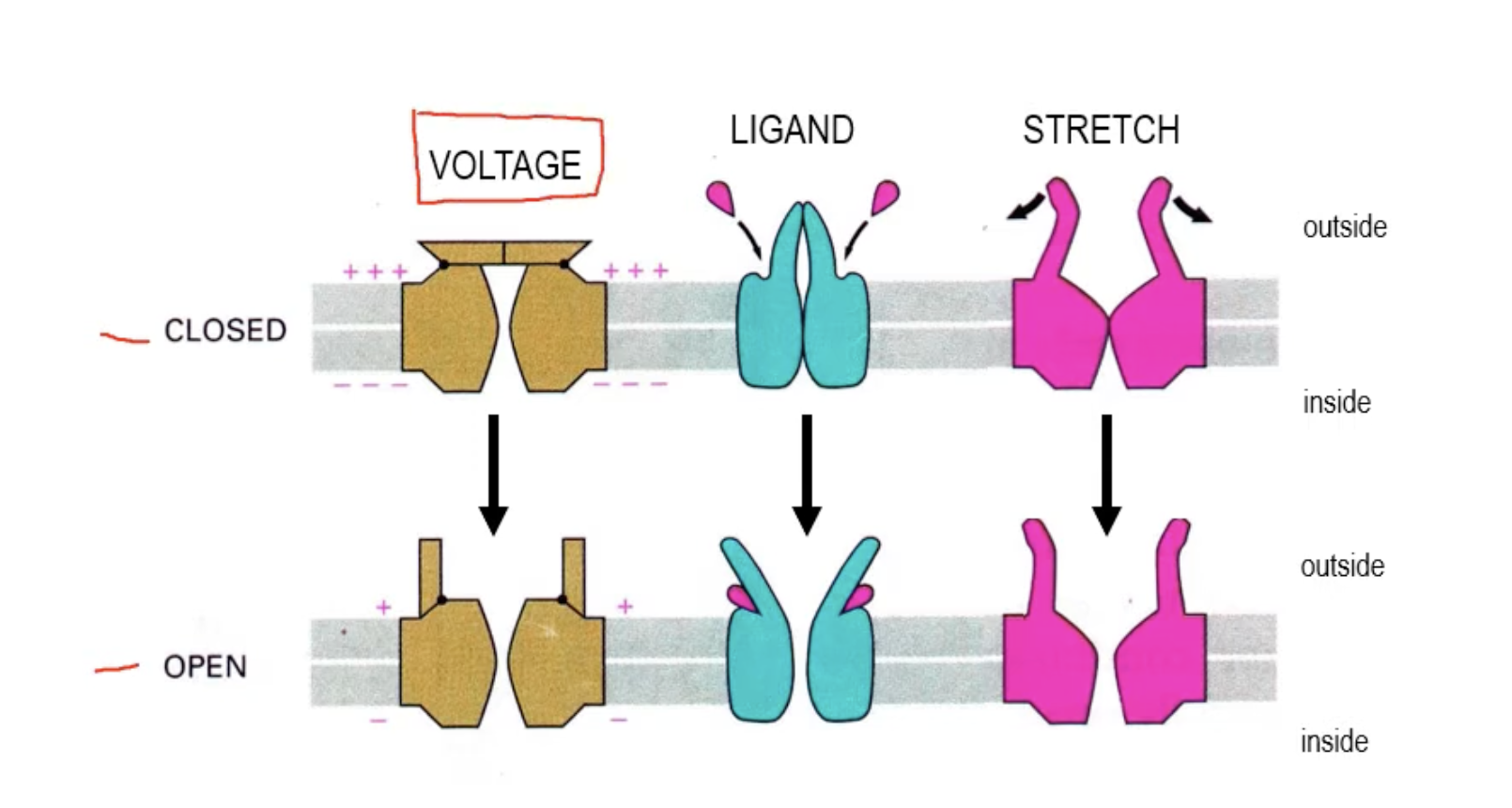
types of GATED ion channels
1) stretch-gated channels→open when membrane is mechanical
2) ligand-gated ion channels→open/close in response to neurotransmitter
3) voltage-gated ion channels→respond to membrane potential
threshold potential to reach action potential?
-55 mV
what causes action potential & what happens as a result?
once threshold potential(-55mV) is hit, a WHOLE BUNCH of Na+ channels will open & flow inside cell=inside more positive
(nerve signal occurs)
sequence of events after resting potential?
resting potential→depolarization→rising phase of action potential→falling phase of action potential→hyperpolarization
(undershoot)→back to resting potential
what happens during the rising phase of action potential
K+ channels are closed & bunch of Na+ channels are open
what happens during the falling phase of action potential
K+ channels reopen & Na+ channels start to close