Purines
 Call Kai
 Learn
Learn Practice Test
 Spaced Repetition
 Match
Match Flashcards
 Knowt Play
1/71

There's no tags or description
Looks like no tags are added yet.
Name | Mastery | Learn | Test | Matching | Spaced | Call with Kai |
|---|
No analytics yet
Send a link to your students to track their progress
72 Terms
What is a de novo anabolic pathway in which the purine ring is assembled stepwise directly onto a ribose-phosphate scaffold provided by PRPP (5-phosphoribosyl-1-pyrophosphate), rather than being synthesized as a free base first
Purine nucleotide synthesis
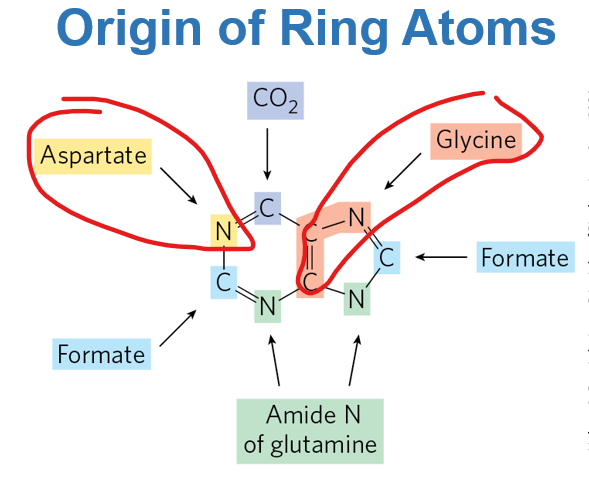
The atoms of the purine ring are derived from multiple sources, including amino acids——- ___________ which donate nitrgoen atoms
glutamine and aspartate
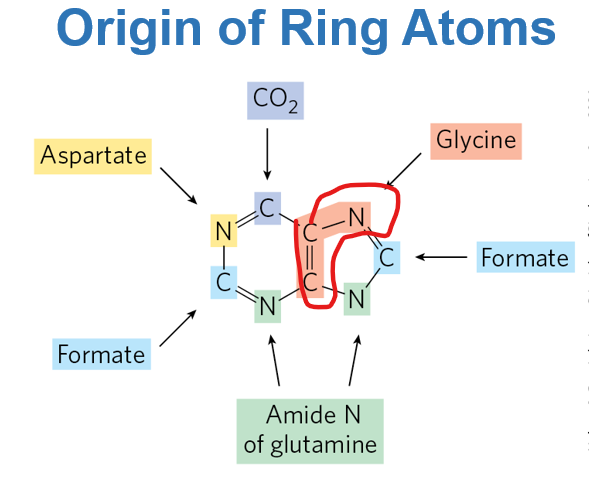
The atoms of the purine ring are derived from multiple sources, including amino acids——- gluatmine and aspartate donate nitrgoen atoms, while _______ contributes both carbon and nitrogen and carbon units from formyl-tetrahydrofolate and Co2
glycine
This highly energy-intensive process produces inosine monophosphate (IMP), the first fully formed purine nucleotide, which then serves as: `
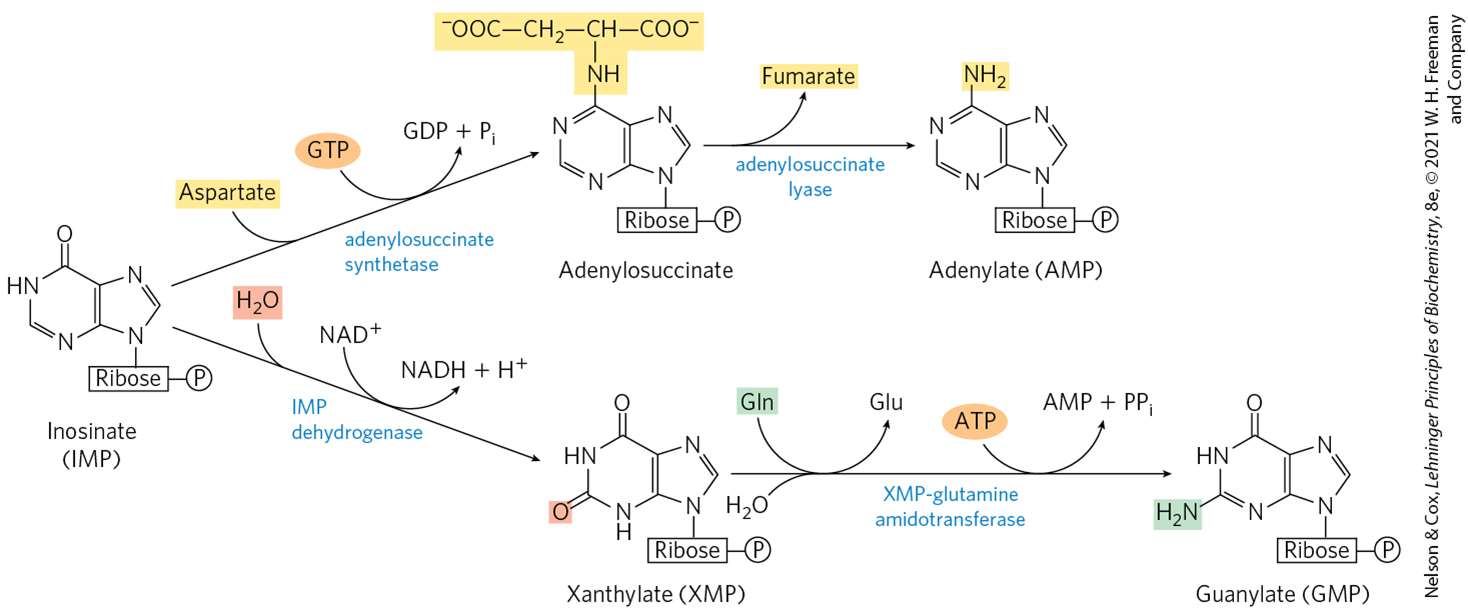
A branch point for the synthesis of adenosine monophoshpahte (AMP) and guanosine monophosphate (GMP)
This highly energy-intensive process produces inosine monophosphate (IMP), the first fully formed purine nucleotide, which then serves as a branch point for the synthesis of adenosine monophosphate (AMP) and guanosine monophosphate (GMP).
What happens to these nucleotides
These nucleotides are subsequently phosphorylated by ATP-dependent kinases to generate their diphosphate and triphosphate forms (ADP/ATP and GDP/GTP
This highly energy-intensive process produces inosine monophosphate (IMP), the first fully formed purine nucleotide, which then serves as a branch point for the synthesis of adenosine monophosphate (AMP) and guanosine monophosphate (GMP).
These nucleotides are subsequently phosphorylated by ATP-dependent kinases to generate their diphosphate and triphosphate forms (ADP/ATP and GDP/GTP)
What do these function as
function as essential energy carriers and substrates for DNA and RNA synthesis
Because de novo purine synthesis requires significant energy investment and multiple enzymatic steps what do cells utilize?
utilize the purine salvage pathway to recycle free bases by attaching them to PRPP, thereby conserving energy.
Purine nucleotide biosynthesis is a metabolic pathway that allows cells to construct purine nucleotides from scratch
What is this process called?
de novo synthesis
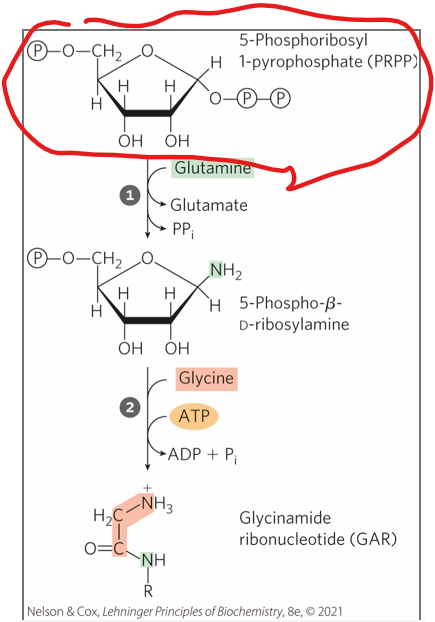
Purine nucleotide biosynthesis is a metabolic pathway that allows cells to construct purine nucleotides from scratch, a process called de novo synthesis.
Unlike pyrimidine biosynthesis ( via de novo synthsis) where the nitrogenous base is synthesized first and then attached to a sugar-phosphate molecule, ______
What does purine de novo biosynthesis start with
purine biosynthesis starts with PRPP (5-phosphoribosyl-1-pyrophosphate
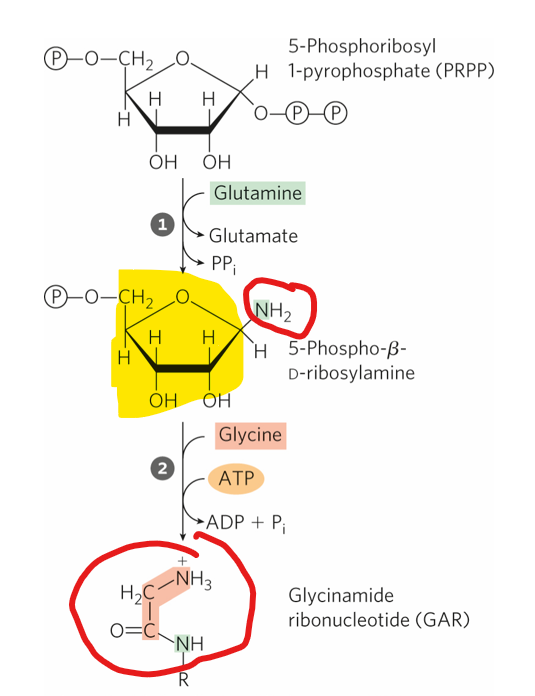
Unlike pyrimidine biosynthesis, where the nitrogenous base is synthesized first and then attached to a sugar-phosphate molecule, purine biosynthesis starts with PRPP (5-phosphoribosyl-1-pyrophosphate).
PRPP already contains a ribose sugar with an attached phosphate group
What is important to know about the purine BASE
it is built directly onto the ribose atom by atom
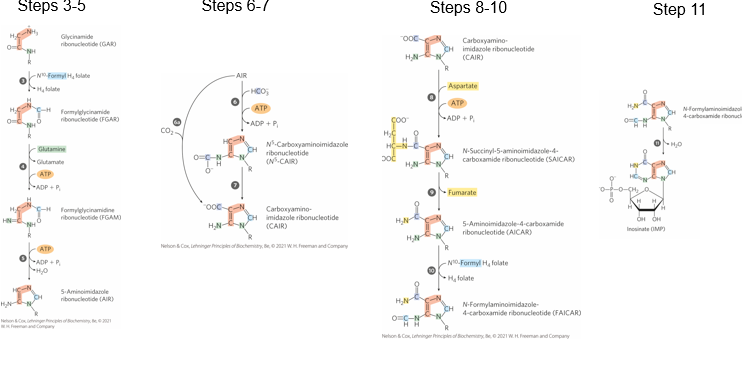
PRPP already contains a ribose sugar with an attached phosphate group, and the purine base is built directly onto the ribose, atom by atom.
What does this mean in regards to the two-ring structure of purines ( the fused imidazole-pyrimidine ring)
it is constructed in a stepwise manner
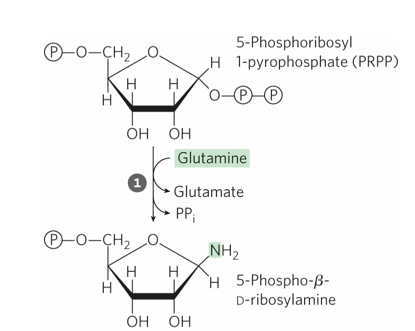
Unlike pyrimidine biosynthesis, where the nitrogenous base is synthesized first and then attached to a sugar-phosphate molecule,
purine biosynthesis starts with PRPP (5-phosphoribosyl-1-pyrophosphate).
PRPP already contains a ribose sugar with an attached phosphate group, and the purine base is built directly onto the ribose, atom by atom.
This means the two-ring structure of purines (the fused imidazole-pyrimidine ring) is constructed in a stepwise manner
What is the first step within this stepwise manner?
the attachment of nitrogen from glutamine to carbon 1 of PRPP
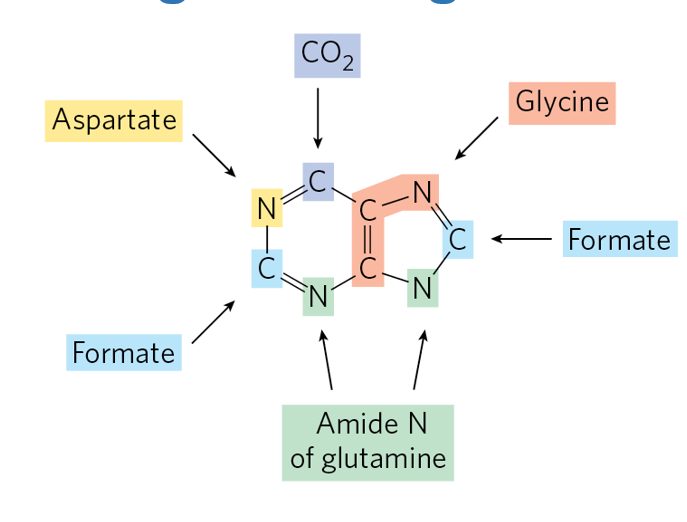
Unlike pyrimidine biosynthesis, where the nitrogenous base is synthesized first and then attached to a sugar-phosphate molecule (PRPP), purine biosynthesis starts with PRPP (5-phosphoribosyl-1-pyrophosphate).
PRPP already contains a ribose sugar with an attached phosphate group, and the purine base is built directly onto the ribose, atom by atom.
This means the two-ring structure of purines (the fused imidazole-pyrimidine ring) is constructed in a stepwise manner beginning with the attachment of nitrogen from glutamine to carbon 1 of PRPP.
Where do other atoms in the ring come from, overall?
amino acids and single carbon donors
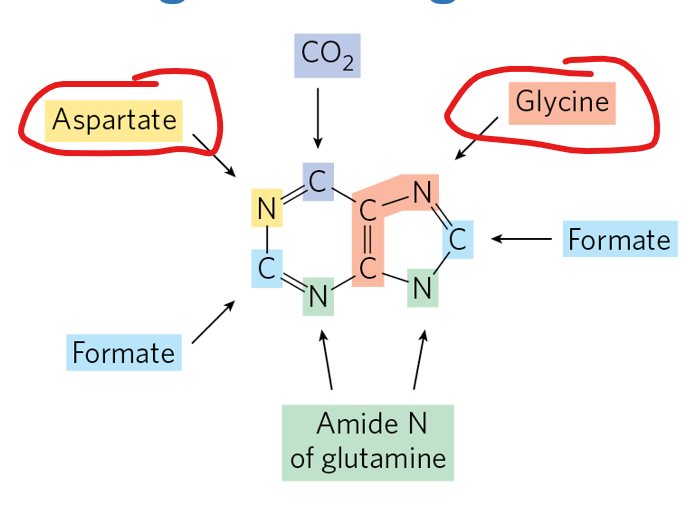
Unlike pyrimidine biosynthesis, where the nitrogenous base is synthesized first and then attached to a sugar-phosphate molecule, purine biosynthesis starts with PRPP (5-phosphoribosyl-1-pyrophosphate).
PRPP already contains a ribose sugar with an attached phosphate group, and the purine base is built directly onto the ribose, atom by atom.
This means the two-ring structure of purines (the fused imidazole-pyrimidine ring) is constructed in a stepwise manner beginning with the attachment of nitrogen from glutamine to carbon 1 of PRPP.
Other atoms in the ring come from amino acids :________ as well as single carbon donors like ______
What are the amino acids
glycine and aspartate
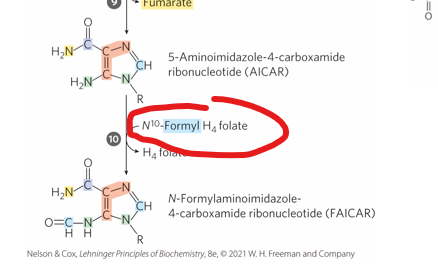
Unlike pyrimidine biosynthesis, where the nitrogenous base is synthesized first and then attached to a sugar-phosphate molecule, purine biosynthesis starts with PRPP (5-phosphoribosyl-1-pyrophosphate).
PRPP already contains a ribose sugar with an attached phosphate group, and the purine base is built directly onto the ribose, atom by atom.
This means the two-ring structure of purines (the fused imidazole-pyrimidine ring) is constructed in a stepwise manner beginning with the attachment of nitrogen from glutamine to carbon 1 of PRPP.
Other atoms in the ring come from amino acids :glycine and aspartate as well as single carbon donors like _________
What is an example of a single carbon donor?
N10-formyl tetrahydrofolate
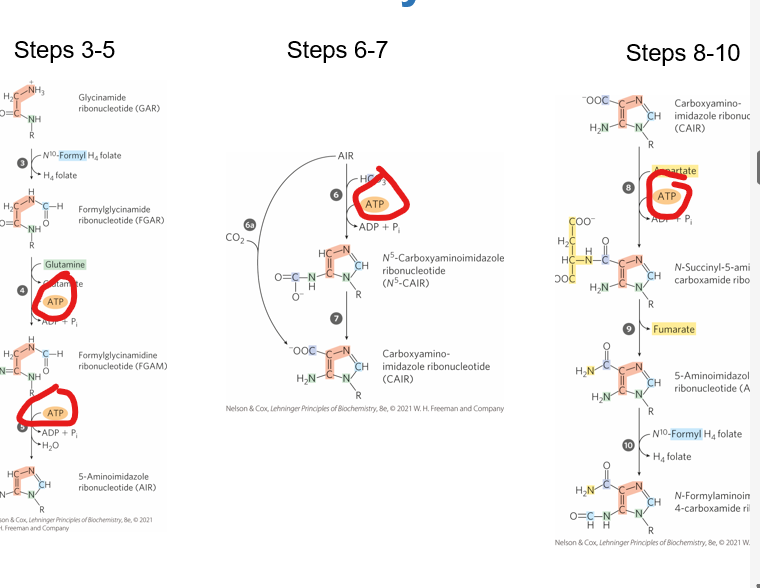
What is the relevence of energy in relation to the purine synthesis pathways?
it is energetically expensive, requiring multiple ATP molecules
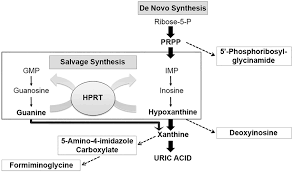
Due to the purine synthesis de novo pathway being energetically expensive and requring multiple ATP molecules, what does the cell rely on?
the purine salvage pathway to recycle pre-exsisting bases instead of always synthesizing them de novo
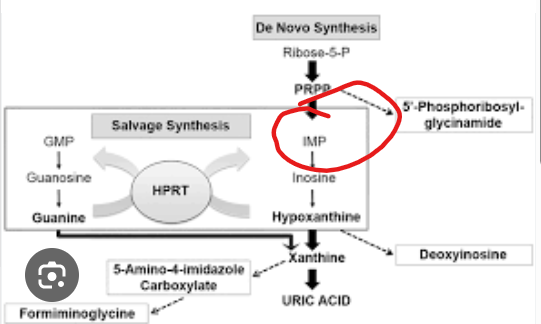
The de novo purine synthesis pathway is long, involving many intermediate steps before the first complete purine nucleotide is formed.
What is the name of the first,complete purine nucleotide ?
inosine monophosphate (IMP)
The purine de novo synthesis pathway is long, involving many intermediate steps before the first complete purine nucleotide, inosine monophosphate (IMP), is formed
What happens in the early steps?
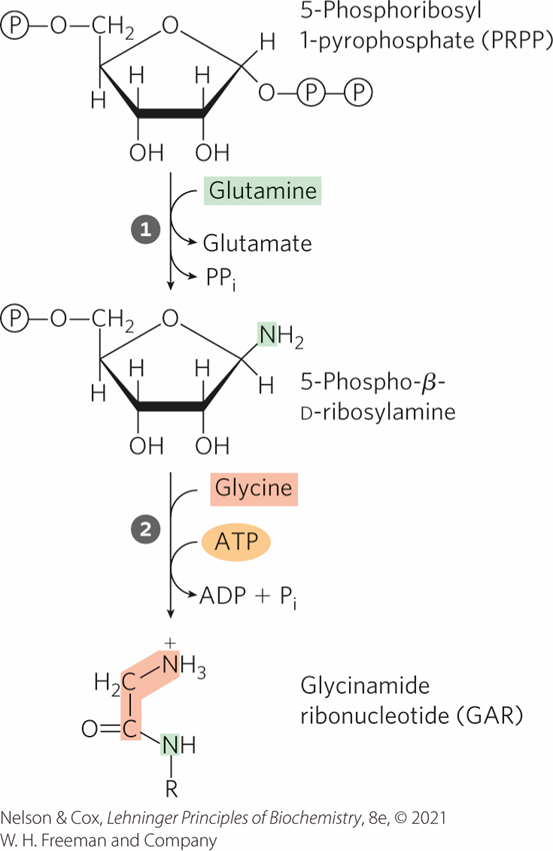
PRPP is aminated by glutamine, adding the first nitrogen, followed by the addition of atoms from glycine, formyl-tetrahydrofolate , and other donors to progressively build the two ring structure
The purine synthesis pathway is long, involving many intermediate steps before the first complete purine nucleotide, inosine monophosphate (IMP), is formed.
In the early steps, PRPP is aminated by glutamine, adding the first nitrogen, followed by the addition of atoms from glycine, formyl-tetrahydrofolate, and other donors to progressively build the two-ring purine structure
While many steps occur, what are they 3 main takeaways
the pathway requires significant energy in the form of ATP
nitrogen comes from amino acids
single-carbon units are added via tetrahydrofolate derivative (N^10- FormylH4)
The purine synthesis pathway is long, involving many intermediate steps before the first complete purine nucleotide, inosine monophosphate (IMP), is formed.
In the early steps, PRPP is aminated by glutamine, adding the first nitrogen, followed by the addition of atoms from glycine, formyl-tetrahydrofolate, and other donors to progressively build the two-ring purine structure
We are going to individually repeat the 3 main takeaways:
What does the pathway require ?
significant energy in the form of ATP
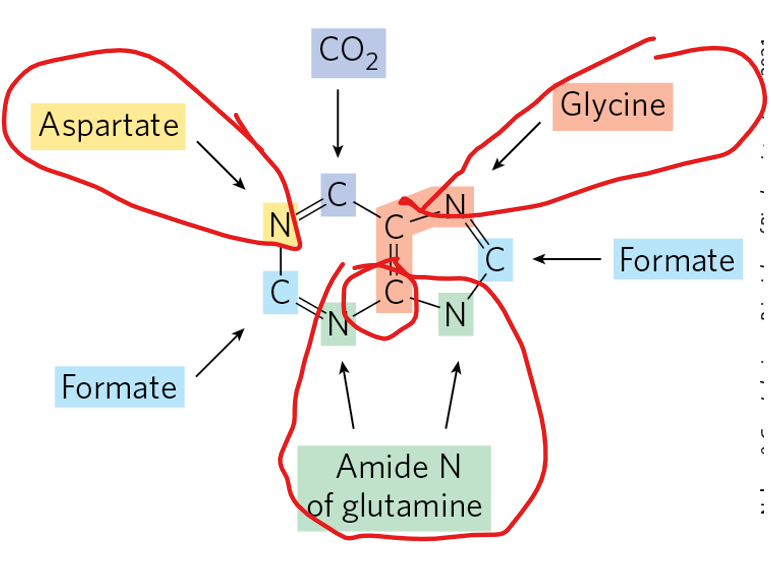
The purine synthesis pathway is long, involving many intermediate steps before the first complete purine nucleotide, inosine monophosphate (IMP), is formed.
In the early steps, PRPP is aminated by glutamine, adding the first nitrogen, followed by the addition of atoms from glycine, formyl-tetrahydrofolate, and other donors to progressively build the two-ring purine structure
We are going to individually repeat the 3 main takeaways:
Where does nitrogen come from?
amino acids
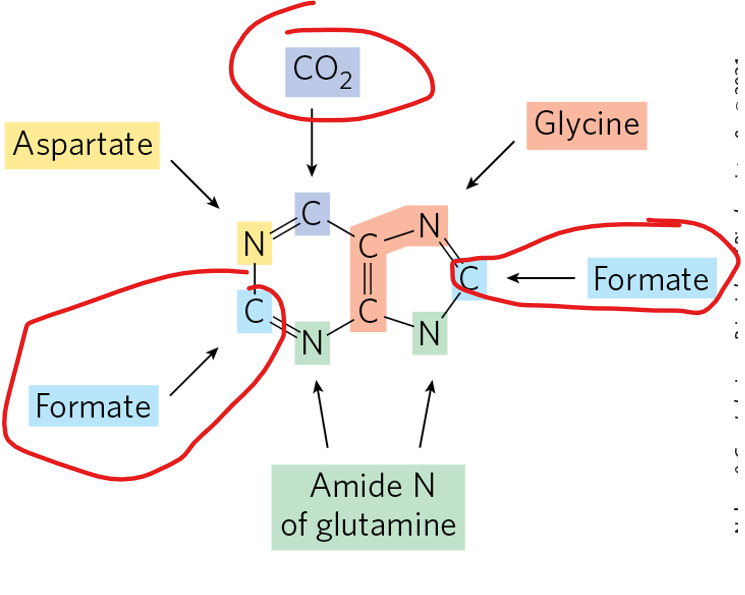
The purine synthesis pathway is long, involving many intermediate steps before the first complete purine nucleotide, inosine monophosphate (IMP), is formed.
In the early steps, PRPP is aminated by glutamine, adding the first nitrogen, followed by the addition of atoms from glycine, formyl-tetrahydrofolate, and other donors to progressively build the two-ring purine structure
We are going to individually repeat the 3 main takeaways:
How are single carbon units added
via tetrahydrofolate derivatives and Co2
Why is step 11 of the formation of IMP critical?
this step actually PRODUCES IMP - the first nucleotide with a fully formed purine base
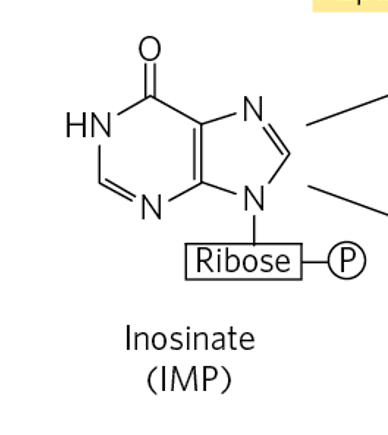
What does IMP contain that is essential to purines and retains the ribose-phosphate group from PRPP
the fused ring system
What is the first enzyme of the IMP pathway
glutamine-PRPP amidotransferase
what does glutamine- PRPP amidotransferase do
it is the first step in the IMP pathway and it catalyzes the transfer of NH3
What is the last enzyme of the biosynthesis of IMP
IMP synthase
What does IMP synthase do
it catalyzes the formation of IMP
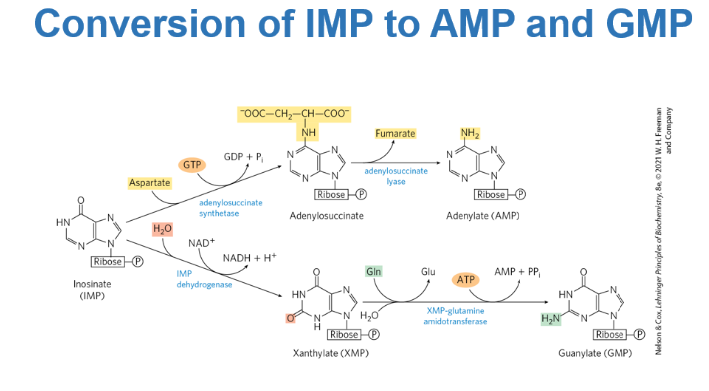
What happens once IMP in synthesized
it acts as a central intermediate at a “fork in the road”
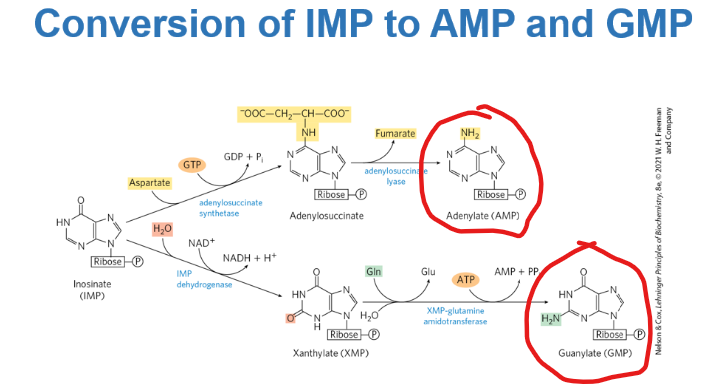
What can cells do from IMP
cells can produce either adenosine monophosphate ( AMP) or guanosine monophosphate (GMP)
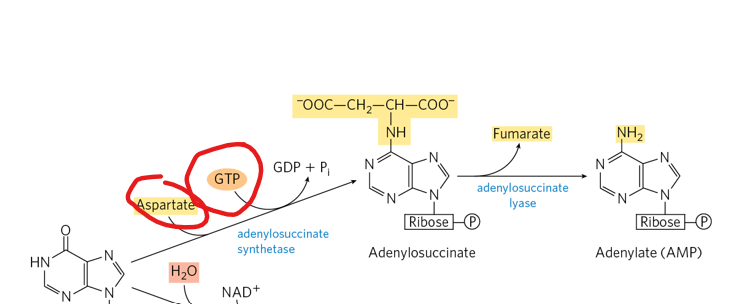
From IMP what happens if a cell chooses to convert to AMP
it requires aspartate as the nitrogen donor and GTP as the energy source
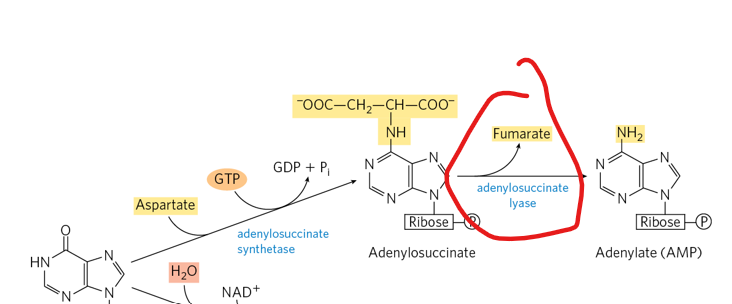
If I decide to convert to AMP from IMP what does this process release as a byproduct
fumarate
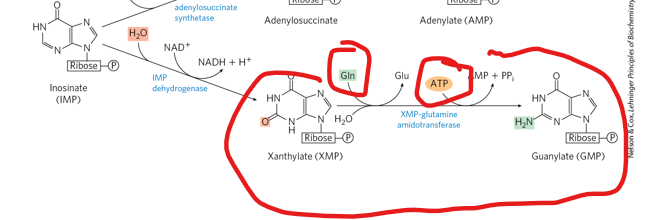
What does the conversion to GMP from IMP require
glutamine as the nitrogen donor, ATP as energy, and a redox reaction via the intermediate
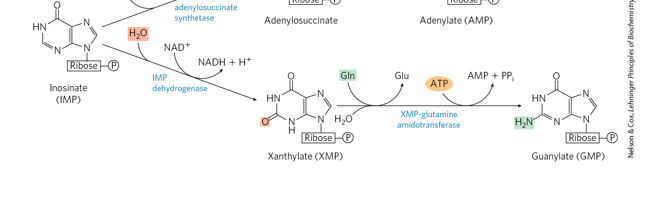
What is the intermediate when converting from IMP to GMP
xanthosine monophosphate (XMP)
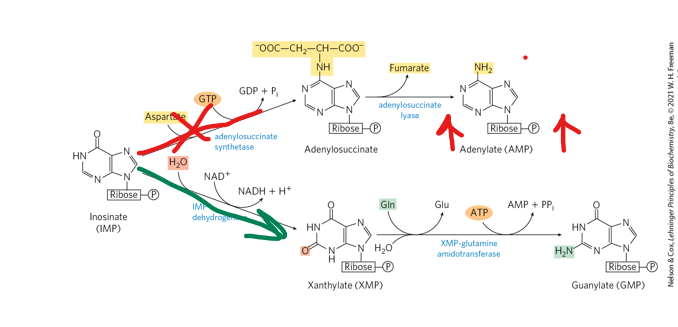
How are the reaction of conveting to AMP from IMP regulated
AMP inhibits its own synthesis from IMP, directing IMP towards GMP and GMP similarly inhibits its own synthesi sby redirecting IMP to AMP - ensuring a balacned production of purines and avoiding excess AMP or GMP
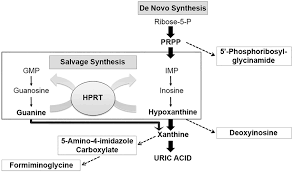
Because de novo purine synthesis is energy-intensive, what do cells use to recycle bases from degraded nucleotides
purine salvage pathway
What does the purine salvage pathway allow the cell to do
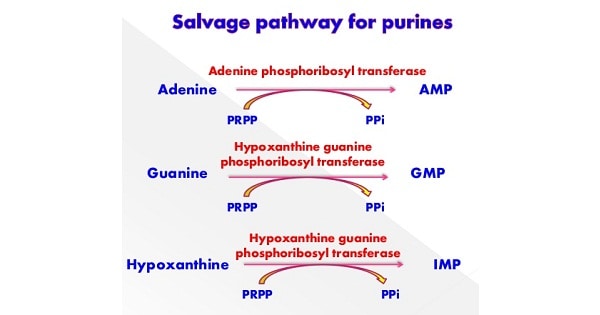
take free purine bases from degredation and attach them back to PRPP, forming nucleotides without having to rebuild the base from scratch
What is an example of the purine salvage pathways in which - the cell takes free purine bases from the breakdown of nucleotides (DNA,RNA,ATP,GTP) and attach them back to PRPP, forming nucleotides without rebuilding the base from scratch.
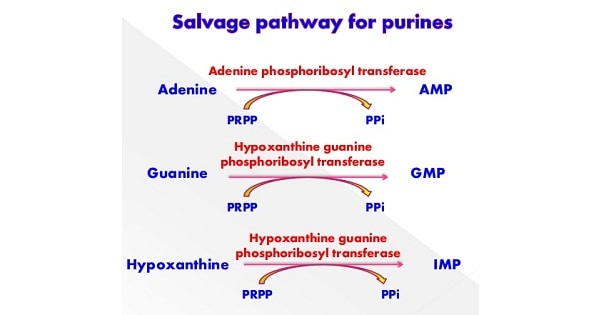
Use guanine as an example
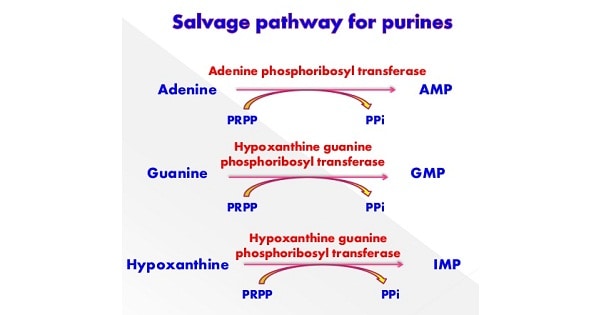
guanine can react with PRPP via HGPRT (hypoxanthine-guanine phosphoribosyltransferase) to form GMP.
Because de novo purine synthesis is energy-intensive, cells use the purine salvage pathway to recycle bases from degraded nucleotides.
Salvage allows the cell to take free purine bases and attach them back to PRPP, forming nucleotides without rebuilding the base from scratch.
For example, guanine can react with PRPP via HGPRT (hypoxanthine-guanine phosphoribosyltransferase) to form GMP.
What can adenine do in a similar fashion?
it can either be deaminated to hypoxanthine ( via adenine deaminase) , then salvaged to IMP with HGPRT
or
directly converted to AMP via APRT ( adenine phosphoribosyltransferase)
What is the purine salvage pathway most crucial in
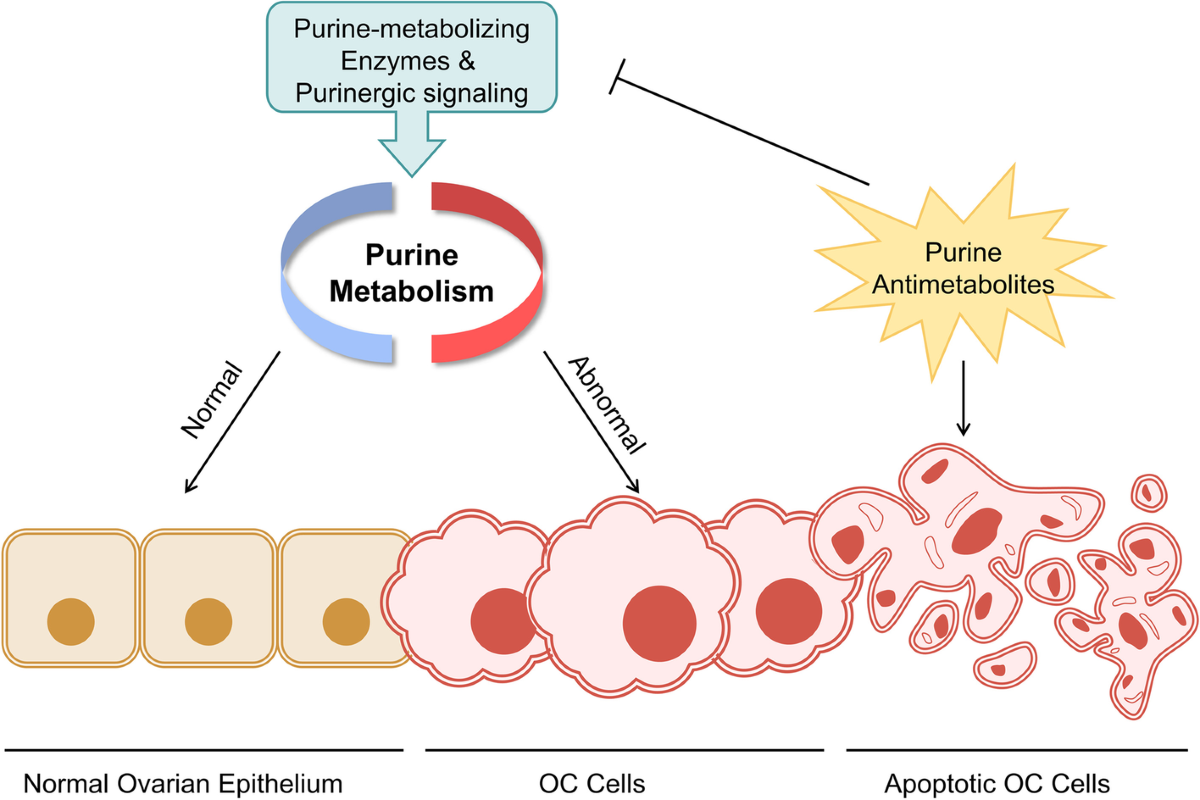
rapidly dividing cells
The purine salvage pathway is most crucial in rapidly dividing cells- what are some examples of cells that it divides
immune cells and liver cells- this is because it acts as a highly efficient recycling system to meet the massive demand for DNA/RNA building blocks, saving significant energy and time compared to de novo synthesi
Why is the salvage pathway crucial in rapidly dividing cells
becasue it saves energy while maintaining nucleotide pools
what can defects in the salvage pathway can lead to
severe metabolic diseases due to the accumulation of free purine bases.- like cancer
By not being able to use those free bases and place them directly on top of pyrimidine, they accumlate
After synthesis or salvage of nucleoside monophosphates (IMP, AMP, GMP) , what do cells do with them
convert them into diphosphates and triphophates
Why does the cell convert the nucleotide monophosphates (IMP , AMP, GMP) to diphosphates and triphosphates (ATP and GTP)
these are the active forms used for RNA and DNA synthesis; ATP is energy currency and DNA and RNA synthesis and GTP is for protein synthesis and signaling
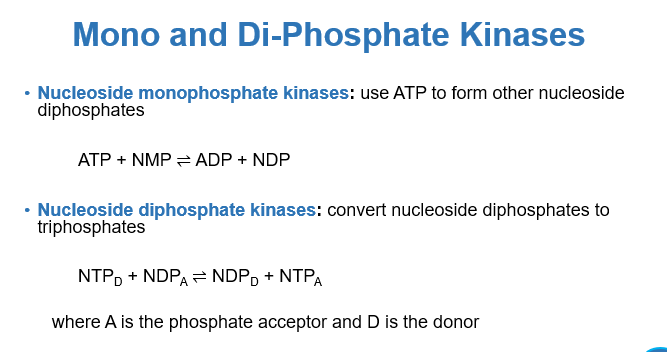
which enzyme is used to go from monophosphate to diphosphate
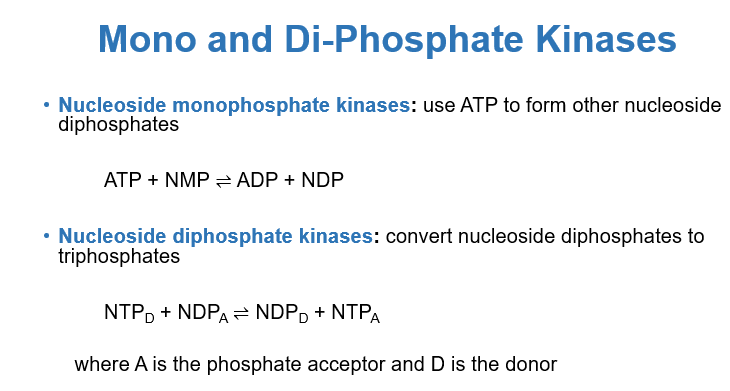
nucleoside monophosphate kinases
which enzymes is used to go from diphosphate to triphosphate
nucleoside diphosphate kinases
Converting monophosphates to diphosphates to triphosphates generally require ATP as the phsophate donor, making it common to all nucleotides
what is this function called
housekeeping function
After synthesis or salvage of nucleoside monophosphates (IMP, AMP, GMP), cells convert these into diphosphates and triphosphates, which are the active forms used for RNA and DNA synthesis.
This conversion uses nucleoside monophosphate kinases to go from monophosphate to diphosphate and nucleoside diphosphate kinases to go from diphosphate to triphosphate.
Each of these steps generally requires ATP as the phosphate donor, and this is a housekeeping function common to all nucleotides.
What is the impact of this
AMP and GMP can be phosphorylated to ATP and GTP, providing the cell with the high-energy molecules needed for nucleic acid synthesis and other cellular processes.
To synthesize DNA, what must the ribose sugar of nucleotides must be converted into
deoxyribose
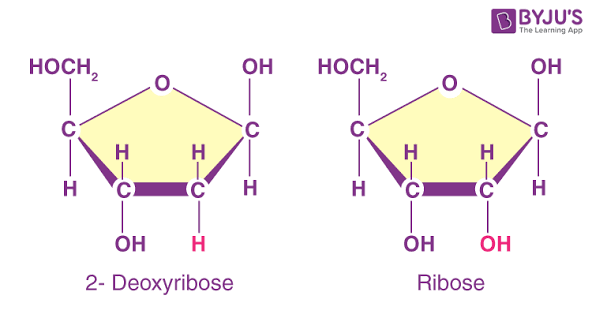
To synthesize DNA, the ribose sugar of nucleotides must be converted into deoxyribose.
What enzyme is repsonsible for this?
ribonucleotide reductase
What does ribonucleotide reductase do
converts ribonucleoside diphosphates into deoxyribonucleoside diphosphates (e.g., ADP → dADP).
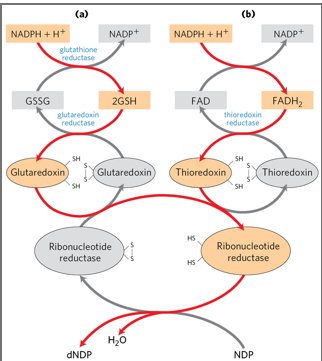
To synthesize DNA, the ribose sugar of nucleotides must be converted into deoxyribose.
This is done by ribonucleotide reductase, which converts ribonucleoside diphosphates into deoxyribonucleoside diphosphates (e.g., ADP → dADP).
What does this enzyme require to function
reducing equivalents
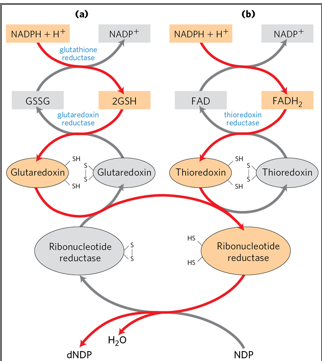
To synthesize DNA, the ribose sugar of nucleotides must be converted into deoxyribose.
This is done by ribonucleotide reductase, which converts ribonucleoside diphosphates into deoxyribonucleoside diphosphates (e.g., ADP → dADP).
The enzyme requires reducing equivalents to function
What are these reducing equivalents derived from
NADPH
To synthesize DNA, the ribose sugar of nucleotides must be converted into deoxyribose.
This is done by ribonucleotide reductase, which converts ribonucleoside diphosphates into deoxyribonucleoside diphosphates (e.g., ADP → dADP).
The enzyme requires reducing equivalents to function, which are ultimately dervied from NADPH and passed through intermediates
What are the intermediates called
glutaredoxin or thioredoxin
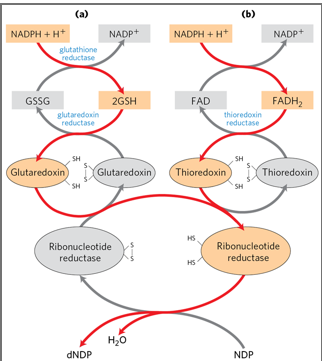
To synthesize DNA, the ribose sugar of nucleotides must be converted into deoxyribose.
This is done by ribonucleotide reductase, which converts ribonucleoside diphosphates into deoxyribonucleoside diphosphates (e.g., ADP → dADP).
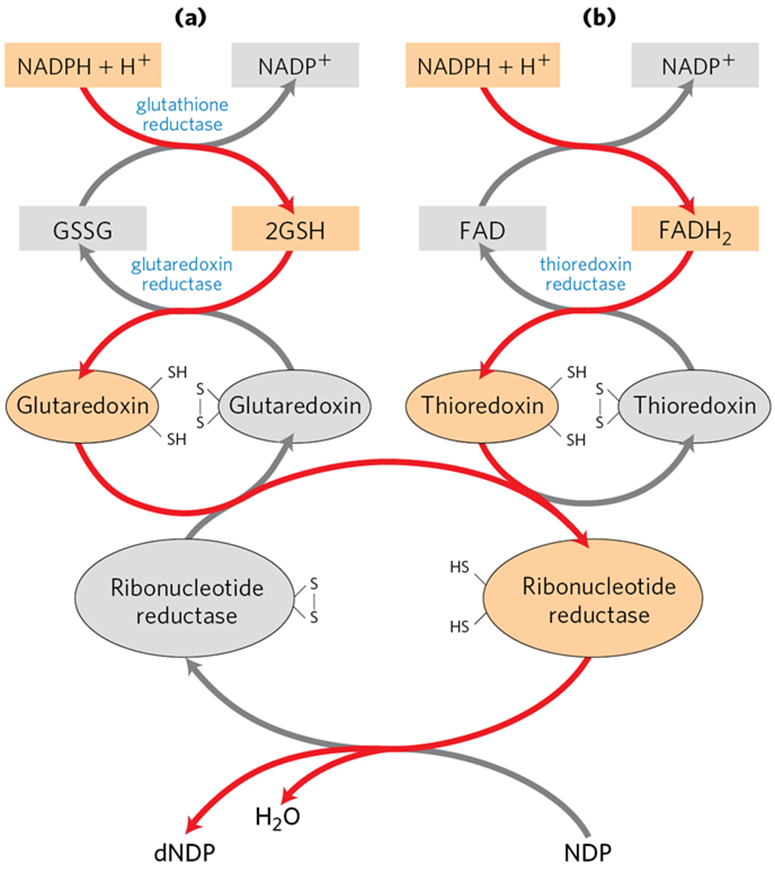
The enzyme requires reducing equivalents to function, which are ultimately dervied from NADPH and passed through intermediates such as glutaredoxin or thioredoxin.
How do these intermediates recieve electrons
they recieve them from reduced glutathione or FADH2, which in turn recieves electrons from NADPH
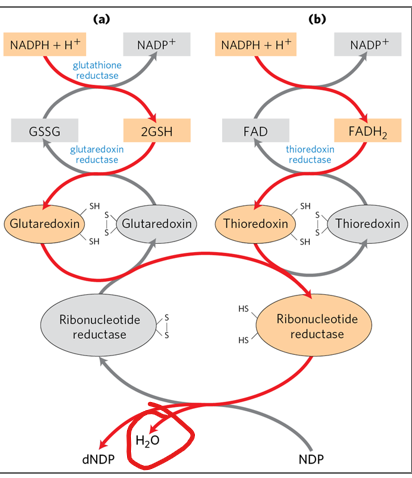
To synthesize DNA, the ribose sugar of nucleotides must be converted into deoxyribose.
This is done by ribonucleotide reductase, which converts ribonucleoside diphosphates into deoxyribonucleoside diphosphates (e.g., ADP → dADP).
The enzyme requires reducing equivalents to function, which are ultimately derived from NADPH and passed through intermediates such as glutaredoxin or thioredoxin.
These intermediates receive electrons from reduced glutathione or FADH2, which in turn receive electrons from NADPH
What is this electron relay essential for
reducing the 2’-hydroxyl group on the ribose, forming the deoxyribose needed for DNA synthesis
When purine nucleotides are degraded, what do they produce as their end product in humans
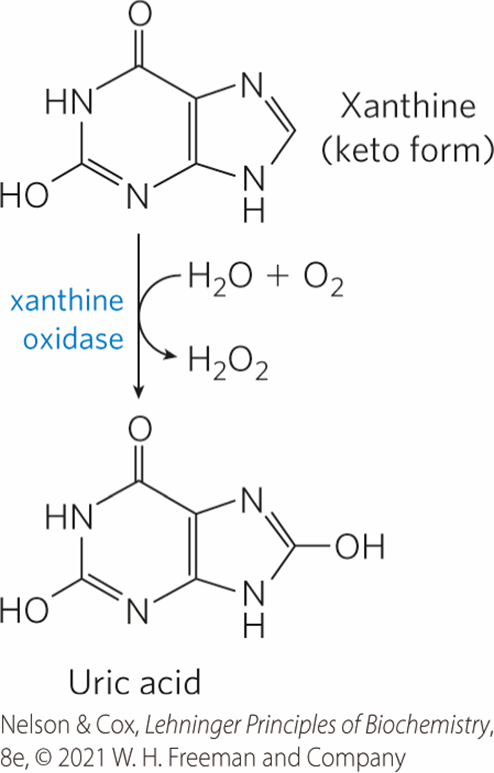
uric acid
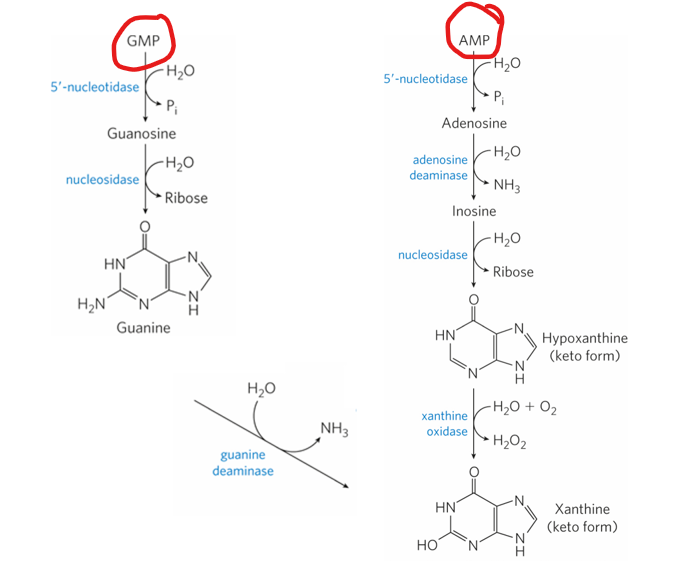
During purine degredation , what are first things to be dephosphorylated to nucleosides (guanosine and adenosine)
GMP and AMP
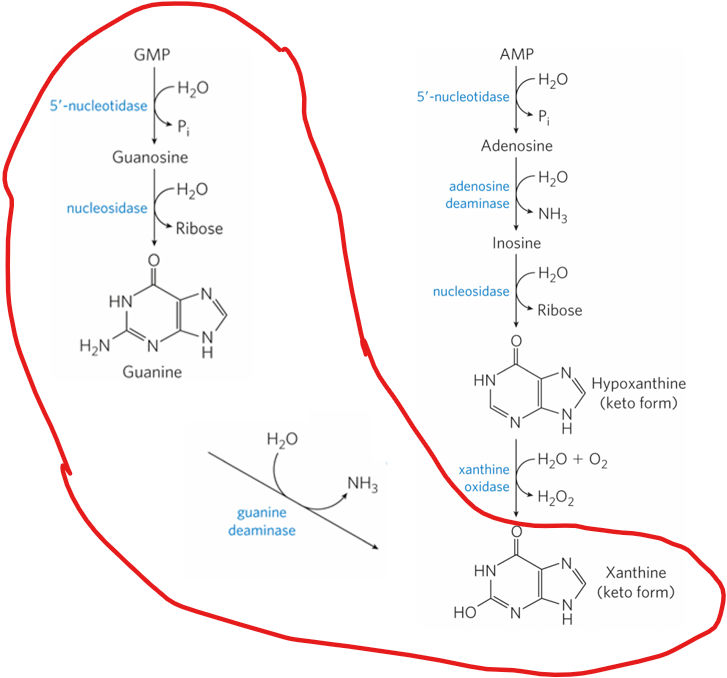
Purine nucleotides are also degraded, producing uric acid as the end product in humans. GMP and AMP are first dephosphorylated to nucleosides (guanosine and adenosine).
What happens to guanosine
it is then converted to guanine, which is deaminated to xanthine
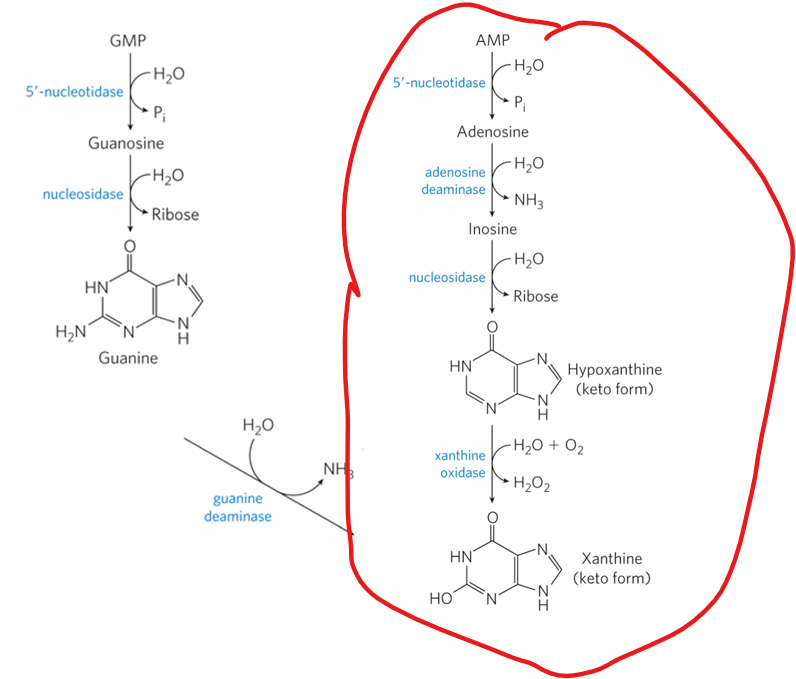
Purine nucleotides are also degraded, producing uric acid as the end product in humans.
GMP and AMP are first dephosphorylated to nucleosides (guanosine and adenosine).
Guanosine is then converted to guanine, which is deaminated to xanthine.
What happens to adenosine
its deaminated to inosine, which loses ribose to become hypoxanthine
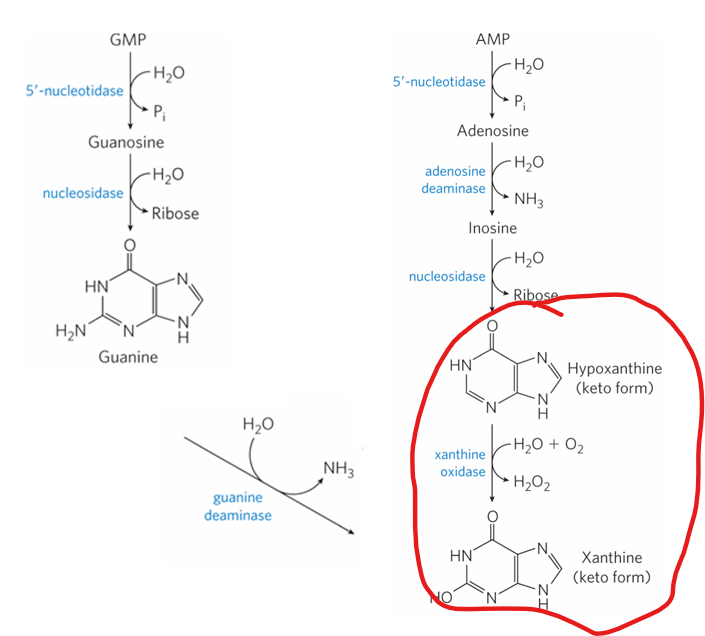
Purine nucleotides are also degraded, producing uric acid as the end product in humans.
GMP and AMP are first dephosphorylated to nucleosides (guanosine and adenosine).
Guanosine is then converted to guanine, which is deaminated to xanthine.
Adenosine is deaminated to inosine, which loses ribose to become hypoxanthine
What happens to hypoxanthine
Hypoxanthine is then oxidized to xanthine, and xanthine is further oxidized to uric acid.
Humans lack the enzymes to further degrade uric acid— so what happens to it
it is excreted in urine
what happens due to excess uric acid accumulation
it can lead to gout
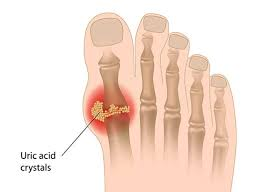
what is gout
a condition charaterized by uric acid crystal depositon in joints
the degredation pathway also intersects with the salvage pathway- how and why
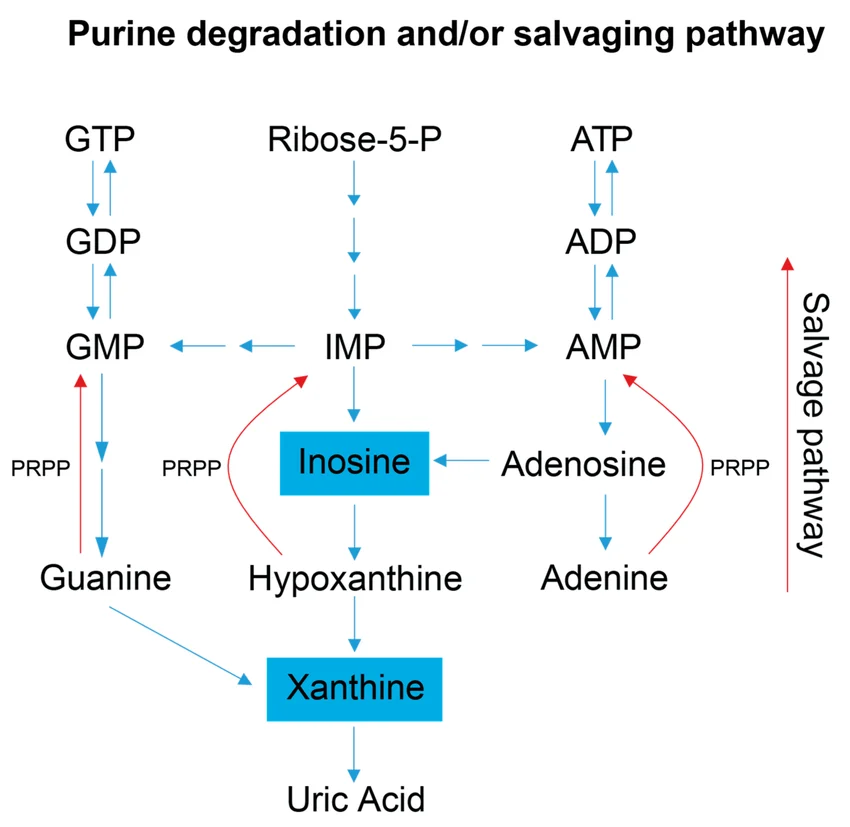
hypoxanthine and guanine can be reused to synthesize IMP and GMP via HGPRT
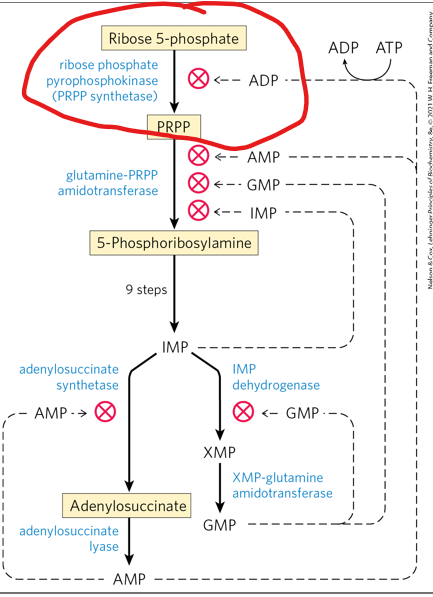
Purine metabolism is highly regulated at multiple points.
What is PRPP synthetase, which produces PRPP, regulated by?
ADP levels
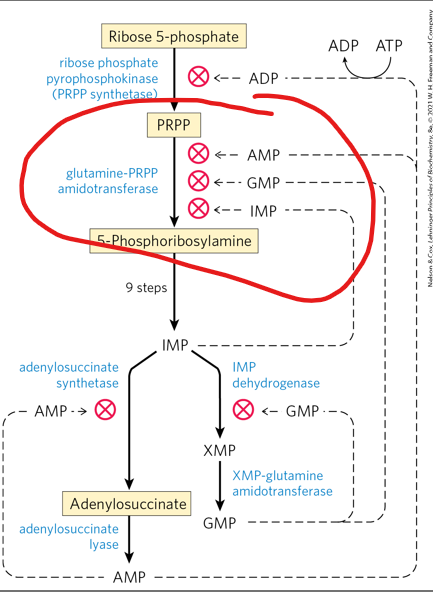
What is the first enzyme in purine syntheisis ( glutamine PRPPamidotransferase) inhibited by
AMP, GMP, and IMP, controlling the de novo pathway.
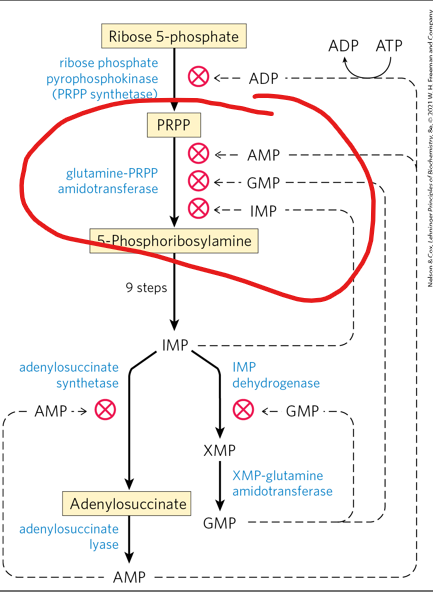
At the fork where IMP can become AMP or GM, what does feedback inhibition ensure
balanced nucleotide production
Additionally, energy considerations dictate the choice of GTP versus ATP as the energy donor in AMP versus GMP synthesis
What is GTP used for in relation to regulation of the two
When GTP levels are high, it stimulates the pathway to form more AMP (by providing energy to adenylosuccinate synthase) while simultaneously inhibiting its own synthesis pathway (by inhibiting IMP dehydrogenase).
Additionally, energy considerations dictate the choice of GTP versus ATP as the energy donor in AMP versus GMP synthesis
What is ATP used for
ATP is the energy donor (acting as a phosphate donor to create an AMP-XMP intermediate) in the conversion of Xanthosine monophosphate (XMP) to Guanosine monophosphate (GMP).