Contemporary Issues in Biology LAB EXAM 2
 Call Kai
 Learn
Learn Practice Test
 Spaced Repetition
 Match
Match Flashcards
 Knowt Play
1/36

There's no tags or description
Looks like no tags are added yet.
Name | Mastery | Learn | Test | Matching | Spaced | Call with Kai |
|---|
No analytics yet
Send a link to your students to track their progress
37 Terms
What is the most dangerous animal in the USA, based on human deaths caused by that animal?
Bees/Wasps
Why would an animal attack a human?
We invade their territory
Habitat loss and development
We threaten their young
Poaching, collecting, and accidents
We look like food
Wrong place, wrong time!
Are humans a typical food source of any animals?
Humans are NOT a typical food source for any animals
Describe how to identify each of the dangerous spiders from class visually
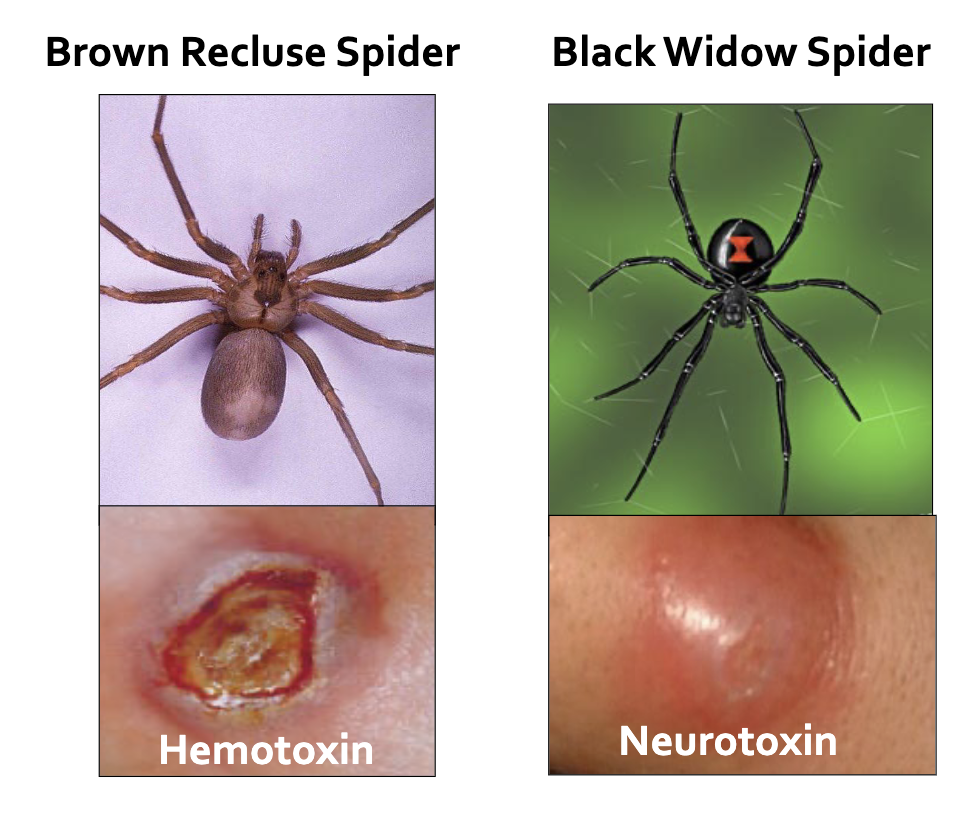
Black Widow
Neurotoxin
Jet black, glossy body
Large, round, globe-shaped abdomen
Signature marking: bright RED HOURGLASS on the BOTTOM of the abdomen
Long solid-black legs, no banding
8 eyes
Found in dark, dry spaces
Brown Recluse
Hemotoxin
Uniform tan/brown, matte body
Signature marking: dark brown VIOLIN shaped on the TOP of the cephalothorax (front section)
Oval, flat abdomen
Only 6 EYES in 3 pairs (most other spiders have 8)
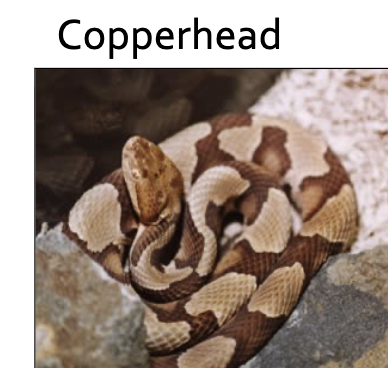
Copperhead - Pit Viper
Distinctive hourglass-shaped crossbands — wide at the sides, narrowing to a point at the center of the back — in copper/brown tones on a lighter tan/pinkish background
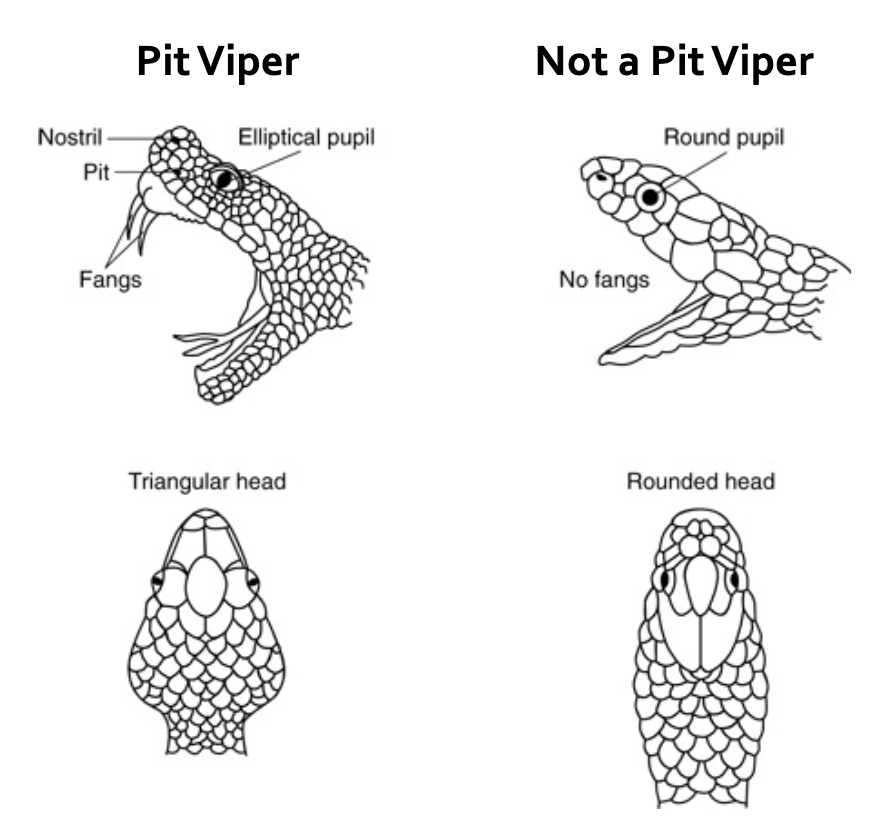
Copper-colored triangular head, noticeably wider than the neck
Generally NOT aggressive; bites are rarely fatal. Will give a waning bite with little venom (“dry bite”)
Fun fact: Southern copperhead venom contains a protein that halts cancer cell growth in mice and prevents metastasis - potential medical value!
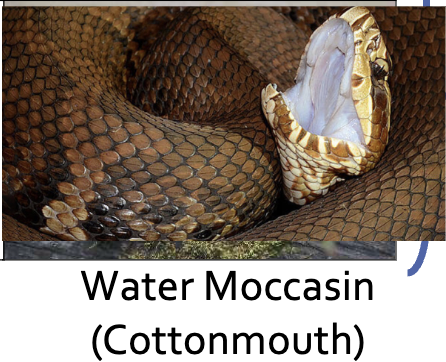
Cottonmouth/Water Moccasin - Pit Viper
Short, fat, and drab — dark olive, brown, or nearly black body. Pattern is wide at the base and narrows at the top
When threatened, coils body and opens mouth wide exposing the bright white cotton interior — this is the key ID feature that gives it its name
Has a dark “Zorro mask” stripe on the side of the face; ridge above the eye gives it a mean/heavy-browed look; slot/oval cat-eye pupil
World’s only semi-aquatic viper. Swims on TOP of the water and NEVER submerges. Basks on land, not in trees
Stands its ground when threatened and coils/exposes fangs — does NOT chase
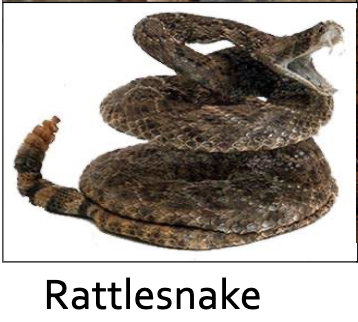
Rattlesnake - Pit Viper
Rattle on the tail — shaken as a warning when threatened. The only Texas snake with this feature
Heavy-bodied, keeled (ridged) scales, triangular head
Texas species from slides: Western Diamondback (large, diamond pattern down back, black-and-white banded tail), Timber Rattlesnake (large, chevron pattern, yellow/brown/black), Pygmy Rattlesnake (very small), Western Massasauga (small)
Shakes rattle as warning; bites are rarely fatal if treated promptly; MANY different species exist
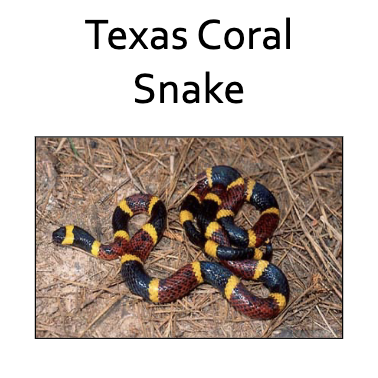
Texas Coral Snake - NOT a Pit Viper
Bright red, yellow, and black bands circling the entire body. Red bands touch yellow bands
“Red on yellow, kill a fellow” (coral snake - dangerous) vs. “Red on black, friendly Jack” (milk snake - harmless)
Small, rounded, black head (NOT triangular). No loreal pit. Round pupils. No true fangs (small fixed front teeth)
Venom → powerful NEUROTOXIN - can cause respiratory failure and cardiovascular failure — potentially fatal
Symptoms can be DELAYED up to 12 hours after a bite, so people may feel fine and delay treatment. Antivenom is available
Related to cobra
Behavior: Secretive and not aggressive; rarely bites unless handled
Pit Viper Identification
Which snake bites will lead to fatality if left untreated?
All the dangerous snakes studied (Copperhead, Cottonmouth, Rattlesnakes, and Coral Snake) can be fatal without treatment
HOWEVER, the Coral Snake is considered especially dangerous because its venom is neurotoxic and symptoms may be delayed, causing people to underestimate the bite
The Eastern Diamondback Rattlesnake has the most potent venom by volume
Copperhead bites are rarely fatal with prompt treatment
What are the symptoms of black widow and brown recluse spider bites? How are the symptoms different?
Black Widow (Neurotoxin) symptoms:
The venom attacks the nervous system
Symptoms include immediate pain at the bite site, then systemic muscle cramps and spasms (especially the abdomen), sweating, nausea, elevated blood pressure, and chest tightness
The bite itself looks relatively minor (two small puncture marks, mild redness/swelling)
Brown Recluse (Hemotoxin) symptoms:
The venom destroys blood cells and tissue (hemotoxic)
Initially painless, the bite develops into a bull’s-eye lesion with necrosis (dead, rotting skin) and a deep ulcer
Systemic symptoms (fever, chills, rash) can occur but local tissue destruction is the hallmark
Key Difference: Black Widow → NEUROTOXIN = systemic nervous system/muscle effects, minor local wound; Brown Recluse → HEMOTOXIN = severe local tissue/skin necrosis, minor systemic effects
How much does food production need to increase to meet estimated demands in 2050?
Food production must double to meet 2050 needs based on our current consumption efficiency
What is the expected global population in 2050?
Global population will exceed 9 billion by 2050 (current population: 8 billion)
What is carrying capacity? Are we close to the carrying capacity for humans on earth?
Carrying capacity is the maximum population size that an environment can sustainably support given available resources (food, water, space)
We are approaching or may have already exceeded Earth’s carrying capacity for humans in some respects, particularly regarding resource consumption and environmental degradation
What is the main reason for clear cutting in the Amazon rainforest?
The main reason for clear-cutting in the Amazon rainforest is to create agricultural land, specifically cattle ranching and soybean farming (used largely for animal feed)
What are some positive impacts using GMOs can have on crops? What is an example of a GMO crop?
Benefit to Humans:
GMO (Genetically Modified Organisms) = higher crop productivity
Less pesticide use (at least short term)
Add nutrition to foods
Examples:
Golden Rice — engineered with Vitamin A
Bt corn — engineered with the Bacillus thuringiensis gene to produce its own insecticide
What does crop diversification and crop rotation on farms result in?
Crop diversification and rotation result in improved soil health, reduced soil depletion, natural pest and disease control, reduced need for chemical fertilizers, and increased farm resilience to climate variability
As countries become wealthier, how do people’s diets shift?
As countries become wealthier, people shift towards diets higher in animal products (meat, dairy)
What are the causes of food waste? How does this differ between wealthy and developing countries?
Wealthy countries: Waste occurs mainly at homes, restaurants and supermarkets — spoilage, over-purchasing, restaurant/household over-preparation
Developing countries: Waste occurs mainly between producer and consumer due to inadequate refrigeration, transportation, and storage infrastructure
Should unfarmed lands (tundra, desert, rainforest) be turned into croplands? Why?
No. Converting tundra, deserts, and rainforests into croplands is generally not recommended
These ecosystems provide critical services: carbon sequestration, biodiversity habitat, water regulation, and climate stabilization
Destroying them for farmland would likely worsen food insecurity long-term and accelerate climate change
Better solutions include reducing food waste, improving crop yields on existing farmland, and shifting to more plant-based diets
True or False: Some bacteria are resistant due to random chance
TRUE; antibiotic resistance arises from random genetic mutations that occur naturally (random mutations in bacterial DNA can → antibiotic resistance)
Would using antibiotic hand soap lead to more or fewer antibiotic resistant bacteria at a global scale?
Using antibiotic soap would lead to MORE antibiotic-resistant bacteria at a global scale
Widespread use creates selection pressure that kills susceptible bacteria while allowing resistant strains to survive and proliferate
Can antibiotics be used to treat viruses?
NO (viruses lack cell walls, which antibiotics block cell wall formation; antibiotics only work against bacteria)
What was the first antibiotic and who discovered it? Has this antibiotic lost effectiveness over time? If yes, why?
The first antibiotic: Penicillin
Produced by a mold
Discovered by Alexander Fleming in 1928
Yes Penicillin has lost effectiveness over time because many bacteria have evolved resistance to it
Methicillin-resistant Staphylococcus aureus (MRSA) is a well-known example
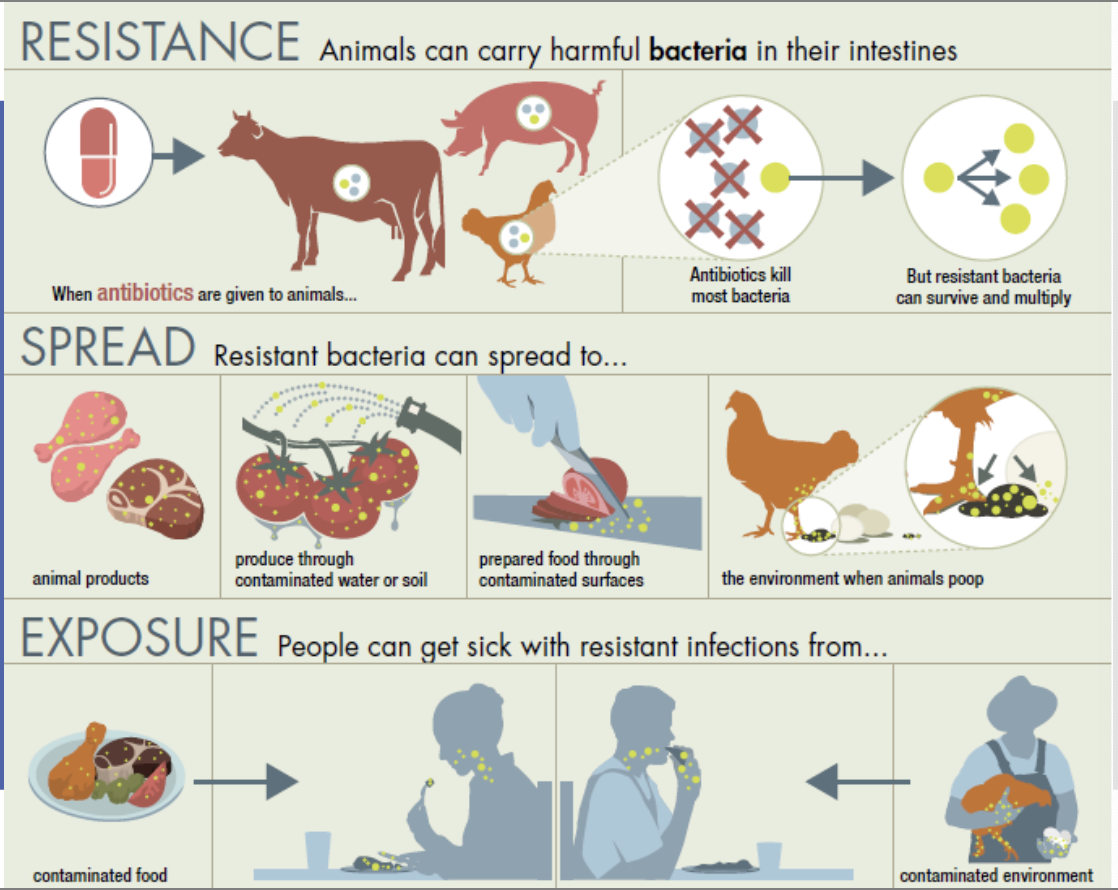
Why are antibiotics used in animal populations and what is a consequence of this?
Attempt to prevent spread of disease
Causes animals to grow bigger
May contribute to bacterial resistance to antibiotics
If you are prescribed antibiotics should you take the full dose, why?
Yes, you should take the full dose
Not finishing a course of antibiotic kills weak bacteria, but allows the strong to survive
Not only are you still sick, but you are now spreading the stronger, more antibiotic resistant bacteria!
What is the cause of TB (tuberculosis)? Has TB developed antibiotic resistance?
TB is caused by the bacterium Mycobacterium tuberculosis
Yes, TB has developed antibiotic resistance
Multi-drug resistant TB (MDR-TB) and extensively drug-resistant TB (XDR-TB) are serious health threats, partly due to incomplete treatment courses
How do antibiotics target bacteria?
Block cell wall formation
Prevent protein synthesis
Prevent bacterial replication
Do human cells have cell walls?
Human cells do NOT have cell walls
What are the benefits of forest fires?
Cleans forest floor and returns nutrients to soil
Removes underbrush and debris
More sunlight reaches ground
Returns nutrients to soil
Reduces competition among trees & undergrowth
Reduces risk of future catastrophic fires
Fewer & healthier trees = (pre-settlement conditions)
Provides habitat for wildlife and encourages a new generation of seedlings to grow (secondary succession)
Fire clears heavy brush
Stimulates growth of grasses and small herbaceous plants (forbs)
Creates “snags” (standing dead trees) which provide nesting habitat
Increases water supply in streams due to additional run-off (fewer plants absorbing water)
Kills diseases and harmful insects
Fire kills diseases and insects that prey on trees
More trees die each year due to diseases and insects than from fire
What are consequences of forest fires?
Releases smoke that can cause respiratory problems
Pollutants in the smoke can damage crops
Run-off from burned areas pollutes the drinking water
Extensive smoke impairs visibility of drivers can cause accidents on highways
Reduction in tourism dollars
Carbon monoxide
What is the impact of forest fires on soil erosion?
Forest fires increase soil erosion
Vegetation normally holds soil in place; when it burns away, exposed soil is vulnerable to erosion by rain and wind
Burned soil also loses organic matter and becomes hydrophobic (water-repellent), causing more runoff
What is the impact of forest fires on pine trees with pinecones?
Some forests depends on fire
Ponderosa Pine & Lodgepole Pine
Serotinus Cones: Cones open when stimulated by heat
This releases seeds onto newly cleared, nutrient-rich soil, giving them an ideal germination environment. Fire is essential for these species’ reproduction
What is secondary succession? What are the stages of succession?
Secondary succession: succession that begins after a disturbance event clears the community but leaves the soil intact
Secondary succession → Pioneer species → Intermediate species → Climax community
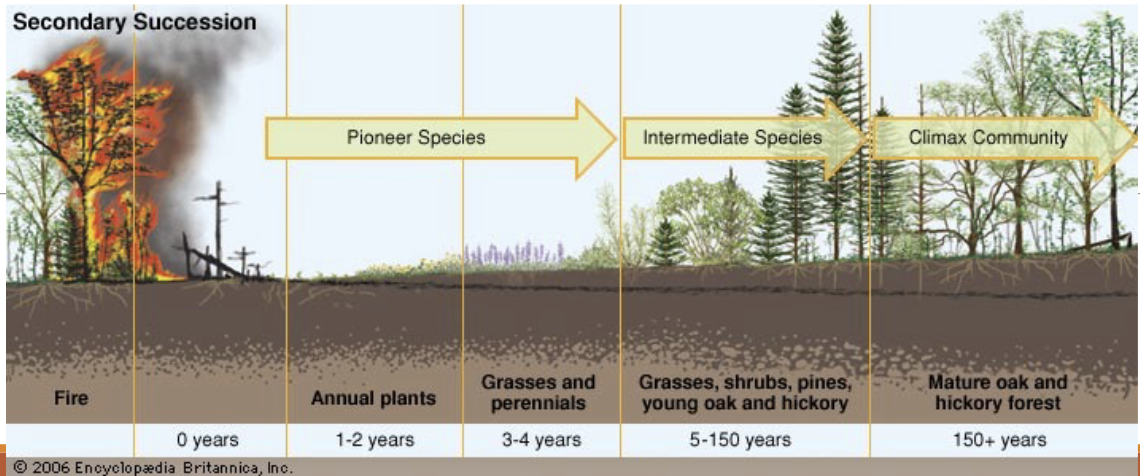
What are examples of pioneer species?
Predominant vegetation can tolerate high levels of sunlight
Pioneer species are annuals, such as grasses and perennials, wildflowers
These help with soil stabilization and prevent erosion
Some of these species require heat or smoke exposure to germinate
What is a climax community? Does it include young or old trees?
An ecological community in the final stage of succession, in which the species composition remains relatively stable until a disturbance such as fire occurs
Some species require these types of communities to thrive
Climax community: mature forest
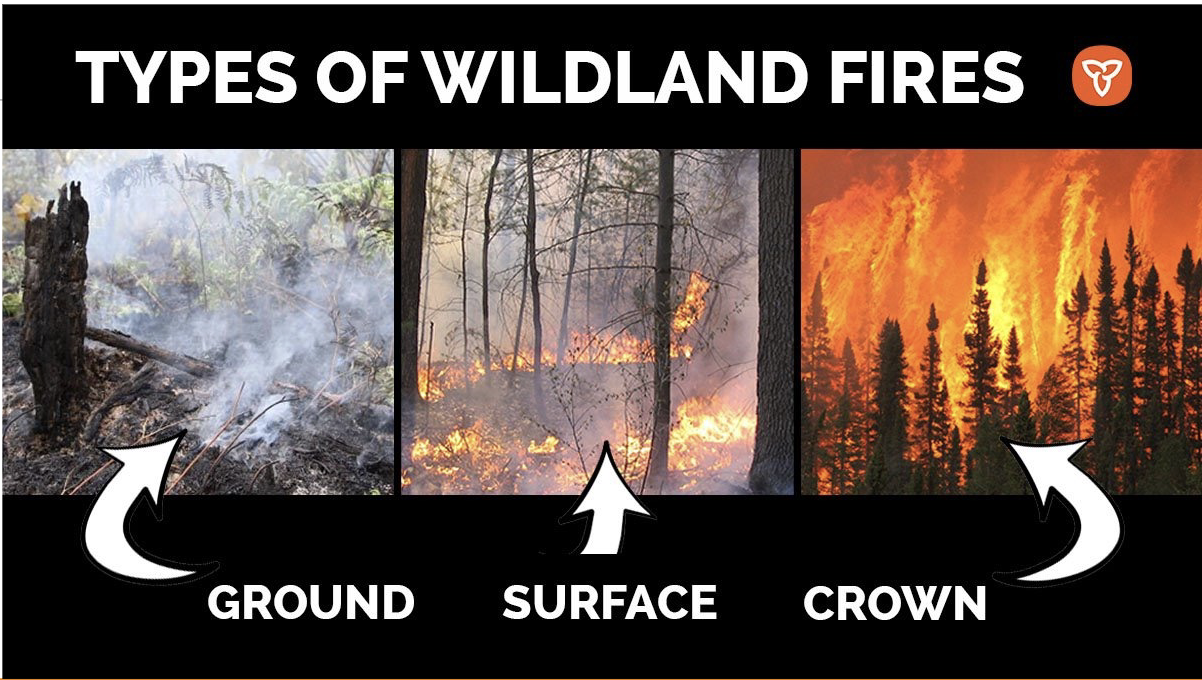
Which kind of fires (ground, surface, crown) are beneficial, which are harmful? Why?
Ground fires: Burn slowly through organic material (leaf litter, roots) in the soil. Generally beneficial — low intensity, recycle nutrients, clear debris without killing mature trees
Surface fires: Burn along the forest floor through underbrush. Can be beneficial (controlled burns, clears competition) or harmful if intense
Crown fires: Spread through the tops (canopy) of trees. Highly destructive — kill mature trees, destroy wildlife habitat, and are very difficult to control. Considered harmful