BI-157 Ch 10: Photosynthesis
 Call Kai
 Learn
Learn Practice Test
 Spaced Repetition
 Match
Match Flashcards
 Knowt Play
1/20

There's no tags or description
Looks like no tags are added yet.
Name | Mastery | Learn | Test | Matching | Spaced | Call with Kai |
|---|
No analytics yet
Send a link to your students to track their progress
21 Terms
Photosynthesis
Photosynthesis is the process that converts solar energy into chemical energy
Directly or indirectly, photosynthesis nourishes almost the entire living world (There are Chemosynthetic biological processes that use chemical energy and the earth's heat as initial sources of energy in places where sunlight is absent)
The Process That Feeds the Biosphere
Autotrophs sustain themselves without eating anything derived from other organisms
Autotrophs are the Producers of the biosphere, producing organic molecules from CO2 and other inorganic molecules
Almost all plants are Photoautotrophs, using the energy of sunlight to make organic molecules
Photosynthesis occurs in plants, algae, certain other unicellular eukaryotes, and some prokaryotes
These organisms feed not only themselves but also most of the living world
Heterotrophs obtain their organic material from Other organisms
Heterotrophs are the Consumers of the biosphere
Almost all heterotrophs, including humans, depend on photoautotrophs for food and O2
Earth’s supply of fossil fuels was formed from the remains of organisms that died hundreds of millions of years ago
In a sense, fossil fuels represent stores of solar energy from the distant past
Chloroplast Evolution
Chloroplasts are structurally similar to and likely evolved from endosymbiotic photosynthetic bacteria
The structural organization of these organelles allows for the chemical reactions of photosynthesis
Chloroplasts: Parts and Structure
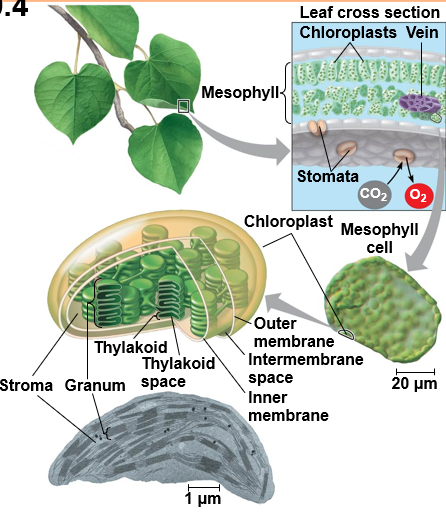
Leaves are the major locations of photosynthesis
Chloroplasts are found mainly in cells of the mesophyll, the interior tissue of the leaf
Each mesophyll cell contains 30–40 chloroplasts
CO2 enters and O2 exits the leaf through microscopic pores called Stomata
A chloroplast has an envelope of two membranes surrounding a dense fluid called the Stroma
Thylakoids are connected sacs in the chloroplast which compose a third membrane system
Thylakoids may be stacked in columns called Grana
Chlorophyll, the pigment which gives leaves their green colour, resides in the thylakoid membranes
Tracking Atoms Through Photosynthesis
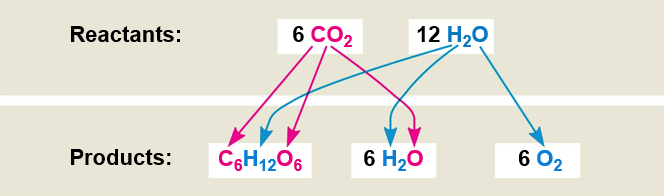
Photosynthesis is a complex series of reactions that can be summarized as the following equation:
6 CO2 + 12 H2O + Light energy → C6H12O6 + 6 O2 + 6 H2O
The overall chemical change during photosynthesis is the reverse of the one that occurs during cellular respiration
The Splitting of Water
Chloroplasts split H2O into hydrogen and oxygen, incorporating the electrons of hydrogen into sugar molecules and releasing oxygen as a by-product
Photosynthesis as a Redox Process
Photosynthesis reverses the direction of electron flow compared to respiration
Photosynthesis is a redox process in which H2O is oxidized and CO2 is reduced
Photosynthesis is an endergonic process; the energy boost is provided by light
The Two Stages of Photosynthesis
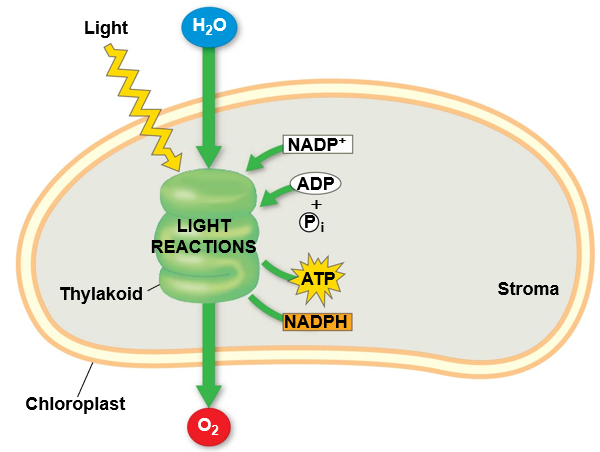
Photosynthesis consists of the light reactions
(the photo part) and Calvin cycle (the synthesis part)The light dependent reactions (in the thylakoids)
Split H2O
Release O2
Reduce the electron acceptor NADP+ to NADPH
Generate ATP from ADP by photophosphorylation
Light independent reactions
The Calvin cycle (in the stroma) forms sugar from CO2, using ATP and NADPH
The Calvin cycle begins with carbon fixation, incorporating CO2 into organic molecules
Chloroplasts as solar-powered chemical factories
Their thylakoids transform light energy into the chemical energy of ATP and NADPH
Photosynthetic Pigments: The Light Receptors
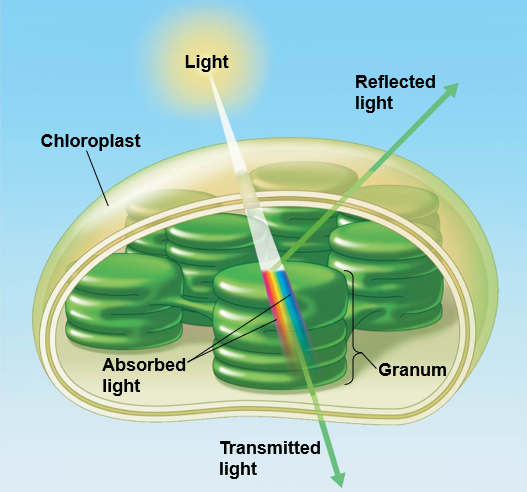
Pigments are substances that absorb visible light
Different pigments absorb different wavelengths
Wavelengths that are not absorbed are reflected or transmitted
Leaves appear green because chlorophyll reflects and transmits green light
Chlorophyll a is the main photosynthetic pigment
Accessory pigments, such as chlorophyll b, broaden the spectrum used for photosynthesis
The difference in the absorption spectrum between chlorophyll a and b is due to a slight structural difference between the pigment molecules
Accessory pigments called carotenoids absorb excessive light that would damage chlorophyll
Carotenoids function in photoprotection; they absorb excessive light that would damage chlorophyll
Excitation of Chlorophyll by Light
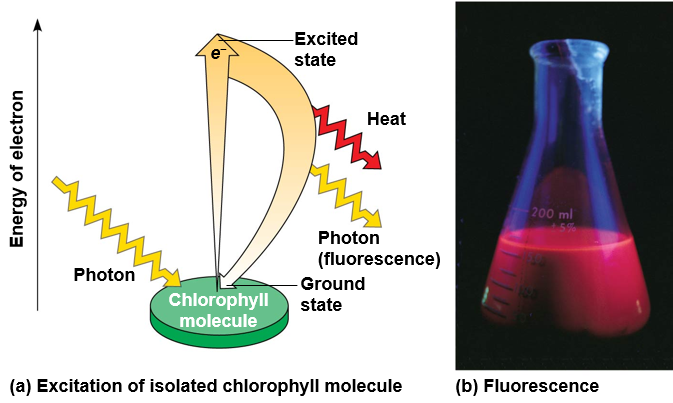
When a pigment absorbs light, it goes from a ground state to an excited state, which is unstable
When excited electrons fall back to the ground state, photons are given off, an afterglow called fluorescence
If illuminated, an isolated solution of chlorophyll will fluoresce, giving off light and heat
A Photosystem
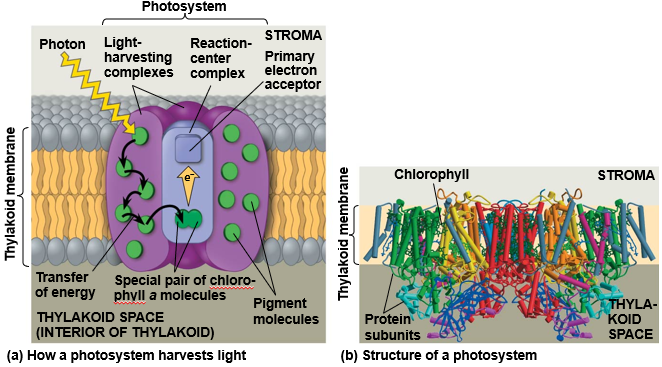
A photosystem consists of a reaction-center complex (a type of protein complex) surrounded by light-harvesting complexes
The light-harvesting complexes (pigment molecules bound to proteins) transfer the energy of photons to the reaction center
A primary electron acceptor in the reaction center accepts excited electrons and is reduced as a result
Solar-powered transfer of an electron from a chlorophyll a molecule to the primary electron acceptor is the first step of the light reactions
Types of Photosystems in the Thylakoid Membrane
There are two types of photosystems in the thylakoid membrane
Photosystem II (PS II) functions first (the numbers reflect order of discovery) and is best at absorbing a wavelength of 680 nm
The reaction-center chlorophyll a of PS II is called P680
Photosystem I (PS I) is best at absorbing a wavelength of 700 nm
The reaction-center chlorophyll a of PS I is called P700
Linear Electron Flow
During the light reactions, there are two possible routes for electron flow: cyclic and linear
Linear electron flow, the primary pathway, involves both photosystems and produces ATP and NADPH using light energy
Steps of Linear Electron Flow
There are 8 steps in linear electron flow:
A photon hits a pigment and its energy is passed among pigment molecules until it excites P680
An excited electron from P680 is transferred to the primary electron acceptor (we now call it P680+)
H2O is split by enzymes, and the electrons are transferred from the hydrogen atoms to P680+, thus reducing it to P680
P680+ is the strongest known biological oxidizing agent
O2 is released as a by-product of this reaction
Each electron “falls” down an electron transport chain from the primary electron acceptor of PS II to PS I
Energy released by the fall drives the creation of a proton gradient across the thylakoid membrane
Diffusion of H+ (protons) across the membrane drives ATP synthesis
In PS I (like PS II), transferred light energy excites P700, which loses an electron to an electron acceptor
P700+ (P700 that is missing an electron) accepts an electron passed down from PS II via the electron transport chain
Each electron “falls” down an electron transport chain from the primary electron acceptor of PS I to the protein ferredoxin (Fd)
The electrons are then transferred to NADP+ and reduce it to NADPH
The electrons of NADPH are available for the reactions of the Calvin cycle
This process also removes an H+ from the stroma
The energy changes of electrons during linear flow through the light reactions can be shown in a mechanical analogy
Cyclic Electron Flow
In cyclic electron flow, electrons cycle back from Fd to the PS I reaction center
Cyclic electron flow uses only photosystem I and produces ATP, but not NADPH
No oxygen is released
Some organisms such as purple sulfur bacteria have PS I but not PS II
Cyclic electron flow is thought to have evolved before linear electron flow
Cyclic electron flow may protect cells from
light-induced damage
A Comparison of Chemiosmosis in Chloroplasts and Mitochondria
Chloroplasts and mitochondria generate ATP by chemiosmosis, but use different sources of energy
Mitochondria transfer chemical energy from food to ATP; chloroplasts transform light energy into the chemical energy of ATP
Spatial Organization of Chemiosmosis in Chloroplasts and Mitochondria
In mitochondria, protons are pumped to the intermembrane space and drive ATP synthesis as they diffuse back into the mitochondrial matrix
In chloroplasts, protons are pumped into the thylakoid space and drive ATP synthesis as they diffuse back into the stroma
ATP and NADPH are produced on the side facing the stroma, where the Calvin cycle takes place
In summary, light reactions generate ATP and increase the potential energy of electrons by moving them from H2O to NADPH
Calvin Cycle’s Process of Reducing CO2 to Sugar
The Calvin cycle, like the citric acid cycle, regenerates its starting material after molecules enter and leave the cycle
The cycle builds sugar from smaller molecules by using ATP and the reducing power of electrons carried by NADPH
Carbon enters the cycle as CO2 and leaves as a sugar named glyceraldehyde 3-phospate (G3P)
For net synthesis of 1 G3P, the cycle must take place three times, fixing 3 molecules of CO2
The Calvin cycle has three phases
Carbon fixation (catalyzed by rubisco)
Reduction
Regeneration of the CO2 acceptor (RuBP)
Causes of Photorespiration
Dehydration is a problem for plants, sometimes requiring trade-offs with other metabolic processes, especially photosynthesis
On hot, dry days, plants close stomata, which conserves H2O but also limits photosynthesis
The closing of stomata reduces access to CO2 and causes O2 to build up
These conditions favor an apparently wasteful process called photorespiration
The Importance of Photosynthesis
The energy entering chloroplasts as sunlight gets stored as chemical energy in organic compounds
Sugar made in the chloroplasts supplies chemical energy and carbon skeletons to synthesize the organic molecules of cells
Plants store excess sugar as starch in structures such as roots, tubers, seeds, and fruits
In addition to food production, photosynthesis produces the O2 in our atmosphere