DH228: Oral Pathology Picture

0.0(0)
Studied by 0 people
call kaiCall Kai
learnLearn
examPractice Test
spaced repetitionSpaced Repetition
heart puzzleMatch
flashcardsFlashcards
GameKnowt Play
Card Sorting

1/75

encourage image

There's no tags or description

Looks like no tags are added yet.

Last updated 6:52 PM on 6/13/26
Name
Mastery
Learn
Test
Matching
Spaced
Call with Kai

No analytics yet

Send a link to your students to track their progress

76 Terms

1
New cards

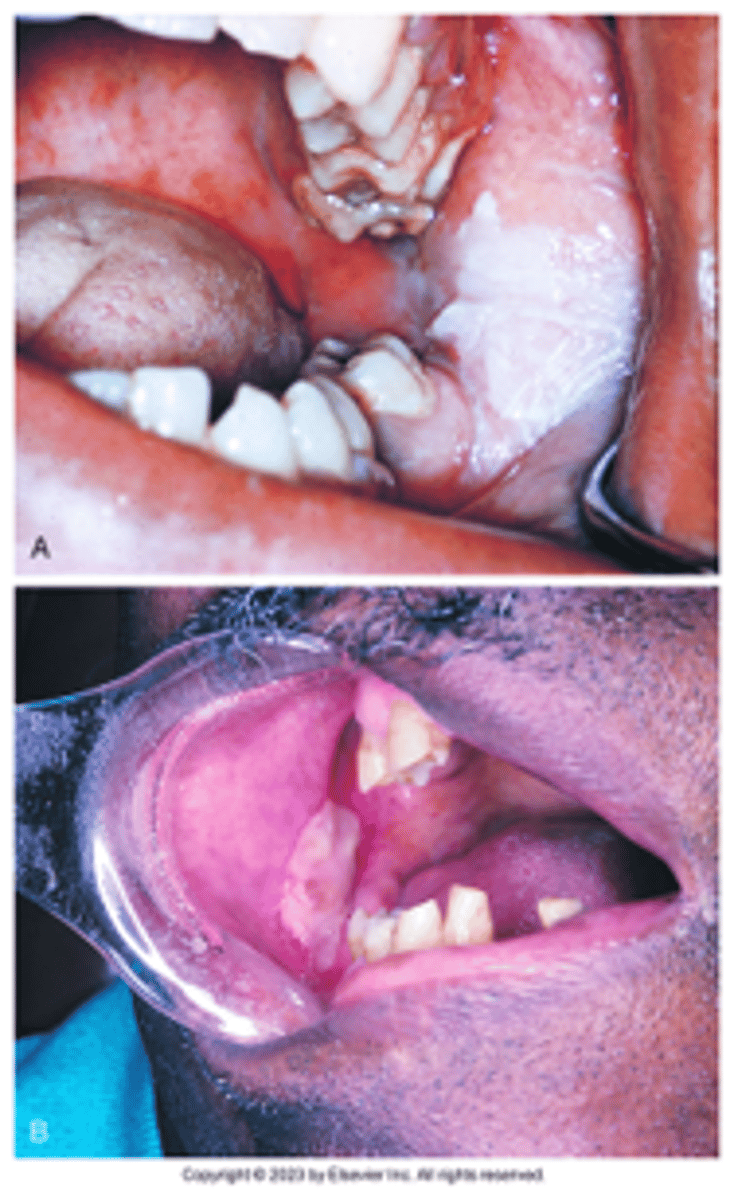
Aspirin Burn

Topical application is a common misuse of this product; The tissue becomes necrotic & white; Surface may slough off, leaving a painful ulcer; Usually heals in 7-21 days


Your patient is complaining of a toothache in the LL posterior. During the EIOE, you notice a white to gray patch on the left buccal mucosa.

•What do you suspect is the cause of this lesion?

What question would you ask the patient?
<p>Topical application is a common misuse of this product; The tissue becomes necrotic &amp; white; Surface may slough off, leaving a painful ulcer; Usually heals in 7-21 days</p><p><br>Your patient is complaining of a toothache in the LL posterior. During the EIOE, you notice a white to gray patch on the left buccal mucosa.</p><p>•What do you suspect is the cause of this lesion?</p><p>What question would you ask the patient?</p>
2
New cards

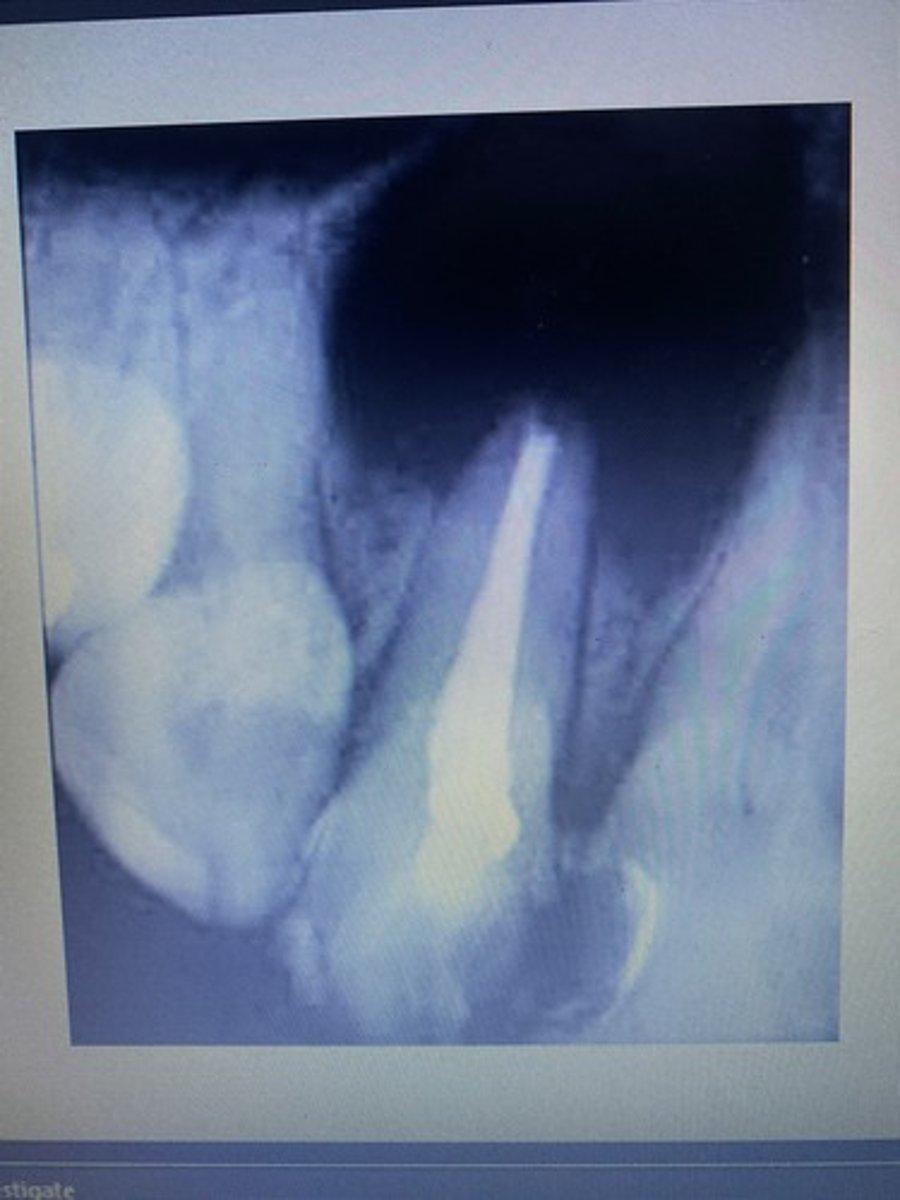
Radicular cyst

Name this condition (Most common cyst observed in the oral cavity, caused by pulpa inflammation and often a side effect of a long lasting or recurrent periapical infection)
<p><span>Name this condition (Most common cyst observed in the oral cavity, caused by pulpa inflammation and often a side effect of a long lasting or recurrent periapical infection)</span></p>
3
New cards

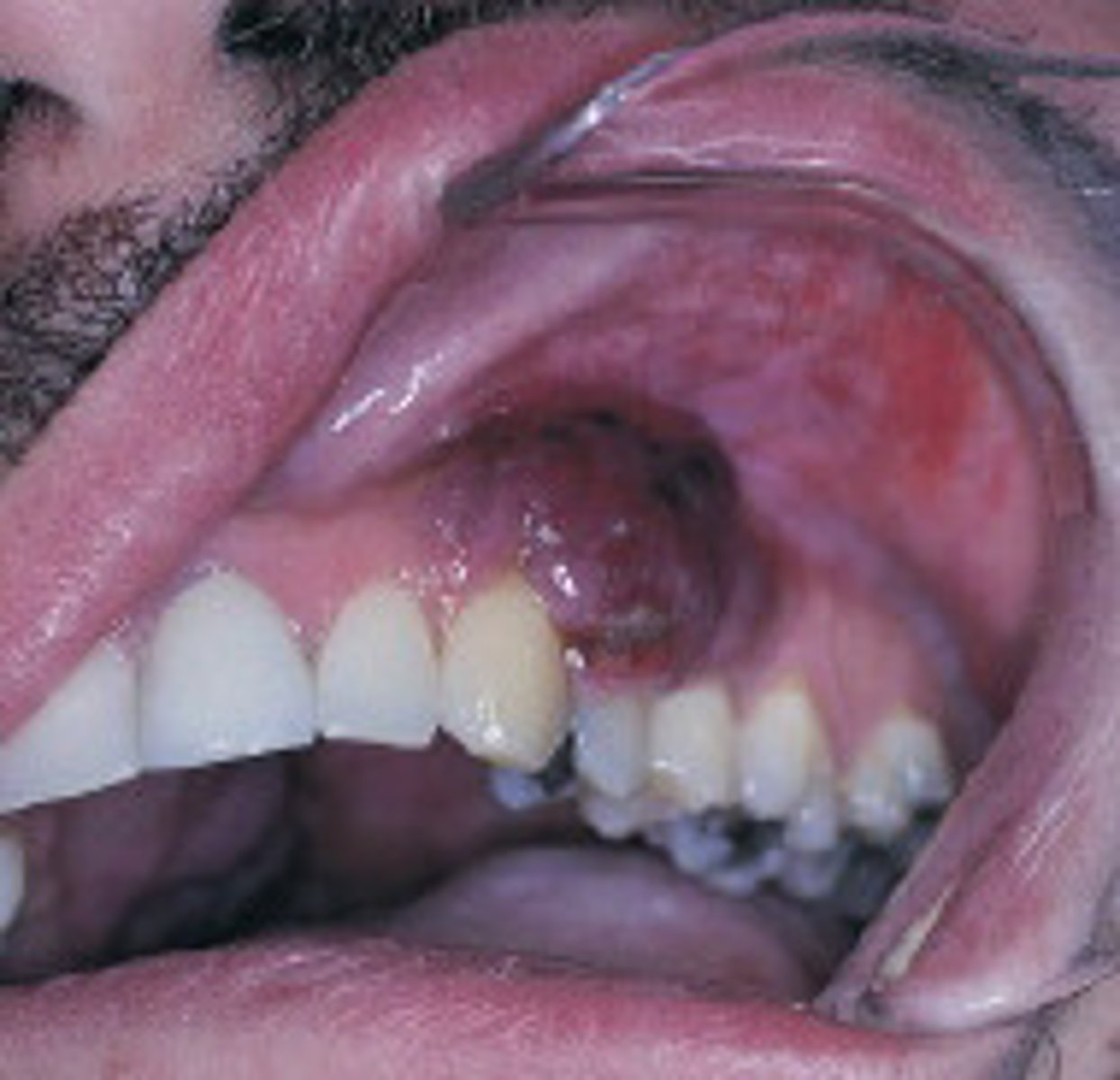
kaposi sarcoma

-diagnosis is made via biopsy

-no effective treatment exists


The most common intraoral locations for this lesion are the gingiva and palate. When diagnosed, this vascular lesion meets the criteria for the diagnosis of acquired immune deficiency syndrome (AIDS). What is the name of this vascular lesion?
<p><br><span>The most common intraoral locations for this lesion are the gingiva and palate. When diagnosed, this vascular lesion meets the criteria for the diagnosis of acquired immune deficiency syndrome (AIDS). What is the name of this vascular lesion?</span></p>
4
New cards

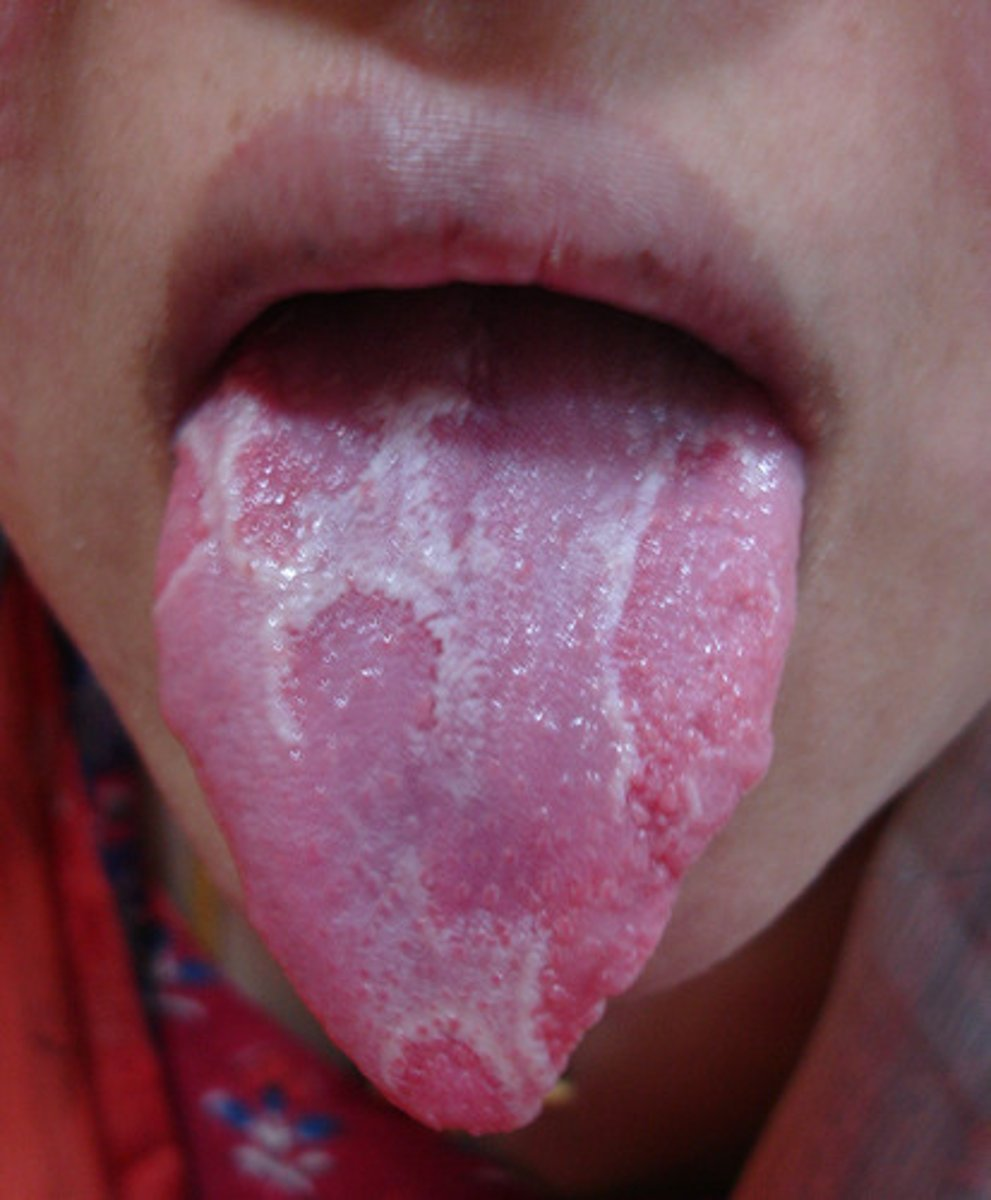
erythema migrans (geographic tongue)


the lesions by the arrows on the dorsal of the tongue are characterized by diffuse areas devoid of filiform papillae that form on the dorsal and lateral borders of the tongue are called
<p><br><span>the lesions by the arrows on the dorsal of the tongue are characterized by diffuse areas devoid of filiform papillae that form on the dorsal and lateral borders of the tongue are called</span></p>
5
New cards

calcium channel blockers.

the common drug is nifedipine


What class of drugs can cause gingival enlargement as seen in the image below?
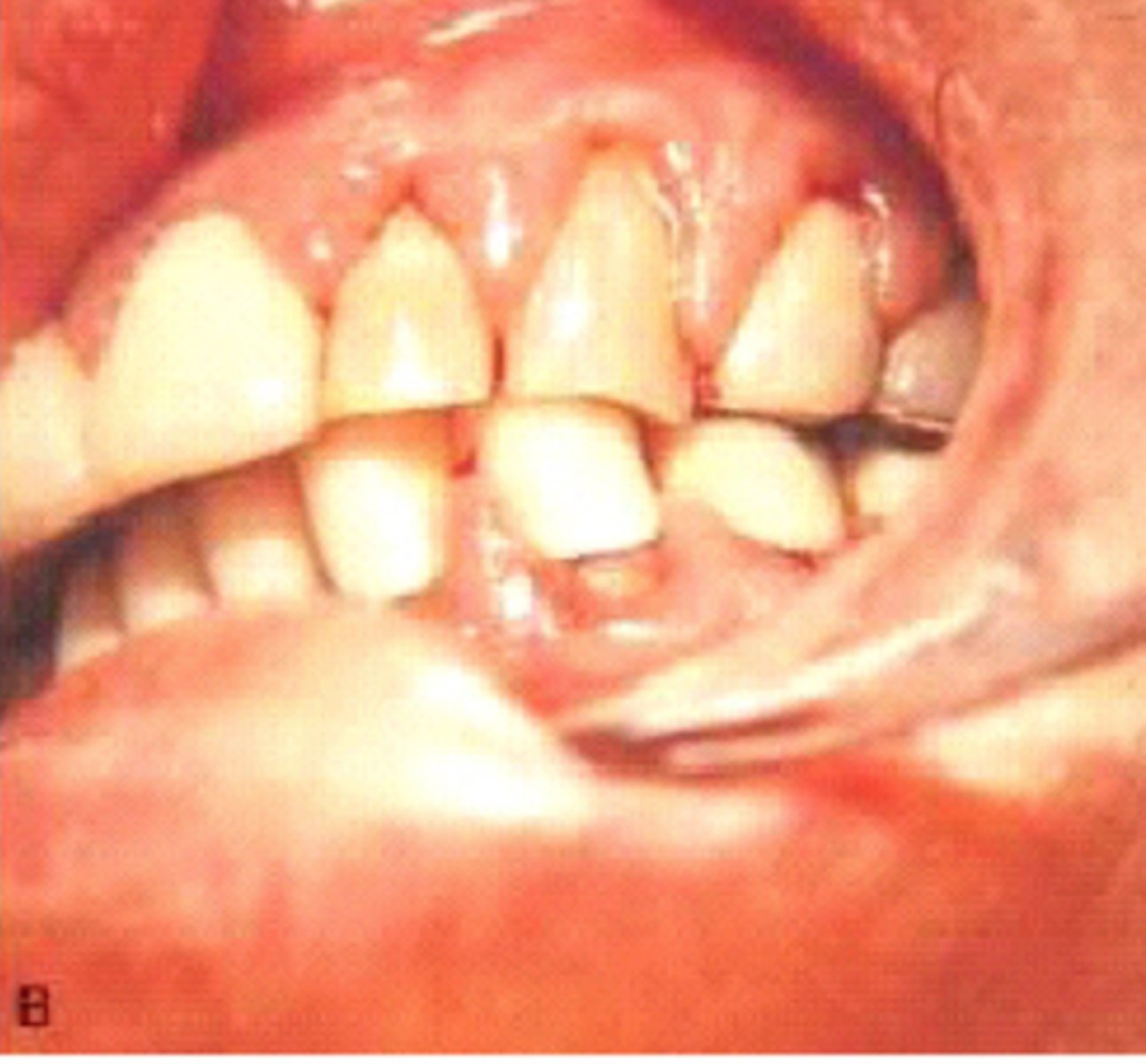
<p><br><span>What class of drugs can cause gingival enlargement as seen in the image below?</span></p>
6
New cards

Torus Palatinus (AKA palatine torus)

This bony hard, radiopaque structure in the midline of the hard palate is diagnosed through clinical diagnosis. It is genetic and inherited in an autosomal dominant manner...
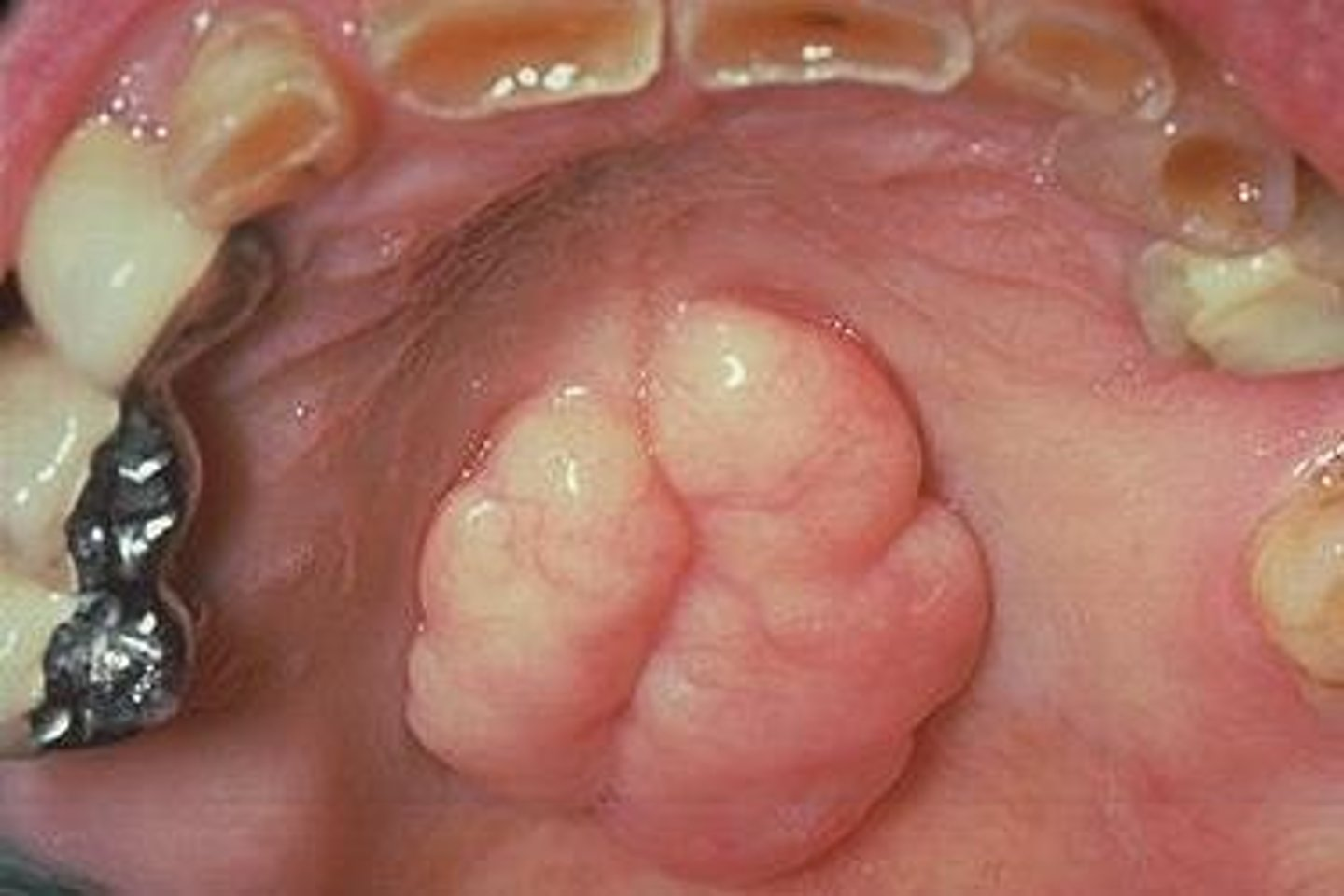
<p><span>This bony hard, radiopaque structure in the midline of the hard palate is diagnosed through clinical diagnosis. It is genetic and inherited in an autosomal dominant manner...</span></p>
7
New cards

osteonecrosis

staged based on size, location and symptoms. -bisphosphonate therapy
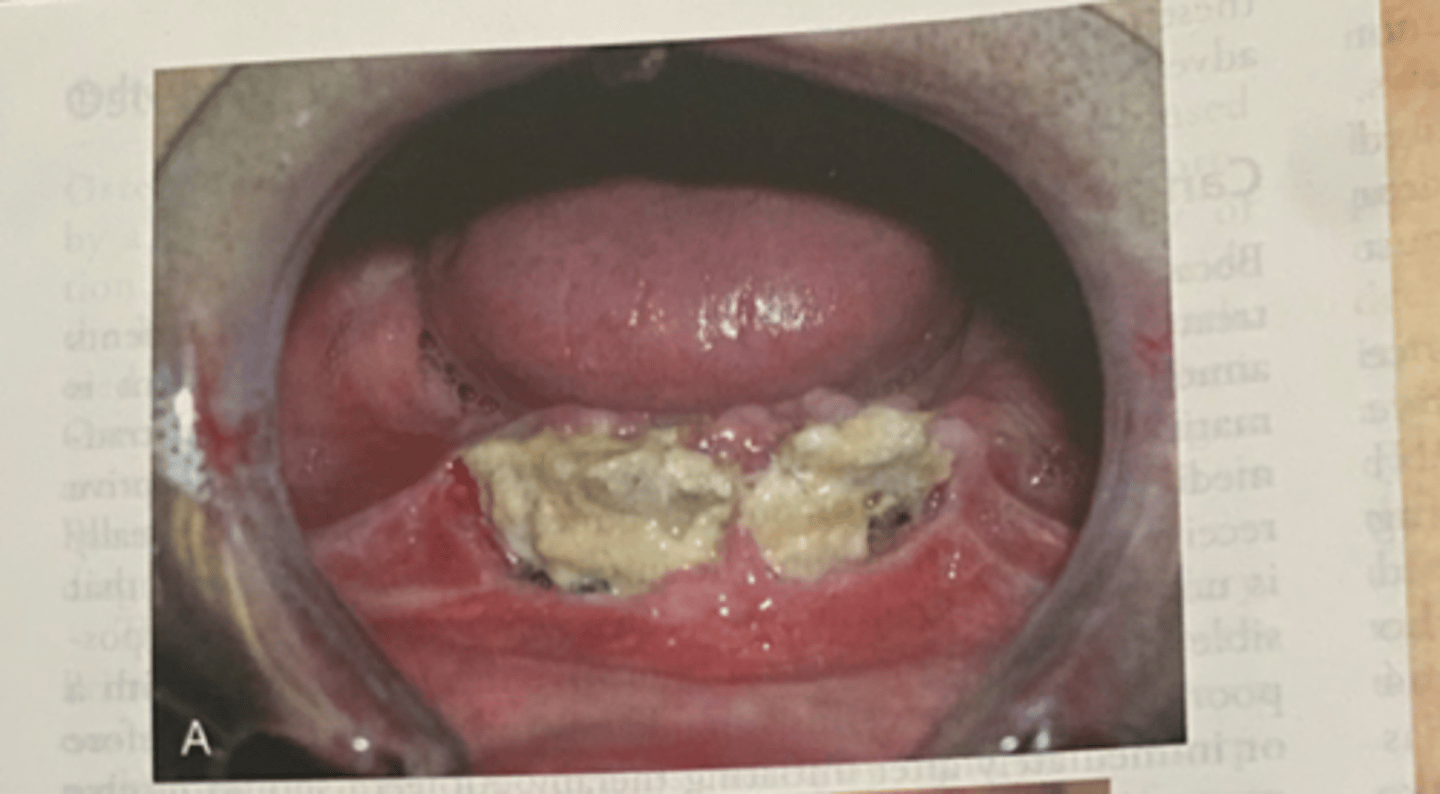
<p><span>staged based on size, location and symptoms. -bisphosphonate therapy</span></p>
8
New cards

iron deficiency anemia

-tongue is devoid of filiform papillae
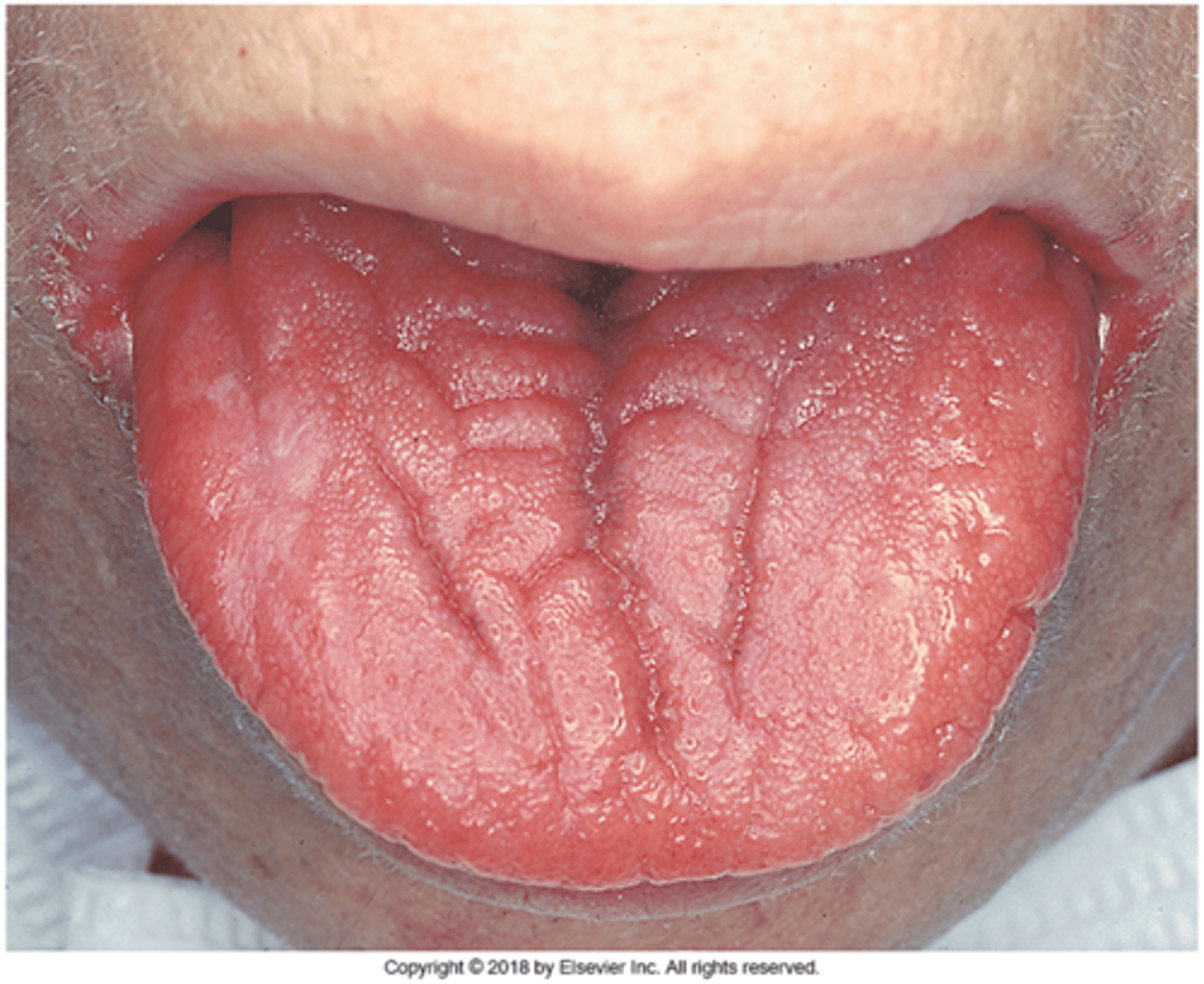
<p><span>-tongue is devoid of filiform papillae</span></p>
9
New cards

pernicious anemia


-Vitamin B12 deficiency that is caused by a deficiency of intrinsic factors a substance secreted by the parietal cells of the stomach
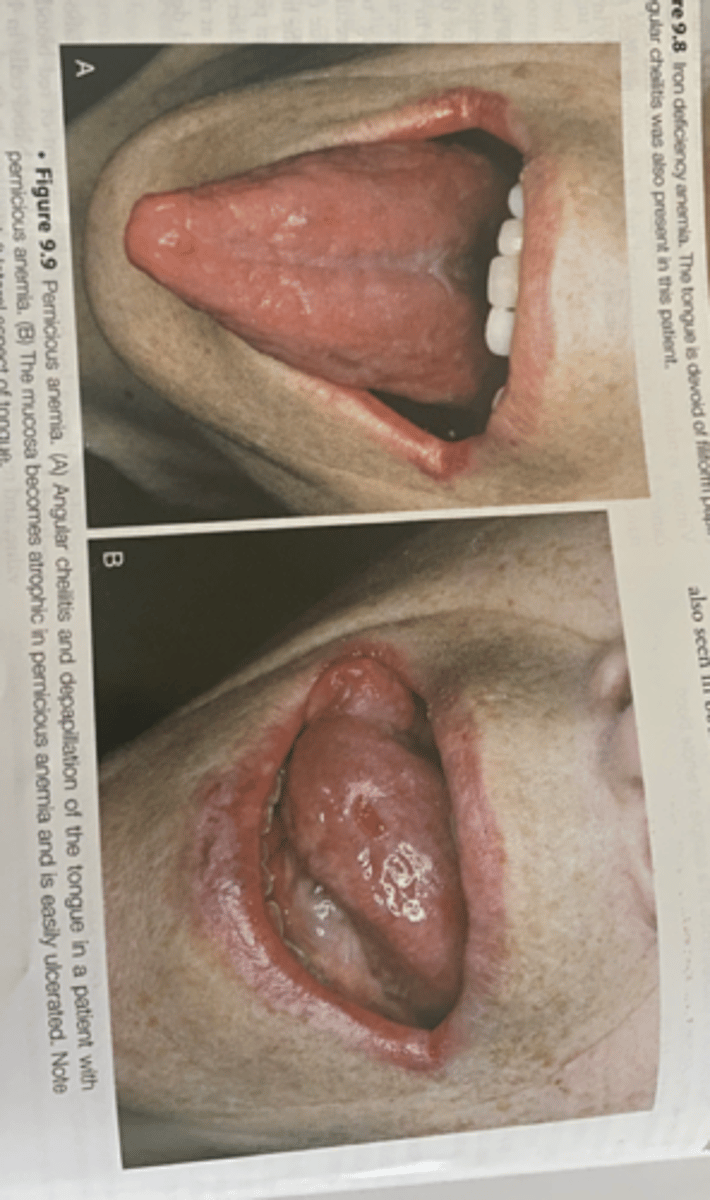
<p><br><span>-Vitamin B12 deficiency that is caused by a deficiency of intrinsic factors a substance secreted by the parietal cells of the stomach</span></p>
10
New cards

sickle cell anemia


-abnormal trabeculation

-most common inherited disorder of red blood cells
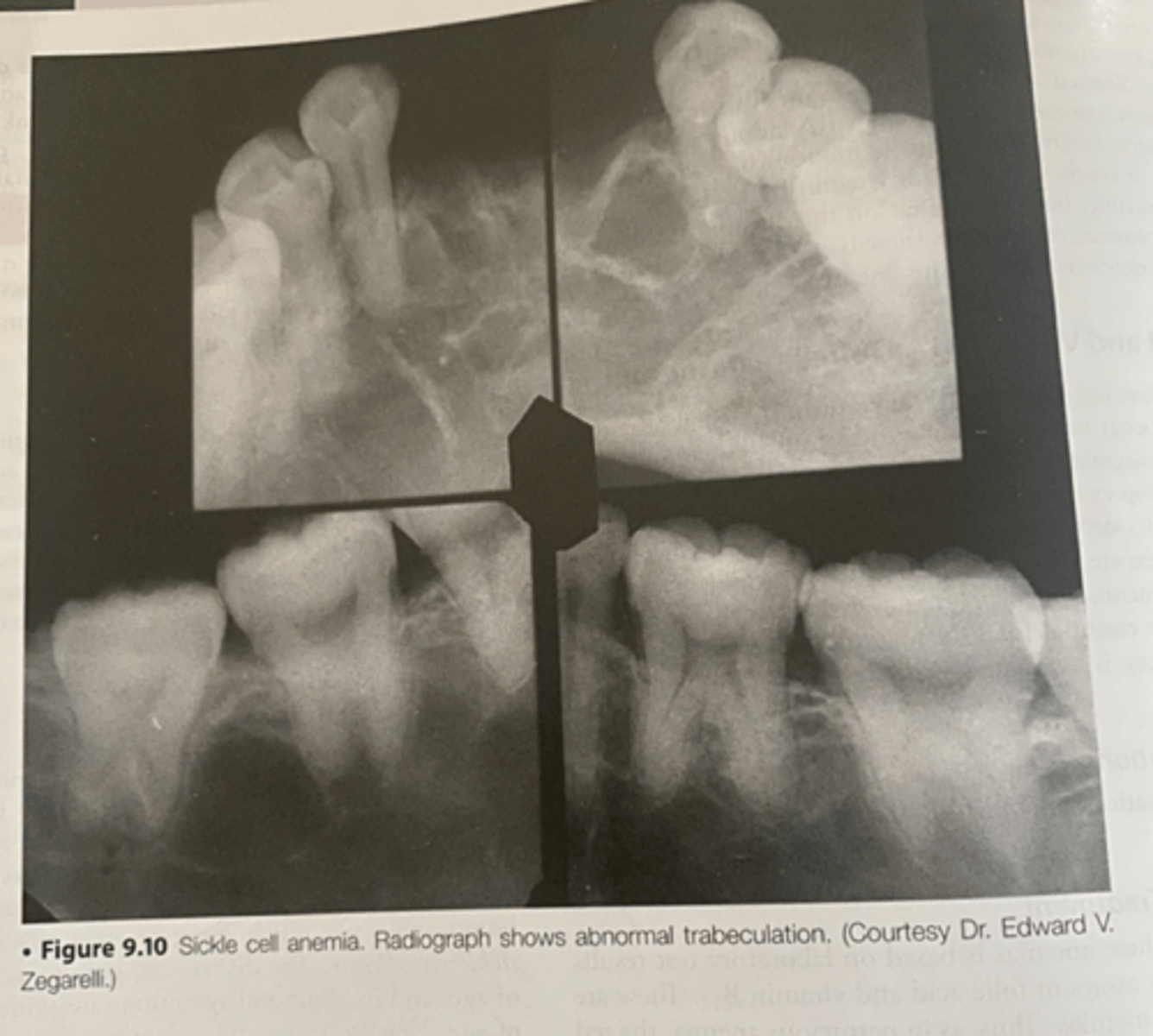
<p><br>-abnormal trabeculation</p><p>-most common inherited disorder of red blood cells</p>
11
New cards

Verrucous Carcinoma

-commissure and anterior buccal mucosa

-is a specific type of squamous cell carcinoma that is separated from other squamous cell carcinoma because it has a much better prognosis

-appears as a slow growing exophytic tumor with a pebbly white and red surface

-most cases occurs in men older than 55 years of age and involves the vestibule and buccal mucosa
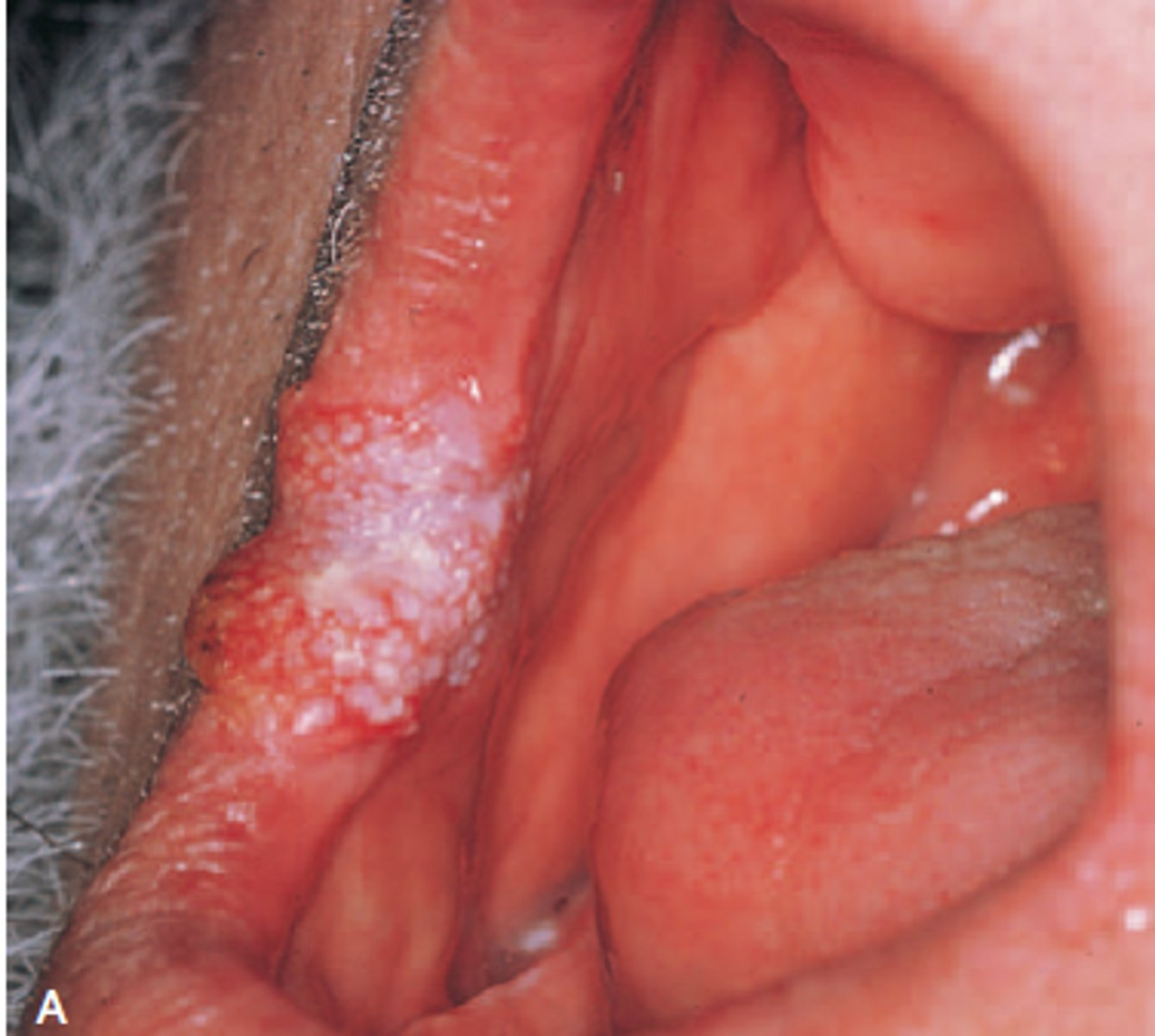
<p>-commissure and anterior buccal mucosa</p><p>-is a specific type of squamous cell carcinoma that is separated from other squamous cell carcinoma because it has a much better prognosis</p><p>-appears as a slow growing exophytic tumor with a pebbly white and red surface</p><p>-most cases occurs in men older than 55 years of age and involves the vestibule and buccal mucosa</p>
12
New cards

ameloblastomas B

-show multilocular radiolucencies in the molar areas if the mandible

-is benign, slow growing but locally aggressive epithelial odontogenic tumor that may arise in either the maxilla or the mandible

-it is a non encapsulated tumor that infiltrates into surrounding tissue and can cause extensive destruction
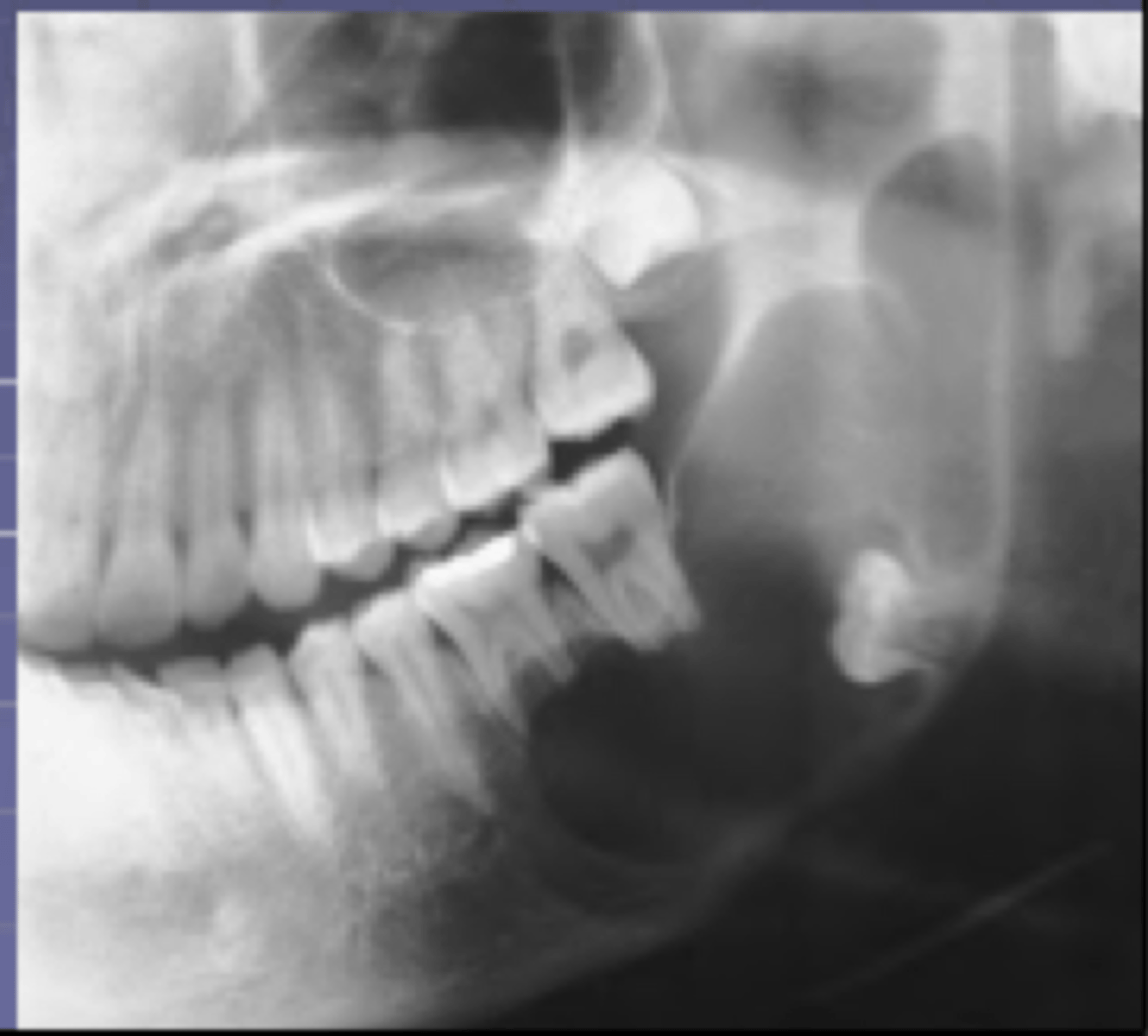
<p>-show multilocular radiolucencies in the molar areas if the mandible</p><p>-is benign, slow growing but locally aggressive epithelial odontogenic tumor that may arise in either the maxilla or the mandible</p><p>-it is a non encapsulated tumor that infiltrates into surrounding tissue and can cause extensive destruction</p>
13
New cards

Benign Cementoblastoma


-shows a well circumscribed radiopaque mass surrounded by a radiolucent halo and attached to the root of a mandibular first molar

-pain is a frequent symptom

-occurs in young adults and most occur in patients under 30
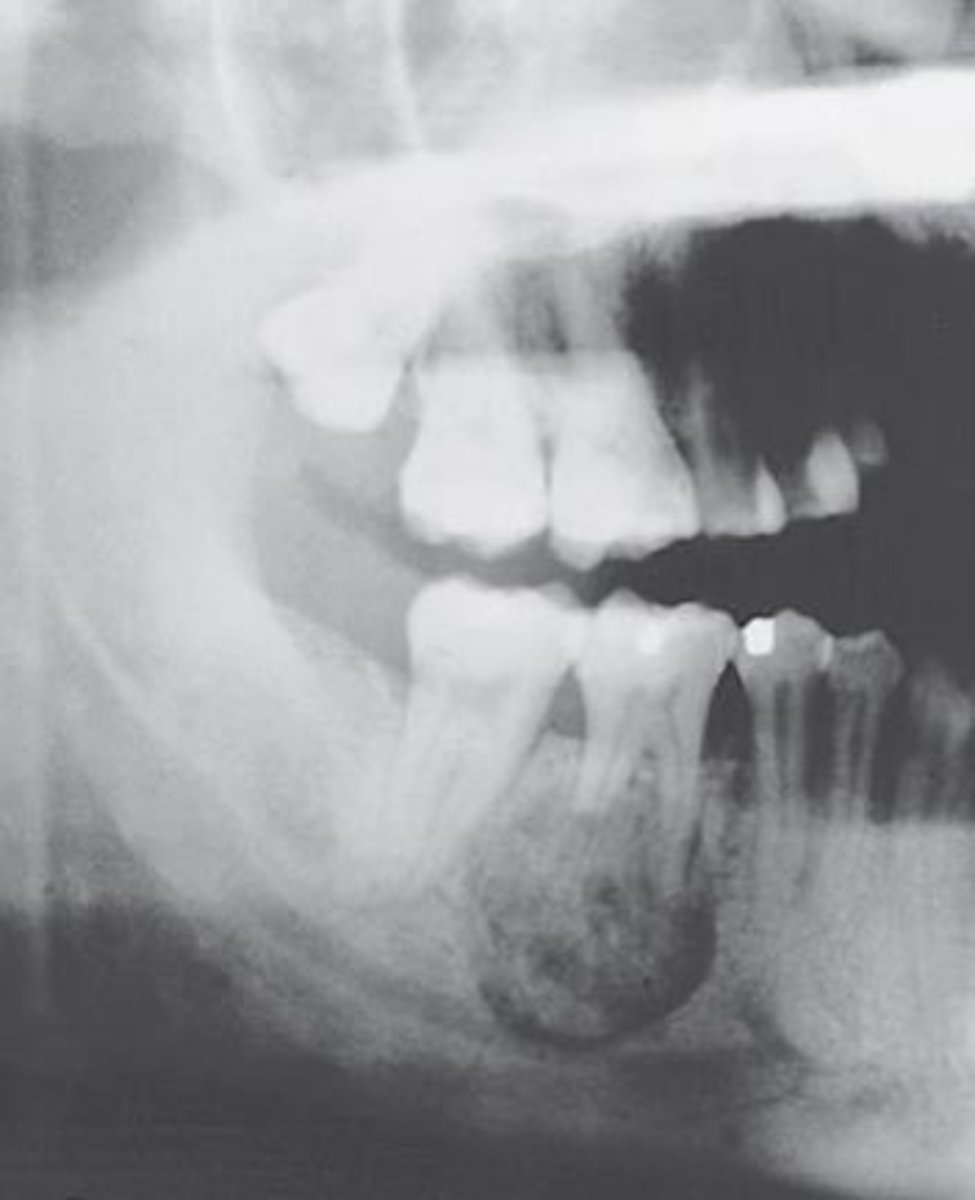
<p><br>-shows a well circumscribed radiopaque mass surrounded by a radiolucent halo and attached to the root of a mandibular first molar</p><p>-pain is a frequent symptom</p><p>-occurs in young adults and most occur in patients under 30</p>
14
New cards

paget disease

-enlargement of the maxilla with spaces between the teeth

-radiograph demonstrating irregular opacification that is also referred to as a cotton wool appearance
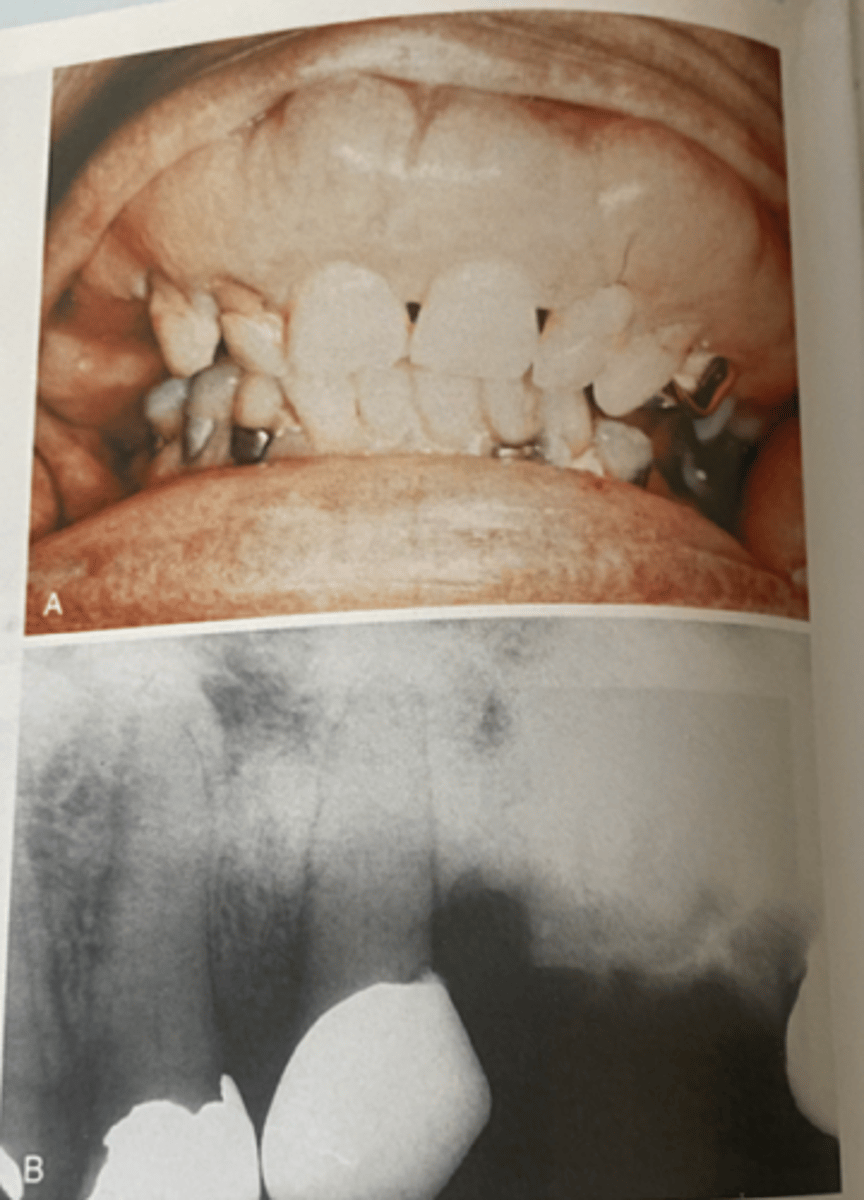
<p>-enlargement of the maxilla with spaces between the teeth</p><p>-radiograph demonstrating irregular opacification that is also referred to as a cotton wool appearance</p>
15
New cards

Calcifying Odontogenic Cyst


-composed of odontogenic epithelium that contains "ghost cells"

-also referred to as gorlin cyst

-most commonly seen individuals younger than 40 years

-lesions occur equally in the maxilla and mandible, most often in the incisor and cuspid area

-present as well defined unilocular or multilocular radiolucency
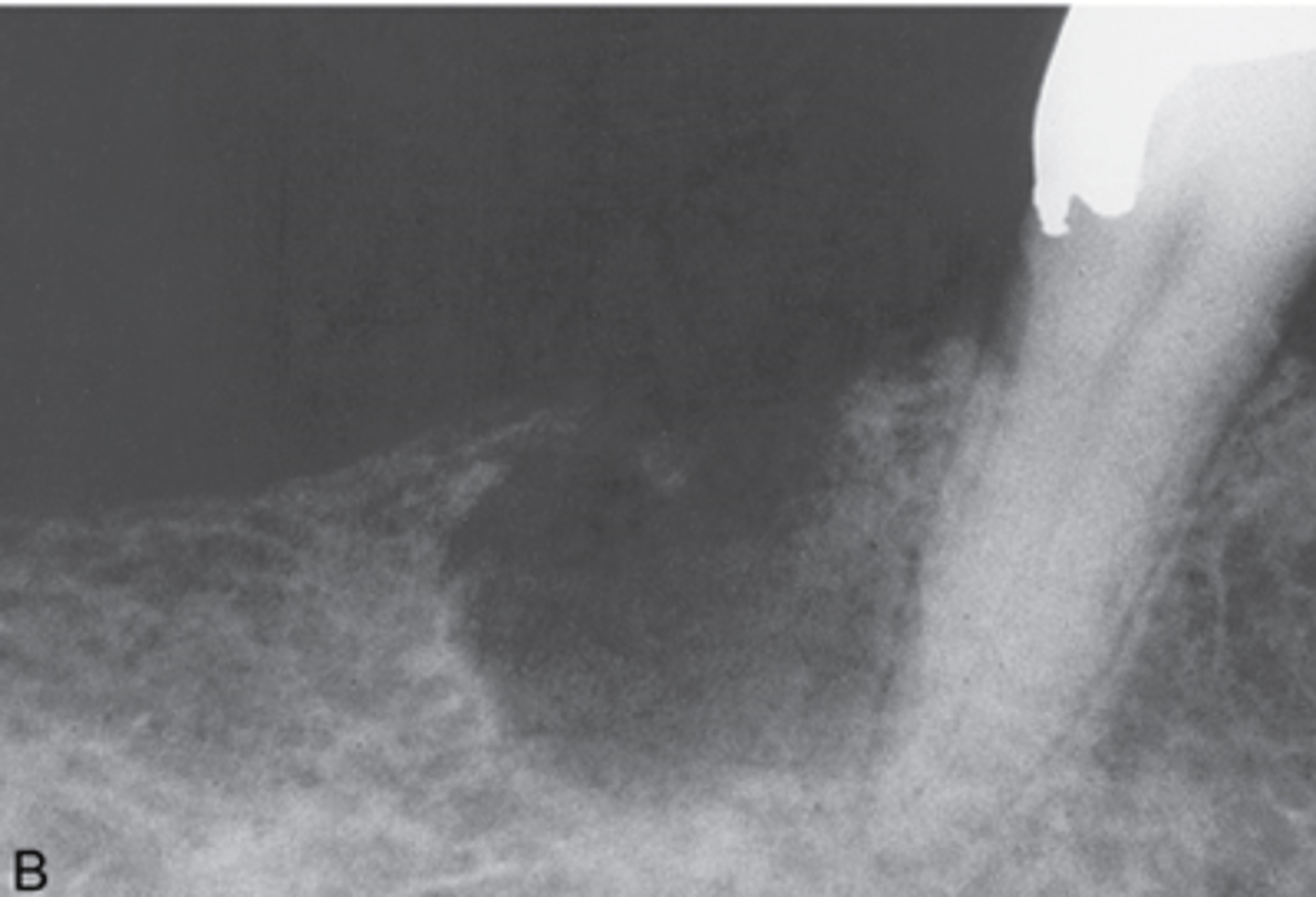
<p><br>-composed of odontogenic epithelium that contains "ghost cells"</p><p>-also referred to as gorlin cyst</p><p>-most commonly seen individuals younger than 40 years</p><p>-lesions occur equally in the maxilla and mandible, most often in the incisor and cuspid area</p><p>-present as well defined unilocular or multilocular radiolucency</p>
16
New cards

Mottled enamel- fluorosis

Discoloration of enamel from high fluoride intake


The patient in this image is healthy with no local or systemic infection or disease. The patient's teeth are caries free, as are all of the teeth of all of the patients who exhibit this defect. What is this condition?
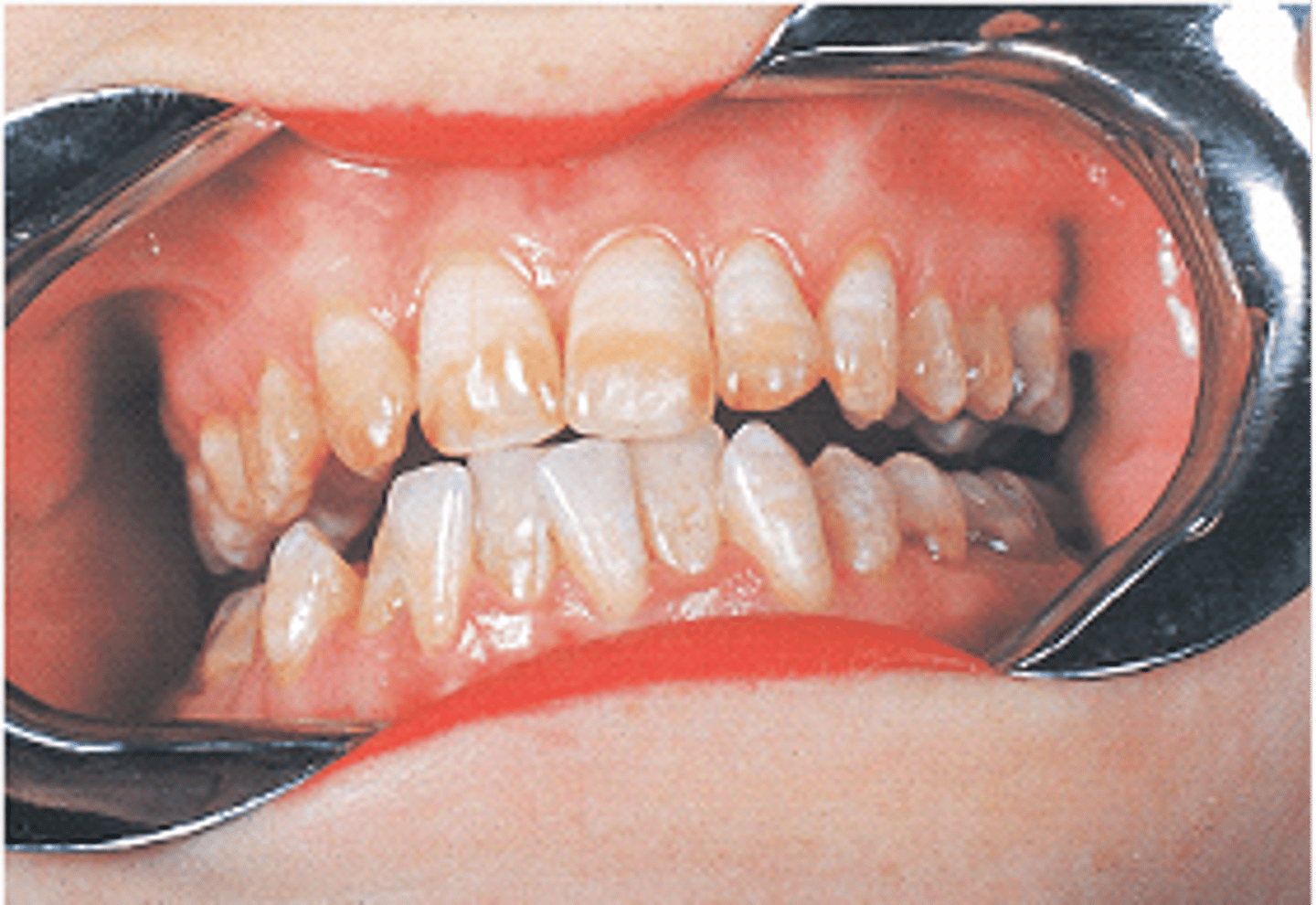
<p>Discoloration of enamel from high fluoride intake</p><p><br><span>The patient in this image is healthy with no local or systemic infection or disease. The patient's teeth are caries free, as are all of the teeth of all of the patients who exhibit this defect. What is this condition?</span></p>
17
New cards

Lichen Planus


Benign, chronic disease that affects the skin and oral mucosa

-White lines= Wickham Striae

The classic appearance of lichen planus affecting the oral mucosa is a pattern of interconnecting slender white lines referred to as?
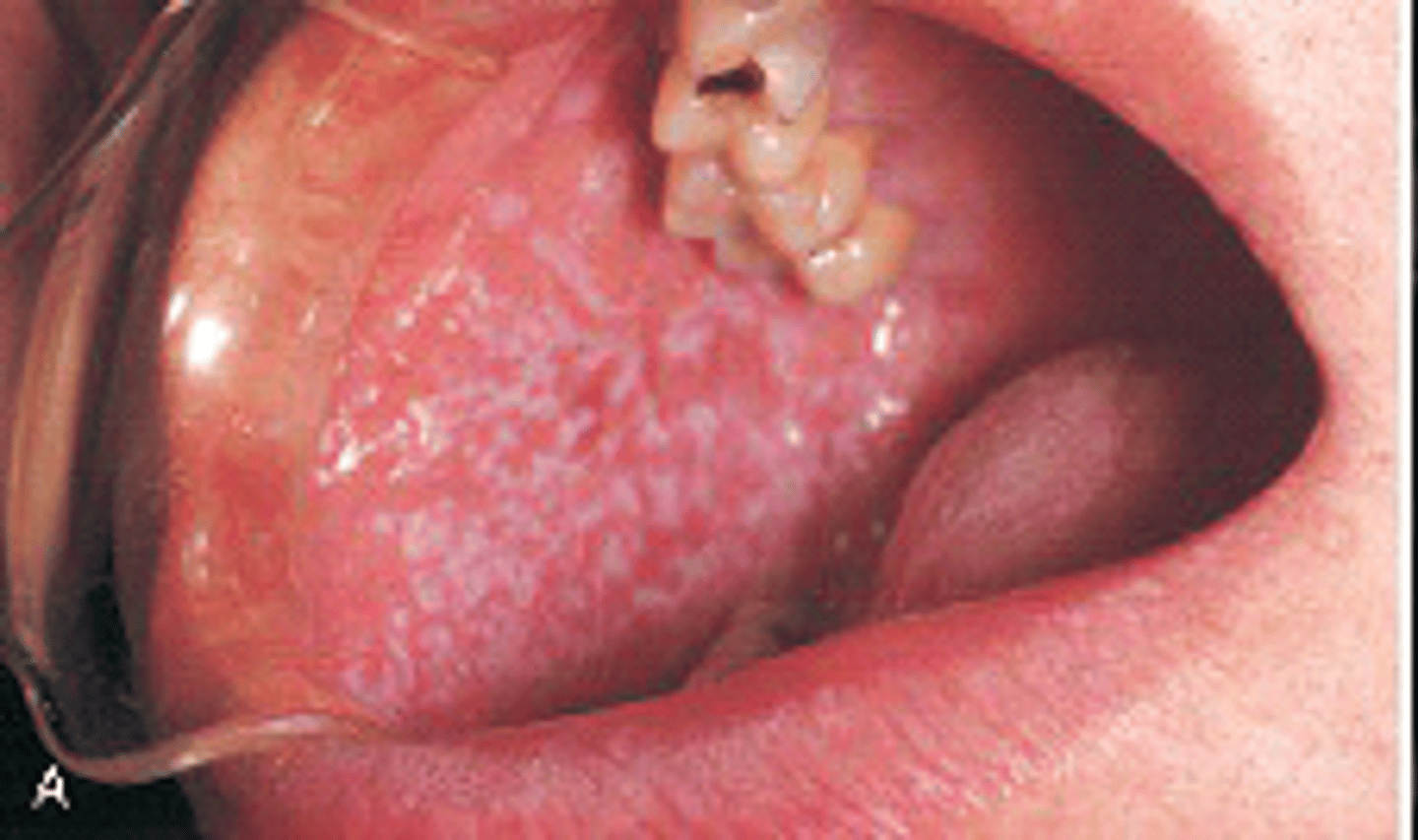
<p><br>Benign, chronic disease that affects the skin and oral mucosa</p><p>-White lines= Wickham Striae</p><p><span>The classic appearance of lichen planus affecting the oral mucosa is a pattern of interconnecting slender white lines referred to as?</span></p>
18
New cards

Abfraction

loss of tooth surface in the cervical area, caused by tooth grinding compression forces


What are these wedge-shaped defects at the cervicofacial surfaces of these teeth called?
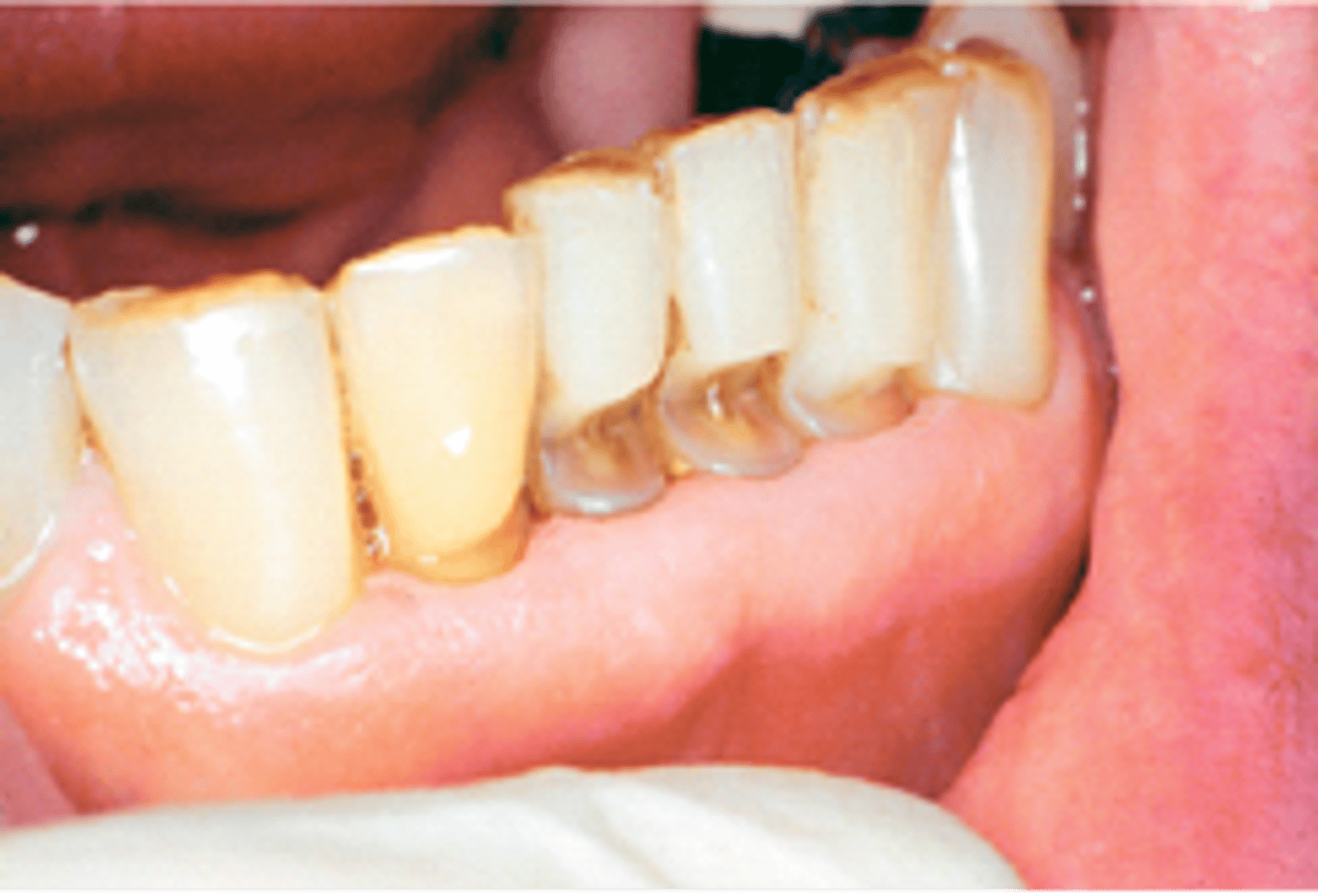
<p>loss of tooth surface in the cervical area, caused by tooth grinding compression forces</p><p><br><span>What are these wedge-shaped defects at the cervicofacial surfaces of these teeth called?</span></p>
19
New cards

Kaposi sarcoma (KS)


Cancer caused by the human herpes virus 8 (HHV-8) that mainly affects the skin and mucous membranes but may also cause extensive visceral organ involvement; also called malignant neoplasm of soft tissue
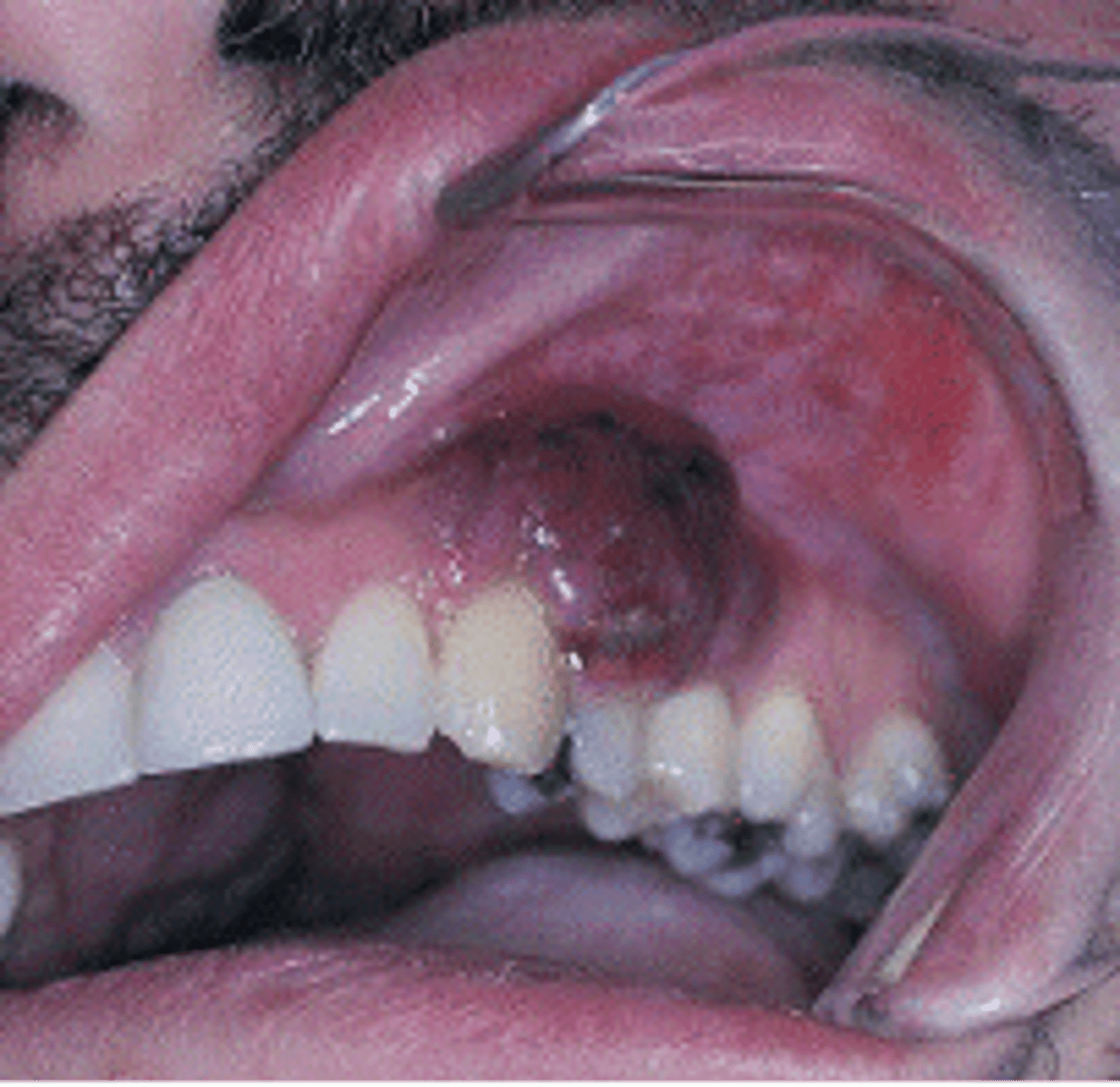
<p><br><span>Cancer caused by the human herpes virus 8 (HHV-8) that mainly affects the skin and mucous membranes but may also cause extensive visceral organ involvement; also called malignant neoplasm of soft tissue</span></p>
20
New cards

Gingival Enlargement by a calcium channel Blocker

Seen by a patient taking nifedipine (Ca Channel blocker)
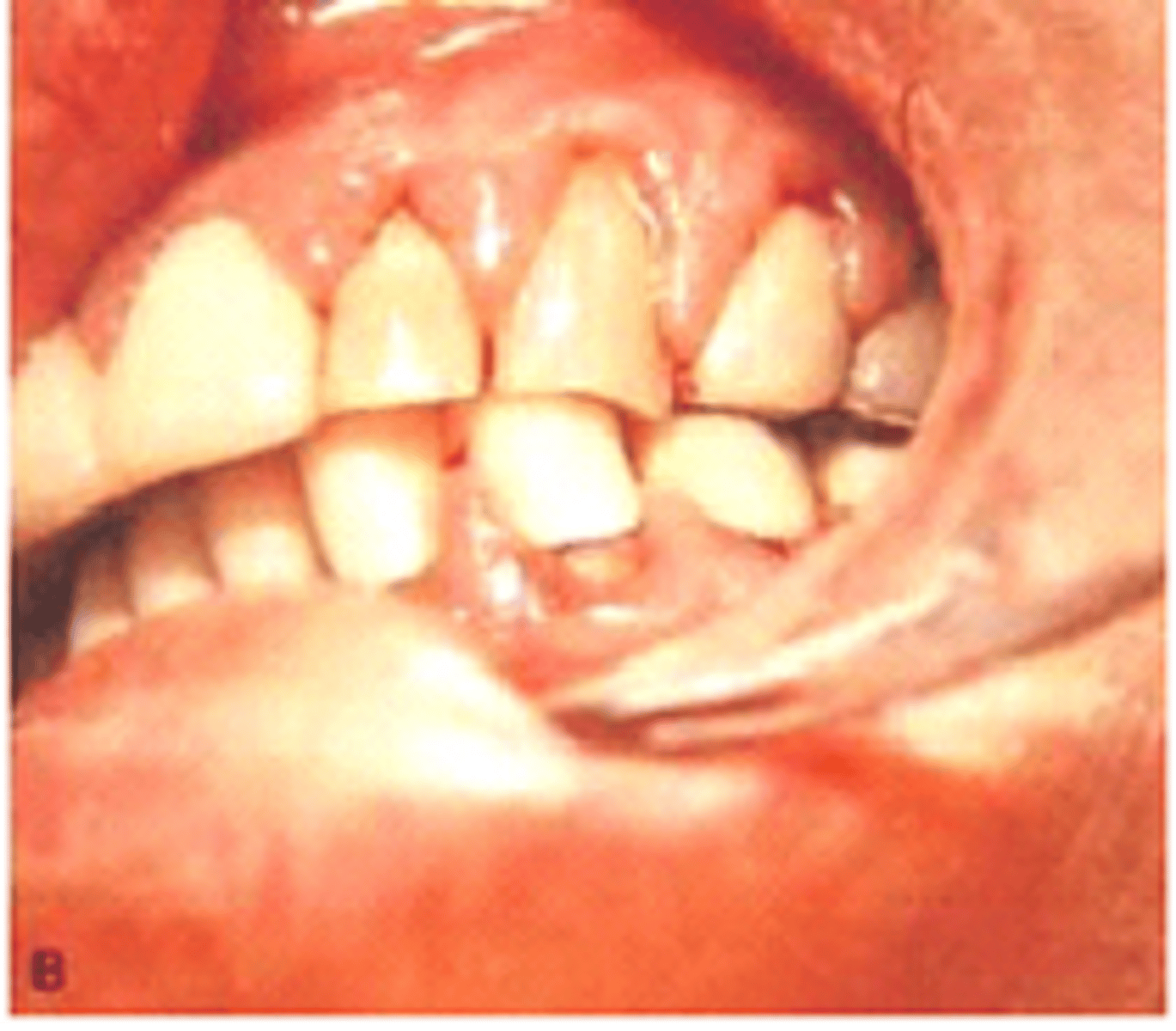
<p><span>Seen by a patient taking nifedipine (Ca Channel blocker)</span></p>
21
New cards

Concrescence

Union of teeth by cementum

What is it called when two or more teeth are joined by cementum?
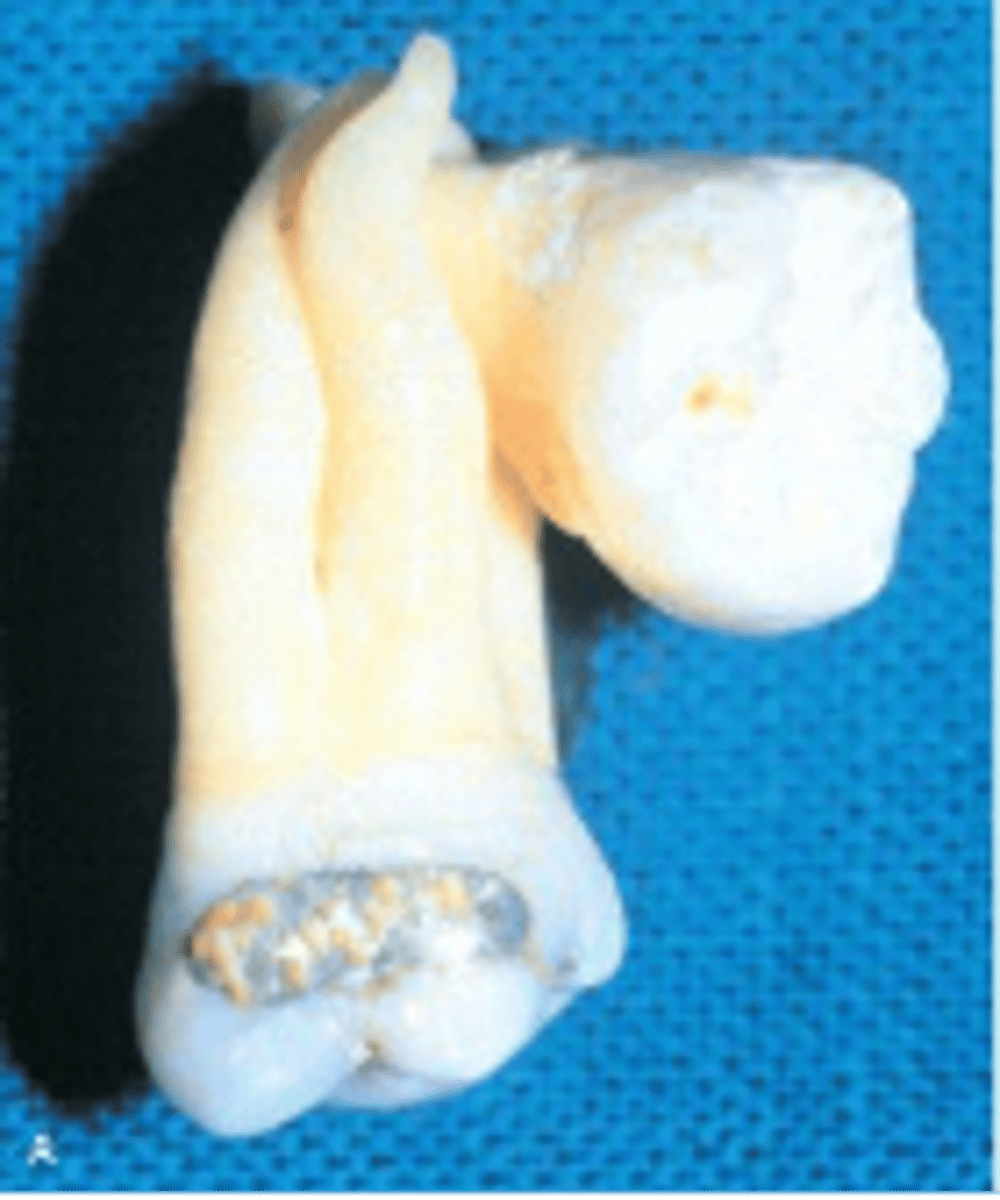
<p>Union of teeth by cementum</p><p><span>What is it called when two or more teeth are joined by cementum?</span></p>
22
New cards

NUG (Necrotizing Ulcerative Gingivits)

Fusiform bacillus and Spirochete cause this, cratered papilla, and white tissue because of cell death

This patient presents with painful, erythematous gingiva and the interdental papillae appear as punched-out, necrotic, cratered areas. Sloughing of necrotic tissue presents as a pseudomembrane over the tissues. What condition do you suspect?
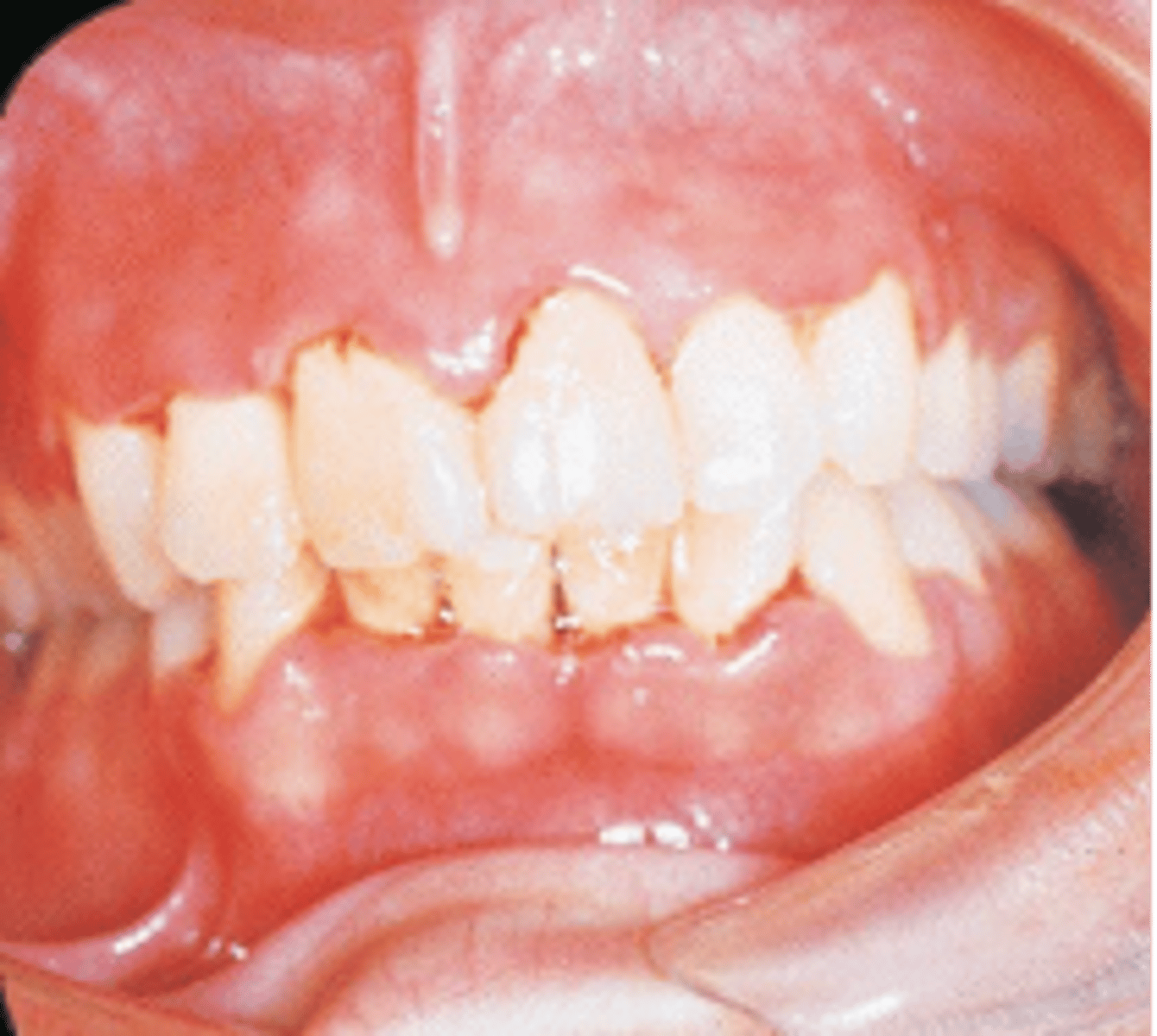
<p>Fusiform bacillus and Spirochete cause this, cratered papilla, and white tissue because of cell death</p><p><span>This patient presents with painful, erythematous gingiva and the interdental papillae appear as punched-out, necrotic, cratered areas. Sloughing of necrotic tissue presents as a pseudomembrane over the tissues. What condition do you suspect?</span></p>
23
New cards

Trisomy 13 (Patau Syndrome)


-abnormalities in multiple organs
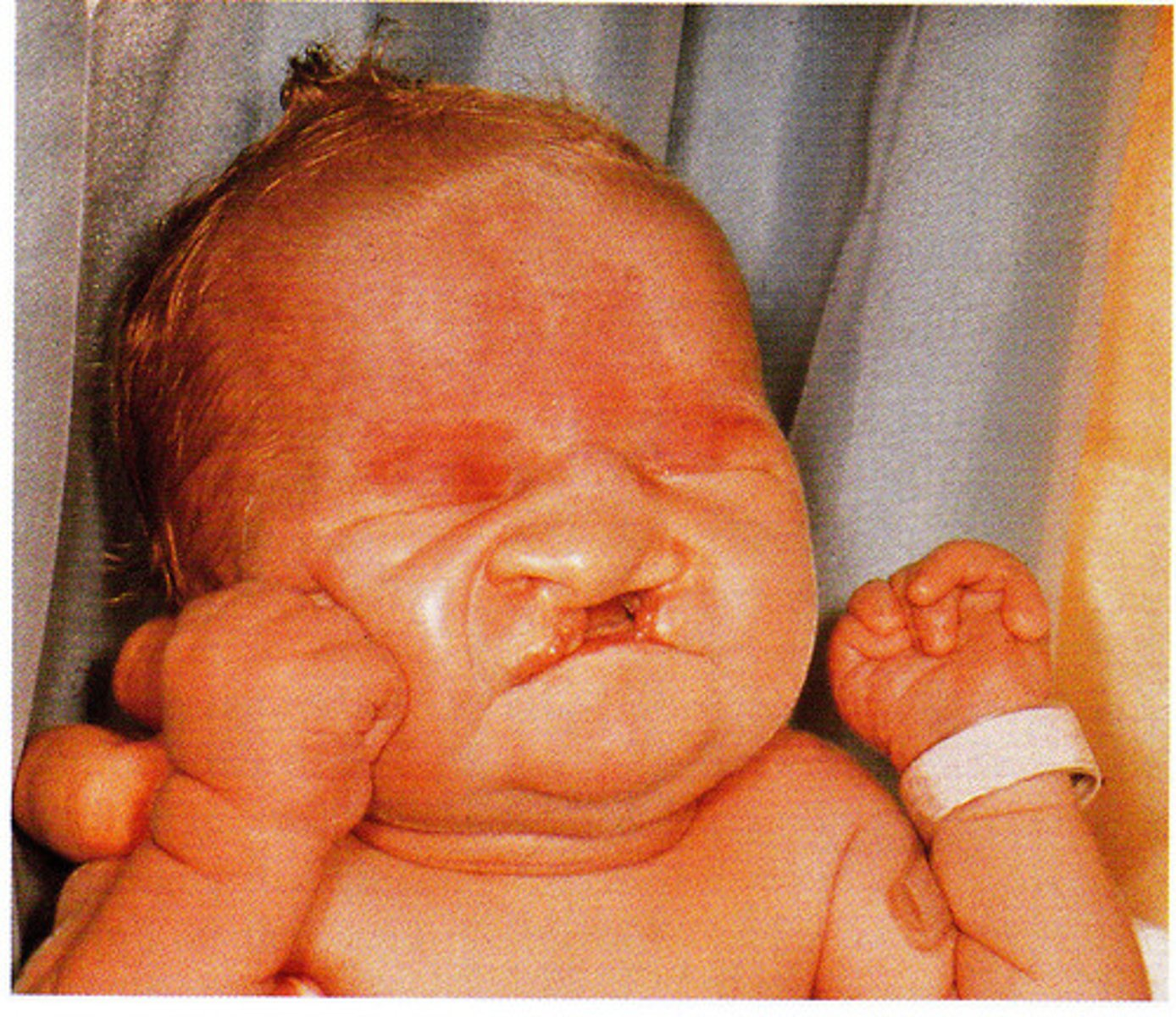
<p><br><span>-abnormalities in multiple organs</span></p>
24
New cards

turner syndrome

-webbing of the neck

-caused by patient has only one X chromosome or monosomy X
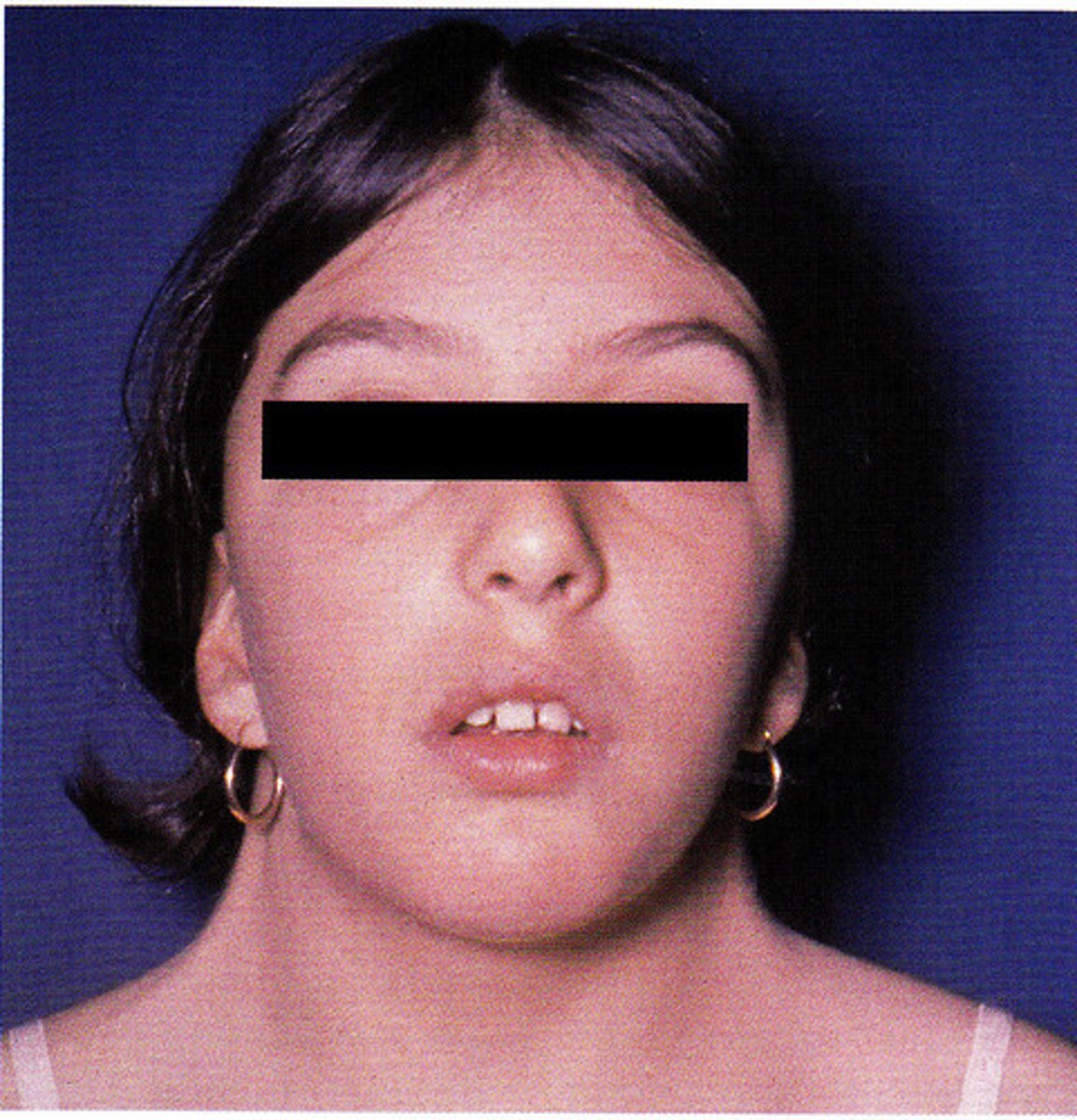
<p>-webbing of the neck</p><p>-caused by patient has only one X chromosome or monosomy X</p>
25
New cards

Papillon-Lefevre Syndrome


-lesion of the hand remain reddish white scaly, thick areas of hyperkeratinization

-autosomal-recessive inheritance
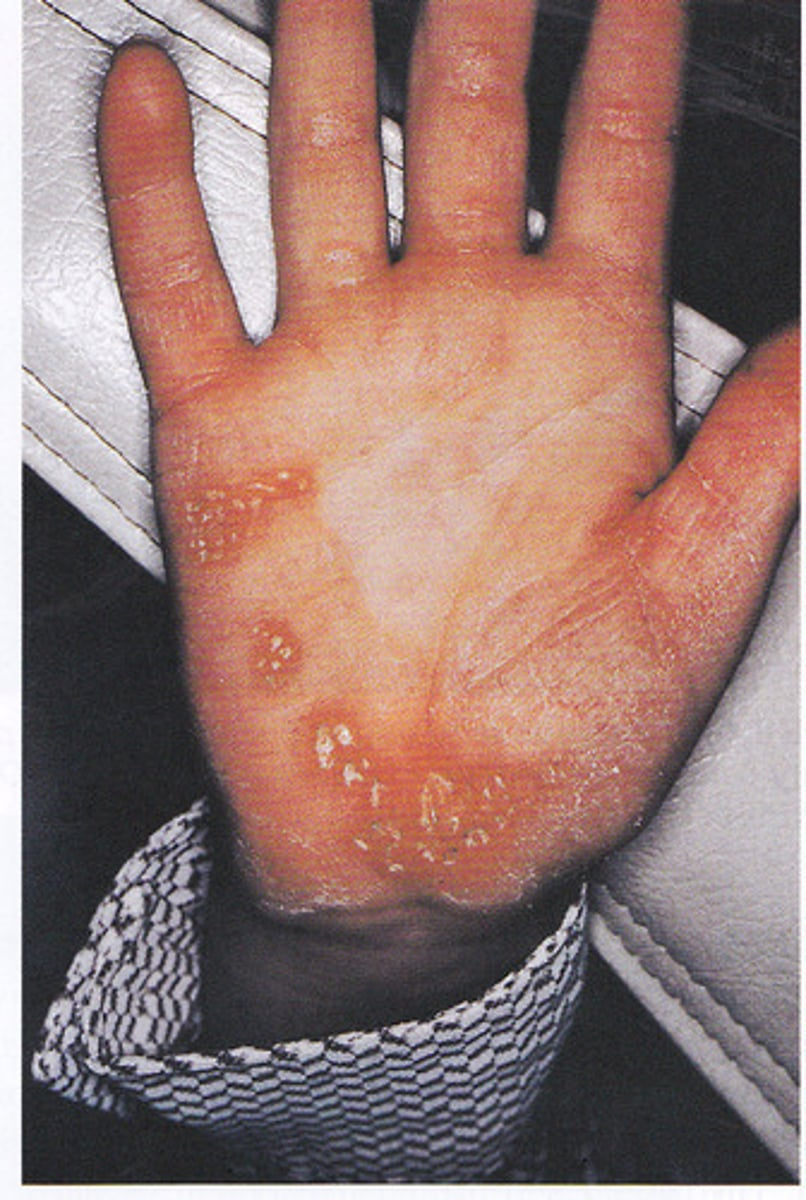
<p><br>-lesion of the hand remain reddish white scaly, thick areas of hyperkeratinization</p><p>-autosomal-recessive inheritance</p>
26
New cards

Cyclic Neutropenia


-by decrease in the number of circulating neutrophilic leukocytes, white blood cells help fight infection and remodel the body.

-autosomal dominant
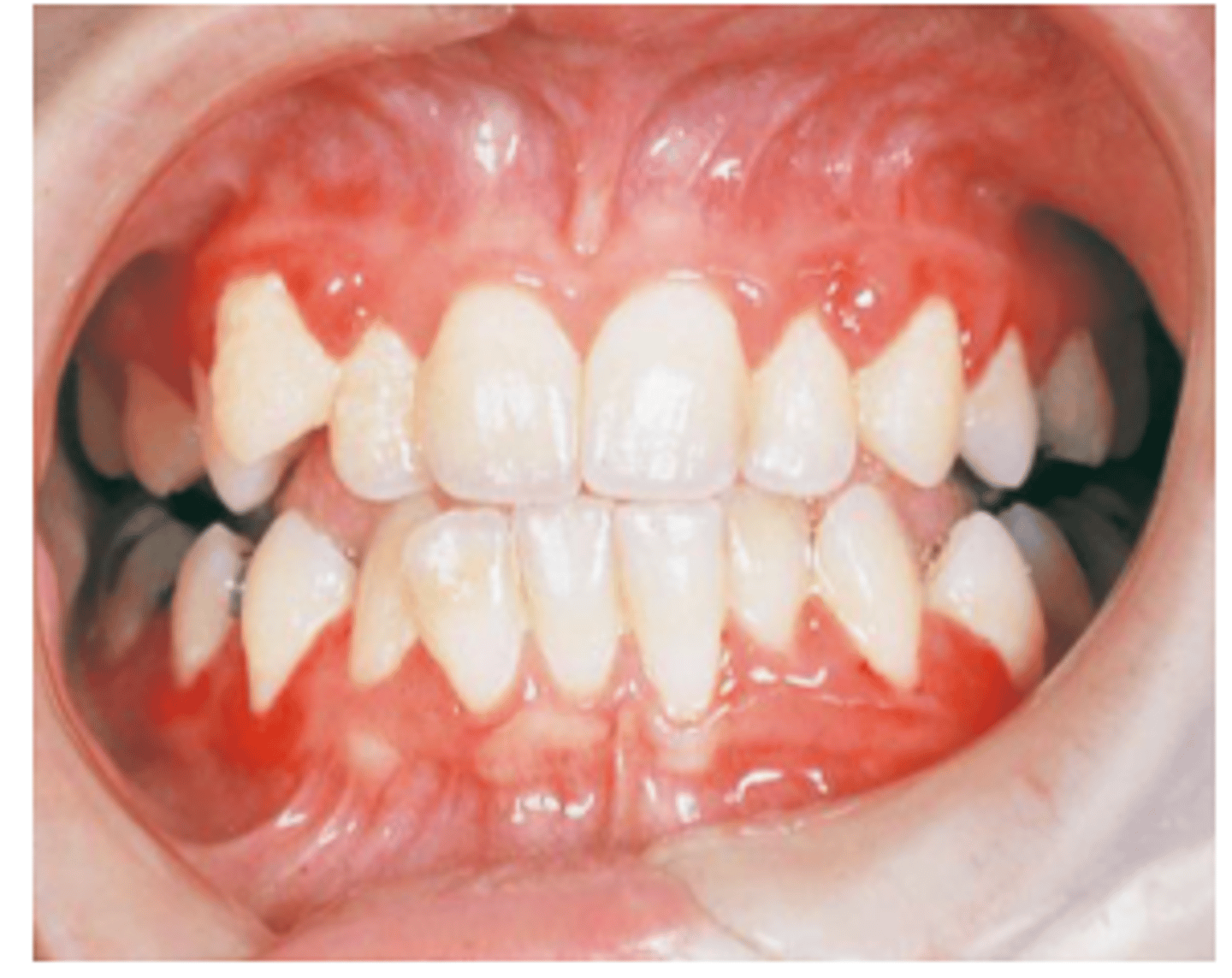
<p><br>-by decrease in the number of circulating neutrophilic leukocytes, white blood cells help fight infection and remodel the body.</p><p>-autosomal dominant</p>
27
New cards

cleidocranial dysplasia


-multiple extracted supernumerary teeth rom the patient with cleidocranial dysplasia

-results in cranium developing into a mushroom shape because the fontanelles remain open

-the premaxilla is generally underdeveloped
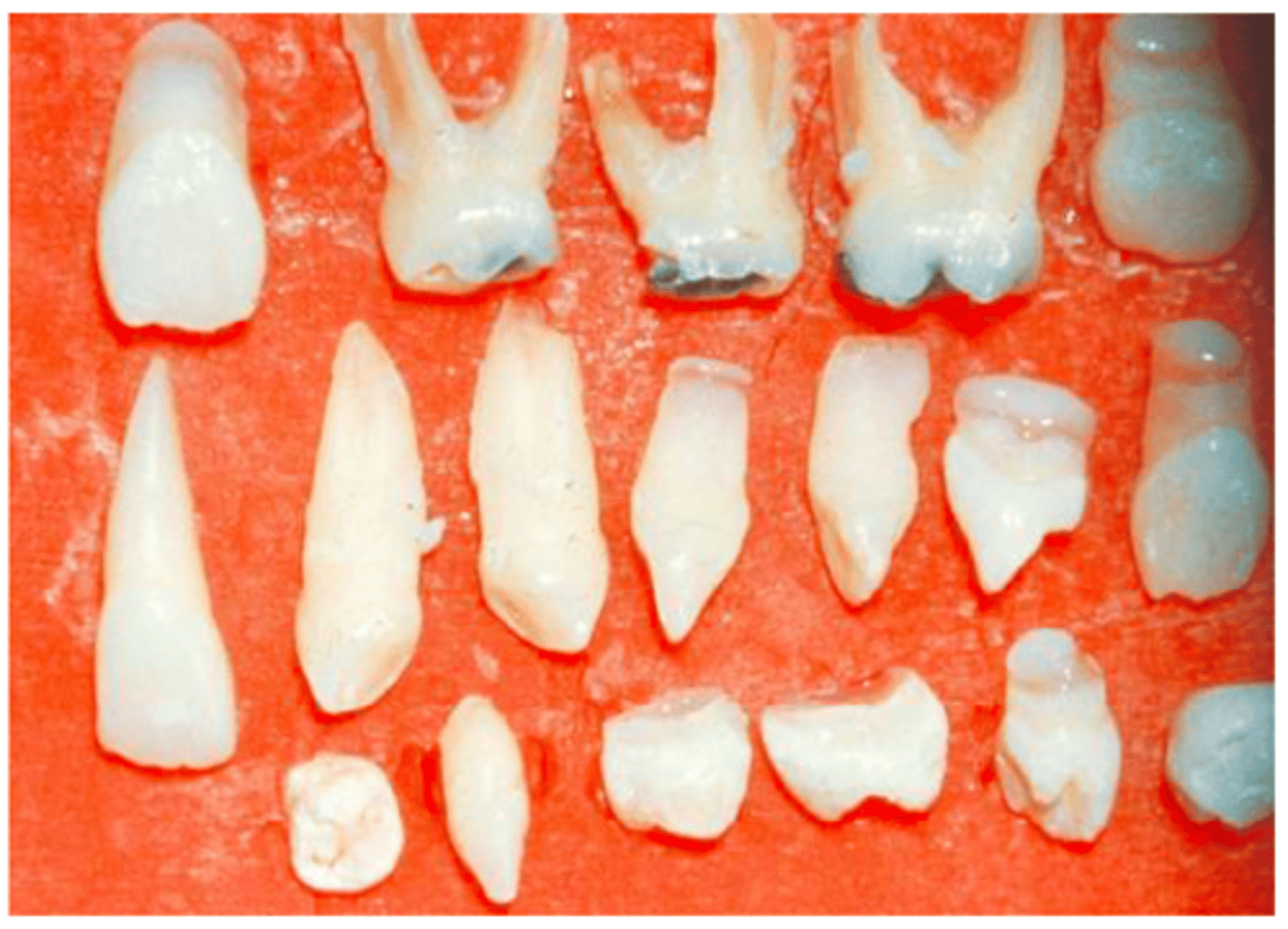
<p><br>-multiple extracted supernumerary teeth rom the patient with cleidocranial dysplasia</p><p>-results in cranium developing into a mushroom shape because the fontanelles remain open</p><p>-the premaxilla is generally underdeveloped</p>
28
New cards

cherubism


-bilateral facial swelling that appears when the patient is between 1.5 and 4 years of age

-soap bubble appearance
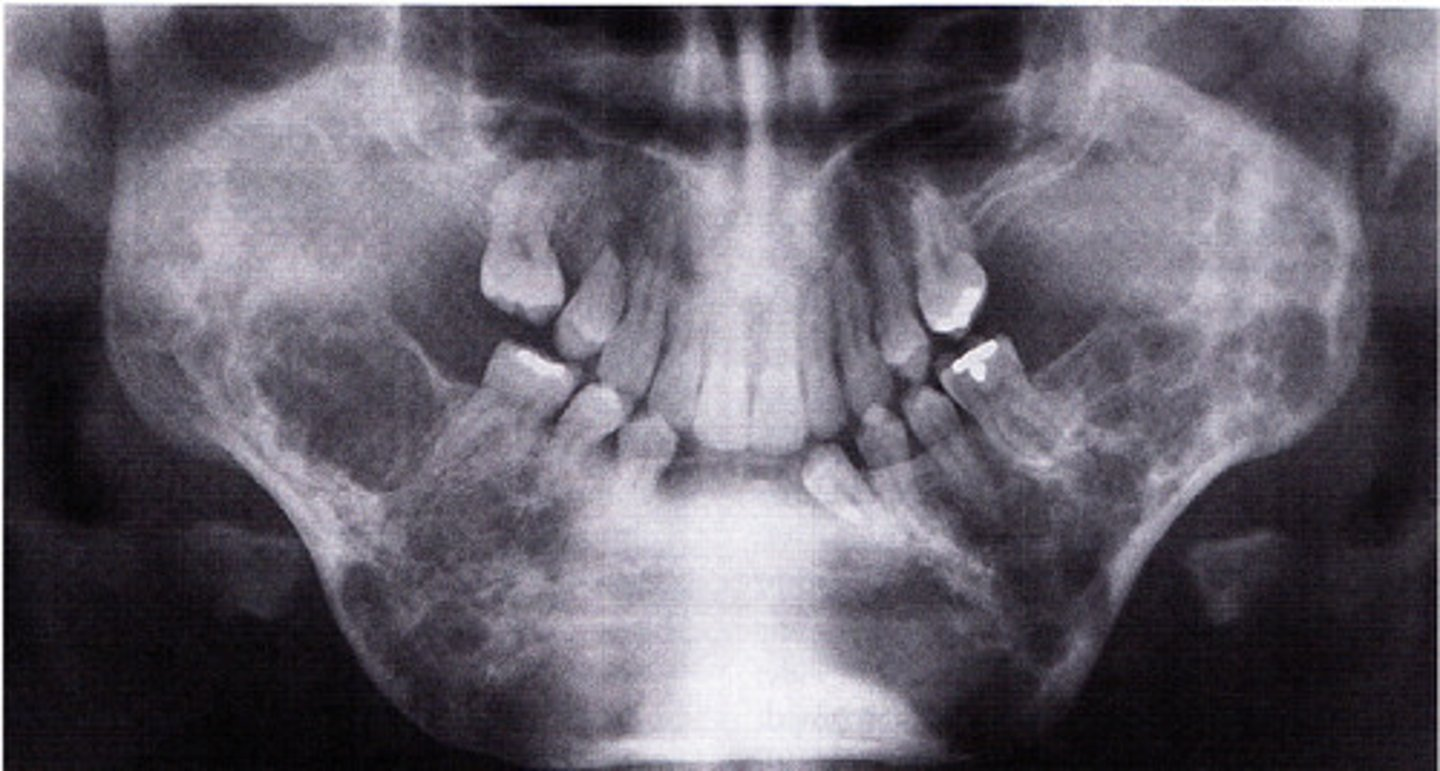
<p><br>-bilateral facial swelling that appears when the patient is between 1.5 and 4 years of age</p><p>-soap bubble appearance</p>
29
New cards

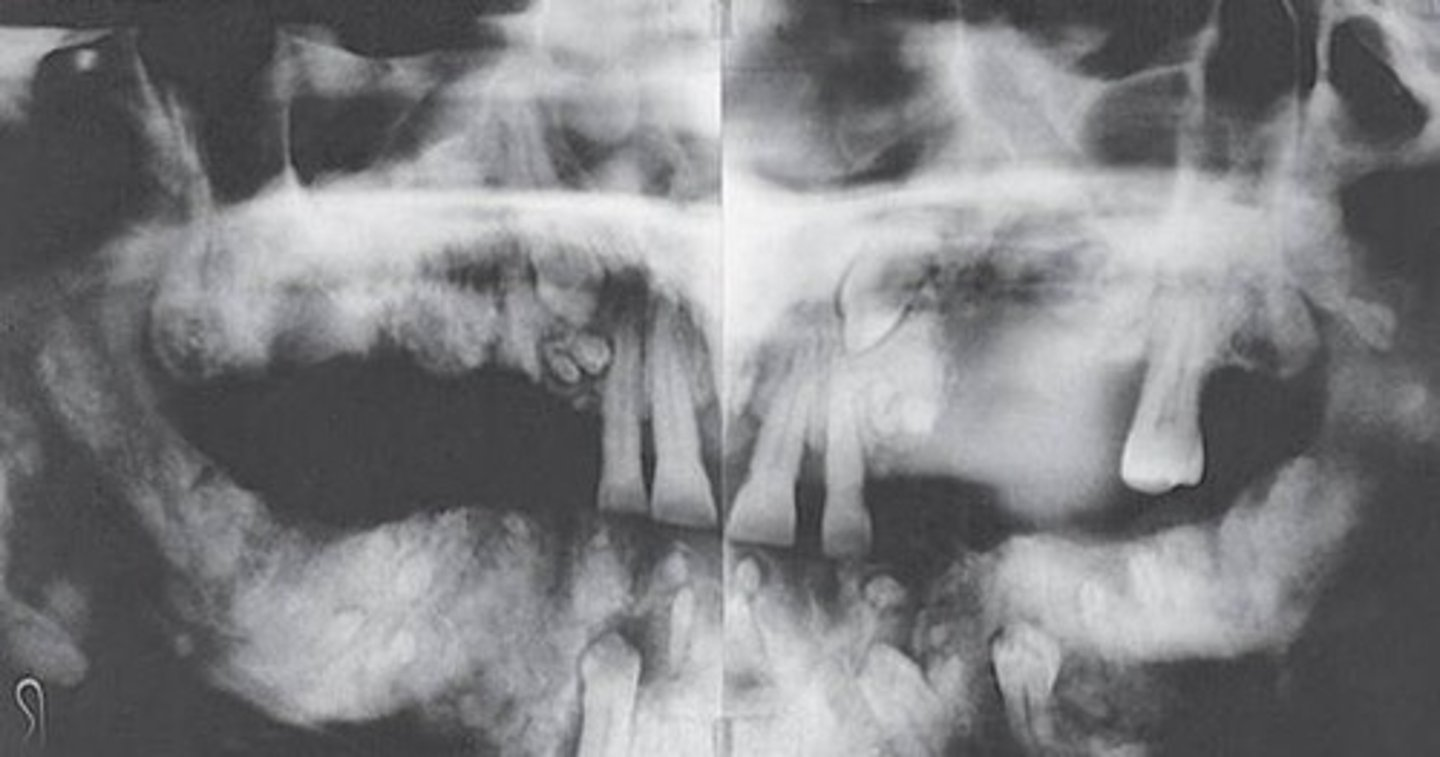
Gardner syndrome

-panoramic radiograph of patient with gardner syndrome shows multiple osteomas and odontomas

-also known as familial adenomatous polyposis

-benign bone growths

-teeth can exhibit hypercementosis and fail to erupt
<p>-panoramic radiograph of patient with gardner syndrome shows multiple osteomas and odontomas</p><p>-also known as familial adenomatous polyposis</p><p>-benign bone growths</p><p>-teeth can exhibit hypercementosis and fail to erupt</p>
30
New cards

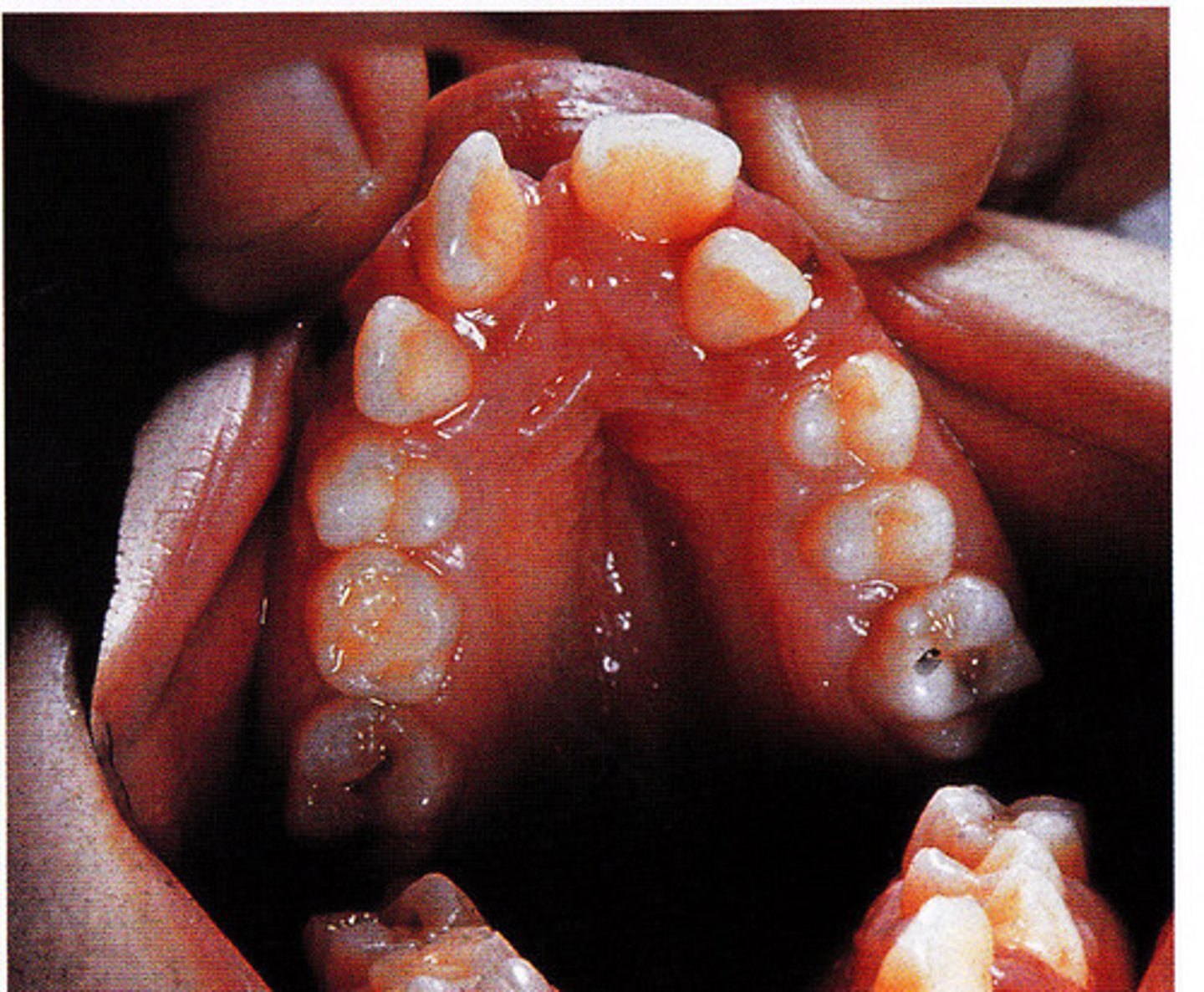
Mandibulofacial Dysostosis


-markedly high-arched palate and malpositioned teeth in a patient with mandibulofacial dysostosis

-also known as treacher collins syndrome

-results in a dysmorphic face, including downward sloping of the palpebral fissures.

-mouth appears fishlike
<p><br>-markedly high-arched palate and malpositioned teeth in a patient with mandibulofacial dysostosis</p><p>-also known as treacher collins syndrome</p><p>-results in a dysmorphic face, including downward sloping of the palpebral fissures.</p><p>-mouth appears fishlike</p>
31
New cards

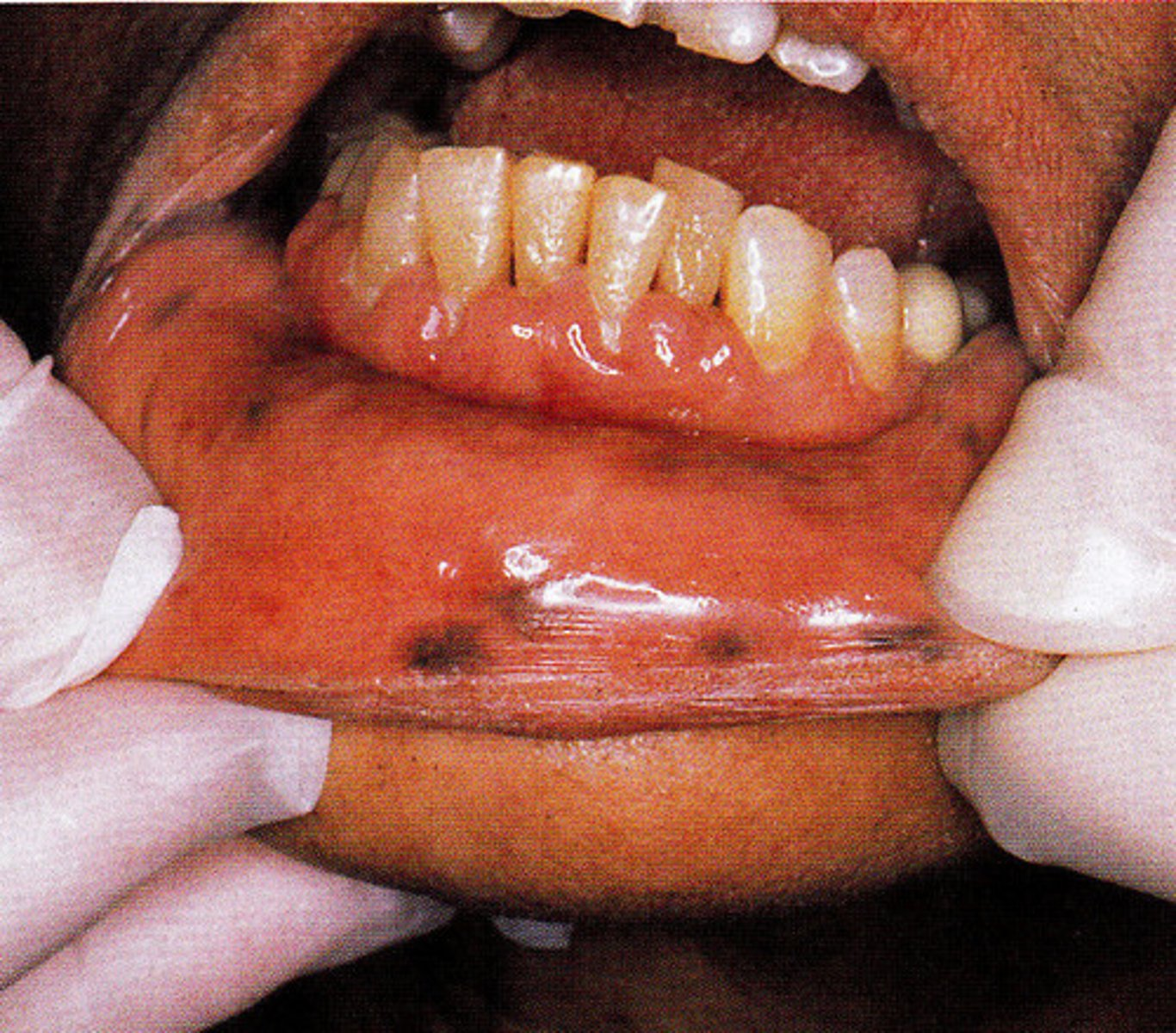
Peutz-Jeghers syndrome

-multiple small to medium sized pigmented macules on the labial mucosa of a patient with peutz-jeghers syndrome

-also known as hereditary intestinal polyposis syndrome

-pigmentation occurs around the eyes, nose and mouth

-associated with gastrointestinal polyposis
<p>-multiple small to medium sized pigmented macules on the labial mucosa of a patient with peutz-jeghers syndrome</p><p>-also known as hereditary intestinal polyposis syndrome</p><p>-pigmentation occurs around the eyes, nose and mouth</p><p>-associated with gastrointestinal polyposis</p>
32
New cards

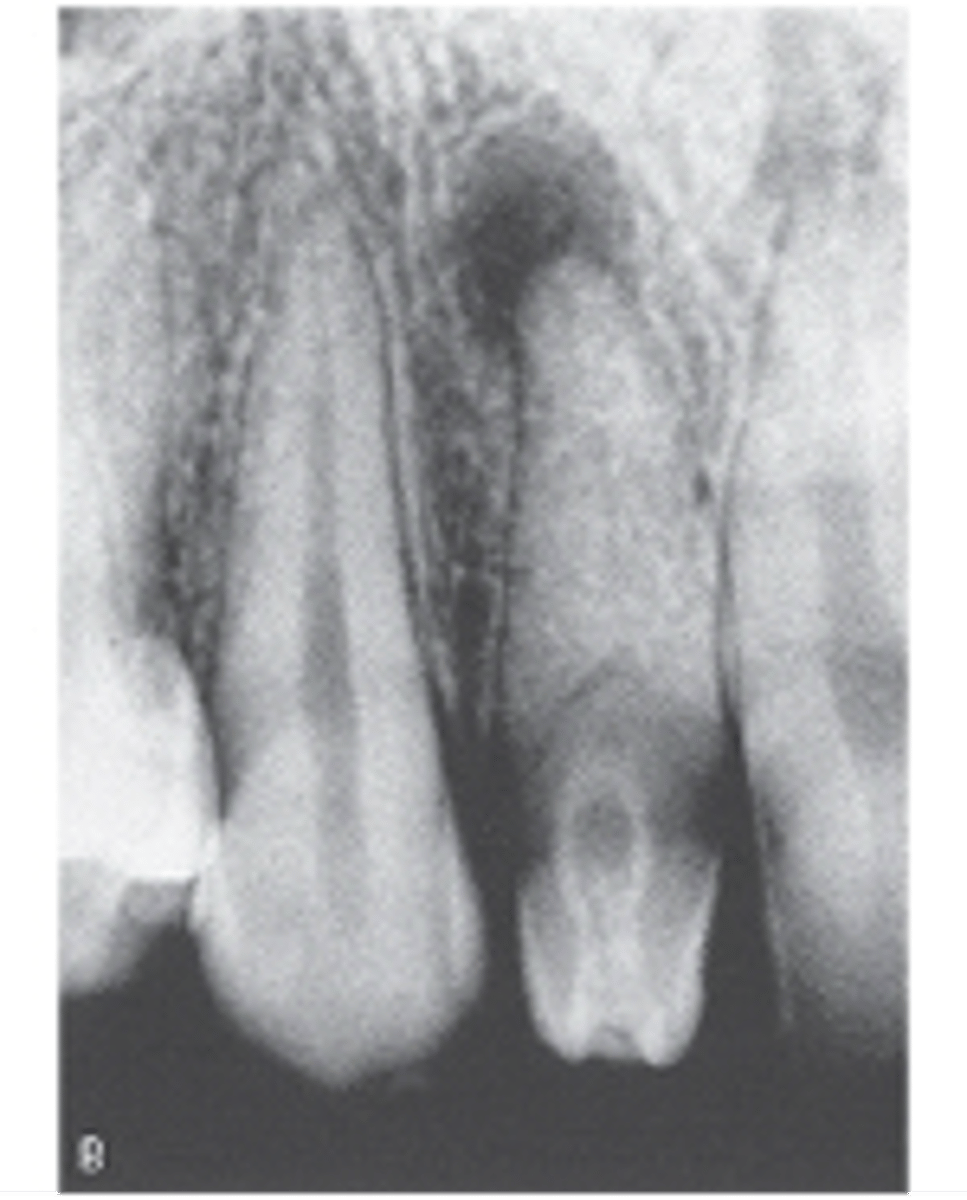
dens invaginants aka dens in dente


-tooth within a tooth


The most common location for this developmental anomaly is the maxillary lateral. What is this anomaly called?
<p></p><p><br></p><p>-tooth within a tooth</p><p><br><span>The most common location for this developmental anomaly is the maxillary lateral. What is this anomaly called?</span></p>
33
New cards

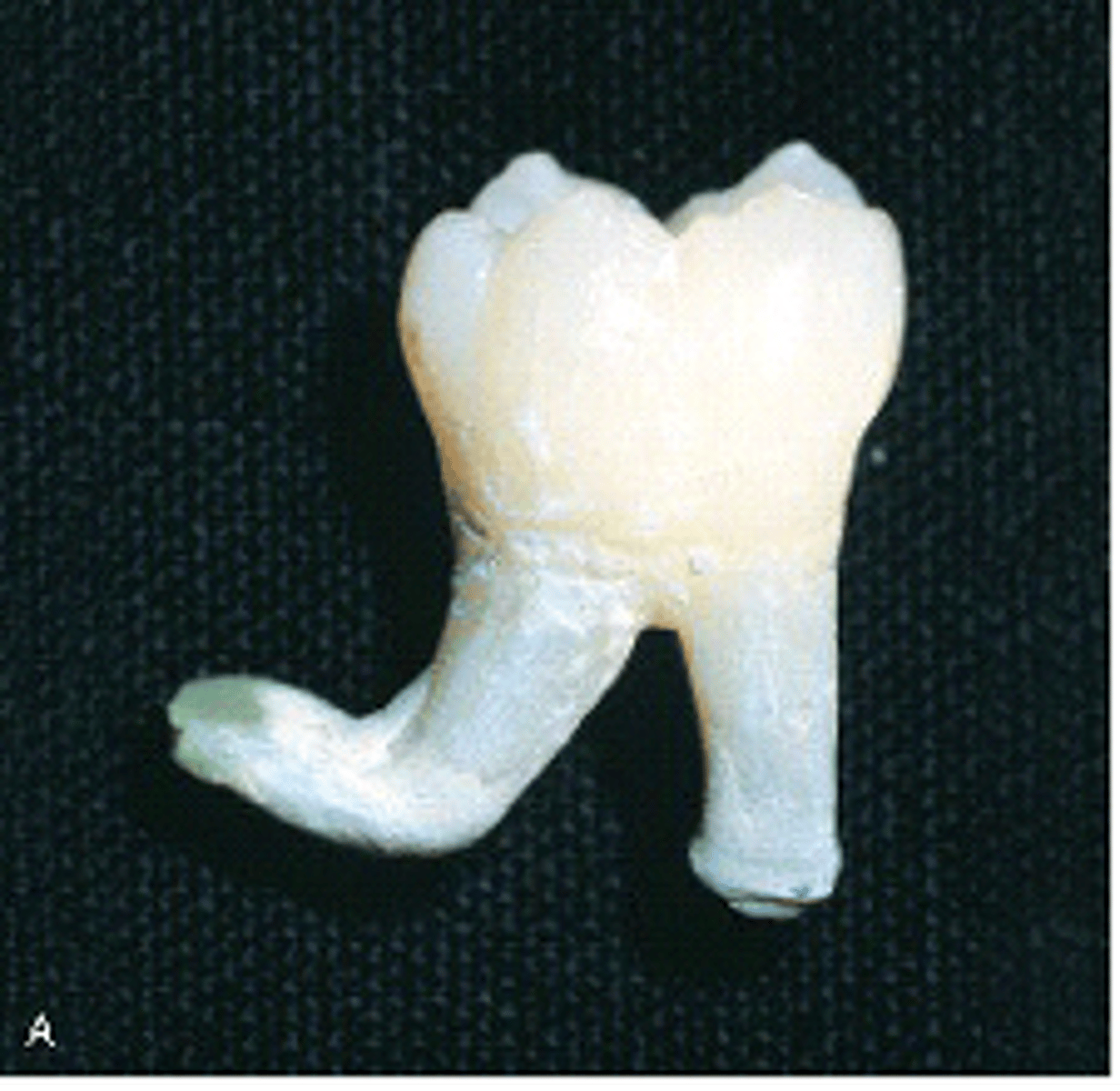
Dilaceration

an abnormal bend or curve, as in the root of a toot

The sharp bend or curve in the root as seen in the image is called?
<p>an abnormal bend or curve, as in the root of a toot</p><p><span>The sharp bend or curve in the root as seen in the image is called?</span></p>
34
New cards

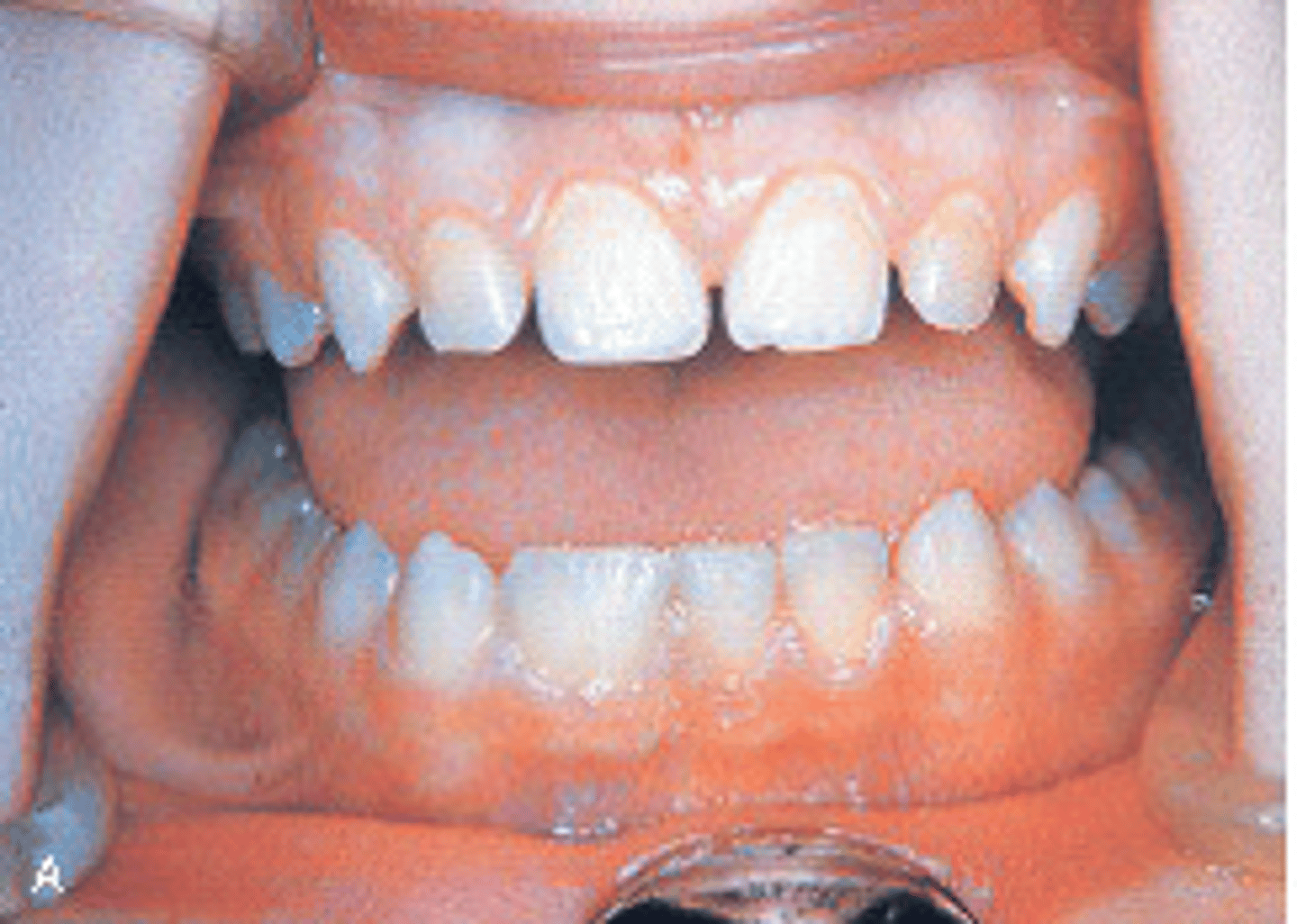
Fusion

Two roots, one crown on MND lateral incisors (in this picture- usually two roots, two heads, 2 pulps)

When the large tooth in the mandibular arch is counted as one, then there's one less tooth than normal in the mandibular dentition.What condition do you suspect?
<p>Two roots, one crown on MND lateral incisors (in this picture- usually two roots, two heads, 2 pulps)</p><p><span>When the large tooth in the mandibular arch is counted as one, then there's one less tooth than normal in the mandibular dentition.What condition do you suspect?</span></p>
35
New cards

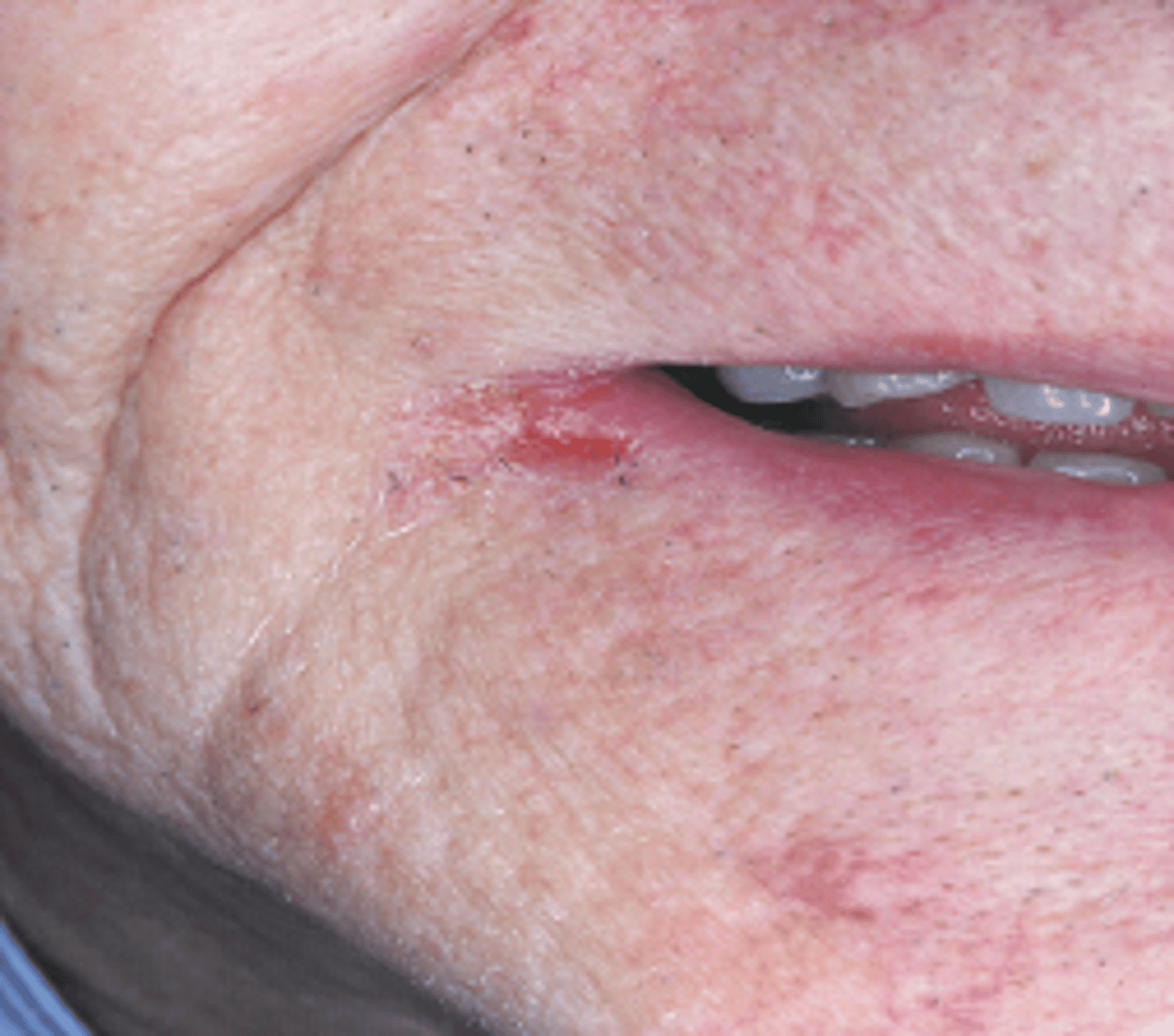
Angular Cheilitis


-inflammation in corners of the mouth

-sore, swollen, cracked

This lesion in the commissure is most likely caused by Candida albicans or a nutritional deficiency.

Which condition do you suspect?
<p><br>-inflammation in corners of the mouth</p><p>-sore, swollen, cracked</p><p>This lesion in the commissure is most likely caused by Candida albicans or a nutritional deficiency.</p><p>Which condition do you suspect?</p>
36
New cards

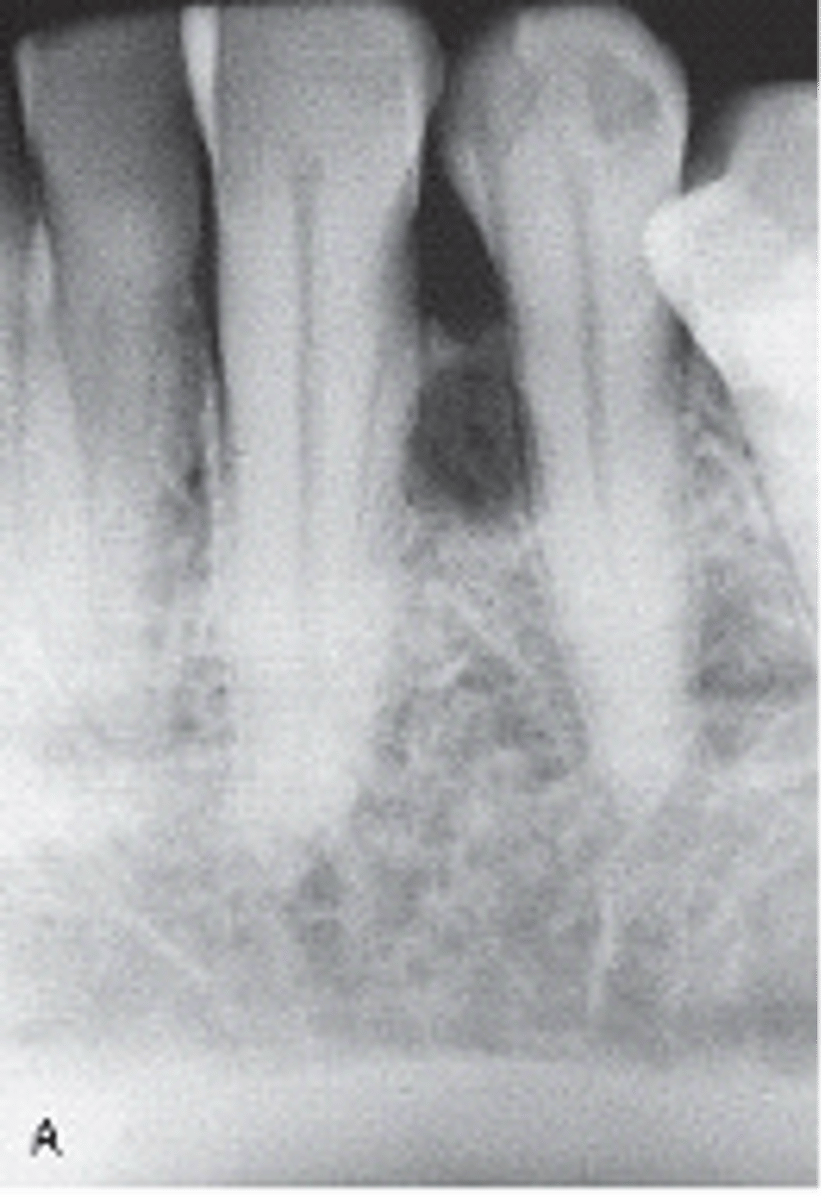
Lateral periodontal cyst

-True cyst (epithelial lining)

-Well circumscribed Unilocular or Multilocular lucency in the lateral periodontal membrane of adults between roots of adjacent, erupted teeth

-most found in mand premolar region

-associated tooth is vital


This radiolucent lesion located interproximal to the mandibular lateral incisor and canine is most likely which of the following?
<p>-True cyst (epithelial lining)</p><p>-Well circumscribed Unilocular or Multilocular lucency in the lateral periodontal membrane of adults between roots of adjacent, erupted teeth</p><p>-most found in mand premolar region</p><p>-associated tooth is vital</p><p><br><span>This radiolucent lesion located interproximal to the mandibular lateral incisor and canine is most likely which of the following?</span></p>
37
New cards

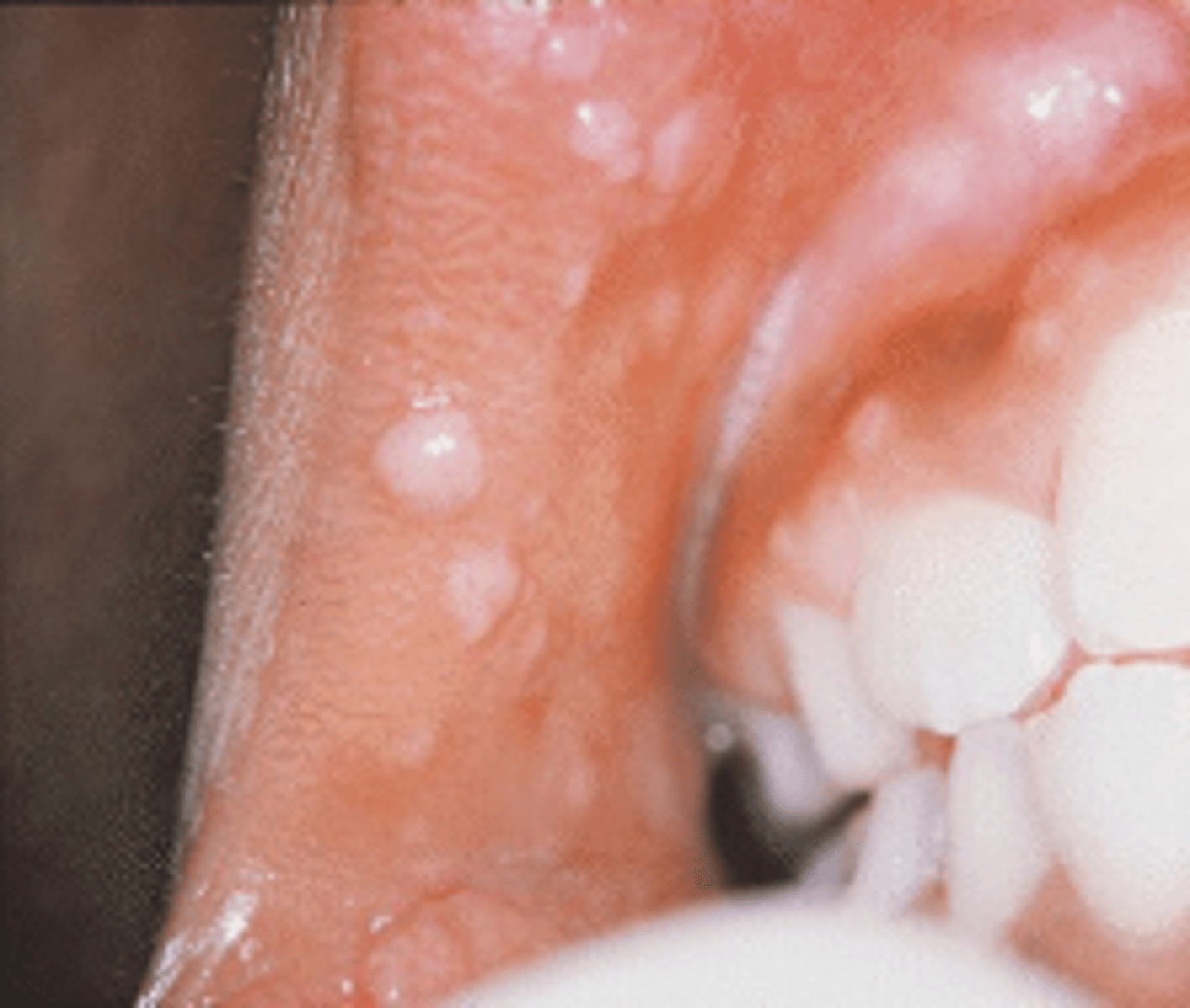
Heck Disease / human papillomavirus (HPV)


is a cutaneous condition characterized by white to pinkish papules that occur diffusely in the oral cavity. It is caused by the human papilloma virus types 13 and 32.

This condition is referred to as Heck disease or multifocal epithelial hyperplasia, is most common in children, and infrequently seen in patients with HIV. What is the etiologic agent for this condition?
<p><br>is a cutaneous condition characterized by white to pinkish papules that occur diffusely in the oral cavity. It is caused by the human papilloma virus types 13 and 32.</p><p><span>This condition is referred to as Heck disease or multifocal epithelial hyperplasia, is most common in children, and infrequently seen in patients with HIV. What is the etiologic agent for this condition?</span></p>
38
New cards

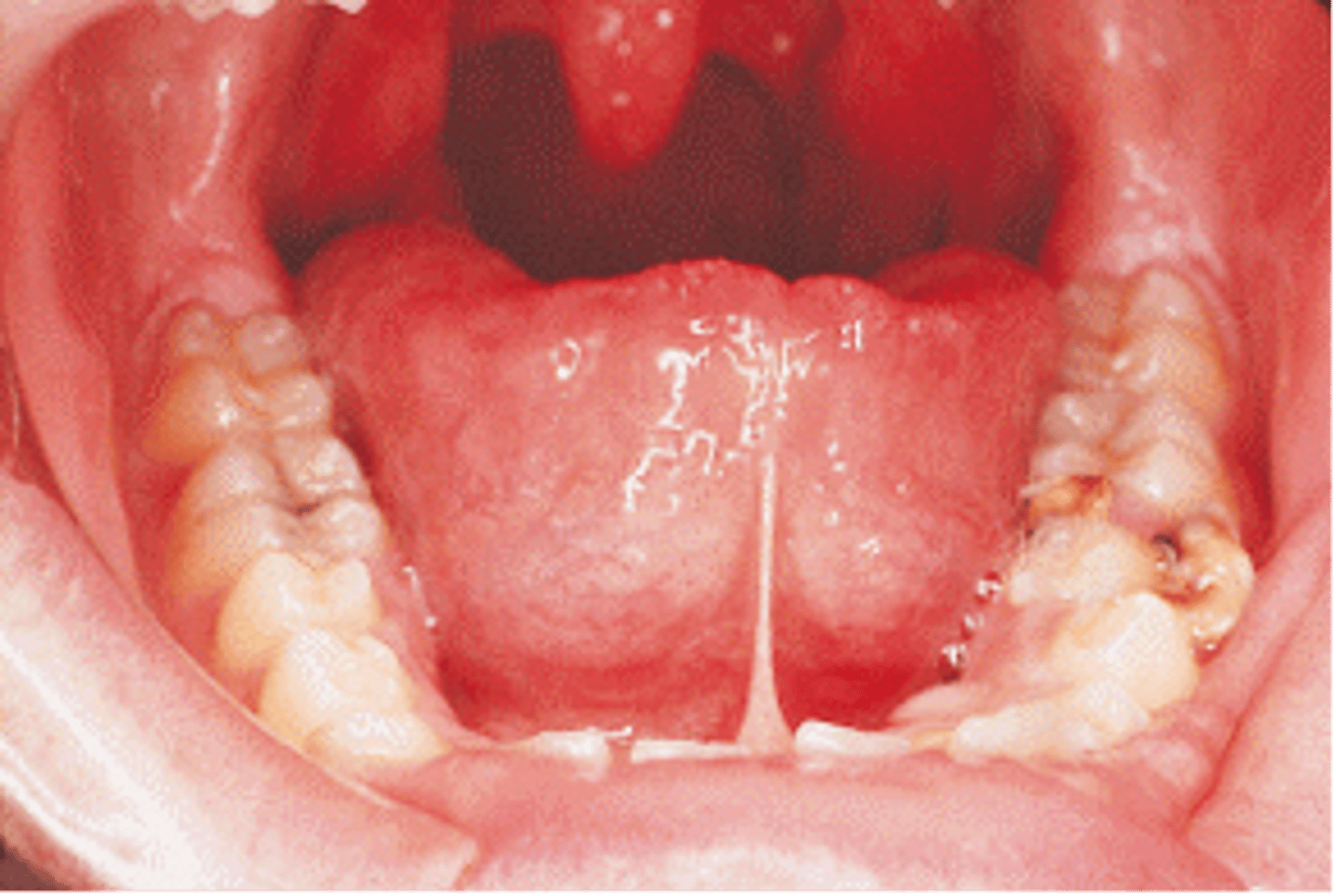
Ankyloglossia (tongue tie)

Significant adhesion of the tongue to the floor of the mouth caused by a short lingual frenum is called?

developmental anomaly characterized by a shortened lingual frenum that limits movement of the tongue.

Can cause speech problems, periodontal defects, and problems with breast feeding.

More common in males
<p><span>Significant adhesion of the tongue to the floor of the mouth caused by a short lingual frenum is called?</span></p><p>developmental anomaly characterized by a shortened lingual frenum that limits movement of the tongue.</p><p>Can cause speech problems, periodontal defects, and problems with breast feeding.</p><p>More common in males</p>
39
New cards

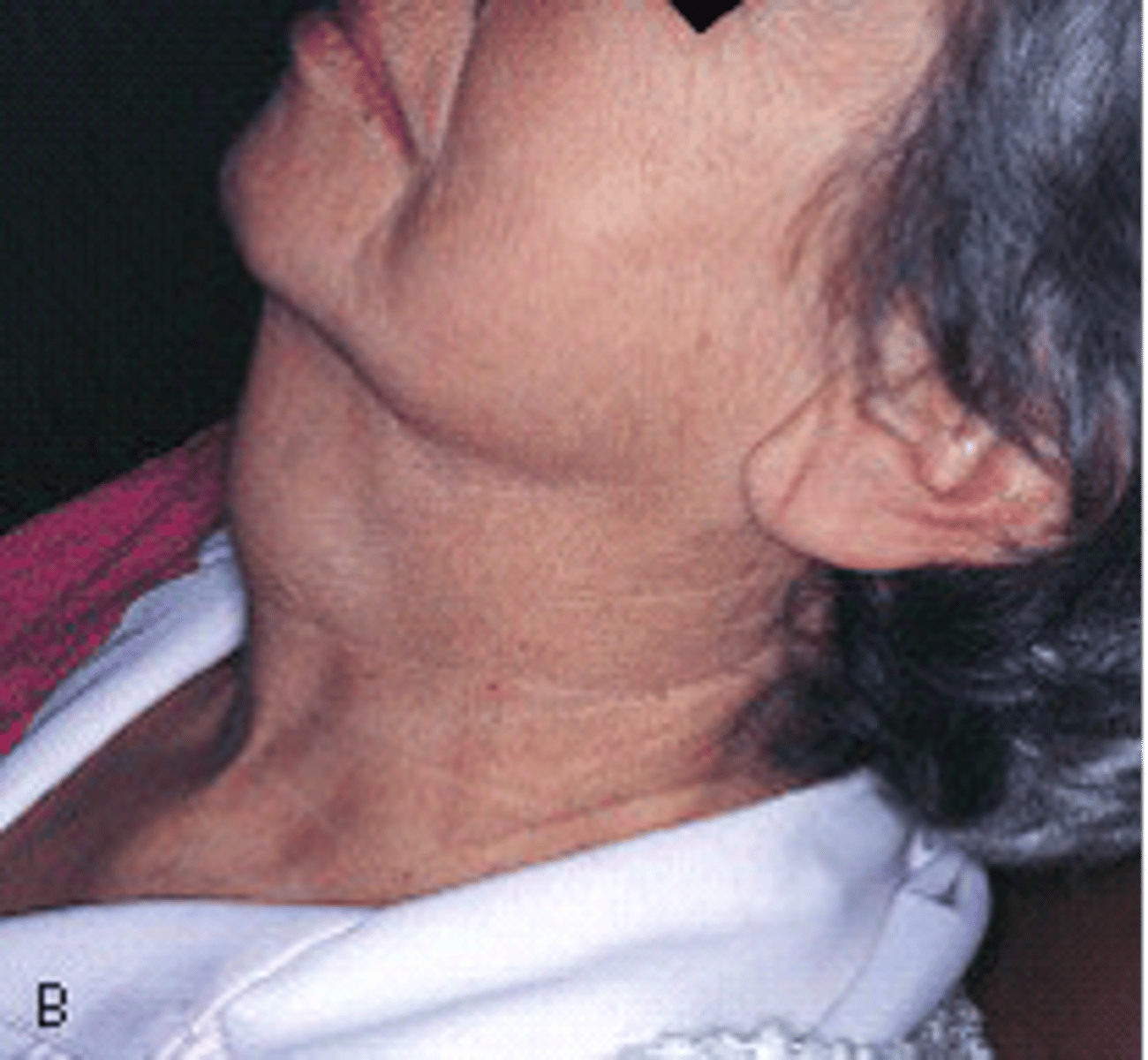
Thyroglossal duct cyst


a palpable cystic midline mass in the neck due to incomplete closure of the thyroglossal duct.

The enlargement on the midline of this patient's neck has been present for months and is slowly increasing in size. It is soft and painless.Histologic examination shows this to be an epithelium-lined sac filled with clear, yellow fluid. What type of cyst is it?
<p><br>a palpable cystic midline mass in the neck due to incomplete closure of the thyroglossal duct.</p><p><span>The enlargement on the midline of this patient's neck has been present for months and is slowly increasing in size. It is soft and painless.Histologic examination shows this to be an epithelium-lined sac filled with clear, yellow fluid. What type of cyst is it?</span></p>
40
New cards

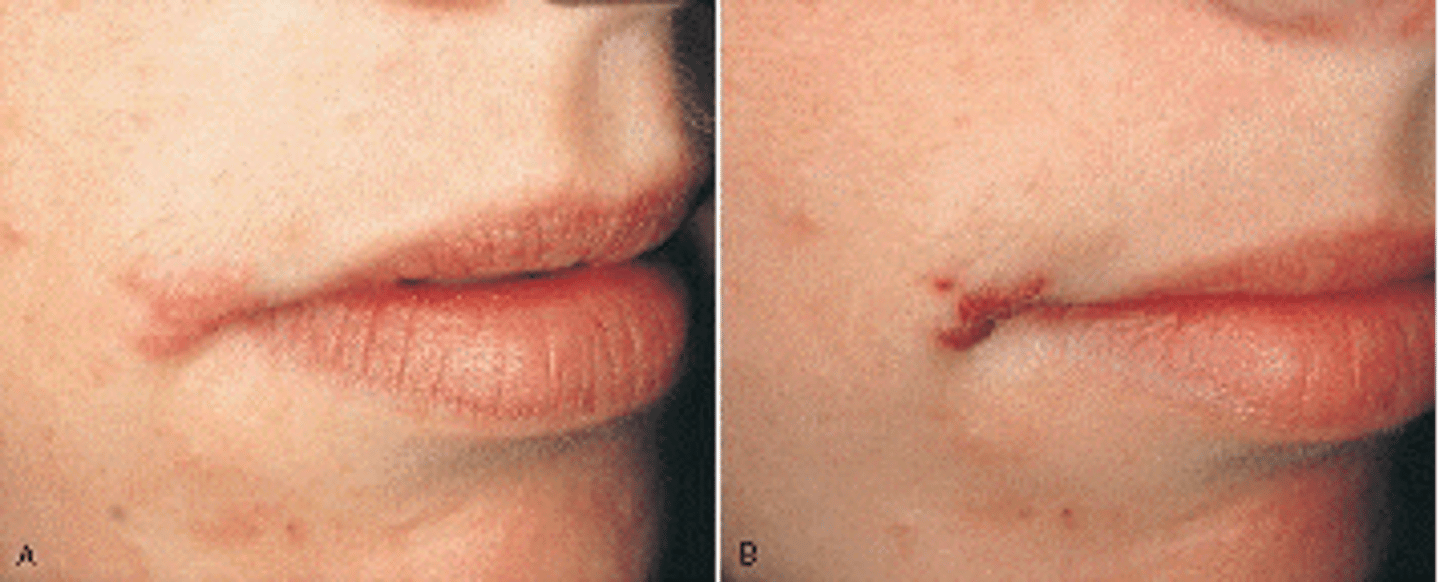
Herpes Labialis

blister-like sores on the lips and adjacent facial tissue that are caused by the oral herpes simplex virus type 1 (HSV-1); also known as cold sores or fever blisters

The cluster of vesicles seen at this pt's vermillion border is commonly called a fever blister or cold sore. What is your DHDx?
<p>blister-like sores on the lips and adjacent facial tissue that are caused by the oral herpes simplex virus type 1 (HSV-1); also known as cold sores or fever blisters</p><p><span>The cluster of vesicles seen at this pt's vermillion border is commonly called a fever blister or cold sore. What is your DHDx?</span></p>
41
New cards

Dentigerous cyst

A cyst that forms around the crown of an unerupted or developing tooth. Also called a follicular cyst. Second most common cyst.

This unilocular radiolucency extending CEJ to CEJ around the crown of this unerupted tooth, is most likely a ?
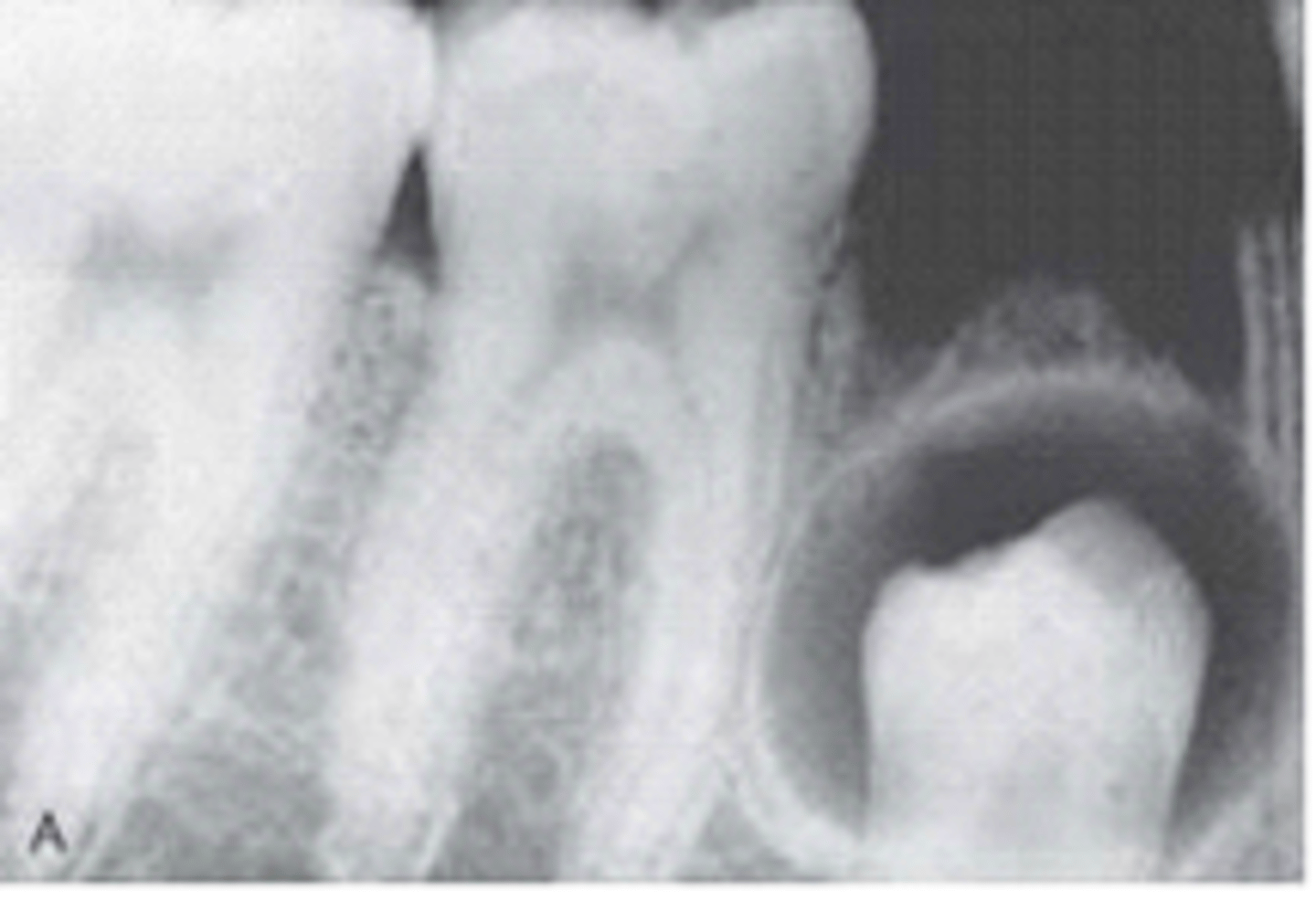
<p>A cyst that forms around the crown of an unerupted or developing tooth. Also called a follicular cyst. Second most common cyst.</p><p><span>This unilocular radiolucency extending CEJ to CEJ around the crown of this unerupted tooth, is most likely a ?</span></p>
42
New cards

Lingual Varicosities

- Normal

- May be very pronounced

- Protruding veins on ventral surface of the tongue

what are the reddish-purple clusters on the ventral surface of the tongue that are variants of normal and diagnosed via clinical exam called
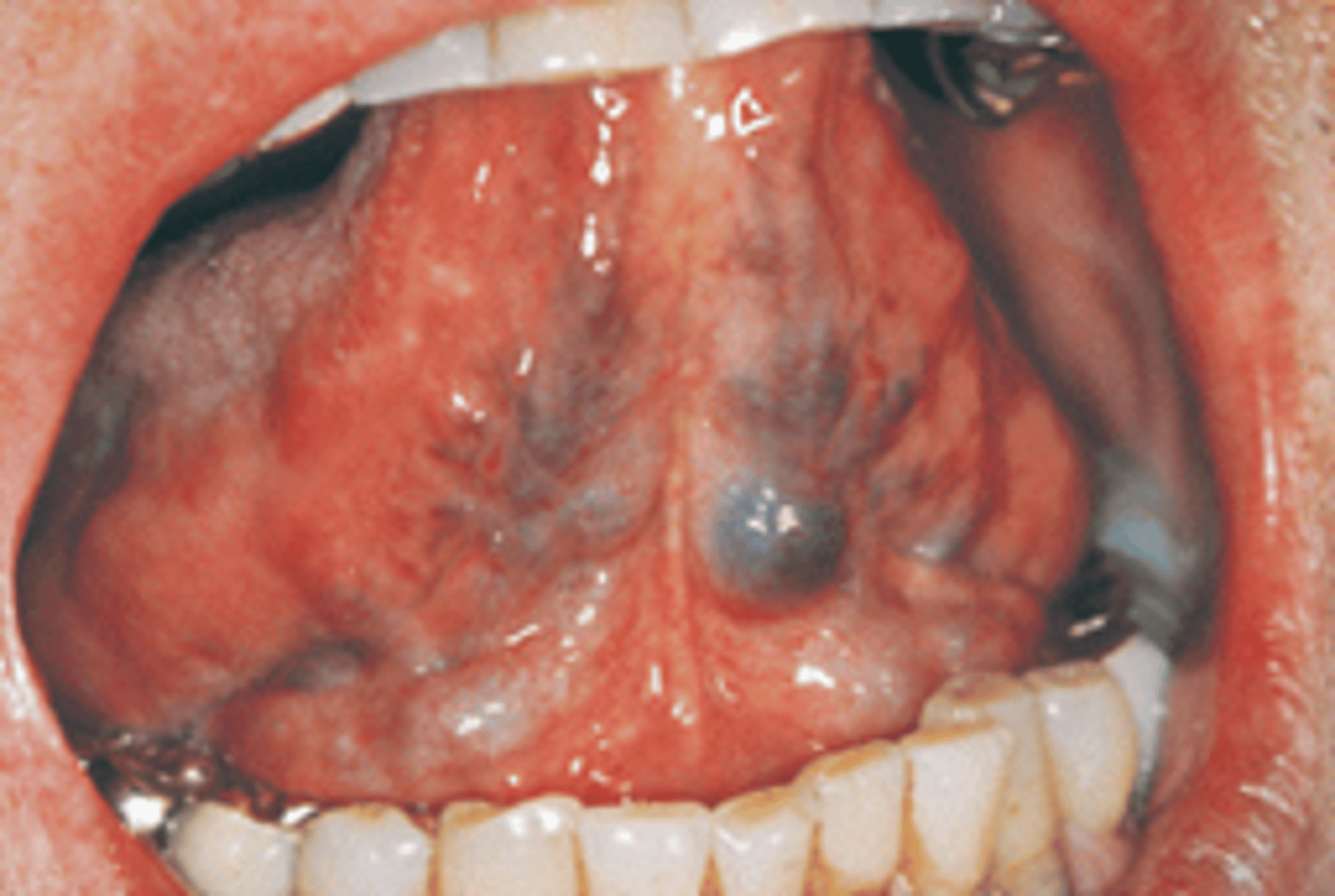
<p>- Normal</p><p>- May be very pronounced</p><p>- Protruding veins on ventral surface of the tongue</p><p><span>what are the reddish-purple clusters on the ventral surface of the tongue that are variants of normal and diagnosed via clinical exam called</span></p>
43
New cards

Enamel Pearl


-Ectopic enamel

-Tooth enamel on the root surface (usually in the furcation)

What is the white, spherical enamel projection located at the furca of the tooth in the image called?
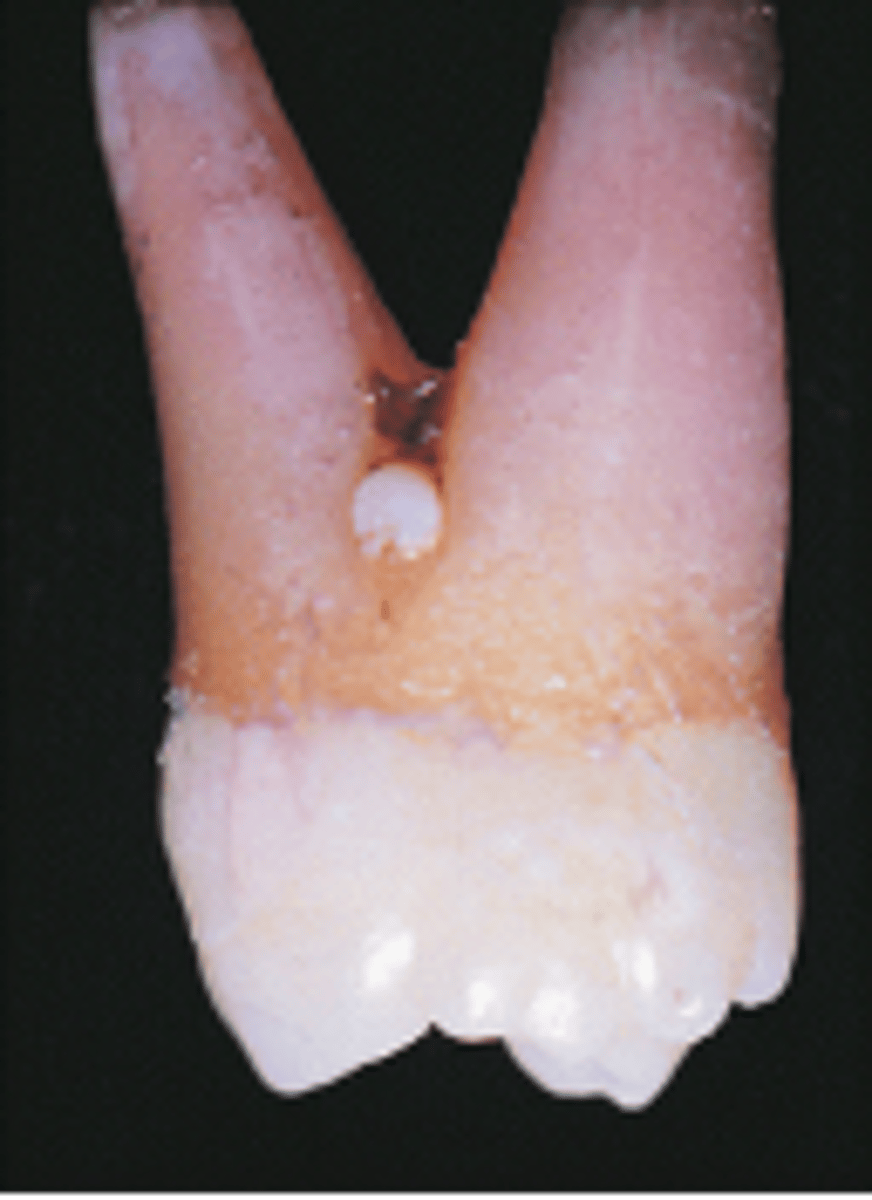
<p><br>-Ectopic enamel</p><p>-Tooth enamel on the root surface (usually in the furcation)</p><p><span>What is the white, spherical enamel projection located at the furca of the tooth in the image called?</span></p>
44
New cards

Stafne bone cyst / defect


Radiolucency in posterior mandible below mandibular canal due to lingual concavity of jaw


This pseudocyst seen is surrounded by salivary gland tissue.
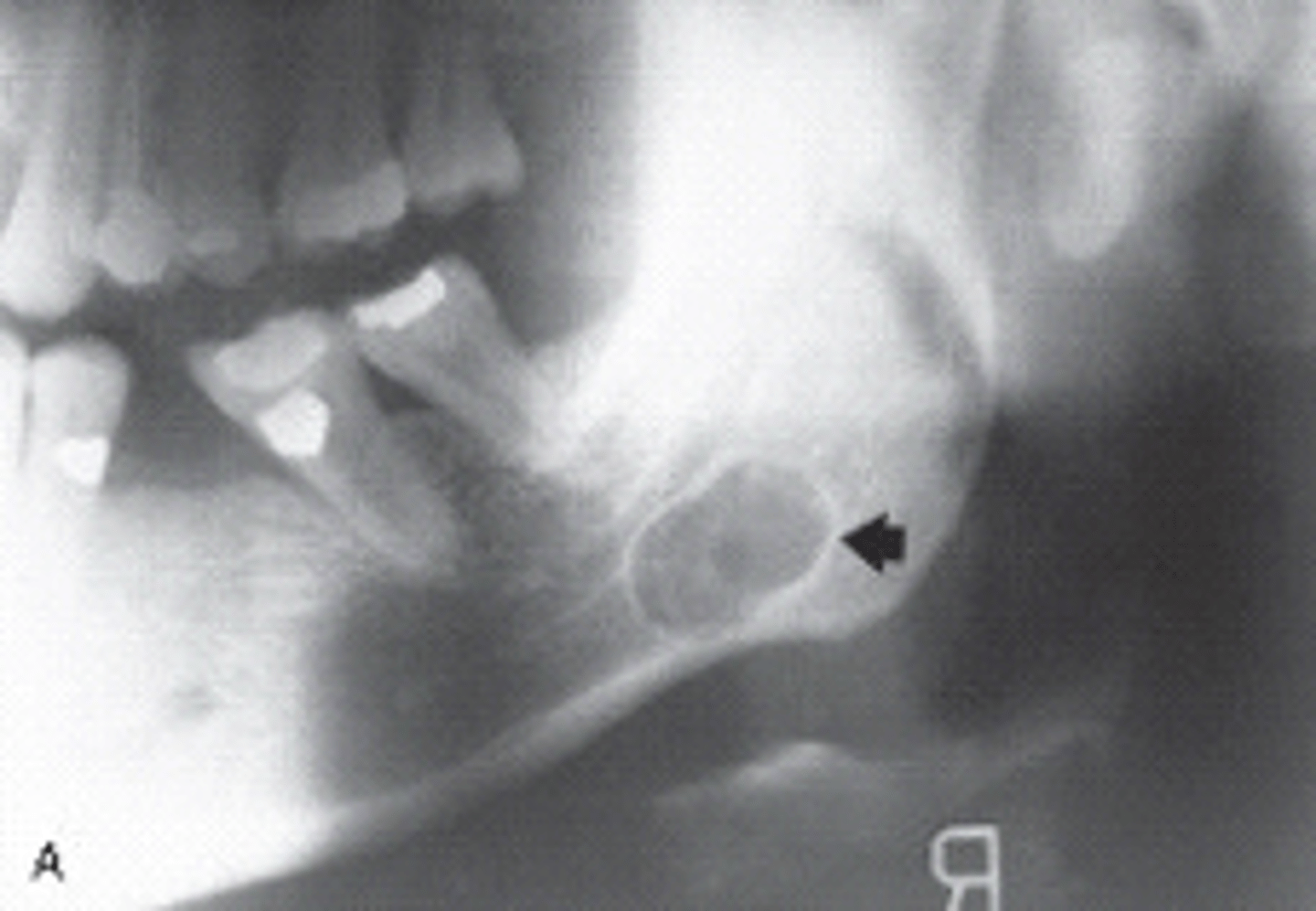
<p><br>Radiolucency in posterior mandible below mandibular canal due to lingual concavity of jaw</p><p><br><span>This pseudocyst seen is surrounded by salivary gland tissue.</span></p>
45
New cards

shingles (herpes zoster)


viral infection producing the eruption of highly painful vesicles that may follow a nerve path


The unilateral eruption of vesicles along the distribution of a sensory nerve seen in this adult patient is called?
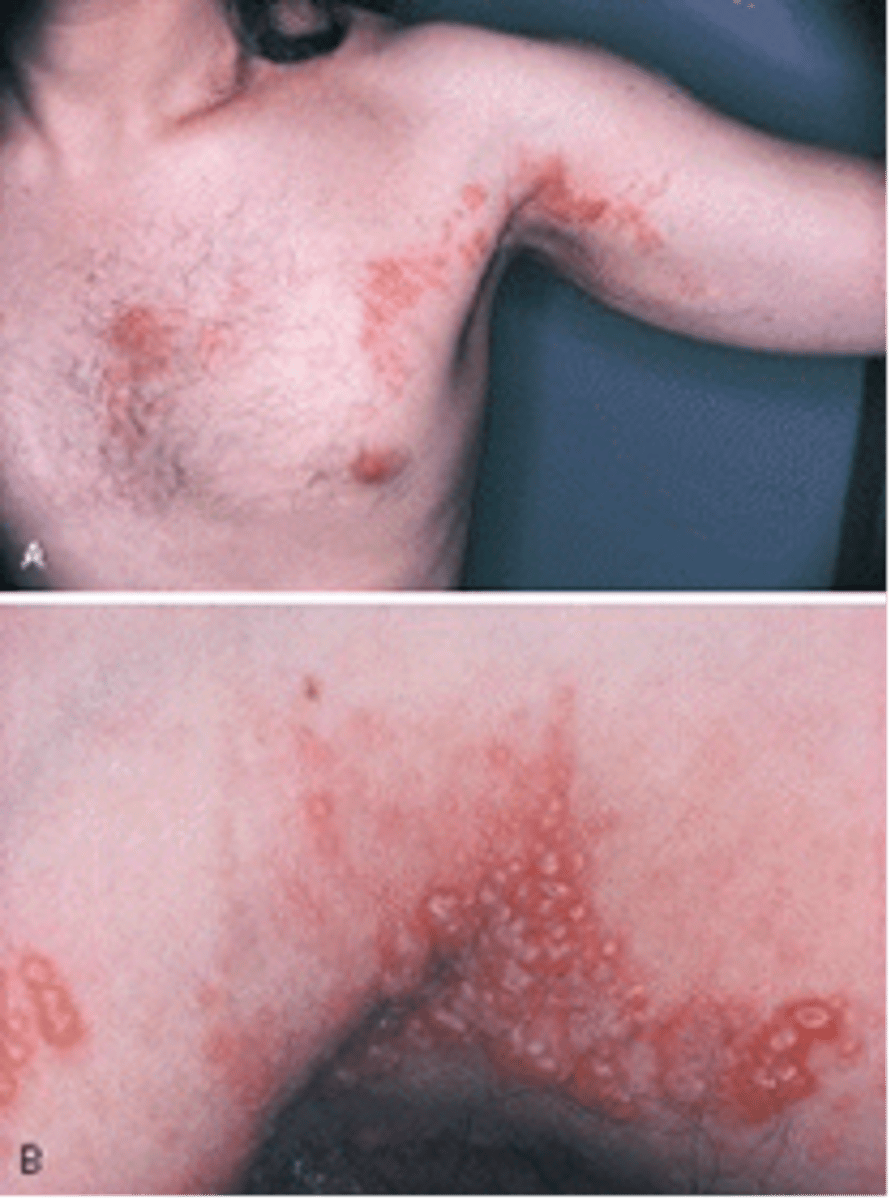
<p><br>viral infection producing the eruption of highly painful vesicles that may follow a nerve path</p><p><br><span>The unilateral eruption of vesicles along the distribution of a sensory nerve seen in this adult patient is called?</span></p>
46
New cards

supernumerary roots on the mandibular premolar


Location: maxillary and mandibular 3rd molars, premolars, and cuspids

*visible extra roots


What is the developmental anomaly seen in this radiographic image?
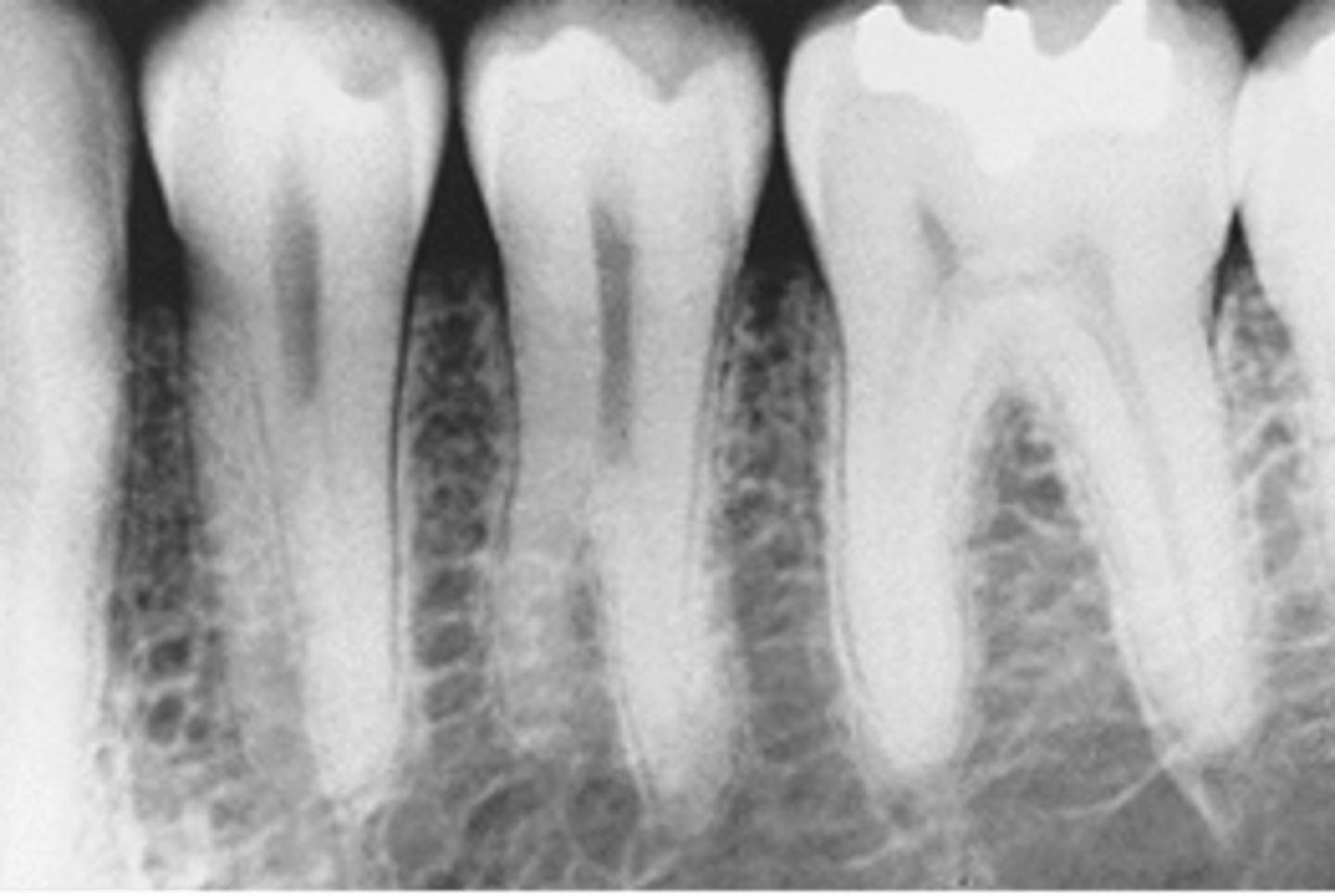
<p><br></p><p>Location: maxillary and mandibular 3rd molars, premolars, and cuspids</p><p>*visible extra roots</p><p><br><span>What is the developmental anomaly seen in this radiographic image?</span></p>
47
New cards

Candidiasis (Thrush)


Thick, white, raised patches in the mouth


This condition most commonly appears in patients with HIV. What is the clinical diagnosis?
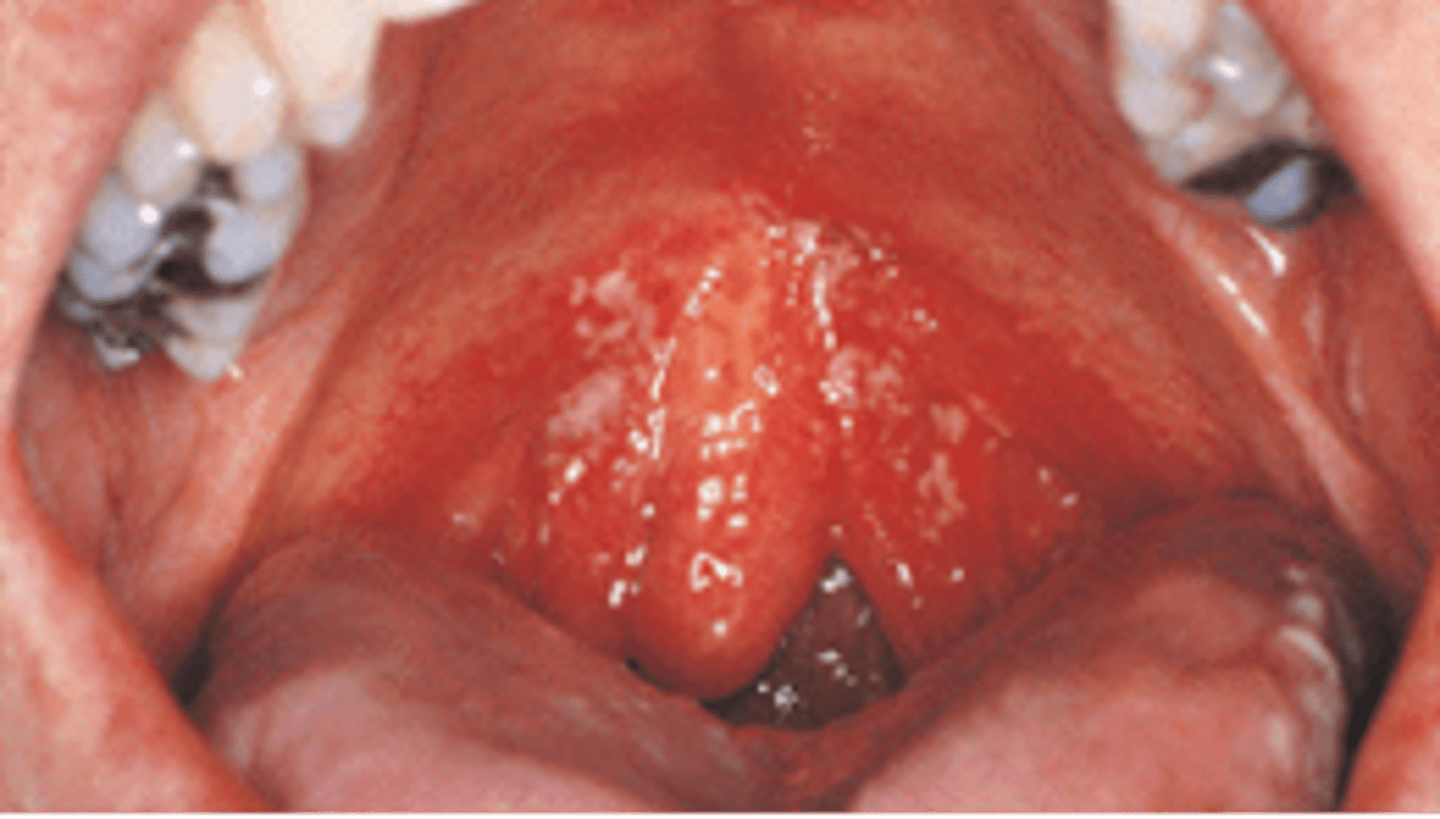
<p><br>Thick, white, raised patches in the mouth</p><p><br></p><p>This condition most commonly appears in patients with HIV. What is the clinical diagnosis?</p>
48
New cards

condyloma acuminatum

lesion that appears as a result of human papilloma virus; on the skin, lesions appear as cauliflower-like warts, and on mucous membranes, they have a flat appearance; also known as venereal or genital warts
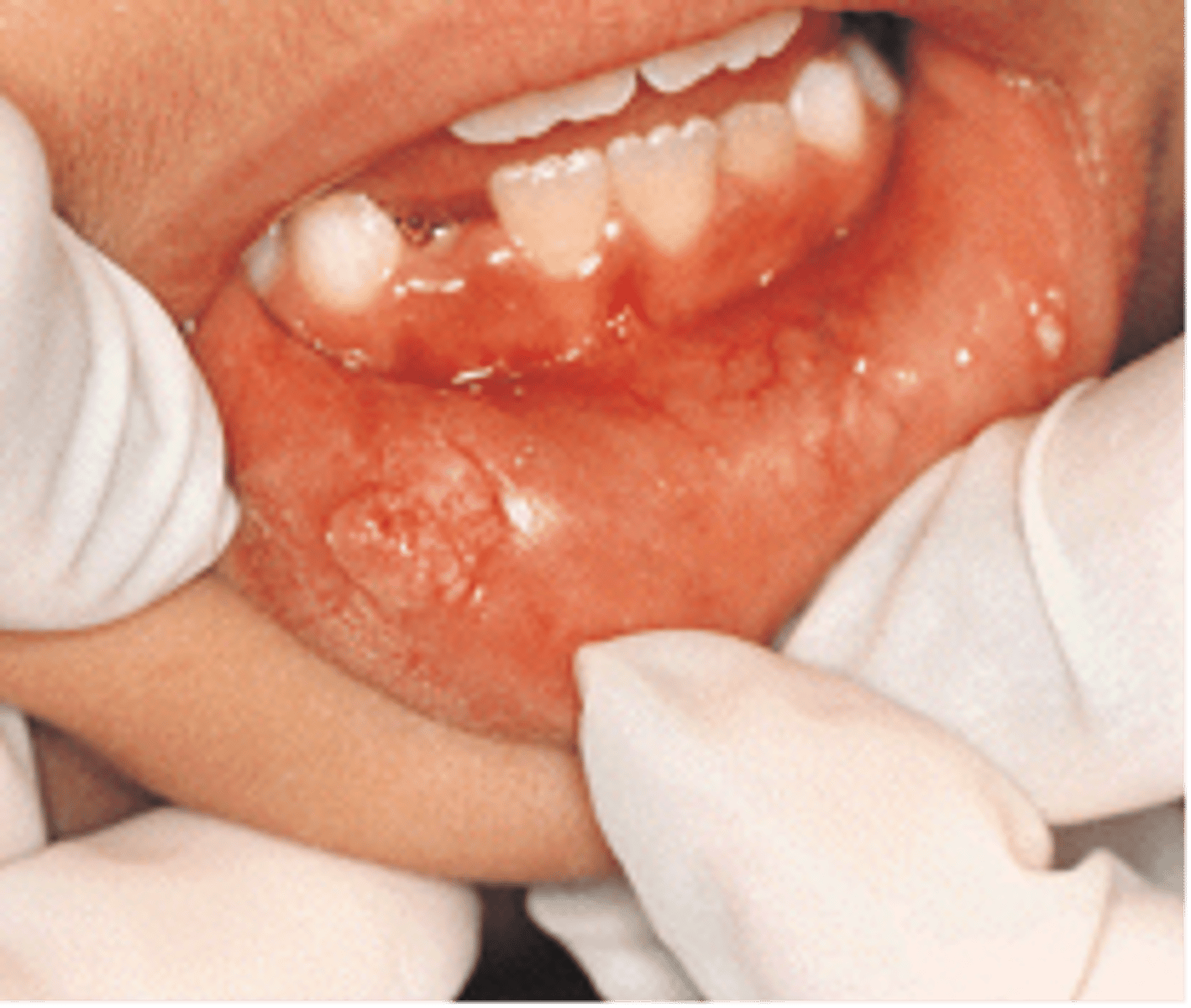
<p><span>lesion that appears as a result of human papilloma virus; on the skin, lesions appear as cauliflower-like warts, and on mucous membranes, they have a flat appearance; also known as venereal or genital warts</span></p>
49
New cards

Localized Juvenile Spongiotic Gingivitis


Distinct subtype of gingivitis that does not respond to local plaque control. Appears as papillary or velvety, red nodule that bleeds easily


This flat, red, velvety lesion involving the maxillary anterior gingiva in an 8-year-old male resolved entirely after topical corticosteroid therapy. What is your DHDx?
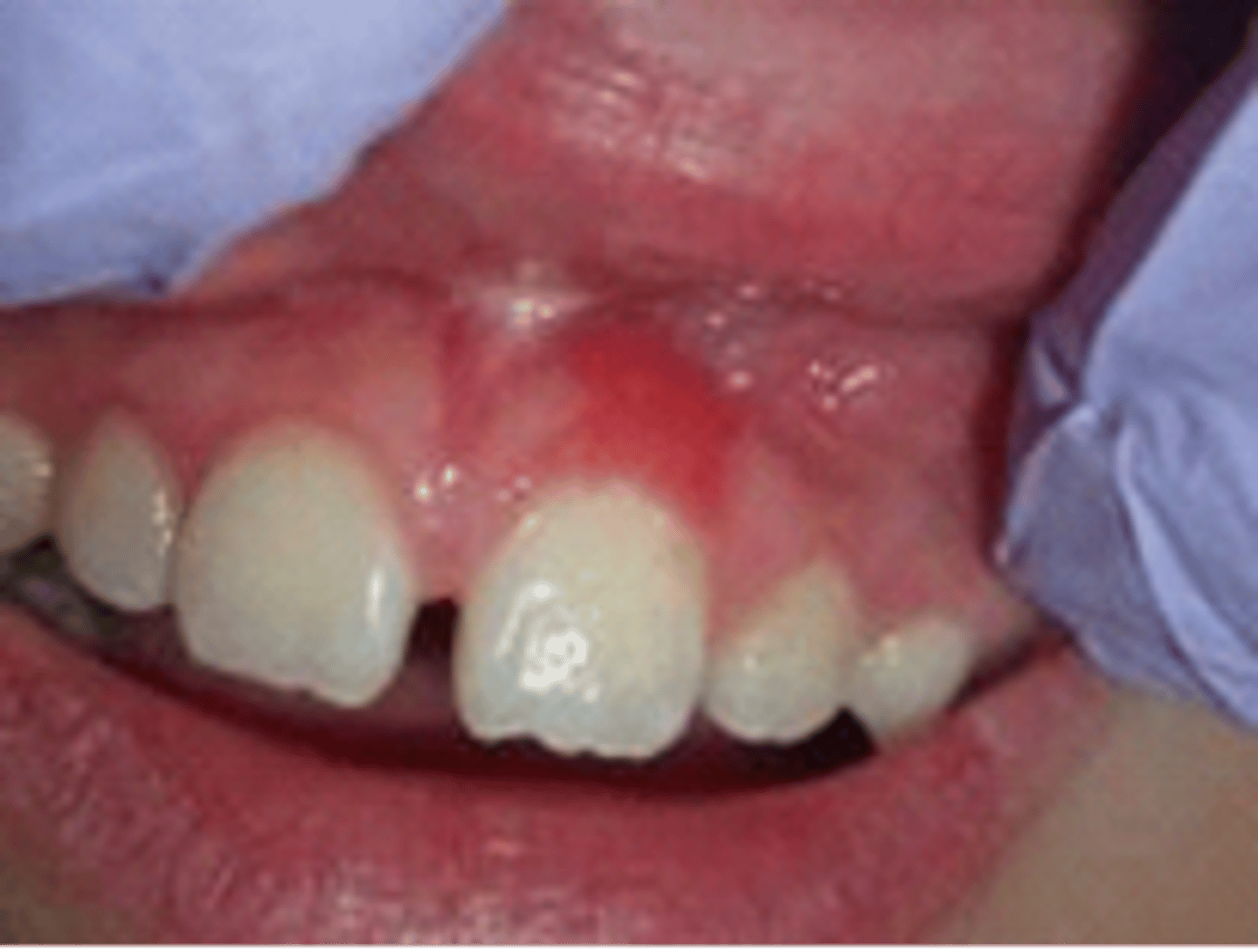
<p><br></p><p>Distinct subtype of gingivitis that does not respond to local plaque control. Appears as papillary or velvety, red nodule that bleeds easily</p><p><br></p><p>This flat, red, velvety lesion involving the maxillary anterior gingiva in an 8-year-old male resolved entirely after topical corticosteroid therapy. What is your DHDx?</p>
50
New cards

Mesiodens


Supernumerary tooth between two permanent maxillary central incisors


The supernumerary tooth seen between teeth #8 & 9 is called?
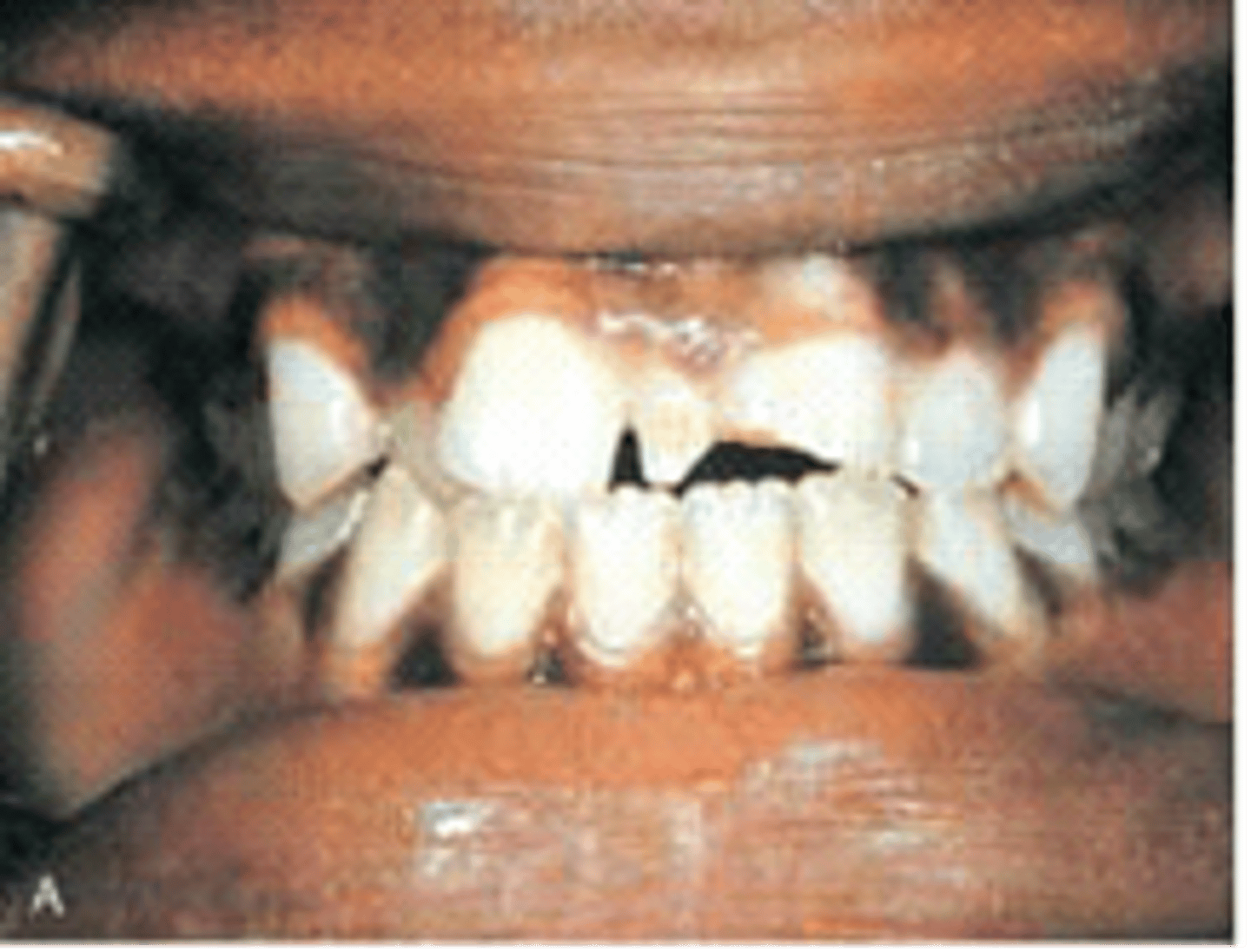
<p><br>Supernumerary tooth between two permanent maxillary central incisors</p><p><br></p><p>The supernumerary tooth seen between teeth #8 &amp; 9 is called?</p>
51
New cards

Palatal Lobule tori


Tori on the palate with defined lobules
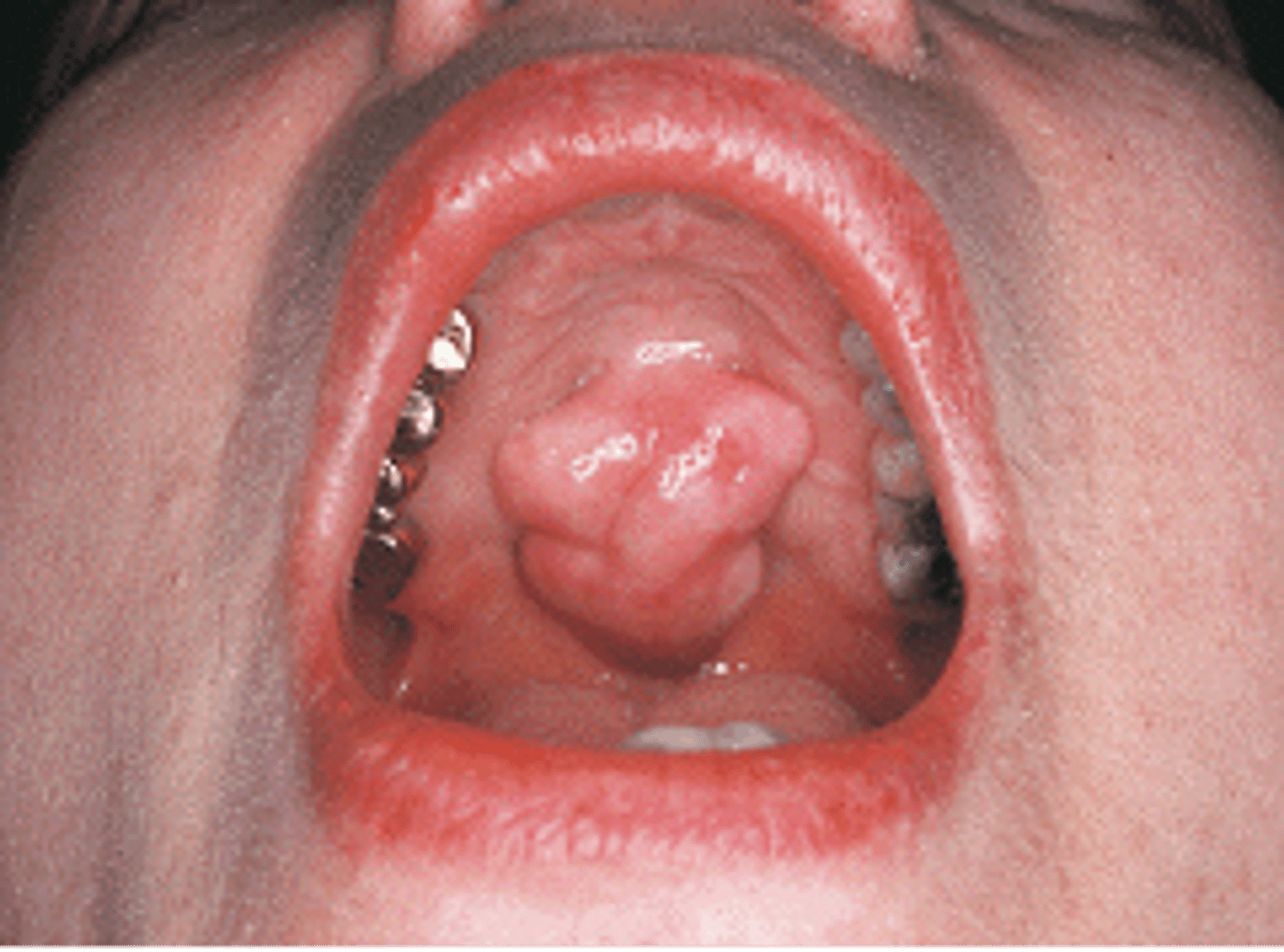
<p><br></p><p>Tori on the palate with defined lobules</p>
52
New cards

Hematoma

Accumulation of blood within tissues as a result of trauma; Appears as a red to purple to bluish-gray mass; Frequently seen on labial or buccal mucosa
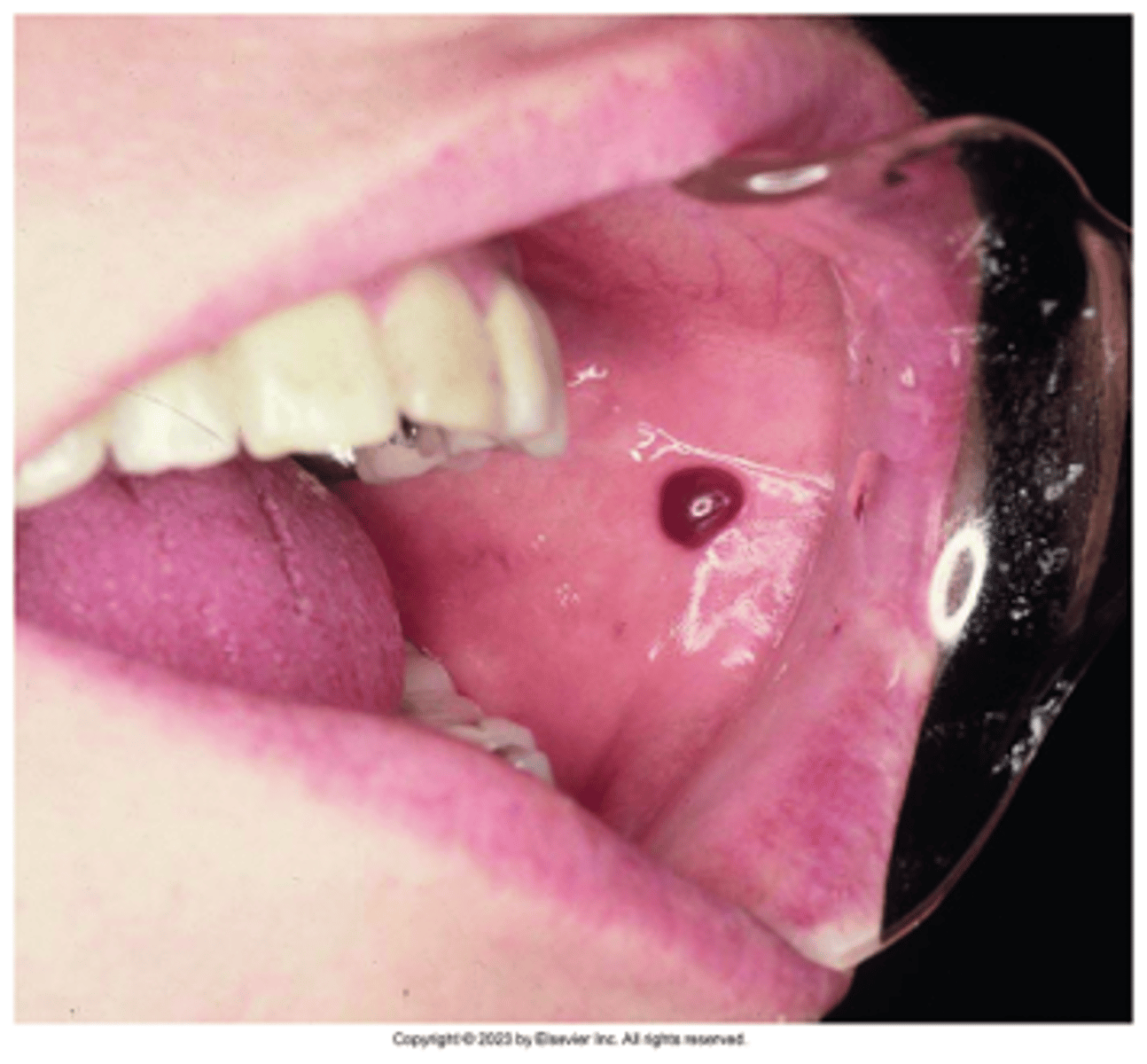
<p>Accumulation of blood within tissues as a result of trauma; Appears as a red to purple to bluish-gray mass; Frequently seen on labial or buccal mucosa</p>
53
New cards

Traumatic Ulcer

Cheek, lip, or tongue biting; Denture irritation; Mucosal injury; Overzealous brushing; Usually heals within 7-14 days unless the trauma persists; May require a biopsy
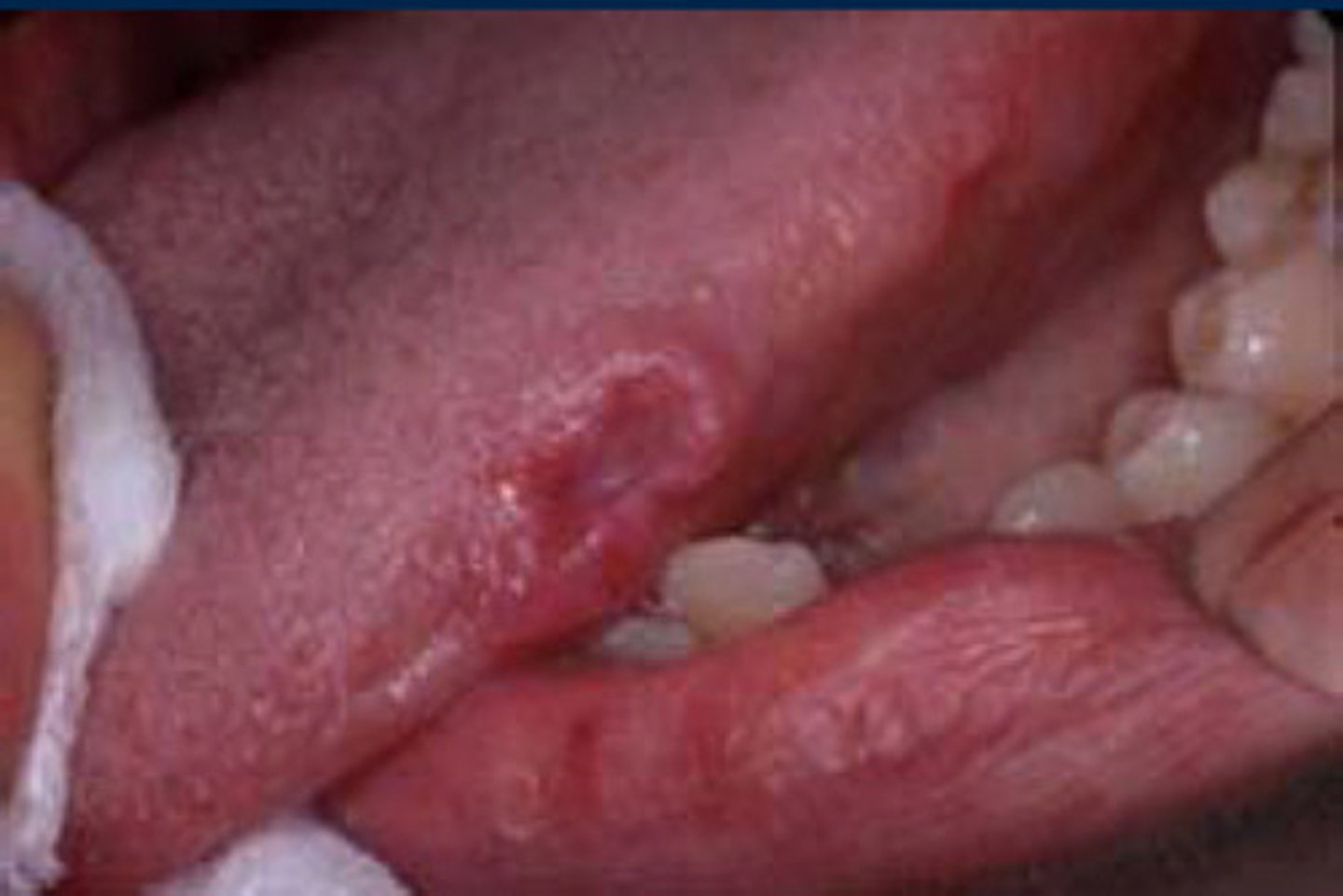
<p>Cheek, lip, or tongue biting; Denture irritation; Mucosal injury; Overzealous brushing; Usually heals within 7-14 days unless the trauma persists; May require a biopsy</p>
54
New cards

Frictional Keratosis

Form of hyperkeratosis; Chronic rubbing or friction against an oral mucosal surface; resembles a callus on skin; appears opaque white
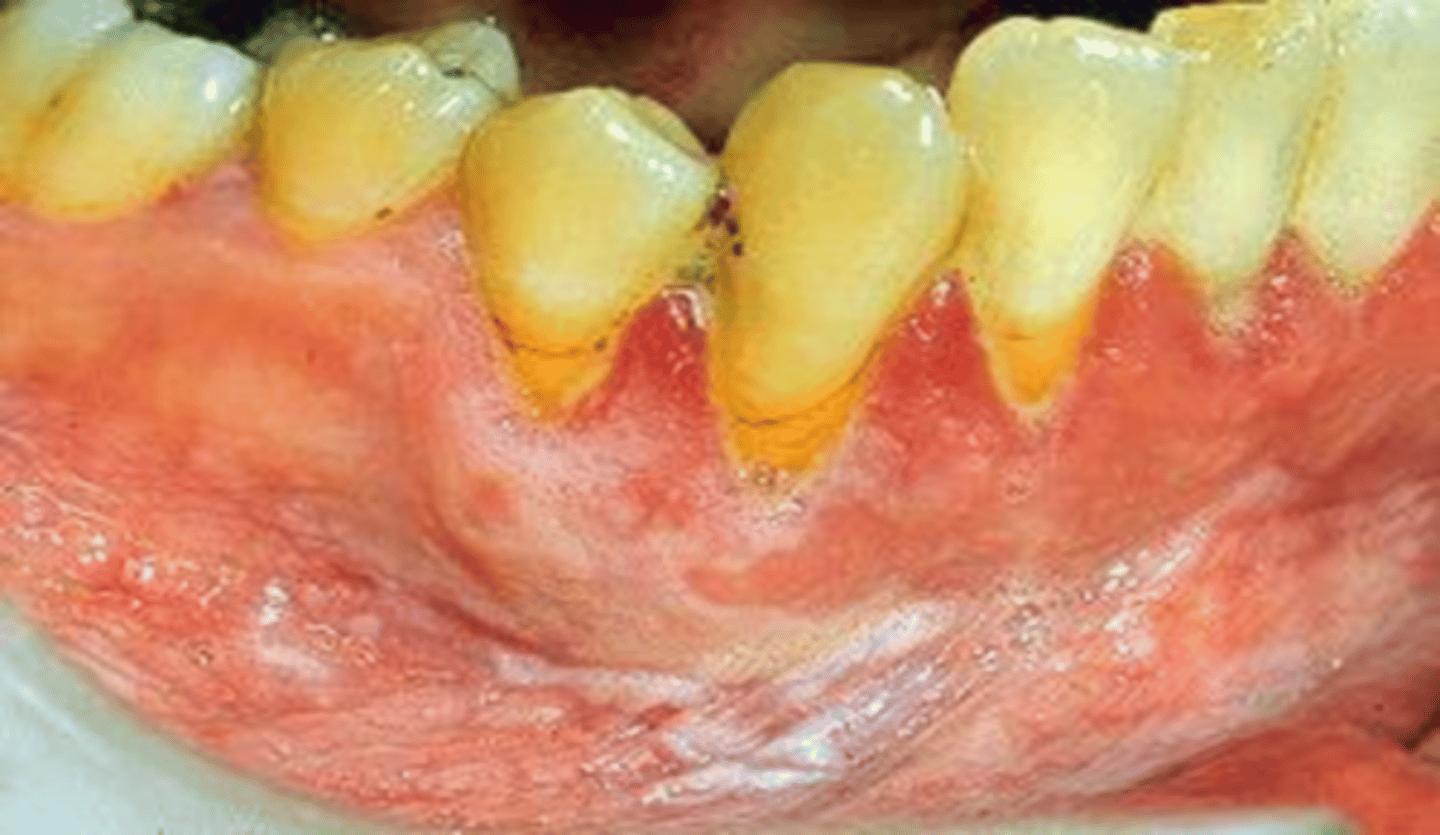
<p>Form of hyperkeratosis; Chronic rubbing or friction against an oral mucosal surface; resembles a callus on skin; appears opaque white</p>
55
New cards

Hairy Leukoplakia


a white rough patch that arises on the LATERAL tongue. Usually seen in immunocompromised and is due to EBV induced squamous cell hyperplasia. NOT pre-malignant.

Isolation of the Eppstein-Barr virus is the most reliable method for diagnosis of this lesion on the lateral border of the tongue. What is this lesion called, and what systemic disease is it most often associated with?
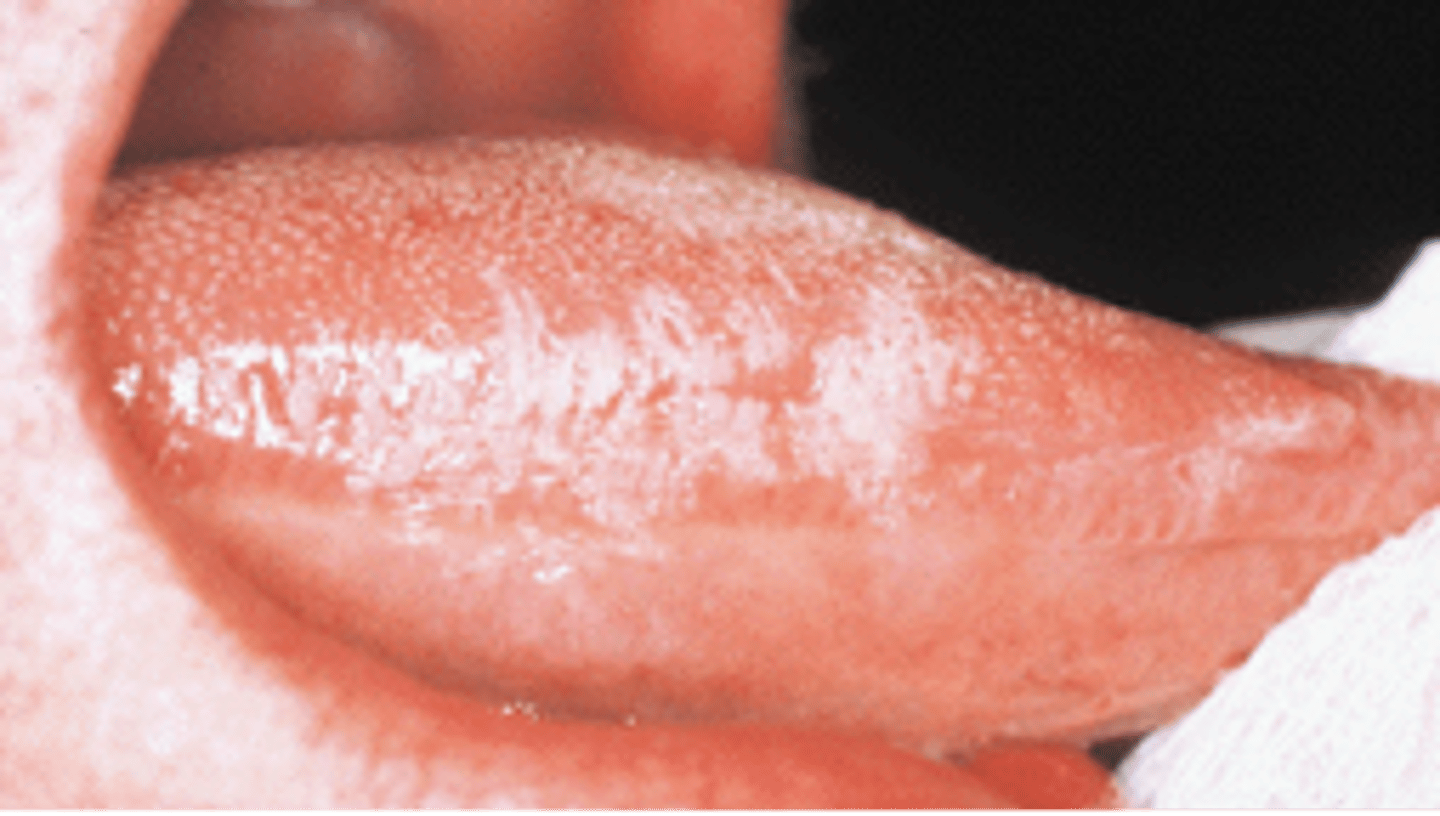
<p><br>a white rough patch that arises on the LATERAL tongue. Usually seen in immunocompromised and is due to EBV induced squamous cell hyperplasia. NOT pre-malignant.</p><p><span>Isolation of the Eppstein-Barr virus is the most reliable method for diagnosis of this lesion on the lateral border of the tongue. What is this lesion called, and what systemic disease is it most often associated with?</span></p>
56
New cards

dentinogenesis imperfecta


incomplete or improper development of dentin tissue, between enamel and cementum
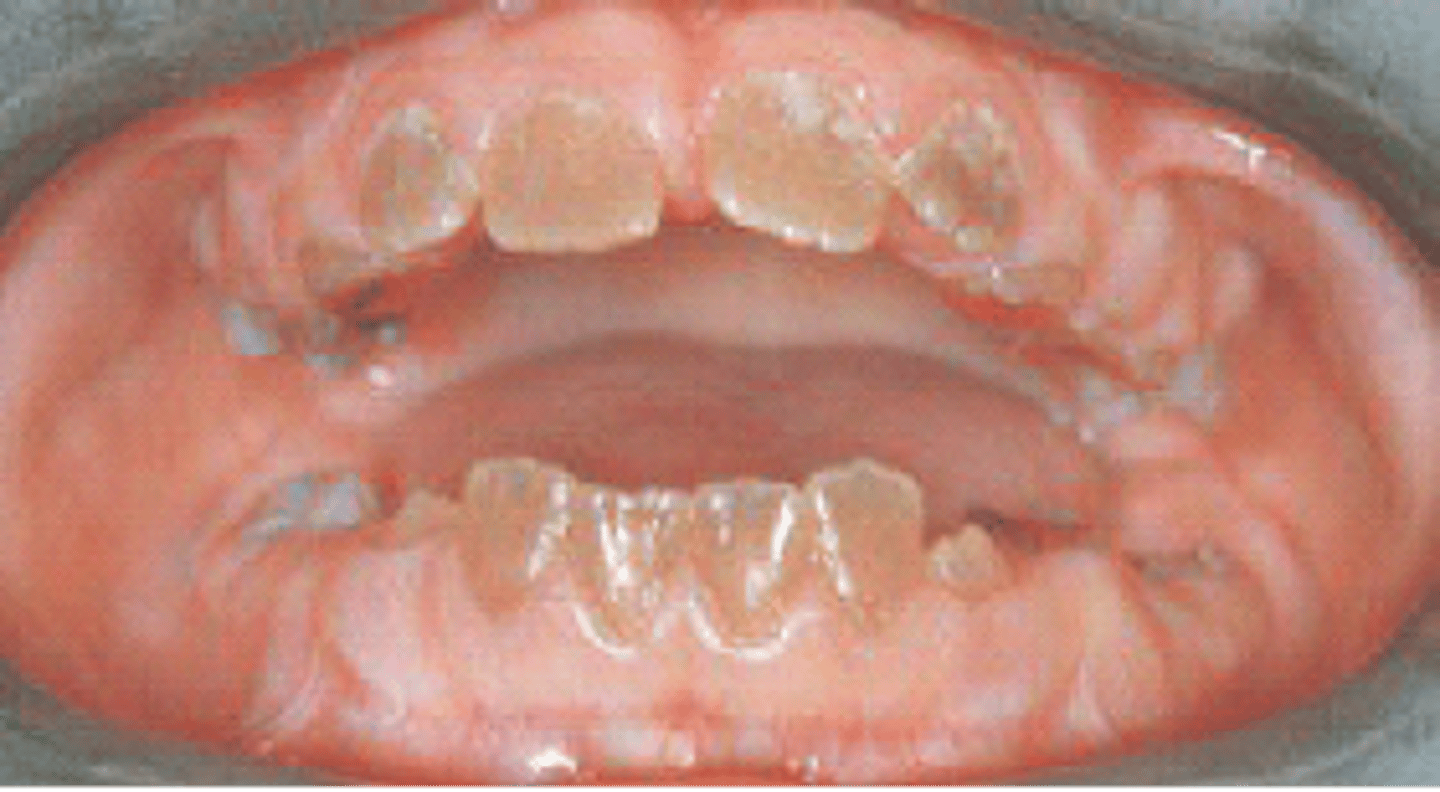
<p><br><span>incomplete or improper development of dentin tissue, between enamel and cementum</span></p>
57
New cards

Globulomaxillary cyst


well-defined, pear-shaped radiolucency found between the roots of the maxillary lateral incisor and canine

The pear-shaped radiolucency seen in this radiographic image was historically referred to as what type of cyst?
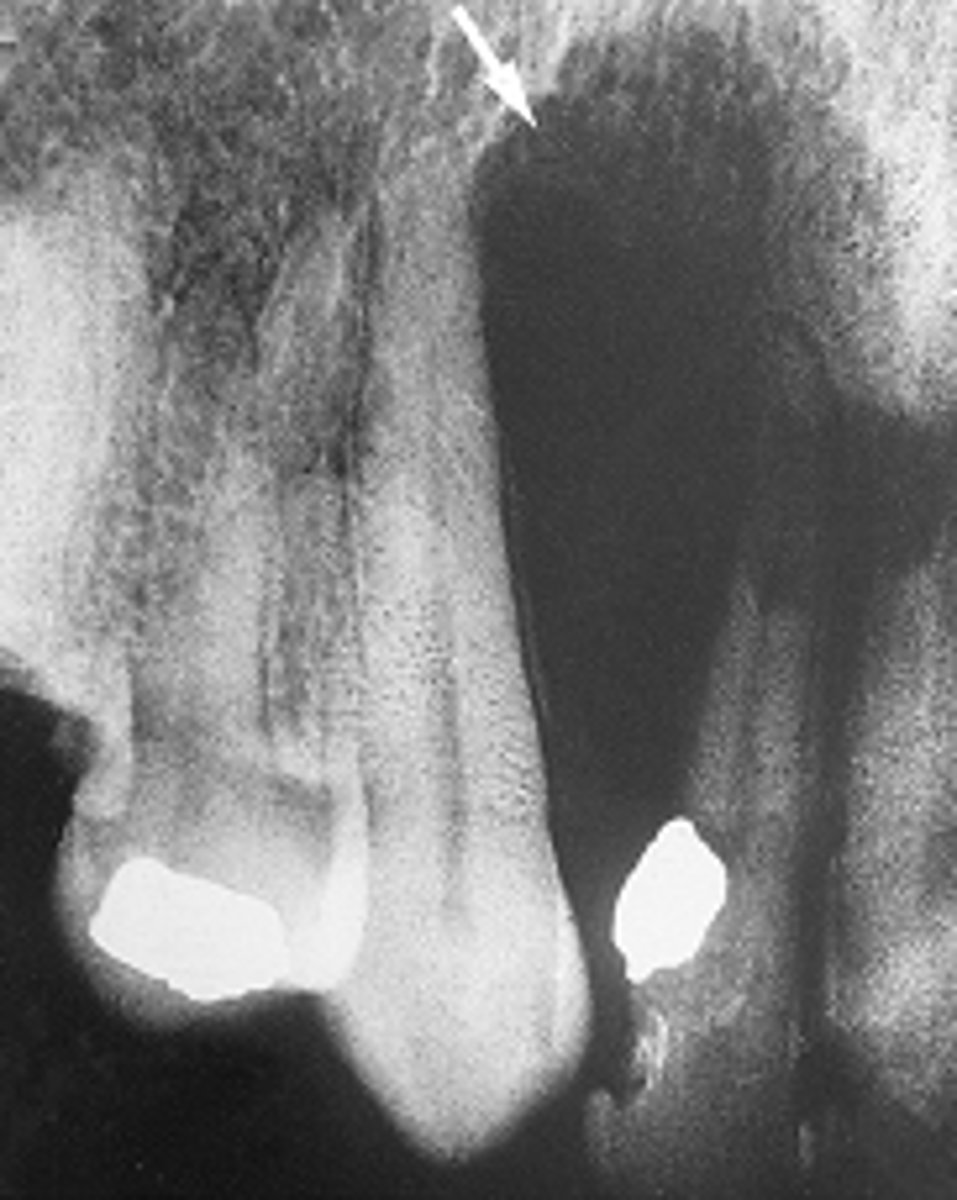
<p><br>well-defined, pear-shaped radiolucency found between the roots of the maxillary lateral incisor and canine</p><p><span>The pear-shaped radiolucency seen in this radiographic image was historically referred to as what type of cyst?</span></p>
58
New cards

talon cusp

Additional cusp on the surface of an anterior tooth that projects at least half the distance from the CEJ to the incisal edge; usually lingual

The accessory cusp located in the cingulum of the maxillary right lateral permanent incisor is called
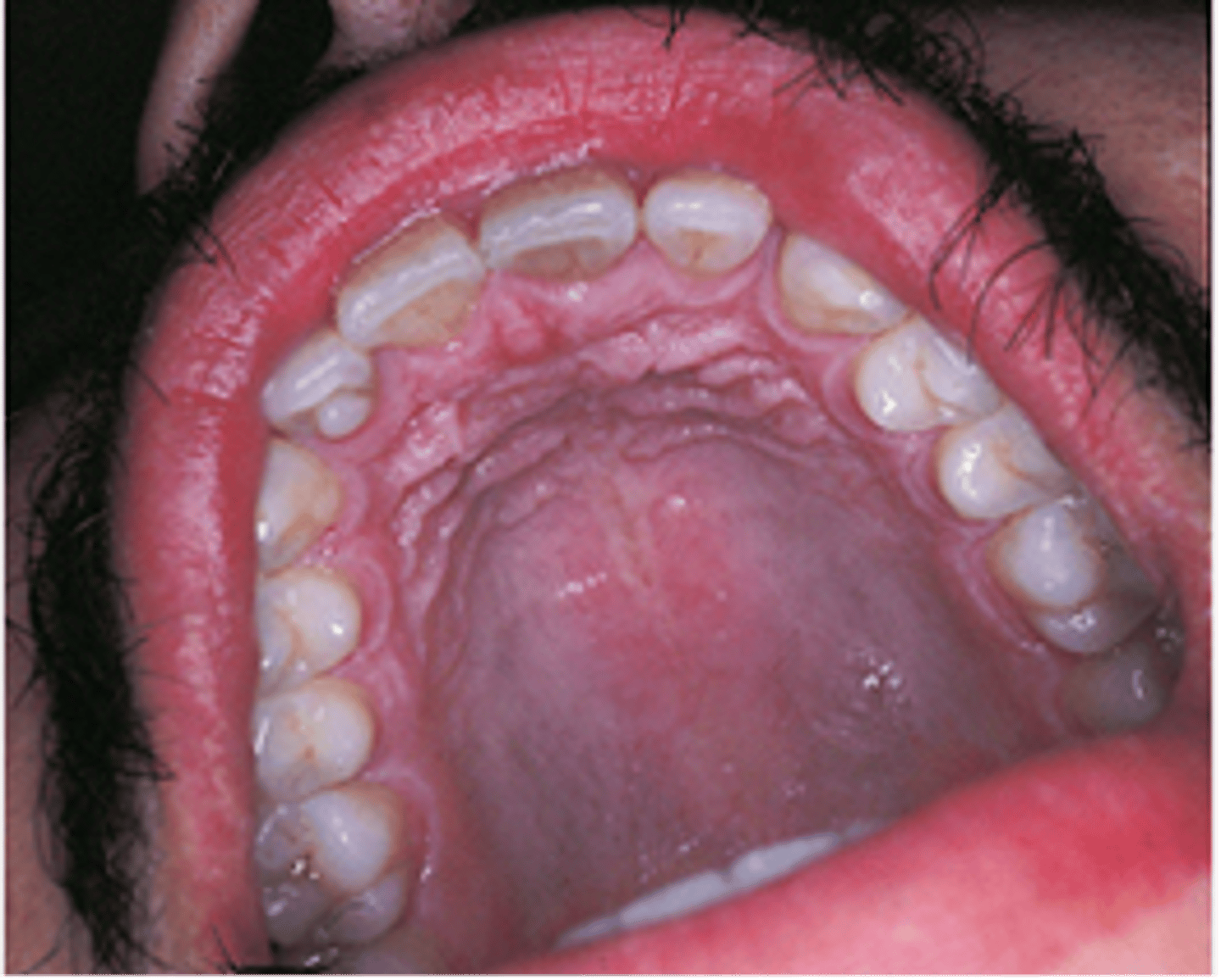
<p>Additional cusp on the surface of an anterior tooth that projects at least half the distance from the CEJ to the incisal edge; usually lingual</p><p><span>The accessory cusp located in the cingulum of the maxillary right lateral permanent incisor is called</span></p>
59
New cards

Linea Alba

White, raised line most commonly on the buccal mucosa at the occlusal plane; No treatment necessary
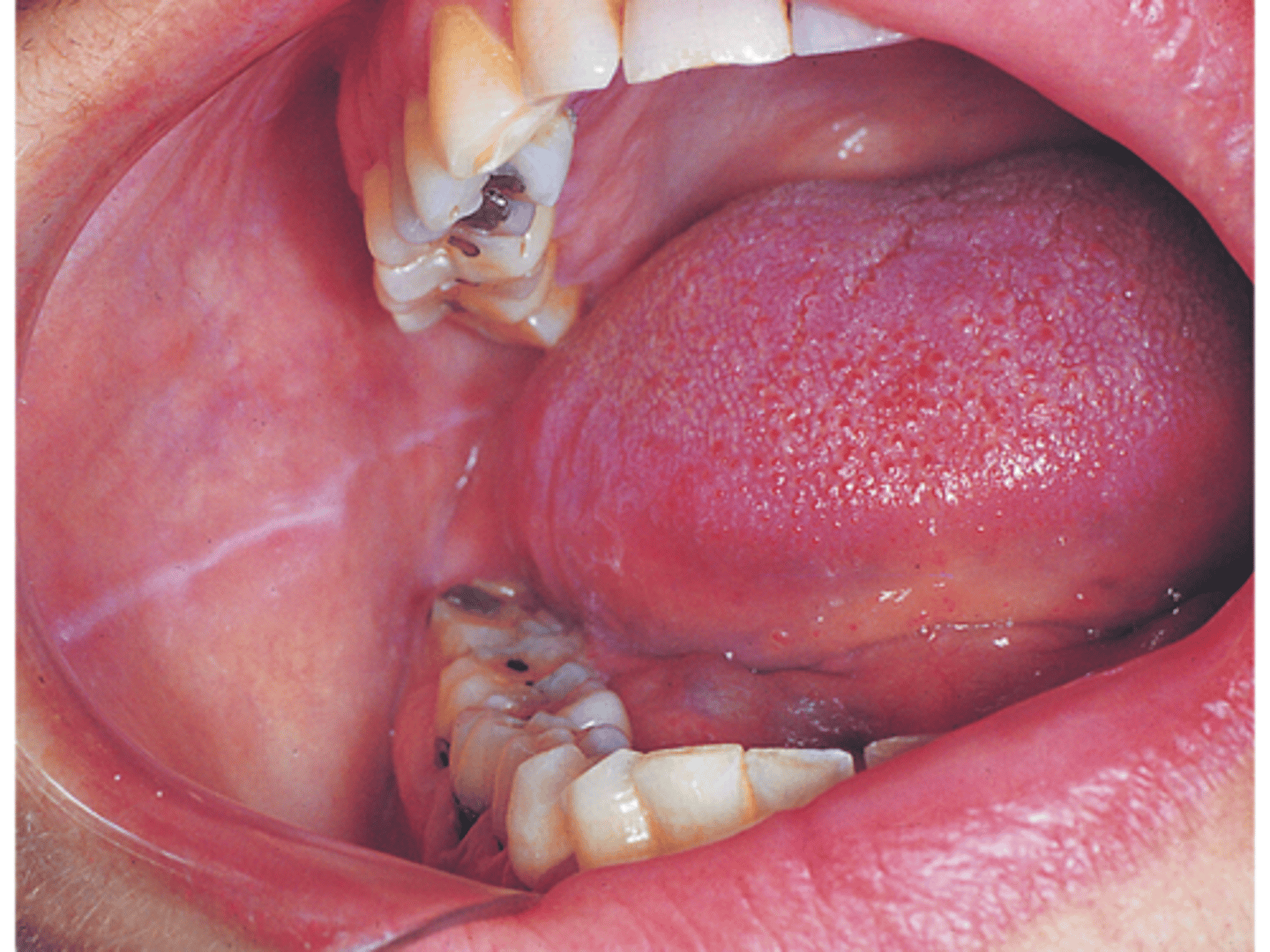
<p>White, raised line most commonly on the buccal mucosa at the occlusal plane; No treatment necessary </p>
60
New cards

Nicotine Stomatitis

Benign lesion typically associated with pipe and/or cigar smoking; May also occur with cigarette smoking

This benign palatal lesion is typically associated with heavy, long-term pipe and cigar smoking and is caused by heat on the palatal mucosa.
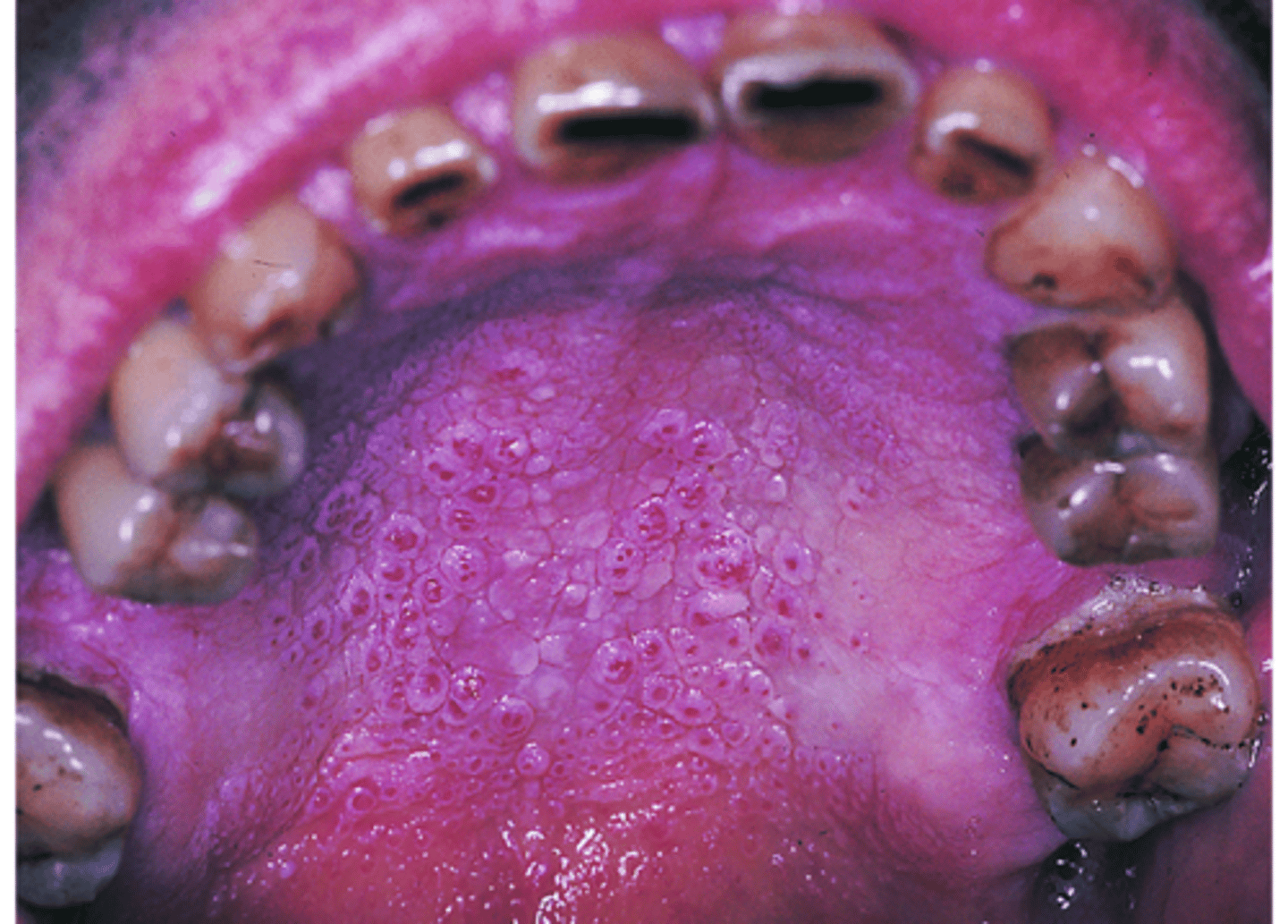
<p>Benign lesion typically associated with pipe and/or cigar smoking; May also occur with cigarette smoking</p><p>This benign palatal lesion is typically associated with heavy, long-term pipe and cigar smoking and is caused by heat on the palatal mucosa.</p>
61
New cards

Smokeless Tobacco Keratosis (epithelial dysplasia)

White lesion located where chewing tobacco is placed, most often in the mucobuccal fold
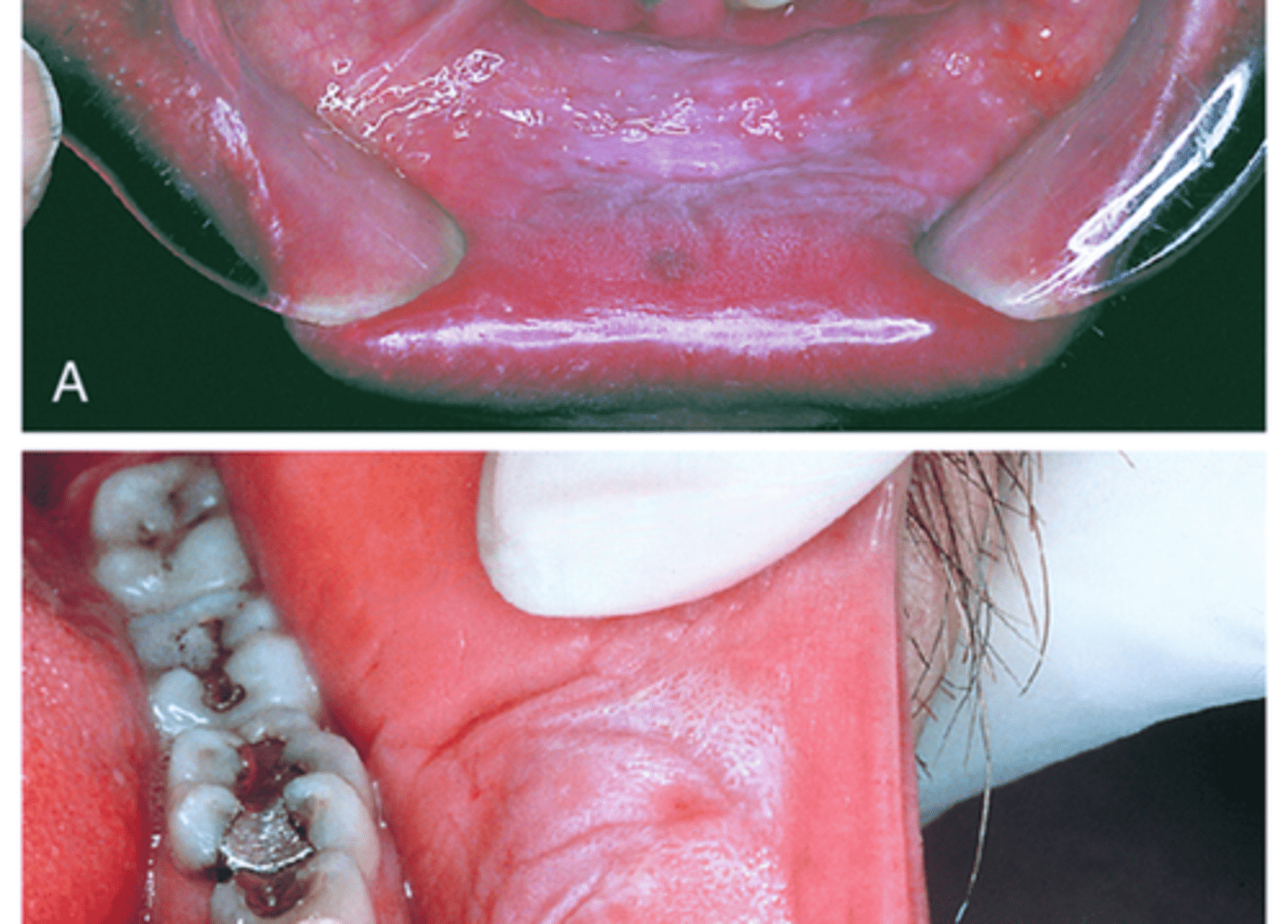
<p>White lesion located where chewing tobacco is placed, most often in the mucobuccal fold</p>
62
New cards

Traumatic Neuroma (peripheral nerve damage/painful)

Lesion caused by injury to a peripheral nerve; Painful, ranging from pain on palpation to severe, intractable pain
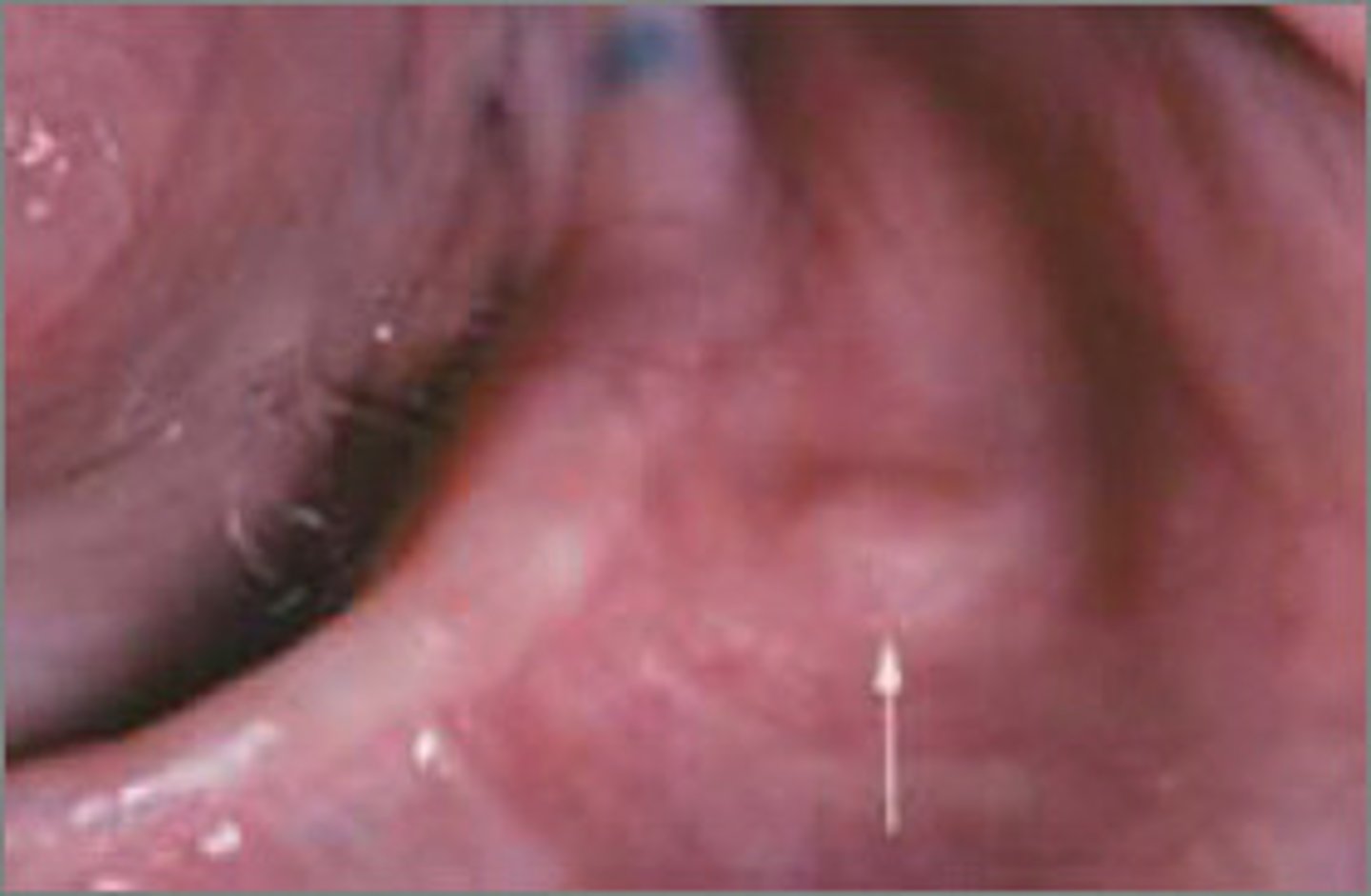
<p>Lesion caused by injury to a peripheral nerve; Painful, ranging from pain on palpation to severe, intractable pain</p>
63
New cards

Amalgam Tattoo (focal argyrosis)

Flat, bluish-gray lesion of the oral mucosa, caused by the introduction of amalgam into tissue; Must be differentiated from malignant melanoma
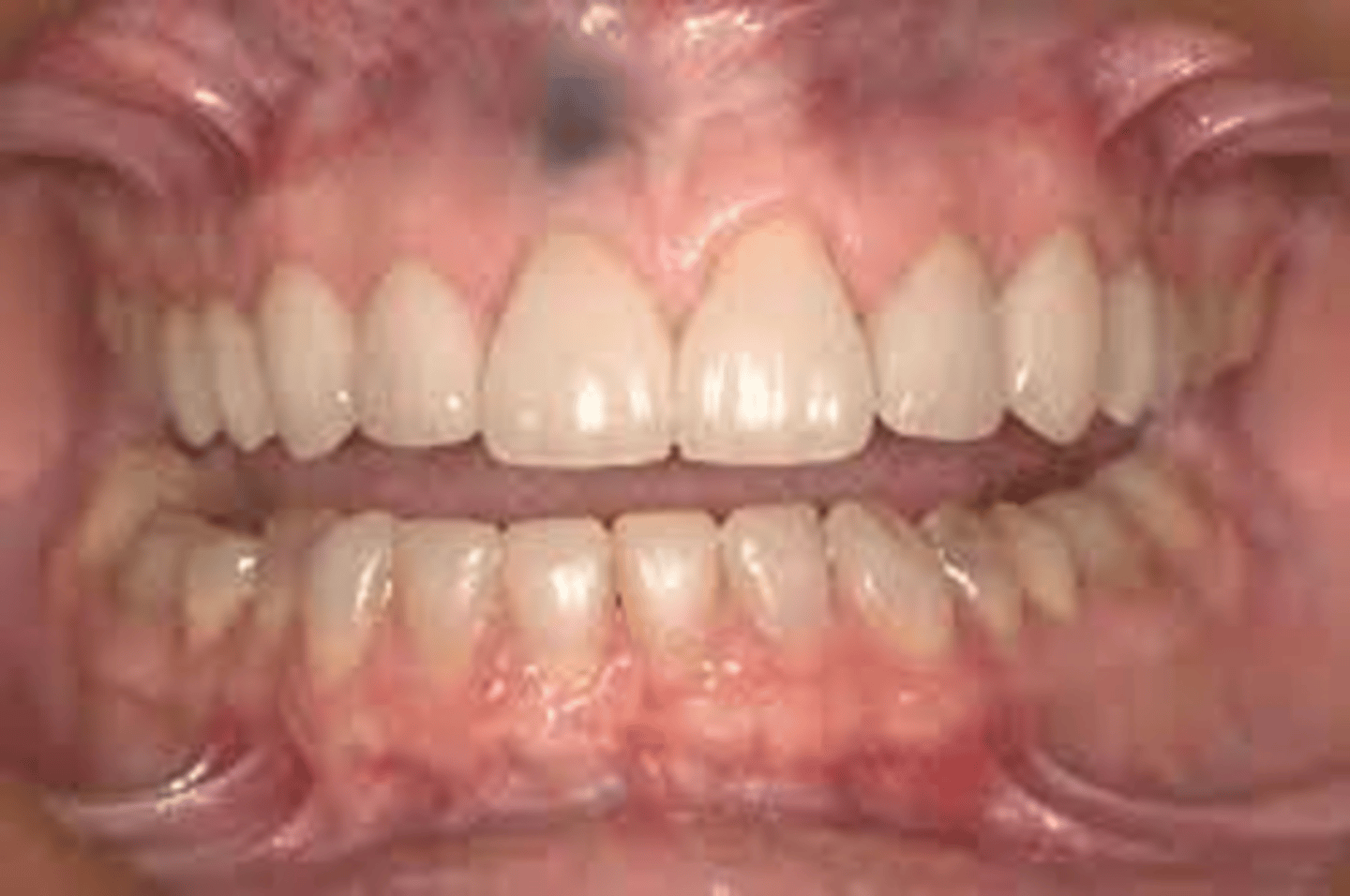
<p>Flat, bluish-gray lesion of the oral mucosa, caused by the introduction of amalgam into tissue; Must be differentiated from malignant melanoma</p>
64
New cards

Melanosis / melanin pigmentation

Normal physiologic pigmentation of oral mucosa


what is the coloration of the mandibular gingiva that is considered a variant of normal called
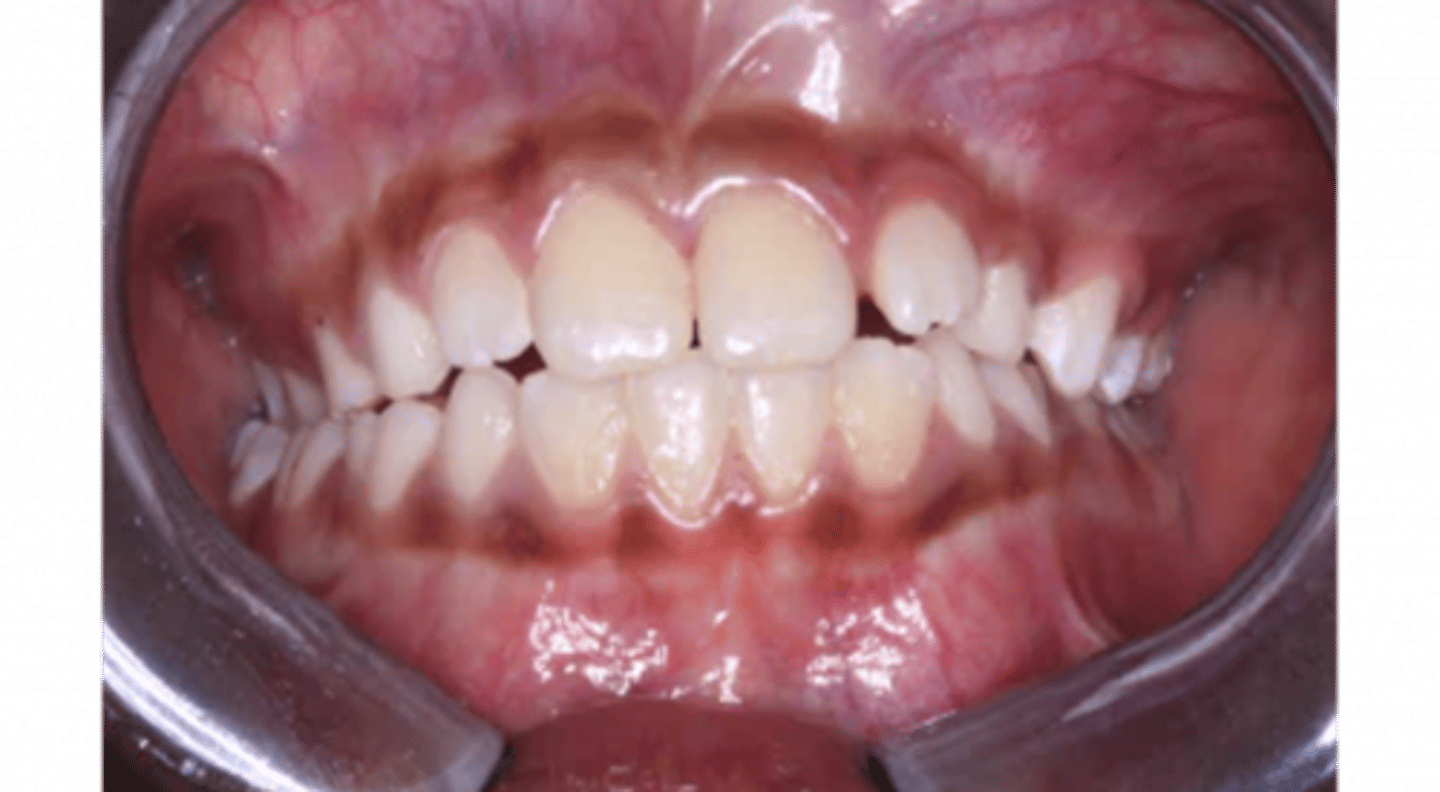
<p>Normal physiologic pigmentation of oral mucosa</p><p><br><span>what is the coloration of the mandibular gingiva that is considered a variant of normal called</span></p>
65
New cards

Solar/Actinic Cheilitis (sun exposure/vermillion border of lips)

Degeneration of the tissue of the lips, caused by exposure to the sun; Smoking & alcohol use increase risk of squamous cell carcinoma
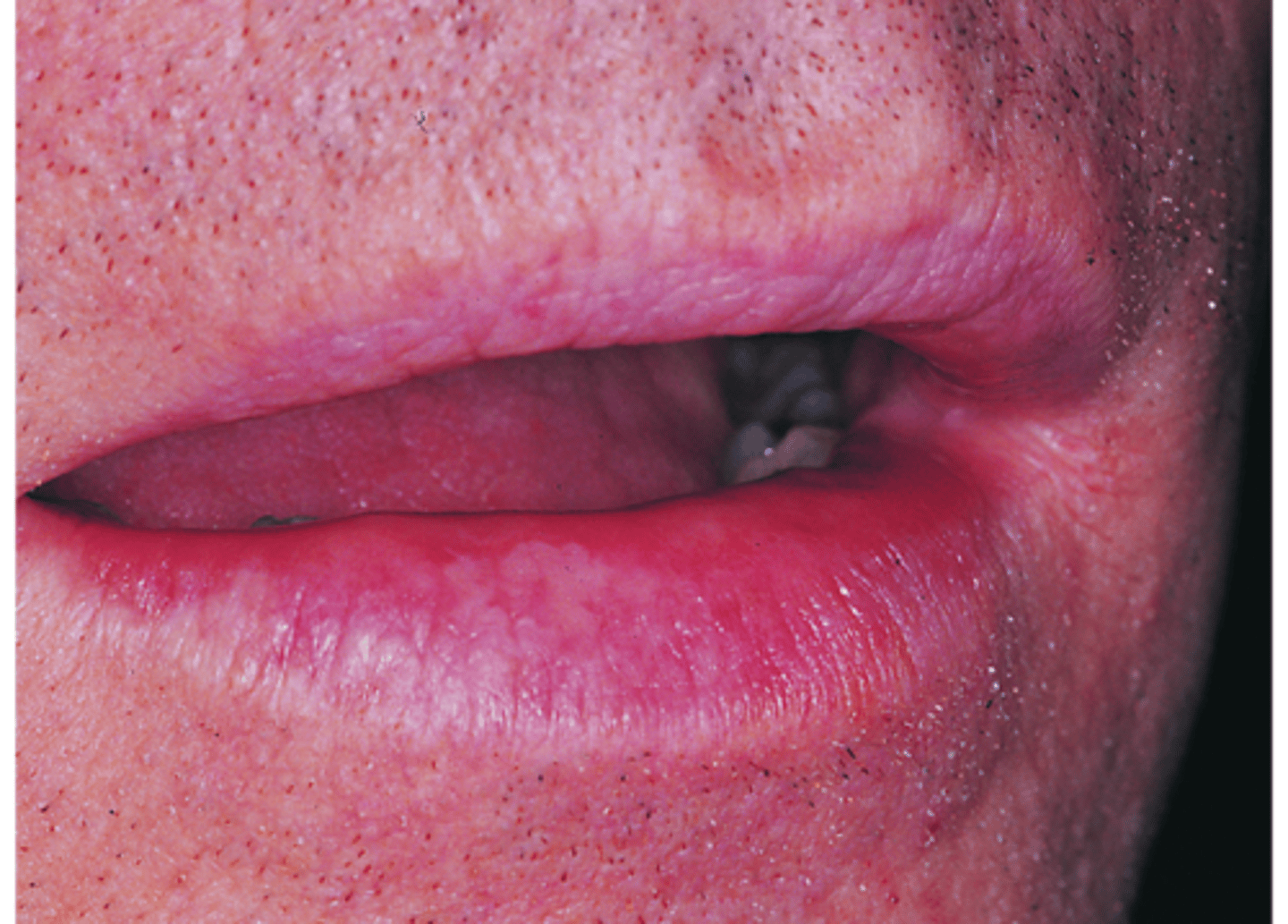
<p>Degeneration of the tissue of the lips, caused by exposure to the sun; Smoking &amp; alcohol use increase risk of squamous cell carcinoma</p>
66
New cards

Mucocele (damage to salivary duct/small/lower lip)

Lesion formed when salivary gland duct is severed & the mucous salivary gland secretion spills into the adjacent connective tissue; Most often seen on lower lip; NOT A TRUE CYST because it is NOT lined with epithelium
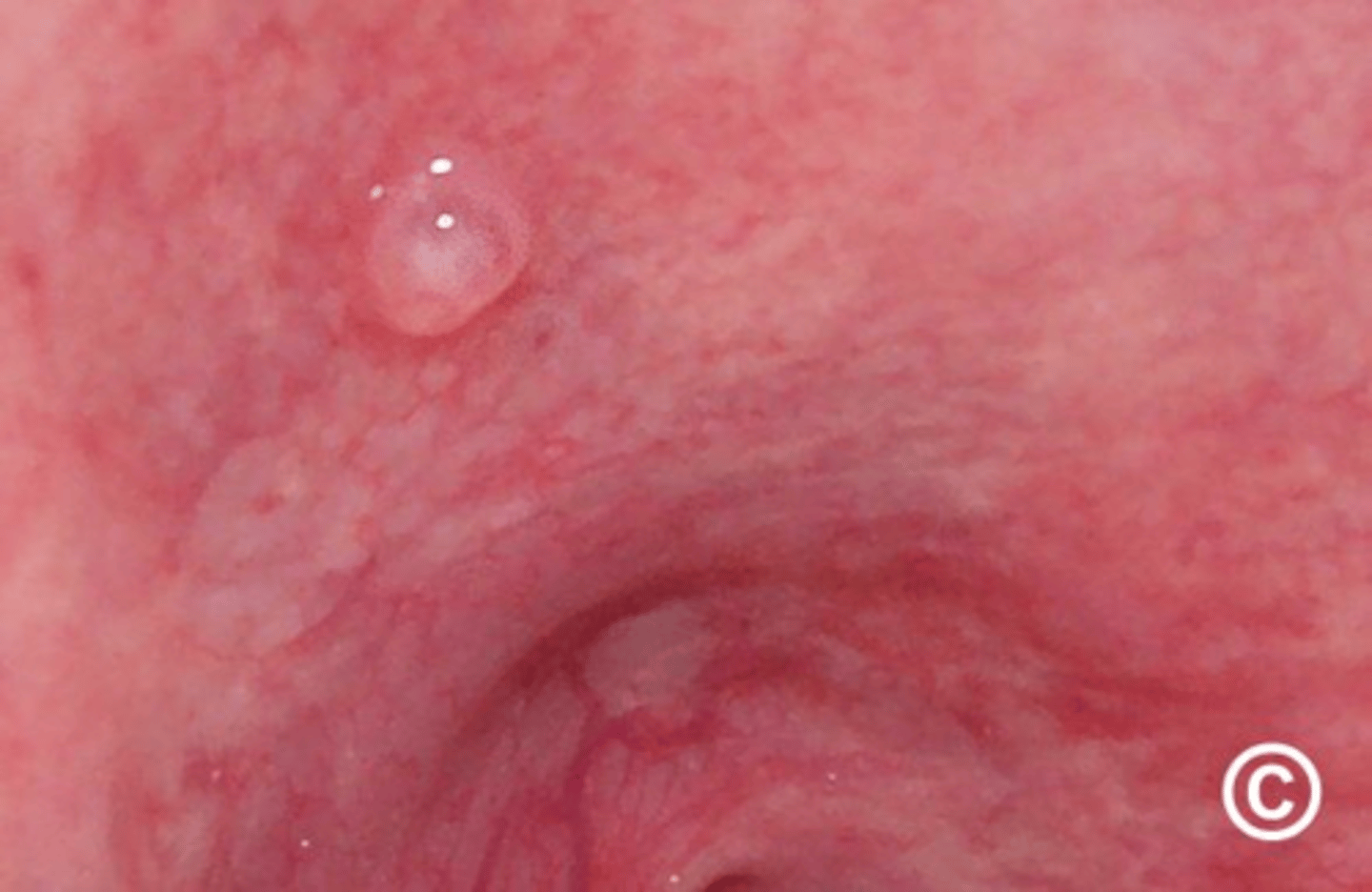
<p>Lesion formed when salivary gland duct is severed &amp; the mucous salivary gland secretion spills into the adjacent connective tissue; Most often seen on lower lip; NOT A TRUE CYST because it is NOT lined with epithelium</p>
67
New cards

Ranula (blocked duct/sialolith/large/unilateral)

Unilateral mucocele-like lesion that forms on the floor of the mouth; Associated with the ducts of submandibular & sublingual glands
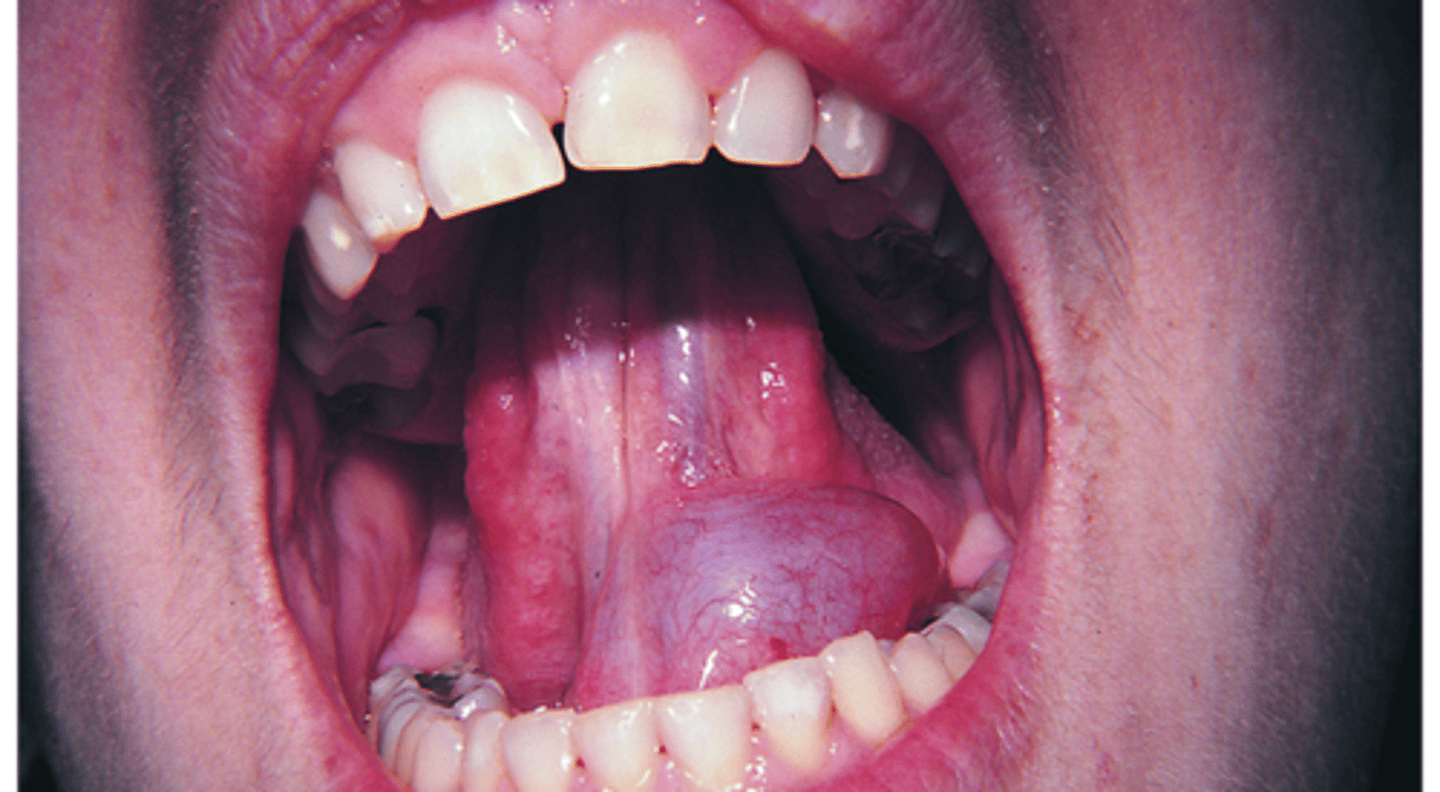
<p>Unilateral mucocele-like lesion that forms on the floor of the mouth; Associated with the ducts of submandibular &amp; sublingual glands</p>
68
New cards

Sialolith (salivary stone/ seen on x-ray)

Salivary gland stone; May be found in minor & major salivary glands; Formed by precipitation of calcium salts around a central core; May often be seen on radiographs
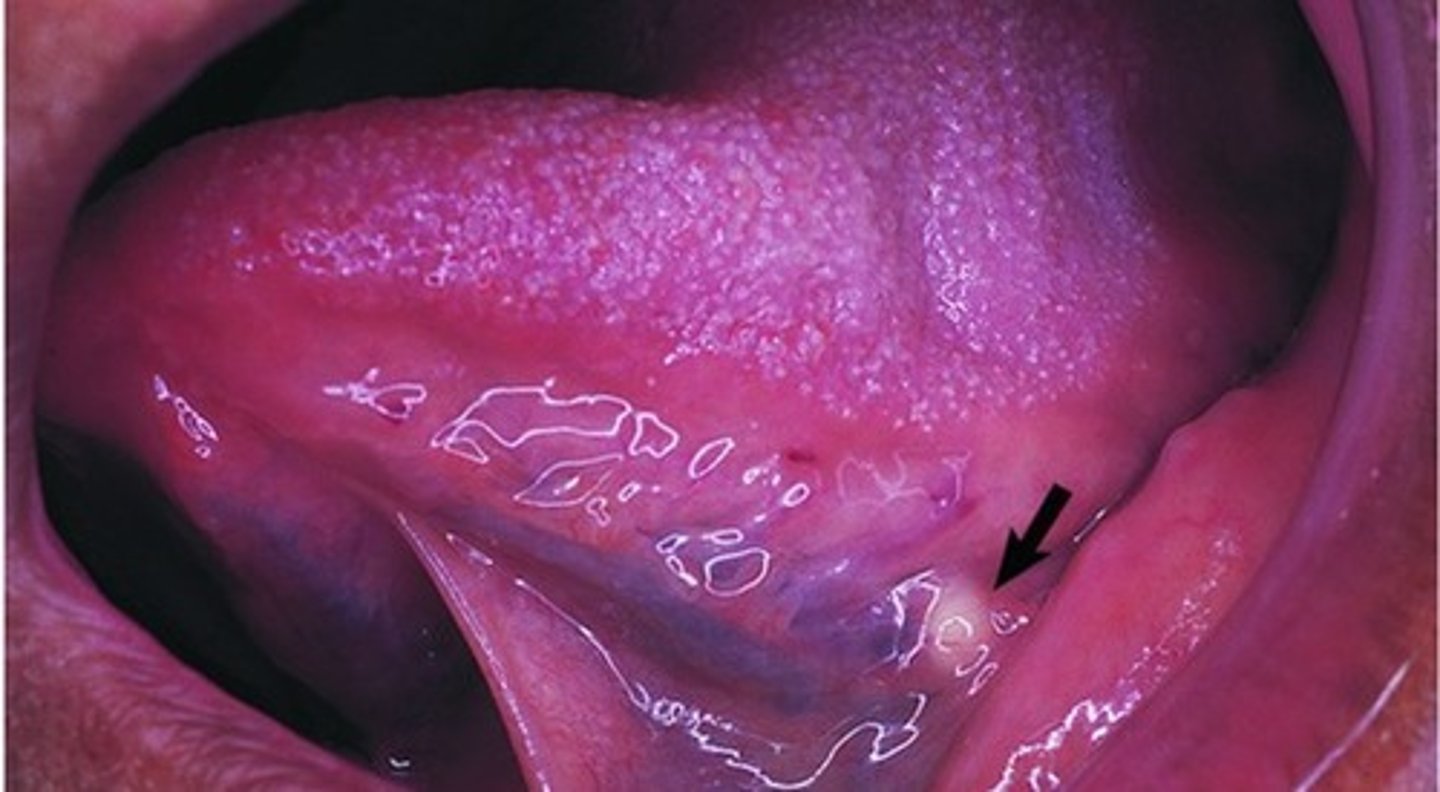
<p>Salivary gland stone; May be found in minor &amp; major salivary glands; Formed by precipitation of calcium salts around a central core; May often be seen on radiographs </p>
69
New cards

Pyogenic Granuloma (pregnancy tumor)

Most commonly observed on the gingiva; Most common in teenagers & young adults; If seen in pregnant female, it is called a pregnancy tumor; May be caused by hormonal changes & increased response to plaque
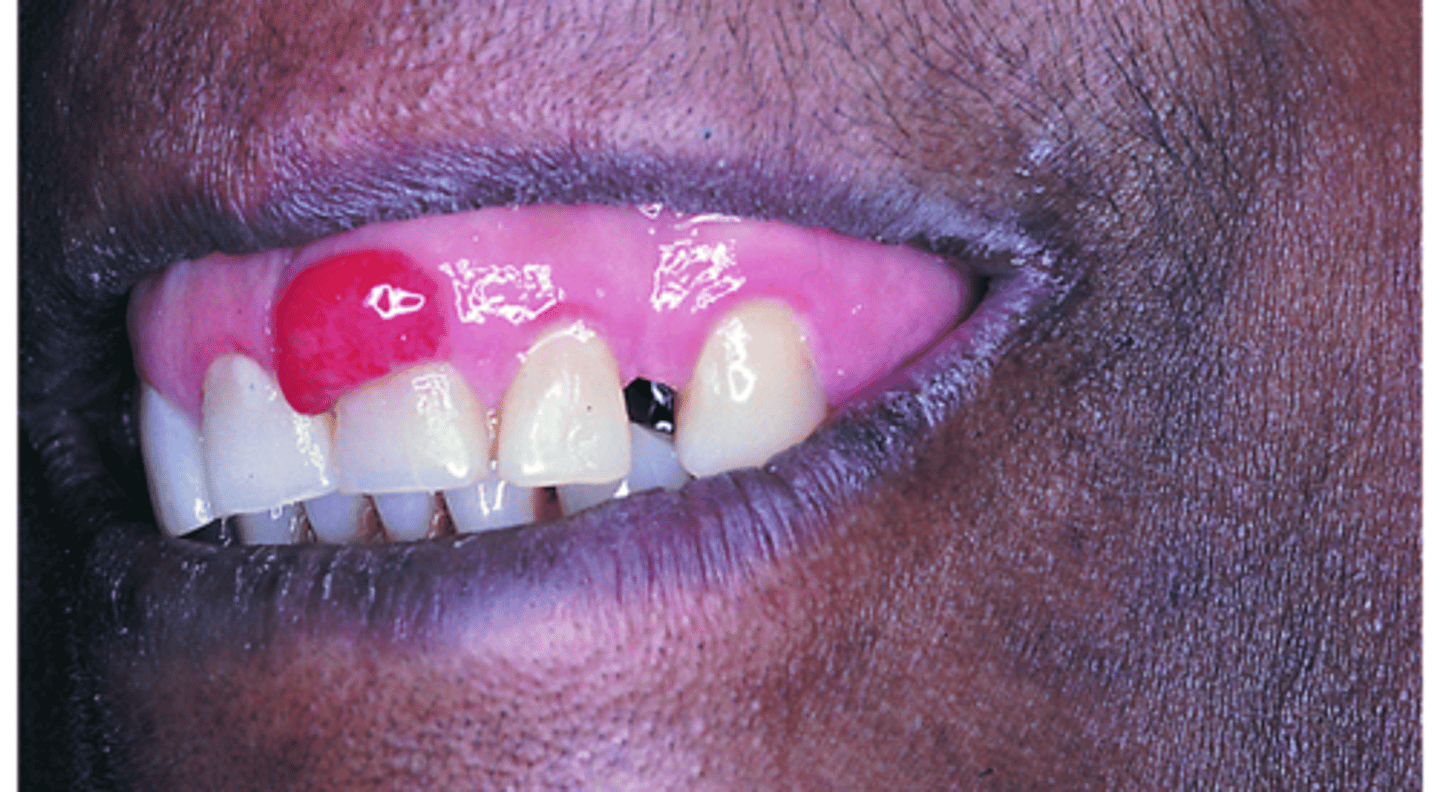
<p>Most commonly observed on the gingiva; Most common in teenagers &amp; young adults; If seen in pregnant female, it is called a pregnancy tumor; May be caused by hormonal changes &amp; increased response to plaque</p>
70
New cards

Peripheral Giant Cell Granuloma (in soft tissue- seen clinically)

Appearance resembles pyogenic granuloma; Reactive lesion; Contains many multinucleated giant cells, well-vascularized connective tissues, RBCs, & chronic inflammatory cells
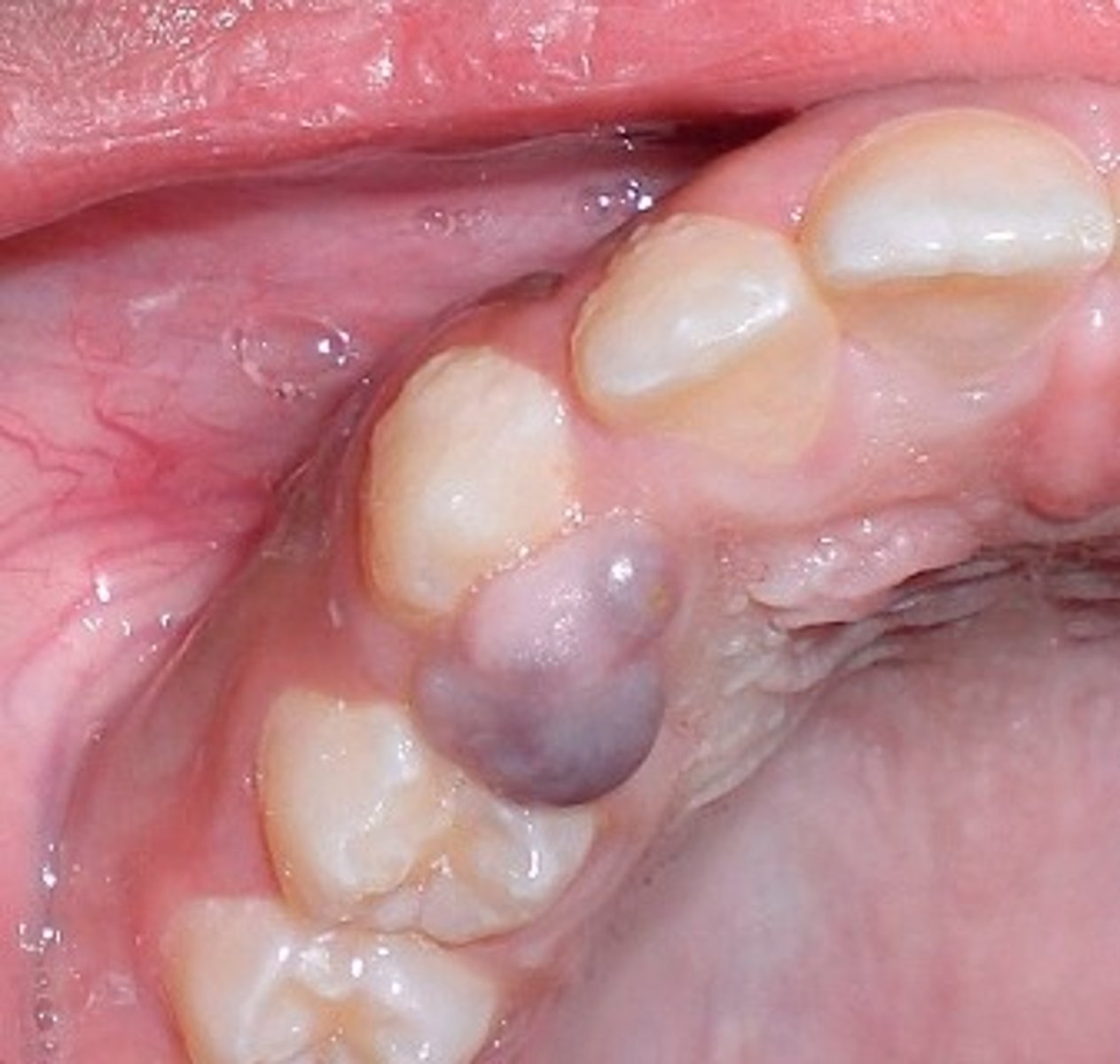
<p>Appearance resembles pyogenic granuloma; Reactive lesion; Contains many multinucleated giant cells, well-vascularized connective tissues, RBCs, &amp; chronic inflammatory cells</p>
71
New cards

Central Giant Cell Granuloma

Within bone; Can be seen radiographically


-may occur on the gingiva or alveolar ridge or in the maxilla or mandible

-divergence of the root of adjacent teeth is a common feature
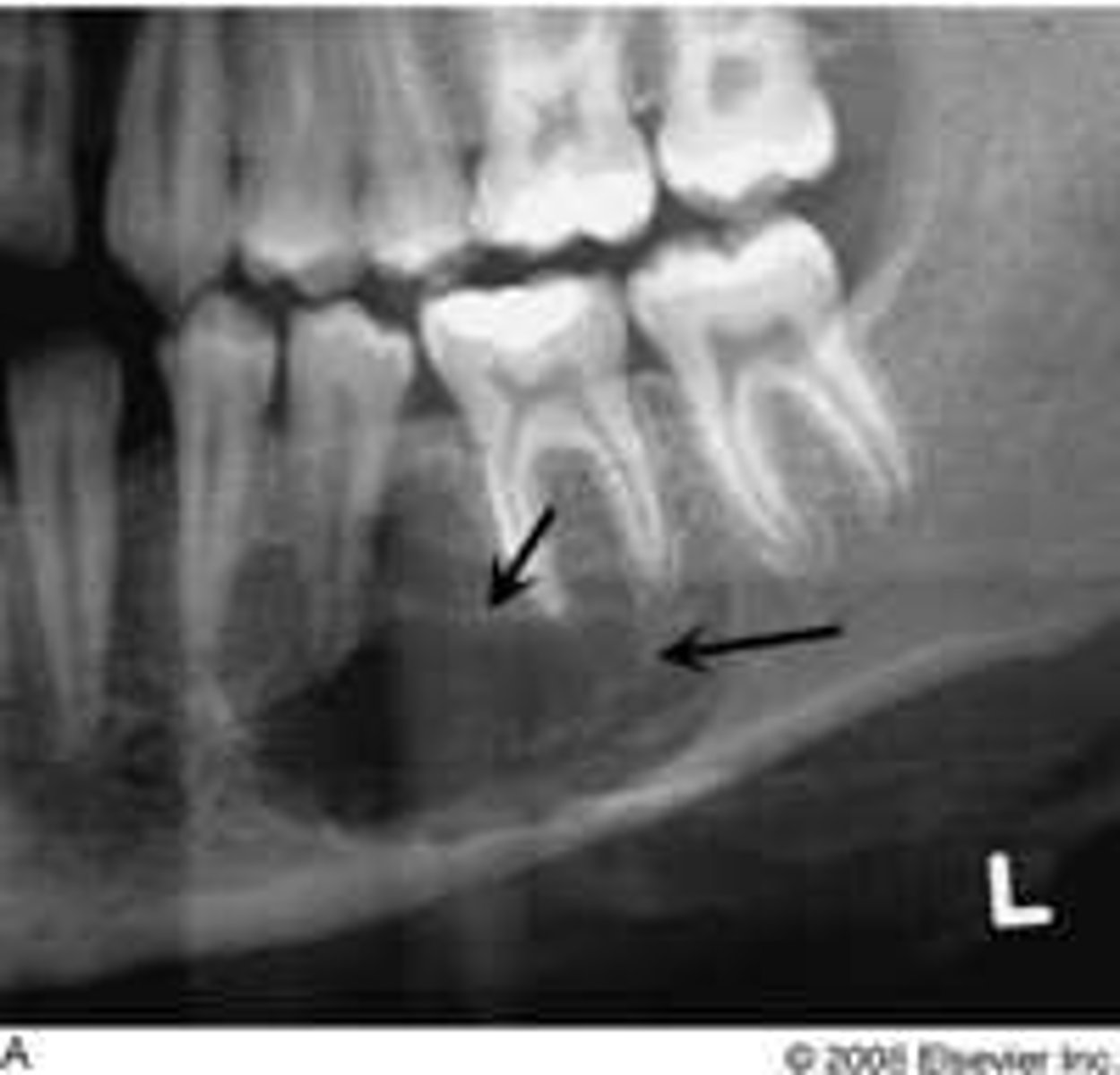
<p>Within bone; Can be seen radiographically</p><p><br>-may occur on the gingiva or alveolar ridge or in the maxilla or mandible</p><p>-divergence of the root of adjacent teeth is a common feature</p>
72
New cards

Irritation Fibroma (traumatic fibroma)

Most common mass on the gingiva; Caused by trauma: Broad-based, usually small lesion, less than 1 cm in diameter
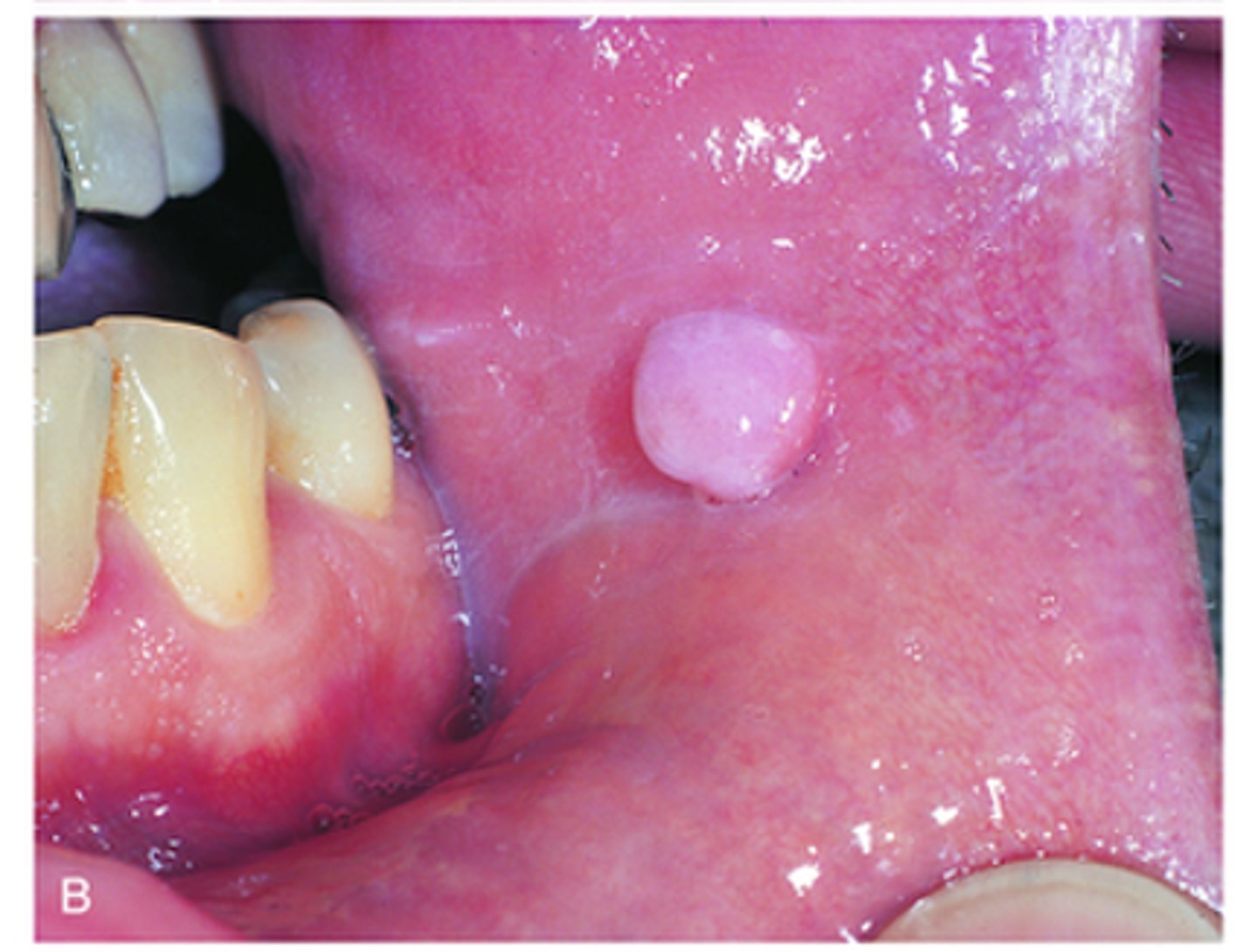
<p>Most common mass on the gingiva; Caused by trauma: Broad-based, usually small lesion, less than 1 cm in diameter</p>
73
New cards

Denture-Induced Fibrous Hyperplasia (epulis fissuratum)

Caused by ill-fitting denture; Usually seen in vestibule due to denture flange

These elongated folds of tissue composed of dense, fibrous connective tissue form as a result of an ill-fitting full or partial denture. What is your DHDx?
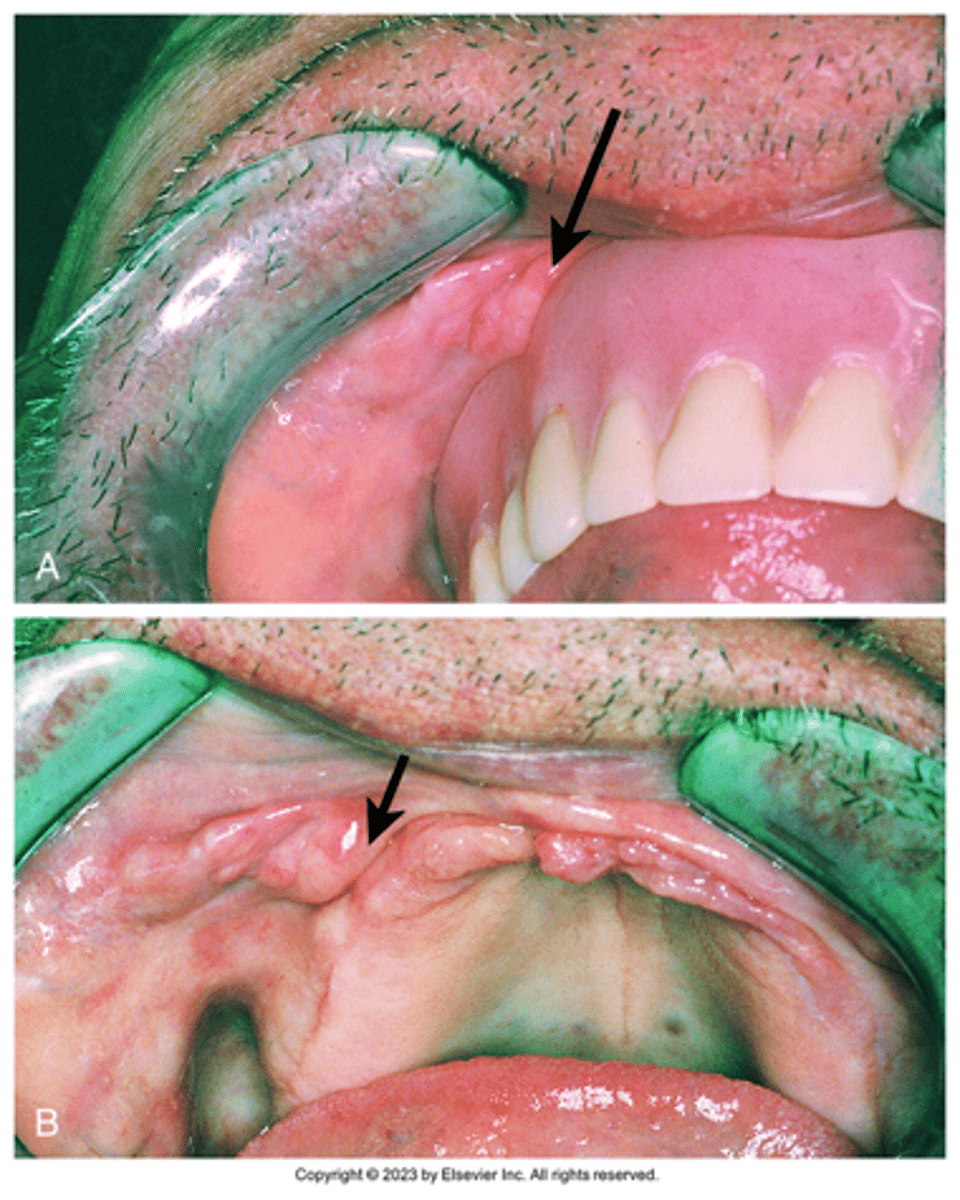
<p>Caused by ill-fitting denture; Usually seen in vestibule due to denture flange</p><p><span>These elongated folds of tissue composed of dense, fibrous connective tissue form as a result of an ill-fitting full or partial denture. What is your DHDx?</span></p>
74
New cards

Papillary Hyperplasia of the Palate (denture stomatitis) candida albicans

Associated with ill-fitting maxillary denture/partial; Denture-induced hyperplasia; "Cobblestone" appearance

This granular, erythematous papillary surface of the palatal vault is called? What was it caused by?
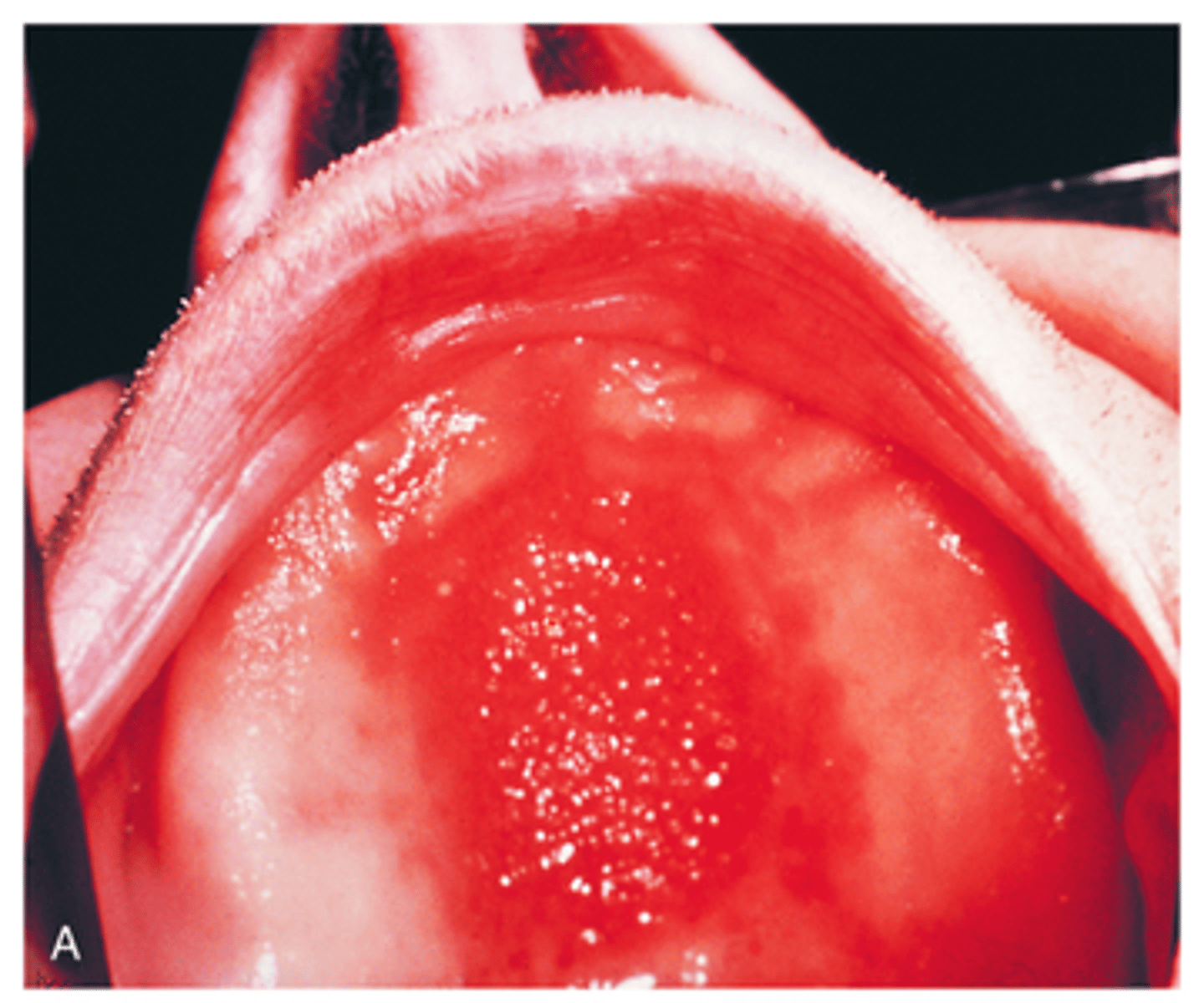
<p>Associated with ill-fitting maxillary denture/partial; Denture-induced hyperplasia; "Cobblestone" appearance</p><p><span>This granular, erythematous papillary surface of the palatal vault is called? What was it caused by?</span></p>
75
New cards

Gingival Hyperplasia (overgrowth/drug induced)

Gingival enlargement; Increase in the bulk of free & attached gingiva, especially the interdental papillae
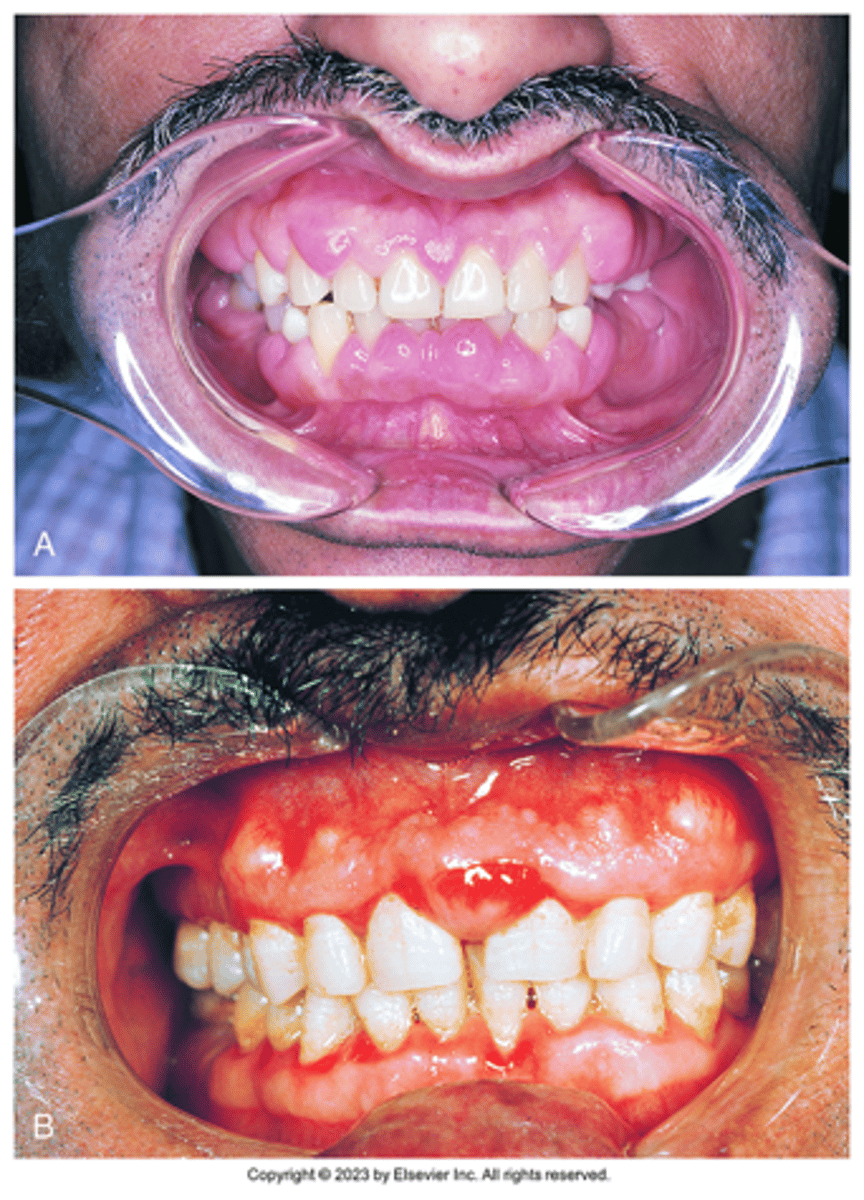
<p>Gingival enlargement; Increase in the bulk of free &amp; attached gingiva, especially the interdental papillae</p>
76
New cards

Chronic Hyperplastic Pulpitis

Excessive proliferation of chronically inflamed dental pulp tissue; Occurs in teeth with large, open carious lesions often in primary & permanent molars; Usually asymptomatic
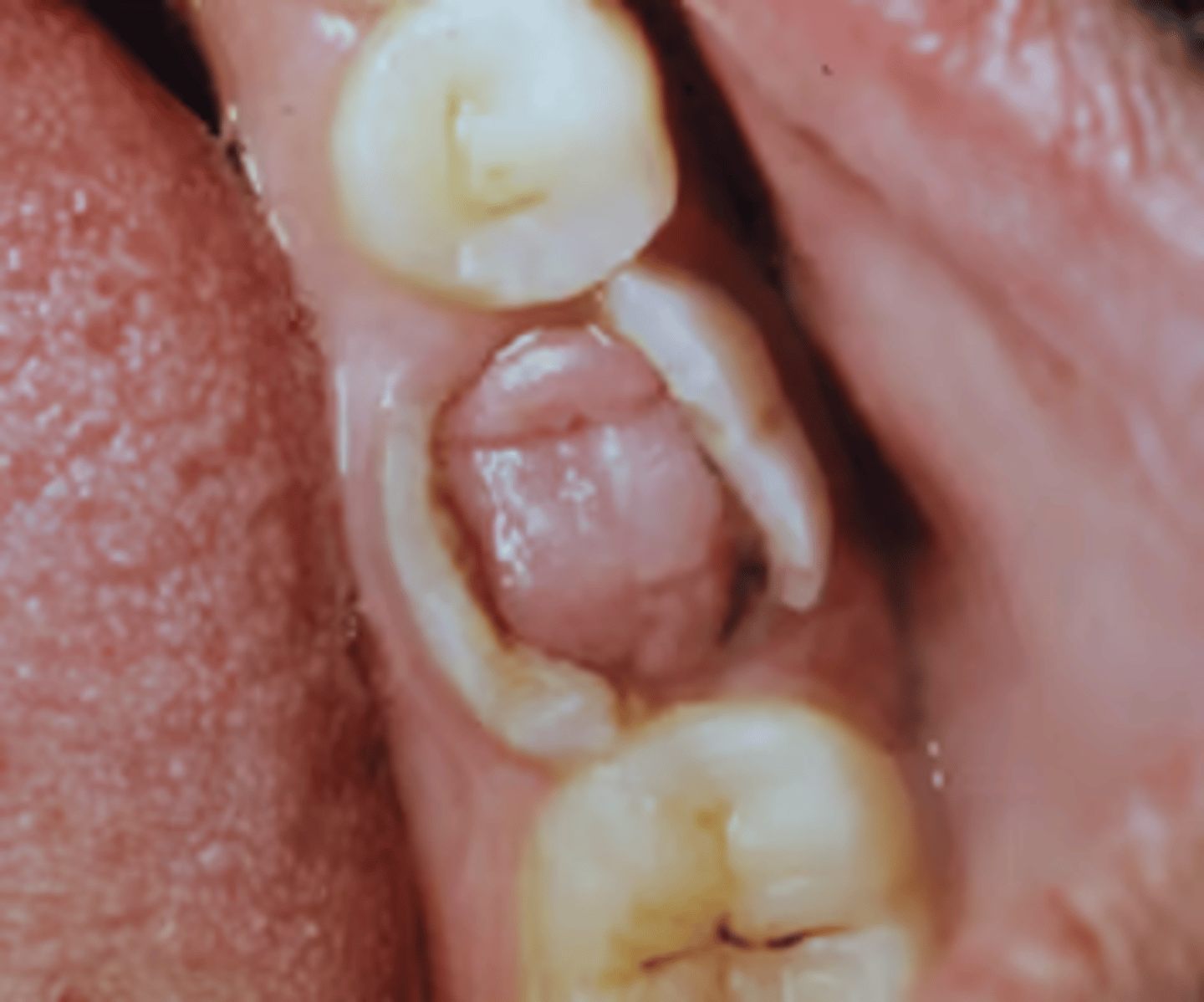
<p>Excessive proliferation of chronically inflamed dental pulp tissue; Occurs in teeth with large, open carious lesions often in primary &amp; permanent molars; Usually asymptomatic</p>



