Lecture 8: Periodization
 Call Kai
 Learn
Learn Practice Test
 Spaced Repetition
 Match
Match Flashcards
 Knowt Play
1/24

Earn XP
Description and Tags
Name | Mastery | Learn | Test | Matching | Spaced | Call with Kai | Chat |
|---|
No analytics yet
Send a link to your students to track their progress
25 Terms
What is periodization?
Theoretical and practical construct that allows for the systemic, sequential, and integrative programming of training interventions into mutually dependent periods of time in order to induce specific physiological adaptations that underpin performance outcomes.
Purpose of periodization
to prevent injury and overtraining
variation in programs to help well trained athletes continue to improve in performance
Periodization allows for variation in what?
Training volume
Intensity
Frequency
Focus
Mode
Exercise Selection
Components of a successful program
induce specific physiological adaptations
translate adaptations to increases in performance
manage the adaptive response
handle accumulated fatigue
capitalize on the after-effects of training factors
manage the above factors so peak performance occurs at appropriate times
Macrocycle
several months to a year
Mesocycle
2-6 weeks
Microcycle
several days to 2 weeks
How to plan short term within a Mesocycle
fatigue is specific to the exercise completed which allows for multiple abilities to be trained in each mesocycle
too identical workouts performed too close together results in accumulation of fatigue (Ex: hitting legs Mon and Wed but not fully recovered)
To avoid this: train multiple motor abilities within a cycle (also allows for greater volume of training these groups on more spread out days)
Pick no more than 3 qualities
conflict of demands: maximize adaptations by training few motor abilities, while providing enough variation to avoid accumulation of fatigue
If aerobic endurance is the dominant training modality, what are compatible modalities?
alactic sprint abilities
strength endurance (aerobic)
maximum strength
hypertrophy
If glycolytic endurance is the dominant training modality, what are compatible modalities?
strength endurance (anaerobic)
aerobic restoration
aerobic-anaerobic (mixed) endurance
If alactic sprints is the dominant training modality, what are compatible modalities?
aerobic endurance
explosive strength
maximum strength
hypertrophy
aerobic restoration
If maximum strength/hypertrophy is the dominant training modality, what are compatible modalities?
maximum strength
flexibility
aerobic restoration
If learning new technical elements is the dominant training modality, what are compatible modalities?
any kind of training modalities after the primary/dominant task
Mesocycle variability
Variation within a microcycle or mesocycle should be done so by changes in the load not the exercise type
there should be daily variation (slight increase in load) to prevent accommodation
Why should you shift training priorities over time?
to prevent overtraining and to optimize performance
Ex: General, non-specific activities w high volume & low intensity —> specific activities w low volume & high intensity
this shift occurs over many weeks and months
too rapidly would cause overtraining and potentially injury
Periods/Phases of Training
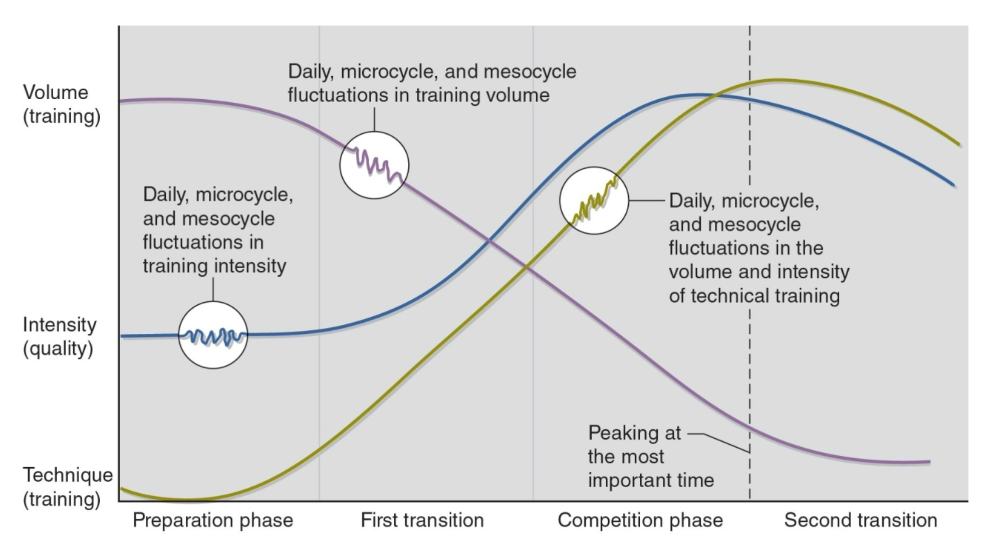
Preparation Phase of Training
High volume, medium-low intensity, low training level
Goal: build general foundation for performing well in competition
General phase: hypertrophy/strength endurance
Specific phase: develop sport specific fitness to prepare for competition
First Transition Phase of Training
medium volume, medium intensity, medium training level
Goal: translate greater strength into power, development, and refine technique
Transmutation: conversion of performance gained in non-specific activity into performance gains in actual sport
Strength/Power phase: training intensifies to near competition pace & uses both low and high intensities to invoke power
Competition Phase of Training (in season)
low volume, high intensity, high training level
Goal: peak strength and power, and refine technique
less time spent on physical conditioning
more time spent on practicing sport specific skills and tactics
Peaking: when competition period is a short duration, intensity and volume are reduced to reduce fatigue
Maintenance: when competition period lasts months, greater intensity and volume to manage fatigue but maintain adaptations
Second Transition Phase of Training (Active Rest/Restoration/Post-Season)
low volume, medium-high intensity, medium-high training level
Goal: rehabilitate injuries, rest mentally and physically
lasts 1-4 weeks
can participate in recreational activities
Ex: deload week - structured breaks during long phases of training where intensity and volume is dropped by 20-30%
Motor abilities progression
General —> Specific —> Complex —> Fast
Ex: Jumping exercises —> barbell exercises —> jumps with weights —> plyometrics
Traditional/Linear Periodization
gradual changes in volume and intensity over the course of many mesocycles
focus on one ability per phase
allows for the slow build up to competition
great for developing a strong foundation
good for beginners and training for one competition
ideal for beginners
EX:
Wk 1-3: 3×10 @70-75% = hypertrophy mesocycle
Wk 4-6: 4×8 @77-82% = Basic strength mesocycle
Wk 7-9: @85-90% = Strength/power mesocycle
Undulating/Non-Linear Periodization
manipulate multiple variables to change stimuli within a training cycle
daily/weekly fluctuations in volume & intensity
addresses multiple abilities at a time
avoids detraining
good for advanced athletes
less accumulation of central fatigue, but may have more accumulation of peripheral fatigue
abilities may not be optimally improved due to focus on more than one at a time
EX:
Wk 1: 4×6RM (strength), 3×10RM (hypertrophy), 5×2RM (power)
increase daily
Pros of Daily Undulating Periodization (DUP)
more effective and absence of accumulated neural fatigue
Cons of Daily Undulating Periodization (DUP)
greater peripheral fatigue, decreased preparedness bc of accumulated fatigue, and increased risk of overtraining and injury