Conformations of Alkanes & Newman Projection
 Call Kai
 Learn
Learn Practice Test
 Spaced Repetition
 Match
Match Flashcards
 Knowt Play
1/11

There's no tags or description
Looks like no tags are added yet.
Name | Mastery | Learn | Test | Matching | Spaced | Call with Kai |
|---|
No analytics yet
Send a link to your students to track their progress
12 Terms
Newman Projection
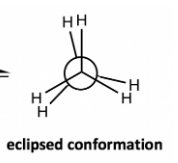
A Newman projection is just a way to look straight down a carbon–carbon single bond so you can clearly see how groups are arranged in 3D
(see image).
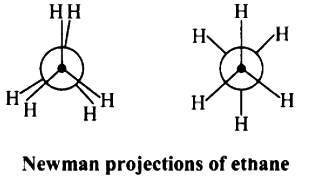
Conformations
Different 3D shapes of the same alkane molecule caused by rotation around a single (sigma) bond.
So:
same molecule
same connectivity
just different rotations in space
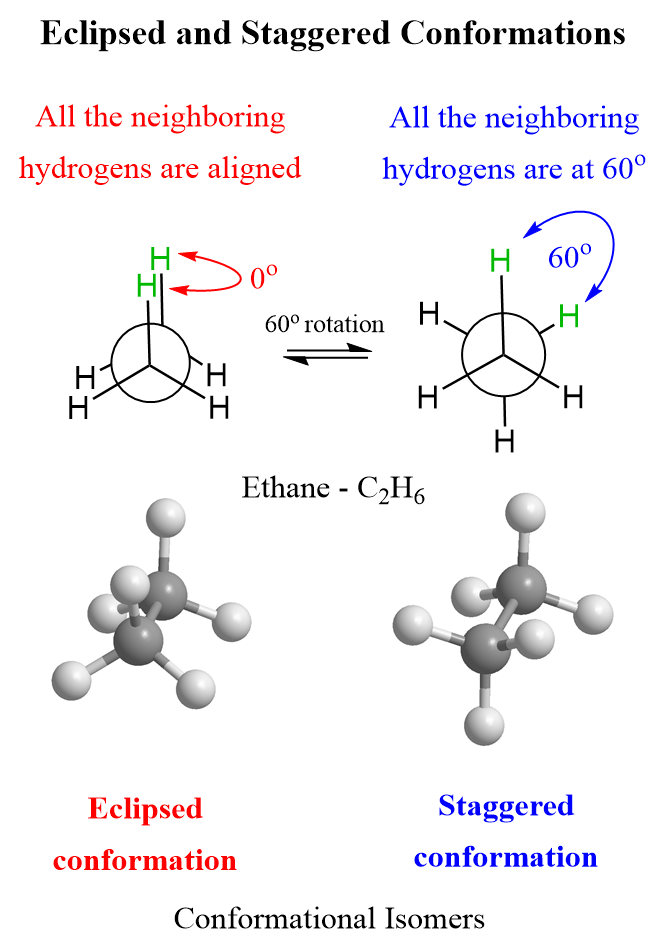
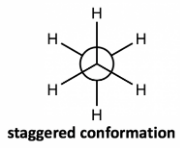
Staggered Conformation
Hydrogen atoms are as far apart as possible (you can see all Hydrogens)
Less electron repulsion
Lowest energy → most stable (If something is not exactly eclipsed, it is staggered)
Eclipsed Conformation
Hydrogens line up behind each other (think of an eclipse) (can’t see all Hydrogens like in staggered because they are directly behind each other)
More electron repulsion (torsional strain)
Highest energy point → least stable
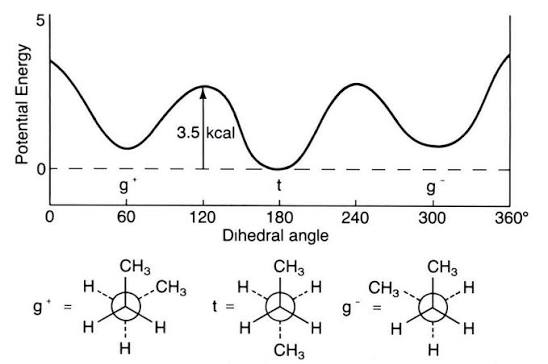
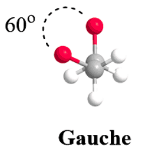
Gauche Conformation
when two bulky groups (usually CH₃ groups) are 60° apart around a single bond.
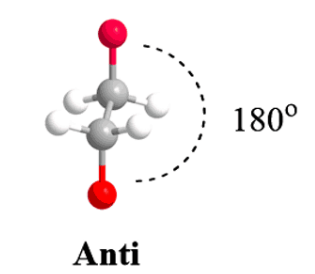
Anti Conformation
An anti conformation is when two bulky groups in a Newman projection are 180° apart from each other.
Torsional Strain
The repulsion that occurs when electron pairs in bonds on adjacent atoms line up too closely during rotation. ONLY happens in eclipsed confirmations
Torsional interactions
Any interaction between bonds on adjacent atoms as they rotate relative to each other.
Steric Strain
Repulsion when atoms or groups are physically too close together in space
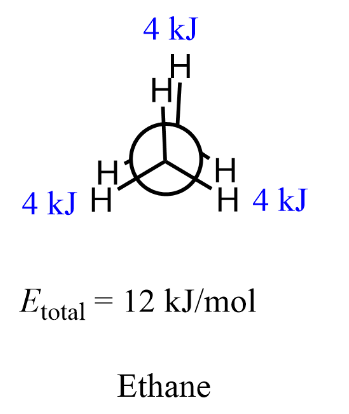
In a Newman projection, kcal/mol
is a way to measure how unstable a conformation is. In a Newman projection, unfavorable interactions have an energy “cost” (kcal/mol), and you can add them up to estimate stability. Not every interaction has a cost — only the unfavourable ones.
Assigning Costs in Newman Projections
Step 1: Identify what’s interacting:
Look at the front carbon vs back carbon. You are checking:
Which groups are directly eclipsed (lined up)?
Which bulky groups are close (gauche, 60° apart)?
Step 2: Mark eclipsed interactions (biggest cost)
If bonds are directly on top of each other, that’s eclipsing.
You look for:
H behind H
H behind CH₃
CH₃ behind CH₃
Then assign costs:
H–H eclipsed ≈ 1 kcal/mol
CH₃–H eclipsed ≈ 1.5 kcal/mol
CH₃–CH₃ eclipsed ≈ 3–4 kcal/mol
You “circle each overlap” and assign a number.
Step 3: Look for gauche interactions (60° apart)
Only matters if bulky groups (usually CH₃) are:
staggered BUT close together (60° apart)
Assign:
CH₃–CH₃ gauche ≈ 0.9 kcal/mol
Step 4: Anti = no cost
180° apart
no penalty, don’t count anything
Barrier Rotation
the energy difference (in kcal/mol) between the lowest and highest energy conformations during rotation. EX: barrier rotation = 3kcal/mol, which means, you need about 3 kcal/mol of energy for the molecule to rotate through the highest-energy eclipsed state. EX: Ethane. Lowest point, staggered, = 0 kcal/mol, highest point, eclipsed = 3 kcal/mol, 3-0 = 3kcal/mol