uf bsc2010 exam 3 hart spring '26
 Call Kai
 Learn
Learn Practice Test
 Spaced Repetition
 Match
Match Flashcards
 Knowt Play
1/81

There's no tags or description
Looks like no tags are added yet.
Name | Mastery | Learn | Test | Matching | Spaced | Call with Kai |
|---|
No analytics yet
Send a link to your students to track their progress
82 Terms
Evolution
genetic changes in POPULATIONS over time
Theory of evolution
supported by evidence
parsimonious: simplest explanation
falsifiable: make testable predictions
evidence of evolution
fossil record
molecular biology
comparative anatomy (homologous anatomy)
Darwin’s inspiration
Lyell & Mathus
conditions of darwin’s natural selection
variation in a trait
heritable
higher fitness
process of adaptation
beneficial mutations that evolve through natural selection
How are adaptations constrained
genetic
physical
developmental
ecological factors
darwin’s 3 conditions for evolution
population has variation in a trait
the variation is heritable
high fitness
heritablity
proportion of total phenotypic variance that is due to genetic factors
gene flow
movement of genes between populations; introduces new alleles into population
genetic drift
random changes in allele frequency; affect smaller populations, due to random events like getting hit by a car
mutation
change in dna sequence; original source of all new genetic information
non-random mating
organisms choose mates based on certain traits; changes genotype frequencies
bottleneck population
an environmental event results in survival of only a few individuals; reduction in population size causes loss of genetic diversity and intensifies genetic drift
founder effect
when a few individuals from a population colonize a new area and become isolated, genetic drift changes allele frequencies
directional selection
favors individuals that vary in one direction from the mean; doesn’t change variance
stabilizing selection
favors average individuals; changes variance
disruptive selection
favors individuals that vary in both directions from the mean; increases variation
intrasexual selection
competing with same sex organisms for mates
intersexual selection
choosey about mates due to phenotypes
heterozygote advantage
individuals with heterozygote genotypes have higher fitness
negative frequency-dependent selection
rarer phenotypes have higher fitness, so multiple phenotypes are maintained
positive frequency-dependent selection
common phenotypes have higher fitness
genes
segment of dna
alleles
specific variant of gene
rare vs common alleles
one is rare one is not?
beneficial allele
these increase survival and fitness
deleterious allele
decrease survival and fitness
dominant alleles
A
recessive alleles
a
conditions for Hardy-Weinberg Equilibrium
no mutation
no selection
random mating
no gene flow
infinite population size
Hardy-Weinberg Equilibrium
p= 2(NAA)+ 1(NAa)/ 2(population)
q= 2(Naa)+ 1(NAa)/ 2(population)
p2+2pq+q2=1
synonymous substitution
amino acid doesn’t change
nonsynonymous substitution
amino acid does change; can be advantageous, deleterious, or selectively neutral
positive selection
synonymous LESS than nonsynonymous
neutral selection
synonymous is EQUAL to nonsynonymous
purifying selection
synonymous is MORE than nonsynonymous
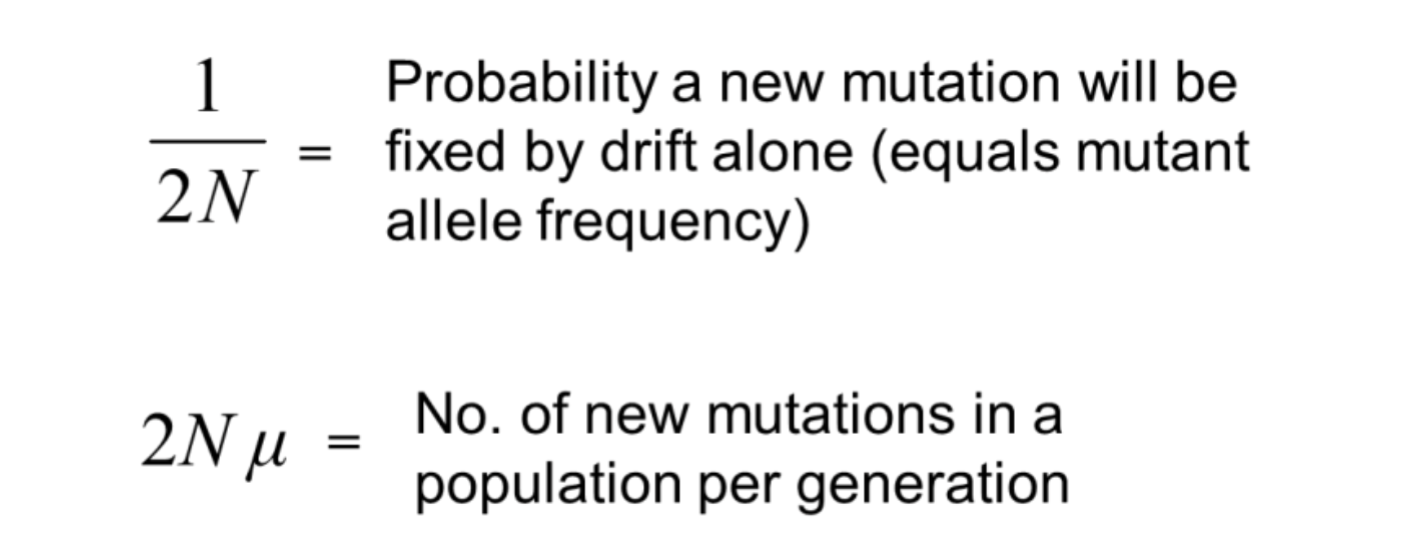
why is the neutral mutation rate independent of population size?
the variable for population size cancels out when calculating the mutation rate.
rate of fixation
lateral gene flow
individual genes, organelles, or genome fragments move horizontally from one lineage to another; bacteria uses this to increase resistance
gene duplication
a gene is duplicated, allowing one copy to mutate and evolve
two-fold cost of sex
cost of meiosis: females pass on 50% of her genes
cost of males: dividing off-spring into genders reduces female’s reproductive rate
Linnaean taxonomic classification scheme
how scientists name and classify organisms based on shared characteristics
what are monophyletic groups?
a group of organisms descending from a SINGLE common ancestor
what are paraphyletic groups?
a group that includes some descendants of an common ancestor but not all
what are polyphyletic groups?
a group that does not include the common ancestor
ancestral traits
trait found in common ancestor of two or more species; present in outgroup
derived traits
a trait that evolved later
monophyletic groups vs clades
same thing; clades used in phylogenetics
homologous traits
same structure due to common ancestry
analogous traits
similar function, different ancestry
parsimony principle
tree with fewest changes/ simplest form
synamorphy
shared derived trait found in more recent evolved species and groups; not present in earlier lineage
homoplasy
trait that looks similar but did not come from common ancestor; caused by convergent evolution and reversals
phylogenetic trees
built based on shared characteristics; following the parsimony principle
convergent evolution
when superficially similar traits may evolve independently in different lineages
evolutionary reversal
when a reverts from its derived state to its ancestral state
molecular clock
estimates divergence time by using constant rate of neutral mutations to measure how long two lineages have been evolving independently
molecular clock equation
T= D/2r
T=divergence time D=# of differences r=mutation rate
cryptic species
species that look VERY similar but don’t mate
morphological species concept
group of organisms that look similar; limited by cryptic species, regional variation and sexual dimorphism
biological species concept
groups of organisms that CAN mate together; limited by asexual & extinct species, and hybridization
lineage species concept
group of organisms that share a branch on the tree of life; requires phylogeny; species can interbreed, but offspring may be considered a new species based on genetic divergence
reproductive isolation
two species can’t successfully mate because of biological differences; makes sure lineages stay distinct, and all species can’t mate
allopatric speciation
populations are separated by a physical/geographical barrier; evolve through genetic drift
sympatric speciation
speciation without physical barriers/isolation; occur with disruptive selection and assortative mating
pre-zygotic isolation
isolation BEFORE egg fertilization; happens by temporal (time), habitat, mechanical, behavioral, and gametic isolation
post-zygotic isolation
isolation AFTER egg fertilization; happens b/c offspring doesn’t survive or reproduce
reinforcement
prevents hybridization from happening
things that affect speciation
dispersal ability
degree of specialization
sexual selection
environmental stability
adaptive radiation
rapid evolution of species from one ancestor; caused by little competition and threats;
rapid proliferation
outcome of adaptive radiation
how is an organism likely to become a fossil
organisms with hard skeletons or exo-skeleton
how are fossils formed
at sites with no oxygen or heat
typically found in sedimentary rocks
stratigraphy
how geologist estimate age of rocks; younger layers on top of older
major geological & atmospheric forces that affect earth history
tectonic plates, oxygenation, climate change, mass extinctions, and volcanic activity
radiometric dating
how geologists determine actual age of rocks
continental drift
position of continents change due to movement of tectonic plates
Pre-cambrian Era
4.2 bya - 542 mya; life appeared; eukaryotes evolved
Paleozoic Era: Cambrian period and on
542 mya - 251 mya; age of fishes, cambrian explosion: rapid diversification of multicellular life; massive extinctions, first plants and insects; swamps and forests
Mesozoic Era
251 - 65 mya; first dinosaurs, flowers, and snakes;
Cenozoic Era
65 mya - present; grasslands spread; plants and mammals diversify rapidly; multiple ice ages; many large mammals went extinct