Week 5: Group dynamics and cohesion
 Call Kai
 Learn
Learn Practice Test
 Spaced Repetition
 Match
Match Flashcards
 Knowt Play
1/47

There's no tags or description
Looks like no tags are added yet.
Name | Mastery | Learn | Test | Matching | Spaced | Call with Kai |
|---|
No analytics yet
Send a link to your students to track their progress
48 Terms
What defines a group?
A collection of interacting individuals who have a sense of shared purpose/common goals and mutual influence.
What is a team?
Any group of people who must interact with each other to accomplish shared objectives.
(Carron and Hausenblaus, 1998)
List the four characteristics that separate teams from groups.
Collective sense of identity
Distinctive roles
Structured modes of communication
Norms
What are the 3 theories of group development?
Linear theory
Cyclical theory
Pendular theory
What is the linear theory of group development? What are the 4 stages?
Groups develop in stages or in a linear fashion.
Forming
Storming
Norming
Performing
What occurs during the 'forming' stage of group development?
Familiarisation, social comparisons, and identification of strengths/weaknesses.
What characterises the 'storming' stage of group development?
Resistance to leader, interpersonal conflicts, infighting, communication and establishing role/status
What happens in the 'norming' stage of group development?
Conflicts are resolved, solidarity and cooperation increase, and a sense of unity/goals develops.
What is the focus during the 'performing' stage of group development?
Togetherness, team success, problem-solving, roles are defined and testing new ideas.
What are group roles?
The specific functions individuals perform within a group.
Name some of the 11 informal roles (Cope et al, 2011)
Comedian
Spark plug
Cancer
Enforcer
Mentor
Informal leader (nonverbal)
Informal leader (verbal)
Team player
Star player
Malingerer
Social convener
What is role clarity?
The degree to which an athlete is clear about their role.
Define role acceptance.
The degree to which athletes accept their purpose on the team.
What is role satisfaction?
The degree to which athletes are satisfied with their role in relation to their skill utilisation and significance for the team.
What is role conflict?
The situation where individuals have conflicting expectations from different roles.
What are group norms?
The standards of behaviour that are accepted and expected within a group.
→ morality and social norms
→ norm for productivity
What are morality and social norms?
Promoting an environment where prosocial behaviour is encouraged and antisocial behaviour is discouraged
What is the norm for productivity?
The standard effort and performance accepted by the team
Name some factors important for team climate
Social support
Proximity
Distinctiveness
Fairness
Similarity
Task interdependence
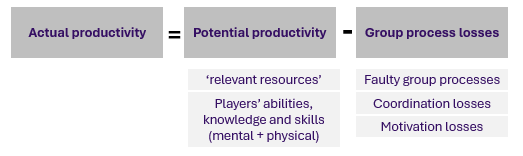
Outline Steiner’s model of actual productivity *
Actual productivity = potential productivity - group process losses
What is the Ringelmann effect?
The tendency for individual members of a group to become less productive as the size of the group increases.
Outline Ringelmann’s (1913) task
ask involved groups of 2, 3 and 8 people pulling a rope
Performance off each individual progressively declined as the number of people in the group increased
Ringelmann effect: tendency for individual members of a group to become increasingly less productive as the size of the group increases
Individual abilities do not neatly sum up to group or team performance
1 person = 100%, 2 pps = 93%, 3pps = 85%, 8pps = 49% effort
Outline Ingham et al’s (1974) replication study
Attempted to replicate Ringelmann's findings
Groups of 2 performed at 91% of their potential and groups of 3 at 82% of their potential
Different to Ringelmann - 'levelling off occurred' - groups of 6 pulled at an average of 78% of their potential
Decreased coordination and motivation: social loafing
What is social loafing?
The phenomenon where individuals in a group put forth less than 100% effort due to a diffusion of responsibility.
Occurs in tasks which are:
Physical
Cognitive
Perceptual
Evaluative
List some causes of social loafing.
Free rider - perception that their effort is unimportant for the outcome
Minimising strategy - motivated to get by doing as little as possible
Allocation strategy - save best effort for when most beneficial to self
How can social loafing be counteracted?
By increasing accountability and communicating the importance of individual contributions.
Define team cohesion.
A dynamic process reflected in the tendency for a group to stick together and remain united in pursuit of its objectives and/or for the satisfaction of member affective needs (Carron et al, 1998)
What are the characteristics of cohesion?
Multidimensional
Dynamic
Instrumental
Affective
Outline Carron’s (1982) conceptual model of cohesion
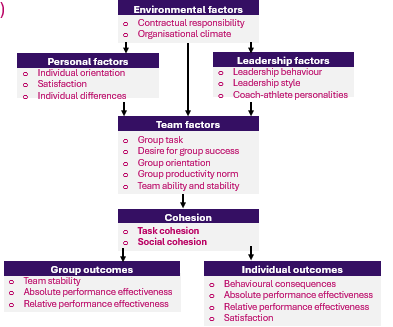
What is social cohesion?
Degree to which members of a group like each other and enjoy one another's company
What is task cohesion?
Degree to which members of a group work together to achieve common goals
What factors influence team climate?
Social support, proximity, distinctiveness, fairness, similarity, and task interdependence.
What is the Group Environment Questionnaire (GEQ)?
A tool that assesses team cohesion by focusing on how attractive the group is to individual members.
Example:
Group integration - task: 'our team is united in trying to reach its goals for performance' (GI-T)
Group integration - social: 'members of our team do not stick together outside of practices and games' (GI-S)
Individual attraction to group - task: 'I do not like the style of play on this team' (ATG-T)
Individual attraction to group - social: 'some of my best friends are on the team' (ATG-S)
What did Mullen and Cooper (1994) discover about the relationship between cohesion and performance?
Review of 66 empirical studies assessing the cohesion-performance relationship in a variety of settings showed positive relationships in 92% of the studies; the strongest relationships were found in sport teams
What did Carron et al (2002) discover about the cohesion-performance relationship?
found moderate to large cohesion-performance effects and found that the strongest effects were in sport teams
What did Filho et al (2014) discover about the cohesion-performance relationship?
using sport teams, they found a moderate relationship between cohesion and performance, with a stronger relationship between task cohesion and performance than social cohesion and performance
How can group cohesion be enhanced?
Through team structure, role clarity, leadership, conformity to standards, and team environment.
What role do coaches play in enhancing group cohesion?
They communicate effectively, explain roles, develop pride, set goals, and encourage group identity.
What are some roles of coaches and leaders in enhancing group cohesion?
Communicate effectively
Explain individual roles in team success
Develop pride within sub-units
Set challenging group goals
Encourage group identity
Avoid formation of social cliques
Avoid excessive turnover
Get to know others - enhance personal disclosure: doesn't need to be overly formal
What does cyclical group development entail?
It includes formation, performance, and dissolution, with psychological preparation for dissolution occurring as the group develops.
As a group develops, psychological preparation for dissolution occurs
→ most relevant for fixed/short-term groups
What is pendular group development? List the stages involved
Only Dogs Run Together
A model that focuses on the shifts in interpersonal relationships that occur in a group.
Orientation
Differentiation and conflict
Resolution and cohesion
Termination
What are group roles?
A set of behaviours required or expected of the person occupying certain positions within a group.
What are the four conditions that influence role acceptance?
Opportunity to use specialised skills
Feedback and role recognition
Role significance
Autonomy.
Perceived individual effort is unimportant, minimising strategy, allocation strategy, and belief that increased effort will not be recognised or rewarded.