BIO-335 Exam #2
 Call Kai
 Learn
Learn Practice Test
 Spaced Repetition
 Match
Match Flashcards
 Knowt Play
1/79

There's no tags or description
Looks like no tags are added yet.
Name | Mastery | Learn | Test | Matching | Spaced | Call with Kai |
|---|
No analytics yet
Send a link to your students to track their progress
80 Terms
Animals
Are fungi more closely related to animals or plants in the ancestral tree?
Chitin
The second most abundant polysaccharide on the planet.
Makes up exoskeleton of arthropods and cell walls of fungi
No
Does fungi contain chlorophyll?
Hyphae
A single fungal filament/cell
Long and thread like
Mycelia
A collection of hyphae
Fungal tissue
Mycotoxins
What do fungi produce for digestion that can have alternate effects to humans etc., if ingested?
Can be hallucinogenic (Fly and agaric)
Ecological Significance of Fungi
Fungi benefit because they feed on soluble sugars made by tree through photosynthesis
Tree benefits because fungi increase the surface area for absorption of water and nutrients and can provide some protection against harmful micro-organisms.
Decomposer
What is the main role of fungi in the ecosystem?
Zygotic Meiosis
What lifecycle do fungi undergo?
Chytridiomycota
This fungus’s outbreaks have major effects on populations of reptiles and amphibians. What is the phylum?
Timber Rattlesnakes in NY
Zygomycota
This fungus is the typical mold, such as bread mold, athlete’s foot, black mold, etc. What is the phylum?
Ascomycota
This fungus includes
Single-celled organisms (yeasts) that live in colonies, are anaerobic, and reproduce asexually via budding
Cup fungi that form fruiting bodies that are cup-shaped
Causes white-nose syndrome on bats
What is the phylum?
Basidiomycota
This fungus includes the typical mushrooms found at the grocery store that we commonly consume. What is the phylum?
Monokaryotic
Cells with one nucleus
Dikaryotic
Cells with two nuclei
Karyogamy
The union of nuclei
Plasmogamy
The union of cytoplasm’s
Lichens
Organisms formed by a symbiotic relationship between fungi (mycobiont) and chlorophyll-containing bacteria and algae (photobiont) as “partners”
Two species working together
Crustose Lichen - “Crusty”
Foliose Lichen - Looks like “Foliage”
Fruticose Lichen - Pendulous
What are the three types of Lichens and what is the main characteristic?
Symmetry (none, bilateral, radial)
Germ Layers (none, diploblastic, triploblastic)
Coelom (acoelomate, pseudocoelomate, eucoelomate)
Developmental Mode (protostome, deuterostome)
What are the four conditions of classifying animals?
Porifera
What phylum of animals is characterized by having no symmetry?
Cnidarians
What phylum of animals is characterized by having radial symmetry?
Bilateral Symmetry
What type of symmetry pattern to most animal phyla have?
Triploblastic
What germ layer characteristic does an animal have to have in order to be considered acoelomate, pseudocoelomate, or eucoelomate?
Eucoelomate
“True” body cavity
Body cavity within mesoderm
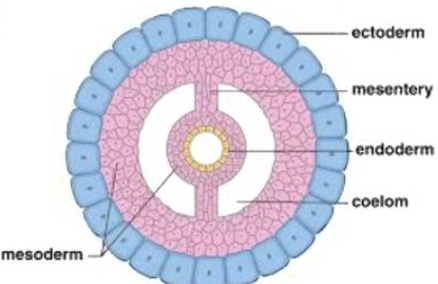
Pseudocoelomate
“False” body cavity between mesoderm and endoderm
Body cavity not within mesoderm
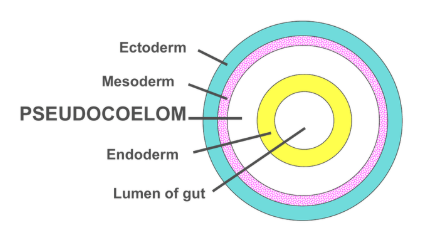
Acoelomate
No body cavity present in the mesoderm
Applies only to triploblastic animals
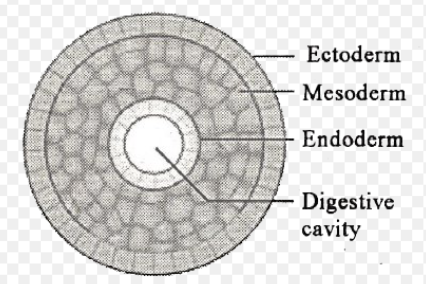
Protostome
The blastopore develops into the mouth
Molluscs, Annelids, and Arthropods
Determinate Cleavage
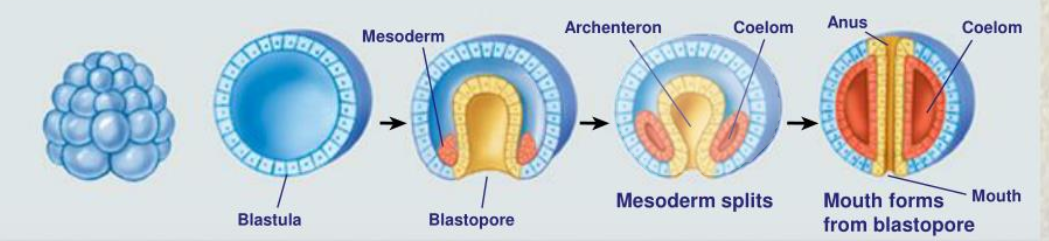
Deuterostome
The blastopore develops into the anus
Echinoderms and Chordates
Indeterminate cleavage
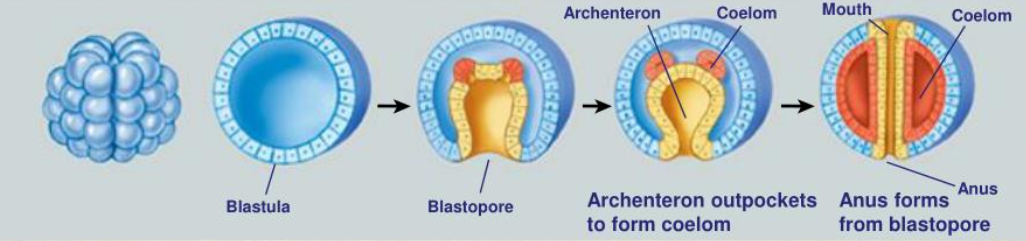
Determinate Cleavage
Cells fate is determined early in embryogenesis.
Indeterminate Cleavage
A cell’s fate is not determined early in embryogenesis; cells remain totipotent (capable of giving rise to any cell type)
Invertebrates
What group of animals is the largest and most diverse?
Porifera (sponges)
What phylum of animals is being characterized?
Pore-bearing
Sessile
Can move via choanocytes (collar cells with flagellum)
Filter Feeders (use sticky collar)
Multicellular
Cellular level of organization (No tissue or organs!)
Sexual Reproduction via Gametic Meiosis
Asexual Reproduction via
Regeneration
Budding
Gemmules - response to adverse conditions - can go dormant and withstand environmental stressors
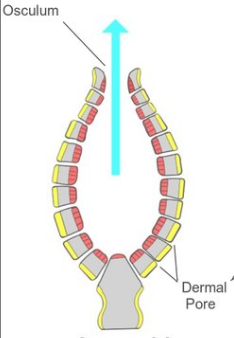
Asconoid
What sponge body form is this?
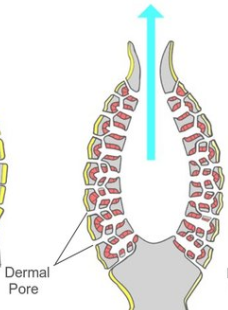
Syconoid
What sponge body form is this?
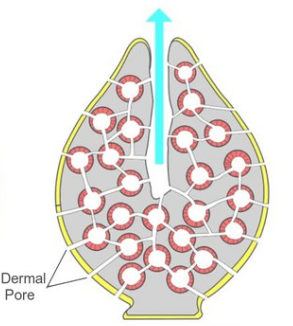
Leuconoid
What sponge body form is this?
Spicules
What is the sponge skeleton made of?
Cnidarians
What phylum of animals is being characterized?
Two types of bodies
Sessile polyp
Free-floating medusa
Reproduce both sexually and asexually
Carnivores that use cnidocytes (stinging cells)
Cnidocytes contain nematocysts (organelle that does the stinging)
Diploblastic
Tissue level of organization
External and Internal Incomplete Digestion
Hydrozoa
Which class of phylum cnidaria is this?
Water animals
Primarily sessile polyp
Some have medusa stage
Hydra sp.
Freshwater
Sexual reproduction - Sperm + Egg = Zygote
Monecious or Dioecious
Asexual reproduction - Budding
Physalia sp.
Colonial polyp - fuse together to form a floatation device - keep on the surface of water
Obelia sp.
Colonial sessile polyp
Solitary medusa
Scyphozoa
Which class of phylum cnidaria is this?
Standard jellyfish
Genus Aurelia
Box Jellyfish - one of the deadliest
Anthozoa
Which class of phylum cnidaria is this?
Sea anemones
Sessile
Bright colors to scare away predators
Stomphia can swim away from predators
Corals
Coral bleaching - corals expel symbiotic algae due to stress from increasing water temperatures and appear “bleached”
Platyhelminthes
What phylum of animals is being characterized?
Flatworms
Dorsoventral flattening
Class Turbellaria
Class Cestoda
Turbellaria (Planarians)
Which class of phylum Platyhelminthes is this?
Planaria sp.
Free-living, leaf shaped, ventral mouth
Regeneration
Terrestrial = Bipalium sp.
Marine
Cestoda (Tapeworms)
Which class of phylum Platyhelminthes is this?
Parasitic, ribbon-like, no mouth
Scolex
Anterior
Modified for attachment to intestine wall
Produces proglottids
Taenia sp.
Nematoda (Roundworms)
What phylum of animals is being characterized?
Ascaris sp. posterior end different for males and females
Males = hooked end
Hookworms found in feral cats
Heartworms in dogs
Wuchereria sp. causes elephantiasis in humans - spread by mosquitoes
Mollusca
What phylum of animals is being characterized?
Mantle - secretes shell and does gas exchange
Foot - muscular and allows organism to move; on ventral side of the animal
Radula - scraping mouth part; on anterior side of the animal
All have one except Bivalves
Class Gastropoda
Class Bivalvia
Class Cephalopoda
Gastropoda
Which class of phylum Mollusca is this?
Helically-coiled shell secreted by mantle
Radula
Snails and slugs
Predatory, scavengers, and algae eaters
Ex. Banana slug
Hermaphrodite
Northwestern U.S.
Open circulatory system
Triploblastic eucoelomate protostome
Bivalvia
Which class of phylum Mollusca is this?
Hinge shell
Two valves
No radula
Clams, mussels, scallops
Two siphons to filter water
Open circulatory system
Cephalopoda
Which class of phylum Mollusca is this?
Predatory
Incredible ability to camouflage
Some of the most advanced invertebrate eyes - important for ecological advancement
Some have a cartilaginous endoskeleton
Ex. Cuttlefish
Some have a calcium carbonate exoskeleton
Ex. Nautilus
Closed circulatory system
Annelida
What phylum of animals is being characterized?
Segmented worms - morphological innovation (segments repeat)
Class Polychaeta (clam worms)
Class Oligochaeta (earthworms)
Class Hirudinea (leeches)
Euceolomate
Closed circulatory system
External complete digestion
Metanephridia - connects adjacent segments together
present in coelomates w/closed circulatory systems
Excretory system
Open Circulatory System
Which type of circulatory system is this?
Arthropods and most molluscs
Circulate hemolymph into open spaces (hemocoel) throughout the body
Closed Circulatory System
Which type of circulatory system is this?
Annelids, Chordates, and Cephalopods
Circulate blood through vessels (arteries, capillaries, and veins)
Oligochaeta
Which class of phylum Annelida is this?
Giant Earthworm
Asian Jumping Worms
Invasive species (Syracuse) that destroys the soil and makes it difficult for plants to grow
Arthropoda
What phylum of animals is being characterized?
Animals with an exoskeleton made of chitin
3 body segments - Head, Thorax, Abdomen
Open circulatory system
Subphylum Chelicarata
Class Merostomata
Class Arachnida
Subphylum Crustacea
Subphylum Myriapoda
Subphylum Hexapoda
Subphylum Chelicerata
Class Merostomata
What class and subphylum of phylum Arthropoda is this animal?
1st pair of appendages = chelicerae (feeding)
2nd pair = pedipalps (used as additional walking legs)
4 pairs of walking legs
Head and thorax fused into cephalothorax
Book gills on abdomen
Primitive animals (horseshoe crabs)
Red Knot birds specialize in eating young horseshoe crabs
Horseshoe crab populations plummeted, which caused red knot populations to plummet as well
Horseshoe crab population decline due to:
Harvest their blood to use for the medical industry
Contains special clotting agent - used to test for bacteria/contamination in vaccines
Subphylum Chelicerata
Class Arachnida
What class and subphylum of phylum Arthropoda is this animal?
1st pair of appendages = chelicerae (feeding)
2nd pair = pedipalps (used as sensors or pincers)
4 pairs of walking legs
Book lungs inside the abdomen
Head and thorax fused into cephalothorax
Wicked venomous spiders in North America
Brown Recluse
Black Widow
Crustacea
What subphylum of phylum Arthropoda is this animal?
Some are small and terrestrial - Roly-poly
Some are super small and aquatic
Some are large and terrestrial
Biggest constraint is respiration
Breathe through pores in exoskeleton
Not enough O2 in atmosphere to support gas exchange of very large terrestrial arthropoda
Barnacles
Sessile
Forehead glands produce sticky secretion to attach to substrate
Secrete a CaCO3 shell external to cuticle
Feed by waving feathery feet through water to create current (filter-feeders)
Myriapoda
What subphylum of phylum Arthropoda is this animal?
Many feet
Centipedes
Many unspecialized segments - most identical
Flat body
Carnivores
1 pair of legs per segment
Millipedes
Many unspecialized segments - most identical
Rounded body
Detritivores - aid in decomposition
2 pairs of legs per segment
Hexapoda
What subphylum of phylum Arthropoda is this animal?
Many life forms
All insects
All appendages uniramous
1st pair = antennae
2nd pair = mandibles
3rd - 5th pairs = thoracic legs
May also have 1-2 pairs of thoracic wings (NOT appendages)
3 distinct body segments (head, thorax, abdomen)
Development
Complete Metamorphosis - go from one body form to a completely different body form
Incomplete Metamorphosis - larvae look like mini adults
Echinodermata
Which phylum of animals is being characterized?
Sea Star Larvae bilaterally symmetrical
Radially symmetrical adult
External Complete Digestion
Tiny CaCO3 plates (ossicles)under a layer of epidermis
Ossicles may articulate separately or be fused into a solid test (ex. sand dollar)
Gas exchange across tube feet and dermal gills
Open circulatory system
Water Vascular system
Excretion across tube feet
Class Asterodiea (sea stars)
Class Echinoidea (sand dollars, sea biscuits, sea urchins)
Asteroidea
What class of phylum Echinodermata is this?
Sea stars
Generally penta (5 appendages) radially symmetrical
Ossicles articulate separately
Echinoidea
What class of phylum Echinodermata is this?
sand dollars, sea biscuits, sea urchins
Ossicles fused into Test
Chordata
Which phylum of animals is being characterized?
Four characteristics present at some stage of life
Notochord
Dorsal Hollow Nerve Chord
Pharyngeal Gill Slits
Post-anal Tail
Notochord
Dorsal Hollow Nerve Chord
Pharyngeal Gill Slits
Post-anal Tail
What are the four characteristics that must be present at some stage in life in order for an animal to be in phylum Chordata?
Urochordata
What subphylum of phylum Chordata is this?
Adult is sessile
Larvae are free-living
Possess all 4 chordate characteristics
Filter-feeders
Some are predatory
Sea Squirts
Incurrent and excurrent siphons for water flow through the animal
Cephalochordata
What subphylum of phylum Chordata is this?
Distinct Head
Has all 4 chordate characteristics as an adult
Lancelets
Vertebrata
What subphylum of phylum Chordata is this?
Notochord is replaced by vertebrae
Bony, interlocking structures
Protects the nerve chord
Cranium
Skeleton of cartilage and/or bone
Class Myxinoidea
Class Petromyzontoidea
Class Chondrichthyes
Class Acrinopterygii
Class Amphibia
Class Reptilia
Myxinoidea
What class of subphylum Vertebrata in phylum Chordata is this?
Most primitive fish
Jawless fish
No paired fins
Tiny eyes
Tentacles
Common Name: Hagfish
Petromyzontoidea
What class of subphylum Vertebrata in phylum Chordata is this?
Jawless Fish
No paired fins
Big eyes
Round mouth
Common Name: Lamprey
Invasive in the Great Lakes
Generalists to water tonicity
Can live in both freshwater and salt water
Chondrichthyes
What class of subphylum Vertebrata in phylum Chordata is this?
Jaws
Paired fins
Gill slits visible
Ventral mouth
Common Name: Cartilaginous fishes
Actinopterygii
What class of subphylum Vertebrata in phylum Chordata is this?
Jaws
Paired fins
Bony skeleton
Operculum covers gill slits
Common Name: Bony fishes
Candiru
What fish is parasitic?
Amphibia
What class of subphylum Vertebrata in phylum Chordata is this?
Tetrapods- 4 appendages
Legs and lungs
Still tied to water by reproduction and skin
Evolutionary transition of animals - can be terrestrial but still require some water
Global decline
Due to disease - fugus that infects the skin makes it hard for them to breathe and absorb nutrients
Eggs are non-amniotic
Lack any sort of extra membranes - MUST be in water
Amniote
Tetrapod’s that produce an enclosed apparatus for developing embryos
Turtles
Snakes
Lizards
Crocodiles
Birds
Mammals
Reptilia
What class of subphylum Vertebrata in phylum Chordata is this?
Scales
Claws
Amniotic egg allows this animal to get away from water
Old Class Aves (birds)
Feathers, flight, endothermic, parental care
Mammals
What class of subphylum Vertebrata in phylum Chordata is this?
Endothermic
Produce fur
Mammary glands
Produce milk meal to support development of their young
Evolutionary advantage
Parental Care
Monotremes
Egg-laying mammals - Oviparous
Primitive Mammals
Females produce milk but do not have nipples
Only five species survive
Platypus
Four species of spiny animals
Marsupials (Metatherians)
Viviparous
Females give birth after a short period of development
Females of most species have a pouch where the young complete their development
A lot of lactation is needed
Include kangaroos, koalas, wallabies, and possums
Mostly in Australia
North America = birthplace
Transition beasts
Placental Mammals
Viviparous
Females have a placenta that provides oxygen and nutrients to embryos in the uterus
Dominated
Evolutionary advantage
Family Hominidae
Gorilla spp.
Pan spp.
Pongo spp.
Life in the trees
Forward-directed eyes and binocular vision - judge distances accurately
Shoulder and elbow joints allow arms to rotate
Retention of ten fingers and ten toes allow us to grasp objects
Most conservation concern = Eastern Gorilla