4- Metal Alloys and Casting (Dr. Akhtar)
 Call Kai
 Learn
Learn Practice Test
 Spaced Repetition
 Match
Match Flashcards
 Knowt Play
1/81

There's no tags or description
Looks like no tags are added yet.
Name | Mastery | Learn | Test | Matching | Spaced | Call with Kai |
|---|
No analytics yet
Send a link to your students to track their progress
82 Terms
Alloy
Define the following:
A mixture of 2 or more metals or metalloids that are mutually soluble in the molten state
hardness
strength
toughness
alloying elements are added to alter the _______ (3) of a metallic element, thus obtaining properties not found in a pure metal
Base metal alloys
Noble metal alloys
High noble metal alloys
Alloys may be classified as (3)
ALL
Which of the following are general requirements of a dental alloy?
A) Not produce harmful toxicologic or allergic effects
B) Chemical properties should provide resistance to corrosion and physical changes in the oral cavity
C) Physical/mechanical properties should meet certain minimum values
D) Technical expertise needed for fabrication and use should be feasible for the average dentist and skilled technician
E) The metals, alloys, and companion materials should be plentiful, relatively inexpensive, and readily available
Type 0
What type of dental metallic material (ISO 22674 classification) is the following for:
- Intended use: Low stress, single-tooth fixed restorations (small)
- Example: Small one-surface inlay
Type 1
What type of dental metallic material is the following for:
- Intended use: Low stress, single-tooth fixed restorations
- Example: Crown with minimal occlusal force
Type 2
What type of dental metallic material is the following for:
- Intended use: Single tooth, fixed restorations
- Example: Crown with normal occlusal force
Type 3
What type of dental metallic material is the following for:
- Intended use: Multiple tooth, fixed restorations
- Example: Fixed partial denture (bridge)
Type 4
What type of dental metallic material is the following for:
- Intended use: Thin sections under high force
- Example: Precision attachment
Type 5
What type of dental metallic material is the following for:
- Intended use: High stiffness and high stress
- Example: Removable partial denture clasp
Chemical
Noble and base metals are defined on the basis of their _____ properties
Noble metals
What type of metals are in the red boxes?
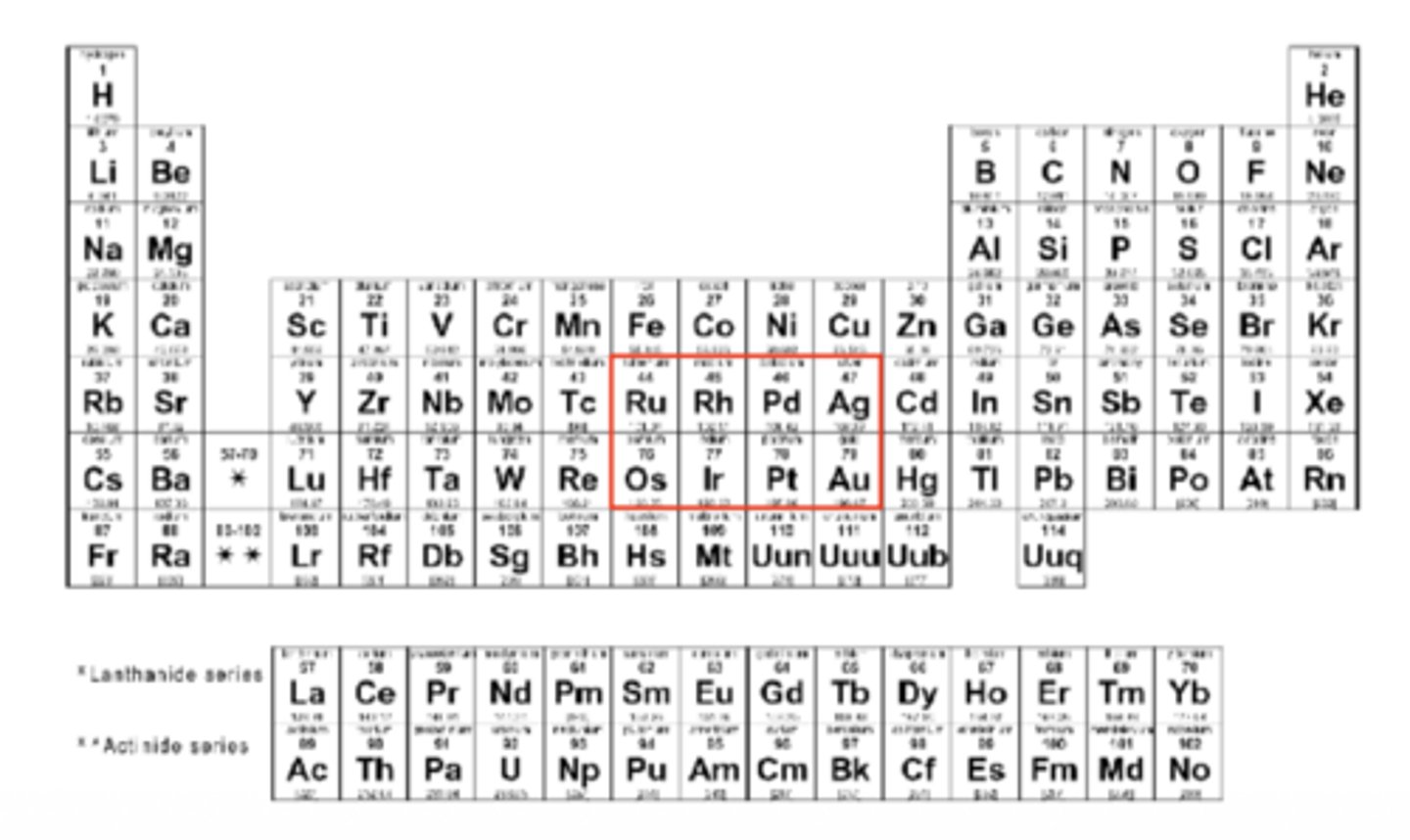
Base metals
What type of metals are in the red boxes?
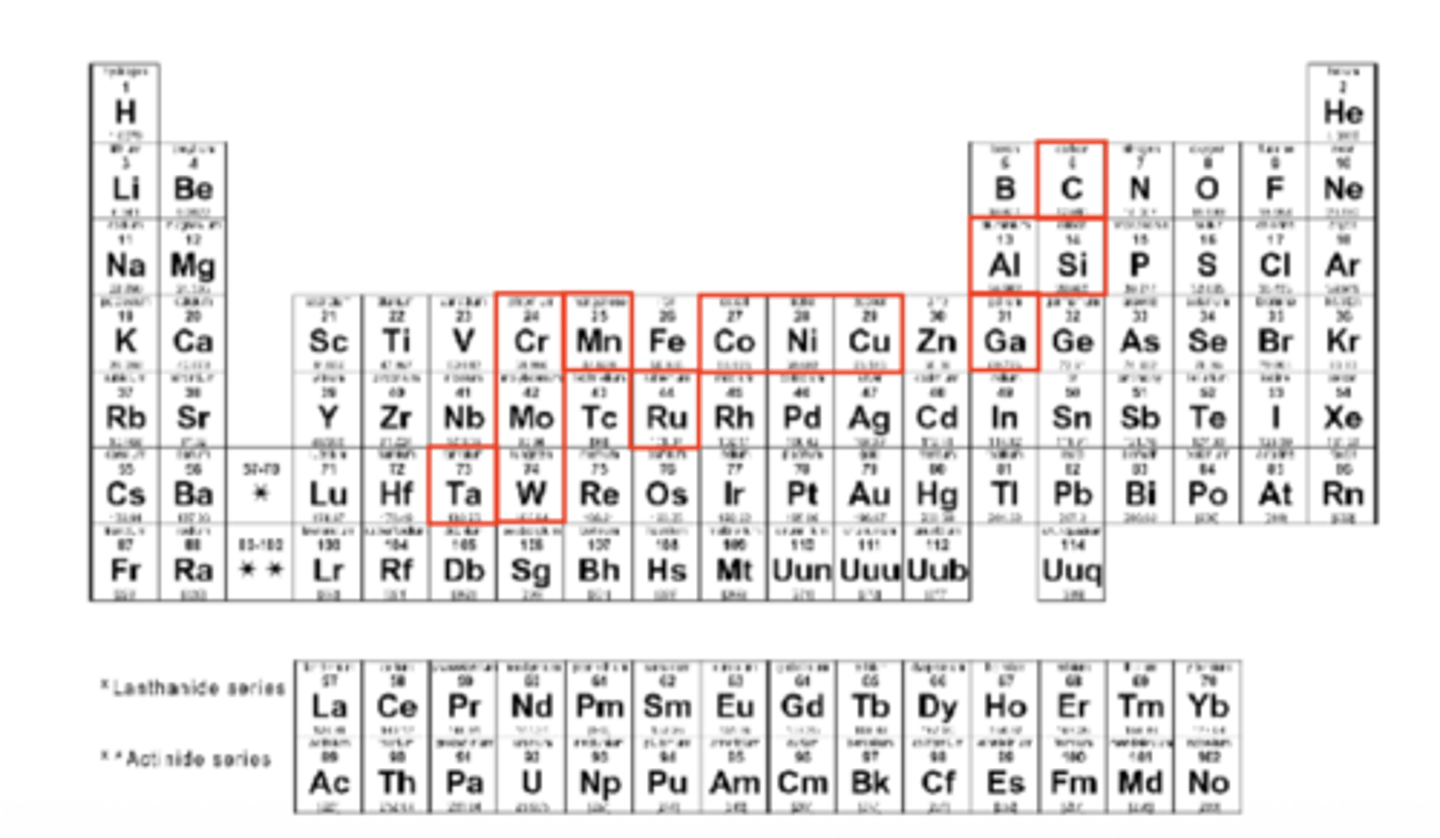
Cost
Precious metals are defined based on ________
Semi precious alloys
________ was originally used for noble metal alloys containing significant amounts of silver
Nonprecious alloys
________ are composed of non-precious ingredients, with most being based on a combination of nickel + chromium
high noble alloys
titanium + titanium alloys
noble alloys
predominantly base metals
4 classifications of alloys for dental prosthesis (ADA)
High noble alloys
Which class?
Total noble content >60% where 40% is gold
Titanium and titanium alloys
Which class?
Titanium content >85%
Noble alloys
Which class?
Total noble content >25%
Predominantly base metals
(*I think the slide was incorrect🧐)
Which class?
Total noble content <25%
B - HARDNESS
All of the following are important considerations when choosing a cast alloy EXCEPT:
a. Noble metal content
b. Softness
c. Yield strength
d. Elongation
e. Fusion temperature
Thermal expansion
Bond strength
Composition
What 3 properties should we consider when choosing alloys for PFM restos?
Porcelain to metal bond strength
What ensures retention of porcelain to the metal both in the oral environment and during thermal processing?
some components can affect the color of the porcelain
why is composition important for alloy selection for PFM restos
small cross section
Yield strength is crucial due to the ________
Stress
What controls the minimum allowable dimensions of critical areas?
Elastic modulus
What allows the flexibility of a metal framework?
resistance
corrosion resistance
thermal stability
chemical stability of alloys affects what of PFM restos (3)
type I soft
type II medium
type III hard
type IV extra hard
4 classifications for dental casting gold alloys (ANSI/ASDA No. 5)
Type I
ID the class type:
- Soft (85% Au, ~20K)
- Use: Inlays (low stress)
- Yield strength: <140 MPa
- Elongation: ~18%
- Hardness: 60–90 VHN
Type II
ID the class type:
- Medium (75% Au, ~18K)
- Use: Inlays & onlays (moderate stress, cusp replacement)
- Yield strength: 140–240 MPa
- Elongation: ~18%
- Hardness: 90–120 VHN
Type III
ID the class type:
– Hard (70% Au, ~17K)
- Use: Crowns & short-span bridges (high stress)
- Yield strength: 201–340 MPa
- Elongation: ~12%
- Hardness: 120–150 VHN
Type IV
ID the class type:
– Extra Hard (65% Au, ~15K)
– Use: Long-span bridges, RPD frameworks (very high stress, high flexural demand)
– Yield strength: > 340 MPa
– Elongation: ~10%
– Hardness: >150 VHN (slide typo again?)
Gold (Au)
ID the alloy in dental gold alloys:
- Specific gravity: 19.32
- Melting point: 1,063°C (1,945°F)
- Atomic diameter: 2.88 Å
- Space lattice: Face-centered cubic
- Chemical activity: Inert
- Color: Yellow
- Approximate content: 50-95%
- Density (specific gravity): Increases markedly
- Effect on color: Lends yellow color
- Melting: Raises melting point mildly
- Tarnish resistance: Essential to good tarnish resistance
- Heat hardening: Contributes importantly with Cu
Platinum (Pt)
ID the alloy in dental gold alloys:
- Specific gravity: 21.45
- Melting point: 1,769°C (3,224°F)
- Atomic diameter: 2.77 Å
- Space lattice: Face-centered cubic
- Chemical activity: Inert
- Color: White
- Approximate content: 0-20%
- Density: Increases markedly
- Effect on color: Whitens slowly; ~12% required; not pure white
- Melting: Raises melting point fairly rapidly
- Tarnish resistance: Contributes importantly
- Heat hardening: Increases with Cu
Palladium (Pd)
ID the alloy in dental gold alloys:
- Specific gravity: 12.0
- Melting point: 1,552°C (2,829°F)
- Atomic diameter: 2.74 Å
- Space lattice: Face-centered cubic
- Chemical activity: Mild
- Color: White
- Approximate content: 0-12%
- Density: Lowers slightly
- Effect on color: Whitens rapidly (as little as 5%)
- Melting: Raises melting point rapidly
- Tarnish resistance: Increases (less than Au and Pt)
- Heat hardening: Some increase with Cu
- Gas absorption: Rather high for hydrogen
- Castability: Effects not critical
Copper (Cu)
ID the alloy in dental gold alloys:
- Specific gravity: 8.96
- Melting point: 1,083°C (1,981°F)
- Atomic diameter: 2.55 Å
- Space lattice: Face-centered cubic
- Chemical activity: Very active
- Color: Red
- Approximate content: 0-17%
- Density: Lowers
- Effect on color: Lends red color; dark plate high in Cu
- Melting: Lowers melting point (even below its own)
- Tarnish resistance: Contributes to tarnish (flame/sulfur)
- Heat hardening: Essential if alloy heat hardens
- Castability: Effects not critical
Silver (Ag)
ID the alloy in dental gold alloys:
- Specific gravity: 10.49
- Melting point: 961°C (1,761°F)
- Atomic diameter: 2.88 Å
- Space lattice: Face-centered cubic
- Chemical activity: Active
- Color: White
- Approximate content: 0-20%
- Density: Lowers
- Effect on color: Whitens slowly; counteracts Cu; can create green gold
- Melting: Slight effect; may raise or lower mildly
- Tarnish resistance: Tarnishes with sulfur
- Heat hardening: Increases with Cu
- Gas absorption: Rather high for oxygen
Zinc (Zn)
ID the alloy in dental gold alloys:
- Specific gravity: 7.31
- Melting point: 420°C (787°F)
- Atomic diameter: 2.66 Å
- Space lattice: Close-packed hexagonal
- Chemical activity: Very active
- Color: White
- Approximate content: 0-2%
- Density: Lowers
- Effect on color: Too low % to affect
- Melting: Lowers melting point rapidly (in solders)
- Tarnish resistance: Will tarnish (low % minimal effect)
- Heat hardening: Slight with Cu
- Gas absorption: Good deoxidizer
- Castability: Decreases surface tension; increases fluidity
Iridium (Ir)
ID the alloy in dental gold alloys:
- Specific gravity: 22.4
- Melting point: 2,443°C (4,429°F)
- Atomic diameter: 3.32 Å
- Space lattice: Face-centered cubic
- Chemical activity: Active
- Color: White
- Approximate content: 0.005-0.1%
- Density: Increases slightly
- Effect on color: White
- Melting: No effect
- Tarnish resistance: Increased
- Heat hardening: No effect
- Gas absorption: No effect
- Castability: No effect
High gold alloys
ID the alloy:
- Gold content between 78% to 87% by weight
- Total noble metal content about 97%
- Tin, indium, and iron are added for strength and to promote good porcelain bond to metal oxide
- Light yellow in color
- Excellent hardness, tensile strength, and corrosion resistance
Gold-palladium-silver alloys
ID the alloy:
- 20% to 30% palladium content
- 10% to 15% silver content
- Higher elastic modulus and less susceptibility of dimensional change during the porcelain baking when compared to high-gold alloys
- Good clinical working characteristics and corrosion resistance
- Silver can change the color of porcelain
Palladium-silver alloys
ID the alloy:
- 50% to 60% palladium, with the most of the balance being silver
- Physical and chemical properties are comparable to other noble metal alloys
- Good corrosion and tarnish resistance
- Can affect the color of porcelain
gold-palladium alloys
ID the alloy:
- 50% gold
- 40% palladium
- Favorable yield strength and hardness
- Higher elastic modulus when compared to high-gold alloys
- Excellent corrosion resistance
- Thermal expansion is incompatible with some higher-expansion porcelain
palladium-copper alloys
ID the alloy:
- 70% to 80% palladium
- Up to 15% by weight of copper
- 9% gallium
- High hardness and low elastic modulus
- Sag resistance is a contra-indication for large span fixed partial dentures
Palladium-Cobalt Alloys
ID the alloy:
- 88% palladium
- 4% to 5% cobalt by weight
- Have high coefficient of thermal expansion
- Forms a dark oxide that may be difficult to cover
- More susceptible to hot tearing and embrittlement from carbon when no silver is present
Base Metal Alloys
ID the alloy:
- Based mostly on nickel and chromium, with a few cobalt-chromium and iron-based alloys available
- Corrosion resistance is based on chemical properties
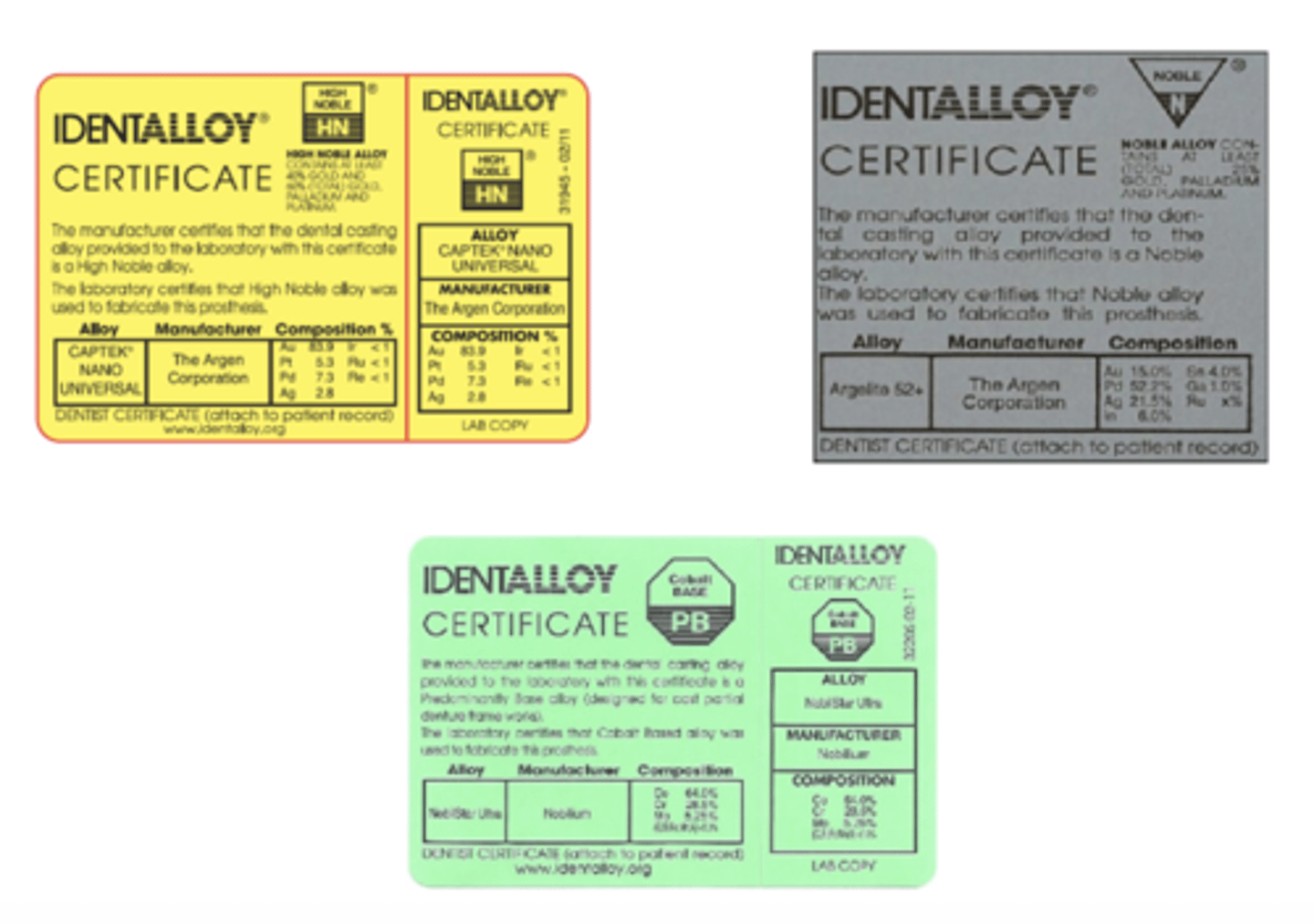
- In case patient is allergic
- Manufacturing recalls
What are important about these stickers?
Dental waxes
What has the following characteristics?
- One of several esters of fatty acids with higher alcohols (usually monohydric alcohols)
- Combinations of various types of waxes compounded to provide the desired physical properties
- Uses include patterns for inlays, crowns, pontics, partial and complete dentures, and for bite registrations
- Classified according to their applications into pattern, processing, and impression waxes
spruing
What has the following characteristics?
- The "channel or hole through which plastic or metal is poured or cast into a gate or reservoir and them into a mold"
- It forms a mount for the wax pattern and fix the pattern in space so a mold can be made
- It creates a channel for elimination of wax during burnout
- This channel allows for molten metal to enter such mold
sprue button
Define the following:
"The excess material remaining at the base of the mold after dental casting"
Sprue designs for casting
What do all of these show?
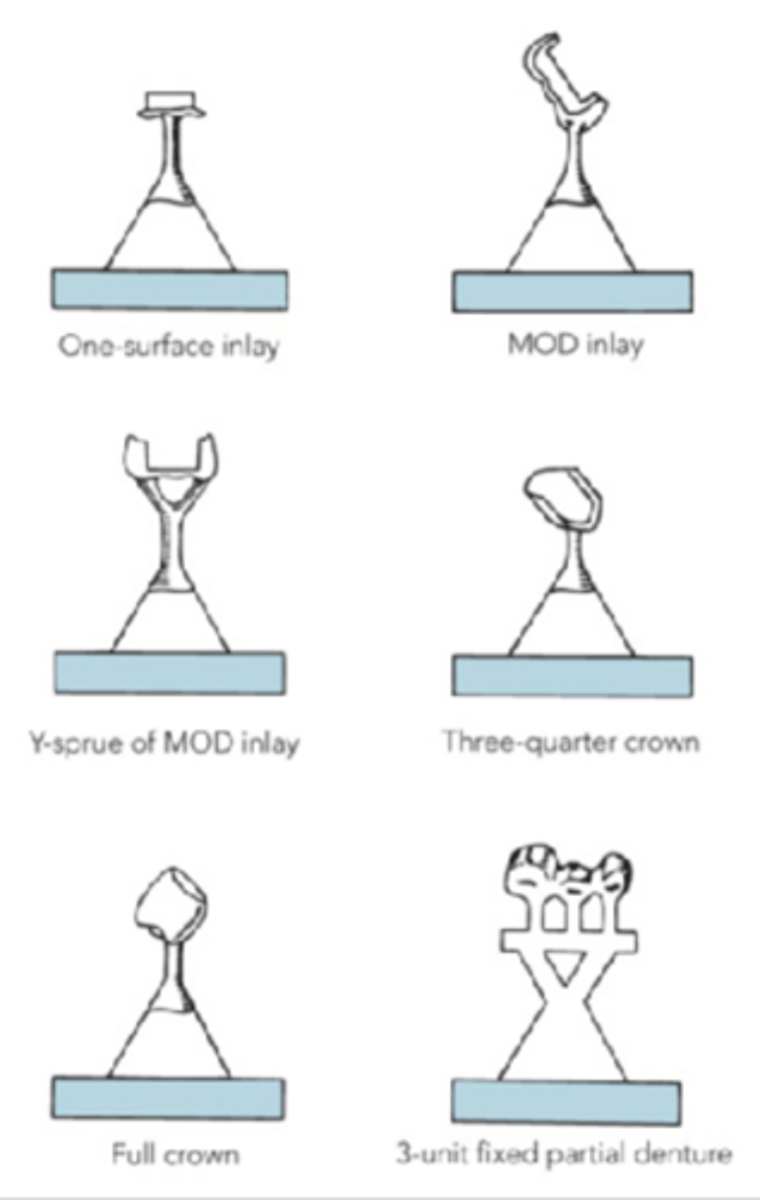
B - Should attach to the BULKIEST PART
Which of the following is FALSE about spruing?
A) The sprue must be large enough so it remains open until the casting solidifies and short enough to allow rapid filling of the mold
B) It should always attach to the thinnest part of the pattern
C) Wax sprues are the most common
6mm
What is the minimum height at the blue box?
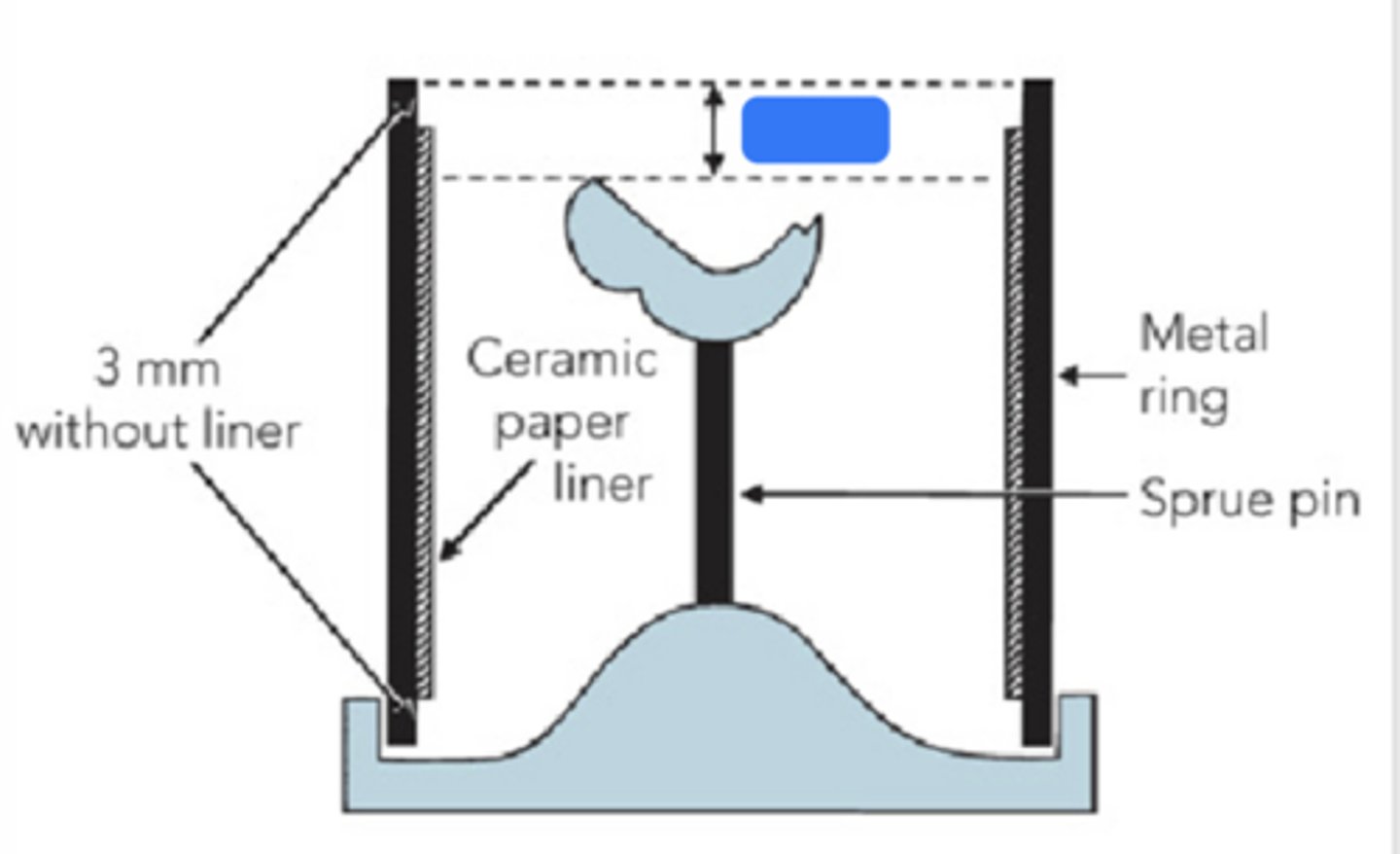
Investment Materials
Define the following:
Materials consisting principally of an allotrope of silica and a bonding agent (gypsum or phosphates and silica)
gypsum-bonded
phosphate-bonded
ethyl silicate-bonded
3 types of investment materials
gypsum-bonded investments
Define the following:
Most commonly used in the casting of dental gold alloys with liquids temperatures no higher than 1080ºC
Gypsum-bonded investments
What has the following characteristics?
- Normally used for gold inlays, crowns, and fixed and removable partial dentures
- Not suitable for high-melting alloys
Phosphate-bonded investments
What has the following characteristics?
- Available as a two-component system (powder and an aqueous solution of stabilized colloidal silica)
- Ingredients in the powder include powdered ammonium dihydrogen phosphate, calcined magnesium oxide powder, particles of refractory materials (quartz and cristobalite), and other metal oxides
Ethyl silicate-bonded investments
What has the following characteristics?
- Supplied as powder and liquid
- Powder consists of refractory particles of silicas and glasses, along with calcined magnesium oxide and other refractory oxides
- Liquid is a stabilized alcohol solution of silica gel, or on two liquids systems, ethyl silicate and an acidified solution of denatured ethyl alcohol
Lost wax technique
(Inexpensive and convenient to use even on complicated shapes)
What is one of the oldest casting techniques available?
0.1%
What is the desired accuracy % for casting?
Investment expansion
Shrinkage from wax and alloy can lead to ________
1/3
_____ of new gold alloy (by weight) must be used for each new casting
True
T/F: Care should be taken to avoid alloy contamination during metal melting
Natural gas/air torch
Gold alloys can be melted via ________/________
Gas/oxygen
Base metal alloys can be melted via ________/________
Mixing zone
ID zone of torch flame:
Consists of unburnt gases and is not hot enough to melt gold
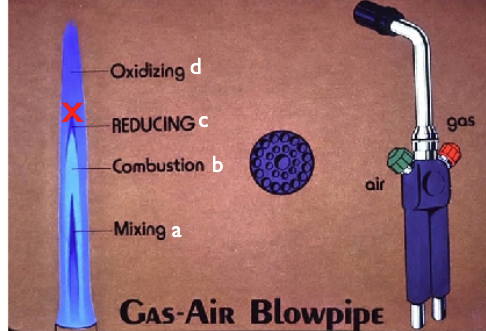
Combustion zone
ID zone of torch flame:
- Partial Combustion of air & gas takes place here. Green in Color
- Zone is oxidizing &should always be kept away from molten alloy during fusion.
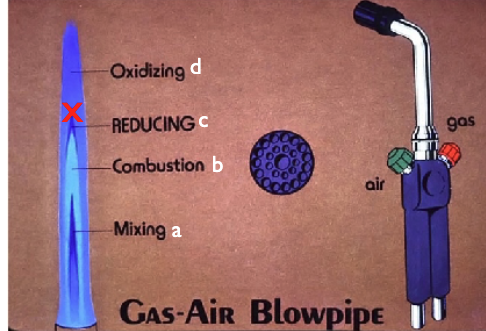
Reducing zone
ID zone of torch flame:
Blue with burning gases and forms a reducing atmosphere
Best for melting or soldering, because it is the hottest zone of the flame
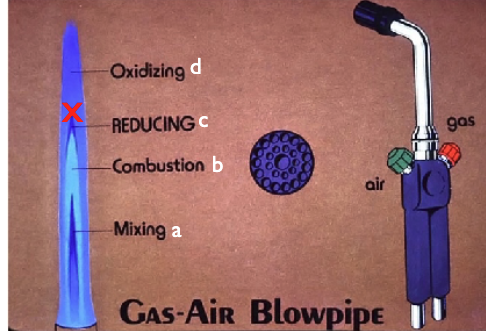
Oxidizing zone
ID zone of torch flame:
Contains burnt gases, forms an oxidizing atmosphere and should be avoided
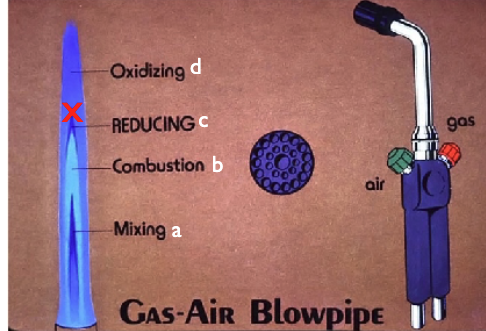
Reducing zone (hottest zone)
What zone of torch flame is best for melting metal?
True
T/F: Electric resistance, induction, and electric arc melting are also used for gold alloys, cobalt-chromium, and titanium alloys
Before!
Cleaning and finishing of a gold crown should happen _______ cementation
Soldering and welding
All of the following are indications for what?
A) Gold alloy fixed partial denture soldering
B) Adding proximal contacts
C) Repairing casting voids
D) Breaking solder joints
E) Pre-veneer metal-ceramic alloy soldering (pre solder)
F) Post-veneer metal-ceramic alloy soldering (post-solder)
Pre-veneer soldering
What has the following characteristics?
- During the fabrication of a fixed partial denture, the metal framework is often returned without porcelain application for try-in
- Soldering the metal framework uses a torch as the source of heat
Pre-veneer soldering
What is the most reliable method for soldering?
Post-veneer soldering
What has the following characteristics?
- The completed restoration (metal and porcelain) have been returned and a misfit is found during the delivery appointment
- Source of heat is a vacuum oven to allow precise heat temperature delivery
- Not as reliable for soldering as pre-veneer scenario
Welding
Define the following:
To unite or fuse 2 pieces by hammering, compression, or by rendering soft by heat with the addition of a fusible material
bonding
during welding, _________ will occur between 2 metallic surfaces if they are placed in contact and are free of surface films, oxides, and roughness
Spot welding
Pressure welding
Laser welding
What are 3 methods of metal to metal welding?